http://dx.doi.org/10.4236/eng.2016.84016
How to cite this paper:Cano, A. and Sobel, K. (2016)Simple Adaptive Delta Operator Aircraft Flight Control for Accommo-dation of Loss of Control Effectiveness. Engineering, 8, 173-195. http://dx.doi.org/10.4236/eng.2016.84016
Simple Adaptive Delta Operator Aircraft
Flight Control for Accommodation of
Loss of Control Effectiveness
Alfredo Cano, Kenneth Sobel
*Department of Electrical Engineering, The City College of New York, New York, NY, USA
Received 10 February 2016; accepted 20 April 2016; published 25 April 2016 Copyright © 2016 by authors and Scientific Research Publishing Inc.
This work is licensed under the Creative Commons Attribution International License (CC BY). http://creativecommons.org/licenses/by/4.0/
Abstract
A new proof for stability of delta operator simple adaptive control is presented in terms of a set of Linear Matrix Inequalities (LMIs). The paper shows how to design a feedforward gain to satisfy the LMIs over a polytope of loss of control effectiveness failures. The MATLAB Robust Control Toolbox is used to find the feedforward gain with the smallest norm that satisfies the LMIs. Examples are presented of the F/A-18 aircraft and the Innovative Control Effectors (ICE) tailless aircraft that show the design of a feedforward gain for a loss of control effectiveness in any one control effector. The designs use a fixed eigenstructure assignment controller for an inner loop augmented with the simple adaptive controller. Simulations of both aircraft include simultaneous loss of control effectiveness failure and lateral wind gust. Simulation results for the F/A-18 aircraft show that the adaptive controller achieves almost perfect tracking whereas the nonadaptive controller cannot achieve a coordinated turn when an aileron failure occurs. The ICE tailless aircraft uses sideslip, washed-out stability axis yaw rate, and stability axis roll rate feedback for both the inner loop ei-genstructure assignment controller and the simple adaptive controller. However, the adaptive controller also uses bank angle feedback. Simulation results for the ICE tailless aircraft show that the adaptive controller achieves almost perfect tracking whereas the nonadaptive controller di-verges when an all moving tip failure occurs.
Keywords
Simple Adaptive Control, Delta Domain, Parallel Feedforward, Aircraft Control Failure
1. Introduction
During recent years, however, several aircraft have experienced major control system failures. These have caused an increased interest in fault tolerant flight control systems. The objective of a fault tolerant flight control system is to control and safely land the aircraft in case of severely damaged or inoperable control surfaces. One of the approaches to fault tolerant control is active control. An active fault tolerant control system has to either reconfigure or adapt the controller in response to the failure. Typical design methods include multiple model, switching, and tuning designs; adaptive designs; and fault detection and diagnosis designs. Adaptive failure ac-commodation designs have simpler control structures and do not rely on knowledge of the actuator failures. Di-rect adaptive designs use the system response error to achieve desired performance.
Early results similar to Simple Adaptive Control (SAC) were obtained by Fradkov [1] in Russia as early as 1974-1976. Independently, Sobel, Kaufman, and Mabius [2][3] proposed a related approach in the USA in the late 1970s. This result was extended and given the name simple adaptive control by Barkana and Kaufman [4][5] who inserted a feedforward compensator around the plant so that the augmented system was Almost Strictly Positive Real (ASPR). Kaufman, Barkana, and Sobel [6] summarized stability results which showed that all signals in the adaptive system were bounded and that the augmented error was asymptotically vanishing if the augmented plant was ASPR. Other results in the design of parallel feedforward compensators which realized an ASPR augmented system were developed by Mizumoto, Fukui, Yamanaka, and Shah [7] using the Fictitious Reference Iterative Tuning (FRIT) method.
Many authors have applied SAC to aerospace problems. For example, Mooij [8] has applied SAC to an Apollo shaped re-entry vehicle; Rusnak, Weiss, and Barkana [9] have applied SAC to a missile autopilot; and Luzi, Peaucelle, Biannic, Pittet, and Mignot [10] add a gain barrier function to SAC with application to attitude control of a satellite. Ulrich and Sasiadek [11] have extended SAC by using a decentralized adaptation law with application to a rigid joint manipulator.
Belkharraz and Sobel [12] extended the work of Kaufman, Barkana, and Sobel [6] to include loss of control effectiveness failures. The percentage loss of control effectiveness is unknown and may be arbitrarily close to a complete loss subject to the satisfaction of the sufficient conditions for stability. A state space approach was in-troduced for computing the feedforward compensator which guarantees that the augmented plant is ASPR by using the MATLAB®LMI and Optimization toolboxes. Belkharraz and Sobel [13] extended this work to include bounded input disturbances. It was proven that all signals were bounded for loss of control effectiveness failures during a bounded input disturbance.
Barkana [14] and Ben-Yamin, Yaesh and Shaked [15] extended simple adaptive control to discrete time sys-tems using a shift operator model. A disadvantage of the shift operator model is that the eigenvalues all ap-proach unity as the sampling period goes to zero. Belkharraz and Sobel [16] extended simple adaptive control to Middleton and Goodwin’s [17] delta domain model. This model is valid for both continuous time and sampled data operation of the plant. An important property of the delta domain model is that the discrete time eigenva-lues approach the continuous time eigenvaeigenva-lues as the sampling period approaches zero. Belkharraz and Sobel [16] proved that all signals were bounded for loss of control effectiveness failures during a bounded disturbance. The simple adaptive control algorithm was applied to a three input model of the linearized lateral dynamics of the F/A-18 aircraft. However, [16] used the feedforward of [13] that was designed for the continuous time model of the F/A-18 aircraft. The extension of the feedforward design method [12] to delta operator systems was left as an open question.
In this paper, a new proof for stability of delta operator simple adaptive control is presented in terms of a set of Linear Matrix Inequalities (LMIs). The paper shows how to design a feedforward gain to satisfy the LMIs over a polytope of loss of control effectiveness failures. The results in this paper are an explicit function of the sampling period Δ. The MATLAB Robust Control Toolbox [18] is used to find the feedforward gain with smal-lest norm that satisfies the LMIs. Barkana, Rusnak, and Weiss [19] have shown that a constant parallel feedfor-ward gain D can be implemented as part of the adaptive controller. Therefore, nothing is added in parallel with the plant in the implementation of our adaptive controller. Examples are presented of the F/A-18 aircraft [12] and the Innovative Control Effectors (ICE) tailless aircraft [20] that show the design of a feedforward gain for a loss of control effectiveness in any one control effector. Simulations of both aircraft include simultaneous loss of control effectiveness failure and lateral wind gust.
adap-tive controller. Both loops use sideslip, washed-out yaw rate, and roll rate feedback sampled at 200 Hz. Simula-tion results show that the adaptive controller achieves almost perfect tracking whereas the nonadaptive control-ler cannot achieve a coordinated turn when an aicontrol-leron failure occurs. A second example is presented of the ICE tailless aircraft [20] that shows the design of a feedforward gain for a loss of control effectiveness in any one control effector of either 50% elevon, 50% all moving tips, or 50% yaw thrust vectoring. Here both the inner loop eigenstructure assignment controller and the adaptive controller use sideslip, washed-out stability axis yaw rate, and stability axis roll rate feedback. However, the adaptive controller also uses bank angle feedback. Both loops use a sampling rate of 1 kHz. Simulation results show the adaptive controller achieves almost perfect tracking whereas the nonadaptive controller diverges when an all moving tip failure occurs.
A preliminary version of this paper [21] was presented at the AIAA Guidance, Navigation and Control Con-ference. This revised version includes 1) an extended explanation of the feedforward gain design method, 2) an extended discussion of almost strictly positive real and its relationship to minimum phase for delta operator sys-tems, 3) the addition of a lateral wind gust to the ICE aircraft example, and 4) new time responses that are con-sistent for both examples with a control effectiveness failure at 5 sec and a lateral wind gust at 10 sec with a du-ration of 10 sec. The addition of a lateral wind gust to the ICE aircraft resulted in a more difficult problem. This problem was solved with the novel idea of adding bank angle feedback to the adaptive controller, but not the in-ner loop eigenstructure assignment controller, in order to achieve excellent tracking during a simultaneous loss of control effectiveness failure and lateral wind gust.
2. Problem Statement
Let
(
T Ti, i+1)
, i=0,1,,q0, with q0 finite and T0 =0, be the time intervals on which the control surface failure pattern is fixed. That is, control surfaces only fail at time Ti, i=1,,q0. Then, the plant on the interval(
T Ti, i+1)
, i=0,1,,q0 is described by( )
( )
( )
( )
( )
( )
:
i
p p p p p d
i
p p p
x t A x t B u t B d t P
y t C x t
= + + = (1)
where
( )
npp
x t ∈ is the plant state vector, up
( )
t ∈m is the control input, d t( )
∈nd is a bounded inputdisturbance, yp
( )
t ∈m is the plant output, and matrices A B B Cp, p, d, p,Bip=Bpα
i,Bp≡Bp0, are of the ap-propriate dimensions.{
1 2}
0diag , , , ; 1, 2, ,
; 0
i i i
m
i i q
I i
α α α
α = =
=
(2)
0 1, if control surface fails, 1, , 1, if surface does not fail, 1, ,
i th
k
i th
k
k k m
k k m
α
α
< < =
= =
Here the failure times are T ii, =1,,q0; which control surfaces fail at Ti, i=1,,q0 is unknown; the amount of the loss of effectiveness at Ti given by αi, where
( )
0,1
i k
α
∈ is unknown. Furthermore, once a control surface fails it may fail again later with a different amount of loss of effectiveness.The unified state space model proposed by Middleton and Goodwin [17] is valid for both the discrete and continuous time cases simultaneously. This unified model, which is assumed to be a minimal realization, is de-scribed by [21]:
( )
( )
( )
( )
( )
( )
:
i
p p p p p d
i
p p p
x t A x t B u t B d t P
y t C x t
ρ ρ ρ
ρ ρ = + +
=
(3)
The plant in Equation (3) is augmented with a fixed feedforward gain matrix D and becomes
( )
( )
( )
( )
( )
( )
( )
:
i
a p p p p p d
i a
p p p p
x t A x t B u t B d t P
y t C x t Du t
ρ ρ ρ
ρ ρ = + +
= +
(4)
aug-menting the plant Equation (3) to obtain Equation (4) we are not physically modifying the system, instead we are just defining a metasystem that will allow us to use the simple adaptive control SAC methodology.
The control objective is to design an adaptive control signal up
( )
t such that all signals in the closed loopsystem are bounded and the augmented plant output yap
( )
t tracks the output of a reference model given by [21]:( )
( )
( )
m m m m m
x t A xρ t B uρ t
ρ
= + (5)( )
( )
m m m
y t =C x t (6)
We remark that the order of the plant may be much greater than the order of the reference model. That is, .
m p
n n
3. The General Tracking Problem
We summarize the general tracking problem for a known plant. These results have appeared in Kaufman, Bar-kana, and Sobel [6] and Barkana [5]. Let the input command um
( )
t be the output of an unknown command generating systems of the form( )
( )
m v m
v t A v t
ρ
= (7)( )
( )
m v m
u t =C v t (8)
Define the ideal trajectories xp∗
( )
t , such that, if the augmented plant could reach and move along them, its output would perfectly track the output of the reference model. That is, the ideal trajectories are targets that the augmented plant tries to reach or at least be close to, in order to have bounded tracking errors. Mathematically,( )
( )
( )
( )
( )
,a
p p p p m m m
y∗ t =C x∗ t +Du∗ t =C x t = y t (9) where the ideal trajectories are defined as
( )
11( )
12( )
p m m
x∗ t =X x t +X u t (10)
and the ideal control signal is defined as
( )
( )
( )
.p x m u m
u∗ t =K x t +K u t (11)
Substituting xp∗
( )
t from Equation (10) into Equation (9), and using um( )
t from Equation (8), gives a con-dition for the existence of the ideal target trajectories:( )
( )
( )
( )
( )
11 12
p m p v m x m u v m m m
C X x t +C X C v t +DK x t +DK C v t =C x t (12)
or
11
12 0
p x m
p v u
C X DK C
C X C DK
= =
+
+
(13)
Since the number
( )
np of equations is smaller than the number(
np×(
nm+mm)
)
of variables, the solu-tions for 11 npnmX ∈ × and 12 npmm
X ∈ × in Equation (13) are guaranteed. This implies the existence of some bounded trajectories in the xap
( )
t space that the plant needs to attain perfect tracking. To see this, define(
)
1
11
x m p
K =D− C −C X and Ku= −D C X−1 p 12. Then substituting Equation (11) into the ideal augmented plant given by
( )
( )
( )
( )
( )
( )
:
i
p p p p p
i a
p p p p
x t A x t B u t P
y t C x t Du t
ρ ρ
ρ∗ ρ
∗
∗ ∗ ∗
∗ ∗
= +
= +
(14)
we obtain
( )
( )
.a
p m
tracking. We now establish a necessary condition for perfect tracking in the following lemma.
Lemma 1: Perfect tracking is possible only if the augmented plant is ASPR and d t
( )
=0.Proof: We can rewrite yap
( )
t = ym( )
t as C xp p( )
t +D ua p( )
t = ym( )
t . Then after solving for up( )
t and substituting into the augmented plant in Equation (4) with d t( )
=0 we obtain( )
(
i 1)
( )
i 1( )
p p p a p p p a m
x t Aρ B D Cρ x t B D yρ t
ρ = − − + −
(16)
Thus, since the reference model is stable, we only require that
(
i 1)
p p p
Aρ−B D Cρ − be stable, which is only true when the augmented plant given by
(
Ap,Bpi,Cp,D)
ρ ρ is ASPR ([6], pp. 50-51).
In general, when the augmented plant does not satisfy the perfect tracking conditions due to a non-zero input disturbance d t
( )
, we look for a controller such as that proposed by Ben-Yamin, Yaesh, and Shaked [15]:( )
( ) ( )
,p
u t =Kr t −u t (17)
with
, ,
e x u
K = K K K
( )
T(
( )
)
T( )
( )
T T
, ,
a
y m m
r t = e t x t u t
where eay
( )
t =ym( )
t −yap( )
t is the error between the reference model output and the augmented plant output,m m e
K ∈ × , m nm
x
K ∈ × , and m mm
u
K ∈ × are stabilizing and bounded gains (since the reference model is sta-ble and um
( )
t is bounded) and where u t( )
is an auxiliary input signal. The control in Equation (17), howev-er, requires calculations of X11 and X12 and also explicit knowledge of the system dynamics. As an alterna-tive, the direct adaptive control algorithm known as Simple Adaptive Control (SAC) is used to calculate the gains which enable the plant to get bounded tracking errors. Note that SAC only requires that the plant outputs be available for measurement.4. Adaptive Control
Algorithm
The unified form of the adaptive algorithm is as follows
( )
( )
( )
a( )
( ) ( )
( ) ( )
.p e m p x m u m
u t =K t y t −y t +K t x t +K t u t
The adaptive gains are concatenated into matrix K t
( )
defined as( )
e( )
, x( )
, u( )
K t = K t K t K t
The concatenated gain K t
( )
is defined as the sum of a proportional gain Kp( )
t and an integral gain( )
I
K t , each of which is adapted as follows
( )
p( )
I( )
K t =K t +K t (18)
( )
a( ) ( )
Tp y
K t =e t r t T (19)
( )
a( ) ( )
T( )
I y I
K t e t r t T K t
ρ = −σ (20)
( )
(
( )
)
T( )
( )
T T T
, ,
a
y m m
r t = e t x t u t
(21)
( )
( )
( )
a a
y m p
e t = y t −y t (22)
where
( )
( )
( )
in continuous time in discrete timeI I
I
K t K t
K t
ρ
δ
=
(23)
Ioannou and Kokotovic [22] and it is used to avoid divergence of the integral gains in the presence of bounded disturbances.
5. Almost Strictly Positive Real and Minimum-Phase Concepts
The following development shows sufficient conditions for a system to be ASPR in the delta domain.
Lemma 2: The unified system described by the minimal realization in Equation (4), with d t
( )
=0, is SPR if and only if there exists a positive-definite symmetric matrix P that satisfies the following LMI( )
( )
( )
T T T T
T T T
T 0.
i i
i i i i
p p p p p p p p
p p p p p p
A P PA A PA PB C A PB
L
B P C B PA D D B PB
ρ ρ ρ ρ ρ ρ ρ
ρ ρ ρ ρ ρ
+ + ∆ − + ∆
= <
− + ∆ − − + ∆
(24)
Proof: The result follows trivially from Proposition 4 in Collins, Haddad, Chellaboina, and Song [23] and the observation that as ∆ →0, Equation (24) approaches the continuous time result given by Lemma 4 in Kottens-tette and Antsaklis [24]. Note that the SPR property for the unified model requires not only D+DT >0 (i.e. positive-definite D), as in the continuous time result, but also that
( )
T
T i i
p p
D+D > ∆ Bρ PBρ for a positive-definite symmetric matrix P that satisfies the LMI in Equation (24). Furthermore, the SPR property implies the unified model is asymptoti-cally stable.
Since most systems are not inherently SPR, consider the stabilizing constant output feedback gain Ke in the control signal given by
( )
a( )
( )
,p e p p
u t = −K y t +v t (25)
where vp
( )
t is an auxiliary input command to the closed loop. Substituting yap( )
t from Equation (4) into Equation (25) yields the following algebraic loop( )
( )
( )
( )
p e p p e p p
u t = −K C x t −K Du t +v t
or
(
I+K D ue)
p( )
t = −K C xe p p( )
t +vp( )
t Assuming that(
I+K De)
−1 exists, we obtain that( )
(
)
1( ) (
)
1( )
.
p e e p p e p
u t = − I+K D − K C x t + I+K D − v t
Now we make the following definition
(
)
1ec e e
K I+K D − K (26) and note that
(
I+K De)
−1= −I K Dec . Thus the algebraic loop becomes( )
( )
(
)
( )
.p ec p p ec p
u t = −K C x t + I−K D v t (27)
Substituting Equation (27) into Equation (4), with d t
( )
=0, we obtain( )
(
)
( )
(
)
( )
( ) (
)
( )
(
) ( )
, :
i i
p
p p p ec p p p ec p p
i v a
p ec p p ec p
x t A B K C x t B I K D v t
P
y t I DK C x t D I K D v t
ρ ρ ρ
ρ ρ = − + −
= − + −
(28)
Letting Ac=Apρ−B K Cρpi ec p=Apρ−Bpρi
(
Ke−1+D)
−1Cp, Bc =Bpρi(
I−K Dec)
, Cc =(
I−DKec)
Cp and(
)
c ec
D =D I−K D we obtain the closed loop system
( )
( )
( )
( )
( )
( )
,p:
p c p c p
i v a
p c p c p
x t A x t B v t P
y t C x t D v t
ρ ρ = +
= +
Using Lemma 1 we have that Equation (29) is SPR (or Equation (4) is ASPR) if and only if there exists a pos-itive-definite symmetric matrix P such that
T T T T
1 T T T T 0.
c c c c c c c c
c c c c c c c c
A P PA A PA PB C A PB
L
B P C B PA D D B PB
+ + ∆ − + ∆
= <
− + ∆ − − + ∆
(30)
Now we derive necessary conditions for the unified system to be minimum-phase (MP). The zero dynamics are obtained from yap
( )
t of Equation (4) and are given by 0≡yp( )
t =C xp p( )
t +Dup( )
t , which yields( )
1.
p p p
u = −D C x− t (31)
Substituting Equation (31) into the first equation of Equation (4), with d t
( )
=0, gives the zero-dynamics equation( )
( )
.p z p
x t A x t
ρ
= (32)where i 1
z p p p
A =Aρ−B D Cρ − . If the unified system in Equation (4) is MP then Az must be asymptotically stable. That is, Equation (4) is MP if there exist a positive-definite symmetric matrix P such that
T T
2 z z z z 0
L =A P+PA + ∆A PA < (33) or, equivalently, all the eigenvalues of Az must reside inside the circle of radius 1∆ centered at γ = − ∆1 in the complex plane. We are now in a position to state and prove the following lemma.
Lemma 3: If the unified system in Equation (4), with D nonsingular and d t
( )
=0, is MP, then it is ASPR.Proof:Assume that the unified model in Equation (4) is MP and D is nonsingular. We want to show that there exists a stabilizing, positive-definite symmetric gain Ke sufficiently large that leads to a closed loop system that is SPR. To this end, consider the control signal of Equation (25) that leads to a closed loop system in Equa-tion (28), which, using EquaEqua-tion (26), can be rewritten as
( )
(
(
)
)
( )
(
)
( )
( ) (
)
( )
(
)
( )
1 1
1
,
1 1
:
i i
p
p p p e p p p e p
i v a
p e p p e p
x t A B K D C x t B I K D v t
P
y t I K D C x t D I K D v t
ρ ρ ρ
ρ ρ
− −
−
− −
= − + + +
= + + +
(34)
Let vp
( ) (
t = I+K De)
−1vp( )
t and a( ) (
)
T a( )
p e p
y t = I+K D y t to obtain
( )
( )
( )
( )
( )
(
)
( )
, : T
i p
p p p p
i v a
p p p e p p
x t Ax t B v t
P
y t C x t I K D Dv t
ρ
ρ ρ = +
= + +
(35)
where
(
i(
1)
1)
p p e p
A= Aρ−Bρ K− +D − C and Cp =
(
I+K De) (
T I+K De)
−1Cp. Applying the left-hand side of Lemma 1 to Equation (35), and assuming a positive-definite symmetric matrix P, we have thatT L= Λ Ψ
Ψ Φ
(36)
where
T T
A P PA A PA
Λ = + + ∆
T T
i i
p p p
PBρ C A PBρ
Ψ = − + ∆
( )
TT T
2 e pi pi
D D D K D Bρ PBρ
Φ = − − − + ∆
First note that Λ <0 follows from the assumption that Equation (4) is MP, since the zeros of the closed loop system with a constant output feedback gain Ke are identical to the zeros of the open loop system [26].
Next we show that Sch
( )
Λ <0. Consider Φ in Sch( )
Λ and note that, since D is nonsingular and 0e
K > , 2D K DT e is the only positive-definite term in Φ. However, while
( )
T
0
i i
p p
Bρ PBρ
∆ ≥ and
(
D+DT)
is nondefinite, these two terms are bounded and hence we can establish that, for a sufficiently large posi-tive-defi-nite gain Ke, the following inequality can be satisfied( )
TT T
2 .
i i
p p e
D D Bρ PBρ D K D
− − + ∆ <
Thus we will have Φ <0, which is a necessary condition for L to be negative-definite. Now consider
(
)
(
1)
1
i
p p e p
A= Aρ−Bρ K− +D − C and Cp, which can be rewritten as Cp =
(
Ke−1+D) (
TKe Ke−1+D)
−1K Ce−1 p.A s
e
K becomes more positive-definite, A and Cp approach a limiting bounded matrix and hence Ψ is bounded. Let Q= −Ψ Λ ΨT −1 . Since Λ <0, we have that Λ <−1 0, and since Ψ is non-definite we have
0
Q≥ . Furthermore, since Q is also bounded, we can similarly establish that, for Ke sufficiently large, the following inequality will hold
( )
TT T
2 .
i i
p p e
D D Bρ PBρ Q D K D
− − + ∆ + < (37)
Note that as we make Ke more positive-definite, the left-hand side of Equation (37) approaches a limiting bounded matrix while the right-hand side becomes more positive-definite so that the inequality can be satisfied. Hence Sch
( )
Λ <0 for Ke sufficiently large. This completes the proof. 6. Stability Analysis
Theorem 1: If the unified delta plant to be controlled is ASPR with the adaptive scheme consisting of the aug-mented plant, the SAC control law and its gain adaptation formula, together with σ < ∆1 , T >0, and
(
)
2 T − ∆T >0, then the gains and state signals are bounded.
Proof:See Appendix. The next theorem due to Belkharraz and Sobel [16] describes a sufficient condition for the boundedness of the Lyapunov functions at the failure instants.
Theorem 2: Let V ti
( )
≡V ei(
x( )
t ,KI( )
t)
,i=1, 2,,q0. The Lyapunov functions at the failure instants given by V Ti( )
i ,i=1, 2,,q0 are bounded.7. Robust Simple Adaptive Control Tracking
We now extend the results of Theorem 1 to the case where the matrices Apρ,Bpρi are known to reside within a given convex hull of matrices, also known as a matrix polytope. The development here is similar to the work of Ben-Yamin, Yaesh, and Shaked [15] for shift operator systems. However, the results here for delta operator sys-tems are explicitly in terms of the sampling period ∆.
Let Ωi be the set of the matrices Apρ,Bpρi denoted by:
{
i}
i
p p
Aρ Bρ
Ω = (38)
such that each Ωi belongs to the polytope defined as:
{
, 1, 2, ,}
i
k
Co k N
Ω ∈ Ω = (39)
where the Ωk’s in Equation (39) represent the vertices of the polytope. Alternatively, Equation (38) can be de-scribed as
( )
1 1
, 0,1 , 1
N N
i
k k k k
k k
f f f
= =
Theorem 3: If each vertex Ωk in the polytope is an ASPR plant, then throughout Co
{ }
Ωk the adaptive scheme consisting of the augmented plant, the SAC control law, and its gain adaptation formula, create bounded gains and state signals.Proof:See [21].
8. Feedforward Gain Design
We propose a method which uses the MATLABLMI toolbox and the Optimization toolbox to design the feed-forward gain D. Given the strictly-proper plant in Equation (3), which may not be inherently ASPR, we seek a gain D to augment the system and obtain a proper plant in Equation (4) which is ASPR. This will enable us to use SAC to generate an adaptive control signal up
( )
t such that all signals in the closed loop system are bounded and the augmented plant output yap( )
t tracks the output of a reference model. It follows from Lemma 3 that if the plant is MP, with D nonsingular, then it is ASPR. Thus we use the MP property, which can be easily verified using Equation (33), to obtain a gain D with the smallest norm possible so that( )
( )
( )
( )
a
p p p p
y t = y t +Du t ≈y t . We reiterate that in augmenting the plant we are not physically modifying the system, instead we are just realizing a metasystem that is ASPR and which will allow the use of SAC.
We use a convex matrix polytope whose vertices, defined as LMIs in MATLAB, represent the unfailed plant and several failed plants which are augmented with the same feedforward gain D that makes each of them MP. Once the vertices of the polytope are MP, then all the possible plants within the polytope are also MP. Note that when D is not specified, Equation (33) is no longer an LMI but a bilinear matrix inequality (BMI) in variables
1
D− and P. On the other hand, when D is given, Equation (33) is an LMI in the variable P and is only feasible when there exists a P>0 that satisfies it. Thus our approach consists of using an optimization routine which iteratively specifies and substitutes a gain D into Equation (33), and simultaneously minimizes the Frobenius norm of D and checks the feasibility of the LMI constraints. We minimize the Frobenius norm of D by using the
fmincon function from the MATLAB Optimization toolbox [27] which finds the minimum of a multivariate function with nonlinear constraints.
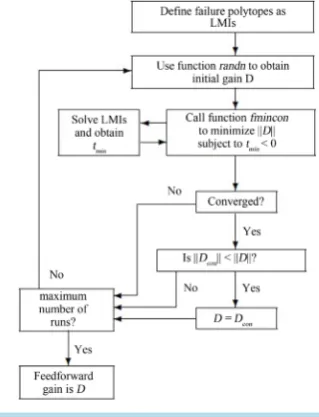
In this paper we consider a single failure in any one control effector. Suppose that the plant has m control ef-fectors. When considering a single failure in any one control effector we define m polytopes with two vertices each; one vertex for the unfailed plant and the other for the failed plant. For the m polytopes we define each of the 2m vertices as an instance of the LMI in Equation (33) using the MATLAB LMI Control Toolbox [28]. We can, however, define only m vertices for each control effector failure plus a shared vertex for the unfailed plant for a total of m+1 LMIs. Note that although we are allowed to define only m+1 LMIs in our computer pro-gram, we still retain the notion that only the unfailed plant and any other vertex representing a failed plant form the required convex polytope. Since P has to be positive-definite, we need to define an additional LMI that will guarantee that P>0 for a total of m+2 LMIs. In order to avoid the ambiguity that results from marginal infeasibility of the LMI constraints when P is close to zero, this additional LMI in our program is defined as
3 10
P> − I, instead of P>0. This will guarantee that P is strictly positive definite. Note that this does not affect the LMI constraints since each vertex is homogeneous in P. The definition of the LMI constraints is the first step of the design process shown in the flowchart in Figure 1.
Next, to initialize the optimization, a gain D0 is obtained using the randn function from MATLAB which returns a square matrix of pseudo-random numbers drawn from a normal distribution with a variance of unity. We use fmincon to find a D with a small Frobenius norm which is constrained to satisfy an LMI set that represents the m polytopes described above. We will perform a specified number of optimization runs with a certain number of iterations each. At each iteration, a D is substituted into the set of m+2 LMIs which is then solved for P. We remark that P is the same for every LMI in the set. The feasibility of the LMI is monitored by the parameter tmin which must be strictly negative in order to guarantee the feasibility of our LMI set for a giv-en D.
Figure 1. Flowchart for design of feedforward gain
using MATLABLMI and Optimization toolboxes. moving on to another initial condition and a new optimization run. This process is repeated until the maximum number of runs has been reached, at the end of which, D is the gain that makes the plant and the failed plants MP. For the examples in the next section we perform 300 optimization runs with 9999 iterations each.
It is important to note that by considering an LMI set consisting of a single polytope corresponding to a fail-ure in one control effector, and using the D obtained from the optimization, we can increase the percentage of loss of control effectiveness in steps of 0.1 and check if the feasibility of the LMI set is maintained for additional percentage failure. Depending on the type of failure, the D may or may not allow more loss of control effective-ness than the amount that was initially defined for each failure.
We remark that when searching for a D for plants with a single failure in any one control effector, the LMI set in design process can be defined to include only one polytope at a time. This would require, however, finding a different D for each type of effector failure and so we would be forced to first identify the failure in order to use the appropriate feedforward gain. Furthermore, no claims are made about the convergence rate and optimality of the proposed feedforward design process.
9. Examples
9.1. F/A-18 Aircraft
9.1.1. F/A-18 Aircraft and Reference Model
Consider the linearized lateral dynamics of the F/A-18 aircraft described in [12]. The rigid body states are lateral velocity v (ft/s), yaw rate r (deg/s), roll rate p (deg/s), and bank angle
φ
(deg). The control surface deflections are asymmetric trailing edge flaps δte (deg), ailerons δa (deg), and rudder δr (deg). The deflection limits, taken to be the same as those for the F-16 aircraft [29], are δteflap ≤25, δaileron ≤21.5, and 30
rudder
δ
≤ .The deflection rate limits are δteflap ≤60 (deg/s), δaileron ≤80 (deg/s), and δrudder ≤120 (deg/s). The mea-surements are sideslip angle
β
(deg), washed out yaw rate rwo (deg), and roll rate p (deg/s). The unfailed aircraft is described by the triple(
0)
, ,
p p p
A B C , where the matrices A Bp, 0p and Cp are shown in [12].
The continuous time model
(
0)
, ,p p p
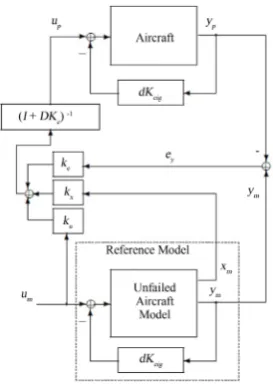
A B C is converted to the delta model using the c2del function from the MATLAB Delta Toolbox with a sampling rate of 200 Hz. Here we use the same output feedback delta domain gain matrix dKeig from [16] shown in Table 1, which was designed using eigenstructure assignment for the unfailed aircraft. This constant output feedback gain will be placed around both the aircraft and the reference model. Thus, the adaptive algorithm will control the closed loop aircraft. The block diagram of the adaptive control system is shown in Figure 2.
of the adaptive controller. However, the gain D does create an algebraic loop. Barkana, Rusnak, and Weiss [19] eliminate the algebraic loop by using the augmented error eay
( )
t to compute the adaptive gain K t( )
in Equa-tion (18) and then using its value to obtain the adaptive control signal in the form( ) (
)
1(
( )
( )
( )
)
,
p e e y x m u m
u t = I+DK − K e t +K x t +K u t (41)
[image:11.595.154.474.192.477.2]As shown in Figure 3. The equivalence between Figure 2 and Figure 3 is shown in detail in [19]. Therefore, Table 1. Eigenstructure assignment gain for the F/A-18 aircraft from Belkharraz and
Sobel [16]. eig
dK
β rwo p
teflap
δ 0 0 0
aileron
δ −1.8674 0.4580 0.1100
rudder
[image:11.595.245.382.504.698.2]δ 1.6969 −1.1917 −0.0650
Figure 2. Block diagram of the simple adaptive controller for accomodation of
aircraft loss of control effectiveness failures.
Figure 3. Block diagram of the implementation of the simple adaptive controller
the computer simulations of the adaptive controllers for the two aircraft examples presented in this paper do not add anything in parallel with the aircraft.
The closed loop unfailed aircraft (plant) in the delta domain is described by the triple
(
0 0)
, ,
p p eig p p p
Aδ −B dK Cδ Bδ C . We choose the reference model to be the same triple. Namely, 0
m p p eig p
Aδ =Aδ −B dK Cδ , Bmδ =Bδp0, and Cm =Cp so that, when there are no failures, the reference model is
exactly the unfailed aircraft with eigenstructure feedback dKeig. The reference model input um
( )
t is given as( )
( )
( )
( )
( )
1, 3 2, 3 3, 3 eigm eig c
eig
dK
u t dK p t
dK = (42)
where p tc
( )
is the pilot roll rate command described by( )
0, 0 2
, 2 6
0, 6 10
, 10 14
0, 14 18
, 18 22
0, 22 26
, 26 30
0, 30 35
m m c m m t p t t p t
p t t
p t t p t t ≤ <
≤ <
≤ <
− ≤ <
= ≤ <
≤ <
≤ <
− ≤ <
≤ <
(43)
and pm is the magnitude of the roll rate pulse in deg/sec.
9.1.2. Bounded Input Disturbance
In this example we consider a bounded input disturbance in the form of a lateral gust vg
( )
t , which is described in [16] and given by( )
(
)
0 0
π
1 cos 0
2 j j m g j m j t T t T v
v t t T T
T
v t T T
− <
− = − ≤ − ≤
− >
(44)
where Tj,j=0,1,,m0 are the instants at which the disturbance occurs and where vm is the lateral gust mag-nitude. The gust length T is chosen to be to be the inverse of the natural frequency ωn of the closed loop com-plex eigenvalue pair of the unfailed aircraft. Here the dutch roll eigenvalues are λdr = − ±2 j2 so that
1 n 0.3536
T = ω = sec.
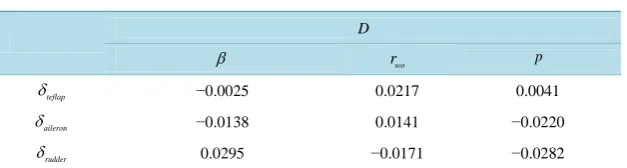
9.1.3. Feedforward Gain for the F/A-18 Aircraft
Table 2. Feedforward gain for the F/A-18 aircraft. D
β rwo p
teflap
δ −0.0025 0.0217 0.0041
aileron
δ −0.0138 0.0141 −0.0220
rudder
δ 0.0295 −0.0171 −0.0282
Once the gain D was found, we considered each of the three two-vertex polytopes that include the unfailed aircraft and the aircraft with one control effector failure. By modifying our LMI program to include only three LMI’s (one for the unfailed aircraft, one for the aircraft with one failure, and one for the P>10−3I constraint) we search for a positive definite P with the same feedforward matrix obtained in the previous optimization. Clearly, when the effectiveness failure is at most 80%, a feasible solution to the new system of LMI's is guaran-teed to exist. However, if we keep increasing the effectiveness failure in steps of 0.1 we find that the single failed F/A-18 aircraft remains minimum-phase for a 92% trailing edge flap failure, a 99% aileron failure, and a 80% rudder failure.
9.1.4. Weighting Matrices for the F/A-18 Aircraft
We now describe our selection process for the weighting matrices for the F/A-18 aircraft using a computer si-mulation with the reference model input in Equation (42), but without the lateral gust in Equation (44). In order to simplify the approach, we first let T and T be diagonal matrices and also let T =T. We then take our first set of candidates to be T = =T I11. A computer simulation for this candidate shows no acceptable tracking of the reference model for the first 20 seconds of the simulation and so it is rejected. We then choose to make the weights for the eay’s (the first three entries in T and T) larger. That is, we choose our second set of candidates as T = =T diag 1
(
e+061e+061e+0611111111)
. A computer simulation for this candidate shows acceptable track-ing everywhere except at t=2 sec where there is an unacceptable jump which results from an unrealistic def-lection rate in the control signals, and so it is rejected. We now let T ≠T and recall that T is the weighting matrix for the proportional part of the adaptive algorithm. Therefore, we make an effort to have the entries ofT be smaller than those of T. This is because we want to avoid having any jumps from appearing in the simu-lation. To this end we choose our third set of candidates to be T =diag 1
(
e+081e+081e+0811111111)
and(
05 05 05)
diag 1 1 1 11111111
T = e+ e+ e+ . A computer simulation shows that although its magnitude has been de-creased, the jump in the response still persists, and so we reject it. Thus we again choose to change the entries of
T and so our fourth set of candidates is taken to be T =diag 1
(
e+081e+081e+0811111111)
and(
06 05 04)
diag 1 1 1 11111111
T = e+ e+ e+ . The computer simulation shows that the jump has almost disappeared but not completely. We note that the jump is larger in the roll rate output and so we choose to modify the third entry of
T, which is the weighting entry for the roll rate measurement. Thus we takeT =diag 1
(
e+081e+081e+0611111111)
and T =diag 1(
e+061e+051e+0411111111)
as our fifth set of candidates. The computer simulation shows the best tracking performance of all attempts. However, we see some undesirable high frequency oscillations in the measurements. Now that we have a good set of candidates for the weighting matrices, we attempt to eliminate the oscillation by modifying the other entries of the matrices. To this end we let(
08 08 06 01 01 01 01 01)
diag 1 1 1 1 1 1 1 1 111
T = e+ e+ e+ e− e− e− e− e− andT =diag 1
(
e+061e+051e+041e−011e−011e−011e−011e−01111)
be our sixth set of candidates. A computer simulation shows that the oscillation is reduced considerably and so we proceed again to further decrease the weights for the xm’s in each matrix until the oscillation completely disappears. Thus we arrive at our final choice for T and T as(
08 08 06 04 04 04 04 04)
diag 1 1 1 1 1 1 1 1 111
T = e+ e+ e+ e− e− e− e− e− and
(
06 05 04 04 04 04 04 04)
diag 1 1 1 1 1 1 1 1 111
T = e+ e+ e+ e− e− e− e− e− .
9.1.5. Simulation Results for the F/A-18 Aircraft
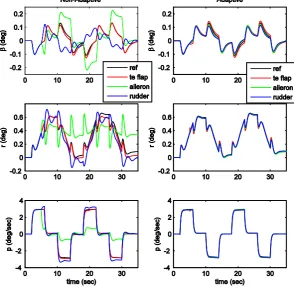
We perform non-adaptive simulations with the fixed gain controller dKeig for the F/A-18 aircraft with 10
m
cor-responds to letting Kx =0,Ke=0,Ku =I, and also omitting D. Both reference model and aircraft have zero in-itial conditions. The non-adaptive time responses are shown on the left side of Figure 4, where the black line corresponds to the reference model, the red line corresponds to a 92% trailing edge flap failure, the green line corresponds to a 99% aileron failure, and the blue line corresponds to a 80% rudder failure. Observe the unac-ceptable tracking performance in sideslip angle
β
, yaw rate r, and roll rate p for each surface failure. Further-more, the coordinated turn is not achieved when an aileron failure occurs. Recall that here we feed back the washed out yaw rate rwo (deg/s), but we plot the true yaw rate r (deg/s).Finally, we perform adaptive simulations of the F/A-18 to accommodate the same surface failures and input disturbance using the proposed adaptive controller with feedforward matrix D as given in Table 2. The weight-ing matrices used in the simulation are the same as those obtained above for the unfailed adaptive response. Here we let
σ
=0.002. The adaptive time responses are shown on the right side of Figure 4. The adaptive con-trol surface deflections are rate limited. Observe the almost perfect tracking in sideslip angleβ
, yaw rate r, and roll rate p.9.2. Tailless Aircraft
9.2.1. Tailless Aircraft and Reference Model
We now consider the linearized dynamics of the Innovative Control Effectors (ICE) aircraft which was de-scribed in Nieto-Wire and Sobel [20]. The state variables are velocity VT (ft/s), angle of attack α (rad), pitch angle
θ
(rad), pitch rate q (rad/s), engine power level, sideslip angleβ
(rad), bank angleφ
(rad), roll rate p(rad/s), and yaw rate r (rad/s). The control effectors are throttle δth (0-1), symmetric pitch flap
δ
pflap (deg), left elevon δel (deg), right elevon δer (deg), left all moving tip δamtl (deg), right all moving tip δamtr (deg), pitch thrust vectoringδ
ptv (deg), and yaw thrust vectoringδ
ytv (deg). The deflection limits are δpflap ≤30,30
elevon
δ ≤ ,
30
δ
amt 60− ≤ ≤ , 15
ptv
δ ≤ , 15
ytv
δ ≤ . The deflection rate limits are 50
pflap
δ ≤ deg/s, 150
elevon
[image:14.595.166.461.396.686.2]δ ≤ deg/s, δamt ≤150 deg/s, δptv ≤60 deg/s, δytv ≤60 deg/s.
Figure 4. FA/18 Aircraft at 200 Hz. Failures at t = 5 sec: 92% trailing edge flap, 99% aileron, and 80% rudder failures. 15 fps lateral wind gust disturbance at t = 10 sec
In this example we consider the linearized lateral dynamics. The lateral control effectors are left elevon δel (deg), right elevon δer (deg), left all moving tip δamtl (deg), right all moving tip δamtr (deg), and yaw thrust vectoring
δ
ytv (deg). The sensor measurements are sideslip angleβ
(deg), roll rate p (deg/s), and yaw rate r(deg/s). Nieto-Wire and Sobel [20] transformed the lateral dynamics from body axis to stability axis so that sta-bility axis roll rate ps could be decoupled from sideslip angle. For the transformation the value of trim alpha used is 0.1569 rad. The states are now sideslip angle
β
, bank angleφ
, stability axis roll rate ps, stability axis yaw rate rs, and a washout filter state xwo. The lateral feedbacks are chosen to beβ
, ps, and washed out stability axis yaw rate( )
swo
r .
The unfailed continuous time aircraft model is described by the triple
(
, 0,)
p p p
A B C where the matrices Ap, 0
p
B , and Cp are given in [20]. The continuous time model for the ICE aircraft is converted to the delta model by using the c2del function from the MATLAB Delta Toolbox with a sampling rate of 1 kHz. We use the me-thod proposed in [20] to compute the eigenstructure assignment gain
ICE
eig
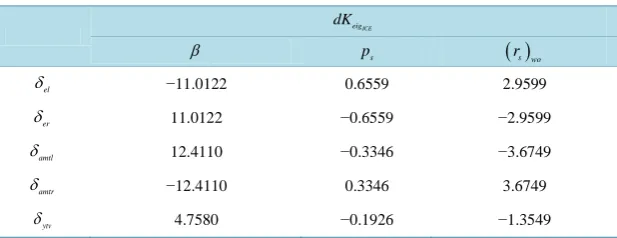
dK for the unfailed aircraft which is shown in Table 3. We assign the desired dutch roll damping ratio
ζ
, natural frequency ωn, and roll subsi-dence eigenvalues asζ
=0.707, ωn=3, and λroll = −4. This constant output feedback gain dKeigICE will beplaced around both the aircraft and the reference model. Thus, the adaptive algorithm will control the closed loop aircraft.
The closed loop unfailed aircraft in the delta domain with eigenstructure assignment is described by the triple
(
0 0)
, ,
ICE
p p eig p p p
Aδ −B dKδ C Bδ C . The reference model is chosen to be the same triple so that 0
ICE
m p p eig p
Aδ =Aδ −B dKδ C , Bδm =Bpδ0, Cm =Cp. Thus, when there are no failures the reference model is the air-craft with eigenstructure assignment gain
ICE
eig
dK . The reference model input um
( )
t is given as( )
( )
( )
( )
( )
( )
( )
1, 22, 2 4
3, 2 3
4, 2
5, 2
ICE ICE ICE ICE ICE
eig
eig
eig
m c
eig
eig
dK dK dK
u t p t
dK dK
=
(45)
where p tc
( )
is the pilot roll rate command given in Equation (43). The 4/3 gain in um( )
t has been added to the pilot stick for the purpose of achieving zero steady-state error to a ps command.9.2.2. Feedforward Gain for the Tailless Aircraft
In this example we consider loss of control effectiveness failures in any one control effector. Here we add bank angle feedback in the implementation of the adaptive controller only. We linearly map the five lateral control effectors into four, and use left and right elevons, the all moving tips, and yaw thrust vectoring to yield a total of four control surfaces. That is, we map left and right all moving tips into a single control signal as:
(
)
2amt amtl amtr
[image:15.595.159.468.604.723.2]δ
=δ
−δ
. This is done because our adaptive algorithm requires that the number of inputs equal the number of outputs. We also require that the failures be symmetric; otherwise cross coupling effects between the lateral and longitudinal axes must be considered.Table 3. Eigenstructure assignment gain for the tailless aircraft using a sampling rate
of 1 kHz.
ICE
eig
dK
β ps
( )
rs woel
δ −11.0122 0.6559 2.9599
er
δ 11.0122 −0.6559 −2.9599
amtl
δ 12.4110 −0.3346 −3.6749
amtr
δ −12.4110 0.3346 3.6749
ytv
For the tailless aircraft we define a set of five LMIs. These include 1) an LMI representing the unfailed air-craft, 2) an LMI for positive definite P, and 3) three LMIs for the three failure polytopes. Each of the three fail-ure polytopes has two vertices with one vertex for the unfailed aircraft and a second vertex for the aircraft with one control effector failure. So the three failure LMIs represent a) the aircraft with a failure in the elevons, b) the aircraft with a failure in the all moving tips, and c) the aircraft with a yaw thrust vectoring failure. Since we do not know in advance how much loss of control effectiveness can be effectively accommodated by the adaptive controller, we choose each of the failed vertices for the tailless aircraft to be defined with a 50% loss of control effectiveness. Using our proposed method with a sampling rate of 1 kHz, we found the feedforward gain matrix
D shown in Table 4 that has a Frobenius norm of 0.0043. This feedforward gain was obtained by choosing the
D with minimum Frobenius norm from among those D matrices with positive definite P using 300 optimization runs. Out of the 300 optimization runs, 29 converged to a feasible feedforward gain; the maximum Frobenius norm was 4.3351.
In this case increasing the percentage of loss of control effectiveness failure for each polytope individually, with the D obtained from the optimization, does not yield feasible LMIs beyond 50%.
9.2.3. Weighting Matrices for the Tailless Aircraft
An approach similar to that described for obtaining the weights for the adaptive algorithm in the FA-18 aircraft example yields the weights T = =T diag 1
(
e+081e+081e+081e+08111111111)
.9.2.4. Simulation Results for the Tailless Aircraft
We now perform computer simulations using the ICE model for different control effector failures. Consider the roll rate pilot command p tc
( )
is given by Equation (43). We first perform non-adaptive simulations with thefixed gain controller
ICE
eig
dK for the ICE aircraft with pm=1. The single control effector failures occur at 5
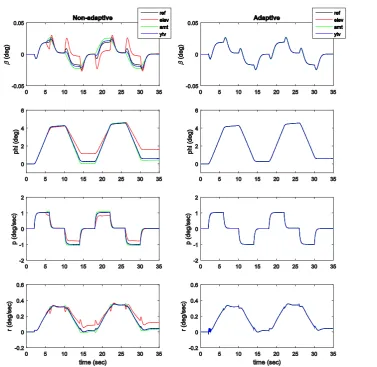
t= sec. In this simulation we do not include a wind gust disturbance. The non-adaptive simulation corres-ponds to letting Kx=0,Ke =0,Ku=I, and also omitting D. Both reference model and aircraft have zero initial conditions. The non-adaptive time responses are shown on the left side of Figure 5, where the black line cor-responds to the reference model time response, the red line corcor-responds to a 50% elevon failure, the green line corresponds to a 50% all moving tip failure, and the blue line corresponds to a 50% yaw thrust vectoring failure. Observe the poor tracking performance in sideslip angle
β
, stability axis yaw rate rs, and stability axis roll rate ps for each surface failure. Recall that we feed back the washed out stability axis yaw rate( )
swo
r (deg/s) but here we plot the stability axis yaw rate rs (deg/s).
Next we perform adaptive simulations of the ICE aircraft to accommodate the surface failures and input dis-turbance using the proposed adaptive controller with feedforward matrix D as given in Table 4. We initialize the adaptive gains as Kx=0,Ke=0,Ku=I, which corresponds to initializing the failed plant with the eigenstruc-ture assignment feedback which was designed for the unfailed aircraft. Here we combine the five lateral control signals from um
( )
t into four signals that go into the adaptive controls. The adaptive algorithm yields four adaptive control signals which are then mapped back into five control signals for the tailless aircraft. The amount of failure and weighting matrices used in the adaptive simulation are the same as those used in the non-adaptive simulation. Here we letσ
=0.002. The adaptive time histories are shown on the right side of [image:16.595.159.469.608.717.2]Figure 5. The adaptive control surface deflections are rate limited. Observe the almost perfect tracking perfor-mance of the adaptive controller in sideslip angle
β
, stability axis yaw rate rs, and stability axis roll rate psTable 4. Feedforward gain for the tailless aircraft using a sampling rate of 1 kHz. D
β
( )
rs wo ps φel
δ −1.446E−05 −6.264E−04 1.265E−03 1.813E−04
er
δ −2.572E−05 3.481E−04 9.448E−04 −9.785E−04
amt
δ −1.619E−03 1.489E−04 −6.865E−04 −9.856E−04
ytv
Figure 5. Tailless Aircraft at 1 kHz. Failures at t = 5 sec: 50% in any one control effector. No wind gust disturbance. for each control effector failure.
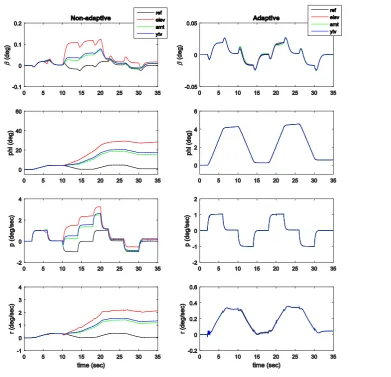
For the following set of simulations we introduce a wind gust disturbance of magnitude vm=5 (ft/s) as de-scribed in Equation (44), which occurs at t=10 sec and has a duration of 10 sec. The gust length T in Equation (44) is chosen to be to be the inverse of the natural frequency ωn of the closed loop complex eigenvalue pair of the unfailed aircraft; here ωn =3 so that T =1ωn =0.3333 sec. Here the amount of failure and weighting matrices are the same as those used in the simulations of Figure 5. The non-adaptive time responses are shown on the left side of Figure 6, where the black line corresponds to the reference model time response, the red line corresponds to a 50% elevon failure, the green line corresponds to a 50% all moving tip failure, and the blue line corresponds to a 50% yaw thrust vectoring failure. By comparing the left sides of Figure 5 and Figure 6, we can clearly see that the fixed controller performance deteriorates considerably due to the disturbance. Observe how the fixed controller, on the left side of Figure 6, starts diverging once the wind gust occurs, as can be seen in the bank angle and yaw rate outputs, and does not recover. Compare this to the response of the adaptive con-troller shown in the right side of Figure 6 which exhibits almost perfect tracking and is able to successfully ac-commodate considerable loss of control effectiveness failures even in the presence of a bounded lateral wind gust disturbance.