Cloning, Expression, and Immunogenicity Analysis of the
CpsE Protein from Group B Streptococcus Isolated from
Tilapia (Oreochromis Niloticus)
Xi Fu1, Kaiyu Wang1, Jinlu Huang1, Jun Wang1, Hai Lian1, Yang He1, Lanmin Li1, Kaiyu Wang2 1
Fish Disease Research Center, College of Veterinary Medicine of Sichuan Agricultural University, Ya’an,China 2Key Laboratory of Animal Disease and Human Health of Sichuan Province,
College of Veterinary Medicine of Sichuan Agricultural University, Ya’an, China Email: [email protected]
Received 2012
ABSTRACT
Group B Streptococcus (GBS) is a major cause of serious bacterial infection in numerous animal species. The production of capsular polysaccharide(CPs) is vital to GBS to evade host immunity. One of the genes that required for production of CPs, cpsE, has been determined to be well conserved in capsule gene cluster (cps).This study cloned the cpsE gene from Tilapia of GBS clinical isolate (serotype Ia) and expressed this gene with aid of pET-32a(+) in Escherichia coli BL21(DE3) competent cells to obtain high levels of the recombinant protein for further study about CpsE in fish and examination of its immunogenicity. The optimization of induction conditions (IPTG concentration, temperature and time) in E.coli was accomplished and let us to perform the recombinant protein induction at 37℃ for 3h,with 0.2mM IPTG in Luria Bertani (LB) medium. At the optimal conditions, recombinant protein was ex-pressed in an insoluble form (inclusion bodies) and accounted for approximately 23% of the total protein. Purification by affinity chromatography yielded about 480mg fusion protein per liter culture.
Keywords: Recombinant CpsE Expression; Purification; Polyclonal Antibody
1. Introduction
Group B Streptococcus (GBS) is the foremost cause of life-threatening bacterial infection in human and other animals [1-4]. GBS also causes septicaemia and meningitis of obvious morbidity and mortality in fish such as tilapia (Oreochromis niloticus), cultured seabream, and wild mullet [5-7]. It is com-monly believed that the threat of GBS disease is a considerable health burden for society.
For GBS, CPs is a major virulence factor as well as a target for protective immunity [8].To date, ten serotypes (serotypes Ia, Ib, and II through IX) of GBS have been identified based on their unique CPS antigens[10-12]. Among these serotypes, Ia、
III、V and VIII are prevalent among human [11,13,14], the most currently isolated from fish are Ia , Ib and III [15,16].
There are five genes (cpsA to –E) that are well conserved among several polysaccharide-producing streptococci including
S. thermophilus, S. pneumoniae, S. suis and among the GBS capsule serotypes[17-19]. According to Cieslewicz et al[20], inactivation of cpsIaE resulted in an acapsular phenotype, con-sistent with previous work that identified CpsE as the glycosyl-transferase [18,22].
Impact of GBS infection on fish was sporadically reported throughout the world [5,6,23-25] . Here we report molecular cloning、prokaryotic expression and purification of the recom-binant protein. Additionally, we studied the optimal induction conditions for recombinant protein including concentration of IPTG (Isopropyl b-D-1-thiogalactopyranoside), induction tem-peratures and induction time.
2. Materials and Methods
2.1. Clinical Isolate, Plasmids and Culture Conditions
GBS strains (n=10) were isolated from liver、brain and kidney from 100 infected tilapia (Wen-chang City, Hainan Prov-ince ,China). One virulent strain was selected through regres-sion test over healthy tilapia. The strain was identified to ex-press the type Ia capsule by multiplex PCR assay [26]. All
E.coli clones were routinely grown in LB broth containing
100μg/ml of ampicillin at 37℃.
2.2. Translated Protein Analysis
The Protean program of software DNAStar was used to predict the secondary structure and the surface probability as well as antigenic index of translated protein. SOSUI Server (http://bp. nuap.nagoya-u.ac.jp/sosui/sosui_submit.html) and SignalP 4.0 Server (http://www.cbs.dtu.dk/services/SignalP/) were used to analyze the presence of transmembrane regions and signal pep-tide, respectively. The hydrophilicity character of the protein sequence was predicted by software Bioedit7.0.Chance of in-solubility of target protein over-expressed in E.coli was pre-dicted using online program (http://www.biotech.ou.edu/).
2.3. Primer Design and PCR Amplification of the cpsE Gene
restric-tion sites Bam HI and Hind III (underlined), respectively. Pri-mers: upstream 5' -
CGGGATCCATGAAAATTTGTCTGGTTGG-3’
downstream 5' -
CCAAGCTT
Bacterial isolates from infected tilapia were initially identified as GBS by conventional phenotypic characteristics (Gram-
positive cocci, β-haemolytic, catalase negative, API 20 STREP
system, Slidex Strepto-kit). Slidex Strepto-kit was positive for group B and API 20 STREP gave profile number 3663414, which corresponded to excellent matches to GBS.
3.2. Bioinformatics Prediction
The analysis results obtained by the software DNAStar indi-cated that there were nine distinct antigenic domains and six surface probability domains. This program also showed a mea-surable amount of beta strands with few turn regions and ran-dom coil. Prediction of SignalP 3.0 Server confirmed the ab-sence of signal peptide in CpsE sequence. Program SOSUI Server indicated that amino acids from 80-102aa in the cpsE
gene may be part of a transmembrane region in the CpsE pro-tein sequence .Results indicate that this region (80-102aa) is likely anchored to the bacterial wall. And possibility of insolu-bility when over-expressed in E.coli was 64.1%.
3.3. Plasmids Construction
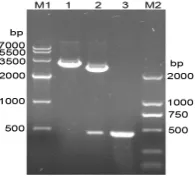
Coning plasmid pMD19-t/cpsE was confirmed by double re-striction enzymes digestion (Bam HI and Hind III) (Figure 1) and sequencing analysis. Correct fragment was fused with pET-32a (+) to form the expression plasmid pET-32a (+)/cpsE.
The initial transformation was performed with competent
DH5αcells for screening. The positive clones were identified by
PCR amplification and double restriction enzymes digestion (Figure 2).
TTAAAAAATTCCTCCTAAATT-3’). Amplification was done at 94℃ for 5 min and then at 94℃
for 1 min, 55℃for 1 min, and 72℃ for 40 s for a total of 30 cycles, followed by 72℃ for 10 min.
2.4. Construction of Cloning Plasmid and Expression Plasmids
The target fragment was ligated into cloning vector pMD19-T to construct recombinant cloning plasmid pMD19-T/cpsE. Competent E.colistrain DH5α cells were used for host cloning
construction.
The pET-32a (+) vector and the recombinant cloning plas-mids were both digested with Bam HI and Hind III and were both spliced with T4 ligase (Takara, Japan) to construct the recombinant prokaryotic expression plasmid pET-32a(+)/cpsE.
The ligated product was transformed into competent DH5a cells. Selection of positive clones was done by PCR amplification, double enzymes digestion and sequence analysis. The positive clones were transformed into expression hosts of BL21 (DE3) cells.
2.5. Expression and Optimization of Expression Conditions
Transformants were inoculated into 5 ml of culture medium in test tubes and grown overnight at 37℃with constant agitation (220 rpm) until they reached the exponential phase (approx-imately OD600≈ 0.5–0.6 measured by absorbance at 600nm) and
were subsequently induced with IPTG. Preliminary tests were performed with 1mM IPTG induction at 37 °C for 4 h and for the optimization of mature CpsE expression. Optimization of the expression conditions were performed at different tempera-tures (30℃, 34℃, and 37℃), for different induction periods (1h, 2h, 3h, 4h, 5h, 6h, 7 h and overnight) and with different IPTG concentrations (0.2mM, 0.4mM. 0.6mM, 0.8mM, 1.0mM, 1.2mM, 1.5mM and 2.0mM).
2.6. Purification of the His6-tagged Recombinant Protein
The His6-tagged recombinant protein was subjected to Bio-RadTM metal affinity chromatography for purification. Under
denatured state, CpsE-containing fractions were pooled and dialyzed against PBS buffer (10mM Na2 HPO 4 1.8mM KH 2
PO4, pH 7.4, 140mM NaCl, and 2.7mM KCl) with step-wise
lower concentrations of urea (6M, 4M, 2M and 0M ) for a total time of 96h. The purified recombinant protein was stored at 4℃
for use within 1 week or at –70℃ for longer time.
3. Results
3.1. GBS Strain Isolate Confirming
Figure1. Characterization of the recombinant plasmid pMD19- T/cpsE by restriction digestion and PCR-based amplification.M1: DNA marker of 7000bp; lane 1:pMD19-T/cpsE digested with Bam HI; lane 2:pMD19-T/cpsE digested with Bam HI and Hind III; lane 3:PCR amplification product of cpsE (ORF450bp); M2:DNA marker of 2000bp
[image:2.595.375.473.397.485.2]3.4. Expression of the Recombinant Protein
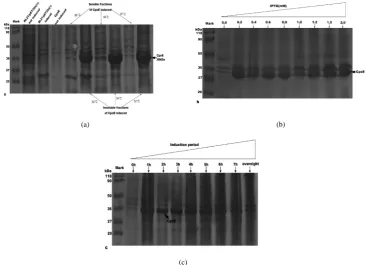
The protein expression was observed in expression hostBL21 (DE3). A distinct band of approximately 36kDa of molecular weight, which corresponded to the expected size of the His6- tagged CpsE fusion protein, was observed (Figure 3a). Distinct or correct band was not detected in both un-induced sample and the pET-32a (+) vector culture in BL21 (DE3) cells (Figure 3(a)).The target protein was mainly expressed in the insoluble fraction, in the form of inclusion bodies.
3.5. Optimization of Culture Conditions
We examined effects of the induction temperature, induction periods and IPTG concentration on the CpsE expression level. The expression level was analyzed by SDS-PAGE.The recom-binant protein expression was best in BL21 (DE3) cells with 0.2mM IPTG induction (Figure 3b) at 37℃(Figure 3a) for 3h (Figure 3c)after the culture reached an OD600 of 0.6. Therefore,
this condition was used throughout the paper for the induction of CpsE expression.
3.6. Purification and Immunogenicity Analysis of the Recombinant Protein
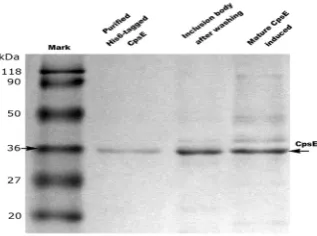
The CpsE was mainly eluted from Ni-NTA column using 250mM imidazole (Data not shown). A clear band corres-ponded to a molecular mass of about 36kDa was observed on the SDS-PAGE gel staining with Coomassie brilliant blue
(Figure 4). From a 1-L culture, 1.62mg of purified CpsE was obtained. (4g of wet weight cell pellets were obtained from 1L of bacterial culture in confirmed expression conditions in our study) The purification profile is summarized in Table 1.
4. Discussion
GBS is among a select number of significant human and animal pathogenic bacteria expressing polysaccharide. CPS confer virulence on these organisms by interfering with the mechan-isms of host immune recognition[27].The striking conservation of cpsE gene among GBS of different serotypes has suggested that the product of this gene has function that is independent of the repeating unit structure of the associated polysaccharide. To our knowledge, there are no reports on characterization of CpsE in fish.
Studies report that CpsE is expressed in heterologous expres-sion systems in E.coli [18].In this work, cpsE from GBS name-ly serotype Ia, isolated from clinical tilapia, was cloned for expression at high levels in E.coli with the intention of detect-ing immunogenicity and further characterization of this protein in fish.
The result obtained for CpsE solubility indicated that the mature protein (without signal peptide), with the transmem-brane region and a theoretic relative high possibility of insolu-bility when over-expressed in E.coli, is mainly retained in the insoluble fraction. This result corroborates the bioinformatics prediction that overall the recombinant protein presents a hy-drophobic character.
(a) (b)
(c)
Figure 3. (a) His6-tagged CpsE expression in BL21(DE3) at different temperature conditions on a 12.5%SDS-PAGE gel.The sample are
[image:3.595.114.481.416.681.2]Figure 4. Purified CpsE on a 12.5%SDS-PAGE gel eluted from Ni-NTA column using 250mM imidazole. Expression of all lanes are accomplished at optimal conditions (at 37℃ for 1h with 0.2mM IPTG induction).
Table 1. Purification of cpse protein from 1l culture.
Step
Total proteina (mg)
CpsE (mg)
Protein concentration
μg/mlb
Purity (%)c
Crude extractd 67.5 15.48 1,214 23
Immobilized metal affinity
chromatography 1.90 1.62 480 85
aTotal protein was isolated from 1liter of culture medium in optimal expression
condition; b Protein concentration was estimated by the Bradford method using
BSA as standard; c The purity was determined as the amount of the stain
asso-ciated with the CpsE band as a fraction of the stain assoasso-ciated with all the bands on the SDS-PAGE[28]; d The pellets containing the insoluble fraction (crude
extract) obtained from 1liter of culture.
To date, there are no reports in literature that approached the expression optimization allowing the development of a process to produce recombinant CpsE in E.coli. Our work is able to present conditions that are optimal for production of recombi-nant protein. Distribution of B cell epitopes is largely related to the secondary structures of the protein because regions of turn and coil can easily change in shape that benefits combination of protein with antibodies. Hydrophilic regions of the protein would serve as likely B cell epitopes. Prediction results of hy-drophilicity character and transmembrane region indicate that there may have certain B cell epitopes in the CpsE protein. Comprehensive analysis of turn regions, coil regions, surface probability regions and hydrophilic regions presented here suggest that the most possible sites for B cell epitopes are Phe52-Asn57, Gly7-Gly11, Ser83-Gly84 and Asp112-Pro114. This speculate is able to locate B cell epitopes, which could help to find specific antigen and further benefit development of subunit vaccine.
5. Acknowledgements
This work was supported by grant from Program for Chang-jiang Scholars and Innovative Research Teamin in University (PCSIRT) (Grant no. IRT0848 ); Science and Technology project of Sichuan Province (No.08ZA082). Kaiyu Wang is the corresponding author. Fish Disease Research Center & Key Laboratory of Animal Disease and Human Health of Sichuan Province, College of Veterinary Medicine of Sichuan Agri-cultural University, 46# Xinkang Road, Yucheng District, Yaan
625014, Sichuan Province of China.
REFERENCES
[1] S.J.Schrag, D.Phil, E.R.Zell, M.Stat, R.Lynfield, A.Roome, K.E.Arnold, A.S.Craig, L.H.Harrison, A.Reingold, K.Stefonek, G.Smith, M.Gamble, A.Schuchat, “A population-based compar-ison of strategies to prevent early-onset group B streptococcal disease in neonates,” N. Engl. J. Med. New York, vol.347, pp.233-239, July 2002.
[2] M.S.Edwards, C.J.Baker, “Group B streptococcal infections in elderly adults,” Clin. Infect. Dis. New York, vol.41 pp.839-847, May 2005.
[3] T.H.Skoff, M.M.Farley, S.Petit, A.S.Craig, W.Schaffner, K.Gershman, L.H.Harrison, R.Lynfield, J.M.Boetani, S.Zansky, B.A.Albanese, K.Stefonek, E.R.Zell, D.Jackson, T.Thompson, S.J.Schrag, “Increasing burden of invasive group B streptococcal disease in nonpregnant adults 1990-2007,”Clin. Infect. Dis. New York,vol.49 pp.85-92, February 2009.
[4] G.P.Keefe, “Streptococcus agalactiae mastitis: a review,” Can.Vet.J. Canada,vol.38, pp.429-437,July 1997.
[5] J.J.Evans, P.H.Klesius, P.M.Gilbert, C.A.Shoemaker, M.A.A.Sarawi, J.Landsberg, R.Duremdez, “Characterization of β-haemolytic group B streptococcus agalactiae in cultured sea-bream, Sparus auratus L., and wild mullet, Liza klunzingeri (Day), in Kuwait,” J.Fish. Dis.Wiley, New York, vol.25, pp.505-513, September 2002.
[6] R.Salvador, E.E.Muller, J.C.Freitas, J.H.Leonhadt, “Isolation and characterization of Streptococcus spp. group B in Nile tilapia (Oreochromis niloticus) reared in hapas nets and earth nurseries in the northern region of Parana State,Brazil,” Ciência Rural Santa Maria, vol.35,pp.1374-1378, November 2005.
[7] A.Eldar, Y.Bejerano, H.Bercovier, “Streptococcus shiloi and Streptococcus difficile: two new streptococcal species causing a meningoencephalitis in fish,” Curr.Microbiol.New York, vol.28, pp.139-143, March 1994.
[8] E.R.Moxon, J.S.Kroll, “The role of bacterial polysaccharide capsules as virulence factors,” Curr.Top.Microbiol. Immu-nol.Berlin, vol.150, pp.65-85, May 1990.
[9] A.S.Cross,“The biologic significance of bacterial encapsula-tion, ” Curr.Top. Microbiol. Immunol. Berlin, vol.150, pp.87-95, May 1990.
[10] D.O.Chaffin, S.B.Beres, H.H.Yim, C.E.Rubens, “The serotype of type Ia and III group B streptococci is determined by the poly-merase gene within the polycistronic capsule operon,” J.Bacteriol.Washington DC, vol.182, pp.4466-4477, May 2000.
[11] E.Persson, S.Berg, B.Trollfors, P.Larsson, E.Ek, E.Backhaus, B.E.B.Claesson, L.Jonsson, G.Radberg, T.Ripa, S.Johansson, “Serotypes and clinical manifestations of invasive group B streptococcal infections in western Sweden 1998–2001,” Clin.Microbiol.Infect.Wiley, New York, vol.10, pp.791-796, September 2004.
[12] H.C.Slotved, F.Kong, L.Lambertsen, S.Sauer, G.L.Gilbert, “Se-rotype IX, a proposed new Streptococcus agalactiae serotype,” J. Clin. Microbiol. Washington DC, vol.45, pp.2929-2936, Sep-tember 2007.
[13] M.E.Hickman, M.A.Rench, P.Ferrieri, C.J.Baker, “Changing epidemiology of group B streptococcal colonization,” Pediatrics. American Academy of Pediatrics, New York, vol.104, pp.203-209, August 1999.
[image:4.595.56.286.280.350.2][15] N.Suanyuk, F.Kong, D.Ko, G.L.Gilbert, K.Supamattaya, “Oc-currence of rare genotypes of Streptococcus agalactiae in cul-tured red tilapia Oreochromis sp. and Nile tilapia O. niloticus in Thailand—Relationship to human isolates?, ”Aquaculture, El-sevier, Amsterdam, vol.284, pp.35-40, July 2008.
[16] P.Vandamme, L.A.Devriese, B.Pot, K.Kersters, P.Melin, “Streptococcus difficile is a nonhemolytic group B, type Ib Streptococcus,” IJSEM. Society for General Microbiology, London, vol.47, pp.81-85, January 1997.
[17] F.Stingele, J.R.Neeser, B.Mollet, “Identification and characteri-zation of the eps (Exopolysaccharide) gene cluster from Strepto-coccus thermophilus Sfi6,” J.Bacteriol. Washington DC, vol.178, pp.1680-1690, March 1996.
[18] S.Yamamoto, K.Miyake, Y.Koike, M.Watanabe, Y.Machida, M.Ohta, S.Iijima, “Molecular characterization of type-specific capsular polysaccharide biosynthesis genes of Streptococcus agalactiae type Ia, ”J.Bacteriol. Washington DC, vol.181, pp.5176-5184, September 1999.
[19] A.Guidolin, J.K.Morona, R.Morona, D.Hansman, J.C.Paton, “Nucleotide sequence analysis of genes essential for capsular polysaccharide biosynthesis in Streptococcus pneumoniae type 19F,” Infect. Immun. Washington DC, vol.62, pp.5384-5396, December 1994.
[20] M.J.Cieslewicz, D.L.Kasper, Y.Wang, M.R.Wessels, “Function-al an“Function-alysis in type Ia group B Streptococcus of a cluster of genes involved in extracellular polysaccharide production by diverse species of streptococci,” J. Biol. Chem. Washington DC, vol.276, pp.139-146, January 2001.
[21] J.K.Morona, J.C.Paton, D.C.Miller, R.Morona, “Tyrosine phos-phorylation of CpsD negatively regulates capsular polysaccha-ride biosynthesis in Streptococcus pneumoniae,” Mol. Micro-biol.Wiley, New York, vol.35, pp.1431-1442, March 2000.
[22] C.E.Rubens, L.M.Heggen, R.F.Haft, M.R.Wessels, “Identifica-tion of cpsD,a gene essential for type III capsule expression in group B streptococci,” Mol. Microbiol. Wiley, New York, vol.8, pp.843-855, May 1993.
[23] A. M. Baya, B. Lupiani, F. M. Hetrick, B. S. Roberson, R. Lu-kacovic, E. May, C. Poukish, “Association of Streptococcus sp. with fish mortalities in the Chesapeake Bay and its tributaries,” J.Fish.Dis.Wiley,New York, vol.13, pp.251-253, May 1990.
[24] R.Duremdez, A. A.Marzouk, J. A. Qasem, A. A.Harbi, H. Gha-rabally, “Isolation of Streptococcus agalactiae from cultured sil-ver pomfret, Pampus argenteus (Euphrasen), in Kuwait,” J.Fish.Dis.Wiley,New York, vol.27, pp.307-310, May 2004. [25] N.Suanyuk, H.Kanghear, R. Khongpradit, K.Supamattaya,
“Streptococcus agalactiae infection in tilapia (Oreochromis nilo-ticus),” J. Sci. Technol. Aquat .Sci. Songkhla, vol.27, pp.307-319, 2005.
[26] M. Imperi, M. Pataracchia, G. Alfarone, L. Baldassarri, G. Ore-fici, R. Creti, “A multiplex PCR assay for the direct identifica-tion of the capsular type (Ia to IX) of Streptococcus agalactiae,” J. Microbiol. Methods, Elsevier, Amsterdam, vol.80, pp.212-214, December 2009.
[27] D. O. Chaffin, L. M. Mentele, C.E. Rubens, “Sialylation of group B streptococcal capsular polysaccharide is mediated by cpsK and is required for optimal capsule polymerization and ex-pression,” J.Bacteriol. Washington DC, vol.187, pp.4615-4626, July 2005.