Journal of Chemical and Pharmaceutical Research, 2014, 6(2):210-216
Research Article
CODEN(USA) : JCPRC5
ISSN : 0975-7384
Landweber iteration algorithm based on sensitivity updating strategy for
electrical capacitance tomography
Lifeng Zhang
North China Electric Power University, China
_____________________________________________________________________________________________
ABSTRACT
Electrical capacitance tomography (ECT) is a technique developed in recent years, which aims to measure multi-phase flow. The quality of reconstructed images is the bottleneck for its successful applications. Sensitivity matrix is calculated based on the known permittivity distributions, which is necessary in the most common used sensitivity-based image reconstruction algorithms of ECT. It is assumed that sensitivity matrix will hardly be affected by flow regimes. As a result, the fixed sensitivity matrix was used during the image reconstruction. However, there exists ‘soft-field’ effect and the sensitivity matrixes are changeable corresponding to different flow regimes, which results the decrease of reconstructed image quality. Therefore, Landweber iterative algorithm with updated sensitivity matrix was studied in this paper to improve the quality of reconstructed images. The initial image for sensitivity matrix update was obtained by Landweber iterative algorithm, and the results of different sensitivity matrix update intervals were compared. The times of sensitivity matrix updating were also analyzed. Experimental and simulation results showed that reconstructed images with higher accuracy can be obtained.
Key words: Electrical capacitance tomography; Image reconstruction; Landweber iteration; Sensitivity matrix update
_____________________________________________________________________________________________
INTRODUCTION
Electrical capacitance tomography (ECT) is one kind of process tomography techniques which was developed during the late 1980s [1, 2]. ECT technique has been investigated extensively during the past decades as a visualization technique for measurement and imaging of two-phase flows in real time in industrial process monitoring [3-5]. The task of image reconstruction for ECT is to determine the permittivity distribution and hence material distribution over the cross-section using the capacitance measurements.
However, there are three difficult problems in image reconstruction, termed as ‘soft-field’ effect, underdetermined problem and ill-posed inverse problem [6]. In general, image reconstruction algorithms can be divided into two classes [7]. One is non-iterative algorithm such as linear back projection (LBP) algorithm, which is fast in speed and suitable for online imaging, but, the quality of the reconstructed images is low. The other is iterative algorithm such as Landweber iterative algorithm which can provide quantitative images. The sensitivity matrix is generally needed for all the algorithms of both classes [8-10].
In principle, sensitivity matrix should be updated according to the true media distribution, which is unknown. Therefore, sensitivity matrix can only be updated according to the reconstructed image by some reconstruction algorithms, say, Landweber iterative algorithm. A modified Landweber iterative algorithm based on updated sensitivity matrix was presented in this paper. The reconstructed image based on conventional Landweber iteration was selected as the initial image for sensitivity matrix update, and the reconstructed images after sensitivity matrix update using different initial images were compared. The effect on the quality of reconstructed images for different times of sensitivity matrix update was also analyzed. Simulation and static test results showed that reconstructed images with higher accuracy can be obtained.
PRINCIPLE OF ECT
ECT technique involves a number of capacitive electrodes mounted circumferentially around a flow pipe, and relies on changes in capacitance values between electrodes owing to the change in permittivity of flow components, as is shown in figure 1.
Fig. 1: Principle diagramof ECT system
The electrical field inside an ECT sensor can be calculated using the Laplace equation which is given by
0 )] , ( ) , ( [ ∇ = ⋅
∇
ε
x y u x y (1)where
ε
(x,y)is the permittivity distribution in the sensing field, u(x,y) is the potential distribution.The relationship between capacitance C andε
(x,y) is governed by the following equation∫
Γ ∇ Γ− =
= x y u x y d
V V Q
C 1
ε
( , ) ( , ) (2)where Q is the charge of an electrode, V is the potential difference between an electrode pair and Γ is the electrode surface.
Capacitances are measured between different electrode pairs and the measurements obtained are used to reconstruct a cross sectional distribution of flow components. For a 12-electrode system, the number of independent capacitance measurements is 66.
Landweber iterative algorithm is one of the widely used iterative algorithms for ECT. Landweber iterative algorithm is defined as [11, 12]
= − + = +
λ
λ
η
T k T k k S G SG S G G 01 ( )
(3)
j
i− when the pipe is full of high and low permittivity material, respectively. Cijmis the measurement capacitance of electrode pair i−j when the kth element has high permittivity and the other elements have low permittivity.
m
(k)is a correction factor related to the area of the kth in-pipe element.LANDWEBER ITERATIVE ALGORITHM WITH UPDATED SENSITIVITY MATRIX
[image:3.595.167.444.189.358.2]The Landweber iterative algorithm with updated sensitivity matrix can be expressed as figure 2.The block in dash line is conventional Landweber iterative algorithm. While for the modified Landweber iterative algorithm with updated sensitivity matrix, the initial image is obtained by the conventional Landweber iterative algorithm [13].
Fig. 2: Landweber iterative algorithm with updated sensitivity matrix
The Landweber iteration algorithmwithupdated sensitivity matrix can be expressed as
= − + = + ) Landweber al Convention ( ) ( 0 1 m k up T up k k G G G S S G
G η λ
(5)
Where
G
0 is the reconstructed image after mtimes iterations of conventional Landweber iterative algorithm, which is used as the initial image for sensitivity matrix update.S
upis the updated sensitivity matrix.EXPERIMENTS AND RESULTS
SIMULATIONS
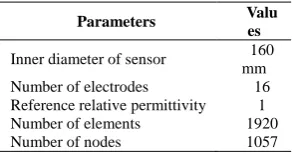
Simulation experiment was carried out on a PC with PentiumTM 2.9 GHz and 512 M memory using the software developed by Tianjin University with MATLAB 2007. A 16-electrode ECT sensor was adopted and the mesh grid was shown in figure 3. The parameters of ECT sensor and mesh were listed in Table 1.
Table 1. Parameters of sensor and mesh
Parameters Valu es
Inner diameter of sensor 160 mm Number of electrodes 16 Reference relative permittivity 1 Number of elements 1920
[image:3.595.233.380.604.681.2]Fig. 3:Mesh grid
To compare the reconstructed images quantitatively, the relative image error (RE) was used.
*
2
2
RE
σ
σ
σ
−
=
(6)
Where
σ
andσ
*are the real and reconstructed permittivity distributions, respectively.COMPARISON OF DIFFERENT INITIAL IMAGE FOR SENSITIVITY MATRIX UPDATE
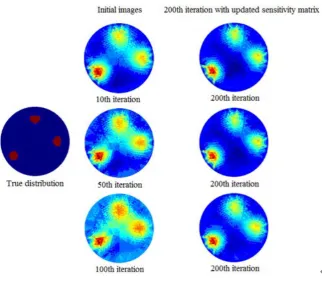
[image:4.595.153.476.433.716.2]figure 5 that the RE of the initial image at 50th iteration is smallest. The reconstructed image of 50th iteration using conventional Landweber iterative algorithm was adopted as the initial image for sensitivity matrix update.
Fig. 5: Numerical result of RE
TIMES OF SENSITIVITY MATRIX UPDATE
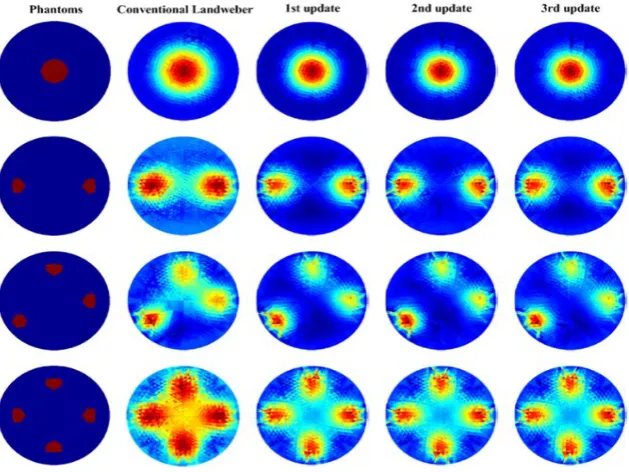
[image:5.595.150.465.378.614.2]Four different phantoms were selected and the reconstructed images of both conventional Landweber iterative algorithm at 50th iteration and Landweber iterative algorithm with 1st, 2nd and 3rd sensitivity matrix update at 50th iteration were shown in figure 6 and the behaviour of RE was also shown in figure 7. It can be seen from figure 7 that the RE was smallest. Usually two times of sensitivity matrix update should be enough.
Fig. 7: Numerical result of RE
STATIC TEST
To verify the performance of the presented method, static test was carried out using a FPGA-based ECT system developed by Tianjin University [14]. The excitation signal, demodulation and data acquisition are finished by FPGA.
The static test results were shown in figure 8. For the first test phantom, there were three objects with different size. These three objects cannot be distinguished for the reconstructed image using conventional Landweber iterative algorithm. After 1st update, the quality of reconstructed image was enhanced a little. After 2nd update, these three objects can be distinguished clearly.
For the second test phantom, two objects were close to each other. As the reason of the ‘soft-field’ effect, these two objects cannot be separated clearly for the reconstructed image. After 2nd update, these two objects can be separated. The quality of reconstructed images was improved after sensitivity matrix update.
Fig. 8: Static test results
CONCLUSION
This paper presented the sensitivity matrix update strategy for ECT. Simulation and static test results indicated that the quality can be improved. It also can be seen that there is no need to update sensitivity matrix many times and two times update are usually enough. The sensitivity matrix was calculated using the software developed by MATLAB 2007. If the software based on Visual C++ can be used, the calculation time can be further decreased, with which the sensitivity matrix update strategy can be used in more situations.
Acknowledgments
[image:6.595.146.466.394.601.2][3] HSTapp; RA Williams.Chem. Eng. J.,2000, 77(1-2), 195-125.
[4] S Liu; WQ Yang; H Wang; F Jiang; Y Su.Meas. Sci. Technol.,2001, 12(8), 1120-1125. [5] I Ismail; JC Gamio; SFA Bukhari; WQ Yang.Flow Meas. Instrum.,2005, 16(2-3), 145-155. [6] HX Wang;L Tang; Z Cao.Flow Meas. Instrum.,2007, 18(5-6),262-267.
[7] WQ Yang; LH Peng.Meas. Sci. Technol.,2003, 14(1),R1-R13. [8] LF Zhang; HX Wang.Meas. Sci. Technol.,2009, 20(10), 104028.
[9] Q Marashdeh; W Warsito; LS Fan; FL Teixeira.Meas. Sci. Technol.,2006, 17(8), 2097-2103. [10] WF Fang.Meas. Sci. Technol.,2004, 15(10), 2124-2132.
[11] Y Li; WQ Yang.Meas. Sci. Technol.,2008, 19(9), 094014.
[12] WQ Yang; DM Spink; TA York; H McCann.Meas. Sci. Technol.,1999, 10(11),1065-1069. [13] S Liu;L Fu; WQ Yang.Meas. Sci. Technol.,1999, 10(7), L37-L39.