Awareness in Networked Collaborative Environment: A
Comparative Study on the Usage of Digital Elements
ZAINURA IDRUS1, SITI Z. Z. ABIDIN1, R. HASHIM2, N. OMAR1
1
Faculty of Computer and Mathematical Sciences, University Technology MARA,
40450, Shah Alam, Selangor
2
Faculty of Information Technology and Multimedia Universiti Tun Hussein Onn Malaysia
Batu Pahat, Johor MALAYSIA
{zainura501, sitizaleha533}@salam.uitm.edu.my, [email protected], [email protected]
Abstract: - This paper presents a comparative study on the usage of digital elements in networked collaborative virtual
environments (NCVE). The focus of this study is to explore the characteristic of digital elements that promote social awareness. Social awareness is defined as the understanding of a contextual situation at a present time. In networked collaborative virtual environments (NCVE), awareness plays an important role for achieving an effective digital communication. For a particular virtual situation, participants should be aware of the people whom they are interacting with, their responsibilities and contributions, the collaboration activities involved and their progress level. This paper discusses about the digital elements that are used to support awareness during virtual collaboration. We compare various elements such as text, 2D graphic, 3D avatar and audio-video and their specific roles in contributing to awareness. With the main focus on social awareness, eight types of awareness models (presence, turn taking, emotion, identities, state, status/role, contextual and conversational) are identified with respect to these digital elements. The impacts of using each digital element in various applications are also identified in order to enhance the usage of these elements when they are applied to their relevant networked collaborative applications. Thus, with appropriate use of digital elements, awareness in such situation can be improved.
Key-Words: -Networked Collaborative Virtual Environment (NCVE), Digital elements, Social Awareness, Awareness Models, Communication, Collaborative Applications
1 Introduction
In networked collaborative virtual environments (NCVE), people are able to work together as a group, even when they are at different physical locations. While working together, they need to communicate as though they are dealing face to face. In face to face communication, verbal and non-verbal communication are easily and naturally identified and understood. An effective human communication does not involve only verbal communication. It includes body language or non-verbal communication cue like gestures, body postures, facial expressions, direction of gaze [1] and physical appearance like clothes and make-up. The way they respond during communication are greatly affected by the communication cue that they receive. According to Nova et al. [2], a collaborative game can perform better when awareness tools were used. These awareness tools are significant in order to increase user performance.
Unfortunately, most NCVE systems support non-verbal communication cue only to a limited degree
causing unnatural communication and degrading communication quality [3]. This leads to miss communication and miss interpretation of information during the collaboration.
This paper discusses the use of digital elements in supporting social awareness where users in a virtual space are aware of whom they are working with and what they are doing. We look at how text, 2D graphic, 3D avatar and audio-video elements are used in the awareness of presence, state, role, turn taking, emotion, identities, contextual and conversational. Some research works have been reviewed to investigate on how these digital elements are used in different collaborative applications for supporting users’ awareness. The study reveals that effective presentation of digital elements will help to determine the appropriate way of using such elements in users’ communication medium.
study on several digital elements (text, 2D graphic, 3D avatars and audio-video) with respect to awareness types and collaborative applications, before the concluding remarks in Section 4.
2 Related Work
Many studies have been carried out on the awareness issues in networked collaborative environments. They focused on different aspects of awareness such as social awareness (who is present in the virtual space), action awareness (what is happening in the virtual space) and activity awareness (why does it happen) [4]. In terms of sharing data and artifact, some of the interest areas are asynchronous awareness (on-line as well as off-line) and synchronous awareness (on-line collaboration) [5]. Synchronous awareness is being explored further into tight synchronous base on “What You See is What I See” (WYSIWIS) model [6] and loose synchronous where during collaboration, users in the same virtual space can working together on a different screen or different part of the same screen.
2.1 Networked Collaborative Environment
Networked Collaborative Virtual Environment (NCVE) allows people from various locations to engage in common activities interactively and remotely via computer networks as thought they are working in a face-to-face environment [7]. NCVE involves more than just simple chatting between users in a virtual space but also involves other activities including sharing of the same resources during collaboration. Users can directly manipulate these resources and at the same time they can be viewed by others. These resources can be in various digital elements such as text messages, 2D graphics, 3D graphics, audio as well as video. NCVE has slowly changed the way people do things as it is cheaper to collaborate online without any traveling cost and precious time can be saved. NCVE can also increase productivity and promote knowledge as people share and exchange information among themselves [7]. It also offers enjoyment and entertainment when people get together to play games [7].
Currently NCVE is widely used commercially to developing projects, negotiate business deals, promote products or conduct meetings. In teaching and learning, NCVE has allowed students from different countries and ethnic backgrounds to meet and work on the same projects. This is an opportunity to exchange ideas and culture and at the same time, improve self-confidence [8]. Many interactive collaborative games that had been developed were not even possible before. A successful collaboration requires support from effective tools for interaction and communication. In order to do so, digital elements like text, 2D graphic and 3D graphic,
verbal-audio, none-verbal audio and audio-video, are the main media of communication. Text, verbal-audio and audio-video are categorized as verbal communication whilst 2D and 3D graphic and verbal-audio are non-verbal.
2.2 Awareness and Communication
Many awareness issues that had been addressed in the literature focused on enhancing communication effectiveness in many fields [9-12]. For example, DiMicco et. al. [9] designed and developed a system, called Second Messenger, which displayed dynamic awareness. The system displays and analyses participation patterns of a speaker in a face-to-face collaboration. The study indicates that the system had successfully increased collaborators’ awareness among speakers and others who were involved in the discussion. In addition, the presence of awareness was able to increase participant’s interest to get involved and eventually the number of people participated and contributed ideas in the decision-making process. Moreover, the findings suggest that awareness applications facilitate systematic changes in group communication styles and highlighted the potential for such applications to improve group interactions [10]. Another research by Ha et. al. [11] studies the affect of awareness by exploring users’ interpersonal interactions during collaboration using a tabletop display. They studied the interaction of collaborators in a virtual space by means of stylus, mouse and touch-based devices. By using a tabletop, the group of collaborators interacted simultaneously. Observations were made on the usage of these input devices and their impact on collaboration. Their investigation was to find out how these input devices affected natural interactions, ergonomics, territoriality, gestures, and awareness of both intention and action. In term of awareness, result shows that it is difficult and distracting to keep track of the mice cursors because they are too many to keep track. On the other hand, styli are the best choice to stimulate users’ awareness of intentions and actions. A A user responded that “the position of the pen enabled me to guess what my partner wants us to do” and that “the stylus was less confusing as to who was pointing at what when there were two input devices”. In term of response, users respond faster when using touch input devices. Another user responded, “It was easier to keep track of where my partner's hand was than where the mouse cursor was”, and “you were more aware of their hands than the cursor when they used the mouse.” In short, input device can have impact on user’s awareness and interaction [11].
dangerous and small areas to search for survivors. The robots were teleported by means of directions received from operators. To execute the task effectively and efficiently, operators should have a high degree awareness of the robot’s environment. Unfortunately, situation awareness is complex and is not easily obtained [13,14]. Many tools such as sensor maps, color videos, infrared (heat detection), sounds, and carbon dioxide are needed to establish awareness. Some of these tools were attached together to the robots and the rest were within their monitoring system.
Research on group awareness in NCVE continues to flourish, as it is a crucial issue in virtual communication. In NCVE, it helps users to feel comfortable and natural when communication takes place in a virtual space. Thus, communication objectives are achieved as planned. This research, perhaps, is the first attempt to study on several digital elements and their support for awareness. This leads to the identification of eight types of awareness and how they are supported by the specific digital elements.
3 Comparative Study
In this section, eight types of awareness are presented and how well the awareness are supported by four digital elements (text, 2D, 3D and audio-video) is discussed. The eight types of awareness are: awareness of presence [10,15], awareness of turn taking, awareness of emotion, awareness of identities, contextual awareness, conversational awarenes [10], awareness of state and awareness of role [3].
Text can be presented in terms of words for users to communicate nonverbally. It is widely used for informal communication like personal chatting and sharing of interest. On other hand, 2D graphic can be represented by any graphical image with a variety of colors, shapes and sizes. Likewise, 3D avatar can also be in various shapes and sizes. Here, in this paper, avatar is referred to 3D objects that embodied human, look like human and imitate most of the human actions. Both 2D graphic and 3D avatar can be used to represent entities such as users, artifacts and background scenes, in a virtual space. Since voice-message is by itself another medium, it is excluded from 2D and 3D avatar. This exclusion is only made for non-verbal communication. An audio-video is also considered as another medium, which involves the usage of camera and audio facilities for communication. Generally, with such medium, users are able to see each other through screens as their virtual windows. One window represents one user or a group of users if they are in the same physical space. The nature of audio-video media allow it to support verbal as well as non-verbal communication.
3.1 Social Awareness vs. Digital Elements
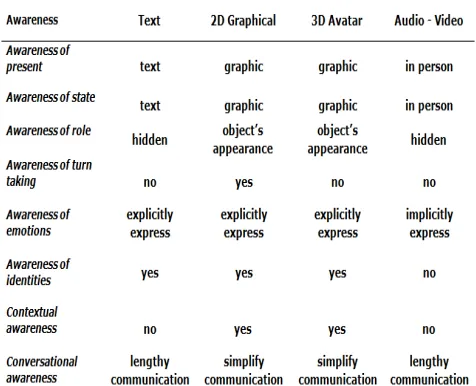
[image:3.612.317.555.155.348.2]A comparison is made on how and to what extend four digital elements, namely text, 2D graphic, 3D avatar and audio-video support eight types of the awareness models discussed. The result is depicted in Table 1.
Table 1: Awareness and their representation in various media
Awareness of presence is when user knows who is in the virtual space, how many participants are involved, where they come from and their availability [15]. Each of these digital elements have their own unique ways of presenting awareness of presence. For example, text base systems present awareness in a form of list. A user’s identification(id) or nickname is added to the list as user login into the virtual space [1]. Everyone in the same workspace can see the same id, even though some prefer to use different id to be displayed to different users [10]. However, user can select visibility status to only certain group of users. Unlike text, both 2D and avatar represent users in a graphical form. 2D object represents users in simpler graphic which can be as simple as a small dots [15] and may also come in different types, shapes and sizes with variety of colors. Usually they are displayed on a floor map, which may be a geographical map, hierarchy tree, organization chart, radar or a room as the background. Some of these objects can also perform limited animation like, jumping, smiling and changing colors [16]. On the other hand, avatar (embodiment of human) represents user in the most realistic way. It can imitate and perform most of the human actions like walking, sitting, dancing, running and facial expression. Unlike other media, audio-video presents user in person where the user’s face appears on the screen. Once a user’s face appears on the other user’s window, it means that the particular user is available for communication.
immediate state of mind or availability needs to be broadcasted to group members also and this is known as awareness of state. Awareness of state is best represented with audio-video. This is because any of the user’s actions represent his state. For example yawning, mood swings, anger or non-attentive actions are automatically projected to others. Unlike audio-video where user’s state is projected by user in person, text media allows user to choose their own state in words. Some example of states are “I am busy”, “I am not in front of my computer” and “Online but not available” [10,17]. These messages usually appear beside the users’ name in the login list. There are times where user’s id is dimmed to indicate that the user is not active in the on-line communication. Similarly, 2D and avatar allow users to decide their own states by means of graphical images. For instance, static or dimmed color of icons [15] indicate that users are away or inactive. Since avatar can perform most of the human action, the state of an avatar can easily be identified by simply looking at it. For example, an avatar can walk out of a virtual space to indicate that the user is leaving the workspace and in a game environment, an injured avatar will not be able to stand or walk due to injury.
Awareness of role is referred to user’s position in the virtual space during collaboration, best supported by avatar as compared to others. To illustrate the senario, an avatar that represents a project leader will be wearing a project leader’s name tag, charing a meeting and holding a laser pointer. In a gaming environment, costume, weapon, its size and facial expression will indicate different status of an avatar [18]. Leader is normally projected as taller, more handsome and holding a much more outstanding weapon. With simply a glimpse, we can recognize the user’s status from the avatar’s appearance. Although 2D supports awareness of role in the objects’ form, its representation is very much limited and less realistic compared to avatar. In contrast, NCVE systems use text and audio-video as the communication media and display users’ profile only when requested. Users identify each other’s profile from the introduction at the beginning of a collaboration, tooltip when pointed to users’ name or from drop-down menu.
Awareness of turn-taking is when users are aware of who is talking, who is listening, whose ideas it is and whose turn to talk. Studies have shown that “individuals with higher social status yet lower amounts of information to contribute often speak more and have more influences on final outcomes of group decisions than those who speak less in the discussion” [9]. This leads to a biased outcome, favoring only a certain group of people [9]. This is why turn taking in collaboration is important so that all users have equal right to speak. Unfortunately, awareness is only supported by 2D
graphical objects when numbers and objects are positioned on a floor map are consistently used to represent turn taking in communication. A simple animation like jumping is used to indicate that the user’s turn is on or user is currently talking. In text mode system, everyone can communicate at the same time with many topics, which can lead to floor control conflict. Nevertheless, typing cue appears when a small number of users are typing their texts during the interaction. However, for the large number of users, the typing cue element is not offered [10] due to the complexity in managing multiple users. Similarly, systems that use avatar fail to provide turn taking awareness [2]. There is no turn-taking indicator that can control turn-taking. An active user can simply monopolize the virtual space. Despite that, it does show who is currently talking, who is listening and everyone can be active at the same time. Likewise, turn taking awareness is not provided by audio-video system. Worse still, users are not able to know who can and who cannot hear them. They also have no idea who is viewing them [10]. In some cases, user can hear but cannot view other users.
Next, awareness of identity is when users have choices to use different identity in different virtual space [10]. For example, among close friends and people they know very well, their identifications resemble who they really are in person. The awareness is well supported by text, 2D and avatar system but not in audio-video although their roles keep changing as they change workspace. From the list of digital elements in Table 1, awareness is best supported by avatar. With a glance, anyone can easily tell the identity and role of the avatar. In a game, the avatars’ costumes and performances can reveal the role they play, for instance a king, a soldier or a wizard [3]. Therefore, these avatar will be projected wearing their appropriate costumes accordingly.
Another awareness that is equally important is contextual awareness where users in a virtual space are aware about the task and progress of themselves and others [10]. Contextual awarenwess is well-supported by 2D and avatar but not in text and audio-video. For a project collaboration, 2D media can easily support contextual awareness via progression chart, graph and other 2D objects to keep track of project progression and to ensure projects meet deadline. Individual contribution and progression can also be represented via graphs. In gaming environment where avatar is widely used, contextual awareness can be in terms of car meter showing the level of gas, point received when sub goals are achieved or an injured avatar indicating the power level of the group or its opponent has gone down [3]. Lastly, conversational awareness means knowing what a user is talking about and what he/she is referring to. It is poorly supported by text and audio-video where lengthy communication and words are irreplacable like, “The left lower part of the green object should be moved to the lowest middle of the biggest object”. It would be simpler if we can point to the object and say, “Move this to there”. In contrast, 2D and avatar systems allow users to use flashing arrows to point directly to objects and artifacts under a discussion [3, 16]. It can increase conversational awareness and simplify communication. Base on our analysis it is fair to say that each of the digital elements are independent from each other. Each supports awareness differently in their own different ways. Due to that by using one media only, awareness are not fully supported and this will result in uneffective communication. The digital elements must be combined to completely support awareness to enhanced communication.
3.2. Digital Elements vs. Applications
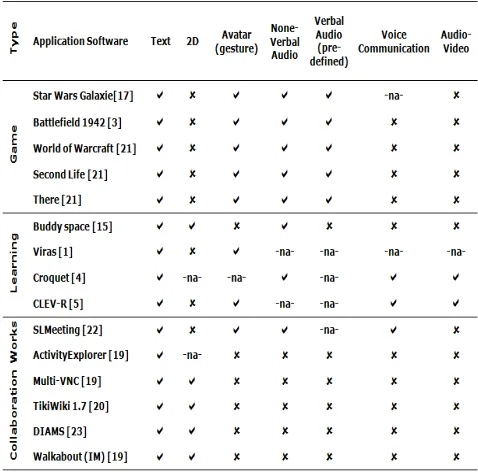
A study is also performed by giving special attention to digital elements (text, 2D, avatar, none-verbal audio, verbal audio (pre-defined), voice communication and audio-video) and their applications in collaborative games, e-learning, collaborative works like project
management, e-meeting and resources sharing. The result of the study is in Table 2.
Even though text and voice communication are categorized under verbal communication, it is obvious that text is favorable as compared to voice communication. It exists in all collaborative systems under studied. Compare to text, voice is not as popular due to its transmission issue where it requires larger bandwidth and the quality of voice transmitted along the transmission channel can also be another issue to be raised. Nevertheless, it is used in several e-learning systems.
[image:5.612.316.555.329.565.2]Similar to voice, 2D is unfavorable when it comes to NCVE applications. However, it does exists in distance learning and e-meetings. On the other hand, avatar and non-verbal audio (sound effect) are used in most applications except in collaborative works. Avatar and audio are widely used in gaming environment to create realistic environment and to boost excitement during the play.
Table 2: The applications of digital elements
4 Conclusion
Awareness is crucial in ensuring successful communication in virtual space. Unlike face-to-face communication, virtual communication lacks of communication cue such as gesture, eye contact, facial expression and body language. In the first part, we have identified eight types of awareness models: awareness of present, awareness of turn taking, awareness of emotion, awareness of identities, contextual awareness, conversational awareness, awareness of state and awareness of role. By using the awareness models as our base, we have compared four types of digital elements (text, 2D graphic, 3D avatar and audio-video) and to what extent they support awareness. Our findings show that the digital elements cannot stand alone on its own as a mean of communication since each has its own strengths and weaknesses. Creative combinations of various digital elements will be able to promote effective communication. In the second part, the review shows that text is the most favorable elements for communication ranging from personal chatting up to a more serious type of communication. Unexpectedly, audio communication and audio-video fall behind in terms of their usage. This might be due to the higher bandwidth required by these digital elements and the quality of data transmission by the media is currently not up to real-life expectation. In the future, we will model the digital elements to be embedded in collaborative systems.
References:
[1] Forland, E.P. and Divitini, M., Supporting Social Awarness: Requirements for Educational CVE, In: Proceedings of The 3rd IEEE International Conference on Advanced Learning Technologies, 2003, pp. 366-367.
[2] Nova, N., Wehrle, T., Goslin, J., Bourquin, and Dillenbourg, P., Collaboration in a multi-user game: impacts of an awareness tool on mutual modeling, Multimed Tools Appl , Vol. 32, 2007, pp.161–183, DOI =10.1007/s11042-006-0065-8.
[3] Manninen, T. and Kujanpaa, T., The Hunt for Collaborative War Gaming – CASE:Battlefield 1942, The International Journal of Computer Game Research, Vol. 5, No. 1, 2005. [4] Ganoe C. H., Somervell, J. P., Neale D. C., Isenhour, P. L.,
Carroll, J. M., Rosson, M. B., Crickard S. M., Classroom BRIDGE: using collaborative public and desktop timelines to support activity awareness, ACM, Vol. 5, No. 2, 2003. [5] Millen, D. R., Muller, M. J., Geyer, Y., Wilcox, E. and
Brownholtz, B., Patterns of Media Use in an Activity-Centric Collaborative Environment, CHI Portland, Oregon, USA, April 2005.
[6] Stefik, M., Foster, G., Bobrow, D., Kahn, K., Lanning, S., Suchman, L., Beyond the chalkboard: computer support for collaboration and problem solving in meetings, Commun ACM, Vol.30, No. 1, 1987, pp. 32–47.
[7] Abidin, S. Z. Z., Interaction and Interest Management in a Scripting Language (Doctoral thesis), University of Wales Swansea, UK, 2006.
[8] Chia A., Parikshat M., An Interactive Virtual Global Cultural Course: Building a Real Time Cost Effective Global Collaborative Learning Environment, Conference of Interactive computer aided learning ICL2007, 2007.
[9] DiMicco, J. M., Hollenbach, K. J., Pandolfo, A., and Bender, W., The impact of increased awareness while face-to-face. Hum.-Comput. Interact, Vol. 22, No. 1, 2007, pp. 47-96. [10] Tran, M. H., Supporting Group Awareness in Synchronous
Distribution Groupware: Framework, Tools and Evaluations (Doctorial thesis), Swinburne University of Technology, Melbourne, Australia, 2006.
[11] Ha,V., Inkpen, K. M., Mandryk, R. L., Whalen, T., Direct Intentions: The Effects of Input Devices on Collaboration Around a Tabletop Display. Proceedings of the First IEEE International Workshop on Horizontal Interactive Human-Computer Systems (TABLETOP ’06), 2006.
[12] Baker, M., Casey, R., Keyes, B. and Yanco, H. A., Improved Interfaces for Human-Robot Interaction in Urban Search and Rescue, Proceedings of the IEEE Conference on Systems, Man and Cybernetics, October 2004.
[13] Drury, J., Scholtz, J. and Yanco, H. A., Awareness in human-robot interactions, In: Proceedings of the 2003 IEEE Conference on Systems, Man and Cybernetics, 2003.
[14] Yanco, H.A. and Drury, J. L., “Where am I?” Acquiring situation awareness using a remote robot platform. Proceedings of the Conference on Systems, Man and Cybernetics, 2004.
[15] Eisentadt, M., Komzak, J. and Dzbor, M. Instant messaging + maps = powerful collaboration tools for distance learning. Proceeding of TelEduc03, Havana, Cuba, 2003, 19-21. [16] Carroll, J. M., Neale, D. C., Isenhour, P. L., Rosson, M. B.,
and McCrickard, D. S., Notification and awareness: synchronizing task-oriented collaborative activity. Int. J. Hum.-Comput. Stud. Vol. 58, No. 5, May. 2003, pp. 605-632. DOI= http://dx.doi.org/10.1016/S1071-5819(03)00024-7 [17] Ducheneaut, N. and Moore, R. J., The social Side of Gaming:
A study of Interaction Patterns in a Massively Multiplayer Online Game, Proceeding of CSWC’04, ACM, 2004, pp. 6-10. [18] Manninen, T., Interaction Forms and Communicative Actions
in Multiplayer Games, The International Journal of Computer Game Research, Vol. 3, No. 1, 2003.
[19] Gutwin, C., Greenberg, S., Blum, R., Dyck, J., Tee, K. and McEwan, G. Supporting Informal Collaboration in Shared-Workspace Groupware. Journal of Universal Computer Science, Vol.14, No. 9, 2008, pp. 1411-1434.
[20] Wagner, C., WIKI: A Technology for Conversational
Knowledge Management and Group Collaboration,
Communications of the Association for Information Systems Vol. 13, 2004, pp. 265-289
[21] Moore, R. J., Ducheneaut, N. and Nickell, E., Doing Virtually Nothing: Awareness and Accountability in massively Multiplayer Online Worlds, Computer Supported Cooperative Work, Vol. 16, 2007, pp. 265–305, Springer 2006 DOI 10.1007/s10606-006-9021-4
[22] Lucia, A. D., Francese, R., Passero, I. and Tortora, G., SLMeeting: supporting collaborative work in Second Life, In: AVI 08 - Proceedings of the working conference on Advanced Visual Interfaces, 2008, pp. 301- 304, ISBN/ISSN: 978-1-60558-141-5