DEVELOPMENT OF POSITION TRACKING OF BLDC MOTOR
USING ADAPTIVE FUZZY LOGIC CONTROLLER
ELIA NADIRA BINTI SABUDIN
A thesis submitted in partial
fulfillment of the requirement for the award of the Degree of Master of Electrical Engineering
Faculty of Electrical and Electronic Engineering Universiti Tun Hussein Onn Malaysia
v
ABSTRACT
vi
ABSTRAK
vii
TABLE OF CONTENTS
TITLE i
DECLARATION ii
DEDICATION iii
ACKNOWLEDGEMENT iv
ABSTRACT v
ABSTRAK vi
TABLE OF CONTENTS vii
LIST OF TABLE x
LIST OF FIGURE xi
LIST OF ABBREVIATION xii
CHAPTER 1 INTRODUCTION 1
1.1 Research background 1
1.2 Problems statement 2
1.3 Objectives of study 3
viii
CHAPTER 2 LITERATURE REVIEW 4
2.1 Technology Developments 4
2.1.1 Development and Control of BLDC Motor using
Fuzzy Models 4
2.1.2 Realization of Fuzzy Logic Controlled Brushless DC Motor Drives Using Matlab/Simulink 5 2.1.3 Adaptive Position Tracking Control of a BLDC
Motor Using a Recurrent Wavelet Neural Network 5 2.1.4 High Performance Speed and Position Tracking of
Induction Motors Using Multi-Layer Fuzzy Control5 2.1.5 Repetitive Tracking Control of DC motors Using a
Fuzzy Iterative Learning Controller 6 2.2 Brushless Direct Current (BLDC) Motor Operation 7 2.2.1 Construction and Operating Principles 7
2.3 Fuzzy Logic Controller System 8
2.3.1 Fuzzification 10
2.3.2 Rule Base 10
2.3.3 Inference engine 11
2.3.4 Defuzzification 12
CHAPTER 3 METHODOLOGY 13
3.1 Introduction 13
3.2 BLDC Motor Modelling 15
3.3 PID Controller Design 18
3.4 Proposed Controller 20
3.5 Fuzzy Logic Controller Design 21
ix
3.5.2 Fuzzy rule 24
3.5.3 Inference Engine 26
3.5.4 Defuzzification 26
CHAPTER 4 RESULTS AND DISCUSSIONS 27
4.1 Introduction 27
4.2 System performance without controller 28 4.3 System performance of PID controller and fuzzy logic
controller 30
4.4 System performance of fuzzy logic controller 33
4.4.1 Fuzzy logic controller 34
4.5 Discussions 37
CHAPTER5 CONCLUSIONS AND RECOMENDATIONS 38
5.1 Conclusions 38
5.2 Recommendations 39
REFERENCES 40
x
LIST OF TABLES
2.1 Example of rule base for air conditioner system 10
3.1 Parameter of BLDC Motor 17
3.2 Rule table of fuzzy logic controller (membership 3 × 3) 25 3.3 Rule table of fuzzy logic controller (membership 5 × 5) 25 3.4 Rule table of fuzzy logic controller (membership 7 × 7) 25 4.1 Measurement of response parameter for system response BLDC
motor with PID controller 33
4.2 Measurement of response parameter for fuzzy logic controller
with 3 membership functions 35
4.3 Measurement of response parameter for fuzzy logic controller
with 5 membership functions 36
4.4 Measurement of response parameter for fuzzy logic controller
xi
LIST OF FIGURES
2.1 Structure of fuzzy logic controller system 9 3.1 The fuzzy controller design for position control project methodology 14
3.2 Circuit diagram of BLDC motor 15
3.3 Block diagram of the closed loop BLDC motor with PID controller 18
3.4 Structure of proposed controller 20
3.5 Membership function for input and output of fuzzy logic controller 21 3.6 Membership function for (a) input variable “error” (b) input variable 22
3.7 Structure of rule editor 24
xii
LIST OF SYMBOLS AND ABBREVIATION
PID - Proportional Integral Derivative Controller
BLDC
Ra
- Brushless DC Motor
- Armature resistance
La - Armature inductance
Ia(t) - Motor current
m - Position in terms of angle
Tm - Motor torque
Jm - Motor inertia
B - Damping ratio
KT - Torque constant
Kp - Proportional gain
Ki - Integral gain
Kd - Derivative gain
Tp - Peak time
xiii
Ts - Settling time
Os% - Percentage of overshoot
CHAPTER 1
INTRODUCTION
1.1 Research background
The electric drive system is a vital part to drive any motor. The electric drive system is used to control the position, speed and torque of the electric motors. Many works has been done on power converter topologies, control scheme of the electric drive systems and on the motor types in order to enhance and improve the performance of the electric motors so as to exactly perform and do what is required [1].
BLDC motors have some advantages over conventional brushed motors and induction motors. Some of these are; better speed versus torque characteristics, high dynamic response, high efficiency, long operating life, noiseless operation and higher speed ranges. In addition BLDC motors are reliable, easy to control, and inexpensive. Due to their favourable electrical and mechanical properties, BLDC motors are widely used in servo applications such as automotive, aerospace, medical, instrumentation, actuation, robotics, machine tools, and industrial automation equipment and so on recently [2].
Classical PID controllers are commonly used in industries due to their
2
motor drive, control performance of the PID controller becomes poor and difficult to determine the controller parameters [4] .
In order to improve control performance of the BLDC motor drive, intelligence controllers such as fuzzy logic control for BLDC motor is used. Fuzzy
logic has many advantages over conventional control. It does not use mathematical model of the system and therefore is less sensitive to system
parameter changes. Design objectives that are difficult to express mathematically can be easily incorporated in a fuzzy controller by linguistic rules. In addition, its
implementation is simple and straight forward [5]. In this project, a complete simulation model with Takagi Sugeno fuzzy logic
(TSFC) control method for BLDC motor drive is proposed using Matlab/Simulink. The Develop TSFC has the ability to learn instantaneously and adapt its own controller parameters based on external disturbance and internal variation of the converter with minimum steady state error, overshoot and rise time of the output voltage.
1.2 Problems statement
The brushless dc motors are gradually replacing dc motors and ac motors because of their small size, high operating speed, high efficiency, less maintenance and excellent speed torque characteristics. They are used in robotics, computer disk drives, machine tools, electric vehicle and battery powered applications. The conventional control scheme such as proportional (P), proportional integral (PI) and proportional integral derivative (PID) have been developed for position control of BLDC motors.
3
Sugeno Fuzzy Logic controller (TSFLC). Why we use this algorithm? Well, TSFLC are very suited to control system with uncertain, complex, inaccurate or non-linear dynamics such as BLDC motor control systems. TSFLC can be easily designed and implemented knowing the behaviours of the system and it can greatly reduce the effects of non-linearity on the BLDC motor control systems. Besides that, we also concentrate on how to develop the modelling of controller, inverter and BLDC motor.
1.3 Objectives of study
The objectives of this project are;
a) To develop dynamic model of BLDC motor.
b) To develop the position controller using intelligent control.
1.4 scopes
This project is primarily concerned with the several aspects for easier troubleshoot due to problems occur during the project implementation. The scope of this project is:
a) Develop the simulation model using Matlab Simulink.
CHAPTER 2
LITERATURE REVIEW
2.1 Technology Developments
From the previous research work, knowledge of how others people construct their project and how they specified particular application. These researches that are relevant to this project discussed next to demonstrate continuity from previous researches.
2.1.1 Development and Control of BLDC Motor using Fuzzy Models
5
2.1.2 Realization of Fuzzy Logic Controlled Brushless DC Motor Drives Using Matlab/Simulink
In this project, an efficient simulation model for fuzzy logic controlled brushless direct current motor drives using Matlab/Simulink is presented. The brushless direct current (BLDC) motor is efficiently controlled by fuzzy logic controller (FLC). The control algorithms, fuzzy logic and PID are compared. Also, the dynamic characteristics of the BLDC motor (i.e. speed and torque) and as well as currents and voltages of the inverter components are easily observed and analyzed by using the developed model.
2.1.3 Adaptive Position Tracking Control of a BLDC Motor Using a Recurrent Wavelet Neural Network.
An adaptive position tracking control (APTC) system which is composed of a neural controller and a robust controller is proposed in this project. The neural controller uses the recurrent wavelet neural network structure to online mimic and ideal controller, and the robust controller is designed to achieve L2, tracking performance with desired attenuation level. The adaptive laws of APTC system are derived based on the Lyapunov stability theorem and gradient decent method. This project also proposed APTC method that applied to a brushless DC (BLDC) motor.
2.1.4 High Performance Speed and Position Tracking of Induction Motors Using Multi-Layer Fuzzy Control
6
(MLFC), is proposed and applied to high performance tracking of induction motors. The MLFC has two layers. The first layer is the execution layer which is made up of small subcontrollers. The second layer is the supervisor layer which fuzzily combines the execution layer subcontrollers to achieve the system objectives. The design and the tuning of the controller is simpler because of the layered topology.
2.1.5 Repetitive Tracking Control of DC motors Using a Fuzzy Iterative Learning Controller
The theoretical design of a fuzzy iterative learning controller for sampled-time linear time invariant systems is presented in this project. The project also investigates of digital circuit implementation of the proposed controller with application to repetitive position tracking control of DC servo motors. The stability and convergence of the learning system are analyzed under uncertainties of initial state errors, input disturbance and output measurement error. This project also stress that the learning error will converge to a residual set whose level of magnitude will depend on the size of the uncertainties. The learning error will asymptotically converge to zero if all uncertainties disappear. To improve the learning performance, a concept of fuzzy learning gain is introduced which is designed based on the tracking error in the current and past iteration.
7
2.2 Brushless Direct Current (BLDC) Motor
The Brushless Direct Current (BLDC) motor is rapidly gaining popularity by its utilization in various industries, such as Appliances, Automotive, Aerospace, Consumer, Medical, Industrial Automation Equipment and Instrumentation. As the name implies, the BLDC motors do not use brushes for commutation; instead, they are electronically commutated. The BLDC motors have many advantages over brushed DC motors and induction motors. A few of these are:
• Better speed versus torque response • High dynamic response
• High efficiency • Long operating life • Noiseless operation • Higher speed ranges
In addition, the ratio of torque delivered to the size of the motor is higher, making it useful in application where space and weight are critical factors. The torque of the BLDC motor is mainly influenced by the waveform of back-EMF (the voltage induced into the stator winding due to rotor movement). Ideally, the BLDC motors have trapezoidal back-EMF waveform and are fed with rectangular stator currents, which give a theoretically constant torque.
2.2.1 Construction and Operating Principles
8
magnets and their displacement on the rotor are chosen in such a way that the back-EMF shape is trapezoidal. This allows the three-phase voltage system, with a rectangular shape, to be used to create a rotational field with low torque ripples. In this respect, the BLDC motor is equivalent to an inverted DC commutator motor, in that the magnet rotates while the conductors remain stationary.
In the DC commutator motor, the current polarity is reversed by the commutator and the brushes, but in the brushless DC motor, the polarity reversal is performed by semiconductor switches which are to be switched in synchronization with the rotor position. Besides the higher reliability, the missing commutator brings another advantage. The commutator is also a limiting factor in the maximal speed of the DC motor. Therefore the BLDC motor can be employed in applications requiring high speed [1], [3]. Replacement of a DC motor by a BLDC motor place higher demands on control algorithm and control circuit. Firstly, the BLDC motor is usually considered as a three phase system. Thus, it has to be powered by a three-phase power supply. Next, the rotor position must be known at certain angles, in order to align the applied voltage with the back-EMF. The alignment between the back-EMF and commutation events is very important. In this condition the motor behaves as a DC motor and runs at the best working point. But the drawbacks of the BLDC motor caused by necessity of power converter and rotor position measurement are balanced by excellent performance and reliability, and also by the ever-falling prices of power components and control circuits.
2.3 Fuzzy Logic Controller System
A fuzzy control is a controller that is intended to manage some vaguely known or vaguely described process. The controller can be used with the process in two modes:
9
ii Feed forward mode where the controller can be used as a prediction device.
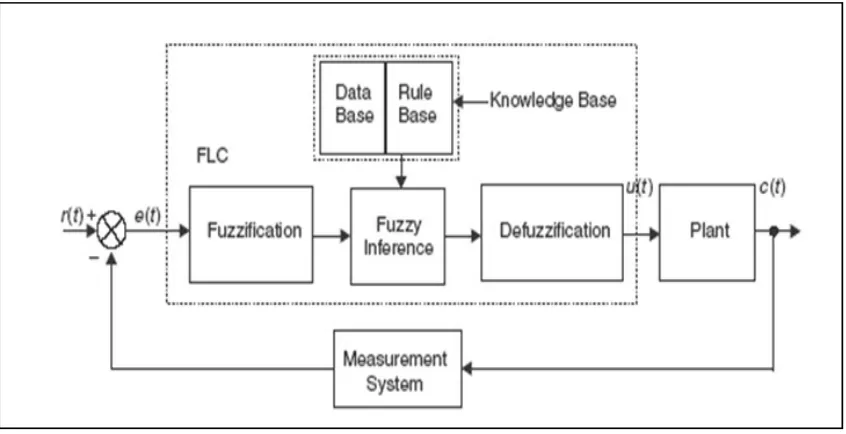
[image:19.595.119.542.354.571.2]Figure 2.1 shows a fuzzy logic control system in a closed loop control. there are four important elements in the fuzzy logic controller system structure which are fuzzifier, rule base, inference engine and defuzzifier. Details of the fuzzy logic controller system structure can be seen in in figure below. Firstly, a crisp set of input data are gathered and converted to a fuzzy set using fuzzy linguistic variables, fuzzy linguistic terms and membership functions. This step also known as fuzzification. Afterwards, an inference is made base on a set of rules. Lastly, the resulting fuzzy output is mapped to a crisp output using the membership functions, in the defuzzification step.
10
2.3.1 Fuzzification
The first block of the fuzzy controller is fuzzification, which converts each piece of input data to degrees of membership by a lookup in one or several membership functions. The fuzzification block thus matches the input data with the conditions of the rules to determine how well the condition of each rule matches that particular input instance. There is a degree of membership for each linguistic term that applies to that input variable.
2.3.2 Rule Base
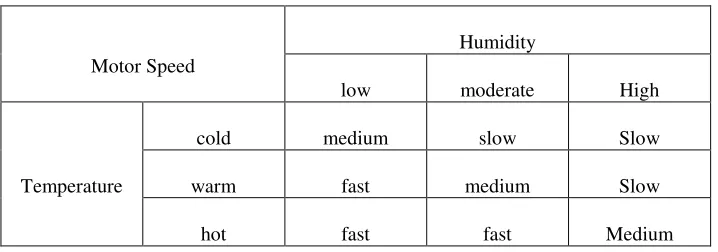
[image:20.595.141.500.562.688.2]In a fuzzy logic control system, a rule base is constructed to control the output variable. A fuzzy rule is a simple IF-THEN rule with a condition and conclusion. It can be represented by the matrix table. Let say, the air controller system with two input linguistic variables of temperature and humidity and one output linguistic variable of motor speed as shown on Table 2.1.
Table 2.1 : Example of rule base for air conditioner system
Motor Speed
Humidity
low moderate High
Temperature
cold medium slow Slow
warm fast medium Slow
11
Row caption in the matrix contain the values that current room temperature can take while column caption contain the values for humidity in the room. Each cell is the resulting command when the input variables take the values in that row and column. Based on the Table 2.1, the maximum numbers of rules are nine. For instance, the cell (3,3) can be read as follows : IF temperature is hot and humidity is high THEN motor speed is medium.
2.3.3 Inference engine
In general, inference is a process of obtaining new knowledge through existing knowledge. In the context of fuzzy logic control system, it can be defined as a process to obtain the final result of combination of the result of each rule in fuzzy value. There are many methods to perform fuzzy inference method and the most common two of them are Mamdani and Takagi Sugeno Kang method.
Takagi Sugeno Kang method was introduced in 1985 and it is similar to the Mamdani method in many aspects. The first two parts of fuzzy inference processes which are fuzzifying the inputs and applying the fuzzy operator are exactly the same but, the main difference is that the Takagi Sugeno Kang output membership function is either linear or constant. A typical rule in Takagi Sugeno Kang fuzzy model has the form as follows;
IF input 1= x AND input 2 = y
THEN output z = ax + by + c
For a zero order Takagi Kang model, the output z is a constant (a=b=0). The output of zi of each rule is weighted by the firing strength wi as follows;
12
Where F1(x) and F2(y) are membership functions for input1 and input2 respectively.
The final output of the system is the weighted average of all rule outputs, computed as;
Final Output =
∑
∑
2.3.4 Defuzzification
Defuzzification is a process that maps a fuzzy set to a crisp set and has attracted far less attention than other processes involved in fuzzy systems and technologies. Four most common defuzzification methods:
• Max membership method • Center of gravity method • Weight average method
CHAPTER 3
METHODOLOGY
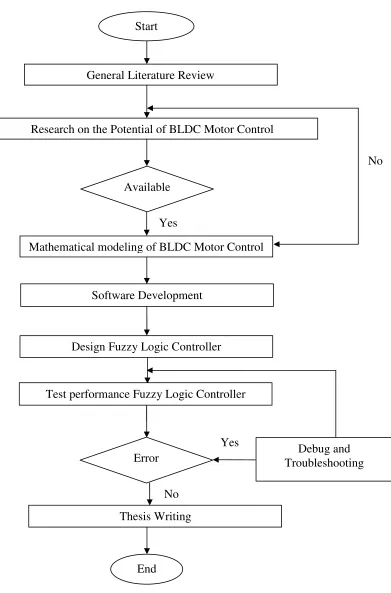
3.1 Introduction
14
Start
General Literature Review
Research on the Potential of BLDC Motor Control
Available
Mathematical modeling of BLDC Motor Control
Design Fuzzy Logic Controller
Debug and Troubleshooting Software Development
Error
Thesis Writing
End Yes
No
No
[image:24.595.169.560.77.670.2]Yes Test performance Fuzzy Logic Controller
15 1 1 1 V + i
T+ TL - θ ω
[image:25.595.175.544.155.289.2]-3.2 BLDC Motor Modelling
Figure 3.2: Circuit diagram of BLDC motor
The analysis of BLDC motor is based on the assumption for simplification and accuracy. The BLDC motor is type of unsaturated. To perform the simulation of the position control, an appropriate model needs to be established. Based on the equivalent circuit of BLDC motor shown in Figure 3.2, the dynamic equations of BLDC motor using the assumption can be derived as
The motor torque, is related to the armature current by a constant factor of K;
Tm = KIa (3.1)
The back emf, is relative to angular velocity, by;
= K= K
(3.2)
16
Newton’s Second Law,
Tm = Jm
+ Bm
(3.3)
Substitution equation (3.1) into equation (3.3) to obtain;
Jm
+ Bm
= KIa (3.4)
Khirchoff’s Law, L
+ R = Va- (3.5)
Substitute equation (3.2) into equation (3.5) to obtain;
L
+ R = Va = K
(3.6)
By taking Laplace Transform, equation (3.5) and (3.6) can be expressed in term of s as;
Jm !(s) + BmS(s) =KIa(s) (3.7)
LsIa(s) + RIa(s) = Va(s) - KS(s) (3.8)
From equation (3.7), Ia(s) can be expressed as;
Ia(s) = "#$%& '$ ()*
+ (3.9)
Substitute equation (3.9) into equation (3.8) to obtain;
Va(s) = $&'$ ( )*&,$ ( -*(+
17
Therefore, from the equation (3.10), the transfer functions where the position, as an output and the voltage, Va (s) as an input can be obtained;
#$% .#$% =
/
0&120 ( 32*&40(5* (/!
(3.11)
The constants value of voltage, Va, torque constant factor, K, rotor inertia, Jm,
damping ratio, Bm, resistance R and inductance, L for BLDC motor must be known.
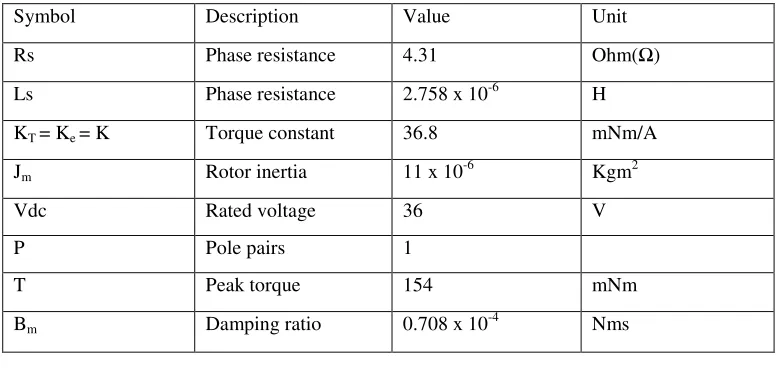
[image:27.595.125.513.344.530.2]The specifications of BLDC motor which will use are described in the Table 3.1 below:
Table 3.1 : Parameter of BLDC Motor
Symbol Description Value Unit
Rs Phase resistance 4.31 Ohm(Ω)
Ls Phase resistance 2.758 x 10⁻⁶ H
KT = Ke = K Torque constant 36.8 mNm/A
Jm Rotor inertia 11 x 10-6 Kgm2
Vdc Rated voltage 36 V
P Pole pairs 1
T Peak torque 154 mNm
Bm Damping ratio 0.708 x 10⁻⁴ Nms
Thus, when substitute these parameter values into equation (3.11), the transfer function of BLDC motor as below;
θm(s) = 776.2076
18
3.3 PID Controller Design
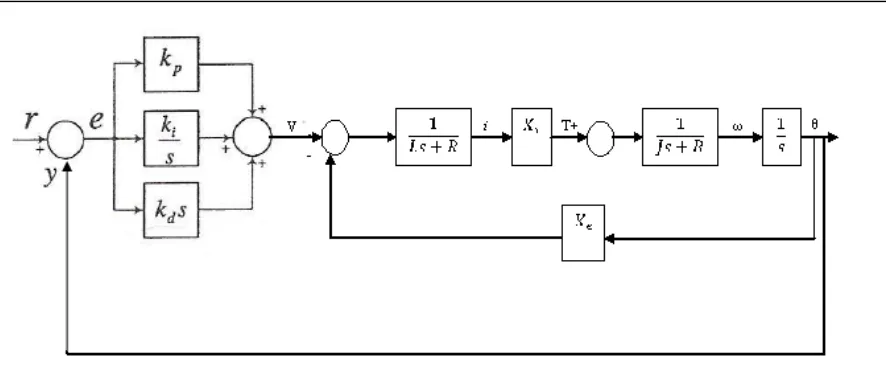
A PID (proportional-integral-derivative) controller is one of the most commonly used controllers because it is simple and robust. This controller is extremely popular because they can usually provide good closed loop response characteristics, can be tuned using relatively simple rules and easy to construct using either analogue or digital components. Figure 3.3 below illustrates the block diagram of PID controller.
[image:28.595.117.560.288.480.2]
Figure 3.3: Block diagram of the closed loop BLDC motor with PID controller
The PID controller can be defined as equation (3.13) by the following relationship between controller input e(t) and the controller output V(t) that is applied to the motor armature.
19
By using the Laplace transform, the transfer function of PID controller as following in equation (3.14).
.#$%
6#0% = Kp + +7
$ + Kd s (3.14)
Assumed that the Kp = K, Ki =
+
7 and Kd = Ktd
Then, the transfer function of PID controller is depend by the following equation below;
K(s) = Ktd s2 + 1 s + K (3.1)
s td td ti
The values of Kp, Ki and Kd are calculated by using the Ziegler Nichols tuning
algorithm. This method gives automatic oscillation of the process to compute the proportional, integral and derivative gains. The PID controller has been simulated using MATLAB simulink to ensure the manual calculation is correct. The values of Kp, Ki and Kd are as follow:
Kp = 10
Ki = 5
20
BLDC Motor
de/ dt
POSITION
CONTROL PLANT
DeltaError
Fuzzy Logic Controller
Error
Reference Position,
89:
Actual Position,
;
Voltage, V
3.4 Proposed Controller
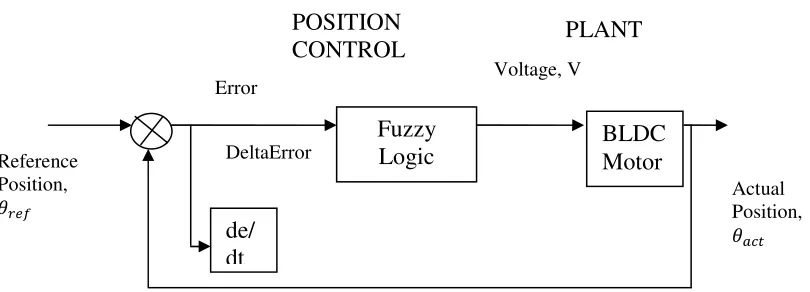
[image:30.595.124.529.334.480.2]The structure of the proposed controller for BLDC motor is shown in Figure 3.4. The proposed controller consists of fuzzy logic controller for position control in the completed closed loop system. The designation of fuzzy logic controller is based on expert knowledge which mean the knowledge of skillful operator during the handling of BLDC motor system is adopted into the rule based design of fuzzy logic controller.
21
3.5 Fuzzy Logic Controller Design
There are four elements to be considered in order to design the fuzzy logic controller which are fuzzification interface, fuzzy rule, fuzzy inference mechanism and defuzzification interface.
3.5.1 Fuzzification
[image:31.595.118.519.508.648.2]The most important step in fuzzification interface element is to determine the state variables or input variables and the control variables or output variables. There are two input variables for BLDC motor system in terms of position control which are error and delta of error. Error can be described as a reference of position set point minus actual position. Meanwhile, delta of error or change of error is error in process minus previous error. The voltage applied to the BLDC motor system is defined as output variable.
22
(a) error(e)
(b) rate(de error)
[image:32.595.134.503.112.235.2]
(c) output
23
The linguistic variables of the fuzzy sets need to be defined which are represent:
(i) Input variables: • Error(e)
Quantized into 3, 5 and 7 membership function: Negative N(e), Negative Small NS(e), Negative Medium NM(e), Negative Big NB(e), Zero Z(e), Positive P(e), Positive Small PS(e), Positive Medium PM(e) and Positive Big PB(e).
• Rate(de error)
Quantized into 3, 5 and 7 membership function: Negative N(de), Negative Small NS(de), Negative Medium NM(de), Negative Big NB(de), Zero Z(de), Positive P(de), Positive Small PS(de), Positive Medium PM(de) and Positive Big PB(de).
(ii) Output variables: • Output
24
3.5.2 Fuzzy rule
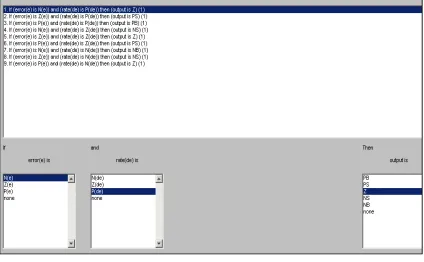
[image:34.595.115.539.291.553.2]The basic function of the rule based is to represent the expert knowledge in a form of if-then rule structure. The fuzzy logic can be derived into combination of input (3 × 3, 5 × 5 and 7 × 7). The figure 3.9 shows the structure of rule editor. The rule table of fuzzy logic controller as listed in Table 3.2, Table 3.3 and Table 3.4.
REFERENCES
1. P.C Krause O. Wasynozuk, S.D.Sudhoff. AnalysisofElectric Machinery and Drive Systems. IEEEPress, Second Edition.2002.
2. Mehmet Cunkas, Omer Aydogdu. Realization of Fuzzy Logic Controlled Brushless DC MotorDrives Using Matlab/Simulink, Mathematical and Computional Applications. 2010.Vol 15, (2), pp.218-229.
3. Rubaai. A., Marcel, J., Castro-Sitiriche and Abdul, R.Ofoli. Design and Implementation of Parallel Fuzzy PID Controller for High Performance. 2008.
4. Hong, W.et.al. Tipsuwanporn, V.et.al. Brushless Motor Drive: An Integrated Environment for Rapid Control. 2007.2002.
5. Tony C. Huang, M.A.El-Sharkawi (1996). IEEE Transactions on Energy Conversion,Vol 5(2).
6. W.Hong, W.Lee and B.K.Lee. Dynamic Simulation of Brushless DC Motor Drives Considering Phase Commutation for Automotive Applications. IEEE International Electric Machines & Drives Conference. IEMDC,
2007.pp.1377-1383.
7. B.Indu Rani, Ashly Mary Tom. Dynamic Simulation of Brushless DC Drive Considering Phase Commutation and Backemf Waveform for
Electromechanical Actuator. IEEE TENCON, Hyderbad. 2008.ISBN:978-1-4244-2408-5.
8. C.-C. Kung and K.-H. Su. Adaptive fuzzy position control for
41
9. Erdal Kayacan, Okyay Kaynak, Rahib Abiyev, Jim Tørresen, Mats Høvin and Kyrre Glette. Design of an Adaptive Interval Type-2 Fuzzy
Logic Controller for the Position Control of a Servo System with an Intelligent Sensor). Fuzzy Sets and Systems,1985. vol. 5, pp. 277–290.
10. Wen-Ruey Hwang and Wiley E. Thompson. An Improved Method for Designing Fuzzy Controllers for Position Control Systems. Automatic, 1977.vol. 13, pp. 235-242.
11. A. Azri. Developement of Rotary Crane System Controller Using Fuzzy Logic Controller: Membership Function Study. Master thesis. Universiti Tun Hussein Onn Malaysia; 2011.
12. C.M. Azie Hailma (2011). Fuzzy Controller Design for Position Control. Master Thesis. Universiti Tun Hussein Onn Malaysia; 2011.