67
CHAPTER 7
ANIONIC SURFACTANTS IN ENVIRONMENTAL WATER
SAMPLES: A REVIEW
Nor Haslina Hashim, Amnani Abu Bakar, Zarizi Awang , Nur Aini Binti Mohd Arish @ Arshad
Faculty of Engineering Technology, University Tun Hussein Onn Malaysia, 84600 Panchor, Johor, Malaysia.
7.1 INTRODUCTION
The complexity of environmental chemical exposure become a major concern because an essential objective of the global research effort is to improve life quality feature. Currently, environmental monitoring has become even more critical as human population increase, with the increasing strains on the environment. Surprisingly, enormous quantities of anionic surfactants (AS) are being used in households and industry every day, and most of it was end up with dispersed in different environmental compartments such as soil, water, and sediment [1].
Surfactants are compounds with molecules having a hydrophobic part such as a nonpolar hydrocarbon chain, and a hydrophilic one, either ionic or non-ionic, but polar. Due to this molecular structure, surfactants tend to organize their molecules based on hydrophilic-hydrophobic interactions, at the interface of two non-miscible different media, acting as tensioactive compounds. Synthetic detergents, commonly called syndets, are anionic, cationic or nonionic surfactants, of which anionic ones are widely used, as sodium sulphates, sulphonates,
tripolyphosphates, or silicates [2].
Furthermore, their production and consumption continue to grow every year. The major sources of surfactants in the environment are discharges from household, textile industry, cosmetic industry, industrial laundering or other cleaning operation using detergent formulations [3]. As a result of their wide applications, AS residues in natural waters can cause serious damage to the environment by inhibiting biological activity and promoting the diffusion of oily pollutants. According to the World Health Organization (WHO), the elevated consumption of surfactants worldwide is a reason for concern in terms of global pollution. Clearly, AS that possess hydrophobic alkyl chains (nonpolar) and hydrophilic groups (polar) are indispensable in the detergent industry; for emulsification, lubrication, and catalysis; and for their well-known interaction with biomolecules such as proteins, DNA, and peptides, even possessing the ability to
68
human eyes and skin. Ribelles and his coworkers reviewed the literature from the period and found little evidence that at high concentrations of SDS cause death of fishes primarily due to three modes: decrease in surface tension, destruction of tissue and alteration of biomacromolecules[6].
Thus, the development of effective methods for the chemical analysis of surfactant is importance. As well-known surfactant analysis methods, such as the methylene blue active substances method (MBAS), ion-selective electrodes, capillary electrophoresis, colorimetric and spectrometric techniques, require exhaustive procedures, large amounts of toxic solvents and high cost. Therefore, it is highly desirable to develop efficient methods for environmental monitoring.
7.2 GENERAL STUDIES OF ANIONIC SURFACTANTS
Surface-active agents (surfactants) are a diverse group of chemicals consisting of a polar, water-soluble head group and a nonpolar hydrocarbon tail group, which is not as soluble in water (Figure 1). The surfactant can be defined by a substance that lowers the surface tension of the liquid and promotes wetting and spreading which allows the detergent solution to spread more easily across the surface [7],[8]. Based on the chemistry and physiochemistry, surfactants have an amphiphilic characteristic which contains both hydrophilic (head) and hydrophobic (tail) that convey partial affinity towards both polar and nonpolar surface.
Figure 7.1: Schematic structure of surfactant molecule
69
hydrophobic tail and hydrophilic head [10]. This characteristic makes surfactants have an inclination to absorb at different types of surface and interfaces which has an interaction with hydrophilic and hydrophobic molecules whether by binding or by forming of mixed micelles [5].
[image:3.595.92.481.350.477.2]Micelle or micellization is an aggregation of colloids as a self-association into organized molecular assemblies (Figure 3.2). As a matter of fact, the driving force for micelle formation is the decrease of contact between the hydrocarbon chain and water, thus decreasing the free energy of the system. These micelles are in dynamic equilibrium and the rate of exchange between a surfactant molecule and the micelle may alter by orders of magnitude, depending on the structure of the surfactant molecule. A dynamic equilibrium of micelles is a surfactant exchange and micelle formation or breakdown processes. The self-association of surfactant are thermodynamically stable species that are in chemical equilibrium with free surfactants monomer. Commonly, it is determined by a conduct metric and a surface tension method. Comparatively, the tail part which has the hydrophobic interaction of the aggregate forms the core of the micelle. Meanwhile, the polar head part which is located at the micelle-water that has a hydrophilic interaction at the interface in contact with and hydrated by a number of water molecules [11].
Figure 7.2: Schematic diagram of surfactant increased concentration [12].
Indeed, there are two types of micelles which are form in spherical micelles (normal micelles) that contain hydrocarbon tails by forming the core and the polar head groups in a contact with an aqueous solution. Other types are the inverse micelles which are formed in nonpolar media with water core consisting the polar head groups and the hydrocarbon tails and directly in contact with the oil. A micelle can also have a structure that is inside out which is of its normal structure or behavior. Instead of having the hydrocarbon chains inside, a micelle can change its behavior by facing outside and while the polar heads are arranged inside the sphere. This behavior is happen in a "water in oil" situation because there is so much oil surrounding the drop of water that the hydrocarbon chains face outside instead of inside.
Evidently, according to Chen et al. (2009) at low bulk concentrations, surfactant
70
Due to these characteristics, surfactants are best known for their solubility and cleaning properties which are widely used to secured them a place among detergents, other cleaning products, lubrication, plastics industry, emulsification and metal plating [15]. By considering the charged from the hydrophilic group, the surfactant can be divided into four categories which are anionic, cationic, amphoteric (zwitterion) and non-ionic. The types of group surfactant are below [65],[66]:
i. Anionic surfactants - Soaps (CO2-), early synthetic detergents sulphonates (SO3-)
and sulphate (OSO3-), feature extensively in cleaning formulations. The major
advantages of the sulphonates and sulphate over the carboxylates are their greater tolerance of divalent metal ions in hard water.
ii. Cationic surfactants - Quaternary ammonium, imidazolinium or alkali pyridinium
compounds. The positive charge of the head group gives the surfactant a strong substantively on negatively charged fibers such as cotton and hair, therefore, used as fabric and hair conditioners.
iii. Zwitterionic surfactants (amphoteric) - Form betaines (N+ (CH3)2 CH2CO2-) or
sulfobetaine (N+ (CH3) 2 CH2SO3-). These compounds are milder on the skin than
the anionic and have especially low eye-sting effects, which lead to their use in toiletries and baby shampoos. Among the naturally occurring surfactants in these class are the important lecithins or phosphatidylcholines, which have the head
group O, PO3-, CH2CH2, N+(CH3)3.
iv. Nonionic surfactants - Dominated by the ethoxylates (OCH2CH2) nOH. An
extensively in low-temperature detergents and as emulsifiers. A semi-polar compound such as amide oxides, sulphoxides and phosphine oxides, pyrrolidones and sugar. Non-ionic such alkanolamides and ethoxylated derivatives.
Basically, AS possess a negative charge on their head group part which is results in superior foaming, cleaning, and end result attributes. This feature interaction of the hydrophobic and hydrophilic makes AS has a capability to adsorbing on oil-water, air-water and also polystyrene-air-water by reduce the energy of interaction and also the energy of solvation between a high variety of heterogeneous phases [18]–[20].
AS can be varying the chain length of bearing a terminal, hydrophilic groups which is are containing anion, whereas this surfactant ion neutralized with cation base derived
(Na+, K+, NH4+, or an alkanolamine cation). AS with hydrophilic part contain mostly of
sulphonates, alkyl sulphonates, alkylbenzene sulphonates, petroleum sulphonates, olefin
sulphonates, naphthalenesulphonates, sulphates, sulphated ester, sulphated
71
Table 7.1: Classification of anionic surfactants [22]. Type Chemical structure
Alkylsulfates
R
R= C11-C17 Linear
alkylbenzene sulfonates (LAS)
R
R= C10-C13 Alkylsulfonates
α-Olefine sulfonates
R
R= C11-C17
(CH2)mHC CH(CH2)nCH3
m + n = 9-15
Fatty alcohol ether
sulfates ( )CH2CH2O n R
R= C11-C17; n = 1-4
α- Sulfo fatty acid
methyl esters R
COOCH3
R= C14-C16
Sulfo succinate
esters
COOR
COONa
R= C12
Soaps NaOOC R
R= C10-C16
Surfactants have long been used to improve the properties of dispersion and film in many industrial products and processes, with the simpler (and hence low cost) ionic and nonionic surfactants mainly being used. It has useful and fascinating properties are essentially a result of combining into one molecule certain group that as separate molecules would be compatible. A usually, surfactants have polar and nonpolar components and the resolution of this incompatibility by aggregation or adsorption at interfaces.
7.3 ANIONIC SURFACTANTS IN ENVIRONMENTAL WATER SAMPLES
72
and household detergents are of the anionic type such as the linear alkyl benzene sulfonate (LAS). Even if they are more easily biodegraded than the highly branched alkyl benzene sulfonate (ABS), their presence in waters favors the formation of stable and highly difficult to separate an emulsion.
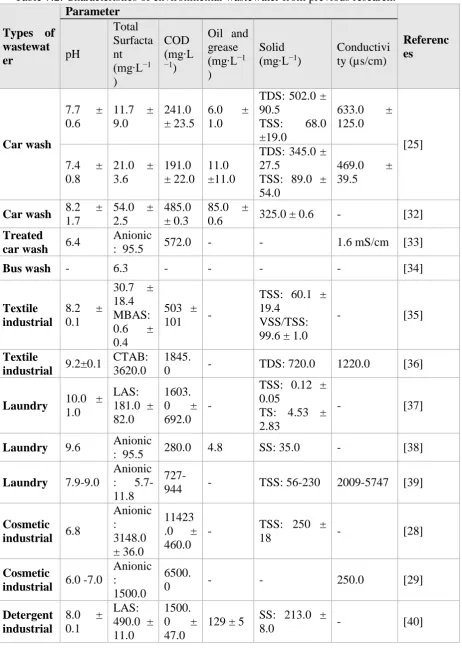
The essential point here is the wide consumption of these substances is leading to a growing and need to control their concentration in environmental water for reasons of toxicity and biodegradability [23]. Other minor uses are in personal-care products, textile and fiber processing, mining, flotation and petroleum production, paint and plastics (among other materials). The total world consumption of surfactants in 2003 was estimated at approximately 9.2 million tons, 4.5 million tons of which was from the consumption of anionic surfactants. Table 3.1 shows the characteristics of vehicle wash wastewater from previous research.
The range pH of car wash wastewater in environmental water sample was 6.4 -8.2 while laundry wastewater has higher range 7.9-10.0. Certain chemicals such as fabric softeners, bleach, and disinfectant, may contribute to the variation of pH [24]. Meanwhile, TSS in car wash has been reported in the literature in a range 68.0 - 4887
mg∙L−1 [25], [26]. The values of both soluble COD and TSS in car wash and laundry are
due to the use of COD and TSS comes from the use of a non-biodegradable surfactant with dirt and oil including both organic and inorganic compounds during car washing are more than in laundry wastewater. The low suspended solids concentration in the laundry wastewater and textile industrial wastewater has indicated that a large portion of the contaminants in the dissolved form and contribute higher values of TDS [27]. Cosmetic
industrial wastewater effluent has higher values of AS which have above 1500 mg∙L−1
[28],[29]. This is due to the large amount of AS has been used in cosmetic industry as an emulsion of formulation techniques which a surface active agent and it is specifically for preservation storage properties [30]. Many countries have listed AS in permission range in their country. For example, according to the World Health Organization (WHO), the
anionic detergent limit of drinking water is under 0.2 mg∙L−1. Meanwhile, the European
Union wastewater quality criteria have the reference level of as methylene blue active
agents which is at ≤0.3 mg∙L−1 [31]. AS is not listed in permission range of
environmental quality regulations sewage and industrial effluent in Malaysia but in anyhow, AS has been listed of parameters for a discharge of industrial effluent or mixed
73
Table 7.2: Characteristics of environmental wastewater from previous research.
Types of wastewat er Parameter Referenc es pH Total Surfacta nt (mg∙L−1 ) COD (mg∙L −1)
Oil and grease
(mg∙L−1
)
Solid
(mg∙L−1) Conductivity (µs/cm)
Car wash
7.7 ±
0.6
11.7 ± 9.0
241.0 ± 23.5
6.0 ±
1.0
TDS: 502.0 ± 90.5
TSS: 68.0
±19.0
633.0 ±
125.0
[25]
7.4 ±
0.8
21.0 ± 3.6
191.0 ± 22.0
11.0 ±11.0
TDS: 345.0 ± 27.5
TSS: 89.0 ± 54.0
469.0 ±
39.5
Car wash 8.2 ± 1.7
54.0 ± 2.5
485.0 ± 0.3
85.0 ±
0.6 325.0 ± 0.6 - [32]
Treated
car wash 6.4
Anionic
: 95.5 572.0 - - 1.6 mS/cm [33]
Bus wash - 6.3 - - - - [34]
Textile industrial
8.2 ±
0.1
30.7 ± 18.4 MBAS:
0.6 ±
0.4
503 ±
101 -
TSS: 60.1 ± 19.4
VSS/TSS: 99.6 ± 1.0
- [35]
Textile
industrial 9.2±0.1
CTAB: 3620.0
1845.
0 - TDS: 720.0 1220.0 [36]
Laundry 10.0 ± 1.0
LAS: 181.0 ± 82.0
1603.
0 ±
692.0 -
TSS: 0.12 ± 0.05
TS: 4.53 ± 2.83
- [37]
Laundry 9.6 Anionic
: 95.5 280.0 4.8 SS: 35.0 - [38]
Laundry 7.9-9.0
Anionic
:
5.7-11.8
727-944 - TSS: 56-230 2009-5747 [39]
Cosmetic industrial 6.8
Anionic : 3148.0 ± 36.0
11423
.0 ±
460.0
- TSS: 250 ±
18 - [28]
Cosmetic
industrial 6.0 -7.0
Anionic : 1500.0
6500.
0 - - 250.0 [29]
Detergent industrial
8.0 ±
0.1
LAS: 490.0 ± 11.0
1500.
0 ±
47.0
129 ± 5 SS: 213.0 ±
74
Total suspended solids (TSS), total dissolved solids (TDS), suspended solids (SS), methylene blue active substances assay (MBAS), cetyltrimethylammonium bromide (CTAB), Linear alkylbenzene sulfonate (LAS)
The wide application of AS are in laundry detergents, domestic and industrial cleaning products, cosmetics and personal care products result in the increased pollution of surface waters. After use, they are discarded down the drain into municipal sewer systems and afterward treated in wastewater treatment plants (WWTPs), where they are completely or partially removed by a combination of sorption and biodegradation. The biodegradation of surfactants in WWTPs has been studied in numerous papers. In general, most of the surfactants are well eliminated by conventional wastewater treatment, but some surfactants have a low biodegradability of the parent compounds, and, in others, undesirable biodegradation products are formed and discharged with WWTP effluents into surface waters [41].
7.4 RISK OF EXPOSURE TOWARD ANIONIC SURFACTANTS
The highest per capita detergent consumption is the United States of America which is around 10 kg/year. Meanwhile, Malaysia has moderate per capita detergent consumption is 3.7 kg/year which is similar to the Philippines. In addition, in places like India is around 2.7 kg/year which has low per capita detergent consumption compared to others country. AS production and consumption have continued to grow every year. As a result of their wide and excessive applications, AS has led to the highly contaminated wastewaters discharge in the terrestrial and aquatic environment due to the imperfection of technological processes [42]. Generally, the high consumption rates of detergents also develop a high detergent concentration in our water bodies.
Specifically, these substances cause a danger towards aquatic ecosystems by an adsorption on the cell surface of microorganisms, accumulated on food chains and also affected the self-purification of the aquatic environment [42],[43]. Commonly, aquatic
toxicity was measured on fish, daphnia, and algae. The values below 1 mg.L-1 prolong to
96 hours testing on fish and algae whereas 48 hours on daphnia are considered toxic.
Environmentally surfactants should preferably be above 10 mg.L-1. The other
information is sodium lauryl sulfate (SLS) are considered toxic at lethal concentration
50% (LC50) of aquatic in 1-12 mg.L-1 at 96 hours [44]. Liwarska-Bizukojc and
co-authors have tested the acute toxicity and genotoxicity of alkyl sulphates (AS), alkylbenzene sulphonates (LAS) and alkylpolyoxy- ethylene sulphates (AES) to the
three different aquatic organisms: Physa acuta Draparnaud, Artemia salina and
Raphidocelis subcapitata [2]. Based on the results of their research, shows that none of
the surfactants researched was genotoxic at the concentration 1000 mg∙L−1 and based on
toxicity were harmful at LC50 between 10 and 100 mg.L-1. They also conclude that the
increase of molecular weight of AS compound, the higher toxicity was observed.
As explained by Kiran et al., the toxins of AS will create a bacterial population
enhancement which is transmitting through the food chain of protozoa that contained
within car wash [45]. In addition, Almeida et al. have pointed out that all detergents
75
little evidence that at high concentrations of sodium dodecyl sulfate (SDS) cause death of fishes primarily due to three modes: decrease in surface tension, destruction of tissue and alteration of biomacromolecules [6].
On the other hand, AS target mainly the stratum corneum of the membrane bilayer of the sensitive skin resulting in dermatitis [47] and aphthous ulcers [48] in humans. Distinctly, the studies of dermal toxicity have demonstrated that after prolong 24 hours of exposure to a 1–2% (w/w) solution of SLS can rise the trans-epidermal water loss of the stratum corneum, the outer most layer of the skin thus cause mild yet reversible skin inflammation [49], [50]. Moreover, its confirm that SLS concentration that above 2% at exposure prolong to 24 hours are considered irritating to normal skin based on human patch test [51], [52]. The barrier function of human skin may be disrupted by AS. Besides, another effect may be delayed the release of toxic metabolic products from the cell leading to a build-up, both effects ultimately resulting in the death of the organism. It is also reported that morphology, pigmentation, exudates production, and rigidity of sporangiophores in microfungi are critically affected by AS [53].
AS toxicity effect cause a marked dangerously environmental pollutant in the case of human, plants, aquatic and microbes. This serious problematic of AS risk has to take a cautiousness in every country. Due to unfortunately negative consequences on the environmental cause by surfactant, banning the use of a surfactant is impossible in such the need of surfactant in a modernized lifestyle towards of various application.
ACKNOWLEDGEMENTS
This work is funded by the Ministry of Higher Education of Malaysia under the Fundamental Research Grant Scheme (FRGS) Vot No. : 1565.
REFERENCES
[1] T. Ivanković and J. Hrenović, “Surfactants in the environment.,” Arh. Hig. Rada
Toksikol., vol. 61, no. 1, pp. 95–110, 2010.
[2] E. Liwarska-Bizukojc, K. Miksch, A. Malachowska-Jutsz, and J. Kalka, “Acute
toxicity and genotoxicity of five selected anionic and nonionic surfactants,” Chemosphere, vol. 58, no. 9, pp. 1249–1253, 2005.
[3] D. G. Song, S. H., Koelsch, P., Weidner, T., Wagner, M. S., & Castner, “Sodium
Dodecyl Sulfate Adsorption onto Positively Charged Surfaces: Monolayer Formation With Opposing Headgroup Orientations,” Langmuir, vol. 18, no. 9, pp. 1199–1216, 2013.
[4] S. Hussain, A. H. Malik, and P. K. Iyer, “Highly precise detection, discrimination,
and removal of anionic surfactants over the full ph range via cationic conjugated polymer: An efficient strategy to facilitate illicit-drug analysis,” ACS Appl. Mater. Interfaces, vol. 7, no. 5, pp. 3189–3198, 2015.
[5] T. Cserháti, E. Forgács, and G. Oros, “Biological activity and environmental
impact of anionic surfactants,” Environ. Int., vol. 28, no. 5, pp. 337–348, 2002.
[6] A. Ribelles, M. C. Carrasco, M. Rosety, and M. Aldana, “A histochemical study
76 2. pp. 131–8, 1995.
[7] J. Drelich, E. Chibowski, D. D. Meng, and K. Terpilowski, “Hydrophilic and
superhydrophilic surfaces and materials,” Soft Matter, vol. 7, no. 21, p. 9804,
2011.
[8] L. L. Schramm, E. N. Stasiuk, and D. G. Marangoni, “Surfactants and their
applications,” Annu. Reports Sect. “C” (Physical Chem., vol. 99, p. 3, 2003.
[9] G. Biresaw, Tribology. CRC Press, 2008.
[10] M. J. Rosen and J. T. Kunjappu, Surfactants and interfacial phenomena, vol. 40. John Wiley & Sons, 2012.
[11] A. Domínguez, A. Fernández, N. González, E. Iglesias, and L. Montenegro, “Determination of Critical Micelle Concentration of Some Surfactants by Three Techniques,” J. Chem. Educ., vol. 74, no. 10, pp. 1227–1231, 1997.
[12] X. Cui, S. Mao, M. Liu, H. Yuan, and Y. Du, “Mechanism of Surfactant Micelle Formation,” vol. 24, no. 13, pp. 10771–10775, 2008.
[13] M. Chen, I. Burgess, and J. Lipkowski, “Potential controlled surface aggregation of surfactants at electrode surfaces - A molecular view,” Surf. Sci., vol. 603, no. 10–12, pp. 1878–1891, 2009.
[14] A. Tulpar and W. A. Ducker, “Surfactant Adsorption at Solid - Aqueous Interfaces Containing Fixed Charges : Experiments Revealing the Role of Surface Charge Density and Surface Charge Regulation,” pp. 1667–1676, 2004.
[15] G. Kyzas, E. Peleka, and E. Deliyanni, “Nanocrystalline Akaganeite as Adsorbent
for Surfactant Removal from Aqueous Solutions,” Materials (Basel)., vol. 6, no.
1, pp. 184–197, 2013.
[16] R. Zhang and P. Somasundaran, “Advances in adsorption of surfactants and their
mixtures at solid/solution interfaces,” Adv. Colloid Interface Sci., vol. 123–126,
no. SPEC. ISS., pp. 213–229, 2006.
[17] G. G. Warr, “Surfactant adsorbed layer structure at solid/solution interfaces: Impact and implications of AFM imaging studies,” Curr. Opin. Colloid Interface Sci., vol. 5, no. 1–2, pp. 88–94, 2000.
[18] S. F. Turner, S. M. Clarke, and A. R. Rennie, “Adsorption of Sodium Dodecyl Sulfate to a Polystyrene / Water Interface Studied by Neutron Reflection and Attenuated Total Reflection Infrared Spectroscopy,” no. 3, pp. 1017–1023, 1999. [19] V. E. Haverd and G. G. Warr, “Cation selectivity at air/anionic surfactant solution
interfaces,” Langmuir, vol. 16, no. 1, pp. 157–160, 2000.
[20] E. Staples, J. Penfold, and I. Tucker, “Adsorption of Mixed Surfactants at the Oil-Water Interface,” J. Phys. Chem. B, vol. 104, pp. 606–614, 2000.
[21] G. Konnecker, J. Regelmann, S. Belanger, K. Gamon, and R. Sedlak, “Environmental properties and aquatic hazard assessment of anionic surfactants:
Physico-chemical, environmental fate and ecotoxicity properties,” Ecotoxicol.
Environ. Saf., vol. 74, no. 6, pp. 1445–1460, 2011.
[22] B. Thiele, “Surfactants,” in Chromatographic Analysis of the Environment, 2005, pp. 1173–1198.
[23] M. Gerlache, Z. Senturk, G. Quarin, and J.-M. Kauffmann., “Self-assembled
monolayer gold electrode for surfactant analysis,” J. Solid State Electrochem.,
vol. 1(2), pp. 155–160, 1997.
[24] J. K. Braga and M. B. a Varesche, “Commercial Laundry Water Characterisation,” Am. J. Anal. Chem., vol. 2014, no. 5, pp. 8–16, 2014.
[25] R. Zaneti, R. Etchepare, and J. Rubio, “Car wash wastewater reclamation.
Full-scale application and upcoming features,” Resour. Conserv. Recycl., vol. 55, no.
11, pp. 953–959, 2011.
Díaz-77
Delgado, and M. García-Pulido, D., & Lucero-Chavez, “Carwash wastewaters: characteristics, volumes, and treatability by gravity oil separation,” 2007.
[27] O. R. Al-Jayyousi, “Greywater reuse: Towards sustainable water management,” Desalination, vol. 156, no. 1–3, pp. 181–192, 2003.
[28] F. Aloui, S. Kchaou, and S. Sayadi, “Physicochemical treatments of anionic
surfactants wastewater: Effect on aerobic biodegradability,” J. Hazard. Mater.,
vol. 164, no. 1, pp. 353–359, 2009.
[29] A. Dhouib, N. Hamad, I. Hassaïri, and S. Sayadi, “Degradation of anionic surfactants by Citrobacter braakii,” Process Biochem., vol. 38, no. 8, pp. 1245– 1250, 2003.
[30] W. Umbach, “The importance of colloid chemistry in industrial practice,” Struct.
Dyn. Prop. Disperse Colloid. Syst., vol. 111, pp. 9–16, 1998.
[31] E. Minareci, O., Öztürk, M., Egemen, O. and Minareci, “Detergent and phosphate
pollution ın Gediz River, Turkey,” African J. Biotechnol., vol. 8, no. 15, pp.
3568–3575, 2009.
[32] N. H. Hashim and N. Zayadi, “Pollutants Characterization of Car Wash Wastewater,” MATEC Web Conf., vol. 08, pp. 4–9, 2016.
[33] M. Panizza and G. Cerisola, “Applicability of electrochemical methods to carwash wastewaters for reuse. Part 1: Anodic oxidation with diamond and lead dioxide anodes,” J. Electroanal. Chem., vol. 638, no. 1, pp. 28–32, 2010.
[34] J. R. Ã and R. N. Zaneti, “Treatment of washrack wastewater with water recycling by advanced flocculation – column flotation,” vol. 8, no. November 2015, pp. 146–153, 2009.
[35] A. M. Lotito, U. Fratino, G. Bergna, and C. Di Iaconi, “Integrated biological and ozone treatment of printing textile wastewater,” Chem. Eng. J., vol. 195–196, pp. 261–269, 2012.
[36] S. Koner, A. Pal, and A. Adak, “Utilization of silica gel waste for adsorption of cationic surfactant and adsolubilization of organics from textile wastewater: A case study,” Desalination, vol. 276, no. 1–3, pp. 142–147, 2011.
[37] T. P. Delforno, A. G. L. Moura, D. Y. Okada, and M. B. A. Varesche, “Effect of biomass adaptation to the degradation of anionic surfactants in laundry wastewater using EGSB reactors.,” Bioresour. Technol., vol. 154, no. November, pp. 114–21, 2014.
[38] S. Šostar-Turk, I. Petrinić, and M. Simonič, “Laundry wastewater treatment using
coagulation and membrane filtration,” Resour. Conserv. Recycl., vol. 44, no. 2,
pp. 185–196, 2005.
[39] S. Bering, J. Mazur, K. Tarnowski, M. Janus, S. Mozia, and A. W. Morawski, “The application of moving bed bio-reactor (MBBR) in commercial laundry wastewater treatment,” Sci. Total Environ., vol. 627, pp. 1638–1643, 2018.
[40] X. J. Wang, Y. Song, and J. S. Mai, “Combined Fenton oxidation and aerobic biological processes for treating a surfactant wastewater containing abundant sulfate,” J. Hazard. Mater., vol. 160, no. 2–3, pp. 344–348, 2008.
[41] T. González, J. R. Domínguez, J. Beltrán-Heredia, H. M. García, and F. Sanchez-Lavado, “Aluminium sulfate as coagulant for highly polluted cork processing wastewater: Evaluation of settleability parameters and design of a clarifier-thickener unit.,” J. Hazard. Mater., vol. 148, no. 1–2, pp. 6–14, Sep. 2007.
[42] Y. R. Bazel, I. P. Antal, V. M. Lavra, and Z. a. Kormosh, “Methods for the determination of anionic surfactants,” J. Anal. Chem., vol. 69, no. 3, pp. 211–236, 2014.
78 431, 2006.
[44] C. A. M. Bondi, J. L. Marks, L. B. Wroblewski, H. S. Raatikainen, S. R. Lenox, and K. E. Gebhardt, “Human and Environmental Toxicity of Sodium Lauryl Sulfate ( SLS ): Evidence for Safe Use in Household Cleaning Products,” Environ. Health Insights, vol. 9, pp. 27–32, 2015.
[45] S. A. Kiran, G. Arthanareeswaran, Y. L. Thuyavan, and a. F. Ismail, “Influence of bentonite in polymer membranes for effective treatment of car wash effluent to protect the ecosystem,” Ecotoxicol. Environ. Saf., vol. 121, pp. 1–7, 2015.
[46] C. M. V. B. Almeida, D. Borges, S. H. Bonilla, and B. F. Giannetti, “Identifying improvements in water management of bus-washing stations in Brazil,” Resour. Conserv. Recycl., vol. 54, no. 11, pp. 821–831, 2010.
[47] S. Marrakchi and and H. I. Maibach, “Functional map and age‐related differences in the human face: nonimmunologic contact urticaria induced by hexyl nicotinate,” Contact Dermatitis, vol. 55, no. 1, p. 15–19., 2006.
[48] L. Chahine, N. Sempson, and C. and Wagoner, “The effect of sodium lauryl sulfate on recurrent aphthous ulcers: a clinical study,” (Jamesburg, NJ 1995), vol. 18, no. 2, pp. 1238–1240, 1997.
[49] C. M. De Jongh, M. M. Verberk, C. E. T. Withagen, J. J. L. Jacobs, T. Rustemeyer, and S. Kezic, “Stratum corneum cytokines and skin irritation
response to sodium lauryl sulfate,” Contact Dermatitis, vol. 54, no. 6, pp. 325–
333, 2006.
[50] C. M. de Jongh, M. M. Verberk, S. W. Spiekstra, S. Gibbs, and S. Kezic, “Cytokines at different stratum corneum levels in normal and sodium lauryl sulphate-irritated skin,” Ski. Res. Technol., vol. 13, no. 4, pp. 390–398, 2007. [51] M. V. Dahl and R. J. and Trancik, “Sodium lauryl sulfate irritant patch tests
Degree of inflammation at various times.pdf,” Contact Dermatitis, vol. 3, no. 5,
pp. 263–266, 1977.
[52] J. Piret, G. Laforest, M. Bussières, and M. G. Bergeron., “Structure – activity relationships for thiol reactivity and rat or human hepatocyte toxicity induced by substituted p -benzoquinone compounds,” J. Appl. Toxicol., vol. 28, pp. 608–620, 2008.
![Figure 7.2: Schematic diagram of surfactant increased concentration [12].](https://thumb-us.123doks.com/thumbv2/123dok_us/8751194.891935/3.595.92.481.350.477/figure-schematic-diagram-surfactant-increased-concentration.webp)
![Table 7.1: Classification of anionic surfactants [22]. Type Chemical structure](https://thumb-us.123doks.com/thumbv2/123dok_us/8751194.891935/5.595.95.517.50.510/table-classification-anionic-surfactants-type-chemical-structure.webp)