Journal of Chemical and Pharmaceutical Research, 2015, 7(8):168-174
Research Article
ISSN : 0975-7384
CODEN(USA) : JCPRC5
Removal and decolorization of dye bearing textile effluents by modified
unsaturated polyester resin
Pradip Dave and S. V. Patel
*Chemistry Department, Sir P. T. Science College, Modasa, Gujarat, India
_____________________________________________________________________________________________
ABSTRACT
Hydroxy terminated unsaturated polyester resin was prepared by condensation of maleic anhydride with
pentaerythritol at 1:2 ratios respectively. The resultant resin was then treated with ethylacetoacetate and NaHCO3.
The so-called resin known as modified unsaturated polyester resin (MUSPE) was characterized by Elemental and FT-IR analysis, which further used as adsorbent for dye and pollutants. Various textile effluents were collected and treated with mixture of MUSPE, Rice husk, Saw dust, Animal charcoal etc. The adsorption properties of this resin were investigated under different adsorption conditions with different initial dye concentrations, contact times and pH values. The adsorption equilibrium data were analyzed with Langmuir and Freundlich models. The adsorption behaviours of various textile effluents onto the MUSPE-resin were better described by the Freundlich model.
Keywords: Hydroxy terminated resin, Freundlich model, Adsorption, Textile effluents.
_____________________________________________________________________________________________
INTRODUCTION
adsorbers composed of synthetic polymer and ligand, wherein the metal ions are bound to the polymer ligand by a coordinate bond. A ligand contains anchoring sites like nitrogen, oxygen or sulfur obtained either by polymerization of monomer possessing the coordinating site or by a chemical reaction between a polymer and a low molecular weight compound having coordinating ability [21-23]. During the last few years, attempts were made to improve these adsorbed polymers which originally were developed on the basis of ion exchange resins [24]. On the other hand, the use of new technologies allowed the production of highly porous polymers with a specific surface of 800– 1500 m2g-1 which is similar to the surface of activated carbon [25]. Recently Patel et al.,[26] did the dye removal of effluents by Sulfinated Furfural-Acetone Resin.
The area in which the modification of USPE towards the pollutant adsorbents has not been developed academically and technically, Though USPE resins are versatile polymers with ease of synthesis, low cost and excellent end properties. Consequently, we attempted to incorporate the -SO3H group into the resin by a sulfonation reaction. Then, this resin was used as a sorbent for the adsorption of basic dyes from textile effluents for the first time. So it has been thought to explore the field of sulfonated-modified USPE as water pollutant adsorbents. The work is shown in Scheme 1.
EXPERIMENTAL SECTION
Materials:
Maleic anhydride, Pentaerythritol, Ethylacetoacetate etc. were purchased by local market. All the chemical used were of AR grade.C, H, N was estimated by Colman Analyzer. The infrared spectra (FT-IR) were obtained from KBr pellets in the range 4000–400 cm−1 with a Perkin Elmer spectrum GX spectrophotometer (FT–IR) instrument. The thermogravimetric analysis of resins was carried out by Du Pont 950 thermogravimetric analyzer at 10°C min.
(1) Synthesis of unsaturated polyester based on Maleic anhydride &Pentaerythritol (USPE):
Maleic anhydride and pentaerythritol (1:2) were condensed into a three-necked glass reactor. The mixture of materials was melted at 65°C with constant stirring for 1 h, so that the maleic anhydride was dissolved completely in the pentaerythritol and the solution. In order to prevent discoloration, the reaction is carried out in an inert atmosphere of N2.The mixture is heated at 150-200°C for 6-10 hours, while the pressure was reduced to 100 mbar. The water formed during the reaction was removed by azeotropic distillation. The products were designated as USPE. The characterization details are furnished in Table 1.
(2) Synthesis of modified unsaturated polyester resin (MUSPE):
The above prepared unsaturated polyester resin (USPE) was modified by further condensation of this USPE-resin with ethaylacetoacetate using alkali. The unsaturated polyester resin was dissolved in ethylacetoacetate and reflux for 1 hour at room temperature with constant stirring. The sodium hydroxide was added to the mixture is then further condensed at 200-225°C for 8 hours. Once the required end point has been reached the batch is cooled up to 90°C and dissolved in a reactive diluent. The products were designated as MUSPE. The characterization details are given in Table 1.
(3) Sulfonation of the modified unsaturated polyester resin (S-MUSPE):
O O O Maleic anhydride OH HO HO OH O O O O O HO OH USPE O O O O O MUSPE ethaylacetoacetate O O O O NaHSO3 O O O S-MUSPE O O Pentaerythritol 1:2 ratio O O O O O
OSO2Na
OSO2Na
HO
OH O
Scheme-1.The Synthetic route for the formation of S-MUSPE
1. Characterization of synthesized resins:
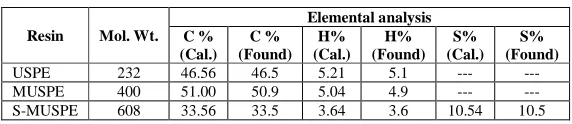
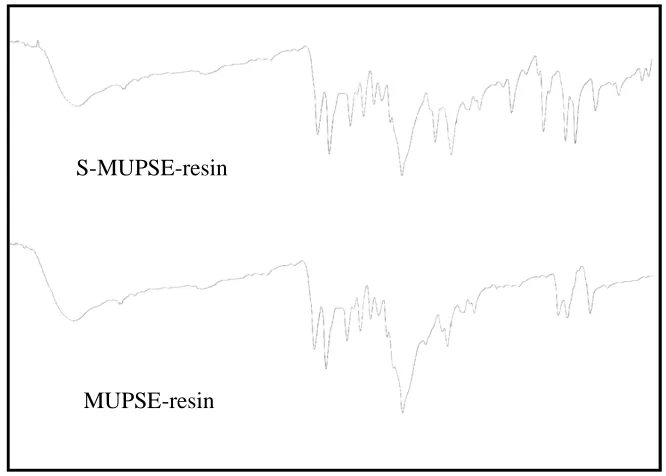
[image:3.595.155.441.602.664.2]The resultant unsaturated polyester resin (USPE),modified polyester resin (MUSPE-resin) and its sulphonated polyester resin (S-MUSPE-resin) was characterized by elemental analysis. The C, H, N data for all compounds along with molecular weight given in Table 1. Further the comparison of IR-spectrum(Fig.1) and thermogravimetric analysis of MUSPE-resin and sulphonated MUSPE (S-MUSPE-resin) were carried out.
Table 1 Elemental analysis of synthesized resins
Resin Mol. Wt.
Elemental analysis C % (Cal.) C % (Found) H% (Cal.) H% (Found) S% (Cal.) S% (Found)
USPE 232 46.56 46.5 5.21 5.1 --- ---
MUSPE 400 51.00 50.9 5.04 4.9 --- ---
The spectrum of S-MUSPE-resin showed additional peaks, which was different from the spectrum of MUSPE-resin. These new absorption peaks were observed at about 615, 1042, 1132, and 1185 cm-1. The absorption peaks at 615, 1042, and 1132 cm-1 resulted from the symmetric stretching vibration of SO3H groups and the stretching vibration of the sulfonate anion, respectively. In addition, sulfonic group vibration bands were observed at 1185 cm-1. Moreover, after sulfonation, a significant decrease in the intensity of methylol groups (1355 cm-1) supported the occurrence of a sulfonation reaction between the SO3H groups and the methylol groups of resins. These changes observed in the spectrum indicated the incorporation of SO3H groups into the resin structure after sulfonation.
Fig. 1 IR spectra of MUPSE and S-MUPSE resins
2. Dye adsorption experiments
Adsorption experiments were carried out in 100 ml flasks containing synthetic dye influents and S-MUSPE-resin with different concentrations (Table 2) at 25 °C. At different time intervals of 5, 10, 15, 30, 45, 60, 90, 120, 180, 240, 300, 360 min and 24 h at pH 6, the dye concentration in the influents was analyzed calorimetrically with a spectrometer by the measurement of absorbance at the maximum absorption wavelength. In the equilibrium adsorption isotherm experiments, a fixed amount of sorbent (0.25 g) was contacted with dyes influents having different ratio(Table 2). The mixture was sporadically shaken and then kept for 24 h for saturation. Thereafter supernatant liquid was filtered through Whatmann Filter Paper No. 42 and the amount of dye adsorbed was determined spectrophotometrically at the λ max 426 nm.
Table 2 Elemental analysis of synthesized resins
No. S-MUSPE Resin Animal charcoal Saw dust Rice husk
M-1 60 10 10 20
M-2 60 10 15 15
M-3 60 10 20 10
RESULTS AND DISCUSSION
The elemental (C,H,N) data suggest that the value is consistent with the calculated for the structure. The IR spectra of MUSPE-resin are show characteristic band of C=O group at around 1720 cm-1, while all other bands are show peaks at their respective position. FTIR analysis of S-MUSPE-resin shows some additional peaks at 615, 1042, 1132, and 1185 cm-1, which were attributed to the symmetric stretching vibration of SO3H groups and to the stretching vibration of the sulfonatean ion. Moreover, because of the interference between the peaks attributed to
[image:4.595.180.418.581.635.2]methylol groups and to a newly formed band at (SO2 group), the intensity of the peaks in this region changed (1355 cm-1) significantly.
2.1 Scanning electron microscopy analysis of S-MUSPE-resin
The scanning electron micrograph of the S-MUSPE-resin sorbent was taken at a magnification of 2500. The scanning electron micrograph of the S-MUSPE-resin absorbent showed its smooth and nonporous surface.
2.2 UV–vis spectroscopy analysis of S-MUSPE-resin
At the end of 6 h of adsorption, the adsorption capacities of the S-MUSPE-resin were determined as about 120 mg/g for all of the basic dyes effluents. Because the S-MUSPE-resin surface demonstrated a nonporous structure, we can say that the incorporation of SO3H groups into the structure provided sorbent characteristics to the resin.
2.3 Adsorption behavior of the cationic dyes
The S-MUSPE-resin has many ionizable groups, such as SO3H groups. At pH 6, the SO3H groups were in their ionized form, and electrostatic interaction could occur between the SO3H groups of the resins and the cationic groups of the basic dye molecules consequently, the dye adsorption ability became better.
2.4 Effect of the contact time and pH
The residual dye concentrations in solution were determined at different times from initial solutions of different concentration and a sorbent dosage of 0.2 g/L. According to the adsorption studies, which were carried out at different pH values, the optimal pH value was determined as 6, and all experiments were carried out in triplicate at this pH value. This result was compatible with other results given previously in the literature. Furthermore, it has also been reported that the pH values of the basic dye effluent from the dyeing processes are below 7.25. The adsorption capacities for dyes effluent were increased with the increase of the adsorption time. After the equilibrium adsorption time of 6 h, the adsorption capacities for different dyes influents were measured. As a result, the dye uptake capacities of this sorbent for these basic dyes were compatible and comparable with that other sorbents that have been given in the literature.
.
2.5 Effect of the initial dye concentration
The adsorption isotherms were determined in beaker flasks containing synthetic dyes effluent at 25 ºC and pH 6. A fixed amount of 0.25 g of sorbent was contacted with 50 mL of dyes effluent with different concentrations. The
0 20 40 60 80 100 120 140
0 200 400 600 800 1000 1200 1400 1600
A
d
o
sr
p
ti
o
n
C
a
p
a
ci
ty
(
m
g
/g
)
Where Co and Ce are the initial solution concentration (mg/L) and equilibrium concentration (mg/L), respectively; V is the volume of the solution; and W is the weight of the dry S-MUSPE-resin (g). Several models have been published in the literature to describe adsorption isotherms. The Langmuir and Freundlich models are the most frequently used models [28,29]. In this study, the Langmuir and Freund where Co and Ce are the initial solution concentration (mg/L) and equilibrium concentration (mg/L), respectively; V is the volume of the solution; and W is the weight of the dry S-MUSPE-resin (g). In this study, the Langmuir and Freundlich models were used to describe the relationship between the amount of dye adsorbed and its equilibrium concentration in solution. However, when the Langmuir isotherm model was applied to these systems, the regression coefficient (R20 s) values were found to be 0.4853, 0.3587 and 0.5341 for different dyes influents. Therefore these results are not suitable for describes the adsorption of these basic dyes.
The logarithmic form of the Freundlich model is given by the following equation:
log = log + 1log
Where Kf and n are Freundlich constants related to the adsorption capacity and adsorption intensity, respectively, when log qe was plotted against log Ce, a straight line was obtained with slope 1/n, which showed that the adsorption followed a Freundlich isotherm well. The parameters of the Freundlich isotherm, Kf, which is calculated from the intercept of the plots, and n and R2, are given in Table I. R2’s indicate whether the Freundlich isotherm is applicable for a system or not. The R2 values were 0.9645, 0.9675, and 0.9670 for mixtures M-1, M-2, and M-3, respectively. n values between 1 and 10 indicate beneficial, economical, and viable adsorption. [30-32] For the adsorption of textile effluent over the surface of S-MUSPE-resin, where value of n is always greater than 1, but above the critical beneficial adsorption the value of n = 1.
CONCLUSION
In this work, MUSPE-resin was prepared and sulfinated with sodium hydrogen sulfite. Then, this sulfinated MUSPE-resin was used as a sorbent in adsorption studies for the different textile effluent. The adsorption properties were evaluated under different adsorption conditions with different initial dye concentrations, contact times, and pH values. The adsorption equilibrium data were analyzed with the Freundlich and Langmuir models.
Results revealed the following:
The different parameters observed during the process of experiments reveal that the pH, temperature, contact time, adsorbent amount and concentrations manage the overall process of adsorption.
After the incorporation of SO3H groups to the resin structure, the adsorption capacity of the modified resin increased noticeably. The adsorption capacities for textile effluents increased with the increase of the adsorption time until a plateau value was reached.
After the equilibrium adsorption time of 6 h, the adsorption capacities for the textile influents were reached about maximum values of mg/g.
The resultant study reveals that that the sulfonated MUSPE-resin may be used as an alternative sorbent for the removal of water pollutants from some dye molecules.
REFERENCES
[1].SAAbbasi;RSoni.Heavy Metals in the Environment. Mittal. New Delhi. 1998; 71-73. [2] M Pipsika;MHornik;MRemenarova;JAugustin:JLesny.ActaChim. Slov.,2010, 57, 163-172. [3] KBajpai;SKumar;MArmo; M Namdeo.ActaChim. Slov.,2009, 56, 254-261.
[4] KSaberyan;EZolfonoun;MShamsipur;Shemshadi;MSalavati-Niasari.ActaChim. Slov.,2010, 57, 222-229. [5] DRTurner;RTPablan;FPBertetti.Clay Miner.,1998, 46, 256-269.
[6] R Naseem, SS Tahir.Water Res.,2001, 35, 3982-3986. [7] R Pusch.Clay Miner.,1992, 37, 353-361.
[8] SAKhan;RRehman;MAKhan.Waste Manage.,1995, 15, 271-282. [9] R Chandra;RRustgi.Prog. Polym. Sci.,1998, 23, 1273-1335. [10] GCrini;Bioresour. Tecnol.,2003, 90, 193-198.
[13] E Guibal;MVVooren;BADempsey;JRoussy.Separation Sci. Tech.,2006, 41, 2487-2514. [14] M Ajmal;AHKhan;SAhmad;AAhmad;Water Res.,1998, 32, 3085-3091.
[15] SMLee;APDavis.Water Res.,2001, 35, 534-540.
[16] BJMcafee;WDGould;JCNadeau;ACADa Costa.Sep. Sci. Technol.,2001, 36, 3207-3222. [17] F Delval;GCrini;SBertini;CFiliatre;GTorri.Carbohydr. Polym.,2005, 60, 67-75. [18] FLMi;SSShyu;CTChen; JYLai.Polymer.,2002, 43, 757-765.
[19] PHBoenig;DDBeckmann;VLSnoeyink.J. Am. Water Works Assoc.,1980, 72, 54-59. [20] J.F.Ferraro, Technische Mitteilungen.1987, 80, 334-338.
[21] CKantipuly;SKatragadda;AChow;HDGesser.Talanta.,1990, 37, 491-517. [22] NArsalani;RRakh;EGhasemi;AAEntezami.Iran. Polym. J.,2009, 18, 623-632. [23] T Kaliyappan;PKannan.Prog. Polym. Sci.,2000, 25, 343-370.
[24] WDedek;LWeil;LFeistel.Vom. Wasser.,1992, 78, 155-164. [25] HSchroder;KHRadeke.Chem. Ing. Tech.,1995, 67, 93-96. [26]PN Patel; YS Patel; HS Patel.
[27] HYunchao;ZFansen;YHu;LChunying;WZhaoqiang;LWeining;YShukai.J. Appl.Polym. Sci.,1995, 56, 1523. [28] FQLiu;JLChen;AMLi;ZHFei;ZLZhu;QXZhang.Chinese J.Polym. Sci.,2003, 21, 311.
[29]MUgurlu;AGurses;CDogar.Coloration Technol.,2007, 123, 106.
[30]SNir;TUndabeytia;DYMarcovich;YEl-Nahhal;TPolubesova;CSerban;GRytwo;GLagaly;BRubin. Environ. Sci.
Technol.,2000, 34, 1269.