A review on computational trust models
for multiagent systems
Lu, G, Lu, J, Yao, S and Yip, YJ
http://dx.doi.org/10.2174/1874947X00902010018
Title
A review on computational trust models for multiagent systems
Authors
Lu, G, Lu, J, Yao, S and Yip, YJ
Type
Article
URL
This version is available at: http://usir.salford.ac.uk/id/eprint/23110/
Published Date
2009
USIR is a digital collection of the research output of the University of Salford. Where copyright
permits, full text material held in the repository is made freely available online and can be read,
downloaded and copied for noncommercial private study or research purposes. Please check the
manuscript for any further copyright restrictions.
1874-947X/09 2009 Bentham Open
Open Access
A Review on Computational Trust Models for Multi-agent Systems
Gehao Lu
1,2, Joan Lu
*1, Shaowen Yao
2and Jim Yip
11School of Computing and Engineering, University of Huddersfield, Huddersfield, UK and 2Laboratory of Network
In-telligence Computing, University of Yunnan, Kunming, Yunnan, China
Abstract: Trust plays important roles on effective interaction and cooperation for multi-agent systems(MAS). This study aims at finding out the current situation and future trends of computational trustfor multi-agent systems. Through defining seven common compositional elements for the computational trust models, the study points out significant weaknesses in the current design. Finally, the paper figures out the future research trends through discussion and analysis around the strengths and weaknesses identified. Also the paper proposes an idea of using ontology and XML technologies such as RDF that allow systems to provide both human and machine readable annotations for trust models.
INTRODUCTION
With the increasing size and complexity of the computer systems, it is nearly impossible to design a system from the scratch and control every details of the system purely by human brain (Simon MIT 1996) [1]. It is difficult to control millions of transactions occurred in a large-scale E-market. It is also difficult to monitor an enterprise information system which encompasses huge amount of heterogeneous devices and covers thousands of different geographical locations (Rothkopf AEA 2003) [2]. Grid Computing, Autonomic Computing, Pervasive computing and Multi-agent systems, are all committing themselves to challenge the design of large-scale distributed system (Coulouris AWLP 2000) [3].
Computational trust is to make an intelligent agent trust another agent and delegate part of their tasks to the target agent in a heterogeneous distributed multi-agent environ-ment. Delegation of action is the result of trust and it also forms the foundation of future cooperative large-scale com-puter systems. Generally, trust toward specific agent is gen-erated through recognition and experience under repeated transactions with that agent. Reputation is the socialized trust which can be propagated through a social network of agents. It helps agents trust the target agent without any direct inter-action with the target agent. The benefits of introducing trust and reputation into multi-agent system include:
• As a lubricant, trust can eliminate much of unnecessary communications which are currently necessitates in many interaction protocols thus greatly improve the performance of the multi-agent systems.
• An agent can make decision easier based upon the evaluation of the trustworthiness of another agent. Computa-tional trust is also a very beneficial addition to the tradiComputa-tional decision theory.
Address correspondence to this author at the School of Computing and
Engineering, University of Huddersfield, Huddersfield, UK; E-mail: [email protected]
• Trust is a kind of soft security which complements the traditional hard security like encryption, authorization, and authentication. An agent exists in complex heterogonous environment must possess both two securities in order to be safe and effective.
The mechanisms for coordinating interactions among agents are always pre-defined, that is, the designer specifies how one agent responses to another agent in a fixed protocol (Ree AGJ 1998) [4]. Such mechanisms are not flexible enough because of the intrinsic highly openness and variabil-ity of the distributed systems (Ferber AW 1999) [5]. For example, in open MAS (Multi-agent Systems), an agent can-not expect to always interact with the agents in the prede-fined application domain in a predetermined way (Subrah-manian MIT 2000) [6]. Agent will interact with different agents coming from heterogeneous applications and they may face challenges from lying, deceiving and accidental incidents (Ferber AW 1999) [5]. Such complexity creates the following questions: can agents accept services from other unfamiliar agents? Can agents make use of the interac-tion history and transform them into experiences? Can agents avoid excessive negotiation with a familiar agent in an effi-cient way? Computational trust seems to be the answer and the next step of research for the multi-agent systems. Thus, a systematic review on the existing trust models is necessary.
Trust actually is a belief that someone or agents can delegate the host to finish some actions. There are two layers of meaning in the expression: first, agent should generate the belief of trustworthiness toward some other agents in some specific form; second, agent should make decision whether to delegate actions to the trusted agent. The first layer is ac-tually to study how agents generate and update their belief which is part of research from computational intelligence. The second layer is an extension of the traditional decision theory which adds agents belief, trustworthiness, as one of the concerns during decision making.
dimen-A Review on Computational Trust Models for Multi-dimen-Agent Systems The Open Information Science Journal, 2009, Volume 2 19 sional view, there are two types of models involved, i.e. local
trust based and reputation based models. For local trust based model, the early model developed by Marsh, Univer-sity of Stirling, 1994, only considers the local trust dimen-sion which only derives trust from the agent’s direct interac-tion without referencing to the recommendainterac-tions from other witness agents (Marsh UoStirling 1994) [8]. For reputation based models, like SPORA (Zacharia MIT 1999) [9], they only consider the reputation (witness trust) dimension with-out looking at the local experience of the agent itself. Re-cently RegreT, Referral Network and TRAVOS take both local trust and witness trust into account (Sabater UAdB 2003) [10] (Luke AAMAS’05 2005) [11]. They combine the value of the two dimensions with relative weights and finally get a sum. Some models, such as FIRE, even introduce addi-tional dimension called as role-based trust and certified repu-tation (Trung UoS 2006) [7] (Huynh AAMAS 2006) [12].
From a point of algorithmic view, different ways of cal-culating trust and reputation are proposed. For example, Bayesian systems take binary ratings as input and are based on calculating reputation scores by statistical updating of beta probability density functions (PDF). Such models in-clude TRAVOS (Luke UoS 2006) [13] (Luke AAMAS’05 2005) [11]. Models such as RegreT (Sabater UAdB 2003) [10] (Sabater FWDFTAS 2001) [14] bases on discrete trust model to represent trustworthiness and untrustworthiness as discrete value. A detailed analysis about the composing ele-ments of trust and reputation model will be given in Section 3.
The objective of the study is finding out the current situa-tion and future trends of computasitua-tional trust for multi-agent systems. It also aims at looking for common necessary com-positional elements that compose the models through ex-tracting the essence of those representative models, and summarizing their common weaknesses through comparison, discussion and analysis. Finally, a clear research path is pro-posed to help the community to promote the research of computational trust.
METHODS EMPLOYED
The investigation is carried out through viewing and ana-lyzing conference papers, journal papers and technical re-ports on computational trust from varieties of sources. The criteria of choosing analyzing target are based on whether the model is representative and whether the model reflects the latest trend of the research. To achieve a comparative result, the first thing is to figure out the common basic com-positional elements of different models. Taking the elements as parameters then compares the above models in the form of table; it will also try to find out the significance of the result table. The results will be organized in the form of spider graph to show the reader a clear relationship between the evaluation criteria. The study will also differentiate research paths of different models through quantitative analysis and statistics.
RESULTS
Results are shown from two approaches, i.e. centralized approach and distributed approach. The centralized approach
saves all the rating procedure, storage of reputation, query of reputation, searching of comments to the computer server, while the distributed approach finishes all these jobs by agents themselves.
Centralized Approach
• eBay (eBay WWW 2007) [15]: eBay has built a feed-back reputation system for its Customer-to-Customer web-sites. The goal of designing such a system is to transfer the trust and reputation mechanism in the real life human market to the internet-based e-Market.
• SPORAS (Zacharia MIT 1999) [9]: a reputation model was developed by Zacharia in MIT, 1999. It is an evolved version of the eBay’s online reputation models. In this model, only the most recent rating between two users is considered. Another important characteristic is that users with very high reputation values experience much smaller rating changes after each update than users with a low reputation. SPORAS incorporates a measure of the reliability of the users’ reputa-tion based on the standard deviareputa-tion of reputareputa-tion values.
Distributed Approaches
• Marsh’s Model (Marsh UoStirling 1994) [8]: The pio-neer work on computational trust model was done by Mash in 1994. Marsh thought that knowledge, utility, importance, risk, and perceived competence are important aspects related to trust. He defined three types of trust: dispositional trust, general trust and situational trust. The trust management provided by Marsh does not treat the collection of recom-mendations provided by other agents; he only models direct trust between two agents. The aspect of risk is dealt with explicitly based on costs and benefits of the considered en-gagement. The decision making is threshold based. Among other parameters the cooperation threshold depends on the perceived risk and competence of the possible interaction partner. If the situational trust is above the value calculated for the cooperation threshold, cooperation will take place otherwise not. Furthermore, the decision making can be ex-tended by the concept of reciprocity, i.e. if one does another one a favor, it is expected to compensate at some time.
• Referral Reputation (Yu ACM 2002) [18] (Yu ACM 2003) [17]: The underlying computational framework is based on Dempster-Shafer theory (Dempster JRSS 1968) [19]. The model has a well-defined trust network to propa-gate the trust value from the witnesses, the proposed ap-proach does not concerns the uncertainty surely occurred in the interaction and there is no risk management in this model.
• FIRE (Trung UoS 2006) [7] (Huynh AAMAS 2006) [12]: The FIRE model believes that most of the trust infor-mation source can be categorized into the four main sources: direct experience, witness information, role based rules and third party references. FIRE integrates all four sources of information and is able to provide trust metrics in a wide variety of situations. The reliability value bases on the rating reliability and deviation reliability to counteract the uncer-tainty due to instability of agents.
• TRAVOS (Luke UoS 2006) [13] (Luke AAMAS’05 2005) [11]: TRAVOS (Trust and Reputation model for Agent-based Virtual OrganizationS) is based on probability theory and Bayesian system (DeGroot AW 2002) [20]. The prominent feature of TRAVOS is that it takes confidence into account and the trustor makes decisions based upon the confidence level instead of the trust value. The reputation is not simply added to the direct trust value or confidence value, the introduction of reputation depends on the value of dence level. If the agent can achieve the minimum confi-dence level through checking belief of its direct interaction, then it does not have to query other agents. But if the agent cannot find enough confidence, then the agent needs to seek more evidence form the witness.
The researcher builds a test-bed for implementing TRO-VOS model. Such test-bed is also useful for future evalua-tion of the researchers own model and the other models. The implementation of the testbed is illustrated in Fig. (1). The test-bed is to mimic a general market where agents carry on business automatically standing for human beings. Each agent seizes some resources and cost specific amount of re-sources with time elapsing (charging energy). The lifetime of the agent ends when the agent owns nothing (starving to death). The goal of each agent is to maximize their assets (resources) and keep itself alive as long as possible. Transac-tion is the only way to accumulate resources and avoid dying because the system is designed to make agents achieve more resources in transaction than the resources elapsing with time. There are two attitudes held by the agents: benevolence and malevolence. Under the attitude of benevolence, the agent tends to give full value to the other agent in a transaction; under the attitude of malevolence, the agent tends to give partial value to the other agent in a transaction. The details of transaction are illustrated in Fig. (2).
Fig. (1). The benevolence and malevolence agents.
Fig. (2). System design of TROVOS Testbed.
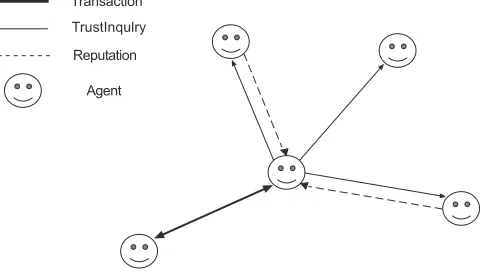
Before any transaction, an agent should find out a target agent and evaluate the trustworthiness of that agent. To find out a target agent, the usual way is to use Contract Net Pro-tocol, the agent broadcast its needs and the other capable agents who are willing to sell goods will response to the re-quest listing their preferred price and quantities. However, in our design, to simplify the scenario and focus on the effect of trust model, the target agent is selected randomly by the simulation engine. The trustworthiness is calculated by the agent through combining the reputation from other agents and the experience accumulated in the past transactions with the target agents. The evaluation engine is based on TRA-VOS model. The process of evaluating trustworthiness is illustrated in Fig. (3). Agent must consult other agents through broadcasting request for reputation. If agent has knowledge (experience) about the target agent then the agent should respond to the request and send their experience to originated agent. The originated agent then combine these experience with its own experience according to the TRA-VOS model to decide whether to make transaction with the target agent.
Fig. (3). The agent transaction with trust support.
Through filtering and combining the duplicated termi-nologies used in the different trust models, seven critical compositional elements can be summarized in Fig. (4).
BENEVOLENCE
MALEVOLENCE
Activate Transaction(Price = 10)
Activate Transaction(Price = 12) Sending Goods (Value = 12)
Sending Goods (Value = 12)
Database
Game Server
Simulation Engine
Agent_1 Agent_2 Agent_i
Socket Socket
Socket
InterfaceMonitor Game Game
Setup Interface
[image:4.612.333.571.59.254.2] [image:4.612.334.575.532.668.2] [image:4.612.69.305.647.704.2]A Review on Computational Trust Models for Multi-Agent Systems The Open Information Science Journal, 2009, Volume 2 21
Fig. (4). The compositional elements of computational trust.
• Dimension is to study what the sources of the trust val-ues are.
• The semantics focus on the meaning behind the trust in case that the outcome from the trust is a composite product.
• The mathematical model employed in calculating trust or reputation is sometime called trust computation engine (Josang DSS 2007) [21].
• Trust network is the study on the topology of organiz-ing witness agents and the host agent.
• Uncertainty refers to the management of risk which monitors the accidental incident and environmental changing, and reliability which ensures that the trusted agent is reliable enough even though it is trustworthy based upon the result of mathematical calculation.
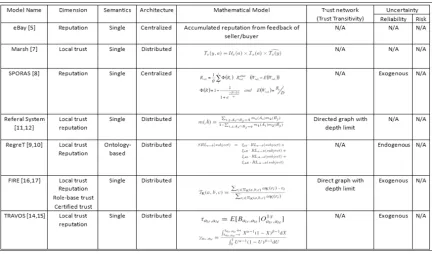
The summary of the result is listed in the Fig. (5). Based on the Table in Fig. (5), significant observations can be listed as follow.
1. There are multiple facts (cardinality of dimensions) to forge the trust or reputation. 3 models (eBay,Marsh, SPO-RAS) are single dimension and 4 models (Referal System, RegreT, FIRE and TRVOS) are multiple dimensions.
2. 6 models presume the semantics behind trust is consis-tent to all the agents except that RegreT adds an ontological dimension to deal with the semantic difference.
3. 5 models choose distributed architecture rather than centralized architecture (eBay and SPORAS).
4. 6 mathematical models are based on summation or product of different dimensions with selected weights repre-senting their influences. TRAVOS is an exception which is based on Bayesian probability theory.
(The evaluation criterion is the confidence level instead of the trust or reputation value).
5. 5 models, except Referal System and FIRE, don’t take trust network and trust transitivity into account.
Their hypothesis is that the trust propagates from the tar-get witness to the host agent without any distortion or loss.
6. None of the models take risk management for acciden-tal incidents and environmenacciden-tal changing into account.
Fig. (6 ). Strengths and weaknesses of models based upon the ele-ments.
Fig. (5). Comparison of different computational trust models.
Artichtecture
Semantics
Dimension
Trust
Computational Uncertainty Trust Network Model
Mathematical
eBay/Ama Ion
Marsh
SPORAS
Referal System Architecture
FIRE Regret
Model Trust Network
Reliability Risk
Dimension
[image:5.612.80.283.60.172.2] [image:5.612.334.573.290.433.2] [image:5.612.105.538.470.724.2]The strengths and weaknesses of each model can be visu-alized through a spider chart in Fig. (6) based upon the compositional elements. The findings are: semantics, risks, trust network pose weak points for most models, whereas the dimension, architecture and mathematical models are inten-sively studied by researchers.
DISCUSSION AND ANALYSIS
It is found in Fig. (5) that most models have two basic dimensions: local trust and reputation. But they aren’t the only dimensions that can be used to deduce trust. FIRE [7, 12] introduces role-based reputation, which models the trust to the specific role in the society. This is similar to the situa-tion that people always tend to trust some group of people with occupation like professor, doctor or police in the human society. FIRE (Trung UoS 2006) [7] (Huynh AAMAS 2006) [12] also has a design called ”certified reputation” which is reputation collected by the trustee from its previous interac-tions. The truster then does not need to contact its acquain-tances to know about the trustee thus the design improves the efficiency of communication. Some idea can be borrowed from social science study on trust; cultural trust and mecha-nism trust (Sztompka CUP 2000) [22] are trust that may find their places in computational trust.
Most models ignore the semantics behind trust through examining Fig. (5). Their potential hypothesis is that their trust is restricted to a predefined topic. For example, in eBay, trust (reputation) to the seller implicitly means the belief held by the buyer that the seller will send a right product to a right place in a right time (eBay WWW 2007) [15]. However, this is an ambiguous semantic. A few sellers may have be-lieves that a right product to a right place with a little delay deserves the buyer’s trust. Such gaps of semantics lead to disruption between buyers and sellers. In multi-agent sys-tems, if two agents with different trust semantics meet, do they simply refuse to trust the other because of incompatible semantics or they need to build up a consensus through ne-gotiation? If the semantics of trust can be adjusted, how of-ten should such adjustment happen and in what exof-tent? It is necessary to create an ontology built upon XML and RDF that allows systems to provide machine-readable semantic annotations for trust of specific domain. The solution is briefly depicted in Fig. (7).
Fig. (6) also shows that most models do not explain how the trust network work and what mechanism the trust transi-tivity is based. How the trust or reputation value is trans-ferred? Does it simply keep the original value from the wit-nesses? Or does its value attenuate along distance as same as what happens in the transitivity of human reputation? The solutions to these questions are keys to implement a practical system. Theories about social network analysis in social sci-ence make sense to build algorithms for searching witnesses in the network of intelligent agents. The transitivity or propagation algorithm can also benefit from studying the social network analysis. Some researchers have already no-ticed the transitive trust and proposed their ideas (Josang APCCM 2005) [23].
Fig. (7). A possible solution for filling the semantic gap between agents.
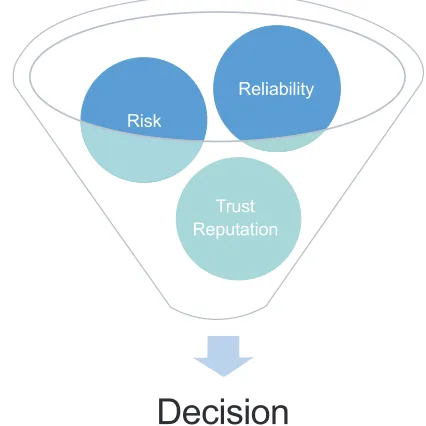
Another result from Fig. (5) and Fig. (6) is that none of the reviewed models introduce risk management to control the uncertainty due to the environmental influence or acci-dental incidents, although they do define reliability to coun-teract the uncertainty due to instability of individual agent. It is necessary to use risk evaluation to evaluate the risk associ-ated with the prospective transaction under specific envi-ronmental facts. The risk here mainly means the risk derivate from the environmental influence or accidental incidents. For example, agent A trust a reliable agent B, but B’s environ-ment is instable (B’s system often cracks down due to an accidental power off). Such type of risk can be called as en-vironmental reliability. If agent A has assessed the risk of B’s unstable environment additional to its reliability and trust, it will be more careful when making decision about whether to trust or not. Fig. (8) illustrates how the decision of trustworthiness is made under synthesizing the concerns from trust/reputation, reliability and risk.
Fig. (8). The decision making process of trust.
An important part is not listed in the comparison table but deserving discussions. Most models stay as a theoretical model without performing a strict experiment in the real sys-tem. A few of them do have simple test but not complete. A complete experiment to assess the trust model for MAS should at least pass functionality test, performance test and security test. The functionality test focuses on whether the model supports heterogeneous agents to effectively cooper-
Trust Semantics
Ontology Base
Trust
Trust Semantics
Decision
Trust Reputation
[image:6.612.352.562.58.155.2] [image:6.612.342.555.399.612.2]A Review on Computational Trust Models for Multi-Agent Systems The Open Information Science Journal, 2009, Volume 2 23
ate with each other in different scenarios. The performance test focuses on measuring the efficiency of the model in the form of comparison with other models. The security test needs to measure whether the trust model enhances or does harm to the traditional security like authorisation and authen-tication. The test environment should firstly be a simple but complete agent system. Some tools of building multi-agent system can be applied to the experiment like JADE (Java Agent Development Environment), FIPA-OS, zeous, etc. The details about different tools can be seen in technical report from Gerstner Laboratory (Gerstner EASSS’05 2005) [24].
JADE (Bellifemine JWS 2007) [25], FIPA-OS (Guide WWW 2007) [26], and ZEUS (Nwana ACM 1999) [27] are the most prominent and prevalent platforms that support MAS development. The similarities among the three plat-forms are: all of them are based on Java programming lan-guage, all of them are open-source project, and all of them claim to strictly follow the FIPA (Foundation for Intelligent Physical Agents) specification. Through comparing these tools, the following observations and conclusions can be made:
• JADE platform is a better choice for MAS development than FIPA-OS and ZEUS in FIPA compliancy, platform ma-turity and non-technical concerns.
• Adopting XML as specification message encoding, representation and content language can be a choice to alleviate interaction problems.
• It is necessary to extend the range of applicability of the agent mobility to low-end devices.
• Web Service enhanced agent can freely integrate with any system that supports Web Services; The combination of agent paradigm and the Web Service paradigm may form an intelligent service provision network to complement the tra-ditional static service oriented architectures (SOA).
• It is necessary to introduce agent oriented software en-gineering process and agent based modeling tools such as AUML (Luke UoS 2006) [13] into MAS platforms.
The continuity of development efforts is important for the maturity of a successful agent platform. For the MAS research community, it is possible to develop better tools and platforms to support the agent development through three routes. The first route is to update the FIPA specification with continuously absorbing new findings and new mecha-nisms, to incorporate with the existing widely adopted speci-fications such as XML and UML; the second route is to build more powerful application platform through strength-ening the administration, monitoring, debugging and logging functionality, to exploit the successful development tools like eclipse, to incorporate Web Service and agent oriented software engineering; the third route is to maintain and en-large the open source communities and let more researchers take part in and contribute to the development of platforms.
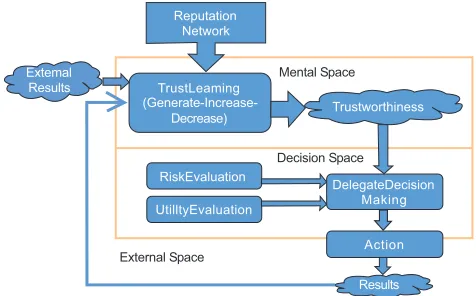
Fig. (9) is a framework designed for the computational trust and reputation. In the mental space, agents carry out trust learning through observing the results of actions. Such learning leads to the generation, increasing or decreasing of trustworthiness. The learning process is discussed in the next
section in details. Next to the mental space is the decision space where agents use trustworthiness derived in the learn-ing process to make delegation decisions. It is combinatory decision making process in that the risk and utility evalua-tion are also included. The outcomes of specific transacevalua-tion are constantly observed by the other agents. The observation will become the input of next round trustworthiness learning. Apart from the agents own experience, the trust from the other agents, reputation, is also part of the input of trust learning. The reputation from an organized social network and its propagation mechanism is also research topic in the future work.
Most aforementioned trust and reputation models are mathematically based upon simplistic algebraic summation or explicit statistical deduction through counting the success or failure of historical transactions toward the target agents. Surely these methods can produce reasonable numerical re-sults and then translate them into thresholds which help agents make decisions. However, the assumption that the agents always repeat the same transactions with the same target opponents is impossible in an ever changing complex multi-agent environment.
• First, the semantics are various among objects and it does not make sense to hold some invariable elements as formula to calculate the trustworthy or not trustworthy.
• Second, the count of success or failure of transaction is non-sense when the target of discussion is different. It is impossible to draw an equal mark between a success of a coke transaction and a success of an airplane transaction.
• Third, there is no sure clear border between trustwor-thiness and distrust-wortrustwor-thiness, that is, trustwortrustwor-thiness or its opposite should be a pattern generated from the repeated transactions instead of a simplistic value.
Fig. (9 ). Strengths and weaknesses of models based upon the ele-ments.
The above analysis leads the modeling of trust and repu-tation to the area of compurepu-tational intelligence. Actually, trustworthiness is one kind of belief. The research on genera-tion of trustworthiness is to model a specialized kind of be-lief for the computer agent. In the study of computational intelligence, several streams are popular and focused in re-cent years: neural networks, evolutionary computation, swarm intelligence and fuzzy systems. Since 1970s, neural network becomes one of the main research streams of
com-Extemal Results
Network Reputation
TrustLeaming
(Generate-Increase-Decrease)
Decision Space
External Space
Mental Space
Trustworthiness
DelegateDecision Making
Action
Results RiskEvaluation
[image:7.612.335.573.448.596.2]putational intelligence. It is widely applied in machine learn-ing, pattern recognition, and biological science. The reasons of choosing neural network as the basic calculating mecha-nism are listed as below:
• Instances are represented by many attribute-value pairs. The target function to be learned is defined over instances that can be described by a vector of predefined features.
• The target function output of the computational trust can be discrete-valued, real-valued or a vector of several real or discrete-valued attributes.
• Neural network learning is good choice for fast evalua-tion of the learned target funcevalua-tion. Usually, the recognievalua-tion of trustworthiness should be finished several times per sec-ond by the agents.
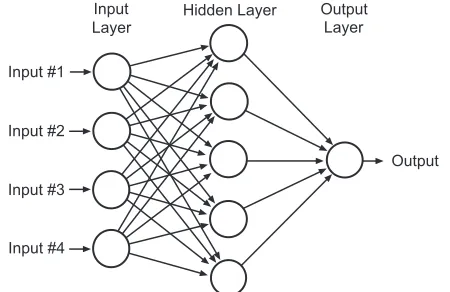
• The ability of humans to understand the learned target function is not important. The weighted learned by neural networks are often difficult for humans to interpret. Fig. (10) illustrates the topological design of the computational trust recognition for intelligent agent. The input layer is composed by dynamically organized element. The elements are ex-tracted from the semantic library according to the target ob-ject. For example, if the target object is digital camera, then the elements extracted maybe price, quality, guarantee and delivery. The neural network will gradually adjust its weights in a way of unsupervised learning.
f (x) = K
w
ig
i(x)
i
where K is some predefined function, such as the hyperbolic tangent. It will be convenient for the following to refer to a collection of functions g as simply a vector g = g1,g2,...gn.
Fig. (10). Neural Network based Trust Calculation.
CONCLUSIONS
Plenty of interests have been attracted to the construction of computational trust from various research communities. Through analyzing and comprising theses models, the study proposes that a complete computational trust model should at least have seven fundamental elements. Some conclusions are drawn as follows:
• The current trust dimensions are not enough to repre-sent trust in multi-agent systems and new dimension can be modelled through introducing concepts in sociology.
• Agents from different domains must fill their semantic gaps through constructing ontology with XML and RDF.
• The searching algorithm for trust network and the propagation mechanism for trust network can be progressed through introducing techniques in social network analysis.
• Except for the reliability of target agents, agents also need to manage the risk (or environmental reliability) due to environmental changes or accidental incidents.
• A complete experimental platform which used to test the functionality, performance and security of computational trust model is a necessity.
The future work of the research domain can also be natu-rally derived from the above conclusions.
• The dimension of trust can be extended based on the study of trust in sociology and psychology. It is necessary to categorize the scenarios where the dimension is appropri-ately used.
• The results in the research of semantic web can be used in the computational trust model. It is necessary to create an ontology built upon XML and RDF that allows systems to provide machinereadable semantic annotations for trust of specific domain.
• Theories about social analysis in social science can be used to build algorithms for searching witnesses in the net-work of intelligent agents. It is necessary to develop a trust transitivity or propagation mechanism which fulfils the re-quirement of different situations.
• There is still needs for a simplified, effective mathe-matical model which can be evaluated through appropriately constructing experiments.
REFERENCES
[1] Simon HA. The science of artificial 3rd ed. MIT Press 1996. [2] Rothkopf MH. The future of e-markets. J Econ Lit 2003; 41(1):
214.
[3] Coulouris G, Dollimore J, Kindberg T. Distributed systems: con-cepts and design. Addison-Wesley Longman Publishing Co., Inc 2000. [4] Ree Source P. A really great journal paper. Really Great J 1998;
23(2): 728-36.
[5] Ferber J. Multi-agent systems: An Introduction to Distributed Arti-ficial Intelligence.Addison-Wesley 1999.
[6] Subrahmanian VS, Bonatti P, Dix J, et al. Heterogeneous Agent Systems MIT Press 2000.
[7] Huynh TD. Trust and Reputation in Open Multi-agent Systems. Ph.D. thesis. Schools of Electronics and Computer Science, Uni-versity of Southampton 2006.
[8] Marsh S. Formalising trust as a computational concept. Ph.D. thesis. Department of Mathematics and Computer Science, University of Stirling 1994.
[9] Zacharia G. Collaborative reputation mechanisms for online communities. Master’s thesis. Massachusetts Institute of Technology 1999.
[10] Sabater J. Trust and reputation for agent societies. PhD thesis. Universitat Autnoma de Barcelona 2003.
[11] Luke TW, Jigar P, Nicholas R, Jennings ML. Coping with inaccu-rate reputation sources: Experimental analysis of a probabilistic trust model. AAMAS’05 2005.
[12] Huynh TD, Jennings NR, Shadbolt NR. An integrated trust and reputation model for open multiagent systems. Auton Agent Multi Agent Syst 2006; 13: 119-54.
[13] Luke TW. Agent-based trust and reputation in the context of inac-curate information sources. Ph.D. thesis. Schools of Electronics and Computer Science, University of Southampton 2006.
Input #1
Input #2
Input #3
Input #4 Input
Layer Hidden Layer OutputLayer
[image:8.612.72.297.447.593.2]A Review on Computational Trust Models for Multi-Agent Systems The Open Information Science Journal, 2009, Volume 2 25 [14] Sabater J, Sierra C. REGRET: A reputationmodel for gregarious
societies. In Fourth workshop on deception fraud and trust in agent societies. Montreal, Canada 2001; pp. 61-70.
[15] eBay Site. (http://www.ebay.com), World Wide Web.
[16] Pesnick P, Zeckhauser R. Trust among strangers in internet transactions: empirical analysis of eBay’s reputation system; In: Baye MR, Ed. The economics of the internet and e-commerce; ad-vances in applied microeconomics; Elsevier Science 11: 2002. [17] Yu B, Singh MP. Searching social networks. In Proceedings of the
second international joint conference on autonomous agents and multiagent systems (AAMAS). ACM Press 2003: pp. 65-72. [18] Yu B, Singh MP. An evidential model of distributed reputation
management. In Proceedings of first international joint conference on autonomous agents and multi-agent systems. ACM Press 2002; Vol. 1: pp. 294-301.
[19] Dempster AP. A generalization of Bayesian inference. J R Stat Soc Ser B 1968; 30: 205-47.
[20] DeGroot MH, Schervish MJ. Probability and statistics, 3rd ed. Addison-Wesley 2002.
[21] Josang A, Ismail R, Boyd C. A survey of trust and reputation sys-tems for online service provision. Dec Supp Syst 2007; 43: 618-44. [22] Piotr Sztompka.Trust: A Sociological Theory (Cambridge Cultural
Social Studies). Cambridge University Press 2000.
[23] Josang A, Pope RS. Semantic Constraints for Trust Transitivity. APCCM , University of Newcastle 2005.
[24] Gerstner Laboratory. Agent System Development Hands-on Exer-cise. EASSS-05 (7th European Agent Systems Summer School), Utrecht, The Netherlands 2005.
[25] Bellifemine F, Caire G, Greenwood D. Developming multi-agent systems with JADE. John Wiley and Sons 2007.
[26] FIPA-OS Developers Guide, http://citeseer.ist.psu.edu/477218.html. [27] Nwana H, Ndumu D, Lee L, Collis J. Zeus: a toolkit and approach for building distributed multi-agent systems. Proceedings of the Third International Conference on Autonomous Agents (Agents’99). ACM Press 1999; pp. 360-1.
Received: March 31, 2008 Revised: November 22, 2008 Accepted: November 22, 2008
© Lu et al.; Licensee Bentham Open.