PAPER • OPEN ACCESS
Passive wall cooling panel with phase change
material as a cooling agent
To cite this article: Masni A. Majid et al 2017 IOP Conf. Ser.: Mater. Sci. Eng. 271 012022
View the article online for updates and enhancements.
Related content
Heat transfer characteristics of coconut oil as phase change material to room cooling application
M Irsyad and Harmen
-Phase changes of iron near surface layers under argon ion irradiation
V P Filippov, B A Kalin, V I Petrov et al.
-HIPped High Density Bi-(Pb)-Sr-Ca-Cu-O Superconductors Produced without Any Additional Treatment
Hiroshi Seino, Kozo Ishizaki and Masasuke Takata
Passive wall cooling panel with phase change material as a
cooling agent
Masni A. Majid 1 ,Rasyidah Ahmad Tajudin 1, Norhafizah Salleh 1, Noor Azlina Abd Hamid 1
1Jamilus Research Center, Faculty of Civil and Environmental Engineering, University of Tun
Hussein Onn Malaysia, Batu Pahat
Corresponding E-mail: [email protected]
Abstract. The study was carried out to the determine performance of passive wall cooling panels by using Phase Change Materials as a cooling agent. This passive cooling system used cooling agent as natural energy storage without using any HVAC system. Eight full scale passive wall cooling panels were developed with the size 1500 mm (L) x 500 mm (W) x 100 mm (T). The cooling agent such as glycerine were filled in the tube with horizontal and vertical arrangement. The passive wall cooling panels were casting by using foamed concrete with density between 1200 kg/m3 – 1500 kg/m3. The passive wall cooling panels were tested in a small house and the differences of indoor and outdoor temperature was recorded. Passive wall cooling panels with glycerine as cooling agent in vertical arrangement showed the best performance with dropped of indoor air temperature within 3°C compared to outdoor air temperature. The lowest indoor air temperature recorded was 25°C from passive wall cooling panels with glycerine in vertical arrangement. From this study, the passive wall cooling system could be applied as it was environmental friendly and less maintenance.
1.Introduction
Nowadays, we were facing the global warming problem. Global warming was a serious threat to our planet and would result in a wide variety of harsh environmental impacts. Greenhouse gas (GHG) emissions (especially CO2 emission) were the underlying cause of this warning. Due to this problem, the people in world feel uncomfortable. For providing comfortable environment, they would find the alternative way such as using air conditioner and using fan. All of this needed to consume the electrical energy [1].
Energy used and supplied current trends were clearly unsustainable from social, economic and environmental perspective. The increase in energy demand results in increasing level of greenhouse gas emission that contributes to the increased global warming and cost of energy. Without decisive steps, carbon dioxide (CO2) emission associated with energy consumption expected double in 2050 which leads to growing demand of fossil energy and intensity concerns over the supplies security [1].
One of the major challenges for administration and government is energy demand to satisfy thermal comfort in building. In energy systems where temporal differences exist between the supply of energy and its utilization, thermal storage is necessary to ensure the continuity of a thermal process [2].
2
[image:3.595.179.435.186.326.2]comfortable environment for their life. Figure 1 showed the breakdown of energy consumption in Malaysia. This research was carried out to find the best way and solution to solve the thermal problem without using electrical energy and environmental friendly by using passive cooling system in order to save the future generation’s life.
Figure 1. Breakdown of energy consumption Source: (Malaysia Energy Commission)
2.Literature Review
2.1.Phase Change Materials
Phase change materials (PCMs) could be defined as unique materials that store and release heat by means of latent heat. PCMs were used as thermal energy storage (TES) for building to control temperature over a cycle period of 24 hours to change and discharged the heat. PCMs were one of the best management methods used to control building temperature within the daily cycle.
A first classification of substances used for thermal energy storage materials stating those utilized as PCM which was useful and widely used. The basic mechanism of phase change materials (PCMs) application in free cooling was for reduction of overheating inside buildings, as PCMs had enormous thermal capacity to absorb large amounts of heat and large ranges of melting temperatures [3]. As such, the used of PCMs helped to reduce the need for regular heating and cooling and worked as an alternative to air-conditioning to control the temperature inside the space [4]. For the selection of PCM certain specifications must be taken into account [5], melting point of PCM must be very close to the application temperature, high specific heat must be considered for the PCM, and high thermal conductivity in solid and liquid phases must be taken to support charging and discharging process in storage system used.
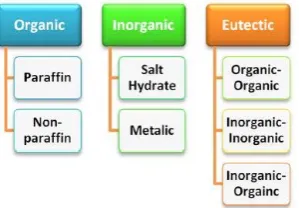
Changing of material phase had been classified into four states, solid-solid, solid-liquid, gas-solid and gas-liquid. For practical purposes, only the solid-liquid variety had been used for building cooling or heating because the other varieties had technical limitations [6]. There was a wide variety of PCMs on the market with different melting point ranges. The most common classification of PCMs are organic, in organic and eutectic as presented in figure 2 [7].
[image:3.595.225.375.613.717.2]3.Methodology
3.1.Preparation of materials
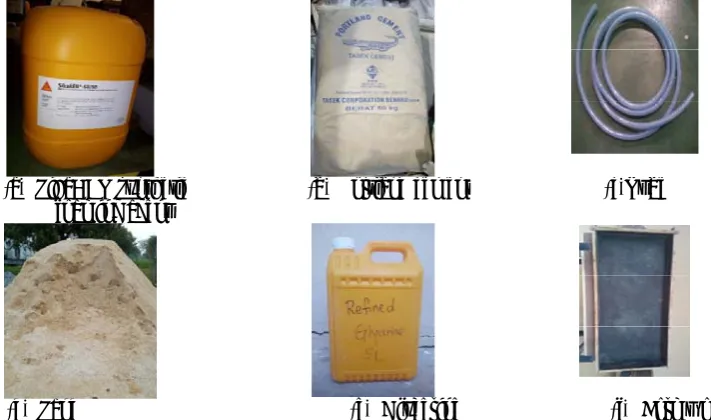
The materials were used in this research were foam agent, Ordinary Portland Cement, aggregate, water, cooling agent (glycerine & tap water), tube and formwork. The volume of foaming agent used for panel with the size 1500 mm x 500 mm x 100 mm was 500 ml. with the mixing of water ten times the volume of foam agent. The Ordinary Portland Cement used was 27.72 kg for each panels. The aggregate used was fine aggregate with the size of 5 mm, quantity used was 50 kg and the aggregate was in saturated and dry surface condition. The quantity of water and glycerine used were 12.73 kg and 1000 ml. The type of tube used was reinforcement tube because of its high durability and could withstand the glycerine. Size of formwork was used same as the size of wall cooling panels, 1500 mm (L) x 500 mm (W) x 100 mm (T) and the formwork was made up of high quality of plywood and waterproofing.
(a) SikaAER synthetic
foaming agent
(b) Portland cement (c)Tube
[image:4.595.120.476.289.499.2](d) Sand (e) Glycerine (f) Formwork
Figure 3. (a) – (f) : Materials of passive wall cooling panels
3.2.Casting of wall cooling panels
The wall cooling panel with dimension 1500 mm x 500 mm x 100 mm had been cast. The preparation of foamed concrete with foaming agent and installation of reinforcement tube and cooling agent in wall cooling panel had been done before using them to the field measurement. The targeted wet
density for foam concrete was 1300-1400 kg/m3. Table 1 showed, list of sample, cooling panel with
horizontal arrangement (CPWH) with water, cooling panel with vertical arrangement (CPWV) with water, cooling panel with horizontal arrangement (CPWH) with glycerine, cooling panel with vertical arrangement (CPWV) with glycerine, and brick panel (BP). Table 2 showed the mix design for each of the panels.
Table 1. List of samples
Type of wall panel Cooling agent No of samples
CPWH Water 2
CPWV Water 2
CPWH Glycerine 2
CPWV Glycerine 2
BP - 2
[image:4.595.109.486.635.727.2]4
Table 2. Mix Design
Material Sand OPC Water Foam Agent Glycerine
Mix design (kg/m3) 666.67 369.60 169.73 6.67 13.33
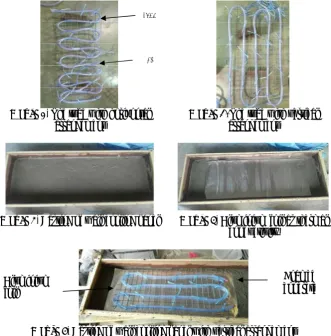
Eight wall cooling panel was developed to further the next phase, which was field measurement. The wall cooling panel with 1500 mm x 500 mm x 100 mm was developed. The wall cooling panels were the different arrangement of tube which are in horizontal and vertical.
Figure 4. The tube with horizontal arrangement
Figure 5. The tube with vertical arrangement
[image:5.595.134.466.224.561.2]Figure 6. Casting of wall cooling panel Figure 7. Aluminium foil as thermal conductivity
Figure 8. Casting of wall cooling panel with vertical arrangement
3.3.Testing on foamed concrete
For fresh properties, the slump flow test was carried out according to ASTM C1611/C1611 to accesses the properties of the fresh foam concrete. The primary characteristics of fresh foamed concrete was evaluated by this two tests and was carried out directly after concrete mixing.
The flowability of self-compacting concrete was evaluated by slump flow test without any obstruction. The diameter require was shown in figure below was the measurement required for all self-compacting lightweight concrete. The self-compacting concrete should had the value between 500 mm to 850 mm for a slump value, while T50 time are the time spend for the concrete to reach the 500 mm spread circle [8]. Foamed concrete workability performance was visually evaluated, which aims to be achieved an appropriate viscosity of the mix. The workability by using spreadability method. This test was done on a fresh mix of low-strength materials by measuring the spread in two directions of a
Tube
BRC
Aluminium foil
sample placed in a 75 mm diameter and 150 mm long open-ended cylinder, after cylinder was raised vertically. The average of two measured diameters was calculated and reported to the nearest 5 mm.
For hardened concrete properties, compression test was carried out. The test was conducted according to BS 1881: Part 116: 1983 [9]. According to ASTM C 796, at least three days before proceeding the testing, foamed concrete cube that will be conducted the compression test should be cured in a moist room with 100% relative humidity. The sample need to take out from the curing room and be oven-dried for 72 hours at 60° [10]. The desired compressive strength will be obtained when the sample have been cured in a normal moist air for one day and the temperature must increase at 20°C/h for steam state to preserve at 65°C for 4 hours and then cooled in air [11].
Figure 9. Air curing Figure 10. Curing of wall cooling panel
3.4. Field Measurement Test
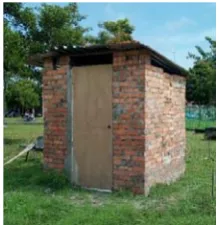
For field measurement test, a small house had been developed for the testing of the wall cooling panel.
The size of the small house was 2 m x 2 m x 2 m. The area of the floor was 4.0 m2 The test for
[image:6.595.284.472.241.315.2]temperature performances of passive wall cooling panels were tested in the small house for 3 days. The air temperature reading were taken inside and outside of the small house. Due on Ibrahim and M. Hazrin, the thermal comfort parameter should be measure at least one meter from the floor to represent the height of occupant at seated level. The point of sampling was selected at 8 point according to the Industry Code of Practice On Indoor Air Quality 2010. However, it will change based on the condition of the nature of the building. Since the area of small house 4m2 only 1 point had consider when doing field measurement. The parameter such as air velocity, air temperature and relative humidity was used as thermal comfort parameter. The measurement tool used for this test was an anemometer.
Figure 11.Small house Figure 12. Anemometer for temperature
4.Results and Discussion
4.1.Slump Flow Test
[image:6.595.122.232.476.589.2] [image:6.595.319.434.530.584.2]6
Table 3. Result of Slump Flow Test
Panels Cooling Agent Time (s) Result
CPWH Water 10 Pass
CPWV Water 12 Pass
CPWH Glycerine 11 Pass
CPWH Glycerine 10 Pass
Figure 13. Spreadability of fresh concrete
4.2.Space considerations
[image:7.595.182.418.408.554.2]Compressive test was conducted to test the strength of harden concrete. It was the capacity of a concrete sample to withstand axially the direct force until the limit of failure load was achieved, the sample crushed. Six sample of cubes were tested to get the value of compressive strength. Figure 14 shown the compressive strength result. Based on the result below, the strength of foamed concrete increase with the day. The result of compressive strength according to BS 1881: Part 116: 1983 passed because of correct technique of rate of foam agent, w/c ratio, sand particle type, the curing method and cement-sand ratio.
Figure 14. Compressive strength result
4.3.Space considerations
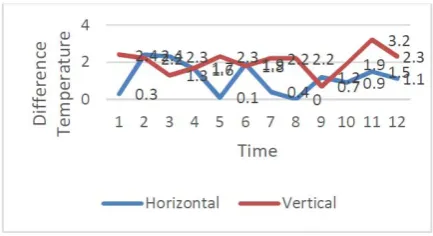
The results were analysed for difference arrangement of tube and different type of cooling agent. For difference arrangement, the results were analysed for glycerin and water. According to figure 15, the result showed the differences of the temperature between horizontal and vertical arrangement of tube by using glycerine as cooling agent. The result showed 8 out of 12 times, the vertical arrangement had biggest value of difference temperature and the biggest difference was on time 10 which vertical was 5.5°C and horizontal was 1.1°C. This differences happened due to wall cooling panels with vertical arrangement had a large surface area of the exposed tube with the cooling agent compared to horizontal arrangement. Then, the cooling agent reacted quickly and decreased more temperature in the small house.
As conclusion, the wall cooling panels with vertical arrangement had better performance in decreasing air temperature in the small house compared to horizontal arrangement.
Figure 15. Temperature of different arrangement of wall cooling panel with glycerine
According to figure 16, the result showed the differences of the temperature between horizontal and vertical arrangement of tube by using glycerine as cooling agent. The result showed 8 out of 12 times, the vertical arrangement had biggest value of difference temperature and the biggest difference was on time 8 which vertical was 2.2°C and horizontal was 0°C. This differences happened due to wall cooling panels with vertical arrangement had a big surface area of the exposed tube with the cooling agent compared to horizontal arrangement. Then, the cooling agent reacted quickly and can decrease more temperature in the small house. As conclusion, the wall cooling panels with vertical arrangement had good performance in decreasing temperature in the small house compared to horizontal arrangement.
Figure 16. Temperature of different arrangement of wall cooling panel with tap water
[image:8.595.202.419.397.515.2]8
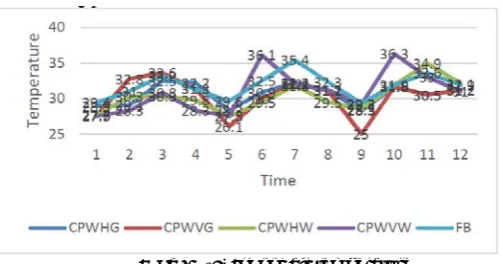
Figure 17. Indoor air temperature
5.Conclusion
Based on the study that had been carried out, the result obtained was to determine the temperature performance of wall cooling panel by using difference arrangement of the tube and to analyse temperature performance of wall cooling panel by using difference type of cooling agent. Comparison between the brick panel as control and all the wall cooling panel had been analysed. Hence, the conclusions were concluded, the wall cooling panel with vertical arrangement had better temperature performance because they had big area exposed to tube contained glycerine. The wall cooling panel with PCMs which was glycerine as passive cooling agent have the lowest temperature such as 25°C compared to others panel with more than 25°C. The Phase Change Materials, glycerine was one of the suitable cooling agent that showed lowest air temperature compared to other panels. Based on the comparison between all the cooling agent and medium with the brick panel as control, it was proved that vertical arrangement with glycerine were the suitable medium for passive cooling.
6.References
[1] International Energy Agency 2002 Technology Roadmap Energy-efficient Building. (France:
Heating and Cooling Equipment).
[2] Alizadeh M and Sadrameli S M 2016 Development of free cooling based ventilation technology
for buildings: Thermal energy storage (TES) unit, performance enhancement techniques and design considerations- A review Renewable and Sustainable Energy Reviews 58 619-645.
[3] Baetens R, Jelle B P and Gustaven A 2010 Phase change materials for building application: A
state review. Energy Building. 42(9) 1361-1368.
[4] Biswas K, Lu J, Soroushian P and Shrestha S 2014 Combined experimental and numerical
evaluation of a prototype nano-PCM enhanced wallboard. Applied Energy 131 517-529.
[5] Tyagi V V and Buddhi D 2007 PCM thermal storage in buildings: A state of art. Renewable and
Sustainable Energy Reviews 11(6)1146-1166.
[6] Sun X, Zhang Q, Medina M A and Lee K O 2016 Experimental observation on the heat
transfer enhancement caused by natural convection during melting of solid-liquid phase change materials (PCMs). Applied Energy, 162, pp 1453-1461.
[7] Cao L, Su D, Tang Y, Fang G and Tang F 2015 Properties evaluation and application of
thermal energy storage in building. Renewable and Sustainable Energy Reviews 48500-522.
[8] Biswas K, Lu J, Soroushian P and Shrestha S 2014 Combined experimental and numerical
evaluation of a prototype nano-PCM enhanced wallboard. Applied Energy 131 517-529.
[9] Barreneche K, Navarro L, De Gracia A, Fernandez A I and Cabeza L F 2016 In situ
thermal and acoustic performance and environmental impact of the introduction of a shape- stabilized PCM layer for building applications Renewable Energy 85281-286.
[10]Amran Y H M Farzadnia N and Ali A A A 2015 Properties and applications of foamed
concete: A review Construction and Building Materials 101(1)990-1005.
[11]Fujiwara H, Sawada E and Ishikawa Y 1995 Manufacture of High-Strength Aerated Concrete
[12]Barreneche K, Navarro L, De Gracia A, Fernandez A I and Cabeza L F 2016 In situ thermal and acoustic performance and environmental impact of the introduction of a shape-stabilized PCM layer for building applications Renewable Energy 85 281-286.
Acknowledgment