International Journal of Emerging Technology and Advanced Engineering
Website: www.ijetae.com (ISSN 2250-2459, Volume 2, Issue 4, April 2012)200
SDR based Energy Efficient Routing for
Ad Hoc Networks
1
Tanu Preet Singh,
2Dr. R.K Singh,
3Vishal Sharma
1Department of Computer Science & Engineering, Punjab Technical University, Jalandhar, India 2Department of Electronics & Communication Engineering, Uttarakhand Technical University, Dehradun India
3
Department of Computer Science & Engineering, Punjab Technical University, Jalandhar, India
Abstract: - MANETs are networks capable of communicating in a set of small, low cost, low power sensing devices. A wireless sensor networks is totally based on the limiting factor i.e. energy consumption. A wireless sensor network consists of large number of sensor nodes distributed or scattered in particular network region. MANETs consist of node that is highly mobile, so in particular the range of the nodes is very important. Each device in a MANETs is free to move independently in any direction, and will therefore change its links to other devices frequently. The energy and the bandwidth of such path are of major concern. The lifetime of the network depends upon these parameters. The paper deals with the working of the SDR for routing that makes an ad hoc network energy efficient in terms of consumption of energy. SDR is equipment that is integrated circuit type chip that is used in place of receiver and transmitter. The paper deals with the integration of SDR chip with the traditional routing heads in MANETs.
Keywords: - SDR, receiver processing energy, transmitter energy.
I.
I
NTRODUCTIONA wireless ad hoc network is based on the nodes that are mobile and have capabilities of communicating each other with packet radios over a shared wireless medium. The limited radio propagation causes the route to be multi hop [1] [2] [7] [8]. The applications of such networks can be search and rescue, automated battlefields, disaster recovery, crowd control and sensor networks. The routing protocol must have the ability to manage the frequent topology changes caused by the mobility of nodes and these need to be efficient as compared on basis of efficiency in terms of bandwidth and power as well as on basis of load transmission.
With the advent of On-demand routing, the tables are not maintained and the topological views are also rescued and the routing totally becomes dynamic. Existing on demand routing protocols such as DSR (Dynamic Source Routing), AODV (Ad-hoc on demand distance vector routing) are the shortest path based routing protocols,
also these don’t consider the packet size and the antenna range of the nodes as a performance metric due to which there is a problem of long delays and congestions in the routing path and the whole set up of the nodal structure enters in to the dead state [10]. Also, on demand protocols that use the shortest paths as performance metric suffer from performance degradation as the network traffic increases [10]. In the paper [6], the energy of the nodes is the major area of concerned for the research to be carried on in this field. The one of the method suggested was CPACL protocol. It stands for cost based power aware routing protocol. In this paper the energy factor of the nodes is taken to be major concern. In this paper, a routing algorithm has been suggested that selects the path form the source to the destination on basis of the path that consumes the least energy [10]. The path selected for this transmission is the best selected path for the particular types of nodes. This means that if a path is defined from node 1 to node 2 by CPACL algorithm, it is the best suited path in all conditions [7] [10]. This protocol is the reactive routing protocol.
It maintains the established routes as long as they are needed by the sources. AODV- CPACL uses sequence numbers to ensure the freshness of routes. The route discovery process is initiated whenever; a traffic source needs a route to a destination. Route discovery typically involves a network wide flood of route request packets targeting the destination and waiting for a route reply. It has also been shown that the per node throughput capacity of ad hoc networks with nodes n decreases with n as Θ (1/n log n) 1/2
International Journal of Emerging Technology and Advanced Engineering
Website: www.ijetae.com (ISSN 2250-2459, Volume 2, Issue 4, April 2012)201
Also the receiver consumption can be improved by using the cross layer design including the effects of the power amplifier used at the transmitter end [8]. The transport efficiency of an ad hoc network was defined considering the transmitter energy and the receiver’s processing energy [9] [10]. Thus the energy consumption for the packet transmission and the large number of hops is considered [6]. For the networks that have energy as their limiting resource, the network lifetime related to the energy is one of the significant performance metrics [6]. To solve the dead state problem, we have earlier got our paper published that resolved this issue of nodes getting into the dead state[2]. This protocol was termed as DSPO. But there was a concern about delays that may arise due to selection of alternative path that may occur as hindrance for the real time networks that have performance issues with them.
In this paper, we are proposing the practically verified protocol for MANETs termed Delay Elimination Protocol. This protocol implements the technique of sub network control protection on mobile nodes and allows ring formation that can switch the network with zero delay. The protocol searches for the shortest path as well as the most optimized node for purpose of transmission.
II.
S
YSTEMM
ODELThe network model we considered comprises of k number of hops, hops here are the nodes, and the nodes here considered are to be single channel node. This means for k number of nodes there is k number of channels. Thus, if two nodes are communicating at a time, then we have k-1 number of relaying nodes in the network model. The distance between the source and the destination is denoted by d. the distance between the relaying nodes can be decided on basis of the dynamic routing considered or it can be given on mathematical computations, this means that the distance between the relaying nodes will be less than the actual distance between the source and destination. Thus, if we consider a constant, let this constant be αn then, from the theoretical analysis [6], we obtain that this value is multiplied with the total distance to obtain the actual distance between the relaying nodes then this value should be positive and less than one. Thus, the distance between the relaying nodes will be:
The mobility introduces another simple concept. If the mobility of the structure nodes is more, the attenuation has greater effect but if the nodes are considered to be at rest then, the attenuation comes out to be so small that it
can be neglected. Thus, the modified formula for the attenuation loss in a network model will be:
Here, is the attenuation loss in the MANETSs, β is the antenna constant, d is the end to end distance between source and destination, ε is the path loss constant such that 2 < ε < 4 and δ is the mobility factor. The mobility can be computed by analyzing the movement in terms of number of bits transferred per second per meter of the network model. Here, Pout = fo (Pin), which is based on the working power amplifier present in each of the node.[1]
III.
A
BOUTSDR
According to SDR forum, “Software Defined Radio (SDR) are Radios that provide software control of a variety of modulation techniques wide and narrowband operation, communication security function and waveform requirements of current and evolving standards over a broad frequency range [SDR forum]”
SDR is a collection of hardware and software technologies that enable re-configurable system architectures for wireless networks and user terminals. SDR provides an efficient and comparatively inexpensive solution to the problem of building multimode, multi-band, multifunctional wireless devices that can be adapted, updated or enhanced by using software upgrades. To achieve this purpose, the primary goal of SDR is to replace as many analog components and hardwired digital VLSI devices of the transmitter-receiver as possible with programmable devices.
This includes:
Air interface
Modulation and coding schemes
Data converters (ADC/DAC)
International Journal of Emerging Technology and Advanced Engineering
Website: www.ijetae.com (ISSN 2250-2459, Volume 2, Issue 4, April 2012)202
The SDR concept promises the main solution of supporting a multitude of wireless communication services in a single infrastructure design. The need to communicate with people using different types of equipment can only be solved using software programmable radios because of its flexible architecture [3].
MAIN COMPONENT OF SDR BASED SYSTEM ARCHITECUTRE:
Figure 2 shows the main components that play vital role to enable SDR concept.
Fig. 2
The key components, which play vital role to support SDR-based architecture, which have been identified in the literature are as follows:
Intelligent antenna,
Programmable RF modules,
Digital-to-Analog (DAC)
Analog-to-Digital Converters (ADC),
Digital Signal Processing Techniques
Interconnect Technologies
IV.
U
SINGS
DRI
NM
ANETSSDR can easily be integrated with ad hoc network antennas or nodes and can be changed using programming logics. This can be done by developing advance problem solving software that can control hardware moments and their power generation. This can be used as an alternative resource for use of traditional nodal structure. Also, some of the advantages of SDR integration with nodes used in Ad hoc Networks are:
1. Easy application of SNCP in MANETs.
2. Delay variation and overheads control using SDR. 3. Less Energy consumption in terms of transmitter
energy and receiver processing energy.
4. Easy routing decision in terms of energy requirement on basis of acknowledgement.
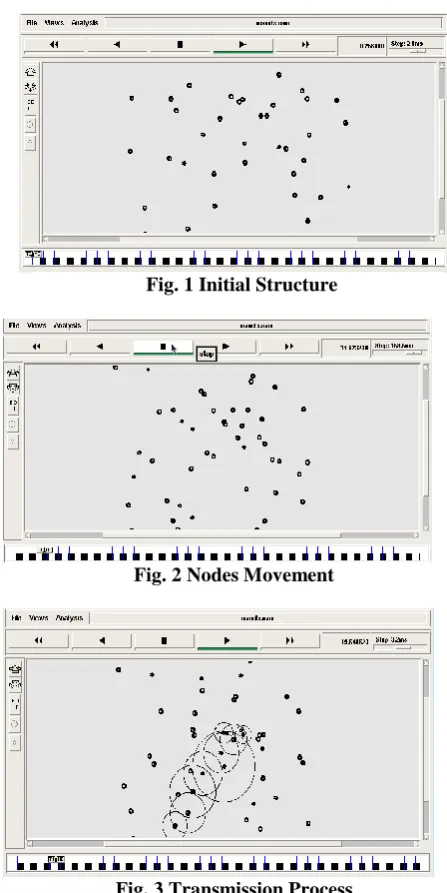
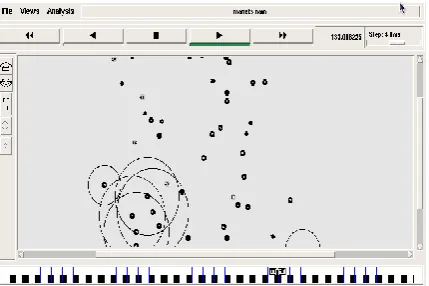
However, the SDR can improve the performance of MANETs but do not affect the working. The working of SDR can be shown through following animations of network simulators.
Fig. 1 Initial Structure
Fig. 2 Nodes Movement
[image:3.595.314.538.300.747.2]International Journal of Emerging Technology and Advanced Engineering
Website: www.ijetae.com (ISSN 2250-2459, Volume 2, Issue 4, April 2012) [image:4.595.50.265.154.297.2]203
[image:4.595.50.264.318.488.2]Fig. 4 Weakening of Transmission in normal mode
Fig. 5 Appropriate Transmission after SDR integration
V.
R
ESULTSA
NDA
NALYSISThe result is carried out by comparing the trace file of the newly designed and previous version of protocol. The comparison is carried out by use of files present in the x graph of NS-2. The graphs taken by us are as follows:
Parameter Value
Dimensions 1500X1500 sq. m. Number of Nodes 5,25,50,75 Simulation Time 200 s
Source Type UDP
Number of Connections 4,10,14,25 Packet Size 512 bytes Mac Layer IEEE 802.11 b Buffer Size 10,50,75,100 packets Propagation Radio
Model
Two Ray Ground
Physique layer Band width as 2 Mb/s Maximal Speed 10 m/s
Pause Time 10 s
Interval Time To send 2 packets /s
PARAMETER WITHOUT
SDR
WITH SDR Network Life average High Energy
Consumption
average Low
Overheads Limited Low
Source type handling
All type All type
Network traffic All type All type Network Size All Size All Size
VI.
C
ONCLUSIONSDR is a modern technology that increases the performance of the network without intervening in the process of actual transmission. The performance increases by continuous and endless transmission till all the packets get transmitted from source to destination. Thus, in future, work can be carried out in modifying the architecture of SDR for less power consumption and more number of device integration over it.
R
EFERENCES[1]. Tanu Preet Singh, Vishal Sharma “Automated Recovery Based Power Awareness Routing Protocol for MANETs” in International Conference on Computer Communication & Management, Sydney Australia May 2-4 2011.
[2]. Dr. R.K. Singh, Tanu Preet Singh, Vishal Sharma:”Dead State Recovery Based Power Optimization Routing Protocol for MANETs”, HPAGC-2011, CCIS 169, pp.424-429,2011. © Springer-Verlag Berlin Heidelberg-2011.
[3]. Wasserman, M., “SDR-Based Readers Keep Pace With Changing RFID Technology,” RTC Magazine, January 2007, pp 42-45.
[4]. Couch, L.E, Digital and Analog Communications Systems, 4th edition, Macmillian, NY, 1993, p 252 [5]. Simoneau, J.S., and L.W. Pearson, “Digital
Augmentation of RF Component Performance in Software Defined Radio,” IEEE Transactions on Microwave Theory and Techniques, Vol. 57, No 3.March 2009, pp 573-581.
International Journal of Emerging Technology and Advanced Engineering
Website: www.ijetae.com (ISSN 2250-2459, Volume 2, Issue 4, April 2012)204
[7]. Frerking, M. E., Digital Signal Processing in Communications Systems, Van Nostrand, Reinhold, NY, NY, 1994
[8]. Mitola, III, J., “Cognitive Radio Architecture,” in Cognitive Radio,Software Defined Radio and Adaptive Wireless Systems, Hüseyin .
[9]. Hosking, R. H., Putting FPGAs to Work in Software Radio Systems,3rd edition, Pentek, Upper Saddle River, NJ, 2006