S h a p i n g t h e f u t u r e fo r p ri m a r y
c a r e e d u c a ti o n a n d t r a i ni n g
p r oj e c t . Fi n di n g t h e e vi d e n c e fo r
e d u c a ti o n & t r a i ni n g t o d e liv e r
in t e g r a t e d h e a l t h & s o ci al c a r e : A
s y s t e m a ti c r e vi e w of t h e
lit e r a t u r e
H o w a r t h , M L, G r a n t , MJ a n d H oll a n d , Ka r e n
T i t l e
S h a p i n g t h e f u t u r e fo r p r i m a r y c a r e e d u c a ti o n a n d t r ai ni n g
p r oj e c t . Fi n di n g t h e e vi d e n c e fo r e d u c a ti o n & t r ai ni n g t o
d eliv e r i n t e g r a t e d h e al t h & s o ci al c a r e : A s y s t e m a ti c
r e vi e w of t h e lit e r a t u r e
A u t h o r s
H o w a r t h , M L, G r a n t , MJ a n d H oll a n d , Ka r e n
Typ e
M o n o g r a p h
U RL
T hi s v e r si o n is a v ail a bl e a t :
h t t p :// u sir. s alfo r d . a c . u k /i d/ e p ri n t/ 1 7 6 2 6 /
P u b l i s h e d D a t e
2 0 0 4
U S IR is a d i gi t al c oll e c ti o n of t h e r e s e a r c h o u t p u t of t h e U n iv e r si ty of S alfo r d .
W h e r e c o p y ri g h t p e r m i t s , f ull t e x t m a t e r i al h el d i n t h e r e p o si t o r y is m a d e
f r e ely a v ail a bl e o nli n e a n d c a n b e r e a d , d o w nl o a d e d a n d c o pi e d fo r n o
www.pcet.org.uk
Shaping the Futur
e for Primar
y
Car
e Education & T
raining Pr
oject
Finding the Evidence for Education & T
raining to deliver Integrated Health & Social Car
e:
A Systematic Review of the Literatur
e
V
olume One 2004
Shaping the Future for Primary
Care Education & Training Project
Authors: Michelle
Howarth
Maria J Grant
Karen Holland
VOLUME: ONE
2004
Funded by the NorthWest Development Agency
Finding the Evidence for Education & Training
to deliver Integrated Health & Social Care:
A Systematic Review
of the Literature
Shaping the Futur
e for Primar
y
Car
e Education & T
raining Pr
oject
Finding the Evidence for Education & T
raining to deliver Integrated Health & Social Car
e:
A Systematic Review of the Literatur
e
V
olume One 2004
Contents
Finding the Evidence for Education and Training to deliver Integrated Health and Social Care: ContentsPage
Executive Summary 4
The Project Context: Introduction 6
Chapter One: Methodology for Systematic Review 7
1.1 Methodology 7
1.2 Sources of evidence 8
1.3 Review structure 8
Chapter Two: Integrated Health and Social Care 10
2.1 The Meaning of Collaboration 10
2.2 Achieving Collaboration 10
2.3 Defining Primary Care within the context of integration 11
2.4 The nature and purpose of Primary Care 12
Chapter Three: Integrated Health and Social Care Policy 14
3.1 Introduction 14
3.2 Promoting a seamless service through policy change 14 3.3 Funding strategies to support integrated working 15 3.4 Professional and Educational Response to the
Modernisation Agenda 16
3.5 Inter-professional education to promote
integrated working 18
Chapter Four: The Impact of Integrated Health
and Social Care Policy on future Education & Training Needs 21
4.1 Introduction 21
4.2 Operational indicators: 21
4.2.1 Team working 21
4.2.1.1 Team characteristics 22 4.2.1.2 Individual attributes to the team 23
4.2.1.3 Team Process 25
4.3 Communication 25
4.4 Role Awareness 28
4.5 Personal and Professional Development 31
4.5.1 Significance of Personal and Professional Development
to Integrated Health and Social Care 32
4.5.1.1 Perceived Professional Development needs 32
4.6 Strategic indicators 34
4.6.1 Practice Development and Leadership 34
4.7 Partnership Working 38
4.7.1 Culture and relationship in relation to partnership working 41
4.8 Summary of appraised evidence 42
Finding the Evidence for Education and Training to deliver Integrated Health and Social Care: Contents
Page Chapter Five: Developing the Workforce:
Validating the Emergent Themes 44
5.1 The Skills and Competency Frameworks 44
5.1.1 NHS Knowledge and Skills Framework 44
5.1.2 National Occupational Standards for Care & Social Care 44
5.1.3 NatPaCT PCT Competency Framework 45
5.1.4 The National Occupational Standards for Social Work 45
5.2 Mapping of Themes 45
5.2.1 Team Working 45
5.2.2 Communication 48
5.2.3 Role Awareness 49
5.2.4 Personal and Professional Development 50
5.2.5 Practice Development and Leadership 50
5.2.6 Partnership Working 51
5.3 Conclusion 52
Chapter Six: The Evidence and Implications for
Future Education and Training Provision 53
6.1 Introduction 53
6.2 Implications for future Education and Training 53
6.2.1 Team Working 54
6.2.1.1 Implications for Education and Training
to promote team working 55
6.2.2 Communication 55
6.2.2.1 Implications for Education and Training
to promote communication 56
6.2.3 Role Awareness 56
6.2.3.1 Implications for Education and Training
to promote role awareness 57
6.2.4 Practice Development and Leadership 57
6.2.4.1 Implications for Education and Training
to promote practice development and leadership 57
6.2.5 Personal & Professional Development 58
6.2.5.1 Implications for Education and Training
to promote personal and professional development 58
6.2.6 Partnership Working 58
6.2.6.1 Implications for Education and Training
to promote partnership working 59
6.3 Implications for the User/Carer perspective 59
6.4 Conclusion 59
Finding the Evidence for Education and Training to deliver Integrated Health and Social Care: Contents
Page
Appendices 61
Appendix 1 Checklist to assess whether to review papers 61 Appendix 2 Finalised inclusion and exclusion criteria 62
Appendix 3 Search strategies 63
Appendix 4 Policy Framework Mapping tables 67
Appendix 5 National Occupational Standards Tables for Health – Mapping in relation to integrated Health
and Social Care education and training 72 Appendix 6 Allied Health Professionals self-assessment document 73 Appendix 7 Summary of studies included in the review 74
References 78
Websites 82
Bibliography 83
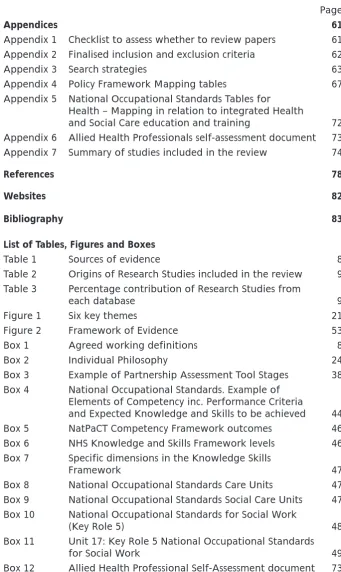
[image:7.595.195.537.167.740.2]List of Tables, Figures and Boxes
Table 1 Sources of evidence 8
Table 2 Origins of Research Studies included in the review 9 Table 3 Percentage contribution of Research Studies from
each database 9
Figure 1 Six key themes 21
Figure 2 Framework of Evidence 53
Box 1 Agreed working definitions 8
Box 2 Individual Philosophy 24
Box 3 Example of Partnership Assessment Tool Stages 38 Box 4 National Occupational Standards. Example of
Elements of Competency inc. Performance Criteria
and Expected Knowledge and Skills to be achieved 44
Box 5 NatPaCT Competency Framework outcomes 46
Box 6 NHS Knowledge and Skills Framework levels 46 Box 7 Specific dimensions in the Knowledge Skills
Framework 47
Box 8 National Occupational Standards Care Units 47 Box 9 National Occupational Standards Social Care Units 47 Box 10 National Occupational Standards for Social Work
(Key Role 5) 48
Box 11 Unit 17: Key Role 5 National Occupational Standards
for Social Work 49
Executive Summary
Finding the Evidence for Education and Training to deliver Integrated Health and Social Care: Executive Summary
Introduction
This literature review is one of series of outputs from Shaping the Future in Primary Care Education and Training
project (www.pcet.org.uk) which is
funded by the North West
Development Agency (NWDA). It is the result of a collaborative initiative between the NWDA, the North West Universities Association and seven Higher Education Institutions in the North West of England.
Methodology
An iterative search process was adopted for the review. A total of 80 documents were identified as background, context or policy papers and 24 research studies have been appraised in terms of their rigour, trustworthiness and relevance. The review took account of and included an appraisal of contemporary literature, key policies and research evidence. In particular it took account of the importance and
inter-connectedness of policy, practice, population and workforce needs within an integrated health and social care service.
Evidenced based implications
for health and social care
services and education
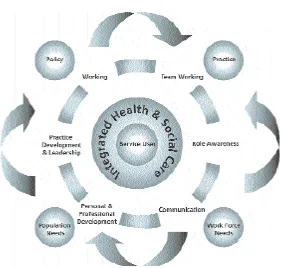
Six key themes emerged from the policy documents and wider research evidence base. These are:
■ team working
■ professional and personal development
■ practice development and leadership
■ role awareness
■ partnership working
■ communication
The themes have been mapped against the NHS Knowledge and Skills Framework, National Primary and Care Trust Development Programme
Competency Framework (NatPaCT) and the National Occupational Standards for Health and Social Work. The combined themes are considered essential requirements of effective integrated health and social care services.
The key implications for health and social care services and education are:
Team working
■ Develop teams, with the
appropriate skills and knowledge, that are able to liaise and work collaboratively across
organisations and agencies
■ Ensure that any team has the required awareness of all the member role functions and professional background as appropriate
■ Education and training programmes need to take cognisance of team working in integrated health and social care services, and not simply working in a team
■ Education and training for team working needs to be planned to take account of both professional working and inter-agency working
■ Service planning and service provision need to take account of the education and training required for a whole team when creating new roles
■ Pre-registration/access to health work programmes need to place greater emphasis on team working in integrated health and social care as a core skill
■ Co-location of teams needs to take into account education and training for new ways of working
Communication
■ Ensure staff working in integrated teams have well developed communication skills to enable
them to work within and across inter-professional and inter-agency boundaries
■ Pre-registration/access to health work programmes need to ensure that effective communication skills for integrated working, including use of technology, are core skills
■ Ensure a common language is used between health and social care organisations to aid effective team work
■ Ensure service users of integrated services are integral to developing communication networks and language
■ Ensure that the workforce has the knowledge and skills to manage changing communication channels e.g. information technology
Role awareness
■ Role awareness should become an essential element of all
programmes relating to preparing the workforce to deliver
integrated health and social care
■ When developing new roles ensure that there has been organisational preparation for their introduction into the workforce
■ Shared learning initiatives between health and social care workforce students in practice should be encouraged to develop awareness and understanding of team roles
■ A variety of innovative learning opportunities need to be considered, including role
shadowing, secondments to work with multi-professional team and inter-professional education
■ Role awareness education for service users/carers should be considered essential to ensure effective communication and appropriate use of services
Finding the Evidence for Education and Training to deliver Integrated Health and Social Care: Executive Summary
Practice development
and leadership
■ Leaders need to be identified and educated to lead integrated health and social care services
■ Practice development needs to be led by leaders who take account of a cultural change needed to ensure effective working in integrated health and social care services
■ Leadership education and training for integrated health and social care services needs to be built into educational programmes for all professions
■ Practice development in integrated health and social care requires collaboration between education and training organisations and departments to ensure skills and knowledge base meets
requirements for service and user outcomes
Personal and professional
development
■ Compatibility needs to exist between all the NHS and Social Care skills and knowledge frameworks in ensuring the workforce is able to work in integrated health and social care organisations and services
■ Supportive environments need to exist to enable personal and professional development in integrated working
■ Flexible learning opportunities need to exist to enable the workforce to be able to access inter-professional/inter-agency working programmes
■ Being able to work in integrated health and social care situations at all levels of organisations should be built into role descriptions and job specifications
■ Personal and professional
development education and training programmes need to include essential competencies in team working, role understanding and effective communication as well as leadership development for working in integrated health and social care
Partnership working
■ Partnership and collaborationbetween health and social care should be essential in the development of curricula for integrated health and social care working
■ Education and training standards from professional bodies should include core requirements for partnership working to deliver integrated health and social care
■ Education and training providers (HE/FE) need to consider including compulsory elements for
integrated working, taking account of team working, effective communication and role awareness as essential elements of the programme
■ Leaders of integrated health and social care services need to offer a supportive culture for integrated working and delivery of care
■ Service users need to be involved in any education and training development which promotes partnership working
The evidence from this review has been integrated into the development of other project outputs. Full
recommendations for future policy and practice in relation to education and training of the workforce to delivery integrated health and social care services will be provided in the final overarching project report.
Acknowledgements
The authors wish to thank members of the project Steering Group and the project delivery team for their help, support and advice with the search strategy and review.
In addition, thanks to Sam Mello Baron, Senior Lecturer in Social Work at the University of Salford for her invaluable advice and comments. Special thanks to Andy Duffin (Project Administrator) for his calmness and support in the preparation and completion of this review.
The Project Context
Finding the Evidence for Education and Training to deliver Integrated Health and Social Care: The Project Context
Introduction
Collaboration and partnership working between Higher Education and the NHS is an essential
requirement for effective delivery of care (Universities UK 2003). The North West Universities Association (NWUA) and the North West Development Agency (NWDA) are two organisations at the forefront of creating such alliances. The research project,
Shaping the Future for Primary Care
Education and Training Projectis a
collaborative partnership between both these organisations and seven North West Higher Education Institutions. In addition, the project brings together for the first time all the key partners in the health, social care and education sectors who are involved in supporting the delivery of integrated health and social care in the North West Region.
These include:
■ The North West Development Agency who are funding the project as part of their key target areas, i.e. Health
■ The North West Universities Association
■ Three North West Strategic Health Authorities
■ Primary Care Trusts
■ Social Services
■ Higher Education Institutions and Further Education Colleges The project has a project
management and development team and a participative Steering Group, which it is anticipated will be the precursor to a close regional partnership intended to create real synergies at a regional level. For ease of implementation the project has been divided into a series of Work Packages, based on the key objectives, each led by one of the partner Higher Education Institutions.
Aim and objectives
The main aim of the project is to identify the evidence base for delivery of integrated health and social care; the skills and knowledge required to deliver this care, together with the current and future education and training needs of the North West of England Primary Care Workforce. The key objectives of the project are: i. To provide a comprehensive
systematic review of the evidence base for integrated health and social care services within the regional, international and national contexts.
ii. To develop a Benchmarking Tool for achieving best practice in collaborative working and delivery of integrated health and social care.
iii. To develop a course finder tool and map the Higher
Education/Further Education provision of education and training which can support the delivery of integrated health and social care services.
iv. To identify visions for the future, for both the health and social care workforce and service users, on education and training
requirements needed to deliver integrated services.
v. To develop and pilot an Education and Training Needs Analysis Model (ETNA) for identifying the
education and training needs of the primary care workforce to meet the NHS and social care agendas.
Conclusion
Ensuring that the health and social care workforce is educated and trained to meet changing community needs is essential for current and future delivery of services. This project
is an opportunity for a number of key stakeholders in health, social care and education to collaborate in a new and unique way to address this, both directly through the project outcomes and indirectly through creating communities of learning across the North West Region.
Chapter 1:
Methodology for Systematic Review
Finding the Evidence for Education and Training to deliver Integrated Health and Social Care: Chapter 1This report provides a systematic review of what is known about the current and future education and training needs of the primary care trust workforce to achieve and deliver integrated health and social care services. Whilst the broader project aim is concerned with the primary care trust workforce in the North West of England, the review is contextualised within the local, national and international perspective of integrated health and social care.
1.1
Methodology
Systematic reviews are thought to have emerged relatively recently (Cullum 1999). Technological advances over the past decade have resulted in the publication of a vast array of literature. Research evidence has become more accessible as a result and systematic reviews were developed because they have the ability to reduce large amounts of research into key findings (Droogan & Cullum 1998). Systematic reviews have been defined as being:
“A review of a clearly formulated question that uses systematic and explicit methods to identify, select and critically appraise relevant research and to collect and analyse data from the studies that are included in the review” (Mulrow & Oxman 1997:Section 6.7.2).
The goal of any systematic review is to produce an analytical evaluation of the topic area (Hart 1998).
Correspondingly, the aim of this systematic review was to draw together research evidence which related to integrated health and social care services in order to enable the overall project aim to be met. The overarching project aim was:
‘To identify the evidence of current and future education and training needs of the North West of England
primary care trust workforces to achieve and deliver Integrated Health and Social Care services and the NHS modernisation agenda, taking into account the needs of the
independent sector as it interfaces with primary care’
This aim influenced all stages of the review process. Key terms identified through the review were used to develop a working definition of integrated health and social care. Glendinning (2002) argued that there is a need to allow agencies to adopt an entirely flexible approach which can reflect local needs and which should be reactive to the expertise and levels of trusts and partners. The project team was keen to reflect this notion by ensuring that the definition encompassed the community both in the local and individual context. (See Box 1)
To ensure an accurate, transparent account of the review, validated critical appraisal techniques were used to identify the strengths and limitations of research located. Validated appraisal tools, such as the Health Care Practice Research and Development Unit (University of Salford) tools for qualitative, quantitative and mixed method research designs were used (Health Care Practice Research and Development Unit 2001), together with critical appraisal tools developed by Critical Skills Appraisal Programme ((CASP), Public Health Resource Unit 2003). The appraisal also took account of Avis’s (1994) three key principles: consideration of the relevance, evaluation of the evidence and the validity of any conclusions. As a result, all the retrieved documents were appraised in terms of their rigour, trustworthiness and relevance. The iterative nature of the appraisal process resulted in the inclusion of research articles which were of direct
relevance to the project and whose methodologies were appropriate and robust.
Prior to the appraisal, the first step was to identify and map all the key words and terms associated with integrated health and social care. To accomplish this, an iterative search process was adopted which facilitated a fluid interaction between all activities in the review lifecycle (Grant & Brettle 2000). This included the scoping of, searching for and appraising of the evidence base, reviewing the process in light of emerging findings, revisiting stages and defining the next steps.
Finding the Evidence for Education and Training to deliver Integrated Health and Social Care: Chapter 1
1.2
Sources of Evidence
The breadth of the topic area covered a range of perspectives and crossed professional boundaries necessitating a comprehensive approach to searching.
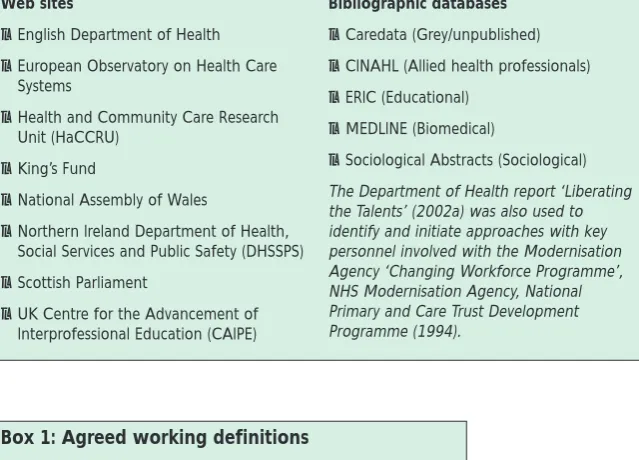
Background documentation was identified from organizational and governmental web sites, whilst the broader evidence base including research studies was identified by searching a range of bibliographic databases (see Table 1).
1.3
Review Structure
An audit trail of all documents identified during the lifetime of the review was created using Endnote reference management software. Documents were categorized as either being included in the review, excluded from the review, or requiring further assessment. A checklist was developed to assist with this process (see Appendix 1). During the initial scoping exercise it became apparent that ambiguities existed concerning the terms primary care and integrated health and social care. Clarity was sought via key policy documents and discussions with the project management team. A set of working definitions to inform the overall project was agreed. (See Box 1).
From project management team discussions, emerging evidence from search results, and insights into the ‘reality’ of integrated health and social care initiatives from key personnel identified via ‘Liberating
the Talents’ (Department of Health
2002a), the inclusion and exclusion criteria were continual reviewed and
refined (see Appendix 2). Working collaboratively resulted in the
development of tightly defined search strategies which were then utilised within bibliographic databases. Searches were then revisited and further enhancements made. A combination of free-text and thesaurus terms were utilised to maximise recall. To accommodate the indexing policies of the databases, unique search strategies were developed for each resource (see Appendix 3). Citation tracking
identified additional relevant studies, and quality checks were made against the search strategies to identify why they had not been retrieved. A total of 602 database records were retrieved, including duplications, of which 297 were selected for
relevance checks. From these checks, 80 documents were identified as background, context or policy papers, with 24 research studies identified for in-depth critical appraisal. The number of research studies meeting
Web sites
●English Department of Health
●European Observatory on Health Care
Systems
●Health and Community Care Research
Unit (HaCCRU)
●King’s Fund
●National Assembly of Wales
●Northern Ireland Department of Health,
Social Services and Public Safety (DHSSPS)
●Scottish Parliament
●UK Centre for the Advancement of
Interprofessional Education (CAIPE)
Bibliographic databases
●Caredata (Grey/unpublished)
●CINAHL (Allied health professionals)
●ERIC (Educational)
●MEDLINE (Biomedical)
●Sociological Abstracts (Sociological)
The Department of Health report ‘Liberating the Talents’ (2002a) was also used to identify and initiate approaches with key personnel involved with the Modernisation Agency ‘Changing Workforce Programme’, NHS Modernisation Agency, National Primary and Care Trust Development Programme (1994).
Box 1: Agreed working definitions
Integrated Health and Social Care:
Care that is determined by partnerships between health and social care agencies and users and carers for the health and well-being of the (local) community.
Primary Care:
[image:12.595.231.551.199.429.2]Primary Care encompasses social, community and primary care. We recognise that currently these three areas remain distinct rather than being encompassed in a generic term.
Finding the Evidence for Education and Training to deliver Integrated Health and Social Care: Chapter 1
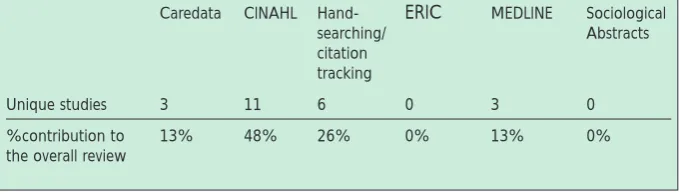
the review inclusion criteria varied for each database; from 3 studies
(MEDLINE) to 11 studies (CINAHL - see Table 2). Each database contributed a substantial percentage of unique studies (13%-48% - see Table 3). (Unfortunately, one of the search strategy databases (Sociological Abstracts) was ‘lost’ due to serious network failure and is unable to be recorded within the review).
The iterative process was adopted to ensure that integration of all the individual project Work Packages ‘contributed to the development of the review’. In turn these were dependent on the review evidence for development of their methodologies and project outputs.
Although the research base is limited due to limited transparency, it has illuminated ways of working at both a strategic and operational level. Reviewing the evidence revealed that much of the work to promote integrated services has been undertaken but the findings have as yet, not been combined through a comprehensive review.
Caredata CINAHL Hand- ERIC MEDLINE Sociological
searching/ Abstracts
citation tracking
All studies 4 12 6 0 3 0
Unique studies 3 11 6 0 3 0
Caredata CINAHL Hand- ERIC MEDLINE Sociological
searching/ Abstracts
citation tracking
Unique studies 3 11 6 0 3 0
%contribution to 13% 48% 26% 0% 13% 0%
[image:13.595.41.384.346.428.2]the overall review
Table 3: Percentage contribution of research studies from each database Table 2: Origins of research studies included in the review
[image:13.595.43.383.468.565.2]Chapter 2:
Integrated Health & Social Care
Finding the Evidence for Education and Training to deliver Integrated Health and Social Care: Chapter 2
Collaboration and partnership are inherent components which warrant the expediency of integrated services. By its very nature, integrated health and social care relies upon the successful collaboration and partnerships between service providers, agencies and professional groups. However, integrated health and social care is a fluid concept, which many have tried to define. On the most part, the evidence has demonstrated that achieving
collaboration between organisations, agencies and institutions has proved problematic. This may be due to the fact that to date, collaboration, integration and partnership have remained ambiguous concepts within the literature.
As the main aim of this systematic review was to search for and appraise relevant research articles, it was felt that the concept of integrated services required some clarification. In an attempt to decipher these
meanings, a variety of literature was located in the first stage of the review. Surprisingly, although it was widely agreed that successful collaboration is pivotal in partnership working, its concept and application has received limited formal
exploration. Henneman, Lee & Cohen (1995) argued that this lack of exploration consequently led to the concept of collaboration being primarily theoretical. This resulted in ambiguity regarding the meaning of partnership, which has been described as “a vague concept, capable of many interpretations, and its evaluation is therefore
problematic” (Glendinning, Abbott & Coleman 2001). Credible authors such as Øvereit, Mathias & Thompson (1997), Glendinning et al (2001) and Loxley (1997) were used to inform this chapter to try and decipher the concept of collaborative care and how this was considered to be
integral to the notion of integrated care. Attempting to define integrated health and social care has also been challenging due to the plethora and range of theories and opinion which litter contemporary debate.
2.1
The Meaning of
Collaboration
In their concept analysis, Henneman
et al(1995) selected a dictionary
definition to define the term
‘collaborate’ as opposed to providing any analytical framework or new definition. It is interesting to note that the tenth edition of the Oxford English dictionary (2001) defines collaboration as “working jointly on an activity or project”. However, to ‘collaborate’ may also be defined as “co-operating traitorously with an enemy”. This may explain why some avoid the use of the term
collaboration. Alternatively, Warren, Rose & Bergunder (1974) offered a definition of collaboration as being:
“a structure or process of concerted decision making wherein the decisions or actions of two or more organisations are made
simultaneously in part or in whole with some deliberate adjustment to each other”
When discussing the definition of attributes required for collaboration Henneman et al (1995) conferred with other authors (for example, Glendinning, Rummery & Clarke 1998:104) that “collaboration requires that individuals view themselves as members of a team, and contribute to produce a common product or goal”. Henneman’s paper provided model cases that outlined contrary and related cases to exemplify the concept of
collaboration. In addition, Henneman
et al(1995:106) stressed the
importance of the individual having a “clear understanding and acceptance
of their own role and level of expertise”, together with the recognition of their own role boundaries.
As a result of an extensive concept analysis of collaboration Sullivan (1998) offers a definition which encompasses ‘partnership’:
“Collaboration is defined as a dynamic transforming process of creating a power sharing partnership for pervasive application in health care practice, education, research and organizational settings for the purposeful attention to needs and problems in order to achieve likely
successful outcomes”. (Sullivan
1998:6)
2.2
Achieving
Collaboration
The introduction of an internal market in health coupled with economic pressures in the 70’s and 80’s, created a strong culture of competition within and between services which led to marketisation and division in service provision. To reverse this dominant culture and negate the effects of the internal market, the New Labour government (1997) challenged the existing status in an attempt to ameliorate services through the publication of a white paper entitled ‘The New NHS:
Modern, Dependable’(Department of
Health 1997). This paper introduced a ten-year strategy aimed at promoting a collaborative culture through which health and social care could fashion successful partnerships.
With the implementation of these White Paper recommendations for modernisation (Department of Health 1997), a new direction has been introduced to health and social care providers. The move from expensive acute care settings to one based in the community may have reflected a cost-cutting strategy, which aimed to
Finding the Evidence for Education and Training to deliver Integrated Health and Social Care: Chapter 2
improve costs and reduce resources. The resultant shift from the internal market to one that takes account of the services user and promotes the concept of co-operation not
competition and actively encourages inter-agency collaboration has been at the forefront of strategic service planning. However, Hudson, Hardy, Henwood & Wistow (1999) pursued the notion that an inter-agency collaboration remains “conceptually elusive and perennially difficult” (Hudson et al1999:236). They attempted to explore the concept of collaboration and argued that key elements of rationality and altruism are naïve assumptions made about organisations in the pursuit of collaborative practice. Whilst reticent about elements of collaboration, Hudson et al (1999) proposed an iterative and cumulative ‘framework’ to collaboration which ranged from the context in which it could flourish, the recognition of the need to collaborate, assessment of collaborative capability, nurturing fragile relationships to the more pragmatic guidance for ensuring organisational ownership and implementation. These components are to some extent echoed in the findings of research that has explored both barriers and supporting
influences in relation to the integration of services.
2.3
Defining Primary Care
within the context of
integration
Recent aspirations of the modernisation agenda and new primary care policy initiatives have endeavoured to define integrated health and social care within a strategic primary care context. Paradoxically, a parallel can be drawn between the concept of collaboration and primary care. Not dissimilar to the problems associated with defining
the parameters of collaboration, very few have considered the ideology of primary care. For example, when considering the definition of collaboration, Ling (2000) suggested that the variety of academic and non-academic commentaries about partnership and collaboration amounted to “methodological anarchy and definitional chaos”. It is not surprising therefore that generally, (to date) no single, all-inclusive definition has been offered for primary care. Titles to describe primary care have often been underpinned by a medical model and the notion of ‘first point of contact’. Given the lack of formal and acceptable definition, it could be argued that partnership and other terms might be indicative of a range of services dependant upon the organisational context. Glendinning
et al(2001) contends that this is a
beneficial arrangement because it allows for agencies to adopt an entirely flexible approach which can reflect local needs and which is reactive to the expertise and levels of trusts and partners (Glendinning et al
2001).
In an attempt to draw parameters to refine this systematic review, concepts of integration were also explored within the context of primary care. Primary care is often defined
according to the services involved, so, for example primary care in relation to ‘Sure Start’ initiatives (programmes designed to empower disadvantaged young people to provide the best opportunities for growth and development) involves a range of professionals, but not all. Services within primary care may not be integrated; one person may simply need to see the pharmacist or chiropodist without the need to seek help or advice from other
professionals. Therefore, it may be surmised that integrated health and
social care occurs as a result of
primary care and may involve a number of services or professionals to meet the needs of the client.
Integrated health and social care could be considered as potentially central to service delivery but not essential.
If it is accepted that integrated health and social care is as a result of and not the focus of primary care, questions then may arise as to the relationship between integrated health and social care with primary care. Similarly, is it possible and or realistic to suggest or advocate a single definition for integrated health and social care that also encompasses primary care? To answer this
question, a range of primary care definitions was utilised in the review in an attempt to situate integrated services within the context of primary care. The breadth of definitions encompassed Pringle’s (1998) description of primary care being “a system for providing first contact rather than a value system” to Kendrick & Hilton’s (1997) view that primary care is “health care delivered outside the acute hospital sector”. Both of these definitions were located in the British Medical Journal but whilst obvious undertones of a medical model are evident, there is little attention paid to the ‘well-being’ of the individual or community. Similarly, the social care context is rarely reflected in any definition of primary care or integrated health and social care. This has highlighted a noticeable gap in terms of
practitioners’ perceived understanding of the concept of primary care. Although transparent at a strategic level, the existing operational issues and barriers have so far reported a health rather than a social status for organisations and services with the use of performance indicators to
Finding the Evidence for Education and Training to deliver Integrated Health and Social Care: Chapter 2
provide measurable variables for health. On the surface, these have excluded the social influence on care and wellbeing and have advocated the NHS as the political driver more willingly than social services. Perhaps the most notable author to consider this polarisation was Bywaters & McLeod (2001) whose analysis of the current political agenda suggested that social services were still considered to be ‘second class’ despite the modernisation agenda. In an attempt to single out the key concepts of primary care, Elwyn & Smail (1999) concurred with Bywaters & McLeod (2001) and argued for the case that social care had been excluded from the ‘primary care equation’. They suggested that the rhetoric of primary care-led NHS is predicated upon an interesting conceptual sleight of hand that suggested that primary healthcare was in fact synonymous with primary medical care. Whilst they recognised that general practice provided a service to meet health care rather than health needs, Elwyn & Smail (1999) suggested that general practice could never be the whole of the primary healthcare – but is one dimension of it.
Stanhope (1995) considered the social care context and noted that there was a difference between primary care and primary health care. She suggested that primary health care embodies “both primary care and public health as the nuclei for a country’s or community’s health care system”. Stanhope (1995)
subsequently incorporated social, cultural and economic developmental issues within the context of primary health care arguing these were an integral part of enhancing the health of a community.
The evidence would suggest that whilst the current Government’s
relentless aims to secure an equitable health and social care system places a great emphasis on primary care to integrate services and promote seamless care; initial clarity about the principles of primary care at an operational level has been neglected. With a wide range of philosophical values, primary care appears on the surface, to empower the patient and community and reduce health and social inequalities. As such, primary care is viewed as a panacea for all service development since the introduction of the modernisation agenda, yet its definition is elusive.
2.4
The Nature and
Purpose of Primary
Care
So far, the evidence has revealed a range of conflicting opinions about the nature and purpose of primary care. There are some authors who argue that health care needs are driven by a limited resource and should be based on population needs assessment in order to secure effective health care service and delivery (Jordan, Wright, Wilkinson & Williams 1998). Conversely, when considering the attributes of primary care, Flocke (1997) suggested that there are several components. She attempted to measure the attributes of primary care from the perspectives of the patient by developing an instrument which took into
consideration key primary care traits as dictated by the service user. To facilitate this, she relied heavily on the Institute of Medicines (IOM) definition of primary care, which stated that primary care, is:
“the provision of integrated, accessible health care services by clinicians who are accountable for addressing a large majority of personal health care needs,
developing sustained partnership with
patients, and practising in the context
of family and community”. (Flocke
1997:64)
This medicalised perspective exemplifies the role of the physician rather than the ‘integrated’ team. Alternatively, Farrell, Schmitt & Heinemann’s (2001) description of an interdisciplinary team, appears to be more congruent with the principles of primary care. They described the integrated team as being “a group of colleagues from two or more
disciplines who co-ordinate their expertise in providing care to patients”.
Similarly, Gross (1997) offered a definition that had at its nucleus the notion of ordination and co-operation when describing integrated delivery systems (IDS). They purported that an integrated delivery system was:
“a network of organisations that provides or arranges a co-ordinated continuum of services to a defined population and is willing to be held clinically and fiscally accountable for the outcomes and health status of
the population served”.(Gross
1997:23)
Reflected in this definition is the assumption that the population is defined, which as Jordan et al(1998) argued, is a central consideration when developing primary care services to meet the needs of the community. Stanhope (1995) argued and provided a simplistic discussion, which indicated that, the most common definition of primary care was “initial contact with the client with the ‘system’ for the purpose of receiving treatment for common, episodic acute and chronic illness”. The plethora of evidence could leave the reader confused as to the meaning of primary care, but put simply, it appears to be defined by
Finding the Evidence for Education and Training to deliver Integrated Health and Social Care: Chapter 2
the population it serves and as a consequence, the professionals who provide such care.
Whether the care is integrated is entirely dependent upon the needs of the client and the community at large. Øvretveit (1993) explored the notion of community care and created a distinction between primary health care and community care. To accentuate the difference, he used the Department of Health’s (1989) definition of community care in which it proposed that community care “means providing the right level of intervention and support to enable people to achieve maximum independence and control over their lives”. He supported this by stating that care in the community is:
“about helping clients and their carers in or near their homes, rather than in hospitals away from the community in which they live” (Øvretveit 1993:7).
Øvretveit (1993) advocated that primary health care teams were an integral component of one type of community care. Whilst he agreed that many reports referred to the primary health care team, none provided a usable definition. This lack of definition, he argued was due to the need to consider the different ways in which primary health care practitioners and sometimes social workers operated and co-ordinated their services within an area. This, for example, could involve a variety of services and professional groups, including social care and the independent sector to sustain a healthy, independent community. It is evident that in the majority of literature reviewed to date, definitions identified have paid limited attention to the principles of ‘integrated care’ which invariably encompasses the social wellbeing of the community and the individual. However, the
literature has revealed that the social care context has, to a large extent been excluded and it would appear that primary care has focussed on the health of the population as opposed to their overall well-being.
Chapter 3:
Integrated Health and Social Care Policy
Finding the Evidence for Education and Training to deliver Integrated Health and Social Care: Chapter 33.1
Introduction
The introduction of recent reforms through the modernisation agenda emphasised increased partnership working between health and social care (Department of Health 2000a; Department of Health 2001a). The move toward integrated services resulted in front line services working with newly developed practice strategies and frameworks aimed at removing organisational boundaries to promote the successful integration of services. This chapter focuses on the key strategic policies which have had an impact on integrated services. The publication of the White Paper outlining the modernisation of the NHS (Department of Health 1997) has empowered a range of services to promote collaborative working arrangements through the creation of Primary Care Trusts, joint investment and workforce planning, together with a shift towards inter-professional education. The subsequent
redefinition of the internal market introduced by the previous Government has enabled the development of a ‘seamless’ service for patients based on a commitment to reduce health and social
inequalities and protection and support of vulnerable people in society. In essence, the impetus behind the Department of Health’s White Paper - The New NHS: Modern
and Dependable (Department of
Health 1997) sought to promote collaboration between organisations and agencies. To achieve this, an approach to health and social care was proposed which combined efficiency and quality with a belief in fairness and partnership and
introduced the concept that the National Health Service (NHS) does not or should not work in isolation from social care or other agencies. Previous attempts by organisations to
move away from the competitive market towards a more unified and collaborative approach proved problematic. Due to the reluctance of organisations to share best practice and the restrictive nature of the funding systems in place to support development, the notion of integrated care struggled from the outset. In response, and through the influence of the modernisation agenda, the subsequent Health Act (Department of Health 1999a) together with the Health and Social Care Act (Department of Health 2001b) eased the process by emphasising the need for
collaborative work and recommended that all agencies work together in treating people who are ill and reducing health inequality
(Department of Health 1997, 1:2). The publication of ‘Preparing Older People's Strategies: Linking Housing to Health, social care and other local
strategies’by the Department of
Health (Department of Health 2003a) was a recent example which
illustrated work in progress to develop an integrated service between the following agencies and organisations i.e. Health, Housing, Transport and Health Authorities. The central aims of this report were to: “Ease the process of preparing strategies; ensure that all relevant strategies include appropriate housing components in a consistent way and within a unified vision and strategic direction; enable an easy 'read across' from one strategy to another; and assist 'joined up' planning,
commissioning and service delivery.” This strategy complemented the Department of Health 2003-2006 guidance on producing effective housing strategies and targets one of the vulnerable groups in an attempt to reduce health and social care inequalities and promote integrated
services for older people (Department of Health 2002b).
3.2
Promoting a seamless
service through policy
change
The move to end the internal market and replace it with ‘integrated care’ was seen by many as a positive step forward to improving services both within health and social care. Aptly named the ‘Third Way’, Labour offered an alternative solution to managing the NHS, based on partnership and performance. This was to ensure that “individual patients, who too often have been passed from pillar to post between competing agencies, will get access to an integrated system of care” (Department of Health 1997 1:4) therefore promoting a ‘seamless’ service for all. There is now a greater emphasis placed on local health and social needs and the subsequent push to develop integrated services to meet the needs of the local population. The Third Way has encouraged the NHS to work in partnership by breaking down organisational barriers, developing stronger links with Local Authorities which also ensured that the needs of the patient being central to this process.
To ensure the successful
implementation of the modernisation agenda (Department of Health 1997), a range of strategies to support the development of integrated health and social care were proposed. These included National Service Frameworks, which “set national standards and define service models for a defined service or care group” (Department of Health 1998a), and common goals to demonstrate service development and integration with social services, especially areas of social deprivation. Services, it was
Finding the Evidence for Education and Training to deliver Integrated Health and Social Care: Chapter 3
suggested, would be enhanced through greater public involvement and transparency that would strengthen the need for accountability to the public.
Some authors, for example, Bywaters & McLeod (2001) were disillusioned with the Governments newfound commitment to integrated services and argued that the rhetoric rather than the reality of a seamless service would prevail. For example, in their review of the introduction of the new central role of social services within health policy, Bywaters & McLeod (2001) discussed the impact of New Labour health policy on social
services. Based on their exploration of the four years since the introduction of Labours Third Way, they argued that, despite the well meaning intention to promote a seamless service through integration, ideas outlined within the NHS Plan (Department of Health 2000b) place social services staff within NHS locations, but not vice versa. The disparate relationship between health and social care emphasised the NHS as a dominant partner, reluctant to relinquish control and therefore by implication disregarding Social Services. This convincing argument revealed a rather less than rosy picture that the Government may have wished for, and illustrated existing tensions between services despite strategic efforts to promote a seamless service.
Bywaters & McLeod’s (2001) analysis was reciprocated by Glendinning (2003) who reported that despite social service representation on primary care trust boards, they still felt underrepresented. The main thrust of these problems centred on the marginalisation of social service input with decision making and commissioning of services. Evidence of Primary Care Trusts/Primary Care
Groups success in collaborating was limited and the extent to which non-health partners are involved in decision making was unclear. Glendinning (2003) was however, cautious not to over emphasise the apparent success of joint
commissioning and pooled budgets and suggested that:
“major reconfigurations of services carried the risk of de-stabilising provider organisations, including major disruptions to the professional staff who worked in them”
(Glendinning 2003:147)
which led to staff reluctance to change. It is the influence of the wider policy agenda which
Glendinning (2003) suggested may have influenced barriers to integration witnessed today.
The notion that the wider policy agenda has negatively influenced collaboration was further expounded by The King’s Fund (2002) based on the progress in partnership working between the NHS and local
Government argued that current NHS shortfalls within acute care have driven government policy. A ‘push – pull’ scenario between government and the NHS is also described, together with the
suggestion that the political agenda is in a flux, with funding driven by waiting list initiative and performance indicators instead of being directed by the needs of organisations to provide integrated services.
3.3
Funding strategies to
support integrated
working
Shaw (1993) once argued that:
“budgetary devolution and fund holding has altered the power between professions. Internal markets have introduced competition within
which collaboration is somehow
expected to co-exist”(Shaw 1993:255)
To combat funding inequality between services and in an attempt to align funding streams, a number of changes to central funding systems were made. Following the
introduction of the plan for the modernisation agenda (Department of Health 1997), the Department of Health published its discussion document ‘Partnerships in Action: New Opportunities for Joint Working Between Health and Social Services’
(Department of Health 1998b) which outlined the governments strategy for delivering integrated health and social care through the introduction of Health Action Zones (HAZ), Health Improvement Programmes (HiMPS) and Joint Investment Planning (JIP). As a result, numerous strategies for working at different levels within organisations were established. These included; strategic planning between agencies to plan jointly for medium term goals, share information and use of resources and have common goals. Health Improvement Programmes were to be led by Local Authorities working in partnership with NHS & Social services and service
commissioning to secure services needs through the joint meetings to develop a common understanding and encourage effective provision.
The Modernising Health and Social Services National Priorities
Guidance:1999/2000–2001/02
(Department of Health 1998c) considered National Service Frameworks as vehicles for
developing shared statements of the local response to national priories and targets and emphasised working with the National frameworks within the remit of the HiMPs. Although this will be led by the Health Authority, the guidance advocated that this should be an inclusive process between
Finding the Evidence for Education and Training to deliver Integrated Health and Social Care: Chapter 3
organisations to promote ownership and that Social Services authorities area also expected to reflect HiMP objectives in their local plans. Given the problems associated with funding and training, the consultation document: ‘Funding Learning & Development for the Healthcare Workforce. Review of NHS Education
and Training Funding’(Department of
Health 2002c) reviewed the current funding streams for future learning and presented recommendations for future provision. The Government believed that as one of the key values, integration should be promoted through different disciplines learning together. In an attempt to promote sharing of resources and move towards multi-disciplinary education and the alignment of the education system with the modernisation agenda, the levies for medical and non– medical teaching contracts i.e. were abolished. It was claimed that these separate budgets perpetuated historical distinctions in professional education (Department of Health 2002c). The paper recommended that funding should be re-organised and also advocated an inter-disciplinary framework suggesting that this would mark the end of the demarcation and differences in support offered to professionals.
Combining budgets which were once based solely on the provision of organisational needs had the potential to be problematic. The transition process from independent to pooled budget arrangements was smoothed by the Health Act (Department of Health 1999a). The Act identified roles and responsibilities for funding and partnership arrangements and provided flexibility for organisations to work across boundaries by pooled funding and joint commissioning. This was further supported by the Health
and Social Care Act (Department of Health 2001b) which was introduced as:
“An act to amend the law about the NHS; to provide for the exercise of functions by Care Trusts under partnership arrangement of the Health Act 1999 and to make further provision in relation to such
agreements; to make further provision in relation to Social
Services….”Chapter 15 (11th May,
2001).
This was another step towards the transition between agencies to ensure pooled budget arrangements and subsequent integration of services through joint commissioning and equity between organisations. The increased investment in the NHS and the introduction of pooled budgets to support integrated services aimed to increase equality between agencies and bring about real benefits (Bywaters & McLeod 2001). To warrant such benefits, the consultation document of the review of workforce planning: ‘A Health Service of All the Talents: Developing
the NHS Workforce’ (Department of
Health 2000a) was published. It suggested that the workforce should be planned in collaboration with Health Action Zones (HAZ) and focus on the workforce needed to deliver the HAZ across primary, secondary and tertiary care. A greater emphasis was therefore placed on team working across organisational boundaries and the need to integrate with service and financial planning to support multi-disciplinary training and education.
Early reforms which resulted with the internal market enhanced the divide between services and highlighted the budgetary management of service provision. However, monetary reconfiguration alone does not
promote collaboration and
partnership working. Other important considerations have been levelled at environmental factors and
organisational values such as good support systems; participation, autonomy and interdependence. The importance of environmental factors and their influence on integration were explored by Callaghan,
Exworthy, Hudson & Peckham (2000) who offered insight into localisation and collaboration in Primary Care Groups and uncovered major factors which influenced the creation of collaborative relationships. This strategic perspective involved four sites which reflected a range of socio-economic environments all of which advocated the importance of being ‘in touch’ with the population. Integrated services would therefore invariably reflect the needs of the population they serve.
3.4 Professional
and
Educational Response
to the Modernisation
Agenda
Whilst the concept of integrated care was politically problematic, more issues arose when considering the needs of the workforce and how best to prepare them to deliver a quality service.
The integration of services and development of the workforce to deliver these was promoted through the Department of Health’s
publication: ‘Modernising Health and Social Services Developing the
Workforce’(Department of Health
1999b). This document suggested that staff needed to be “supported through the process of building systems of integrated care”. Highlighting the need for effective leadership, commitment of organisations, authorities and staff across all boundaries and agencies, it
Finding the Evidence for Education and Training to deliver Integrated Health and Social Care: Chapter 3
proposed that National Service Frameworks provide a basis for local employers and the Workforce Development Confederations to review the skill mix of current workforce to enable planning of future workforce development. To ensure such a seamless, quality service, the NHS Plan(Department of Health 2000b) advocated partnership and co-operation at all levels, workforce planning needed to generate strong links with organisational development plans. This would entail the development of a ‘core curriculum’ accessible to all which could respond effectively to the needs of the service and the
individual patient. The NHS Plan
(Department of Health 2000b) espoused the need for joint training across professions and proposed a new “common foundation programme” which incorporated communication skills and the principles of the NHS to enable staff to switch career paths more easily. Professional bodies were keen to respond to this and took steps towards promoting professionals who were prepared to deliver and advance integrated services. To facilitate this endeavour, The Department of Health in consultation with the United Kingdom Central Council and Royal College of Nursing published the White Paper ‘Making A Difference: Strengthening the Nursing, Midwifery and Health Visiting Contribution to
Health and Health Care’(Department
of Health 1999c). It was envisaged that nursing, health visiting and midwifery would be strengthened by the development of an integrated programme of measures to tackle the root causes of illness. It was
emphasised that such programmes should bring together government, the public sector and business, local communities and individuals to plan and share responsibilities with regards
to the health and well–being of the community.
With objectives central to delivering the NHS Plan, the publication of
‘Liberating the Talents: Helping Primary Care Trusts and nurses to
deliver the NHS Plan’(Department of
Health 2002a) focused on ‘liberating’ the talent and skills of the workforce in primary care to ensure that all patients receive the right care in the right place at the right time. A key message within the publication suggested that ‘primary care needed to change if patients and
communities were to benefit from the NHS reforms and extra investment’ (Department of Health 2002a:3). It also envisaged that staff, once trained in interprofessional skills would be better equipped to empower the patient and deliver patient centred care.
Using patient and carer comment, the document highlighted the ‘Priorities and Planning Framework for
2003–2006’(Department of Health
2003b) and recommended improvement of access to services, specifically for: Coronary Heart Disease, Mental Health, Older People and life chances for children. It supported a ‘flexible team approach’, new clinical roles, advanced and specialist roles, including closer cross practice and primary care trusts joint working. In relation to nurses, examples of how roles are
encouraged to develop are included, such as: extending the role of the nurse (particularly that currently performed by General Practitioners), developing key roles within 24-hour first contact services and offering the chance for greater skills mix and leadership opportunities.
Greater freedom for professionals was recommended as a way forward to securing better care. In terms of delivering this ambitious agenda, the
Liberating the Talentsreport outlined
the next steps and recommended health needs assessments, team-working to identify local needs and plan work, strong links with national priorities and adopting a public health approach. (Department of Health 2002a) Key concepts within this agenda was the drive to assure team skills reflected priority needs and to develop creative thinking about working across traditional boundaries. This involved assessing the skills and knowledge needed to provide new services and helping staff to identify what they are going to stop doing when planning for new work roles. Other key initiatives included setting up innovative practice based learning programmes to support cross-boundary working with education and preceptorship programmes to support new generalist roles. A whole systems approach to care and care pathways were considered to be pivotal in developing new role within partnerships. Joint multi-agency teams were emphasised to support integrated care at different levels and weaken the tension between professional and
organisational boundaries. Numerous examples of good practice were provided and include: family health plans which identifies client views in relation to health and social care needs, family health profiling, the introduction of ‘changing workforce’ programmes, shared training and shared information technology schemes. This ambitious plan, took
the NHS Plan(Department of Health
2000b) one step further away from rhetoric and closer to reality. Key priorities (outlined in Liberating
the Talents) were built upon in the
Priorities and Planning Framework 2003 - 2006 (Department of Health 2003b). Heavily linked to the NHS Plan, the strategy aimed to transform