Journal of Chemical and Pharmaceutical Research, 2014, 6(2):563-569
Research Article
CODEN(USA) : JCPRC5
ISSN : 0975-7384
Graph kernels and applications in protein classification
Jiang Qiangrong*, Xiong Zhikang and Zhai Can
Beijing University of Technology, Department of Computer Science, Beijing, China
_____________________________________________________________________________________________ABSTRACT
Protein classification is a well established research field concerned with the discovery of molecule’s properties through informational techniques. Graph-based kernels provide a nice framework combining machine learning techniques with graph theory. In this paper we introduce a novel graph kernel method for annotating functional residues in protein structures. A structure¬ is first modeled as a protein contact graph, where nodes correspond to residues and edges connect spatially neighboring residues. In experiments on classification of graph models of pro-teins, the method based on Weisfeiler Lehman shortest path kernel with complement graphs outperformed other state-of-art methods.
Keywords: Protein classification, Machine learning, Graph kernels, Shortest path, Weisfeiler-Lehman.
_____________________________________________________________________________________________
INTRODUCTION
Kernel methods are an important method which is widely used in statistical learning theory[1]. Kernels help to adapt classification regardless how classification performs. That is to say, kernels act like an interface between clas-sification tools and data sets via Support Vector Machines[2]. Early studies on kernel methods dealt almost exclu-sively with vector-based descriptions of input data. This procedure, though convenient, does not always effectively capture topological relationships inherent to the data; therefore, the power of the learning process may be insuffi-cient. Haussler[3] was the first to define a principled way of designing kernels on structured objects, the so-called R-convolution kernel. Over recent years, kernels on structured objects such as strings and trees[4], on nodes in graphs and on graphs have been defined. Graphs are natural data structures to model such structures, with nodes representing objects and edges the relations between them[5]. In this context, one often encounters two questions: “How similar are two nodes or edges in a given graph?” and “How similar are two graphs to each other?”
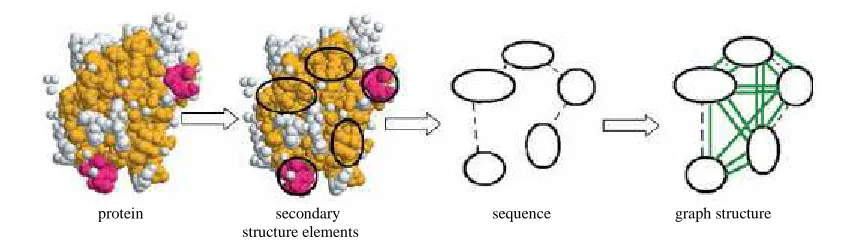
protein secondary sequence graph structure structure elements
Fig. 1: Illustration of graph generation from PDB protein file
EXPERIMENTAL SECTION
2.1 Some Definitions on Graph Theory
We define a graph G as a triplet
(
V
,
E
,
l
)
, whereV
is the set of vertices,E
is the set of undirected edges, and∑
→
V
l :
is a function that assigns labels from an alphabet∑
to nodes in the graph. The neighborhoodΝ
(v
)
ofa node
v
is the set of nodes to whichv
is connected by an edge, that isΝ
(
v
)
=
{
v
'(
v
,
v
')
∈
E
}
. We assume thatevery graph has
n
nodes,m
edges, and a maximum degree ofd
.The adjacency matrix
A
ofG
is defined as follows:
[ ]
,
0
,
)
,
(
1
∈
=
otherwise
E
v
v
if
A
ij i jwhere
v
i andv
j are nodes inG
. Labels can be added on nodes or edges, these labels are referred as attributes.A walk
w
of lengthk
−
1
in a graph is a sequence of nodesv
1,
v
2,
⋅
⋅⋅
,
v
k where(
v
i−1,
v
i)
∈
E
for1
<
i
≤
k
.A path
p
is a walk without same nodes in the sequence.A cycle is a walk with
v
1=
v
k,a simple cycle does not have any repeated nodes except forv
1.Suppose
G
(
V
,
E
)
is a graph with vertex setV
and edge setE
. Then, its complementG
(
V
,
E
)
is a graph with thesame vertex set
V
, but with a different edge setE
=
V
×
V
\
E
. In other words, the complement graph is made up of all the edges missing from the original graph.2.2 Graph Isomorphism
Graph similarity or isomorphism[13] is the most essential problem for learning tasks like clustering and classifica-tion on graphs. In graph theory, an isomorphism of graphs
G
andH
is a bijection between the vertex sets ofG
andH
:f
:
V
(
G
)
→
V
(
H
)
, such that any two verticesu
andv
ofG
are adjacent inG
if and only iff
(u
)
and
f
(v
)
are adjacent inH
. Graph isomorphism problem is neither known to be polynomial-computable, nor NP-hard[14].2.3 The Weisfeiler-Lehman Test of Isomorphism
Our method uses concepts from the Weisfeiler-Lehman test of isomorphism[15][16], more specifically its 1-dimensional variant. Assume we are given two graphs
G
andH
and we would like to test whether they are iso-morphic. The 1-dim Weisfeiler-Lehman test proceeds in iterations, which we index byi
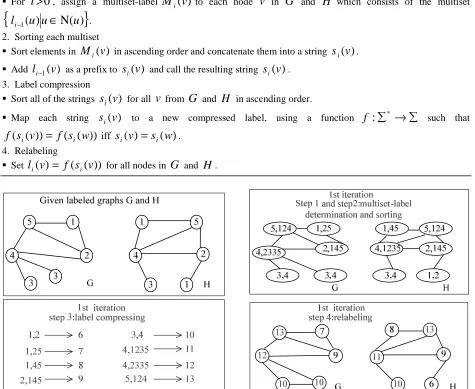
and which comprise the steps given in Algorithm 1.The key idea of the algorithm is to augment the node labels by the sorted set of node labels of neighboring nodes, and compress these augmented labels into new, short labels. These steps are then repeated until the node label sets of
G
andH
are isomorphic, or the algorithm has not been able to determine that they are not isomorphic. See Fig 2, for an illustration of these steps.Algorithm 1. One iteration of the 1-dim. Weisfeiler-Lehman test of graph isomorphism(1968)
1. Multiset-label determination
For
i
=
0
,setM
i(
v
)
=
l
0(
v
)
.For
i
>
0
, assign a multiset-labelM
i(v
)
to each nodev
inG
andH
which consists of the multiset{
l
i−1(
u
)
u
∈
Ν
(
u
)
}
. 2. Sorting each multisetSort elements in
M
i(v
)
in ascending order and concatenate them into a strings
i(v
)
.Add
l
i−1(
v
)
as a prefix tos
i(v
)
and call the resulting strings
i(v
)
.3. Label compression
Sort all of the strings
s
i(v
)
for allv
fromG
andH
in ascending order.Map each string
s
i(v
)
to a new compressed label, using a function∑
→
∑
*
:
f
such that))
(
(
))
(
(
s
v
f
s
w
f
i=
i iffs
i(
v
)
=
s
i(
w
)
.4. Relabeling
Set
l
i(
v
)
=
f
(
s
i(
v
))
for all nodes inG
andH
. [image:3.595.70.545.161.550.2]
Fig. 2: Illustration of the 4 steps of one iteration of the computation of the Weisfeiler-Lehman test of isomorphism
2.4 Weisfeiler-Lehman Sequence Graphs
Define the Weisfeiler-Lehman graph at height
i
of the graphG
=
(
V
,
E
,
l
)
as the graphG
i=
(
V
,
E
,
l
i)
. We callthe sequence of Weisfeiler-Lehman graphs,
)},
,
,
(
,
),
,
,
(
),
,
,
{(
}
,
,
,
{
G
0G
1⋅
⋅⋅
G
h=
V
E
l
0V
E
l
1⋅
⋅⋅
V
E
l
hwhere
G
0=
G
, the Weisfeiler-Lehman sequence up to heighth
ofG
.G
0 is the original graph,G
1=
r
(
G
0)
is the graph resulting from the first relabeling, and so on.2.5 Weisfeiler-Lehman Kernel with Complement Graphs
Let
k
be any kernel for graphs, that we will call the base kernel. Then the Weisfeiler-Lehman kernel withh
).
,
(
)
,
(
)
,
(
)
,
(
0 0 1 1 h hh
WL
G
H
k
G
H
k
G
H
k
G
H
k
=
+
+
⋅
⋅⋅
+
If we take the complement graphs into consideration, we will derive the Weisfeiler-Lehman kernel with comple-ment graphs:
+
+
+
=
(
,
)
(
,
)
(
,
)
)
,
(
G
H
k
G
0H
0k
G
0H
0k
G
1H
1k
wlhk
(
G
1,
H
1)
+
⋅
⋅⋅
+
k
(
G
h,
H
h)
+
k
(
G
h,
H
h),
where
(
G
0,
G
1,
⋅
⋅⋅
,
G
h),
(
H
0,
H
1,
⋅
⋅⋅
,
H
h)
are complement graphs of(
G
0,
G
1,
⋅
⋅⋅
,
G
h),
(
H
0,
H
1,
⋅
⋅⋅
,
H
h).
Let the base kernel
k
be any positive semidefinite kernel on graphs. Then the corresponding Weisfeiler-Lehmankernel
k
WLh is positive semidefinite.2.6 Shortest Path and Floyd-Warshall Algorithm
Given an undirected graph
G
=
(
V
,
E
)
the shortest path graph[17],G
sp(
V
,
E
')
, which contains the same set ofvertices as
G
and the edge between every pair of vertices is labeled with the shortest distance between them in theoriginal graph. The transformation from
G
toG
spcan be performed by any all-pairs shortest path algorithm.Floyd–Warshall algorithm(See Algorithm 2)[18] is attractive and effective because it is straightforward and has time
complexity of
O
(
n
3)
. Then, a kernel function was used to calculate the similarity between two shortest path graphs according to the following definitions, which were first defined by Borgwardt and Kriegel[9]. It is proved to be a positive semidefinite kernel and is computable in polynomial time.Algorithm 2. Floyd–Warshall algorithm (Graph
G
withn
nodes and adjacency matrixA
) Floyd(G
)for
k
←
1
to
n
for
i
←
1
to
n
for
j
←
1
to
n
if(cost(
i,
k
)+cost(k,
j
)<cost(i,
j
))cost(
i,
j
)=cost(i,
k
)+cost(k,
j
) endifendfor endfor endfor
Let
e
1be the edge connecting verticesv
1 andw
1 on graphG
, ande
2be the edge connecting nodesv
2 andw
2on graph
H
. A walk on an edge includes the edge and its two adjacent vertices. A walk kernelk
walkis used tocompare the walk
e
1ande
2as:k
walk(
e
1,
e
2)
=
k
node(
v
1,
v
2)
*
k
edge(
e
1,
e
2)
*
k
node(
w
1,
w
2)
,
where
k
node is the kernelfunction for comparing two vertices, and
k
edgeis a kernel function forcomparing two edges.
The kernel function for comparing two vertices
u
andv
is a Gaussian kernel[19] over their respective feature vec-tors,.
2
)
(
)
(
exp
)
,
(
2 2
−
=
δ
v
f
u
f
v
u
k
nodeThe kernel function for comparing two edges
e
andf
is a Brownian bridge kernel that assigns the highest value to edges with identical weights, and 0 to all edges that differ in weight more than a constantc
:).
)
(
)
(
,
0
max(
)
,
(
e
f
c
length
e
length
f
2.7 Shortest Path Kernel
Given two shortest path graphs
G
(
V
1,
E
1)
andH
(
V
2,
E
2)
the shortest path graph kernel:),
,
(
)
,
(
1 21 1 2 2
e
e
k
H
G
k
E e e Ewalk
sp
∑ ∑
∈ ∈
=
where
k
walk is a kernel function for comparing two edge walks of length 1.Floyd-transformation requires
O
(
n
3)
time.E
1 andE
2containO
(
n
2)
edges. The computation of theshortest-path graph kernel requires
O
(
n
4)
time.2.8 Weisfeiler-Lehman Shortest Path Kernel with Complement Graphs
With the above definitions, we are ready to define Weisfeiler-Lehman shortest path kernel with complement graphs as:
.
)
,
(
)
,
(
)
,
(
)
,
(
)
,
(
)
,
(
)
,
(
1 1 1 1 0 0 0 0 h h sp h h sp sp sp sp sp h WLH
G
k
H
G
k
H
G
k
H
G
k
H
G
k
H
G
k
H
G
sp
k
+
+
⋅⋅
⋅
+
+
+
+
=
For
N
graphs, the runtime of WL shortest path kernel will scale asO
(
N
2n
4)
.RESULTS AND DISCUSSION
We compared the performance of the random walk graph kernel[20], the shortest path kernel, the WL Shortest Ker-nel without complement graphs and WL Shortest KerKer-nel with complement graphs in terms of classification accuracy of the classification on D&D[21] and ENZYMES datasets, where accuracy shows the overall percentage of correct classifications. D&D is a dataset of 691 enzymes and 487 non-enzymes. Each protein is represented by a graph, in which the nodes are amino acids and two nodes are connected by an edge if they are less than 6 Ångstroms apart. The task is to classify the protein structures into enzymes and non-enzymes. ENZYMES is a data set of protein ter-tiary structures obtained from Borgwardt et al(2005), consisting of 600 enzymes from the BRENDA enzyme data-base(Schomburget al., 2004). In this case the task is to correctly assign each enzyme to one of the 6 EC top-level classes. Nodes are labeled in the dataset. In terms of D&D, we also analyzed the sensitivity, specificity, and Mat-thews correlation coefficient (MCC)[22] of the classifications in addition to accuracy (Table 3), where sensitivity is the percentage of enzymes that have been correctly classified as enzymes , specificity indicates the percentage of non-enzymes that have been correctly classified, and MCC shows the overlapping between the predictions and the actual distribution.
Suppose P represents positive instances N negative instances, TP the number of true positives, TN the number of true negatives, FP the number of false positives and FN the number of false negatives. Then the accuracy, sensitivi-ty, specificity and MCC can be calculated by the following formulas,
N
P
TN
TP
accuracy
+
+
=
,FN
TP
TP
P
TP
y
sensitivit
+
=
=
,TN
FP
TN
N
TN
y
specificit
+
=
=
,.
)
)(
)(
)(
(
TP
FP
TP
FN
TN
FP
TN
FN
FN
FP
TN
TP
MCC
+
+
+
+
×
−
×
=
Table 1: The classification accuracy(%) and standard deviation of each kernel on protein data sets
[image:6.595.70.542.169.258.2]Method/Data set D&D ENZYMES Random Walk Kernel 70.26(±0.86) 20.14(±0.69) Shortest Path Kernel 78.19(±0.26) 42.18(±0.43) WL Shortest Path Kernel without complement graphs 81.27(±0.70) 62.47(±0.61) WL Shortest Path Kernel with complement graphs 83.64(±0.92) 63.96(±0.84)
Table 2: CPU runtime for kernel computation on protein classification
Data set D&D ENZYMES Class size 2 6 Maximum nodes 5478 126 Average nodes 284.32 32.63
Number of graphs 1178 600 Random Walk Kernel 52days 39days Shortest Path Kernel 25h 17min22s 38s WL Shortest Path Kernel without complement graphs 64days 1min3s WL Shortest Path Kernel with complement graphs 71days 2min11s
Table 3: Comparison of our method with others using D&D data set
Method Sensitivity Specificity MCC Random Walk Kernel 65.28% 71.35% 0.523 Shortest Path Kernel 71.32% 79.64% 0.736 WL Shortest Path Kernel without complement graphs 78.24% 83.77% 0.821 WL Shortest Path Kernel with complement graphs 81.05% 86.13% 0.836
In terms of runtime, The shortest path kernel and the WL shortest path kernel were competitive to the random walk kernel on smaller graphs (ENZYMES), but on D&D their runtime degenerated to more than 25 hours for the shortest path kernel, 64 days for the WL shortest path kernel without complement graphs and 71 days for the WL shortest path kernel with complement graphs. Using a graph to model the distribution of amino acid residues on the 3D structure, our method efficiently captures various structural determinants related to protein function. The kernels using WL method performed better than other kernel types. Furthermore, the WL shortest path kernel with comple-ment graphs outperforms the other kernels with an accuracy of at least 83.64%, and it achieves improvecomple-ments in accuracy more than 2% over the WL shortest path kernel without complement graphs. Meanwhile, considering shortest paths instead of walks increases classification accuracy significantly. For the random walk kernel, classifi-cation is the worst as with an increasing number of tottering walks, classificlassifi-cation accuracy decreases. Table 3 also shows that our proposed method outperforms other methods.
CONCLUSION
In this paper, we propose a simple yet effective and efficient graph classification approach that is based on topolog-ical and label graph attributes. Our main idea is that graphs from the same class should have similar attribute values. On the basis of an extensive comparison with state-of-the-art graph kernel classifiers, we show that our approach yields competitive or better accuracies and has typically much lower computational times. Our conclusion is that graph attributes are effective in capturing discriminating structural information from different classes. Our new ker-nels based on Weisfeiler-Lehman test of isomorphism open the door to applications of graph kerker-nels on large graphs in bioinformatics, for instance, protein function prediction via detailed graph models of protein structure on the ami-no acid level, or on gene networks for pheami-notype prediction. A challenging question for further studies will be to consider kernels on graphs with continuous or high-dimensional node labels and their efficient computation.
Acknowledgments
This project is supported by Beijing Municipal Education Commission. The authors are grateful to the Beijing Uni-versity of Technology for financial support.
REFERENCES
[1]Vapnik V. The nature of statistical learning theory, Springer-Verlag, New York, 1995.
[2]V.N. Vapnik, S.E. Golowich and A.J. Smola. Adv. Neural Information Procession Syst, 1996, 281-287.
[3]D. Haussler. Convlution kernels on discrete structures, Technical Report, Department of Computer Science, University of California at Santa Cruz, 1999.
[image:6.595.73.542.286.337.2][6]H. Xiangguang, W. Yaya and G. Wei. Journal of Chemical and Pharmaceutical Research, 2013, 5(12), 196-200. [7]K.M. Borgwardt et al. BIOINFORMATICS, 2005, 21(1), i47-i56.
[8]J. Ramon and T. Gärtner. Proceedings of the First International Workshop on Mining Graphs, Trees and
Se-quences, 2003, 65-74.
[9]K.M. Borgwardt and H.-P. Kriegel. Proceedings of the Fifth IEEE International Conference on Data Mining,
2005, 74-81.
[10]V. Vacic, M. L. Iakoucheva, S. Lonardi and P. Radivojac. Journal of Computational Biology, 2010, 17(1), 55-72.
[11]N. Shervashidze et al. International Conference on Artificial Intelligence and Statistics, 2009, 488-495. [12]P. Mahé and J.-P. Vert. Machine Learning, 2009, 75(1), 3-35.
[13]D.L.Vertigan and G.P. Whittle. Journal of Combinatorial Theory, Series B, 1997, 71(2), 215–230.
[14]V. N. Zemlyachenko, N. M. Korneenko and R. I. Tyshkevich. Journal of Soviet Mathematics, 1985, 29(4), 1426–1481.
[15]B.J. Weisfeiler and A.A. Leman. Naucho-Technicheskaja Infrormatsia, 1968, 2(9), 12-16.
[16]B.J. Weifeiler. On construction and identification of graphs, Springer-Lecture Notes in Mathematics, New York, 1976.
[17]R.W. Floyd. Communications of the ACM, 1962.
[18]B.V. Cherkassky, A.V. Goldberg and T. Radzik. Mathematical programming, 1996, 73(2), 129-174. [19]J. Wang , H. Lu and K.N. Plataniotis. Pattern recognition, 2009, 42(7), 1237-1247.
[20]H. Kashima, K. Tsuda and A. Inokuchi. Proceedings of the Twentieth International Conference on Machine
Learning, 2003, 321-328.
[21]P.D. Dobson and A.J. Doig. Journal of Molecular Biology, 2003, 330(4), 771-783. [22]D.M.W. Powers. Journal of Machine Learning Technologies, 2011, 2(1), 37-63.