The Effect of Teaching Practices with Real Life Content in
Light and Sound Learning Areas
i
Sema Altun Yalçin
*, Paşa Yalçin, M. Said Akar, Meryem Özturan Sağirli
Department of Science Education, Education Faculty, Erzincan University, Turkey
Copyright©2017 by authors, all rights reserved. Authors agree that this article remains permanently open access under the terms of the Creative Commons Attribution License 4.0 International License
Abstract
In this present study, it was aimed to investigate the effect of teaching practices with real life content in light and sound learning areas. With this purpose, it was intended to determine the contribution of teaching practices with real life content (TPRLC) to the levels of pre-service teachers’ skills to associate the light and sound learning areas with daily life. The research was designed with an experimental basis and data were collected with the pre-test, post-test pattern. The participants consisted of 30 university students who were in fourth grade in Secondary School Science Teacher Training Department. Data were collected with questionnaires including open-ended questions related to the Use of Learning Areas in Daily Life. With the results, it was found out that the levels of pre-service teachers in associating the learning areas with daily life doubled in light learning areas and trebled in sound learning areas.Keywords
Teaching Science, Physics, Real Life, Teaching Practices with Real Life Content, Learning Areas, Pre-service Teachers1. Introduction
Science is the regular observation of all the events occur in the nature; try to describe them within the frame of a definite necessary knowledge and logic [1]. The students’ understanding the science enables them to adapt the environment. For this to happen, it is critical for them to make a very good observation and perceive the ways for solution by setting reason-result relationship between the events. Science education enables students to resolve their sorts of needs and consists of activities for giving the individuals the suggestions, skills and attitudes including scientific processes [2]. These activities provide the students to understand the scientific concepts developing the students’ problem solving skills and increasing their interests in cooperation and harmony. The Science Education focuses on helping the students love the Physics Concepts and Course,
[12]. In the curricula with real life content, which take those as a base, “context” can only be effective if it is suitable personally for students and related to their lives apart from their own school environment [13]. Thus, effective learning will come to appearance if the students associate a concept and its applications with the real world including their cultures, families or peers [14]. Therefore, the students, suitable for the age levels of them, should not remove their attentions from the relevant concept and should not be difficult and complicated for them to understand [15], should choose the relevant concepts among the cases familiar.
The real life concept in the literature is used in the same meaning with daily life, real world, realistic, contextual and situated concepts. The teaching practices with real life content come to appearance frequently as context based learning [16]. The basic reason of the increase use of the practices in education [17] in the teaching practices with real life content which is a projection of many areas such as program development to book writing, material development and the use of assessment methods is to make the taught items meaningful in the school [18]. Yet, the teaching practices with real life content do not only make the learning meaningful, but also create more enjoyable and interesting learning environment [19]. It ensures the permanence of the gathered knowledge in the mind [20, 21]. It also increases the interests and wishes of the students to learning [22, 23] and science literacy levels [24, 5] and their cognitive thinking skills as well [25].
Students commonly find the field of physics difficult. Therefore, they generally have learning problems. One of the subjects with which they have difficulties is light and sound within a physics discipline [27]. Light and sound are two fundamental concepts in science, and particularly in physics. Students’ understanding of these concepts is crucial to meaningful learning of physics [28]. Because the light and sound concepts are the most used concepts placed among the basic concepts of physics and in daily life [29]. Both its most usage in daily life and high use of it in other disciplines necessitate the correct perception of the light and sound concepts [31, 32]. Moreover, understanding these concepts plays a significant role even in understanding some other relevant events [33]. Therefore, what the students think about the light and sound concepts and how they perceive these concepts is a topic which should be investigated [34]. When the literature is reviewed, it is seen that students from each level have inadequate and incomplete knowledge and misconceptions related to the light and sound topics [28, 32, 35, 36, 37, 38, 40, 41]. It is also seen that the teachers and pre-service teachers, who will educate those students, have deficient and inadequate knowledge and even misconceptions about this topic. The study carried out by Reference [31] aimed to determine the conceptual understanding of the university students, who got optical course at higher education level, related to the light and optical topics. The research was carried out with totally 252 university students as participants in 3 different universities
and 5 faculties within these universities. As a result of the analysis of the data gathered in the research, it was found out that the university students had several light and optical problems and the conceptual understanding levels of the students were low. As a result of the research carried out by Reference [33] with 99 pre-service secondary school science teachers, it was determined that a great many of the pre-service teachers had deficient knowledge about light [65%]; [38%] of them had deficient, incorrect and no knowledge and had misconceptions. Totally 62 students from 3rd class Secondary School Science Teacher Trainin Faculty attended the research carried out by Reference [41]. As a result of the research, it was noticed that the students had extremely low understanding levels for the light concept and misconceptions were encountered related to the concept. There are even other studies showing that the pre-service teachers have misconceptions related to the light [29, 30]. When the relevant literature was reviewed, it was noticed that the pre-service teachers even had difficulties related to the sound. In a study carried out by Reference [42] it was determined that the pre-service secondary school Science and Physics teachers had deficient knowledge related to the sound and had misconceptions related to this topic. In the study carried out by Reference [39] with 56 pre-service secondary school science teachers, it was determined that had difficulties in understanding this important topic. In the study by Reference [43] with primary school pre-service teachers and secondary school science teachers, it was determined that the-pre service teachers had misconceptions related to the sound. In the study by Reference [40] secondary school pre-service science teachers, the concepts which the pre-service teachers had were irrelevant in terms of science and they had deficient knowledge and misconceptions.
the pre-service teachers to understand the topics better and facilitates the learning experiences of the pre-service teachers in their in-service lives [53].
The carried researches demonstrate that the teachers have knowledge deficiencies related to the problems with real life content and the practices in the lessons are random [25] and the teachers have difficulties in applying the teaching practices with real life content on exercises [24]. Similar results are encountered when the opinions of the teachers are considered. It was determined that the teachers have not enough knowledge about TPRLC, they recognize their other student-centered practices in the lessons as TPRLC [24]. Furthermore, although the teachers thought that they used the problems with real life content in their lesson, it was determined that none of their problems in the lesson had real life content. In addition, this shows that there is a dilemma in terms of reflecting the teaching practices with real life content for current practices, developed by the teachers, which are embraced by curricula [25].
In order to manage these problems, it is necessary to give the teachers “clearer, pure” information on this topic, more education about TPRLC according to the needs of teachers, students and their parents [54]. That is, in the ongoing or planned in-service applications, it is necessary to take precautions to increase teacher sufficiencies [25]. In order not to come across with such problems for pre-service teachers in their job experiences, it is crucial for university educators to use TPRLC practices in their lessons during the university education [16]. Thus, the pre-service teachers will have the opportunity to learn how this practice is used, what should be focused on, its effect on individuals and the role of the applicant and student in each step of the practice experiencing verbatim thanks to the experienced university educators.
In the research, it was aimed to investigate the effect of teaching practices with real life content in light and sound learning areas. According to this aim, it was tried to find out the contribution of teaching practices with real life content (TPRLC) pre-service teachers’ skills levels in associating the light and sound learning areas with daily life
2. Method
The research was experimental and the data were collected applying the single group pre-test and post-test pattern [67] in which the experimental procedure is investigated using pre-test, post-test for determining the effect of it on a single group within the scope of weak experimental designs[68]. The independent variable is randomly applied to each of the groups [69]. In this design, the effect of the experimental method has been examined though a study done with only one group. The surveys of subject about dependent variable have been get as a pretesting before practice and post-test after practice on same subject and using same survey tool [70]. Convenient sampling method was used in selecting the
working group. The method provides researcher(s) with opportunity to be more quick and practical, because in the method researcher selects a situation which is easy to access [69].
2.1. Study Group
The research consists of 30 fourth-class students as participants in Secondary School Science Teacher Training Department of the Faculty of Education in a university eastern.
2.2. Data Collection Tools
Data were collected with Questionnaires with Open-ended Questions Related to Using Learning Areas in Daily Life. These questionnaires were prepared to determine the knowledge and development of pre-service teachers about relationship between physics and real life before and after the procedures. The questionnaire, which was prepared according to the common views of 7 education researchers ( 4 in mathematics education and 3 in science education) experienced in qualitative research, included a question-for each learning area- as ………. Is there a close relationship between the learning area and the real life? If there is, explain how it is used writing all the use of it you know.
2.3. Procedure
This present research was carried out applying the TPRLC on the pre-service teachers, which was prepared related to two different learning areas. The criteria; such as whether the chosen activities included the learning areas indeed or not, whether they were specialised to discover the relationship between the learning areas and the real life or not, gave the participants the opportunity to find out different relationships between the learning areas and real life or not etc. were evaluated and the practices for each learning area were determined. Pre-service teachers were provided interesting and different situation that would help them link the issues of light and sound with daily life. In addition, they were asked to state the issues of light and sound they had encountered in their daily life and to explain the meaning of them. By this way, it was aimed to enhance participants' awareness of the related issues and to help them understand the place and importance of the issues of light and sound we encounter in our daily life.
The activities were carried out using all kinds of tools and materials, which may be needed by the participants within the scope of TPRLC. Throughout the activities, the pre-service teachers studied in groups consisting of four or five members.
2.4. Data Collection and Analysis
were gathered in a classroom to determine the pre-knowledges and prevent the possibility for their benefit from various sources. The participants were applied with open-ended questionnaires related to the learning areas before the activities within the scope of the research. Similarly, the data collection process was completed providing the participants to fill in the questionnaires in two days determined after the activities and the collected data were transferred into the computer to analyze them easily.
The qualitative data gathered through the open-ended questionnaires were analysed with descriptive analysis. The daily life practices expressed by the participants between the learning areas of physics and the daily life practices were determined directly, then they were coded-categorized to
carry out more regular presentation and were described with the determined frequency values.
3. Findings
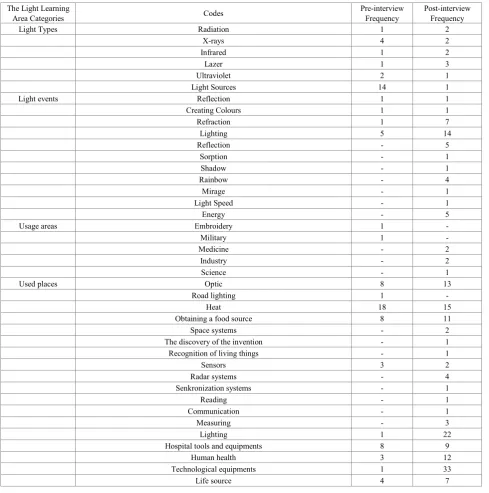
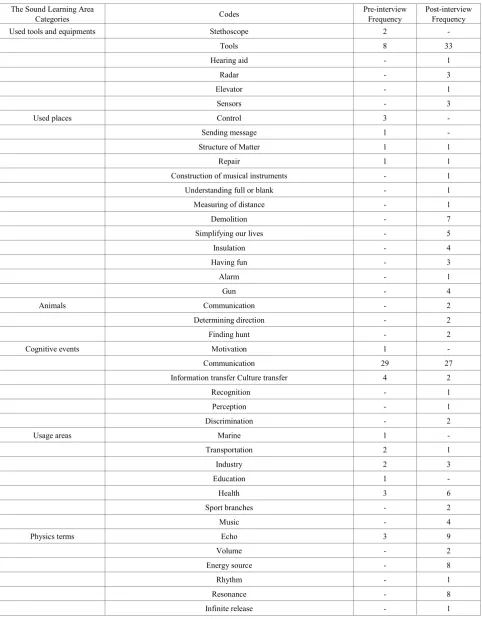
Within the scope of the study, it was aimed to determine the contribution of the practices with real life content (TPRLC) to the light and sound learning areas of the pre-service teachers and their levels of skills to associate the daily life. Analysing the answers of the pre-service teachers before and after the practice, the constituted codes and frequencies are indicated in the table below.
Table 1. The light learning area qualitative data analysis The Light Learning
Area Categories Codes Pre-interview Frequency Post-interview Frequency
Light Types Radiation 1 2
X-rays 4 2
Infrared 1 2
Lazer 1 3
Ultraviolet 2 1
Light Sources 14 1
Light events Reflection 1 1
Creating Colours 1 1
Refraction 1 7
Lighting 5 14
Reflection - 5
Sorption - 1
Shadow - 1
Rainbow - 4
Mirage - 1
Light Speed - 1
Energy - 5
Usage areas Embroidery 1 -
Military 1 -
Medicine - 2
Industry - 2
Science - 1
Used places Optic 8 13
Road lighting 1 -
Heat 18 15
Obtaining a food source 8 11
Space systems - 2
The discovery of the invention - 1 Recognition of living things - 1
Sensors 3 2
Radar systems - 4
Senkronization systems - 1
Reading - 1
Communication - 1
Measuring - 3
Lighting 1 22
Hospital tools and equipments 8 9
Human health 3 12
Technological equipments 1 33
[image:4.595.63.553.261.755.2]As the Table 1 analysed, it is seen that the pre-interview and post-interview data of the pre-service teachers in light learning area are in 4 categories. These categories are light types, light events, usage areas and used places.
The category of light types includes 7 codes in the pre-interview. These are radiation, X-rays, infrared, lazer, ultraviolet, natural light sources, ultraviolet rays artificial light sources. Moreover, pre-interview data include 24 frequencies within this category. The last interview data includes 6 codes in this category. These are radiation, infrared, X-rays, light sources and ultraviolet. The post-interview includes totally 11 frequencies in this category.
While the light events category in pre-interview includes the codes as reflection, creating colors, refraction and lighting, it includes reflection, lighting, refraction, sorption, shadow, creating colors, rainbow, mirage, light speed and energy in the post-interview. While the pre-interview data includes totally 9 frequencies in this category, post-interview data consists of totally 41 frequencies. The participants were observed to stress specifically on the light events within the scope of the light topic which they come across in daily life. They claimed that the events as; rainbow, reflection, lighting, shadow, mirage etc. were among the light events they came across in daily life. Moreover, they claimed that the light was a quantity, which had a speed and energy.
While the used places category consists of the embroidery and military codes in pre-interview, it includes medicine, industry and science codes in post-interview. Pre-interview data includes totally 2 frequencies and post-interview data consists of totally 5 frequencies. The participants expressed their thoughts as “Its use in daily life is that it is used in factories for production machines.”, “In medicine, for visualizing and for machines”, “ Again in medicine, in determining the illness and curing methods.”, “For the sake of the light, it helps the recovery, with X-rays the illnesses in bones are determined”, etc.
The category of used places includes totally 10 codes and 55 frequencies in pre-interview. These are seeing, showing
road, heat, sensors, lighting, hospital equipments, human health, technological equipments and life source. The post-interview data consists of 17 codes and 138 frequencies. The participants described this category as showing roads to the ships, lighting the entertainment places, gathering energy, solar systems, curing the illnesses, determining the illnesses, obtaining food source, obtaining heat, life source, heating the meals, hair dryer, wifi connection, remote control, heating, producing vehicles, identifying the creatures, making operations, photosynthesis and energy source. Moreover, the participants expressed their thoughts as follows: “The light is crucial for the photosynthesis at the same time.”, “It is used for preserving food at home.”, “We can easily heat our meals with microvawe.”, “With infrared lights and hair dryer, we can dry our hair.”, “We can drive cars and change channels with wifi and remote controls.”, “So, we can obtain food.”, “Again, with lights from the Sun, we can heat ourselves.”, “Unless there was light, we could not study lesson, the doctors could not operate on their patients, we could not watch TV.”, “ These lights are used in MR and in Stone reduction units.”.
When the answers about the light learning area by the pre-service teachers before the practice were analysed, it was noticed that it consisted of 4 categories, 23 codes and 92 frequencies. The post-interviews included 4 categories, 37 codes and 195 frequencies. The frequencies generated by the answers of the pre-service teachers are double of the frequencies before the practice. This increase in codes and frequencies of pre-service teachers after the practice may show that they have associated the light topic with daily life, become aware of the light topic in daily events and understood the practice of the learned topics in daily life better. Thus, they have understood and internalized the topics better.
Table 2. The sound learning area qualitative data analysis
The Sound Learning Area
Categories Codes Pre-interview Frequency Post-interview Frequency Used tools and equipments Stethoscope 2 -
Tools 8 33
Hearing aid - 1
Radar - 3
Elevator - 1
Sensors - 3
Used places Control 3 -
Sending message 1 -
Structure of Matter 1 1
Repair 1 1
Construction of musical instruments - 1 Understanding full or blank - 1 Measuring of distance - 1
Demolition - 7
Simplifying our lives - 5
Insulation - 4
Having fun - 3
Alarm - 1
Gun - 4
Animals Communication - 2
Determining direction - 2
Finding hunt - 2
Cognitive events Motivation 1 -
Communication 29 27
Information transfer Culture transfer 4 2
Recognition - 1
Perception - 1
Discrimination - 2
Usage areas Marine 1 -
Transportation 2 1
Industry 2 3
Education 1 -
Health 3 6
Sport branches - 2
Music - 4
Physics terms Echo 3 9
Volume - 2
Energy source - 8
Rhythm - 1
Resonance - 8
[image:6.595.64.547.94.714.2]As the Table 2 is analysed, the data gathered pre-interview in sound learning area are grouped in 5 categories; on the other hand, the data gathered post-interview are grouped in 6 categories. Pre-interview categories are the tools and equipments in which it is used, the used places, cognitive events and physics terms. The post-interview categories are used tools and equipments, used places, animals, cognitive events, usage areas and physics terms. When the pre-interview and post-interview categories are considered in general, it is observed that the post-interview data are more in number.
The stethoscope and tools codes exist in pre-interview in the category of “used tools and equipments” and in the post-interview, hearing aid, radar, elevator and sensors exist. Totally 2 codes and 10 frequencies exist in this category in pre-interview; on the other hand, there are 5 codes and totally 41 frequencies in the post-interview. The sample answers by the participants were: “All the technological tools and equipments have sound items.”, “As TV and computer.”, “The topic sound connected with the technological tools and had a great importance in our lives.”, “For example, in modern washing machines, sound sensors are used.”, “ When the mission completed, it makes warning with sound signals.”
While the pre-interview data in “used places” has 5 codes, post-interview data includes 11 codes. Pre-interview codes are control, sending message, the structure of matter, repair and the structure of the matter. Post-interview codes are, consructing musical instruments, understand full or blank, the structure of the matter, measuring the distances, demolition, make our lives easy, insulation etc. When the pre/post-interview data are compared in this category, there are totally 6 frequencies in pre-interview and 29 frequencies in post-interview. It was observed that the post-interview data of the students were more detailed than the data gathered in pre-interview. The sample answers by the participants are: “ The stone reduction case is through sound waves.”, “when an insulator put in front of it, it cannot pass through, so insolating materials are used in the buildings.”, “For example, if there was not the referee’s sound in football or any other sports games, gong sound, ring tones, it would be difficult and even impossible to play these games or sports.”, “Or, if the vehicles did not have their sound or horn sound during the travel, we could not aware of these vehicles and this case would result in many accidents.”, “…medicine, sound is used in ultrasound.”, “Thanks to the ultra sound, ultra sound speed measuring tools, submarines use ultra sound radars to control their surroundings. Ultrasound drills are used to ream and handle the hard materials.”
While the “cognitive events” include 3 codes and 34 frequencies in pre-interview, it consists of 6 codes and 34 frequencies in post-test. It was observed that the participants focused mostly on “cognitive events” in pre-interview. While the total frequency of the communication code of cognitive events category is 29 in pre-interview, its frequency in post-interview was 27. The sample answer by
the participants was: “We come across with it in communication, perception, to make the presence different in our lives.”
The pre-interview codes of the data in the category of “usage areas” are marine, transportation, industry, education and health. The codes of the post-interview data are industry, medicine, sport branches and music. Although the code numbers are same, the codes are different in content and their total frequencies are different (9 pre-interview and 16 post-interview) from each other. The sample answers by the participants were: “The usage areas are in medicine, machines, in roads, music and science education.”
There are 1 code and totally 3 frequencies in pre-interview data in the “physics terms” category among the categories; on the other hand, there are 6 codes and totally 29 frequencies in the post-interview. Although it is this category in both interview data, it can be claimed that the participants stressed on it more in post-interview. The sample answer bay the participants was “The sound occurs with the resonance event”.
The post-interview data consists of the animal category unlike the pre-interview data. The participants claimed that the animals use sound in communicating with each other, determining their directions and hunting.
When the answers related to the sound learning area by the pre-service teachers are analyzed before the practice, it can be claimed that they include 5 categories, 15 codes and 62 frequencies. The interviews after the practice consist of 6 categories, 35 codes and 154 frequencies. The frequencies of the pre-service teachers’ answers after the practice are three times, compared with the frequencies before the practice. It can be claimed that as a result of the lessons with real life content by the pre-service teachers, they understood the lessons more effectively, interpret and make relations with the events nearby.
4. Result
determining their directions and in army industry at the end of the practice. Although there were many participants, who did not give an opinion related to the usage of this learning area in daily life at the beginning of the practice, almost all of them gave opinion at the end of the practice. At the end of the study, in general, it can be expressed that the pre-service teachers were able to make better connections between the light - sound topics, which are significant in curricula and our daily life, and daily life and they were able to make new context between the real life and topics in their minds. Moreover, it can be claimed that they became aware of the light and sound topics during their observing the events and facts in their surroundings. Thus, they were able to recognize the topics better, internalize and understand effectively. Furthermore, it can be expressed that they were able to perceive its place, importance and usage in daily life. Therefore, giving an answer to the question “When I will use this in my professional life, is it useful?” easily, they will overcome the students’ biases and constitute the contexts, which enable their motivations related to the topics easily. Moreover, they experienced how the TPRLC is applied during the lessons, how it is arranged to the topics, what and how should be carried out during the practice. This case will help them overcome the difficulties, which they may encounter during their professional experiences enabling them to benefit from their own experiences applying this approach. Furthermore, that they are students during the application of this study will help them much in their professions when they use this approach. Thus, they can empathy with their students related to the cases they may encounter, estimate the cases and problem, which they encountered or may encounter. Even taking precautions in order not to make their students encounter such problems, create new situations, and generate ways of solutions. The study is significant in terms of not to encounter with such cases and supports the results of the former studies. Reference [55] refer that the subject matter of teachers is crucial during the teaching-learning process. Because, it is stressed that the teachers’ not understanding the science content of the topics they teach and having contradictory concepts which they think it is adequate cause deficient and incorrect teaching and even misconceptions critically. Reference [56] referred that teachers’ inadequate awareness or unclear understanding of the facts and topics will cause them to cool down from this area, may become hated, and avoided topics. In the study by Reference [21], it was pointed out that the material prepared suitable for the TPRLC was effective in transferring the alternative views of the pre-service teachers into scientific understanding. Moreover, it was found out that this approach increased the permanence and contributed to the configuration process of learned items
in minds even after the teaching process. İt was determined
that it contributed positively both to the success and the attitudes of the pre-service teachers. It was also determined that it was recognised as entertaining by the pre-service teachers, they became interested, and it increased their
motivations. In the study by Reference [57], he used TPRLC for the university students. As a result of the study, it was found out that TPRLC enabled hopeful results especially in learning performances of the students. Reference [58] used TPRLC during the physiotherapy lessons in 1st year physics lessons. TPRLC was both effective in the students’ perceptions and on the depth of learning outcomes, interests and academic achievements. Even the motivation and satisfaction levels were extremely high in the lessons. It was determined that presentation of physics subjects in TPRLC enabled the students to develop interest and courage in practising some of their ideas in daily life. Moreover, it was found out that some new applications as TPRLC affected both the teachers and university educators as well, and made the teaching practice lesson entertaining. Reference [54] carried out his study in Australia with 11 teachers and a university educator. In the study on TPRLC practice in chemistry education, it was aimed to determine the beliefs and limitations of teachers. As a result of the study, as the teaching with TPRLC connected with daily life, it was found out that it increased the interests of the students in teaching the subjects. It was determined that TPRLC was effective in teaching the subjects effectively. Considering these results, it is thought that the students’ misconceptions related to the optical and sound can be eliminated with TPRLC. Because, the misconceptions of the students related to the optical and sound topics originate from incorrect interpretations of events in daily life as they cannot fully cite them. Therefore, teachers making connections with daily life during teaching the optical and sound topics will contribute to better perception of these topics and eliminate misconceptions [31,59]. In the professional lives of the pre-service teachers, as they will teach the students with their existing knowledge, the education that the pre-service teachers have in their university life plays a significant role in order to understand, internalize and make connection with daily life. In this case, the faculties of education and the educators have vital effect in teaching the pre-service teachers who are educated both as a students for their subject matter and as a teacher of future to know how to transfer this knowledge to the students. The university educators should use the teaching methods and techniques as TPRLC in their lessons, so the pre-service teachers may learn their subject matter better and associate their knowledge with daily life.
effectively know the relationship between the real life and topics and apply the activities effectively [16, 61, 62]. Most of the problems, which the teachers encountered, originate from that the approach is entirely new. Therefore, in order to be applied such a new approach by teachers, it is necessary for teachers to be eager for the practice, well-educated and have strong beliefs to deal with the difficulties of the approach [54, 63]. In order to provide this, the teachers should have in-service education; make connections with lesson TPRLC and daily life. Or, the faculties of education should give proper education before the pre-service teachers start their professions [64, 65, 66]. In this context, it is thought that the topics, which are thought to be given to the pre-service teachers, should be supported by similar activities stated in this study to help them gain the needed skills and knowledge before and during their professions. Moreover, the university educators’ having their lessons with this approach not only supports the subject matter of pre-service teachers, but also helps them during their professional lives. As the pre-service teachers may apply this approach by doing and experiencing.
REFERENCES
[1] D. King, I. Ginns. Implementing a context-based environmental science unit in the middle years: Teaching and learning at the creek, Teaching Science, Vol.3, 26-36, 2015. [2] G. Kaur. Drawing insights from cognitive science for a
strengthened teacher preparation: learnings from optics, International Journal for Cross-Disciplinary Subjects in Education, Vol.13, No.2, 741-748, 2012.
[3] M. Enghag, P. Gustafsson, G. Jonsson. From everyday life experiences to physics understanding occurring in small group work with context rich problems during introductory physics work at university, Research in Science Education, Vol.37, No.4, 449-467, 2007.
[4] L.J. Rennie, L.H. Parker. Placing physics problems in real-life context: Students’ reactions and performance, Australian Science Teachers Journal, Vol.42, 55-59, 1996.
[5] E. Ültay, N. Ültay. Context-based physics studies: a thematic review of the literature, Hacettepe University Journal of Education, Vol.29, No.3, 197-219, 2014
[6] E. Whitelegg, C. Edwards. Beyond The Laboratory-Learning Physics Using Real-Life Contexts. In Research in Science Education-Past, Present, and Future Springer Netherlands, 337-342, 2001.
[7] R. S. Güneş Koç. The effect of context based approach
supported by 5e learning Model on 7th grade students’ achievements, retention and attitude on the unit “light”. Unpublished Doctoral Thesis, Gazi University, 2013.
[8] M. Sözbilir, S. Sadi, H. Kutu, A. Yıldırım. Kimya Egitiminde Içerige / Baglama Dayalı (Context-Based) Ögretim Yaklasımı Ve Dünyadaki Uygulamaları, I. Ulusal Kimya Egitimi
Kongresi, 108- 116, 2007.[ Context-Based Teaching In
Chemistry Education And Its Applications In The World, I. National Chemistry Education Congress]
[9] Ş. İlkörücü Göçmençelebi. Primary school sixth grade
students levels of using biological knowledge and connecting with everyday life which is given at science courses. Unpublished Doctoral Thesis. 2007
[10] H. Özmen. Chemistry student teachers’ levels of linking their knowledge with daily life about acid and base concepts, Gazi University Kastamonu Education Journal, Vol.11, No.2, 317-324, 2003
[11] H. Ş. Ayvaci, S. E. Nas, Y. Dilber. Effectiveness of the
context-based guide materials on students’ conceptual understanding: “conducting and insulating materials” sample, YYU Journal of Education Faculty, Vol.13, No.1, 51-78, 2016.
[12] B. Acar, M. Yaman. The effects of context-based learning on students’ levels of knowledge and interest, Hacettepe University Journal of Education, Vol.40, 1-10, 2011.
[13] C. Murphy. Writing centers in context: Responding to current educational theory, Landmark Essays on Writing Centers, Vol.9, 117-127, 1995.
[1] H. Yam. What is contextual learning and teaching in physics, Online available from
http://www.hk-phy.org/contextual/approach/tem/brief_e.html [14] O. De Jong. Context-based chemical education: how to
improve it? Chemical Education International, 8 (1), Online avaliable from
http://old.iupac.org/publications/cei/vol8/0801xDeJong.pdf [15] M. Özturan- Sağırlı, F. Baş, Z. Çakmak, M. Okur. The
effects of real life contented teaching practices on the levels of pre-service elementary mathematics teachers’ association mathematics with daily life, YYU Journal Of Education Faculty, Vol.13, No.1, 164-193, 2016.
[16] M.Ş. Bülbül, G. Aktaş. Context based drama applıcatıons for physıcs courses, Journal of Research in Education and
Teaching, Vol.2, Vol.1, 381-389, 2013
[17] M. Ş. Bülbül, K. Matthews. Bağlam Temelli Eğitimin Olasi Geleceği: [Possible Future of Context Based Education] Online Avaliable from
http://kongre.nigde.edu.tr/xufbmek/dosyalar/tam_metin/pdf/2 487-30_05_2012-22_56_57.pdf
[18] J. K. Gilbert, M. A. Bulte, A. Pilot. Concept development and transfer in context based science education, International Journal of Science Education, Vol.33, No.6, 817-837, 2011. [19] H. J. Choi, S. D. Johnson. “The Effect of Context-Based Video
Instruction on Learning and Motivation in On-Line Courses”, The American Journal of Distance Education, Vol.19, No.4, 215–227, 2005.
[20] H. Demircioğlu. Developing instructional materials about the
topic of "states of matter" based on the context based approach for primary students teachers and probing their effectiveness. Unpublished Doctoral Thesis, Karadeniz Teknik University, Institute of science, 2008.
[21] H. Demircioğlu, G.Demircioğlu, M. Çalik. Investigating the
[22] G. Tural. Amazing physics: learning about work, energy and projectile motion in a historical context, Physics Education, Vol.48, No.3, 336-354, 2013.
[23] H. Ş. Ayvacı. Views of physics teachers about context based approach, Dicle University Journal of Ziya Gökalp Faculty of Education, Vol.15, 42-51, 2010.
[24] M. A. Kurnaz. Fizik öğretmenlerinin bağlam temelli fizik problemleriyle ilgili algılamalarının incelenmesi. Kastamonu Eğitim Dergisi, Vol.21, No.1, 375-390, 2013. [Investigation of the perceptions of physics teachers about context-based physics problems].
[25] J. K. Gilbert. On the nature of “context” in chemical education, International Journal of Science Education, Vol.28, No.9, 957-976, 2006.
[26] G. Tural. Cross-grade comparison of students’ conceptual understanding with lenses in geometric optics, Science Education International, Vol.26, No.3, 325-346, 2015. [27] S. Uzun, N. Alev, I. S. Karal. A cross-age study of an
understanding of light and sight concepts in physics, Science Education International, Vol.24, No.2, 129-149, 2013. [28] M. Uzoğlu, A. Yildiz, Y. Demir, E. Büyükkasap. A
comparison of effectiveness of concept cartoons and open-ended questions to determine the misconceptions of pre-service science teacher about light, Journal of Kırşehir
Education Faculty, Vol.14, No.1, 367-388, 2013.
[29] M. Yalçın, S. Altun, Ü. Turgut, F. Aggül. First year turkish
science undergraduates’ understandings and misconceptions of light, Science Education, Vol.18, 1083–1093, 2009. [30] M. Ahçı. University students’ conceptual understanding about
the subjects of light and optics. Unpublished Master's Thesis, Balikesir University Institute Of Science Secondary Science And Mathematics Education Physics Education, 2012. [31] I. Galili, A. Hazan. Learners' knowledge in optics:
interpretation, structure and analysis, International Journal of Science Education, Vol.22, No.1, 57-88, 2000.
[32] İ. Kara, D. Erduran Avcı, Y. Çekbaş. Investigation of the
scinence teacher candidates’ knowledge level about the concept of light, Journal of Mehmet Akif Ersoy University Education Faculty, Vol.8, No.16, 46-57, 2008.
[33] S. Aydin. Establishment for misconceptions that sciences teacher candidates have about geometric optics, The Online Journal of New Horizons in Education, Vol.2, No.3, 7-15, 2012.
[34] D. Blizak, F. Chafiqi, D. Kendil. Students' Misconceptions About Light In Algeria. In Eleventh International Topical Meeting on Education and Training in Optics and Photonics International Society for Optics and Photonics, 96661F-96661F, 2009.
[35] S. Cepni. Effects of computer supported instructional material (CSIM) in removing students misconceptions about concepts: “Light, light source and seeing, Energy Education Science and Technology Part B: Social and Educational Studies, Vol.1, No.2, 51-83, 2009.
[36] H.E. Chu, D.F. Treagust, A.L. Chandrasegaran. A stratified study of students’ understanding of basic optics concepts in different contexts using two‐tier multiple‐choice items, Research in Science and Technological Education, Vol.27, No.3, 253-265, 2009.
[37] K. Kaewkhong, A. Mazzolini, N. Emarat, K. Arayathanitkul. Thai high-school students’ misconceptions about and models of light refraction through a planar surface, Physics Education, Vol.45, No.1, 97-119, 2010.
[38] A. Küçüközer. Prospective science teachers’ understanding of
sound, Procedia-Social and Behavioral Sciences, Vol.1, No.1, 1889-1894, 2009.
[39] A. Küçüközer. Investigating prospective science teachers’ misconceptions of sound, Elementary Education Online, Vol.8, No.2, 313-321, 2009.
[40] A. Kaya. The fixation of science teacher candidates’ undearstanding levels about light and atom concepts, Erzincan University Journal of Erzincan Faculty of Education, Vol.12, No.1, 15-37, 2010.
[41] M. Bolat, M. Sözen. Knowledge levels of prospective science and physics teachers on basic concepts on sound (sample for Samsun city), Procedia-Social and Behavioral Sciences, Vol.1, No.1, 1231-1238, 2009.
[42] N. Öztürk, N. Atalay. Analyzing Pre-service Teachers’ Misconceptions about Sound, Inonu Unıversıty Journal Of The Faculty Of Educatıon, Vol.13, No.1, 43-58, 2012. [43] F. Mumba, S. Mbewe, V. M. Chabalengula. Elementary
school teachers' familiarity, conceptual knowledge, and interest in light, International Journal of Science Education, Vol.37, No.2, 185-209, 2015.
[44] J. D. Plummer, L. Maynard. Building a learning progression for celestial motion: An exploration of students’ reasoning about the seasons, Journal of Research in Science Teaching, Vol.51, No.7, 902–929, 2014.
[45] P. M. Sadler, G. Sonnert, H. P. Coyle, N. Cook-Smith J. L. Miller. The influence of teachers’ knowledge on student learning in middle school physical science classrooms, American Educational Research Journal, Vol.50, No.5, 1020-1049, 2013.
[46] B. Djanettea, C. Fouadb. Determination of university students’ misconceptions about light using concept maps, Procedia - Social and Behavioral Sciences, Vol.152, 582 – 589, 2014. [47] R. Henrichs. Effects of real-world contexts on long-term
memory and the understanding of chemistry concepts in the high school classroom. Master of Science, Montana State University, 2013.
[48] M. Overman, J. D. Vermunt, P. C. Meijer, A. M. Bulte, M. Brekelmans. Students' Perceptions of Teaching in Context-based and Traditional Chemistry Classrooms: Comparing content, learning activities, and interpersonal perspectives, International Journal of Science Education, Vol.36, No.11, 2014.
[49] I. Parchmann, C. Grasel, A. Baer, P. Nentwig, R. Demuth, B. Ralle. "Chemie im Kontext": A symbiotic implementation of a context-based teaching and learning approach, International Journal of Science Education, Vol.28, No.9, 1041-1062, 2006. [50] M. Rannikmae, M. Teppo, J. Holbrook. Popularity and
relevance of science education literacy: using a context-based approach, Science Education International, Vol.21, No.2, 116-125, 2010.
[52] R. Santagata, C. Zannoni, J. W. Stigler. The role of lesson
analysis in pre-service teacher education: An empirical investigation of teacher learning from a virtual video-based field experience, Journal of Mathematics Teacher Education, Vol.10, No.2, 123-140, 2007.
[53]D. T. King. Teacher beliefs and constraints in implementing a context-based approach in chemistry, Teaching Science: The Journal of the Australian Science Teachers Association, Vol.53, No.1, 14-18, 2007.
[54]D. T. King, E. Winner, I. Ginns. Outcomes and implications of one teacher's approach to context-based science in the middle years, Teaching Science, Vol.57, No.2, 26-30, 2011.
[55]A.İ. Şen. İnvestıgatıon of the mısconceptıons and learnıng dıffıcultıes of elementary students on lıght, vısıon and mırrors,
Hacettepe University Journal of Education, Vol.25, 176-185, 2003.
[56]Z. Y. Dong. Improving learning in undergraduate control
engineering courses using context-based learning models,
Internatıonal Journal of Engineering Education, Vol. 21, No.6,
1076–1082, 2005.
[57]A. Rayner. Reflections On Context-Based Science Teaching: A Case Study Of Physics For Students Of Physiotherapy, In: Proceedings Of The Australian Conference On Science And Mathematics Education (Formerly UniServe Science Conference), 169-172, 2012.
[58]Ö. Kistak. Teaching The “Sound” Unit With Context-Based Learning At Eight Grades In Science And Tecnology Lesson. Unpublished Doctoral Thesis, Balıkesir University, Institute
of Science, 2014.
[59]S. Coştu. Teacher Experiences From A Learning Environment
Based On Contextual Teaching And Learning In Mathematics Teaching. Unpublished Doctoral Thesesis, Karadeniz Teknik University, Institute Of Science, 2009.
[60]M. A. J. Vos, R. Taconis, W. M. G. Jochems, A. Pilot. Classroom implementation of context-based chemistry
education by teachers: the relation between experiences of teachers and the design of materials, International Journal of Science Education, Vol.33, No.10, 1407-1432, 2011. [61] M. J. Stolk, O. De Jong, A. W. M. Bulte, A. Pilot. Exploring a
framework for professional development in curriculum innovation: Empowering teachers for designing context-based chemistry education, Research in Science Education, Vol.41, 369-388, 2011.
[62] S. Avargil, O. Herscovitz, Y. J. Dori. Teaching thinking skills in context-based learning: Teachers’ challenges and assessment knowledge, Journal of Science Education and Technology, Vol.21, No.2, 207-225, 2012.
[63] S. Gomez-Zwiep. Elementary teachers’ understanding of students’ science misconceptions: Implications for practice and teacher education, Journal of Science Teacher Education, Vol.19, No.5, 437-454, 2008.
[64] C. Gordon, R. Debus. Developing deep learning approaches and personal teaching efficacy within a preservice teacher education context, British Journal of Educational Psychology, Vol.72, 483–511, 2002.
[65] L. G. A. Putter-Smits, R. Taconis, W. Jochems, J. Van Driel. An analysis of teaching competence in science teachers
ınvolved in the design of contextbased curriculum materials,
International Journal of Science Education, Vol.34, No. 5, 701-721, 2012
[66] Ş. Büyüköztürk, E. Kılıç Çakmak, Ö. E. Akgün, Ş. Karadeniz, F. Demirel. Bilimsel Araştırma Yöntemleri, Ankara, Pegem
Publication, 2008. [Scientific Research Methods]
[67] J.Faenkel, N. Wallen. How to design and evaluate research in education (7 ed.). Boston: McGraw-Hill Higher Education, 2009.
[68] A. Balcı. Sosyal Bilimlerde Araştırma Yöntem Teknik ve
İlkeler, Ankara, Pegem Publication, 2005.
[69] N. Karasar. Bilimsel Araştırma Yöntemleri (15 ed.). Ankara,
Nobel Publication, 2005. [Scientific Research Methods].
i It includes some of the data in the project "Lifematic With Mathematics