Kaleidoscope laser
Mcdonald, GS, Karman, GP, New, GHC and Woerdman, JP
http://dx.doi.org/10.1364/JOSAB.17.000524
Title
Kaleidoscope laser
Authors
Mcdonald, GS, Karman, GP, New, GHC and Woerdman, JP
Type
Article
URL
This version is available at: http://usir.salford.ac.uk/18336/
Published Date
2000
USIR is a digital collection of the research output of the University of Salford. Where copyright
permits, full text material held in the repository is made freely available online and can be read,
downloaded and copied for noncommercial private study or research purposes. Please check the
manuscript for any further copyright restrictions.
Kaleidoscope laser
G. S. McDonald and G. P. Karman
Huygens Laboratory, Leiden University, Box 9504, 2300 RA Leiden, The Netherlands
G. H. C. New
Laser Optics and Spectroscopy Group, Department of Physics, Imperial College, London SW7 2BZ, UK
J. P. Woerdman
Huygens Laboratory, Leiden University, Box 9504, 2300 RA Leiden, The Netherlands
Received June 11, 1999
We report the first calculations of mode patterns of unstable-cavity lasers with truly two-dimensional trans-verse geometries. A detailed account of numerical techniques, incorporating a nonorthogonal beam-propagation method, and results for cavities with a range of transverse symmetries, such as regular polygonal and rhomboid, are presented. In view of the beautiful complexity of the eigenmodes predicted, a novel kalei-doscope laser is proposed. © 2000 Optical Society of America [S0740-3224(00)00803-1]
OCIS codes: 030.4070, 050.1940, 110.1220, 120.2040, 140.3410.
1. INTRODUCTION
Hermite–Gaussian modes have formed the basis for the analysis and understanding of stable-cavity lasers for many decades. These modes tend to be highly paraxial and have low round-trip loss but often do not exploit the full volume of the gain medium. On the other hand,
unstable-cavity lasers utilize diverging light wave fronts for high-gain extraction, leading to strong periodic aper-turing effects and high-loss modes.1–3 The transverse
structure of these modes is determined, to a large extent, by the detailed symmetry of the aperturing element, re-sulting in mode patterns that are radically different than those of conventional stable-cavity lasers.
To date, only unstable-cavity modes for one-dimensional (1D) transverse geometries, and for rectan-gular and circular geometries in two dimensions, have been studied.3–12 This is because each of these configu-rations can be investigated by use of a 1D transverse cal-culation. We have undertaken, to our knowledge, the first investigation of the eigenmode patterns of unstable-cavity lasers with truly two-dimensional (2D) aperture symmetries, concentrating specifically on resonators with rhombus and N-sided regular polygon aperture shapes. In this paper we present an account of the numerical techniques that we have developed for the calculation of these fully 2D mode profiles. Results for cavities with triangular, rhomboid, pentagonal, hexagonal, and octago-nal aperture symmetries are reported. The profound, and indeed fractal, complexity of the mode patterns leads us to christen such devices ‘‘kaleidoscope lasers.’’
2. THEORY
The simple resonator configuration that we model is sketched in Fig. 1(a) and consists of a convex mirror (focal
lengthf) and a concave mirror (focal lengthfv) that are separated by a free space path of lengthL. For definite-ness we model a confocal unstable resonator (L ⬅ Lc
⫽ fv ⫺ f) in which periodic aperturing of the circulat-ing field occurs at the convex mirror. This aperturing may arise from the shape of the mirror itself or, more con-veniently, be due to an aperture placed directly against this mirror. Figure 1(b) shows the aperture shapes that we consider, and it defines their relative sizes through the parameter a. The eigenmodes of the cavity are param-etrized by only two variables, the round-trip magnifica-tionMand the equivalent Fresnel numberNeqgiven, for
this particular configuration, by M⬅ Mc⫽ fv/f and Neq
⫽ (M⫺1)a2/2L. The same results can also be
ap-plied to different experimental configurations, albeit with different definitions ofMandNeq. In general, the
mag-nification is given by3 M⫽m⫹(m2⫺1)1/2(for a
posi-tive branch resonator), where12 m⫽(Mc⫹ 1/Mc
⫺ ␦2/ff
v)/2 and a finite degree of nonconfocality has been introduced throughL⫽Lc⫹␦. The equivalent Fresnel number is given by3 N
eq⫽ a2(M2⫺1)/2BM, where12
B⫽ Lc(1⫹Mc)/Mc⫹(2f ⫺␦)␦/fv for aperturing at the convex mirror and B⫽Lc(1⫹Mc) ⫹(2fv⫹␦)␦/f when the aperture is at the other end of the resonator.
For rectangular and circular aperturing, semianalyti-cal techniques are useful for determining an approxima-tion to the mode profile. One of the more commonly used methods is the virtual source technique6in which the cav-ity is unfolded into a sequence of effective apertures. The modal pattern is then constructed by taking a weighted sum of edge waves from each aperture and an undiffracted plane-wave component. At the heart of such methods is knowledge of the diffraction patterns that result from particular aperture shapes. However, it is quite surprising that there is almost no published work describing Fresnel diffraction at apertures with
thogonal edges. A notable exception to this is Newton’s two-knife experiment,13which has only recently attracted some deserved attention.14 Newton reported that hyper-bolic fringes appear in the diffraction patterns from thin wedge apertures as one moves toward the far-field do-main. Nevertheless, the complexity of the aperture shapes considered here, and the absence of appropriate analytical work, render the generalization of existing semianalytical techniques quite involved; we therefore adopt a fully numerical approach.
In the numerical scheme used, the intracavity field is initialized with a plane wave and then evolved by circu-lation around the resonator by repeated application of a round-tripABCDmatrix and aperturing. This mapping is iterated until the transverse profile converges, with sufficient accuracy, to the lowest-loss mode. Resolution of the aperture edges and the resulting diffraction pat-terns demands relatively dense discretization of the transverse plane. To minimize memory and run-time re-quirements of the simulations, we use a transverse basis that most closely matches the symmetry of the aperture shape. Figure 2 shows the geometry of the transverse computational axes in the most general case. For each transverse point, orthogonal and nonorthogonal coordi-nates are defined, (x1,y1) and (p1,q1), respectively.
Denoting the angle between the p–q axes by⌽, we see that these sets of coordinates are related through p1
⫽ x1 ⫺ y1/tan⌽andq1⫽y1/sin⌽.
To evolve the field profile over each cavity round trip, we find it is advantageous to transform the actual confo-cal cavity to an equivalent lens guide, consisting of a se-quence of concave lenses and apertures [Fig. 1(c)]. Re-quiring that this lens guide has the same value ofNeqas
the original cavity, we find the focal length of each lens to be fe⫽ ⫺L(M⫹1)/(M⫺1)2. The mode profile
imme-diately before the concave lens in the equivalent guide
Ue1(p,q) is related to the associated profileU(p,q)
ap-proaching the convex mirror through
Ue1共p,q兲⫽U共p,q兲
⫻ exp关⫺i共p2⫹q2⫹2pqcos⌽兲/a2兴,
(1)
where  ⫽(a2/L)(M⫺1)/(M⫹1). The defocusing
and aperturing actions of the lens then transform the field toUe2(p,q), where
Ue2共p,q兲⫽Ue1共p,q兲exp关⫺i共M⫺1兲
⫻共p2⫹ q2⫹ 2pqcos⌽兲/a2兴 (2)
inside the aperture and is zero otherwise. Free space propagation of Ue2(p,q) over a distance Le⫽ L(1
⫹ M)/Mthen yieldsUe3(p,q) and completes the scheme
for a single cavity transit.
The propagation step is implemented in the spatial fre-quency domain and thus involves a pair of fast Fourier transforms (FFT’s). Although there exists a computa-tionally faster scheme in which a cavity transit can be written in terms of only one FFT,3we find that this latter scheme imposes an awkward constraint on the spatial grid. In 1D transverse calculations the effect of this con-straint can be minimized by use of a very large number of transverse points, but in the 2D case this is not possible and the constraint ultimately limits the accuracy of the solution. We also find that the double FFT method per-mits a straightforward accommodation of a nonorthogo-nal transverse basis.
In terms of the Cartesian basisx–yand the longitudi-nal coordinatez, propagation of the field involves the so-lution of
U共x,y兲
z ⫽ i
2k
冉
2
x2 ⫹
2
y2
冊
U共x,y兲, (3) [image:3.612.59.293.50.225.2]where k is the free space propagation constant. In the nonorthogonal basis the field evolution is governed by
Fig. 1. Bare cavity configuration of the kaleidoscope laser. (a) Schematic picture of the unstable cavity, consisting of a convex mirror (focal length f) and a concave mirror (focal length fv) separated by a distanceL. The circulating field is apertured on each round trip by one of the mirrors or, equivalently, by an ap-erture placed directly against that mirror. (b) The transverse shapes of the apertures considered are plotted. (c) In the mod-eling we transform the above system to the equivalent lens guide sketched, which is a series of diverging lenses (focal lengthfeand
a distance Le apart) and apertures adjacent to each of these lenses.
[image:3.612.357.520.565.698.2]U共p,q兲
z ⫽ i
2ksin2⌽
⫻
冉
2
p2 ⫹
2
q2⫺2 cos⌽
p
q
冊
U共p,q兲.(4)
To employ FFT’s for the solution of Eq. (4), we define a spectral functionU˜(K1,K2) such that
U共p,q兲⫽
冕
⫺⬁ ⬁
冕
⫺⬁ ⬁U˜共K1,K2兲
⫻exp关i共K1p⫹ K2q兲兴dK1dK2, (5)
whereby free space propagation is effected by15
U˜e3共K1,K2兲
⫽ U˜e2共K1,K2兲
⫻ exp
冋
⫺ iLe 2ksin2⌽ 共K12⫹K
2
2⫺2 cos⌽K 1K2兲
册
.(6) Once a particular mode is established, the field profiles satisfy the self-consistency condition Ue3(p,q)
⫽ ␥Ue1(p,q), where␥is the (complex) mode eigenvalue.
Equation (1) can then be inverted to determine the mode profileU(p,q) in the actual cavity.
3. RESULTS
In recent experiments,9–11,16,17unstable cavities with low
Neq values and linear magnifications between 1 and 2
have been studied. We have concentrated our investiga-tions of eigenmode patterns in this regime. To facilitate a comparison between transverse modes with different aperture shapes, we present results for a single value of magnification,17M⫽1.3.
First, we checked that the full 2D code gave results consistent with those of 1D codes for apertures with square and circular shapes. Second, since the transverse grid cannot sample individual edges of all polygon aper-tures in exactly the same fashion, checking the overall symmetry of each modal pattern proved to be a good test of whether we were using a sufficient number of trans-verse points. For M⫽1.3 we found that 256⫻256 transverse points were required forNequp to 2.0 and that
a grid density of 512⫻ 512 points was needed for higher values (up toNeq⬇4). Higher-order corrections in the
discretizations, which weight individual sampling points along the edges of each aperture, have also been em-ployed, and the results obtained were checked against those presented here. Finally, the value of the Peter-mannKfactor (the so-called excess quantum-noise factor) for any particular eigenmode pattern depends very sensi-tively on the detail of its transverse structure, since theK
factor is the inverse of an almost vanishing modal overlap integral.7 We used this quantity as a diagnostic to test the accuracy of 2D patterns using corresponding results from 1D calculations and to monitor the convergence of the field profiles. In common with studies of the 1D
problem,12we find that the number of cavity transits for convergence depends on the precise value of Neq
consid-ered and whether there is a nearby mode crossing (a point at which two eigenmodes of the cavity become degener-ate).
Most graphical packages require data defined on a Car-tesian basis, so it is convenient to transform the modal profiles U(p,q) back to a rectilinear representation
U(x,y). To undertake this transformation using con-ventional interpolation techniques would be rather in-volved and may introduce inaccuracies. As an alterna-tive, we use the Fourier transform shift property and perform the required transformation in the frequency do-main. For eachq, we define a functionU˜(K) such that
U共p兲⫽
冕
⫺⬁ ⬁
U˜共K兲exp共iKp兲dK, (7) wherebyx⫽p⫹qcos⌽yields
U共x兲⫽
冕
⫺⬁ ⬁
U˜共K兲exp共iKqcos⌽兲exp共iKp兲dK. (8) Thus in practice, the reconstruction of U(x,y) involves scanning throughqand, on each line of data, performing an FFT, applying a phase ramp given by Kqcos⌽, and then using another FFT.
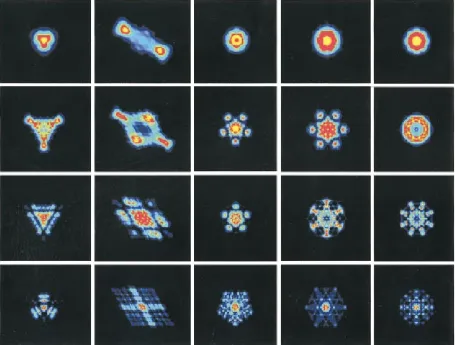
Column 1 of Fig. 3 shows results for triangular aper-turing. The transverse intensity profiles of the modes have increasing complexity asNeqis increased from 0.5 to
4.0 (moving downward in the column). The values ofNeq
used were chosen to give an overview of the distinct pat-terns that arise as the aperture size is slowly increased. The choice of Neq values for other aperture shapes is
made on the same basis. For Neq⫽0.5, a single spot
with overall triangular symmetry is evident. Closer in-spection of this pattern reveals the presence of smooth curves connecting the bright regions that arise from the aperture corners. Since this modal pattern may be con-sidered to be a superposition of aperture diffraction pat-terns that extend into the far field, we believe that these smooth contours are related to a generalization of New-ton’s result in which each aperture of the unfolded system gives rise to a combination of three wedge-type diffraction profiles.
The second profile in column 1 also displays a pattern that has bright spots from the aperture corners. This characteristic was found for all polygon mode profiles whenNeq⬇1. AsNeqis increased to 3.0 (the third
tri-angular profile) a different type of eigenmode pattern is found that is composed of bright sides enclosing a nested structure. This profile is in fact similar to the Fresnel diffraction pattern of the closest aperture of the unfolded system. In the final plot of column 1, where Neq⫽4.0,
the mode characteristics have changed yet again, and the pattern exhibits bright spots emanating from the aper-ture edges.
Our nonorthogonal computational technique is ideally suited to the modeling of configurations with rhomboid aperturing. In column 2 of Fig. 3 we show eigenmode profiles when the cavity aperture has the shape of a 60° rhombus. For this configuration we show the cases Neq
same numerical value of Neqleads to much more
devel-oped modal structure. In fact, the parameterais defined such that, on the one hand, the rhombus aperture has twice the area of the corresponding triangular aperture but, on the other hand, has the same area as the corre-sponding square aperture. This highlights the somewhat arbitrariness in the definition ofNeq. We defineasuch
that there is consistency with square and circular aper-tures, since in these casesNeqis formally defined. In
do-ing so we regard a circle as a regular polygon with an in-finite number of sides.
The equivalent Fresnel number actually has its origin in the relative phase of (magnifying and demagnifying) geometrical eigenmodes of the cavity and is distinct from the collimated Fresnel numberNc⫽ Ma2/B. This lat-ter paramelat-ter is more closely related to the number of dif-fraction ripples across the opening of the aperture3and is generally larger than Neq. This fact explains the
rela-tive complexity of modal patterns for such low values of
Neq. The rhomboid mode profiles for the lowest values of
Neq considered confirm the generality of the
bright-corners characteristic, and, with increasing Neq, the
mode can be seen to cycle through patterns with bright
sides and nested structures. The final frame in column 2 displays a mode that is reminiscent of those found for square aperturing,11even though the overall symmetry is
rhomboid.
Eigenmode profiles for other types of polygonal aper-turing are shown in columns 3–5 of Fig. 3, where the transverse symmetry of the cavities are pentagonal, hex-agonal, and octhex-agonal, respectively. In each column a similar sequence of modal characteristics, as described earlier, is evident. For lowNeq the modes become
pro-gressively more circular as the number of aperture sides is increased. For higher values ofNeq, it is interesting to
note that the results are similar to snowflake patterns. This leads one to enquire whether the eigenmodes have an underlying fractal nature. Two of us have recently undertaken calculations of the fractal dimension of mode profiles of 1D and radially symmetric cavities.18 In these studies the dimension of the modes was found to lie be-tween1 and 2, confirming their fractal character. A sim-plified physical picture, involving the repeated magnifica-tion of the modal pattern on subsequent round trips, was also presented to support their findings. We note that this interpretation is essentially independent of the
aper-Fig. 3. Cross section of the transverse-mode profiles of the kaleidoscope laser. The defining aperture of the cavity has a different shape in each column of this figure. The profiles generally exhibit increasing complexity as the equivalent Fresnel number is increased (mov-ing downward through each column). In column 1 the aperture has the shape of an equilateral triangle (Neq⫽0.5, 1.5, 3.0, and 4.0).
Columns 2–5 are for rhomboid (Neq⫽0.5, 1.0, 1.5, and 3.0), pentagonal (Neq⫽0.5, 1.5, 2.0, and 4.0), hexagonal (Neq⫽0.5, 1.5, 3.0, and
4.0), and octagonal aperturing (Neq⫽0.5, 1.0, 3.0, and 4.0), respectively. The colors yellow, red, green, blue, and black are used to
[image:5.612.80.535.329.674.2]ture shape. On this basis the modes of cavities with po-lygonal and rhomboid symmetries are also expected to be fractal.
Since the fractal dimensions of 1D and square geom-etry modes are identical, we suspect that the modal di-mension for each polygonal configuration also lies be-tween 1 and 2. It is therefore not surprising that any underlying fractal structure can be visualized in the transverseplanesince this surface represents an embed-ding dimension of 2 (which is larger than the dimension of the pattern). To obtain accurate estimates of fractal di-mension, one generally needs many thousands of distinct sampling points. Although this requirement can easily be met in 1D calculations, the 2D spectral method that we employ dictates that the modal structure occupies only a portion of the whole transverse grid, and this feature greatly reduces the number of distinct and useful data points that are available for quantitative dimension esti-mates.
4. KALEIDOSCOPE LASERS
Unstable-cavity lasers are usually associated with high-power applications. Here, we have proposed a novel ka-leidoscope laser for which, particularly in the highNeq
re-gime, dynamic tuning between modes and real-time adjustments of the shape and size of the aperture would result in stunning visual complexity. A prototype kalei-doscope laser17 has actually been constructed by our-selves using a miniature He–Xe laser. A simple tech-nique, based on modifying commercial iris diaphragms, has been developed that yields the required (variable-size and variable-shape) apertures. Using the most sensitive diagnostic available (the Petermann K factor), we have found excellent agreement between theoretical predic-tions and experimental results.17 Noting that the Fresnel number of a cavity depends on the aspect ratio (and not on the absolute size) of the system, the simplicity and the high-gain characteristics of the kaleidoscope laser geometry make it particularly suited to further miniatur-ization; relatively inexpensive and compact devices may be envisaged.
The original kaleidoscope device, invented by Sir David Brewster in 1816, essentially consists of just two plane mirrors that share a common edge.19 The angle be-tween these mirrors defines theN-fold polygonal symme-try of the patterns produced through the relation N
⫽ 2/. A formal connection with the kaleidoscope la-ser can be established by employing Babinet’s principle and decomposing anN-sided polygon aperture of the un-stable cavity into N congruent isosceles triangles. The internal angle of each of those component triangles, 2/N, then corresponds to the angle between the mirrors of Brewster’s kaleidoscope.
This suggests that kaleidoscope mirrors themselves could be employed as an optical element and could give rise to novel laser designs. They could impose polygonal transverse boundary conditions and thus replace more complex aperture assemblies. The result would be a la-ser whose modes could be easily scanned through an infi-nite number of possible polygonal symmetries (by
vari-ance of the angle). Alternatively, other fixed-symmetry systems could be built; gain rods whose longitudinal sur-faces were polished or more exotic lasers that exploit a three-mirror kaleidoscope tube are possible.
5. SUMMARY
We have reported the first calculations, to our knowledge, of unstable-cavity eigenmodes for configurations with truly 2D transverse geometries. Modal patterns for ap-erturing with triangular, rhomboid, pentagonal, hexago-nal, and octagonal symmetries have been mapped out as a function of the equivalent Fresnel number of the cavity. In contrast to the lowest-loss modes of stable-cavity la-sers, a rich and beautiful complexity is revealed that sug-gests such systems be termed kaleidoscope lasers.
The use of a nonorthogonal computational grid made an important contribution to the analysis. Although this technique15has received little attention since it was first proposed in 1993, it is clearly a very powerful and flexible method with a wide range of potential applications. These include the modeling of tapered optical structures and, more generally, two-and three-dimensional propaga-tion problems that involve nonorthogonal features and where efficient discretization is a necessity. Moreover, there is almost no computational overhead arising from undertaking propagation calculations in a nonorthogonal frame.
We plan further theoretical and experimental investi-gations of kaleidoscope lasers, including alternative cav-ity designs, the study of more general aperture shapes, and considerations of higher-order modes.12 This will lend more insight into general Fresnel diffraction prob-lems and the character of excess quantum noise, as well as permit a fuller exploration of the diversity of modal patterns that are possible.
ACKNOWLEDGMENTS
The authors acknowledge numerous invaluable discus-sions with M. van Eijkelenborg and T.I.J. Albaho, as well as interaction over many years with A. E. Siegman. The project was supported by the Foundation for Fundamen-tal Research of Matter of the Netherlands, ESPRIT con-tract 20029 (ACQUIRE), TMR concon-tract ERB4061PL95-1021 (Micro-Lasers and Cavity QED) and the UK Engineering and Physical Sciences Research Council un-der grant GR/L90583.
Please send correspondence to G. H. C. New, Laser Op-tics and Spectroscopy Group, Department of Physics, Im-perial College, London SW7 2BZ, UK. Telephone:
⫹44 20 7594 7791. Fax: ⫹44 20 7823 8376. E-mail: [email protected].
REFERENCES
1. A. E. Siegman, ‘‘Unstable optical resonators,’’ Appl. Opt.13, 353–367 (1974).
3. A. E. Siegman,Lasers(Oxford University, London, 1986). 4. P. Horwitz, ‘‘Asymptotic theory of unstable resonator
modes,’’ J. Opt. Soc. Am.63, 1528–1543 (1973).
5. M. A. Lauder and G. H. C. New, ‘‘Biorthogonality properties and excess noise factors of unstable optical resonators,’’ Opt. Commun.31, 343–348 (1979).
6. W. H. Southwell, ‘‘Unstable-resonator-mode derivation us-ing virtual-source theory,’’ J. Opt. Soc. Am. A3, 1885–1891 (1986).
7. G. H. C. New, ‘‘The origin of excess noise,’’ J. Mod. Opt.42, 799–810 (1995).
8. M. A. Rippin and G. H. C. New, ‘‘Excess noise factors in cir-cular unstable resonators,’’ J. Mod. Opt. 43, 993–1008 (1996).
9. M. A. van Eijkelenborg, A. M. Lindberg, M. S. Thijssen, and J. P. Woerdman, ‘‘Resonance of quantum noise in an un-stable cavity laser,’’ Phys. Rev. Lett.77, 4314–4317 (1996). 10. M. A. van Eijkelenborg, A. M. Lindberg, M. S. Thijssen, and J. P. Woerdman, ‘‘Unstable-resonator diffraction losses and the excess-noise factor,’’ Phys. Rev. A55, 4556–4562 (1997). 11. M. A. van Eijkelenborg, A. M. Lindberg, M. S. Thijssen, and J. P. Woerdman, ‘‘Higher-order transverse modes of an unstable-cavity laser,’’ IEEE J. Quantum Electron. 34, 955–965 (1998).
12. G. S. McDonald, J. P. Woerdman, and G. H. C. New, ‘‘Ex-cess noise in low Fresnel number unstable resonators,’’ Opt. Commun.164, 285–295 (1999).
13. Sir Isaac Newton,Opticks, 4th ed. (London, 1730, reprinted by Dover, New York, 1952).
14. M. P. Silverman and W. Strange, ‘‘The Newton two-knife experiment: intricacies of wedge diffraction,’’ Am. J. Phys.
64, 773–787 (1996).
15. G. S. McDonald and W. J. Firth, ‘‘Spatial grid symmetries and reduced models in the simulation of beam counter-propagation in a nonlinear medium,’’ J. Mod. Opt. 40, 23–32 (1993).
16. Y. J. Cheng, C. G. Fanning, and A. E. Siegman, ‘‘Experi-mental observation of a large excess quantum noise factor in the linewidth of a laser oscillator having nonorthogonal modes,’’ Phys. Rev. Lett.77, 627–630 (1996).
17. G. P. Karman, G. S. McDonald, J. P. Woerdman, and G. H. C. New, ‘‘Excess-noise dependence on intra-cavity aperture shape,’’ Appl. Opt.38, 6874–6878 (1999).
18. G. P. Karman and J. P. Woerdman, ‘‘Fractal structure of eigenmodes of unstable-cavity lasers,’’ Opt. Lett.23, 1909–
1911 (1998).