Journal of Chemical and Pharmaceutical Research, 2016, 8(8):32-38
Research Article
CODEN(USA) : JCPRC5
ISSN : 0975-7384
32
Cost Effective Production of Cellulase using Nonsterile Fermentation Technique
Anshul Joshi, Neeta Raj Sharma* and Mahiti Gupta
School of Biotechnology & Biosciences, Lovely Professional University, Phagwara, Punjab, India
ABSTRACT
The present work was aimed to develop in vitro cost effective nonsterile fermentation technique to enhance cellulase production and also its optimization for carbon and nitrogen source, pH, and temperature. Cellulose degrading novel strain of Paenibacillus was isolated from soil and characterized further using 16S r-RNA analysis (LPUANSHUL strain LPU001; accession number JQ916899). Optimum pH and temperature for cellulase activity was recorded 8.0 and 70o C respectively. Enzyme stability was noted at 60oC for up to 5 hours and activity was also evaluated in the presence of divalent cobalt, manganese and magnesium ions. Bushnell-Haas medium enriched with 0.5% CMC and beef extract showed the best enzyme activity. Optimization of substrate was done by using wheat straw under solid state fermentation (SSF). The enzyme isolated from solid state fermentation was analyzed in a zymogram.
Key words: Cellulase, Cellulolytic microorganisms, Saccharification, Solid state fermentation
INTRODUCTION
Cellulases are key enzymes to hydrolyse the cellulose to its monomer [1], glucose, which is further naturally fermented to ethanol by Saccharomyces cerevisiae. Hence, the cellulases represent the key biocatalysts for biomass - ethanol process technology. The cost of sugar is the determining factor for economics of the ethanol production [2]. It is quite evident from the existing literature that the worldwide interest is now inclined towards the development of new and cost efficient processes for transforming plant derived biomass to bioenergy owing to fast diminution of oil reserves and concomitant increase in air pollution. Nevertheless, substantial technical improvements are still looked for, in developing competent and economically viable lignocellulosic [3] biomass-based bioethanol processes to commercialize. Biofuel production using lignocellulosic waste materials as a sole carbon source has been shown a lucrative approach [4] since it can tackle waste management and at the same time, environmental pollution too.
It is the fact, that the cost of biomass feedstock represents nearly 40% of the cost of ethanol production; this indicates that there is a massive scope to cut down the cost of biomass-to-ethanol transformation. Two major cost determining factors for bioethanol production, recognized by researchers to work out, is feedstock cost [5] and cellulose degrading enzymes. Many workers suggested effective use of lignocellulosic waste for the production of cellulases employing cellulolytic microorganisms using solid state fermentation as a cost efficient technology which is less equipment orientated [6] and therefore being more applicable in less sophisticated situations [7]. It has been proved that there was about tenfold reduction in the production cost in solid state fermentation than submerged fermentation [8].
33
Biochemical Characterization of CellulaseDifferent temperatures starting from 30ºC to 80ºC with 10ºC intervals were tested to screen an optimum temperature of cellulase isolated from fungal strain under investigation. DNS method was performed to measure the activity of cellulase. Effect of temperature on enzyme stability was also studied by measuring residual activity of cellulase. A range of pH from 6 to 10 was worked out using BHB medium supplemented with 0.5% CMC, to detect optimum pH of the enzyme. Stability of enzyme under pH 6-10 was studied by pre incubating the enzyme in 0.1M Tris-HCl for varying time intervals (120, 240 and 360 minutes) [11]. Effect of various metal ions namely Ca2+, Mg2+, Cu2+, Mn2+, Zn2+, Fe2+ and Hg2+ on enzyme activity was measured by incubating the strain with 1% CMC supplemented with these metal ions.
Enzymatic saccharification, non sterile submerged fermentation and solid state fermentation was done as per the method employed by [11] with slight modification in temperature (37ºC in submerged fermentation).
Zymogram Analysis
Zymogram analysis for cellulase was done by copolymerizing CMC (0.1%) with polyacrylamide (12%) in a native Polyacrylamide Gel Electrophoresis followed by loading of cellulase produced from SSF. Staining was done by incubating the gel in Tris–HCl buffer (20 mM, pH 8.6, containing 5% isopropanol) for 24 hrs. followed by several washings with Tris–HCl buffer. Further, the band of cellulase was visualized by staining the agarose gel with Congo red (0.5 % (w/v) and subsequent destaining with NaCl (1M).
RESULTS AND DISCUSSION
Study reveals that about 600 MT of wastes from agricultural sources alone, have been generated in India [12]. Enriching components of agriwaste are mostly hemi-cellulose and lignins which may readily be utilized as sole carbon source for fermentable sugars for the purpose of bioethanol production. In present study, we isolated CMC lytic strain and tested for its potential at various physico-chemical parameters to best optimize for saccharification of these polysaccharides by making use of agriwaste as a carbon source. The growing concern about the shortage of fossil fuel and increasing air pollution has drawn attention of researchers on production of bioethanol from lignocellulosic waste with an option to use cellulases and hemicellulases to perform enzymatic hydrolysis of the this agriwaste [13]. The optimal solution to make the process commercially viable and economically feasible, the cost of cellulolytic enzymes needs to be reduced [6]. In present work, we reported a new strain of Paenibacillus, which possesses considerably high cellulolytic activity and stability at various temperatures. The 16S r-RNA gene was sequenced and analyzed to determine the phylogeny of the strain.
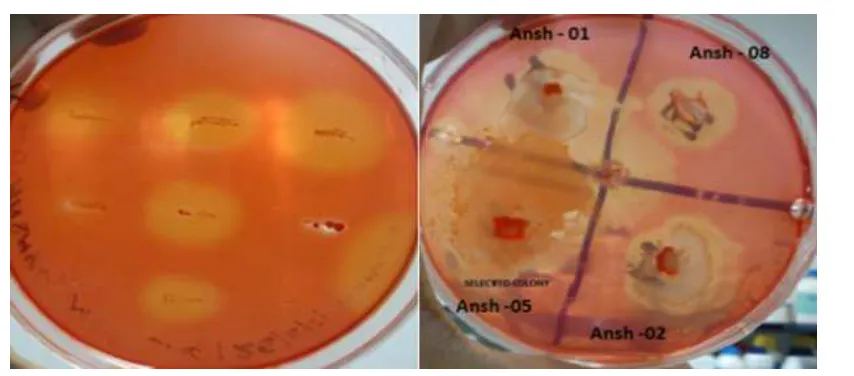
Isolation and genetic identification of cellulolytic strain: Cellulase producers were isolated on MSA plates
34
Figure 1: Congo red stained MSA-CMC plate showing clear zones indicating cellulase activity
Isolated cellulolytic strains were further cultured for 24 hrs in mannitol salt broth for the isolation of total genomic DNA which was used for PCR to amplify 16S r-DNA gene. The 16S r-DNA analysis is the most accepted and convenient method for identification of microbes and moreover, 16S r-DNA gene sequences for most microbes are available on public-access databases. The DNA fragments were eluted, and purified for sequencing. Analysis was done using the software MEGA 4 [14] and then phylogenetic tree was developed. The sequence has been submitted to NCBI with accession number JQ916899. Phylogenetic analysis showed clear branching out of our strain
[image:3.595.99.526.65.253.2]Paenibacillus LPUANSHUL strain LPU001, represented this as a novel strain (Figure 2).
Figure 2: Neighbour joining phylogenetic tree
Optimization Parameters:
Various parameters such as media, carbon, nitrogen, temperature, pH, enzyme stability and metal ions were studied. Media (M1 and M2) supplemented with varying concentrations of CMC were used for optimization which was determined by measuring the cellulase enzyme activity using the standard DNS method. Growth was better supported in media M1 (Bushnell Haas Broth) containing CMC (0.5%).
35
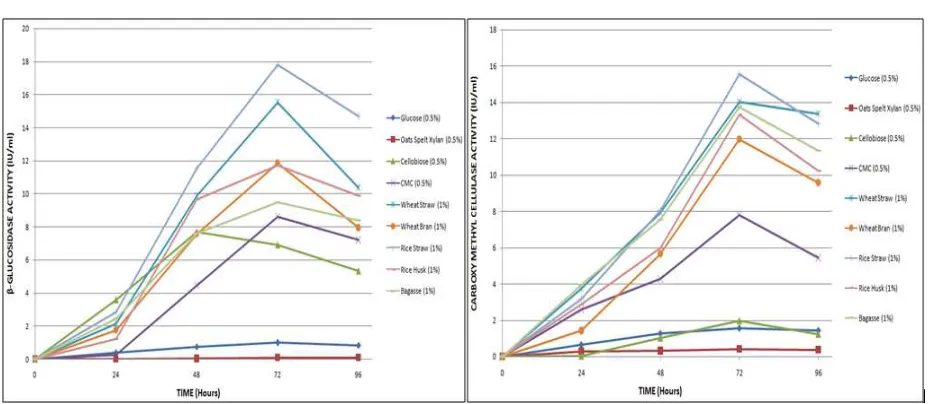
Figure 3: Effect of various carbon sources on Cellulase and β-Glucosidase production
Variety of organic (peptone, yeast extract, beef extract and tryptone) and inorganic nitrogen sources [sodium nitrate (NaNO3), ammonium chloride (NH4Cl) ammonium nitrate (NH4NO3)] at concentration of 1% (w/v) and whey (1%
v/v) were selected for the best nitrogen source optimization. The medium M1, containing CMC (0.5%) and concentrations of various nitrogen sources as indicated, was inoculated with Paenibacillus LPUANSHUL strain LPU001 and cultured for 24, 48, 72 and 96 hours respectively. The enzyme activity was analyzed by standard DNS assay. Organic nitrogen sources such as yeast extract (16.2 IU/ml), peptone (19.8 IU/ml), tryptone (16.0 IU/ml) resulted in higher enzyme concentration compared with other inorganic compounds (Figure 4).
Figure 4: Effect of various nitrogen sources on Cellulase and β-Glucosidase production
[image:4.595.74.539.395.581.2]36
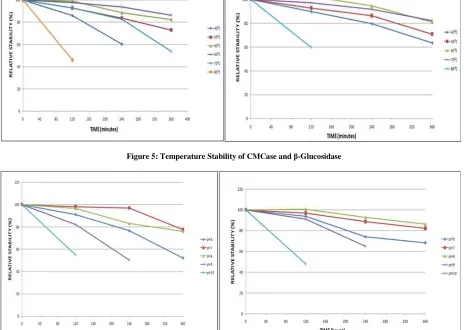
[image:5.595.72.536.114.444.2]Figure 5: Temperature Stability of CMCase and β-Glucosidase
Figure 6: pH Stability of CMCase and β-glucosidase
Cellulase producing strain was grown in media M1 at varying pH values ranged from 6 to 10 and enzyme production was estimated. The results were shown in Figure 6. The optimum enzyme activity of 6.2 IU/ml was noted at alkaline pH i.e., 8.0.
Enzyme stability was studied under various temperatures ranging from 30 to 80ºC at intervals of 10ºC for 120, 240 and 360 minutes respectively. Residual enzyme activity was measured to estimate the stability of the enzyme which showed maximum at 30ºC where the activity was retained 84% even after 380 minutes of incubation. However, 70% activity was retained at 70ºC after 360 minutes of incubation.
Enzyme (CMCs) incubation in 100mM tris-HCl at pH ranging from 6 to 10 for 120, 240 and 360 minutes resulted maximum (95%) stability at buffer pH 8.6 even after 360 minutes of incubation. Nevertheless, the enzyme lost the activity and showed instability at pH 6 and 10.
37
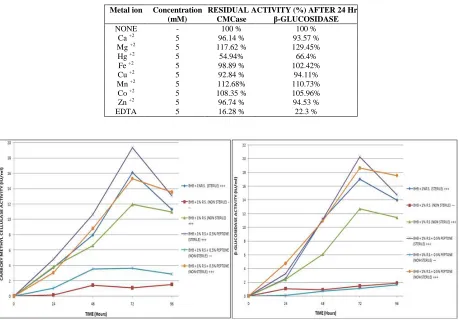
Figure 7: CMCase and β-glucosidase production under non-sterile submerged fermentation
[image:6.595.75.534.88.408.2]Non-sterile submerged fermentation (SmF) was carried out for the production of cellulase and β-glucosidase wherein cellulase production was estimated as 19.2 IU/ml after 72 hours using BHB supplemented with sterile peptone (0.5%). However, it was 15.2 IU/ml after 72 hours in BHB supplemented with 0.5% non sterile peptone. β -glucosidase production was 20.1 IU/ml using BHB supplemented with 0.5% sterile peptone after 72 hours, whereas it was 18.8 IU/ml after 72 hours in BHB supplemented with 0.5% non sterile peptone (Figure 7).
Figure 8: CMCase and β-glucosidase production under non-sterile solid state
[image:6.595.71.535.502.658.2]38
[image:7.595.94.519.153.346.2]Zymogram Analysis showed (Figure 9) diffused clear zone indicating enzyme production. The clear zone was due to hydrolysis of CMC by cellulase enzyme present in the gel as native PAGE was run using 0.5% CMC copolymerised with 12% acrylamide/bis-acrylamide. The gel was incubated with Tris-HCl followed by staining with congo-red and destaining with 1M NaCl. Lane L1 and L3 were showing CMCase produced under non sterile solid state fermentation using rice straw, while Lane L2 and L4 were showing CMCase produced under Sterile Solid state fermentation rice Straw.
Figure 9: Zymogram analysis of CMCase produced by solid state fermentation in rice straw L1 and L3 CMCase produced under non sterile solid state fermentation; L2 and L4 were CMCase produced under Sterile Solid state fermentation
CONCLUSION
Present effort was done to produce cellulolytic enzymes in nonsterile conditions using Paenibacillus LPUANSHUL
strain LPU001 as a novel strain and also agriwaste as carbon source. The study concluded that production of
considerably active CMCase with stability at various physico - chemical conditions was done as a preliminary study. Further recommendation is to explore nonsterile fermentation techniques in order to make the enzyme production commercially viable.
Declaration of interest
The authors declare no conflicts of interests. The authors alone are responsible for the content and writing of this article. The authors are thankful to Lovely Professional University, Punjab for infrastructure.
REFERENCES
[1] H Fatma; Abd El-Zaher; M Fadel. New York Science Journal., 2010, 3(4), 72-78. [2] GD Saratale; SE Oh. African J. Biotechnol., 2010, 11(5), 1002-1013.
[3] R Sims; M Taylor; J Saddler; W Mabee. Int. Energ. Agency., 2008, 1-124.
[4] AK Chandel; ES Chan; R Rudravaram; ML Narasu; LV Rao; P Ravindra. Biotechnol. Mol. Biol. Rev., 2007, 2(1), 014-032.
[5] C Hamelinck; GV Hooijdonk; APC Faaij. Bioenerg., 2007, 28(4), 384–410. [6] A Pandey; CR Soccola; D Mitchell. Process. Biochem., 2010, 35(10), 1153–1169. [7] EPS Bon; MA Ferrara. FAO seminar., 2007, 1-11.
[8] B Bogar; G Szakacs; JC Linden; A Pandey; RP Tengerdy. J. Ind. Microbiol. Biotechnol., 2003, 30(3), 183-189. [9] PS Chahal; DS Chahal; BB George. Appl. Biochem. Biotechnol., 2007, 58(1), 433-442.
[10] NK Sree; M Sridhara; LV Rao; A Pandey. Process Biochem., 1999, 34(2), 115–119. [11] A Kaur; C Chopra; A Joshi; NJ Sharma. J. Chem. Pharm. Res., 2015, 7(1), 266-276.
[12] P Asokan. Third Annual PhD, progress report. Indian Institute of Technology, Bombay, India. 2004. [13] ME Himmel; MF Ruth; CE Wyman. Curr. Opin. Biotechnol., 1999, 10(4), 358-64.