International Journal of Emerging Technology and Advanced Engineering
Website: www.ijetae.com (ISSN 2250-2459,ISO 9001:2008 Certified Journal, Volume 3, Issue 3, March 2013)
917
Experimental Studies on Soil Stabilization Using Fine and
Coarse GGBS
GyanenTakhelmayum
1, savitha.A.L
2, Krishna Gudi
31,2,3
GSS Institute of Technology, VTU
Abstract— In developing country like India due to the remarkable development in road infrastructure, Soil stabilization has become the major issue in construction activity. Stabilization is an unavoidable for the purpose of highway and runway construction, stabilization denotes improvement in both strength and durability which are related to performance. Stabilization is a method of processing available materials for the production of low-cost road design and construction, the emphasis is definitely placed upon the effective utilization of waste by products like ground granulated blast furnace slag GGBS, with a view to decreasing the construction cost. In the present investigation is to evaluate the compaction and unconfined compressive strength of stabilized black cotton soil using fine and coarse ground granulated blast furnace slag (GGBS). Characterization of black cotton soil is carried out for grain distribution and soil classification. A series of compaction test were carried out using mini compaction mould for different combination of soil along with fine and coarse ground granulated blast furnace slag(GGBS) mixtures. For stabilization of black cotton soil, the unconfined compressive strength test were carried out in accordance with the standard procedures for different combination of soil with ground granulated blast furnace slag (GGBS) mixtures.
Keywords— Soil stabilization, black cotton soil, fine and coarse ground granulated blast furnace slag (GGBS).
I. INTRODUCTION
Soil stabilization is not new, for men has sought to accomplish it by various means almost since the road were built, but it is only in recent years that scientific methods have been applied to soil stabilization. Thus stabilization denotes improvement in both strength and durability which are related to performance. Increase in strength may be expressed quantitatively in terms of compressive strength, shearing strength, or some measure of bearing value or load deflection to indicate the load bearing quality; and in terms of absorption, softening, and reduction in strength, or in terms of direct resistance to freezing and thawing, and drying to indicate the durability of the stabilized soil mixture. Soil stabilization used to improve poor subgrade condition cuts down the pavement thickness.
Pavement design is based on the premise that minimum specified physical strength will be achieved for each layer of material in the pavement system. Each layer must resist shearing, avoid excessive deflections that cause fatigue cracking within the layer or in overlying and prevent excessive permanent deformation through densification. As the quality of a soil layer is increased, the ability of that layer to distribute the load over a greater area is generally increased so that a reduction in the required thickness of the pavement layers may be permitted. The most common improvements achieved through stabilization include better soil gradation, reduction of plasticity index or swelling potential and increase in durability and strength. In wet weather, stabilization may also be used to provide a working platform for construction operations. These types of soil quality improvement are referred to as soil modification (SM Sharma 2012).
International Journal of Emerging Technology and Advanced Engineering
Website: www.ijetae.com (ISSN 2250-2459,ISO 9001:2008 Certified Journal, Volume 3, Issue 3, March 2013)
918
[image:2.612.321.567.315.479.2]A pozzolanic reaction also takes place which uses the excess SiO from the slag source, Ca(OH) produced by the hydration of the silicates, and water to produces more of the desirable CSH making slag a beneficial minerals admixture to attain Soil Stabilization with Ground Granulated Blast furnace Slag (GGBFS). A similar study was carried out on GGBS+lime combinations for soil stabilization. The test results reveal that GGBS+lime combinations are practical and effective options for stabilization, and provide technical benefits. In particular incorporation of GGBS is very effective at combating the expansion with increase in the strength, bearing capacity and volume stability control the swell-shrink characteristics caused by moisture changes and proportioning of GGBS vs. lime. A slower early rate of strength development gives considerably more time for construction operations. Regulations permit up to 48 hours between the start and completion of stabilization operations when lime/GGBS issued. There is also extra ability to self-heal, in the case of early life damage caused by over loading. In the long-term, there is an increased strength that will improve the structural performance. According to the Source UK cementitious slag maker association (CSMA) the chemical properties of GGBS is given in Table1 (DD Higginset al 2005).
Table 1
Chemical properties of ground granulated blast slag
Constituent SiO2 MgO CaO Al2O3
Percentage 40% 3.6% 39.2% 13.5%
Constituent Fe2O3 SO3 L.O.I ……..
Percentage 1.8 1.7% 0.2 ……..
II. MATERIALS
Infrastructure projects such as highways, railways, water reservoirs, reclamation etc require earth materials in very large quantity. In urban areas, burrow earth is not easily available which has to be hauled from a long distance. Very often, large areas are covered with highly plastic and expansive soil, which is not suitable for any construction activity. The present investigation aims at improving the geo technical properties of Natural black cotton soil was obtained from Gadag district in Karnataka State. The soil was excavated from a depth of 2.0 m from the natural ground level.
The soil is dark grey to black in color with high clay content.
The obtained soil was air dried and pulverized manually and soil passing through 425 µ IS sieved was used, in the present study. This soil has a property of high moisture retentively and develops cracks in summer. This soil predominantly consists of expansive montmorillonite as the principal clay mineral. Sieve analysis, hydrometer analysis, and Atterberg’s limits were performed to classify the soil the index properties, Compaction characteristics and unconfined compressive strength test were carried out for both fine and coarse soil mixtures. The soils were classified in accordance with Indian Standard classification of soils for engineering purpose.
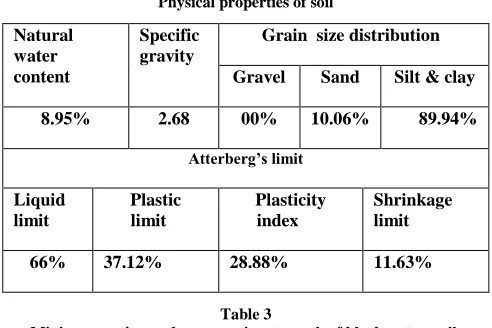
Table 2 Physical properties of soil
Natural water content
Specific gravity
Grain size distribution
Gravel Sand Silt & clay
8.95% 2.68 00% 10.06% 89.94%
Atterberg’s limit
Liquid limit
Plastic limit
Plasticity index
Shrinkage limit
66% 37.12% 28.88% 11.63%
Table 3
Mini compaction and compressive strength of black cotton soil.
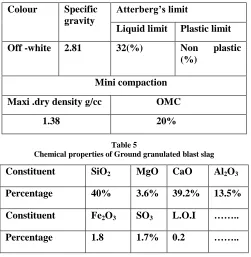
Ten million tons of blast furnace slag is produced in India annually as a by-product of Iron and Steel Industry. Blast furnace slag is composed of silicates and alumino silicates of lime and other bases. It is a latent hydraulic product which can be activated with anyone- lime, alkalies or Portland cement. GGBS which is procured from Hubli Steel plant which is obtained by quenching molten iron slag from a blast furnace has been used in the present work, it is a granular product, and it is then dried and ground into a fine powder. The Physical and chemical composition of GGBS are given in the table4
Max dry density in g/cc
OMC Compressive Strength in Kpa
[image:2.612.50.288.449.560.2]International Journal of Emerging Technology and Advanced Engineering
Website: www.ijetae.com (ISSN 2250-2459,ISO 9001:2008 Certified Journal, Volume 3, Issue 3, March 2013)
919
Table 4
Physical properties of ground granulated blast slag.
Colour Specific
gravity
Atterberg’s limit
Liquid limit Plastic limit
Off -white 2.81 32(%) Non plastic
(%)
Mini compaction
Maxi .dry density g/cc OMC
[image:3.612.44.295.157.414.2]1.38 20%
Table 5
Chemical properties of Ground granulated blast slag
Constituent SiO2 MgO CaO Al2O3
Percentage 40% 3.6% 39.2% 13.5%
Constituent Fe2O3 SO3 L.O.I ……..
Percentage 1.8 1.7% 0.2 ……..
Compaction test were carried out by using Mini compaction test apparatus. In accordance with IS 2720 (part7)-1980. It has been published in the Geotechnical Testing Journal, (2004) (vol 28, no 3). The mould is having an internal diameter of 3.8 cms and external diameter of 4.61 cms. The mould has a detachable base plate and a removable collar of 3.5 cms height. The weight of the hammer is 25N. Number of blows is 36 per layer. The soil is compacted for 3 layers. About 250 grams soil is used for each trial. The soil is mixed with consistent quantity of water and is transferred on to the mould of diameter 3.8 cms and height of 10 cms in three layers, each layer is compacted by 36 blows. The remaining procedure is same as that of Light Compaction test as per IS 2720(part 7) – 1980.
III. UNCONFINED COMPRESSION TEST
The soil samples were prepared by static compaction method to achieve Maximum Dry Density at Optimum Moisture content. The steel split mould having a diameter of 3.6 cms and a height of 7.8 cms is used. The weight of the soil to be taken and the volume of water to be added are calculated by knowing the volume of mould and Maximum Dry Density and Optimum Moisture content of the soil.
Once the trial mix is prepared, the mould is oiled thoroughly. The mix is transferred to the mould compacted and then extracted from the mould. Three identical samples were prepared for their Maximum Dry Density and Optimum Moisture content based on the compaction curves obtained. The sample was subjected to various curing periods (1, 7, 14, 28 days) according to their trial combination chosen. Samples intended for long term testing were kept in desiccators to maintain 100% humidity and to prevent loss of moisture from samples. Water was sprinkled at regular intervals and was cured in the desiccators. All the samples intended for immediate testing were tested immediately. The unconfined compression test was carried out according to IS 2720(part 10) - 1973. The test was conducted using Unconfined Compressive test apparatus at a strain rate of 1.25 mm/ minute. The specimen to be tested was placed centrally in between the lower and upper platform of testing machine. Proving ring reading was noted for 30 divisions on a deformation dial gauge. The loading was continued until three or more consecutive reading of the load dial showed a decreasing or a constant strain rate of 20% had been reached. Unconfined compressive strength for different soil mixtures is as shown in Plate 3.5
IV. RESULTS AND DISCUSSIONS
[image:3.612.321.571.603.720.2]A series of strength test were carried out for different proportions of GGBS mixtures. The black cotton soil with varying proportion of GGBS mixtures were prepared at the respective optimum moisture content and the characteristic compaction and unconfined compressive strength values were determined for different curing. A series of compaction test were carried out by varying soil and Fine GGBS at respective optimum moisture content and the corresponding maximum dry density and optimum moisture content are presented in table 4.3 from the table it can observed that with increase in fine GGBS content the maximum dry density increases.
Table 6
Compaction of fine GGBS mixtures
Soil+ Fine GGBS O.M.C (%) ρ (g/cc)
95%+5% 18.5 1.42
90%+10% 18.0 1.45
85%+15% 17.5 1.55
80%+20% 17.0 1.65
75%+25% 16.5 1.68
International Journal of Emerging Technology and Advanced Engineering
Website: www.ijetae.com (ISSN 2250-2459,ISO 9001:2008 Certified Journal, Volume 3, Issue 3, March 2013)
920
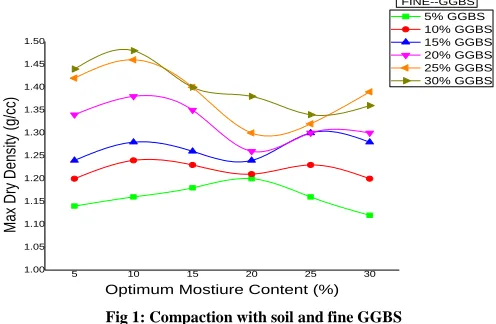
Thevariation of maximum dry unit weight with GGBS
[image:4.612.332.580.273.435.2]content for different proportions of soil GGBS mixtures is presented in fig 4.3. It is observed that with the increase in water content the dry density also increases up to 30% moisture content and with further increase in water content the dry density Increases gradually. Hence the addition of GGBS to black cotton soil in various percentages affects the compaction characteristic which is primarily due to alteration of gradation of soil mixtures. The increase of the maximum dry unit weight with the increase of the percentage of GGBS is mainly due to the higher specific gravity of the fine GGBS compared with expansive soil and the immediate formation of cemented products by hydration which increases the density of soil. It can also be observed that the optimum moisture content was decreased with further increase in GGBS content. The lowest dry density was observed to be about 1.42g/cc for 95% soil and 5% ggbs mixture and highest dry density was about 1.72g/cc. for 70% soil and 30% GGBS mixture. There is enhanced C-S-H formation compared to using Soil alone. This enhanced C-S-H occupies pore spaces, normally occupied by calcium hydroxide in the hydration of pozzolanic reaction taking place in mixtures which uses the excess SiO from the slag source, Ca (OH) produced by the hydration of the silicates, and water to produces more of the desirable CSH making slag a beneficial mineral admixture to attain increase in strength. This leads to reduced porosity and permeability of GGBS hydrates compared to fly ash hydrates. The reduced porosity and permeability reduce the volume of voids and this, together with the resultant stronger structure, provide resistance to damage. Granulated blast furnace slag has a low reactive potential. Its hydraulic reactivity depends on chemical composition, glass phase content, particle size distribution and surface morphology.
Table 7
Compaction of soil with Coarse GGBS mixtures
Activators such as alkalis and sulphates, which are released during the hydration, are able to react with and breakdown the glassy structure resulting in the formation of cementitious calcium silicates and aluminate hydrates.
Various hydraulic parameters have been proposed to relate composition to reactivity; most of these imply an increase in reactivity with increasing CaO, MgO or
A1203and a decrease with increasing Si02. However, BS
6699, British Standard In addition, as the CaO/ Si02 ratio increases, the rate of reactivity of the GGBS also increases up to a limiting point when increasing the
5 10 15 20 25 30
1.00 1.05 1.10 1.15 1.20 1.25 1.30 1.35 1.40 1.45 1.50
5% GGBS 10% GGBS 15% GGBS 20% GGBS 25% GGBS 30% GGBS
M
ax
D
ry
D
en
sit
y (
g/c
c)
Optimum Mostiure Content (%)
FINE--GGBS
Fig 1: Compaction with soil and fine GGBS And also a series of compaction test were carried out by varying soil and Coarse GGBS at respective optimum moisture content and the corresponding maximum dry density and optimum moisture content are presented in Table 7. It is observed that with increase in Coarse GGBS content the maximum dry density increases.
The variation of maximum dry unit weight with coarse GGBS content for different proportions of soil GGBS mixtures is presented in fig 4.4 It is found that with the increase in water content the dry density also increases up to 30% moisture content and with further increase in water content the dry density decreases gradually. Hence the addition of GGBS to black cotton soil in various percentages affects the compaction characteristic which is primarily due to alteration of gradation of soil mixtures. The increase of the maximum dry unit weight with the increase of the percentage of Coarse GGBS is mainly due to the higher specific gravity of the GGBS compared with expansive soil and the immediate formation of cemented products by hydration which reduces the density of soil. It can also be observed that the optimum moisture content was decreased with further increase in GGBS content. Soil+ Coarse GGBS O.M.C
(%)
ρ(g/cc)
95%+5% 18.0 1.30
90%+10% 17.5 1.38
85%+15% 17.0 1.42
80%+20% 16.5 1.45
75%+25% 16.0 1.50
[image:4.612.53.299.562.679.2]International Journal of Emerging Technology and Advanced Engineering
Website: www.ijetae.com (ISSN 2250-2459,ISO 9001:2008 Certified Journal, Volume 3, Issue 3, March 2013)
921
The lowest dry density was observed to be about 1.30 g/cc for 95% soil and 5% fly ash mixture and highest density was about 1.55g/cc. for 70% soil and 30% GGBS mixture.
There is enhanced C-S-H formation compared to using Soil alone. This enhanced C-S-H occupies pore spaces, normally occupied by calcium hydroxide in the hydration of pozzolanic reaction taking place in mixtures which uses the excess SiO from the slag source, Ca (OH) produced by the hydration of the silicates, and water to produces more of. The desirable CSH making slag a beneficial mineral admixture to attain increase in strength. This leads to reduced porosity and permeability of GGBS hydrates compared to fly ash hydrates (Bijen, 1996; Kinuthia 1997). The reduced porosity and permeability reduce the volume of voids and this, together with the resultant stronger structure, provide resistance to damage. Granulated blast furnace slag has a low reactive potential. Its hydraulic reactivity depends on chemical composition, glass phase content, particle size distribution and surface morphology (ACI, 1989). Activators such as alkalis and sulphates, which are released during the hydration, are able to react with and breakdown the glassy structure resulting in the formation of cementitious calciumsilicates and aluminate hydrates. Various hydraulic parameters have been proposed to relate composition to reactivity; most of these imply an increase in reactivity with increasing CaO, MgO or
A1203and a decrease with increasing Si02. However, BS
6699, British Standard In addition, as the CaO/ Si02 ratio
increases, the rate of reactivity of the GGBS also increases up to a limiting point when increasing the CaO content makes granulation to glass phase content.
5 10 15 20 25
1.0 1.1 1.2 1.3 1.4 1.5
COARSE-- GGBS
5% GGBS 10% GGBS 15% GGBS 20% GGBS 25% GGBS 30% GGBS
M
a
x.D
ry
D
e
n
sit
y (
g
/c
c)
Water Content (%) (%)
Fig 2: Compaction with soil and fine GGBS
V. SUMMARY AND CONCLUSIONS
It was found that with the increase in water content the dry density also increases up to 20-30% moisture content and with further increase in water content the dry density increases gradually. The lowest dry density was observed to be about 1.42g/cc for 95% soil and 5% GGBS mixture and maximum density was about 1.72 g/cc for 70% soil and 30% GGBS mixture. This variation in density is primarily due to chemical composition, glass phase content, particle size distribution and surface morphology. The increase in the maximum dry unit weight with the increase of the percentage of GGBS mixture is mainly due to high specific gravity and immediate formation of cemented products by hydration which increases the density of soil. The increase in dry density with increase in fine and coarse GGBS mixture is due to enhanced C-S-H formation compared to using Soil alone. this enhanced C-S-H occupies pore spaces, normally occupied by calcium hydroxide in the hydration of pozzolanic reaction taking place in mixtures
which uses the excess SiO2from the slag source, Ca (OH) 2
produced by the hydration of the silicates, and water to produces more of the desirable C-S-H making slag a beneficial mineral admixture to attain and increase in dry density.
REFERENCES
[1 ] KanirajS R, Havanagi V.G Geo technical characteristics of fly- ash soil mixtures. Geo technical Engineering journal, 1999, 30 (2):129-147.
[2 ] CHOI S.K LEE S. SONG Y.K Leaching characteristics of selected Korean fly ashes and its implications for the ground water composition near the ash mound. Fuel. 81, 1080, 2002.
[3 ] Birkeland, Peter W. Soils and Geomorphology, 3rd Edition. New York: Oxford University Press, 1999.
[4 ] Determination of liquid limit and plastic limit. Indian standard methods for testing of soils-IS2720 (a) Indian standard Institution, New Delhi, India, part 5, pp 109-144,1985.
[5 ] D.D. Higgins, J.M. Kinuthia and S. Wild ―Soil Stabilization using Lime-Activated Ground Granulated Blast Furnace Slag‖ volume 178, pp.1057-1074June 1, 1998.
[6 ] Joan E Mclean., Bert E,.Behavior of metals in soils, report no 540 S-92-018, Environmental protection agency, USA,1992.