Journal of Chemical and Pharmaceutical Research, 2014, 6(6):2168-2172
Research Article
CODEN(USA) : JCPRC5
ISSN : 0975-7384
An improved link repair method in AODV routing protocol
Shunye Wang, Zuotao Jin and Huiying Tian
Department of Computer Science and Technology, Langfang Teachers University, China
_____________________________________________________________________________________________
ABSTRACT
The rapid development of the communication technology gives the heavy research on wireless networks. In recent years, more and more research bases on the Mobile Ad hoc NETwork (MANET) which has many applications in military and civilian environments. MANET is a wireless self-organized distributed network. The routing protocol is the main part in communication networks. Ad hoc On-Demand Vector routing protocol (AODV) is a popular routing protocol in MANET and other wireless networks. It is efficiently to discover and maintain routes between nodes which need to communicate with each other. Because of the mobility of the node in wireless network, the network topology changes frequently that is the main reason of the link break. Link repair is more and more important in route maintenance. In this paper, a new link repair method is proposed. It combines the source repair and local repair. The NS-2 is used to simulate the strategy. The result illustrates that the proposed method has good performance in packet delivery ratio and throughput.
Key words: AODV; link break; link repair; Network Simulation-2
_____________________________________________________________________________________________
INTRODUCTION
Mobile Ad hoc Network (MANET) is the most innovative and challenging area of wireless networking. It is a collection of mobile devices and is self configuring, dynamically changing, multi hop wireless network which forms a communication network via multi hop wireless network connection without any central control. Nodes in the network communication with another node only if it lies within its transmission range. MANET has potential applications in civilian and military environments [1].
Communication is done by forwarding information from one node to another which is called “routing”. The traditional routing protocols like link state and distance vector protocols need to periodically broadcast information in order to keep the routing tables updated. This leads to a lot of overhead of bandwidth, exhaustion of battery and allows limited size networks thus restricting scalability [2]. Routing is a challenging task since there is no central coordinator, such as base station, or fixed routers in other wireless networks that manage routing decision. Each node acts as a router/base station to forward the information. Hence a special form of routing protocols is necessary. There are ample number of routing protocols have been developed for MANET [1]. They are broadly classified into three categories: the proactive or table-driven routing protocols such as DSDV, the reactive or on-demand routing protocols such as AODV and DSR, and hybrid routing protocols such as ZRP. Link break is usually occurred when a node is move away. Now many novel algorithms have been proposed by researchers to improve AODV when links break in [3].
AODV AND THE LINK REPAIR
The AODV is the abbreviation of the Ad hoc On-Demand Vector routing protocol [4, 5] which enables dynamic, self-initiating, multi-hop routing between participation mobile nodes wishing to establish and maintain an MANET and other wireless ad hoc networks [1]. AODV is an on-demand routing protocol.
There are three types of messages that are defined in AODV [2]:
RREQ: when a route is not available for the desired destination, a route request packet is flooded throughout the network.
RREP: if a node either is, or has a valid route to, the destination, it unicasts a route reply message back to the source. RERR: when a path breaks, the nodes on both sides of the links issue a route error to inform the other nodes of the link break.
The operation of the protocol has two phases: route discovery and route maintenance. In AODV, when a route is needed to some destination, the protocol start route discovery. It broadcasts a RREQ for the destination to its neighbours. A node on receiving the RREQ checks if it has received the same request before using the Route-ID. It is not the destination, it broadcasts the RREQ and at the same time backward route to the source is created [6]. If RREQ receiving node is destination, it creates RREP. The RREP reached at source node hop by hop. When RREP broadcasts, each intermediate node establishes a route to the destination. When RREP is received by source, it stores the forward route to the destination and starts sending data. If the source receives multiple RREPs, the route selects the route with less number of hops [7].
Once the route is established, route maintenance is used to give feedback about the links of route and to allow the route to be modified in case of interruption due to movement of one or more nodes along the route. AODV protocol uses hello messages (a RREP message) which is a message from the neighbors periodically to inform that they are reachable by each other. Hello messages can be used to maintain the local connectivity of a node. However, the use of hello messages is not required sometimes. Nodes listen for retransmissions of data packets to ensure that the next hop is still within reach. If such a retransmission is not heard, the node may use any one of a number of techniques, including the reception of hello messages [8].
In AODV, if a node does not receive a hello message or not heard the retransmission from the neighbors, the route repair is occurred. Now the route repair is mainly including two methods, the source repair and the local repair. If a source node moves, it is able to reinitiate the route discovery protocol to find a new route to the destination. If a node along the route moves, its upstream neighbor notices the move and propagates a link failure notification message to each of its active upstream neighbors to inform them of the removing of that part of the route [9]. These nodes in turn propagate the link failure notification to their upstream neighbors and so on until the source node is reached. The source node may then reinitiate route discovery for that destination if a route is still required [2]. This procedure is the source repair. In the local repair of AODV whenever a link breaks because of the node moves, the node who detects the route failure will exploit the fast and localized partial route recovery method. In this procedure, the RERR messages maybe not reach to the source node. At last the link recreate through the intermediate nodes’ effort in the link repair.
The dynamic and mobile nature of the wireless MANET, link may fail due to topological changes by mobile nodes. As the degree of mobility increases, the wireless network would suffer with more link errors. The move node may be the source node, the intermediate node or the destination node. If the source node or the intermediate node that close to the source moves, the source repair may be the best. It broadcast the RERR message hop to hop, and then the source node to rediscover routes to the destination. If the destination node or the intermediate node that close to the destination moves, the protocols use broadcast to discover routes may become inefficient due to many broadcasting messages and frequent failures of intermediate connections in end-to-end communication. It is beneficial to the local repair method which is to discover a new route locally without resorting to an end-to-end route discovery.
In the source repair, there are more broadcast packets. At the same time, the route will be more correct. The delivery ratio will be increase. In the local repair, the number of the broadcast packets will decrease. At the same time the delay and throughput may decrease. So they all have their drawbacks.
PROPOSED LINK REPAIR METHOD
are comparatively more suitable in comparison to source node to broadcast the RREQ message in order to repair or find an alternate route to the destination. Because the link break may occur at anytime and anywhere in the MANET, the selecting of the source repair or the local repair may result the long delay or more broadcast packets.
In this paper, we consider the source repair and the local repair generally, proposed the compromised method. If the link break happens near the source, then the source repair is selected. If the link break happens near the destination, then the local repair is adopted. Suppose the link A-B-C-D-E-F-G, A is the source and G is the destination and the link C-D is break. The intermediate node C discovers the break, the number of the hop from C to the source node A is the n1, the number of the hop from C to the destination G is the n2, if the n1 is less than or equal to the (n1+n2)/2, then the source repair is chosen, if not the local repair is chosen. As more and more new local repair route algorithm appears, we can choose local repair heavily to improve the packet delivery ratio. At this time we can define that if n1
is less than or equal to the (n1+n2)/N, and N is greater than or equal to 2, then the source repair is chosen, else the local repair is chosen. The algorithm is as follows.
Void ::rt_ll_failed(Packet *p)
if (ch->num_forwards() >rt->rt_hops) {
local_rt_repair(rt, p); // local repair
// retrieve all the packets in the ifq using this link, // queue the packets for which local repair is done, return;
} else
#endif // LOCAL REPAIR {
drop(p, DROP_RTR_MAC_CALLBACK);
// Do the same thing for other packets in the interface queue using the // broken link -Mahesh
while((p = ifqueue->filter(broken_nbr))) { drop(p, DROP_RTR_MAC_CALLBACK); }
nb_delete(broken_nbr); }
In the local_rt_repair (RT, P), it performs a SendRequest operation, waits for the REPLY operation from the relay nodes, at the same time carrys out the packet duplication in buffer. If the REPLY arrives, it sends the packets that saved in buffer to the destination node. This is the local repair mechanism. In the nb_delete (broken_nbr), the SendError operation is completed. The intermediate node forwards the broadcast packets until the source node, and then the source repair is finished.
SIMULATION AND RESULTS
The simulation of the AODV and the proposed link repair method in AODV (called AODV-1) in MANET adopts the Network Simulator (NS-2) which is installed on Linux OS to compare the performances. The set of the data stream is defined as follows.
setudp_(0) [new Agent/UDP]
$ns_ attach-agent $node_(0) $udp_(0) set null_(0) [new Agent/Null]
$ns_ attach-agent $node_(28) $null_(0) $ns_ connect $udp_(0) $null_(0)
setcbr_(0) [new Application/Traffic/CBR]
$cbr_(0) set packetSize_ 512 $cbr_(0) set interval_ 4.0 $cbr_(0) set random_ 1 $cbr_(0) set maxpkts_ 10000 $cbr_(0) attach-agent $udp_(0) $ns_ at 0.0 "$cbr_(0) start"
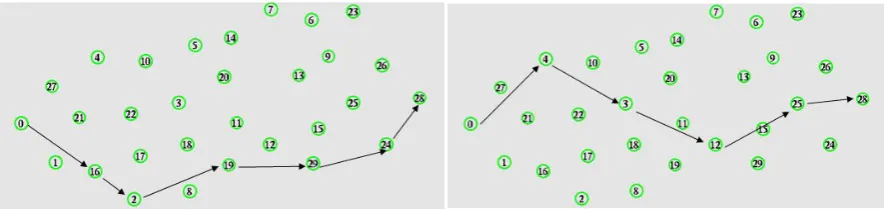
The Fig. 1, Fig. 2, Fig. 3 shows the animated screenshots using NS-2. There is a route link between the nodes 0 to 28. The link from node 19 to 29 breaks. When the node 19 discovers the situation, it calculates the hop numbern1 and
Performance of different route protocols depends upon the routing metrics [10]. The main routing metrics which the performance can be mainly determined are packet delivery ratio, end-to-end delay, throughput and jitter. Fig. 4, Fig.5, Fig. 6 and Fig. 7 shows the comparison of the metrics between AODV that adopts the source repair only and the proposed link repair method in AODV ( AODV-1).
[image:4.595.85.525.415.550.2]Fig. 1 the data stream before the link break Fig. 2 the data stream using source repair
Fig.3 the data stream using local repair Fig. 4 packet delivery ratio on different send interval
Fig. 5 throughput on different time Fig. 6end-to-end delay on different send interval Fig. 7 jitter on different time
The proposed link repair method based on AODV has more packet delivery ratio. The number always is 1. Although the perfect number may be impossible, the theoretical value may be true in some case. In normal, the value may be near the perfect number. It is superior to packet delivery ratio based on the AODV. The throughput is also higher than the AODV. Because of the calculation in the proposed link repair in AODV, the end-to-end delay increases. At the jitter respect, the proposed and the AODV has the same jitter interval, at the rest part, no jitter appears.
Table 1: the comparison in between AODV and AODV-1
Route protocol AODV AODV-1
Send packets 256 256
Received packets 248 255
Packet lost ratio 0.008000000 0.003906250
The average delay time 0.045691232 0.045365578
CONCLUSION
MANET is a collection of autonomous arbitrarily located wireless nodes with no fixed infrastructure. And it has more applications in military or civilian environments. AODV as an on-demand routing protocol has become the research hot. It is one of the most widely used routing protocols in MANET and other wireless networks. It also is very efficient. However, the efficiency of protocol is limited because of the fact that flooding of control packets is needed to broadcast the link error message and discover new routes during the failure of links. Link repair is the main part in the maintenance of the AODV. In this paper we proposed a link repair method in AODV routing protocol. Through the simulation using NS-2, the proposed method has more performance than the normal AODV routing protocol. As the future works, we will try to implement and simulate in more real environment, and also apply this method to multicast AODV environment.
Acknowledgments
This work was supported in part by the Natural Science Foundation of LangFang Teachers College in 2013(LSZY201306). I also thank to my family especially my little son.
REFERENCES
[1] K.Vanaja, Dr. R.Umarani, International Journal of Electronics and Computer Science Engineering, pp:1080-1086, 2012 (9)
[2] MeenuChawla, JyotiSinghai& J L Rana, International Journal of Computer Science & Communication, pp:33-40,
2010 (2)
[3] ArpitDhingra, Anil Kumar, International Journal of Engineering and Computer Science, pp:5633-5636,2014 (5)
[4] Prashant Kumar Maurya, et al, International Journal of Modern Engineer Research, pp:728-732, 2012 (3) [5] Wang Peng, GuoWeida, Science Technology and Engineer, pp: 313-316, 2012 (2)
[6] ChiragBhalodia, Prof AmitM.Lathigara, Internatinal Journal of Advance Engineer and Research Development, pp:1-9, 2014 (5)
[7] Jooti Jain, Roopan Gupta, I.K.Bandhopadhyay, International Journal of Computer Application, pp: 20-25,
2011 (5)
[8] Charles E.Perkins, Elizabeth M.Belding Royer and SimirR.Das, “Ad Hoc On-Demand Distance Vector (AODV)” , RFC 3561
[9] GaoWeiwei, Li Xiaofeng, Ding Shuchun, Comouter& Digital Engineering,pp: 573-577, 2014 (4)