Journal of Chemical and Pharmaceutical Research, 2014, 6(9):241-245
Research Article
CODEN(USA) : JCPRC5
ISSN : 0975-7384
Study of structural and temperature dependence on stability constants of
certain charge transfer complexes in solution by ultrasonic method
Shubhajit Halder
a, Pratibha S. Agrawal
b, Shivani Thakur
aand Lalitmohan J. Paliwal
caDr. Mrs. Ira N.Nimdeokar P.G. and Research centre for Chemistry, Hislop College, Nagpur(M.S), India b
Department of Applied Chemistry, Laxminaryan Institute of Technology, RTM Nagpur University, Nagpur(M.S), India
cDepartment of Chemistry, RTM Nagpur University , Nagpur(M.S), India
_____________________________________________________________________________________________
ABSTRACT
The ultrasonic velocity (U), density (ρ) and coefficient of viscosity (η) of solutions containing equimolar concentration of two ketones (cyclohexanone and Ethyl methyl ketone) and Pyridine in n-hexane solvent have been measured at 293K, 298K and 303K. Acoustical parameters such as adiabatic compressibility (β), Intermolecular free length (Lf), internal pressure (πi) and cohesive energy (CE) values are calculated from the experimental values
of U, ρ and η. These investigations indicate the formation of weak charge transfer complexes between various ketones and pyridine in n-hexane solvent. Stability constant (K) values of the charge transfer complexes in solution have been evaluated using Marwein and Bhatt equation. The free energy of activation (ΔG#) for the formation of these complexes is also computed from K values. The free energy of formation (ΔG0F) and viscous relaxation time
( ) are found to be almost constant for these complexes indicating the formation of similar charge transfer complexes in these systems.
Keywords: Charge Transfer Complexes, Stability Constant, Adiabatic Compressibility and Intermolecular free length.
_____________________________________________________________________________________________
INTRODUCTION
EXPERIMENTAL SECTION
High purity spectroscopic and HPLC grade samples of (purities of 99.5% or better) Cyclohexanone, Ethyl methyl ketone, Pyridine and n- Hexane were purchased from Merck Co. Their purities were 99.5% or better and no further purification has been done. The chemicals were stored over molecular sieves. Densities, Viscosities and Ultrasonic Velocities were measured at 293K, 298 K and 303K over a wide range of concentrations (0.02-0.2M). The densities of pure compounds and their solutions were measured accurately using Rudolph digital densitometer (accuracy ± 0.1). Viscosities of pure compounds and their mixtures were determined using Ostwald’s Viscometer calibrated with double distilled water.
The ultrasonic velocity was measured by using variable path single crystal interferometer (Model F-81S, Mittal Enterprise, India) at fixed frequency 2 MHz with accuracy of ± 0.1 ms-1. The temperature was maintained with an accuracy of 0.10C. Electronically digital operated constant temperature bath (Plasto Craft Industries) for low temperature bath model LTB-10 was used to circulate water through the double walled measuring cell made up of steel containing the experimental solution at the desired temperature (accuracy ±0.01). Acoustical parameters such as adiabatic compressibility (β), free length (Lf),internal pressure (πi), The cohesive energy (CE),relaxation time ( ),
stability constant (K) and the free energy of formation (∆G0F) were calculated using standard equations [19-22].
β = 1/U2ρ kg-1 ms-2 ………. (1)
Lf = k/ √UρA0 ………. (2)
where, k is Jacobson’s constant. This constant is a temperature dependent parameter whose value at any temperature (T) is given by (93.875+0.345T) × 10-8.
πi=bRT(Kη/U)1/2 (ρ2/3/Meff 7/6) atm …….…. (3)
Where b is the cubic packing factor which is assumed to be 2 for all solutions, K is the temperature dependent constant whose value is 4.28 × 10⁹, R is the universal gas constant, T is the absolute temperature, Meff is the
effective molecular weight which is expressed as:
Meff = (X1M1 +X2M2 +X3M3) ……… (4)
Where X and M are the mole fraction and molar weight of the individual constituent in the mixture respectively.
The cohesive energy (CE), relaxation time ( ) and free energy of formation (∆G0F) were calculated using equation
(5-7).
CE= πi × Vm kJmol-1 ……..(5)
Where πi is the internal pressure and Vm is the molar volume given by Vm = Meff / ρ
τ = 4η/3ρU2 s …….. (6)
∆G0F = - RT ln K kJmol-1 ………. (7)
Where R is the universal gas constant, T is the absolute temperature and K is the stability constant.
The stability constant is calculated using the relation
K = Y/ (b-y)2 dm3 mol-1
Where, Y = (a-k1/2 b) / (k-k1/2) ……… (8)
K = x/y.
X= difference between Ucal and Uobs at lower concentration ‘a’,
Y = difference between Ucal and Uobs at higher concentration ‘b’ and Ucal = the ultrasonic velocity of the mixture
RESULTS AND DISCUSSION
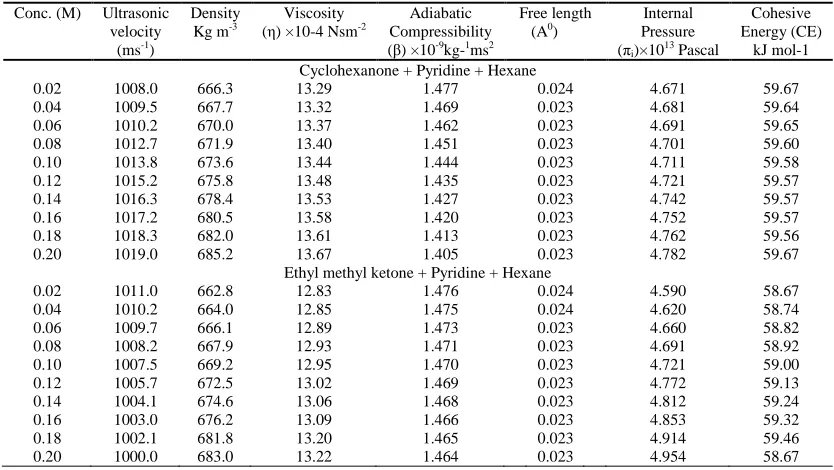
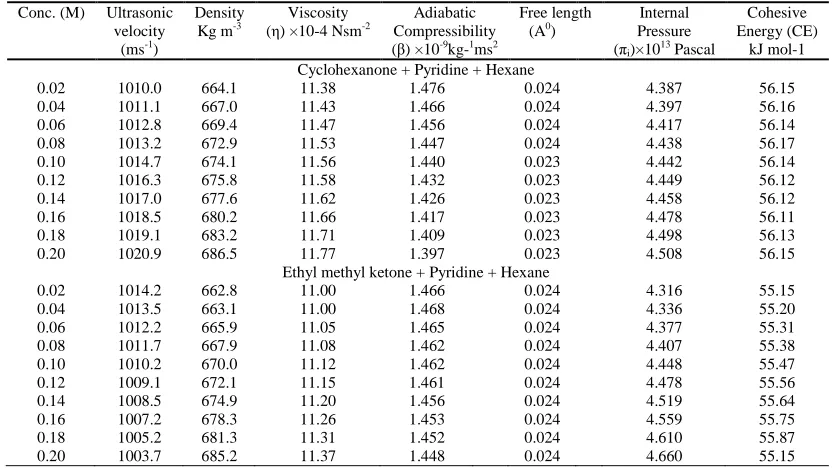
The measured ultrasonic velocities, densities, viscosities and calculated values for various acoustical parameters such as β, Lf, πi and CEat various equimolar concentrations of cyclohexanone and ethyl methyl ketone with
[image:3.595.98.513.166.403.2]pyridine in n-hexane are given in Table 1, 2 and 3.
Table 1.Values of ultrasonic velocity, density, viscosity, adiabatic compressibility, free length, internal pressure and cohesive energy of donor-acceptor complexes at 293K
Conc. (M) Ultrasonic Density Viscosity Adiabatic Free length Internal Cohesive
velocity Kg m-3 (η) ×10-4 Nsm-2 Compressibility (A0) Pressure Energy (CE)
(ms-1) (β) ×10-9kg-1ms2 (πi)×1013 Pascal kJ mol-1
Cyclohexanone + Pyridine + Hexane
0.02 1001.0 670.3 14.93 1.653 0.025 4.904 62.25
0.04 1002.5 671.5 14.95 1.481 0.023 4.904 62.22
0.06 1003.1 672.9 14.98 1.476 0.023 4.914 62.22
0.08 1004.7 673.7 15.00 1.470 0.023 4.914 62.17
0.10 1005.1 675.1 15.03 1.466 0.023 4.924 62.18
0.12 1006.2 676.8 15.07 1.459 0.023 4.934 62.17
0.14 1007.9 679.4 15.13 1.448 0.023 4.954 62.15
0.16 1010.5 682.5 15.20 1.434 0.023 4.964 62.11
0.18 1011.2 684.0 15.23 1.429 0.023 4.975 62.11
0.20 1012.4 686.2 15.28 1.400 0.024 4.995 62.25
Ethyl methyl ketone + Pyridine + Hexane
0.02 1005.0 666.4 14.42 1.485 0.023 4.812 61.23
0.04 1004.1 668.9 14.47 1.482 0.023 4.863 61.33
0.06 1003.7 670.0 14.50 1.481 0.023 4.894 61.39
0.08 1001.2 674.0 14.58 1.480 0.023 4.954 61.56
0.10 999.2 676.1 14.63 1.481 0.023 4.995 61.69
0.12 998.1 677.8 14.67 1.480 0.023 5.025 61.78
0.14 997.0 680.2 14.72 1.479 0.023 5.076 61.88
0.16 996.1 683.4 14.79 1.474 0.023 5.127 61.99
0.18 995.0 685.9 14.84 1.472 0.023 5.167 62.09
0.20 994.1 687.4 14.87 1.470 0.023 5.197 61.23
Table 2.Values of ultrasonic velocity,density,viscosity,adiabatic compressibility,free length,internal pressure and cohesive energy of donor-acceptor complexes at 298K
Conc. (M) Ultrasonic Density Viscosity Adiabatic Free length Internal Cohesive
velocity Kg m-3 (η) ×10-4 Nsm-2 Compressibility (A0) Pressure Energy (CE)
(ms-1) (β) ×10-9kg-1ms2 (πi)×1013 Pascal kJ mol-1
Cyclohexanone + Pyridine + Hexane
0.02 1008.0 666.3 13.29 1.477 0.024 4.671 59.67
0.04 1009.5 667.7 13.32 1.469 0.023 4.681 59.64
0.06 1010.2 670.0 13.37 1.462 0.023 4.691 59.65
0.08 1012.7 671.9 13.40 1.451 0.023 4.701 59.60
0.10 1013.8 673.6 13.44 1.444 0.023 4.711 59.58
0.12 1015.2 675.8 13.48 1.435 0.023 4.721 59.57
0.14 1016.3 678.4 13.53 1.427 0.023 4.742 59.57
0.16 1017.2 680.5 13.58 1.420 0.023 4.752 59.57
0.18 1018.3 682.0 13.61 1.413 0.023 4.762 59.56
0.20 1019.0 685.2 13.67 1.405 0.023 4.782 59.67
Ethyl methyl ketone + Pyridine + Hexane
0.02 1011.0 662.8 12.83 1.476 0.024 4.590 58.67
0.04 1010.2 664.0 12.85 1.475 0.024 4.620 58.74
0.06 1009.7 666.1 12.89 1.473 0.023 4.660 58.82
0.08 1008.2 667.9 12.93 1.471 0.023 4.691 58.92
0.10 1007.5 669.2 12.95 1.470 0.023 4.721 59.00
0.12 1005.7 672.5 13.02 1.469 0.023 4.772 59.13
0.14 1004.1 674.6 13.06 1.468 0.023 4.812 59.24
0.16 1003.0 676.2 13.09 1.466 0.023 4.853 59.32
0.18 1002.1 681.8 13.20 1.465 0.023 4.914 59.46
[image:3.595.97.514.437.672.2]Table 3.Values of ultrasonic velocity,density,viscosity,adiabatic compressibility,free length,internal pressure and cohesive energy of donor-acceptor complexes at 303K
Conc. (M) Ultrasonic Density Viscosity Adiabatic Free length Internal Cohesive
velocity Kg m-3 (η) ×10-4 Nsm-2 Compressibility (A0) Pressure Energy (CE)
(ms-1) (β) ×10-9kg-1ms2 (π
i)×1013 Pascal kJ mol-1 Cyclohexanone + Pyridine + Hexane
0.02 1010.0 664.1 11.38 1.476 0.024 4.387 56.15
0.04 1011.1 667.0 11.43 1.466 0.024 4.397 56.16
0.06 1012.8 669.4 11.47 1.456 0.024 4.417 56.14
0.08 1013.2 672.9 11.53 1.447 0.024 4.438 56.17
0.10 1014.7 674.1 11.56 1.440 0.023 4.442 56.14
0.12 1016.3 675.8 11.58 1.432 0.023 4.449 56.12
0.14 1017.0 677.6 11.62 1.426 0.023 4.458 56.12
0.16 1018.5 680.2 11.66 1.417 0.023 4.478 56.11
0.18 1019.1 683.2 11.71 1.409 0.023 4.498 56.13
0.20 1020.9 686.5 11.77 1.397 0.023 4.508 56.15
Ethyl methyl ketone + Pyridine + Hexane
0.02 1014.2 662.8 11.00 1.466 0.024 4.316 55.15
0.04 1013.5 663.1 11.00 1.468 0.024 4.336 55.20
0.06 1012.2 665.9 11.05 1.465 0.024 4.377 55.31
0.08 1011.7 667.9 11.08 1.462 0.024 4.407 55.38
0.10 1010.2 670.0 11.12 1.462 0.024 4.448 55.47
0.12 1009.1 672.1 11.15 1.461 0.024 4.478 55.56
0.14 1008.5 674.9 11.20 1.456 0.024 4.519 55.64
0.16 1007.2 678.3 11.26 1.453 0.024 4.559 55.75
0.18 1005.2 681.3 11.31 1.452 0.024 4.610 55.87
0.20 1003.7 685.2 11.37 1.448 0.024 4.660 55.15
The trend in the ultrasonic velocity with concentration in the case of systems containing ketones suggests that there are feeble interactions between molecules of ketones and pyridine. The increasing trend in ultrasonic velocity suggests that the complexation increases with increase in concentration. The ultrasonic velocity decreases with increase in concentration in the case of ethyl methyl ketone - acetone. This shows that the complexation is significant even at lower concentration in these two systems. A similar observation was made by Kannappan in the study of donor–acceptor complexes between iodine monochloride and ethers [23]. Thus the donor-acceptor complex formation is significant in this concentration range for this system. There is an increase in density in this concentration range and this suggests that the complexation is concentration dependent. The viscosities are determined for these systems at various concentrations of the donor-acceptor mixtures. The increase in viscosity with concentration in all these systems suggests that the extent of complexation increases with the increase in concentration.
Adiabatic compressibility (β) is a measure of intermolecular association or dissociation or repulsion. It also determines the orientation of the solvent molecules around the liquid molecule. The structural arrangement of the molecule affects the adiabatic compressibility. There is a weak bond between the donor and acceptor molecules. Hence, the compressibility of charge transfer is slightly greater than that of pure component. Further, adiabatic compressibility of all the systems at different temperature are almost constant at the concentration investigated .This suggests that similar type of complexes are formed in these systems. A similar observation was made by Singh and Kalsh stated that adiabatic compressibility should be independent of temperature and pressure for unassociated and weakly associated molecules [24].Intermolecular free length (Lf) is the distance between the surfaces of the
neighbouring molecules. The decrease in free length indicates strengthening of intermolecular interaction. The lower free length values indicate the formation of weak complex between ketone-amine at different temperatures.
The internal pressure is a measure of cohesive forces between the component molecules. The internal pressure values are gradually increases with increase in concentration. This suggests the existence of similar type of complexes in these systems. The cohesive energy (CE) in liquid mixtures is an indicative of the force of attraction between the component molecules. The cohesive energy values are found to be almost constant for a given system at particular temperature indicating similar type of cohesive forces in that system.
Table 4. Stability constant (dm3mol-1), free energy of formation (kJmol-1),Mean free energy of activation (kJmol-1) and mean viscous relaxation time (10-8 s) values of certain charge transfer complexes at different temperatures
Acceptor Donor- Pyridine
K (dm3mol-1)
∆ G (kJmol-1)
∆G# (kJmol-1)
τ (10-8)s T=293K
Cyclohexanone 2.166× 10⁻⁵ 25.56 29.47 2.93
Ethyl methyl ketone 3.321× 10⁻⁵ 25.98 27.52 1.31
T=298K
Cyclohexanone 3.08× 10⁻⁵ 26.17 29.71 2.58
Ethyl methyl ketone 2.84× 10⁻⁵ 26.37 29.67 2.54
T=303K
Cyclohexanone 3.41× 10⁻⁵ 25.91 29.86 2.21
Ethyl methyl ketone 3.93× 10⁻⁵ 25.55 29.81 2.17
From the stability constants obtained for the above systems, the free energy of formation (∆G0F) and free energy of
activation (∆G#) are calculated at 293K, 298K & 303K. For all the systems, ∆G0F values are positive indicating that
the charge transfer complexes are thermodynamically unstable. The free energy of activation (∆G#) and relaxation time ( ) are inherent properties of a charge transfer complexes. The two properties are almost constant in all these systems at different temperature.
CONCLUSION
Amines behave as Lewis bases by the virtue of presence of nitrogen as the basic centre with an unshared pair of electron. A carbonyl compound contains electron deficient carbon which can function as electron acceptor. Thus, donor–acceptor complexes can be formed between amine and carbonyl compounds. The complexation between ketones and amine can be detected by ultrasonic method. The stabilities of these complexes depend on the structure of donor-acceptor molecule and concentration of both donor-acceptors. It is also temperature dependent.
Acknowledgement
One of the authors (SH) is grateful to the Director of Dr.Ira.N. Nimdeokar P.G. and Research Centre for Chemistry, Hislop College, Nagpur, for providing laboratory facilities.
REFERENCES
[1] T.W Solomons Graham, C.B Fryhle. Organic Chemistry, 7th ed. John Wiley & Sons, Inc., 2002, 1088-1089. [2] R Hammker; R Clegg; P Paderson; P Ridder; S Rock, J.Phys.Chem., 1968 , 72(1), 1837-1842.
[3] W Lin; S.J Tasy, J.Phys.Chem., 1970, 74(2), 1037-1050.
[4] W.D Dixon; E Tucker; E Becker, J.Phys.Chem., 1970, 74(1), 1396-1410.
[5] G. C Pimental, A.L Maclellan . The Hydrogen Bond, 1st Edition, W.H. Freeman Co. 1960 , 321-322. [6] M.E Hobbs; W.W Bates, J.Am.Chem.Soc., 1952, 74(2), 746-761.
[7] D.D Deshpande; L.G Bhatgadde, J.Phys.Chem., 1968, 72(1), 72-85. [8] K Sheshadri; K.C Reddy, Acoustica; 1973, 29(3), 59-69.
[9] S Prakash; S.B Srivastava. J.Chem.Thermodyn., 1975, 7(4), 997-1009.
[10] V Kanappan; R Jaya shanthi; E.J.P Malar, Phys.Chem.Liq., 2002, 40(1), 507-513. [11] V Kanappan; R Jaya Shanthi. J.Acous. Soc. Ind., 2001, 29(2), 192-199.
[12] S Jayakumar; N Karunanithi; V Kanappan, Indian J.Pure Appl. Phys., 1996, 34(3), 761-771. [13] N Prasad; R Singh, O Prakash; S Prakash, Indian J.Pure Appl. Phys., 1976, 14(2), 676-681. [14] B.LMarwein; S.N Bhat, Acoustica., 1985,58(1),243-252.
[15] A Tourino; A Gayol; G Marino;M.Iglesias,Phys.Chem.Liq., 2004,42(2) ,323-333. [16] S Prakash; KS Sivanarayana; O Prakash, Can. J.Chem., 1980, 58(1), 942-955. [17] S Pervej; S Ali; A.Y. Khan, Polish J.Chem., 1990, 64(1), 489-500.
[18] M.M.A Hamed; E.M. Abdalla; M.Sh Bayoumi, Spectroscopy Letters., 2003,36(3) 357-369. [19] V A Tabhane; S Agarwal; K G Revetkar, J.Acous. Soc. Ind., 2000, 8(1), 369-376.
[20] A Ali; A K Nain. Acoustics Letters., 1996, 19(2),181-189.
[21] S C Bhatt; H Semwal ; V Lingwal, J.Acous. Soc. Ind., 2000, 28(1), 275-279. [22] P S Nikam; Hiray, Indian J.Pure Appl. Phys., 1991, 29(2), 601-609.