“A Comprehensive Analysis on Human Resource Accounting
Practices in India”
Dr. Jai Prakash Garg
School Lecturer (Commerce)
ABSTRACT-Ever since the concept of Accounting is introduced it is undergoing significant changes and in one way Accounting is aimed at streamlining the financial processes and elements. However, the major asset, which undertakes this essential element is Human Resources, is not given proper importance or scope in today’s accounting framework. Though, there were considerable arguments both for and against viewing Human Resources as assets, the behaviourial scientists, who argues, considering Human Resources as assets, have to realize the fact, majority of Human Resource Management practioner and management scholars have advocated that Human Resources‖ should be viewed from investment perspective. Human resources accounting is an accounting analysis system and in the last decade a large body of literature has been published for setting the various procedures for analysis. At the same time from academicians the theory and underlying concepts of accounting measurement have received sizeable attention and a considerable body of literature has developed. The conventional accountings of human resources are not perceived as physical or financial assets. This paper reviews the literature available on the perception of human resource accounting. In worth, previous study have shown and debated various magnitudes related to valuing human resource. For accounting human resources, different models have been developed which are helpful to identify and report investment made in the human resource of an organization that are not presently accounted for under conventional accounting practice.
KEYWORDS- Human Resources, Management, Accounting Treatments, Human Resourcesand
Investment Perspective.
International Research Journal of Human Resources and Social Sciences ISSN(O): (2349-4085) ISSN(P): (2394-4218)
1.
INTRODUCTION-Human resource accounting (HRA) is of topical origin and is struggling for acceptance. It is clearly said that, Human resources accounting is an accounting measurement system and a large body of literature has been published in the last decade setting for the various procedures for measurement. At the same time the theory and underlying concepts of accounting measurement have received generous attention from academicians and a substantial body of literature has been developed. Under conventional accounting system, human resources are not recognized as physical or financial assets.
Though Human Resources Accounting was introduced back in the 1980s, it started gaining popularity in India after it was adopted and popularized by NLC. Human Resources accounting, also known as Human Asset Accounting, is an information system involved in identifying, measuring, capturing, tracking and analyzing the potential of the human resources of a company and communicating the resultant information to the stakeholders of the company. It is a method by which a cost is assigned to every employee when recruited, and the value that the employee would generate in the future. Human Resource accounting reflected the potential of the human resources of an organization in monetary terms, in its financial statements.
Back in mid of 1980’s, behavioral scientists criticized the conventional accounting system for its failure to value the human resources of the organization. In this changing perspective the accountants were also called upon to play their role by assigning monetary value to the human resources deployed in the organization. Furthermore, the sturdy growth of international financial reporting standards (IFRS) is another indication that the environment for financial accounting reporting is one that potentially encourages the consideration of alternative measurement and reporting standards.
2. CONCEPT OF HRA:
Human Resource Accounting (HRA) is a new branch of accounting. It follows the traditional concept that all expenditure on human capital formation is taken as a charge against the revenue of the period as it does not create any physical asset. Modern view is that cost incurred on any asset as human resources need to be capitalized as it provides benefits measureable in monetary terms. Measurement of cost and value of the people to organizations is highly important, costs incurred in recruitment, selection, hiring, training and development of employees along with their economic values are very much relevant for Human Resource Accounting. American Accounting society on HRA defines HRA as follows:
(a) It is the process of identifying, measuring data about human resources and communicating this information to interested parties.
(d) It is an information system towards the changes in human resources of an organization.
3. OBJECTIVES OF
HRA:-The major objectives of HRA are as follows:
a)Identification of human resource value.
b)Measurement of the cost and value of people to organizations.
c)Investigation of the cognitive and behavioral impact of such information.
4.
OBJECTIVE OF CURRENT STUDY
The main objective of the present study is to explore the literature review related to human resource accounting.
To understand the needs and significance of HRA in the context of business performance measurement.
To provide suggestions for developing such accounting practices in our business enterprises
5.
RESEARCH METHODOLOGY
This study is descriptive cum exploratory in nature. Secondary data is used for the purpose of the study. To develop this study in depth literature review has been used which is collected from websites, different books, previous research findings and from different libraries.
American Accounting Association has defined ―Human Resource Accounting is the process of identifying and measuring data about human resources and communicating this information to interested parties.
R.L.WoodruffJr (1989) defined ―Human Resource Accounting is an attempt to identify and report investment made in human resources of an organization that are presently not accounted for in conventional accounting practice.
Management Scholar Edward Lawler(1992) described human resources from investment perspective as ―to be competitive, organizations in many industries must have highly skilled, knowledgeable workers. They must also have a relatively stable labor force since employee turnover works directly against obtaining the kind of coordination and organizational learning that leads to fast response and high-quality products and services‖.
Lee Brummet, Eric Flamholtz and William C.Pyle(1968) developed Historical Cost Approach, according to them, the cost incurred for recruitment, training and developing the employees should be capitalized (converting the expenses into capital investment or asset) and total amount capitalized is then amortized (gradually reduced) over the estimated useful life of the human resources.
Hekimian and Jones (1967) developed Opportunity Cost Approach, according to them an opportunity cost exists for all human resources that are in short supply and basically any decision that involves a choice from more than one alternative has an opportunity cost‖.
Brauch Lev and Aba Schwartz (1971) developed Present Value of Future Earning Model and according to this model, the value of human resources depends on the present value of the future earnings to be made from a person’s employment.
PekinOgan(1976) developed The Certainty Equivalent Model and this Model consist of two major components (a) the net benefit and (b) the certainty factor, which provides the means of determining the net present value of the human resources
Ratti (2012) calculated the value of human resources at different levels of organization and determined the human resource efficiency quotient taking the sample of fifteen Companies for the measurement of human resources. Primary data were used in the study. It was revealed that the value of human resources did not depend upon the number of persons employed.
Cherian and Farouq (2013) examined the relationship among HRA and organizational performance and a study was conducted on reviews in the field of Human Resource Accounting. It was found that company management and in addition to HR professionals were not willing to execute HRA. Further, it was revealed that organization faced several challenges during the HRA implementation but disclosures on human assets acted as evidence for wealth creation and helped in calculating the human resources capital, worth of management development and enhances the value of management accounting.
Kesavan and Dayana (2013) made an attempt to analyze the Human Resource Accounting disclosure in selected Indian companies. 20 companies were considered for the study, out of that only 6 companies (3 Public and 3 Private sector companies) were following
Bloom and Kamm (2014) conducted a study to aim at analyzing the human resource costs incurred by organization under U.S generally accepted accounting principles and reflect the impact of the Balanced Scorecard and recent literature on the valuation of human capital. The study concluded that superior performing companies recognized and reward their best employees to highlight the value of human capital.
Kaur et. al. (2014) attempted to evaluate extent of HRA measurement and reporting practices of selected Indian companies. The study was aimed at analyzing these companies and ranks the companies on the basis of the extent of disclosure of HRA information in annual reports of companies. The study was based on exploratory research design and secondary data were collected for this purpose. It was revealed that measurements and reporting are highly subjective and the companies are trying to fit available model for the valuation of HR as per their own requirement.
Madhumalathi et. al. (2014) identified the objectives of Human Resource Accounting and various HRA models which are need to arrive at HR value. Itwith special reference to Infosys. It was concluded that HRA in Infosys helped in identifying the right person for right job based on the person’s specialized skills, knowledge, capabilities experience etc. and proper initiation should be taken by the govt. for the measurement and reporting of such valuable assets. It was suggested to take proper initiatives by the government along with the other professional and accounting bodies both at the national and international levels for the measurement and reporting of such valuable assets.
information related to the human resource practices than the private sector banks. Public sector banks were found disclosing some quality information of human capital related information.
7
. FINDINGS OF THE STUDY
7.1 Methods of Human Resource Accounting
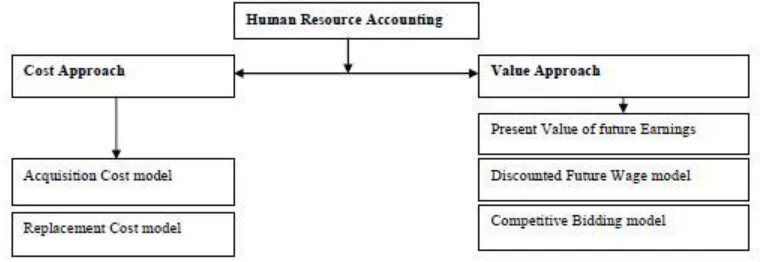
[image:7.612.111.492.338.469.2]Approaches to Human resource accounting was first developed back in 1691; the next stage was during 1691-1960, and third phase post-1960. For valuing human resources, different models have been developed. Mainly, there are two approaches to HRA. Under the cost approach, also called human resource cost accounting method or model, there is a) Acquisition cost model and b) replacement cost model. Under the value approach there are a) present value of future earnings method, b) discounted future wage model, c) competitive bidding model.
Figure 01: Methods of Human Resources Accounting
7.2 General Findings
i.) HRA termed as a vehicle for improvement of management as well as measurement of HR. ii.) The measurement and reporting of HRA in Indian Industry are in growing trend.
iv.) It was found that most of the Indian companies and corporations have followed Lev & Schwartz model for determining the value of human resources.
v.) Some organization faced several challenges during the HRA implementation.
vi.) The companies are trying to fit available model for the valuation of HR as per their own requirement.
8. CONCLUSION
Human Resource Accounting in fact is not a new discipline in Human Resource Management. However, it has not received wide recognition due to wide variety of factors. Now, it is the high time due to liberalized and globalized environment to provide the necessary impetus to this branch of accounting in general financial accounting. At the end of each financial year there will be thorough feedback analysis on each and every aspect of financial matter, but unfortunately it is the only element, which is window dressed in financial accounts is Human Resources. The annual accounts are in fact incomplete, if they fail to consider each and every element in providing the end result. The result can be profit or loss/ product or service. Therefore, a concrete research in a standardized fashion in this respect is an immediate requirement from the ambit of organizations, academicians and practioners. For accounting human resources, different models have been developed which are helpful to identify and report investment made in the human resource of an organization that are not presently accounted for under conventional accounting practice. On the behalf of accounting bodies, government agencies and regulatory bodies there is a need to come forward and issue guidelines of accounting in relation to disclosures being more objective and user worthy. The scope of the further study is in how the technology of HRA can be adapted and broadened to the measure of different types of intellectual property.
REFERENCES
American Accounting Association Committee of Accounting for Human Resources,
―Report of the Committee on Human Resource Accounting, The Accounting Review Supplement to Vol.XLVIII, 1973
B.Lev and A.Schwartz, ―On the use of the Economic Concept of Human Capital
Financial Statements, The Accounting Review (January 1971): 103-12
Batra, G. S. (1996). Human resource auditing as a tool of human resource valuation: interface and emerging practices. Managerial Auditing Journal, 11 (8), 23-30.
Accounting,
Charles R.Greer, ―Strategic Human Resource Management: A General Managerial Approach‖ Second Edition, Pearson, pp.21-50, 2012
Flamholtz, E. G., Bullen, M. L., & Hua, W. (2002). Human resource accounting: A historical perspective and future implications. Management Decison, 40 (10), 947-954.
J.S.Hekimian and C.Jones, ―Put People on Your Balance Sheet,‖ Harvard Business
Review 43 no.2, (1967): 105-113
Lawler, Edward E.III. The Ultimate Advantage: Creating the High Involvement Organization. SanFranciso: Jossey-Bass Publishers, 1992, p.21
M.Scot Myers and Vincent S.Flowers, ―A Framework for Measuring Human Assets,‖
California Management Review, 16, no.4, (Summer, 1974)
Madhumalathi, R., George, Lina., & Madhumathi, T. K. (2014). A STUDY ON HUMAN RESOURCE ACCOUNTING IN CORPORATE SECTORS. International Journal of Organizational Behaviour & Management Perspectives, 3 (1), 717-722.
P.Jyothi, D.N.Venkatesh, ―Huamn Resource Management‖ Oxford University Press, pp