Volume 2009, Article ID 474356,13pages doi:10.1155/2009/474356
Research Article
Lattice Operators and Topologies
Eva Cogan
Department of Computer and Information Science, Brooklyn College, 2900 Bedford Avenue, Brooklyn, NY 11210, USA
Correspondence should be addressed to Eva Cogan,[email protected]
Received 16 March 2009; Accepted 13 October 2009
Recommended by Robert Redfield
Working within a completenot necessarily atomicBoolean algebra, we use a sublattice to define a topology on that algebra. Our operators generalize complement on a lattice which in turn abstracts the set theoretic operator. Less restricted than those of Banaschewski and Samuel, the operators exhibit some surprising behaviors. We consider properties of such lattices and their interrelations. Many of these properties are abstractions and generalizations of topological spaces. The approach is similar to that of Bachman and Cohen. It is in the spirit of Alexandroff, Frol´ık, and N ¨obeling, although the setting is more general. Proceeding in this manner, we can handle diverse topological theorems systematically before specializing to get as corollaries as the topological results of Alexandroff, Alo and Shapiro, Dykes, Frol´ık, and Ramsay.
Copyrightq2009 Eva Cogan. This is an open access article distributed under the Creative Commons Attribution License, which permits unrestricted use, distribution, and reproduction in any medium, provided the original work is properly cited.
1. Introduction
We begin withL, a sublattice of a completenot necessarily atomicBoolean algebra B. If
theorems systematically before specializing to get as corollaries as the topological results of
5,8,12–14.
Section 2provides some background material and generates a topology on an algebra by means of a sublattice.Section 3 defines operators and topological type properties for a lattice.Section 4examines filter and measure behavior with respect to the operators.Section 5
looks at covering properties.Section 6investigates the relationships between two lattices.
2. Background, Terminology, and Notation
We work within a complete Boolean algebraBwith minimal element 0 and maximal element
e. The usual operators are denoted by∨,∧,and.Bis not necessarily atomic; equivalently,B is not necessarily completely distributive15.
iμ, μf denote finitely additive zero-one measures onB. iiL,L1,andL2denote sublattices ofBcontaining 0 and e. iiiALdenotes the algebra generated byL.
ivPSis the power set of the setS.
vThe indicesi, j, k,andnindex countablefinite or countably infinitecollections, whileα, β,andγindex arbitrary ones.
Definition 2.1. iF⊆ Lis anL-filterif and only if for alla, b∈ L:
aa, b∈F⇒a∧b∈F,
ba∈Fanda≤b⇒b∈F.
When there is no ambiguity, we simply say thatFis a filter.
iiAnL-filterFis a primeL-filter if and only if for alla, b ∈ L, a∨b∈F ⇒either
a∈Forb∈F.
iiiAnL-filterFis anL-ultrafilteror ultraif and only ifFis a maximalL-filter.
ivA filterFis fixed if and only if∧F /0. OtherwiseFis free.
vA filterFhas cmpcountable meet propertyor countable intersection property if and only if for any countable subset ofF,iai/0.
Remark 2.2. It follows that
i0/∈Fif and only ifF /L,
iievery ultrafilter is prime.
In this paper, 0 is not in any filter.
Definition 2.3. A measureμon an algebraBcontainingLisL-regularif and only if for all
b∈ B, μb sup{μa:a∈ L, a≤b}.
Lemma 2.4. There exist one-to-one correspondences between
izero-one measures onLand primeL-filters,
Thus, analogous measure theoretic results may easily be derived from our filter statements.
We now topologizeBby means of a sublatticeL. The lattice elements themselves may not be sufficient to be used as open or closed sets. However, we will generate a topology.
Definition 2.5. LetBbe an algebra,La sublattice ofB,anda, b∈ B.
ib{a∈ L:a≥b}.
iib0 {a:a∈ Landa≤b}.
iiib∈ Bis closed if and only ifbb.
ivτLdenotes the set of closed elements ofB.
Remark 2.6. ib→bis a Kurotowski closure operator.
iib→b0is an interior operator. iiiτL {b∈ B:bαaα, aα∈ L}. ivL ⊆τL.
vτLis a lattice which is closed under arbitrary meets.
We observe thatτLis an obvious abstraction of the closed sets in a topological space.
Example 2.7. LetLbe the lattice of zero sets in aT2completely regular topological space. Then τLis the lattice of closed sets11.
Definition 2.8. LetM ⊆ Bbe a meet semilatticei.e., a subset ofBclosed under finite meets. Consider the generated latticeLM {n1{ai :ai ∈ M}:n∈N}. All terminology remains
the same except thatF is a primeM-filterif and only ifn1ai ∈Fforai ∈ Mimplies that
one of theai∈F.
Lemma 2.9. i There exist one-to-one correspondences between the prime, ultra-, fixed, and free filters onMand those onL(M).
iiM-filters with cmp correspond withL-filters with cmp.
Thus we lose no generality in “treating”Mlike a lattice.
Example 2.10. Let M {b ∈ B : b b0}.M is a meet semi-lattice since a∧b ≤ a∧b
implies thata∧b0 ≤ a∧b0 a0∧b0 a∧b, for all a, b∈ M. “An open subsetGin a topological space is regularly open if and only ifGis the interior of its closure”16. Thus the regularly open sets in a topological space form a meet semi-lattice.
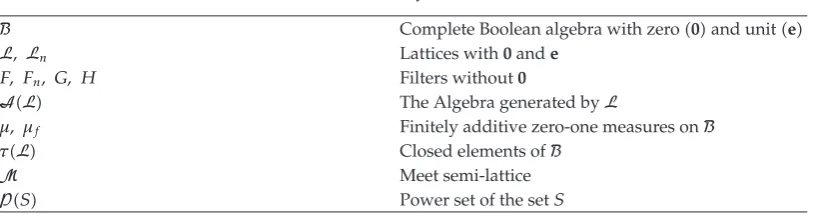
Table 1summarizes the notation used in this paper.
3. Lattice Operators and Properties
In this section we define certain operators and lattice properties. These properties reduce to the conventional topological ones when the operator is taken to be complement.
Definition 3.1. LetMbe a meet semi-lattice containing 0 and e. We define T to be a one-to-one operator onMsuch thatTa∨b Ta∧TbandTe 0. We define a∗Taand
Table 1:Summary of notation.
B Complete Boolean algebra with zero0and unite
L, Ln Lattices with 0 and e
F, Fn, G, H Filters without 0
AL The Algebra generated byL
μ, μf Finitely additive zero-one measures onB
τL Closed elements ofB
M Meet semi-lattice
PS Power set of the setS
Proposition 3.2. aa≤b⇔Ta≥Tb.
bn1Tai≤Tn1ai. cn1Tai e⇒
n 1ai0. dTn1ai 0⇒n1aie.
Proof. aa≤b⇔a∨bb⇔Ta∧Tb Tb⇔Ta≥Tb,
bFor allj, aj≥ n
1ai⇒for allj, Taj≤T n
1ai⇒ n
1Taj≤T n
1ai.
The proof ofcanddfollows readily.
From now on, we assume thatTis defined on a latticeL. ThenL∗is a meet semi-lattice. ByLemma 2.9, we may “treat”L∗like a lattice.
Corollary 3.3. WhenTis defined onτL, one has the following.
aαTaα≤T
αaα.
bαTaα e⇒
αaα0.
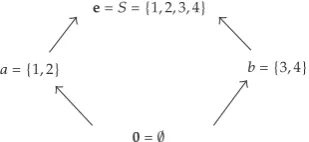
Example 3.4. Let S {1,2,3,4} and B PS the power set of S with set union and intersection as the join and meet operations. LetL{∅, a, b, S}witha{1,2}andb{3,4} as in Figure 1. The operator T is defined by TS ∅, Ta {4}, Tb {2}, and
T∅ {2,4}. We haveTa∨b Ta∧TbandTS ∅. In additionTa∧b Ta∨Tb
andTa∧a ∅.Note that, unlike in2,Tais not the maximal element disjoint froma, and althoughLis complementedthat is,a∈ L ⇒a∈ L, Ta/a.
We now define various properties forL. They generalize some of the definitions in point set topology, reducing to the conventional properties whenBis the power set of a setX
andTis complement.
Definition 3.5. iLis compact if and only if everyL-filter is fixed.
iiLisℵ0-compactif and only if everyL-filter has cmp.
iii L is an I-lattice P-lattice if and only if every prime L-filter with cmp is contained in an ultrafilter with cmp.
ivLis an R-lattice if and only if every filter which contains a fixed prime filter is also fixed.
vA topological space is an I-space if and only if the lattice of closed sets is an I-lattice
a{1,2} b{3,4}
0∅
[image:5.600.223.378.98.169.2]eS{1,2,3,4}
Figure 1:LinExample 3.4.
Proposition 3.6. As an immediate consequence ofDefinition 3.5, one has the following.
iLis compact⇒ Lisℵ0-compact⇒ Lis an I-lattice⇒ Lis aP-lattice.
iiThe following are equivalent:
aLis compact (ℵ0-compact), bevery prime filter is fixed (has cmp),
cevery ultrafilter is fixed (has cmp).
Definition 3.7. iLisℵ0-paracompactif and only if whenever there exists{an} ⊆ Lwith an↓ 0,there exists{bn} ⊆ Lsuch thatan≤b∗nandb∗n↓0.
iiWhenL ⊆τL∗, we say thatLis perfect.
Proposition 3.8. Every perfect lattice isℵ0-paracompact.
Proof. AssumeLis perfect andan↓0. For eachan,there exists{bnα} ⊆ Lsuch thatan
αb∗nα.
Letc∗n∧{b∗k
α :k≤n}. Thenc
∗
n≥anandc∗n↓0.
Example 3.9. The zero sets in a topological space are perfecti.e., complement generated in the sense of11and thusℵ0-paracompact.
Definition 3.10. Leta, ai, b∈ B, andf, fi, g, gi∈ L. Then the following are given.
iLis T1if and only if for alla1/≤a2there existsg∗∈ L∗such thata2≤g∗buta1/≤g∗.
iiLis Hausdorffif and only if for alla1, a2/0witha1∧a20there existg1∗, g2∗∈ L∗
such thata1∧g1∗/0, a2∧g2∗/0, andg1∗∧g2∗0.
iiiLis regular if and only if for allb∈ B, b /0, f ∈ L, b∧f 0there existg1∗, g2∗∈ L∗
such thatb∧g1∗/0, f ≤g2∗, andg∗1∧g2∗0.
The following proposition provides an example.
Proposition 3.11. LetBbe the power set of a topological spaceX, letLbe the lattice of closed sets inX,and letTbe complement.Xis aT1(Hausdorff, regular) space if and only ifLisT1(Hausdorff,
Proof. LetLbe the lattice of closed sets inX. SupposeLis aT1lattice. Leta1/a2 be atoms
inB. Sincea1/≤a2, there existsg2 ∈ Lsuch thata2 < g2 buta1/≤g2. By symmetry, there exists g1 ∈ Lsuch thata1≤g1 buta2/≤g1. ThusXis aT1space.
Now supposeXis aT1topological space. Letb, c∈ B, b/≤c. Then there exists an atom a≤bbuta/≤c. Thus for all atomsaα≤c, a /aα, and there existsgα ∈ Lsuch thataα≤gα but a/≤gα. Letgαgα.Thenc≤g, b/≤g, and thusLisT1.
The proofs for Hausdorffand regular are similar.
Proposition 3.12. SupposeTa∧a0andLis regular. IfF1is prime andF1 ⊆F2, thenF1
F2.
Proof. Suppose there existsF1⊆F2 such thatF1/ F2. LetaF1. a/≤F2implies there
existsf∈F2 with a/≤f.But thenba∧f/0andb∧f 0. By regularity, there existc∗1, c2∗∈ L∗
such thatbc∗1/0, f≤c2∗,andc1∗∧c2∗0.Nowf≤c2∗implies thatc2/∈F2⊇F1. Fromb∧c1∗/0,
it follows thata/≤c1and thusc1/∈F1. Butc∗1∧c∗20implies thatc1∨c2e,and thusF1is not
prime.
Example 3.13. The closed sets in a regular topological space form anR-lattice.
Definition 3.14. Lis normal if and only if for allf1, f2 ∈ L, f1∧f20there existg∗1, g2∗∈ L∗
such thatf1≤g1∗,f2≤g2∗,andg1∗∧g2∗0.
The following proposition demonstrates an example of an application.
Proposition 3.15. LetXbe a topological space. LetT be complement and letLbe the lattice of open sets. Then the following are equivalent.
aLis normal.
ba, b∈ Landa∧b0⇒a∧b0.
ca∈ L⇒a∈ L(i.e.,Xis extremally disconnected).
Proof. Consider the following.i aimpliesb: leta, b ∈ L, a∧b 0. Then there exist
c, d∈ Lsuch thata≤c, b≤d, andc∧d0by normality. Buta≤candb≤dimplies thata∧b0.
ii b impliesc: leta ∈ L. Let b a so that a∧b 0. Then a∧b 0 by hypothesis, so thatb∧b0. Thenb≤bb0, so thatbb0 and b∈ L. Thereforea∈ L
by definition ofb.
iii cimpliesb: let a, b ∈ L, a∧b 0, so thata∧b 0. Since a ∈ L, then
a∧b0.
iv bimpliesa:a, bare elements ofL.
Proposition 3.16. Let Ta∧a 0. IfLis normal and F is a primeL-filter contained in two
L-ultrafiltersGandH, thenGH.
Proof. LetGandHbe two distinct ultrafilters and letF ⊆G∩H. Then there existg ∈G, h∈ H withg∧h0.By normality, there exista∗, b∗∈ L∗such thatg≤a∗, h≤b∗,anda∗∧b∗0.
Butg∧a0implies thata /∈G, andh∧b0implies thatb /∈H, so thata, b /∈G∩H⊇F, that is,a, b /∈F. Buta∨beimplies thatFis not prime.
Example 3.18. A normal topological space is countably paracompact if and only if the lattice
of closed sets isℵ0-paracompact18. Willard16calls such a space binormal.
Proposition 3.19. LetT be complement inB. IfLisℵ0-normal andF1 is a prime filter with cmp,
thenF1 ⊆F2implies thatF2has cmp.
Proof. LetF1 ⊆ F2whereF1is a primeL-filter andF2is anL-filter without cmp. Then there
exists{fk} ⊆F2such that
k{fk}0. Letgn n
1fk. {gn} ⊆F2andgn ↓0.Thus there exist {bn} ⊆ Lsuch thatgn ≤bnandbn↓0. Nowgn∧bn0, so there exist two sequences{cn},{dn}
such thatgn ≤cn, bn ≤dn, cn∧dn 0,for alln. Sincecn∨dn e andF1 is prime, we have cn ∈F1 ordn ∈F1,for alln.Butgn ≤cnimplies thatcn/∈F1,so dn ∈F1,for alln.And since bn≥dnimplies thatdn↓0,we have thatF1does not have cmp.
Remark 3.20. IfLis a normal lattice that has the stronger property that whenever{an} ⊆ L
such thatna∗n ethere exists{bn} ⊆ Lsuch that
nbn eand for alln, a∗n ≥ bn, then we
need only to assume thatTa∧a0.
Corollary 3.21. LetTbe complement inB. IfLisℵ0-normal, thenLis aP-lattice.
4. Behavior of Filters and Measures Under
T
In this section we look at the behavior of filters and measures with respect toT. It is interesting to see an example whereTdoes not “behave as nicely” as complement.
Definition 4.1. LetD⊆ L.D {a∗∈ L∗:a /∈D}.
Proposition 4.2. LetFbe a primeL-filter.Fis a primeL∗-filter.
Proof. a0/∈Fsince e∈F.
ba∗≤b∗, a∗∈F⇒a≥banda /∈F⇒b /∈F⇒b∗∈F.
cLeta∗, b∗ ∈F, so thata, b /∈F; equivalently,a∨b /∈F. But thena∨b∗∈F, and so
a∗∧b∗∈F. Thusbya,b, andc,Fis a filter.
dLeta∗, b∗ ∈ L∗, a∗∨b∗ ≥ c∗ ∈ F.a∧b∗ ≥ a∗∨b∗ ≥ c∗ ∈ F ⇒ a∧b ≤ c /∈F ⇒ a∧b /∈F⇒a /∈Forb /∈F ⇒a∗∈Forb∗∈F. ThusFis prime.
Definition 4.3. A filterFis coultra if and only ifFisL∗-ultra.μF is coregular if and only ifF
is coultra.
Proposition 4.4. FisL∗-ultra if and only ifa∈Fis equivalent toa∗ ≤b∗for someb∗ ∈F(i.e., a∗/∈F⇔there existsb∗∈Fsuch thata∗≤b∗).
Remark 4.5. Proposition 4.4 generalizes a theorem of 12 which we get by taking T to be complement.
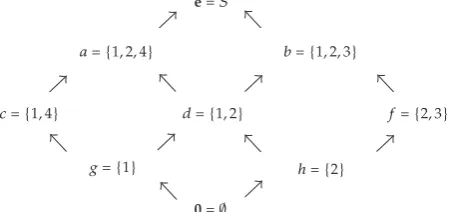
As demonstrated by the following example, we can associate measures with the prime filters onLas usual, but they may lack some of the properties to which we are accustomed.
c{1,4}
a{1,2,4}
g{1}
eS
d{1,2}
0∅
b{1,2,3}
h{2}
[image:8.600.188.416.101.207.2]f{2,3}
Figure 2:LinExample 4.6.
DefineT onLas follows:
Te 0, T0 e,
Ta g, Tga,
Tb h, Th b,
Tc c, Td d, Tff.
4.1
Incidentally, L L∗ and for all a ∈ L, TTa a. However a∧Tadoes not necessarily0.
NowTcan be extended to all ofAL Bby definingTa∨b Ta∧Tb, Ta∧b Ta∨Tb, and Ta Ta.
LetF Ff {x∈ L:x≥ f} {e, b, f}.F {a∗, d∗, h∗, c∗, g∗,0∗} {g, d, b, c, a,e} Fg. SinceFis anL∗-ultrafilter,Fis a coultra filter.Fis a prime filter so we have the associated
measureμμF μf,where
μx ⎧ ⎨ ⎩
1 ifx≥f,
0 otherwise.
4.2
Now consider that{3} ∈ AL. μ{2,3} 1, μ{2} 0, so thatμ{3} μ{2,3}−
μ{2} 1.But{3}/≥any element ofL∗ whose measure is one, soμis notL∗-regular even though it isL-coregular.
Note that
μa 0 andμa∗ μg 0, μf 1 andμf∗ μf 1, μh 0 butμh∗ μb 1, μb 1 butμb∗ μh 0.
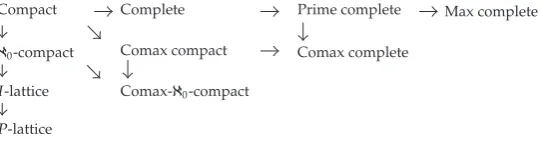
Compact
ℵ0-compact
I-lattice
P-lattice
Complete Comax compact Comax-ℵ0-compact
Prime complete Comax complete
[image:9.600.166.437.97.168.2]Max complete
Figure 3:Lattice Implications.
Remark 4.7. IfTa∧a 0and T is measure inverting, then everyL-coregular measure is
L∗-regular. These concepts are equivalent whenT is complement.
From now on we assume thatTa∧b Ta∨Tb. NowL∗is a lattice.
Example 4.8. See Examples4.6and3.4.
Proposition 4.9. F is a prime L-filter if F is a prime L∗-filter. (Please see Definition 4.1 and
Proposition 4.2for the converse.)
Proof. a 0/∈Fsince e∈F.
b a, b∈F ⇒a∗, b∗/∈F⇒a∗∨b∗/∈F⇒a∧b∗/∈F⇒a∧b∈F.
c a≤banda∈F⇒b∗≤a∗ anda∗/∈F⇒b∗/∈F⇒b∈F.
d a∨b∈F⇒a∨b∗/∈F⇒a∗∧b∗∈/F⇒a∗/∈For b∗/∈F⇒a∈F orb∈F.
Corollary 4.10. aFis a primeL-filter if and only ifFis a primeL∗-filter.
bFis a prime filter ifFis a coultra filter.
5. Covering Properties
In this section we define some covering properties forLand show that they are analogous to the topological ones. In particular, whenT is taken to be complement, we get topological results as corollaries.
Definition 5.1. Lis comax compact if and only if every coultra filter is fixed.Lis comaxℵ0 -compactif and only if every coultra filter has cmp.
Proposition 5.2. Every comax compactR-lattice is compact.
Proof. LetF be a prime L-filter. Form F and extend it toG, an L∗-ultrafilter.G is a prime
L-filter and fixed.G⊆Fimplies thatFis fixed sinceLis anR-lattice. ThusLis compact by
Proposition 3.6.
Corollary 5.3. IfTa∧a0andLis a comax compact regular lattice, thenLis compact.
Definition 5.4. Lisprime, max, comaxcompleteif and only if everyprime, ultra-, coultra filter with cmp is fixed.
We have the implications inFigure 3.
Proposition 5.5. IfLis (comax-)ℵ0-compact, then it is (comax) complete if and only if it is (comax)
Proposition 5.6. IfLis an R-lattice, thenLis prime complete if and only if it is comax complete.
Proof. In the proof ofProposition 5.2, letFhave cmp.
Proposition 5.7. IfLis a max complete I-lattice, thenLis complete.
Proof. LetFbe a filter with cmp. SinceLis an I-lattice,Fcan be extended toG, an ultrafilter with cmp.Gis fixed becauseLis max complete. HenceFis fixed andLis complete.
Corollary 5.8. If L is a max complete P-lattice, thenLis prime complete.
Proof. In the proof ofProposition 5.7, takeFto be a prime filter.
Remark 5.9. WhenTis defined onτL as whenLτLandTαaα
αTaα∀aα∈ L,
our definitions coincide with the conventional topological ones.See Examples3.4and4.6. In particularT may be taken to be complement.
Proposition 5.10. LetTbe defined onτLwithTαaα
αTaαfor allaα∈ L. aLis compact if and only if eαa∗α⇒en1a∗αi.
bLis complete if and only if eαa∗α⇒e∞1 a∗αi.
cLisℵ0-compact if and only if e ∞
1a∗i ⇒e n
j1a∗ij.
Proof. We will prove only partb. Partsaandchave similar proofs.
Suppose the condition holds. LetF {fα}be a freeL-filter. Thenαfα 0implies
thatαfα∗ e, so that there exists{fαi} ⊆ {fα}such that
ifα∗i e. But then
ifα∗ 0andF
does not have cmp, soLis complete.
Conversely, suppose that the condition does not hold. Then there exists{aα}such that
αa∗α ebut
ia∗αi/efor any countable subset. Then 0/
iaαi and{aα}is a subbase for a
filterF.F has cmp since{fj} ⊆ F implies that
jfj ≥
jaαj > 0. F is free since e
αa∗α
implies thatαaα0, and therefore,Lis not complete.
Corollary 5.11. LetXbe a topological space. TakeLto be the closed sets and takeTto be complement. ThenXis compact (Lindel¨of, countably compact) if and only ifLis compact (complete,ℵ0-compact).
Corollary 5.12. Xis a realcompact I-space if and only if it is a Lindel¨of space [14].
Corollary 5.13. If X is regular, countably paracompact, and almost realcompact, then X is realcompact [6].
6. Lattice Interrelations
In this section we investigate the implications between the properties of two lattices when one is a sublattice of the other.
Proposition 6.1. LetL1⊆ L2⊆τL1
aIfL1is complete, thenL2is complete.
bIfL1is prime complete, thenL2is prime complete.
Proof. aLetFbe anL2-filter with cmp,GF∩ L1,andb∈F. There exists{aα} ⊆ L1such
thatb αaα. As b ≤ aα,for allα, we haveaα ∈ F∩ L1 which G,for allα. Now let {bβ} ⊆F.
βbβ
α,βaα,β/0, sinceGis fixed. ThusFis fixed andL2is complete. bLetFinabe prime. ThenGis prime.
cSinceL1is a P-lattice,Gmay be extended to anL1-ultrafilterHwith cmp. SinceL1
is max complete,His fixed, and henceGandFare fixed.
Corollary 6.2. LetL1⊆ L2⊆τL1and letL1be a P-lattice. IfL1is max complete, thenL2is max
and comax complete.
Corollary 6.3. LetL1 ⊆ L2 ⊆τL1and letL1beℵ0-normal. IfL1is max complete, thenL2is max
and comax complete.
Corollary 6.4. IfXis a normal, countably paracompact space, thenZ-replete impliesF-replete and realcompact impliesα-complete [13].
The following proposition generalizes two results of Alexandroff 5.
Proposition 6.5. LetL1⊆ L2⊆τL1. aIfL1is compact, thenL2is compact.
bIfL1is compact and normal, thenL2is normal.
Proof. aLetFbe anL2-filter. LetGF∩ L1. The proof follows as inProposition 6.1. bLeta1, a2 ∈ L2, a1∧a2 0, wherea1
βbβ, a2
γcγ, and of coursebβ, cγ ∈ L1. a1≤bβanda2≤cγ,for allβ, γ. Now there must existbβ0, cγ0such thatbβ0∧cγ0 0.If not, {bβ, cγ}would form a subbase for a free filter in a compact space.By normality ofL1, there
existd∗1, d∗2∈ L∗1such thatd∗1≥bβ0, d2∗≥cγ0,andd∗1∧d∗20.But thend1∗≥a1andd∗2≥a2and
soL2is normal.
Proposition 6.6. LetδLdenote the smallest set containingLand closed under countable meets. LetL1 ⊆ L2⊆δL1. IfL1isℵ0-compact, thenL2isℵ0-compact.
Proposition 6.7. LetL1⊆ L2.IfL2is complete, thenL1is complete.
Proof. LetF be anL1-filter with cmp. LetG {a∈ L2 :a≥f for somef ∈F}. Ghas cmp
sincegi≥
fi>0, gi∈G, andfi∈F.L2is complete soGis fixed. ThusFis fixed andL1is
complete.
Corollary 6.8. LetL1⊆ L2whereL2is an I-lattice. aIfL2is max complete, thenL1is complete.
bIfL2is a comax complete R-lattice, thenL1is complete.
Proof. aSinceL2is an I-lattice,L2that is max complete implies thatL2is complete, which
implies byProposition 6.7thatL1is complete.
bSinceL2is an R-lattice, its being comax complete implies that it is prime complete.
SinceL2is an I-lattice,L2is complete and thusL1is complete byProposition 6.7.
Definition 6.9. L2is anL1-P-lattice if and only if everyL1prime filter with cmp is contained
Definition 6.10. iL2isL1-normalif and only if for allf1, f2∈ L2withf1∧f2 0there exist g1∗, g2∗∈ L1∗such thatf1≤g1∗, f2≤g2∗,andg1∗∧g2∗0.
iiL2 isL1-ℵ0-paracompactif and only if for each{an} ⊆ L2 such that an ↓0there
exists a sequence{bn} ⊆ L1such thatan≤b∗nandb∗n↓0.
iiiL2isL1-ℵ0-normalif and only ifL2isL1-normal andL1-ℵ0-paracompact.
Proposition 6.11. LetTbe complement. IfL2isL1-ℵ0-normal andF1is a primeL1-filter with cmp
contained in anL2-filterF2, thenF2has cmp.
Proof. Similar to the proof ofProposition 3.19.
Corollary 6.12. LetTbe complement.
aThatL2isL1-ℵ0-normal implies thatL2is anL1-P-lattice.
bIfL2isℵ0-paracompact andL1separatesL2,thenL2isL1-ℵ0-paracompact.
Corollary 6.13. aLet L2 be an L1-P-lattice. ThatL2 is max complete implies that L1 is prime
complete.
bIf in additionL2is an R-lattice, then thatL2is comax complete implies thatL1 is prime
complete.
We get Frol´ık’s8theorems as our final corollary.
Corollary 6.14. aIf L1 ⊆ L2 and L2 isL1-ℵ0-normal and prime complete, then L1 is prime
complete.
bLetXbe a normalT2 space. IfX is almost realcompact and countably paracompact, then Xis realcompact.
Acknowledgments
This paper is based on the Ph.D. thesis the author wrote under the supervision of the late George Bachman at The Polytechnic Institute of Brooklyn, now Polytechnic University of NYU. The author is grateful for Professor Bachman’s patient guidance and encouragement. This material was presented at The Second Annual Dr. George Bachman Memorial Conference at St. John’s University Manhattan Campus on June 7, 2009. The author appreciates the comments and encouragement provided by Professors Keith Harrow, Pao-Sheng Hsu, and Noson Yanofsky and the questions raised by the anonymous reviewers. This paper is dedicated to the memory of Professor George Bachman.
References
1 B. Banaschewski, “On Wallman’s method of compactification,” Mathematische Nachrichten, vol. 27, pp. 105–114, 1963.
2 P. Samuel, “Ultrafilters and compactification of uniform spaces,” Transactions of the American Mathematical Society, vol. 64, pp. 100–132, 1948.
3 G. Bachman and R. Cohen, “Regular lattice measures and repleteness,” Communications on Pure and Applied Mathematics, vol. 26, pp. 587–599, 1973.
5 A. D. Alexandroff, “Additive set-functions in abstract spaces,” Matematicheskii Sbornik, vol. 850, pp. 307–348, 1940.
6 Z. Frol´ık, “Prime filters with CIP,” Commentationes Mathematicae Universitatis Carolinae, vol. 13, pp. 553–575, 1972.
7 G. N ¨obeling, Grundlagen der analytischen Topologie, vol. 72 of Die Grundlehren der mathematischen Wissenschaften, Springer, Berlin, Germany, 1954.
8 Z. Frol´ık, “On almost realcompact spaces,” Bulletin de l’Acad´emie Polonaise des Sciences, vol. 9, pp. 247– 250, 1961.
9 P.-A. Meyer, Probability and Potentials, Blaisdell, Waltham, Mass, USA, 1966.
10 R. A. Al `o and H. L. Shapiro, Normal Topological Spaces, Cambridge Tracts in Mathematics, no. 6, Cambridge University Press, New York, 1974.
11 L. Gillman and M. Jerison, Rings of Continuous Functions, The University Series in Higher Mathematics, D. Van Nostrand, Princeton, NJ, USA, 1960.
12 R. A. Al `o and H. L. Shapiro, “Z-realcompactifications and normal bases,” Australian Mathematical Society, vol. 9, pp. 489–495, 1969.
13 N. Dykes, “Generalizations of realcompact spaces,” Pacific Journal of Mathematics, vol. 33, pp. 571–581, 1970.
14 R. T. Ramsay, “Lindel ¨of realcompactifications,” The Michigan Mathematical Journal, vol. 17, pp. 353– 354, 1970.
15 H. Hermes, Einf ¨uhrung in die Verbandstheorie, vol. 73 of Zweite erweiterte Auflage. Die Grundlehren der mathematischen Wissenschaften, Springer, Berlin, Germany, 1967.
16 S. Willard, General Topology, Addison-Wesley, Reading, Mass, USA, 1970.
17 R. W. Bagley and J. D. McKnight Jr., “OnQ-spaces and collections of closed sets with the countable intersection property,” The Quarterly Journal of Mathematics, vol. 10, pp. 233–235, 1959.