A Monthly Double-Blind Peer Reviewed Refereed Open Access International e-Journal - Included in the International Serial Directories.
GE-International Journal of Management Research
Vol. 5, Issue 2, February 2017 Impact Factor- 5.779 ISSN(O): 2321-1709, ISSN(P): 2394-4226© Associated Asia Research Foundation (AARF)
Website: www.aarf.asia Email : [email protected] , [email protected]
LOGISTICS - THEDELIVERYBACKBONEBEHIND E-COMMERCE
CLICK & COLLECT
Saumya Agarwal1, Kingshuk Bhadury2
1
Student of MBA in Finance, Symbiosis Institute of Management Studies, Pune, Maharashtra, India - 411020
2
Professor, Symbiosis Institute of Management Studies, Pune, Maharashtra, India - 411020
ABSTRACT
With the rapid development of e-commerce in India, customer demand for diversity and
timeliness has also increased. The driving force behind the efficiency of e-commerce
industry is the express logistics sector. The demand for e-commerce has given a great
boost to the logistics sector in India.
This paper explores the express logistics industry with respect to e-commerce and
outlines the problems and defines key challenges in express logistics sector. The focus is
also on various transformations and innovations in logistics sector with the advent of
time leading to hedgehog-free life of a common man.
This research report in this paper covers perspective of not only from consumer’s point
of view but also people from the point of view of industry and hence the importance as
well as challenges in logistics industry are analyzed weighing it on both scales.
The paper affirms that logistics has a profound influence on the Indian economy and in
easing the life of Indian consumers. Logistics has same value to e-commerce what queues
The result shows that reliability, economy, time, service flexibility and information are
five key factors that will influence the logistics performance.
KEYWORDS - Customers, Delivery, E-commerce, Logistics, Online
INTRODUCTION
‟Logistics‟ is derived from French word “logistique” meaning “tolodge‟ which originally
means an art of war pertaining to movement and supply of armies. Basically a military
concept, it now commonly pertains to marketing management.
[1] “Logistics is the process of planning, implementing and controlling the efficient,
effective flow and storage of goods, services and related information from point of origin
to point of consumption for the purpose of conforming the customer requirement”.
This definition, au fond, implies that logistics never stops. It keeps moving around the
globe seven days week and 24 hours a day.
Logistics, though not new, but is definitely the next big thing to look for. Logistics has
become the backbone of rising Indian economy. In times when we are heading towards
cashless economy, we cannot ignore the fact of also heading towards travel LESS
economy too. The logistics industry in India is reciprocity of infrastructure & technology
with service providers. The logistics industry focus towards reducing cycle time thus
helping e-commerce proffer efficient services.
1. Literature Survey
[2] Online Shopping Customer Experience Study (commissioned by UPS) was conducted
by thenewlogistics.com on “What factors influence the online shopping experience?
Some of the highlights of the survey are:
Knowing the delivery time estimate ranked among the top factors influencing
online shopping.
42% of online shoppers have abandoned their shopping carts because of delivery
date.
1/3 of shoppers most often choose to pay a fee for faster delivery.
2/3 of people choose the most economical shipping option most of the time.
But 43% expect to see the availability of 2-3 day delivery.
And 30% expect to see the availability of overnight shipping.
Based on Returns
Shoppers appreciate the availability of an easy-to-understand returns process.
63% of online buyers look at the retailer‟s return policy before making a
purchase.
Almost half would shop more often with a retailer and would be more likely to
recommend to a friend if the retailer had a lenient and easy-to-understand return
policy.
Based on shipping services
46% said that receiving their product when expected led them to recommend the
online retailer.
75% of shoppers believe every retailer would offer tracking information.
Consumers like receiving e-mail alerts, having the ability to re-route and the
ability to schedule a 2-hour delivery window.
Internet users are estimated to grow enormously by a hundred -fold by 2021.[3] With the
growing popularity of online shopping in India, the e-commerce companies are expected
to invest close to $6-8 billion in logistics, infrastructure and warehousing in the next few
years, an Assocham-PwC study said. This entails that logistics industry has become the
veritable backbone for the e-commerce industry. As per a report by Roland Berger and
[4] A news report in leading daily The Economic Times perspicuously reveals that India
has jumped 19 places to the 35th rank in the World Bank‟s Logistics Performance Index
2016. The report is generated gauging the performance of countries based on various
factors like customs, infrastructure, international shipments, logistics quality and
competence, tracking and tracing, and timeliness. Improvement in ranking of India
clearly indicates that the logistics industry is becoming the next best thriving sector in
India.
2. Logistics Sector With Respect To Indian E-commerce
Logistics industry is rapidly growing with ever changing evolving patterns in place
giving rise to new forms of logistics models that assimilates e-fulfillment points, delivery
and package hubs, localized depots that cater to order fulfillment of e-commerce industry
and also process their returns.
Challenges in amalgamating logistics industry with e-commerce:
E-commerce is mainly focused on Tier-1 and Tier-2 cities spiraling demand of
good logistics infrastructure to avoid bottlenecks in such cities.
Reliability of CoD (Cash on Delivery) is still an issue to be addressed. When the
payment mode provided by e-commerce vendors is Cash-On-Delivery, customers
shop online “now” and may refuse to pay “later”. This leads to uncalled for losses
in logistics industry.
Logistics for long-distance routes. [5] More requirement of dependency on roads
and railways instead of airlines to cut the cost. This demands good roads and rail
infrastructure to beat time and cost. The overall speed of travel still remains low
at 35-40 kilometers per hour for India compared to global average of 60-80
kilometers per hour.
Reliability on outsourcing and 3rd party logistics. [6] E-commerce companies in
India currently outsource an estimated 52% of logistics, and 3rd party logistics
represents only 1% of logistics cost.
Government rules and regulations. Implementation of Goods and Service Tax(GST) is expected to streamline the processes and reduce a lot of these delays.
3. Inferences
A survey was carried out among nearly 250 customers including industry professionals
who are closely associated with e-commerce industry. The focus of survey was to
ascertain the mindset of consumers while purchasing products online and analyze how
logistics industry is aiding e-commerce achieve its targets by easing the life of customers.
Survey commenced with null hypothesis where it was assumed that express delivery in
e-commerce does not have an impact on the purchase behavior of the customer.
Various inferences were drawn out of the survey that was conducted and analysis was
based on observation of the data collection indicating the consumer purchase patterns and
preferences.
Survey concluded with the rejection on null hypothesis and acceptance of alternate
hypothesis which assumed that express delivery in e-commerce does have an impact on
the purchase behavior of the customer.
Various inferences were drawn as an outcome of the survey report. These inferences are
put in a simplified manner outlining the importance of logistics in e-commerce.
Inference 1: Modern day users prefer online shopping to shopping in malls
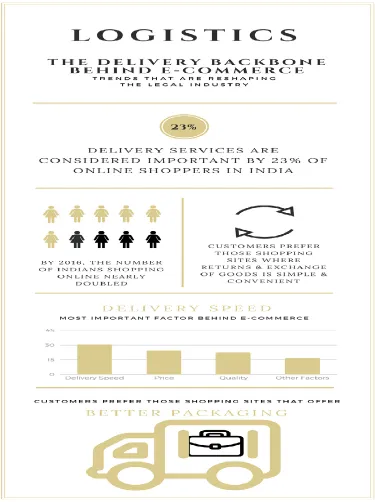
Survey result gives prominence to statistics revealed in figure 1 which highlights the fact
Rohit Jain, a student in Delhi University. He is a crazy online shopper. When asked, he
says that shopping online is very simple and convenient. A wide range of products appear
just at a click of the mouse. An additional benefit of using filters to find the exact product
that he wants. This is rare and difficult when he goes to shop in malls. He says offline
shopping is a time consuming process since displaying products in shops is manual
process plus finding as wide range of products as online retailers provide is difficult in
one single shop. He narrated an incident where his friend invited himfor a party and he
needed a new shirt for the same. Due to exams he would not have time to go out and
shop. He simply ordered the shirt online that got delivered to him without wasting much
of his time. He also says that being a student he gets calculated pocket money. Shopping
online saves his expenses because he does not need to travel to shop and also online
retailers provides lots of offers and discounts, hence lots of advantages to shop online for
a student like him.
Inference 2: Key attribute for customers shopping online is “Delivery Services” after „Product Quality‟ and „Product Price‟
Figure 1 features the importance of delivery services. Online shopping pattern is
influenced widely by delivery services provided by e-commerce vendors. Purchasing
pattern of about 23% of online shoppers is influenced by e-commerce delivery services.
It‟s the wedding season and Sneha Sharma is busy in her sister‟s wedding preparations.
What she decided first was to go for street shopping but because of snags in shopping on
the streets and lack of time she planned to shop online. Being a sporadic online shopper,
she landed up surfing Amazon, Flipkart, Myntra, Snapdeal, Jabong, eBaY and others to
make her selections. She selected clothes, jewellery, shoes, and others requirements. As
online shopping is the current trend in the market e-commerce is taking special care of
their customers. From wide variety of products to different mode of deliveries to
customer care help, everything is taken care of. Sneha‟s preference is fastest delivery of
her orders as wedding date is nearby. So she compared delivery times taken by these
that what will happen if the orders will not arrive on time. But with advance technology
it‟s possible for her to track the orders and get the fastest delivery. So she opted for the
[image:7.612.110.485.171.673.2]vendor with best delivery service matching her requirements.
Inference 3: Most important factor behind the popularity of e-commerce sites is their
delivery speed
The survey result accentuated in figure 1 revealed that about 30% of e-commerce
customers preferred faster delivery, breaking the norm of product price and quality
preferences which used to be the topmost priority of Indian customers.
Tina Dutta is an addictive shopper online. She says that shopping online always helps her
make her selections keeping in mind the price and quality. In an instance where she
wanted to gift her mom a nice saree on the occasion of mother‟s day, she had to spend
only around 20-30 minutes select a beautiful fancy saree for her mom. She liked the color
and the price was just right for her pocket. While confirming her decision to buy it, she
looked at the mention of 10 days delivery time to her place. Mother‟s day was just a week
ahead. The site did not accent on fast delivery even when the customer was ready to pay
additional amount. She cancelled her order and made her purchase from the other site
which could deliver the gift within a week.
Inference 4: Customers always prefer those online shopping sites that provide safe
packaging
Customers would abandon the e-commerce vendor altogether if it fails to deliver its
product safely even once (as spotted in figure 1). Safe delivery in form of packaging is
the unspoken expectation of e-commerce customers.
Laila Mani is has a passion for art. She has visited multiple art galleries and travelled to
cultural shows around the world. One day while randomly surfing on the net, her eyes
stuck on a marvelous piece of art created by none other than M.F. Hussain and put up for
sale on the site. She decided to add the master-piece to her rich collection at home. She
made an advance payment of the expensive art-piece and waited eagerly for its delivery.
After three days, her wait was over and the master piece arrives. With utter excitement
a complaint of crack due to poor packaging from the vendor and woefully returned the
painting. Her bad experience could not drive her to shop from that site again.
Inference 5:Customers prefer to shop on sites where return and exchange of goods is
simple and convenient
Online shoppers are usually those customers that long for a hassle-free experience (that
may be the reason they prefer to shop online rather than offline). So they expect
extremely efficient customer services when it comes to return or exchange of their
products which is brought out in figure 1.
Pragya Tuteja prefers shopping from such vendors where the return policy is simple and
convenient. She says “I keep myself updated with latest fashion trends and I like buying
stuff which is trendy, unique, and new and has some different fashion statement. So at
times it happens with me that I don‟t like what I bought so I have to make a return.”
Once she ordered an ethnic dress online. On delivery, she found the color of dress very
different from the one visible on their site and decided to make a return. I had to face a lot
of problem on the return of that product. To add to her woes, customer care service of
was also not efficient in resolving her problem of return. Due to her bad experience, she
decided to stay away from that site and preferred making her purchases from the vendors
who offered hassle-free return policies.
4. Conclusion
The efficacy of the logistics sector is crucial since the buyer today is not interested in the
promises of seller (over-promise and under-deliver) to supply goods are competitive
prices. Customers of e-commerce industry are more interested in sellers fulfilling its
promise (under-promise, over-deliver) by delivering the goods faster than expected.
Better and timely delivery helps e-commerce vendors getting repeat orders thus creating a
goodwill for seller whereas failing to do so may lead to the seller losing its valuable
Having efficiently managed logistics ensures e-commerce makes quicker deliveries in
minimum time and cost, in turn, bringing down the cost of material handling, carrying
inventory, transportation and other related activities of distribution.
In nutshell, an efficient system of physical distribution/logistics has a great potential for
e-commerce in improving customer service and reducing costs.
Thus, an effective logistics system accords significantly to e-commerce attaining business
objectives thereby maximizing the value satisfaction to its customers.
With all the recent developments like infrastructure, digitization, and increased consumer
awareness certainly holds a promising future for logistics and in turn ecommerce
companies. It can only get brighter and there is nothing to stop this mammoth tide and
today is the time to reap the benefits and savor success riding on the pinnacle of the
ecommerce wave.
I would like to sum up with a quote that says it all, “For e-commerce firms, the three most important infrastructure items are information flow, cash flow and delivery” – Jack
Ma, founder Alibaba – 2013.
5. Practical Implications and Future Studies
Through this study, I was exposed to data collection and analysis. I learnt how to deal
with the primary and secondary data and select the relevant data for my analysis. To
fulfill this study, I had to study many relevant articles and do the literatures review. That
all helped me understand the concepts of e-commerce and logistics. I realized that for the
managers in e-commerce or logistic company, they have to realize that what is the most
important thing for their company‟s own development in a long-term scale, and also they
should balance the relationship between logistics and E-commerce. To offer a service of
delivery is not just about sending items to customers, but satisfy customer needs with a
For the future studies, a good proposal is very necessary before we start a study, which
will give a clear structure that we can follow step by step. Keeping close contact with
customers and industry people is important for the whole study work, because any
uncertain query can have a quick answer.
REFERENCES
1. Shuaib, Khan, Javaid “Logistics Barriers for Multinational Corporations Doing
Business in India”
2. “What factors influence the ONLINE SHOPPING experience”, Online Shopping
Customer Experience Study commissioned by UPS
fromhttp://thenewlogistics.com/retail
3. “Growing e-commerce to invest $8 billion in infra, logistics,” 29 June 2016 study
by Assocham India
4. The Economic Times (2016) “India jumps 19 places in World Bank's global
logistics performance ranking,” 28 June 2016 from
http://economictimes.indiatimes.com/industry/transportation/shipping-/-
transport/india-jumps-19-places-in-world-banks-global-logistics-performance-ranking/articleshow/52959032.cms
5. Chandra, Jain (2007), “The Logistics Sector in India: Overview and Challenges,”
IIM-A, 7 March 2007
6. “National Summit LOGISTICS INDIA 2016 Conference,” 04 May 2016