Parallel MCMC with Generalized Elliptical Slice Sampling
Robert Nishihara [email protected]
Department of Electrical Engineering and Computer Science University of California
Berkeley, CA 94720, USA
Iain Murray [email protected]
School of Informatics University of Edinburgh Edinburgh EH8 9AB, UK
Ryan P. Adams [email protected]
School of Engineering and Applied Sciences Harvard University
Cambridge, MA 02138, USA
Editor:David Blei
Abstract
Probabilistic models are conceptually powerful tools for finding structure in data, but their practical effectiveness is often limited by our ability to perform inference in them. Exact inference is frequently intractable, so approximate inference is often performed using Markov chain Monte Carlo (MCMC). To achieve the best possible results from MCMC, we want to efficiently simulate many steps of a rapidly mixing Markov chain which leaves the target distribution invariant. Of particular interest in this regard is how to take advantage of multi-core computing to speed up MCMC-based inference, both to improve mixing and to distribute the computational load. In this paper, we present a parallelizable Markov chain Monte Carlo algorithm for efficiently sampling from continuous probability distributions that can take advantage of hundreds of cores. This method shares information between parallel Markov chains to build a scale-location mixture of Gaussians approximation to the density function of the target distribution. We combine this approximation with a recently developed method known as elliptical slice sampling to create a Markov chain with no step-size parameters that can mix rapidly without requiring gradient or curvature computations.
Keywords: Markov chain Monte Carlo, parallelism, slice sampling, elliptical slice sam-pling, approximate inference
1. Introduction
These expectations typically correspond to high-dimensional integrals and sums, which are usually intractable for rich models. There is therefore significant interest in efficient methods for approximate inference that can rapidly estimate these expectations. In this paper, we examine Markov chain Monte Carlo (MCMC) methods for approximate inference, which estimate these quantities by simulating a Markov chain with the posterior as its equilibrium distribution. MCMC is often seen as a principled “gold standard” for inference, because (under mild conditions) its answers will be correct in the limit of the simulation. However, in practice, MCMC often converges slowly and requires expert tuning. In this paper, we propose a new method to address these issues for continuous parameter spaces. We generalize the method of elliptical slice sampling (Murray et al., 2010) to build a new efficient method that: 1) mixes well in the presence of strong dependence, 2) does not require hand tuning, and 3) can take advantage of multiple computational cores operating in parallel. We discuss each of these in more detail below.
Many posterior distributions arising from real-world data have strong dependencies be-tween variables. These dependencies can arise from correlations induced by the likelihood function, redundancy in the parameterization, or directly from the prior. One of the pri-mary challenges for efficient Markov chain Monte Carlo is making large moves in directions that reflect the dependence structure. For example, if we imagine a long, thin region of high density, it is necessary to explore the length in order to reach equilibrium; however, random-walk methods such as Metropolis–Hastings (MH) with spherical proposals can only diffuse as fast as the narrowest direction allows (Neal, 1995). More efficient methods such as Hamiltonian Monte Carlo (Duane et al., 1987; Neal, 2011; Girolami and Calderhead, 2011) avoid random walk behavior by introducing auxiliary “momentum” variables. Hamiltonian methods require differentiable density functions and gradient computations.
In this work, we are able to make efficient long-range moves—even in the presence of dependence—by building an approximation to the target density that can be exploited by elliptical slice sampling. This approximation enables the algorithm to consider the general shape of the distribution without requiring gradient or curvature information. In other words, it encodes and allows us to make use of global information about the distribution as opposed to the local information used by Hamiltonian Monte Carlo. We construct the algorithm such that it is valid regardless of the quality of the approximation, preserving the guarantees of approximate inference by MCMC.
In all aspects of machine learning, a significant challenge is exploiting a computational landscape that is evolving toward parallelism over single-core speed. When considering parallel approaches to MCMC, we can readily identify two ends of a spectrum of possible solutions. At one extreme, we could run a large number of independent Markov chains in parallel (Rosenthal, 2000; Bradford and Thomas, 1996). This will have the benefit of providing more samples and increasing the accuracy of the end result, however it will do nothing to speed up the convergence or the mixing of each individual chain. The parallel algorithm will run up against the same limitations faced by the non-parallel version. At another extreme, we could develop a single-chain MCMC algorithm which parallelizes the individual Markov transitions in a problem-specific way. For instance, if the likelihood is expensive and consists of many factors, the factors can potentially be computed in parallel. See Suchard et al. (2010); Tarlow et al. (2012) for examples. Alternatively, some Markov chain transition operators can make use of multiple parallel proposals to increase their efficiency, such as multiple-try Metropolis–Hastings (Liu et al., 2000).
We propose an intermediate algorithm to make effective use of parallelism. By sharing information between the chains, our method is able to mix faster than the na¨ıve approach of running independent chains. However, we do not require fine-grained control over parallel execution, as would be necessary for the single-chain method. Nevertheless, if such local parallelism is possible, our sampler can take advantage of it. Our general objective is a black-box approach that mixes well with multiple cores but does not require the user to build in parallelism at a low level.
The structure of the paper is as follows. In Section 2, we review slice sampling (Neal, 2003) and elliptical slice sampling (Murray et al., 2010). In Section 3, we show how an elliptical approximation to the target distribution enables us to generalize elliptical slice sampling to continuous distributions. In Section 4, we describe a natural way to use paral-lelism to dynamically construct the desired approximation. In Section 5, we discuss related work. In Section 6, we evaluate our new approach against other comparable methods on several typical modeling problems.
2. Background
Throughout this paper, we will useN(x;µ,Σ) to denote the density function of a Gaussian with mean µ and covariance Σ evaluated at a point x ∈ RD. We will use N(µ,Σ) to refer to the distribution itself. Analogous notation will be used for other distributions. Throughout, we shall assume that we wish to draw samples from a probability distribution overRD whose density function isπ. We sometimes refer to the distribution itself asπ.
2.1 Slice Sampling
Slice sampling (Neal, 2003) is a Markov chain Monte Carlo algorithm with an adaptive step size. It is an auxiliary-variable method, which relies on the observation that samplingπ is equivalent to sampling the uniform distribution over the set S={(x, y) : 0≤ y ≤ π(x)}
and marginalizing out the y coordinate (which in this case is accomplished simply by dis-regarding the y coordinate). Slice sampling accomplishes this by alternately updating x
and y so as to leave invariant the distributions p(x|y) and p(y|x) respectively. The key insight of slice sampling is that sampling from these conditionals (which correspond to uni-form “slices” under the density function) is potentially much easier than sampling directly from π.
Updating y according to p(y|x) is trivial. The new value ofy is drawn uniformly from the interval (0, π(x)). There are different ways of updating x. The objective is to draw uniformly from among the “slice” {x : π(x) ≥ y}. Typically, this is done by defining a transition operator that leaves the uniform distribution on the slice invariant. Neal (2003) describes such a transition operator: first, choose a direction in which to search, then place an interval around the current state, expand it as necessary, and shrink it until an acceptable point is found. Several procedures have been proposed for the expansion and contraction phases.
Less clear is how to choose an efficient direction in which to search. There are two approaches that are widely used. First, one could choose a direction uniformly at random from all possible directions (MacKay, 2003). Second, one could choose a direction uniformly at random from the D coordinate directions. We consider both of these implementations later, and we refer to them asrandom-direction slice sampling (RDSS) andcoordinate-wise slice sampling (CWSS), respectively. In principle, any distribution over directions can be used as long as detailed balance is satisfied, but it is unclear what form this distribution should take. The choice of direction has a significant impact on how rapidly mixing occurs. In the remainder of the paper, we describe how slice sampling can be modified so that candidate points are chosen to reflect the structure of the target distribution.
2.2 Elliptical Slice Sampling
Elliptical slice sampling (Murray et al., 2010) is an MCMC algorithm designed to sample from posteriors over latent variables of the form
π(x)∝L(x)N(x;µ,Σ), (1)
whereLis a likelihood function, andN(µ,Σ) is a multivariate Gaussian prior. Such models, often calledlatent Gaussian models, arise frequently from Gaussian processes and Gaussian Markov random fields. Elliptical slice sampling takes advantage of the structure induced by the Gaussian prior to mix rapidly even when the covariance induces strong dependence. The method is easier to apply than most MCMC algorithms because it has no free tuning parameters.
Elliptical slice sampling takes advantage of a convenient invariance property of the multivariate Gaussian. Namely, ifx and ν are independent draws from N(µ,Σ), then the linear combination
is also (marginally) distributed according to N(µ,Σ) for any θ ∈ [0,2π]. Note that x0 is nevertheless correlated with x and ν. This correlation has been previously used to make perturbative Metropolis–Hastings proposals in latent Gaussian models (Neal, 1998; Adams et al., 2009), but elliptical slice sampling uses it as the basis for a rejection-free method.
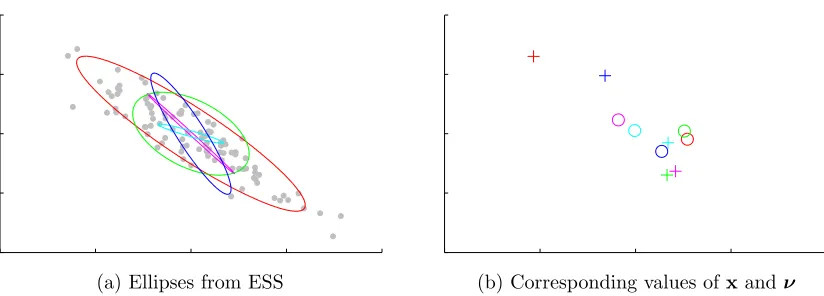
The elliptical slice sampling transition operator considers the locus of points defined by varying θ in Equation (2). This locus is an ellipse which passes through the current state xas well as through the auxiliary variable ν. Given a random ellipse induced by ν, we can slice sampleθ∈[0,2π] to choose the next point based purely on the likelihood term. The advantage of this procedure is that the ellipses will necessarily reflect the dependence induced by strong Gaussian priors and that the user does not have to choose a step size.
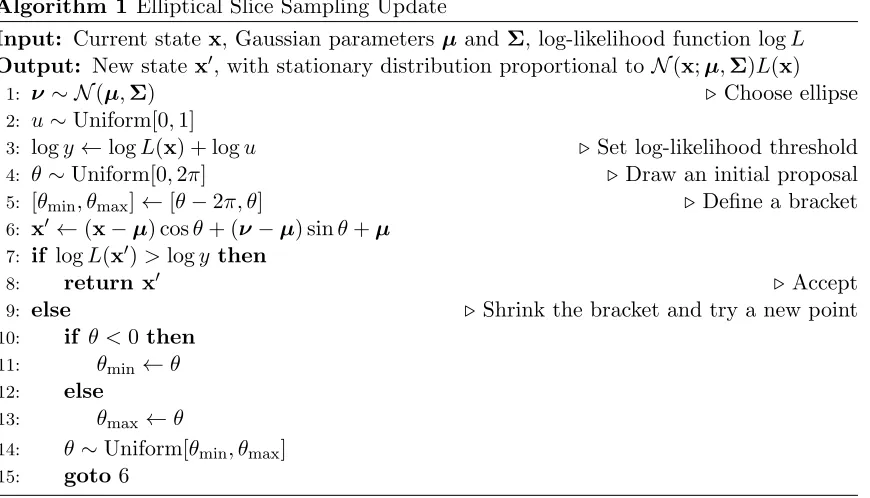
More specifically, elliptical slice sampling updates the current state xas follows. First, the auxiliary variable ν ∼ N(µ,Σ) is sampled to define an ellipse via Equation (2), and the value u ∼Uniform[0,1] is sampled to define a likelihood threshold. Then, a sequence of angles{θk}are chosen according to a slice-sampling procedure described in Algorithm 1. These angles specify a corresponding sequence of proposal points {x0k}. We update the current statexby setting it equal to the first proposal pointx0k satisfying the slice-sampling condition L(x0k) > uL(x). The proof of the validity of this algorithm is given in Murray et al. (2010). Intuitively, the pair (x,ν) is updated to a pair (x0,ν0) with the same joint prior probability, and so slice sampling only needs to compare likelihood ratios. The new point x0 is given by Equation (2), whileν0 = (ν−µ) cosθ−(x−µ) sinθ+µis never used and need not be computed.
Figure 1 depicts random ellipses produced by elliptical slice sampling superimposed on background points from some target distribution. This diagram illustrates the idea that the ellipses produced by elliptical slice sampling reflect the structure of the distribution. The full algorithm is shown in Algorithm 1.
Algorithm 1 Elliptical Slice Sampling Update
Input: Current state x, Gaussian parametersµand Σ, log-likelihood function logL Output: New statex0, with stationary distribution proportional toN(x;µ,Σ)L(x)
1: ν ∼ N(µ,Σ) .Choose ellipse
2: u∼Uniform[0,1]
3: logy←logL(x) + logu .Set log-likelihood threshold
4: θ∼Uniform[0,2π] . Draw an initial proposal
5: [θmin, θmax]←[θ−2π, θ] .Define a bracket
6: x0←(x−µ) cosθ+ (ν−µ) sinθ+µ
7: if logL(x0)>logy then
8: return x0 .Accept
9: else .Shrink the bracket and try a new point
10: if θ <0then
11: θmin←θ
12: else
13: θmax←θ
14: θ∼Uniform[θmin, θmax]
(a) Ellipses from ESS (b) Corresponding values ofxandν
Figure 1: Background points are drawn independently from a probability distribution, and five ellipses are created by elliptical slice sampling. The distribution in question is a two-dimensional multivariate Gaussian. In this example, the same distribution is used as the prior for elliptical slice sampling. (a) Shows the ellipses created by elliptical slice sampling. (b) Shows the values of x (depicted as
◦
) and ν(depicted as +) corresponding to each elliptical slice sampling update. The values ofx andν with a given color correspond to the ellipse of the same color in (a).
3. Generalized Elliptical Slice Sampling
In this section, we generalize elliptical slice sampling to handle arbitrary continuous distri-butions. We refer to this algorithm as generalized elliptical slice sampling (GESS). In this section, our target distribution will be a continuous distribution over RD with density π. In practice, π need not be normalized.
Our objective is to reframe our target distribution so that it can be efficiently sampled with elliptical slice sampling. One possible approach is to putπ in the form of Equation (1) by choosing some approximationN(µ,Σ) to π and writing
π(x) =R(x)N(x;µ,Σ),
where
R(x) = π(x)
N(x;µ,Σ)
0 200 400 600 800 1000 −4
0 4
Using approximation with variance 0.01
0 200 400 600 800 1000
−4 0 4
Using approximation with variance 0.1
0 200 400 600 800 1000
−4 0 4
Using approximation with variance 1
0 200 400 600 800 1000
−4 0 4
Using approximation with variance 10
0 200 400 600 800 1000
−4 0 4
Using approximation with variance 100
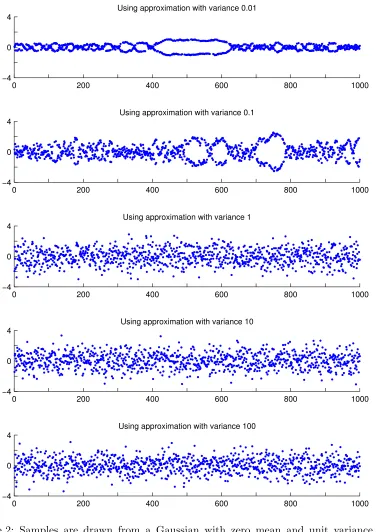
large, the Markov chain is unlikely to move back toward the origin. On the other hand, the size of the ellipse is limited by a draw from the Gaussian approximation, which has low variance in this case, so the Markov chain is also unlikely to move away from the origin. The result is that the Markov chain sometimes gets stuck. In the subplot corresponding to variance 0.01, this occurs between iterations 400 and 630.
In order to resolve this pathology and extend elliptical slice sampling to continuous distributions, we broaden the class of allowed approximations. To begin with, we express the density of the target distribution in the more general form
π(x)∝R(x)
Z
N(x;µ(s),Σ(s))φ(ds), (3)
where the integral represents a scale-location mixture of Gaussians (which serves as an approximation toπ), and whereφis a measure over the auxiliary parameters. As before,R
is the residual error of the approximation. Here,φcan be chosen in a problem-specific way, and any residual error between π and the approximation will be compensated for by R. Equation (3) is quite flexible. Below, we will choose the measure φ so as to make the approximation a multivariate t distribution, but there are many other possibilities. For instance, taking φ to be a combination of point masses will make the approximation a discrete mixture of Gaussians.
Through Equation (3), we can view π(x) as the marginal density of an augmented joint distribution over x and s. Using λ to denote the density of φ with respect to the base measure over s(this is fully general because we have control over the choice of base measure), we can write
p(x, s) =R(x)N(x;µ(s),Σ(s))λ(s).
Therefore, to sampleπ, it suffices to samplexandsjointly and then to marginalize out thes
coordinate (by simply dropping thescoordinate). We update these components alternately so as to leave invariant the distributions
p(x|s)∝R(x)N(x;µ(s),Σ(s)) (4)
and
p(s|x)∝ N(x;µ(s),Σ(s))λ(s). (5)
Equation (4) has the correct form for elliptical slice sampling and can be updated according to Algorithm 1. Equation (5) can be updated using any valid Markov transition operator.
We now focus on a particular case in which the update corresponding to Equation (5) is easy to simulate and in which we can make the tails as heavy as we desire, so as to control the behavior ofR. A simple and convenient choice is for the scale-location mixture to yield a multivariatet distribution with degrees-of-freedom parameterν:
Tν(x;µ,Σ) =
Z ∞
0
IG(s;ν2,ν2)N(x;µ, sΣ) ds,
whereλbecomes the density function of an inverse-gamma distribution:
IG(s;α, β) = β α
Γ(α)s
−α−1e−β/s
Here s is a positive real-valued scale parameter. Now, in the update p(s|x), we observe that the inverse-gamma distribution acts as a conjugate prior (whose “prior” parameters areα= ν2 and β= ν2), so
p(s|x) = IG(s;α0, β0)
with parameters
α0 = D+ν
2 and (6)
β0 = 1
2(ν+ (x−µ)
TΣ−1(x−µ)). (7)
We can draw independent samples from this distribution (Devroye, 1986).
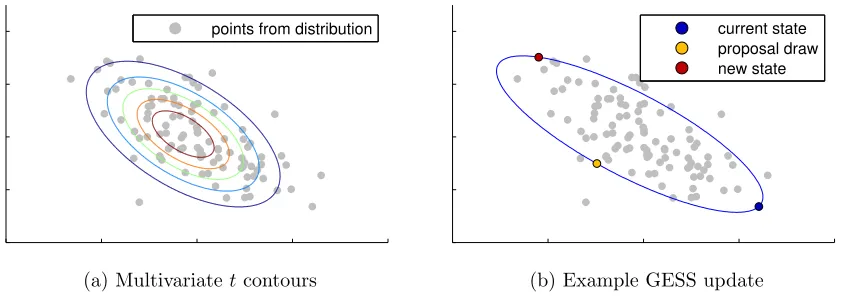
Combining these update steps, we define the transition operatorS(x→x0;ν,µ,Σ) to be the one which drawss∼IG(s;α0, β0), withα0 andβ0 as described in Equations (6) and (7), and then uses elliptical slice sampling to update xso as to leave invariant the distribution defined in Equation (4), where µ(s) = µ and Σ(s) = sΣ. From the above discussion, it follows that the stationary distribution of S(x→ x0;ν,µ,Σ) is π. Figure 3 illustrates this transition operator.
Algorithm 2 Generalized Elliptical Slice Sampling Update
Input: Current state x, multivariate t parameters ν,µ,Σ, dimension D, a routine ESS that performs an elliptical slice sampling update
Output: New statex0
1: α0 ← D2+ν
2: β0 ← 1
2(ν+ (x−µ)
TΣ−1(x−µ))
3: s∼IG(α0, β0)
4: logL←logπ−logT . T is the density of a multivariate twith parametersν,µ,Σ
5: x0←ESS(x,µ, sΣ,logL)
4. Building the Approximation with Parallelism
Up to this point, we have not described how to choose the multivariatet parameters ν,µ,
and Σ. These choices can be made in many ways. For instance, we may choose the
points from distribution
(a) Multivariatetcontours
current state proposal draw new state
(b) Example GESS update
Figure 3: The gray points were drawn independently from a two-dimensional Gaussian to show the mode and shape of the corresponding density function. (a)Shows the contours of a multivariate t approximation to this distribution. (b) Shows a sample update step using the transition operator S(x → x0;ν,µ,Σ). The blue point represents the current state. The yellow point defines an ellipse and is drawn from the Gaussian distribution corresponding to the scale s drawn from the appropriate inverse-gamma distribution. The red point corresponds to the new state and is sampled from the given ellipse.
4.1 Na¨ıve Approaches
We begin with a collection ofK parallel chains. LetX = {x1, . . . ,xK}denote the current states of the chains. We observe that X may contain a lot of information about the shape of the target distribution. We would like to define a transition operator Q(X → X0) that uses this information to intelligently choose the multivariate t parameters ν, µ, and Σ
and then uses these parameters to update each xk via generalized elliptical slice sampling. Additionally, we would like Q to have two properties. First, each xk should have the marginal stationary distribution π. Second, we should be able to parallelize the update of X overK cores.
Here we describe two simple approaches for parallelizing generalized elliptical slice sam-pling, each of which lacks one of the desired properties. The first approach begins with K
A second approach creates a valid MCMC method by including the multivariate t pa-rameters in a joint distribution
p(X, ν,µ,Σ) =p(ν,µ,Σ| X)
"K Y
k=1
π(xk)
#
. (8)
Note that in Equation (8), each xk has marginal distribution π. We can sample this joint distribution by alternately updating the variables and the multivariate t parameters so as to leave invariant the conditional distributions p(X |ν,µ,Σ) and p(ν,µ,Σ| X). Ideally, we would like to update the collectionX by updating each xkin parallel. However, we cannot easily parallelize the update in this formulation because of the factor ofp(ν,µ,Σ| X), which nontrivially couples the chains.
4.2 The Two-Group Approach
Our proposed method creates a transition operator Q that satisfies both of the desired properties. That is, eachxk has marginal distributionπ, and the update can be efficiently parallelized. This method circumvents the problems of the previous approaches by maintain-ing two groups of Markov chains and usmaintain-ing each group to choose multivariate tparameters to update the other group. LetX ={x1, . . . ,xK1}andY ={y1, . . . ,yK2}denote the states
of the Markov chains in these two groups (in practice, we set K1 =K2 = K, where K is
the number of available cores). The stationary distribution of the collection is
Π(X,Y) = Π1(X)Π2(Y) =
"K1 Y
k=1
π(xk)
# "K2 Y
k=1
π(yk)
# .
By simulating a Markov chain which leaves this product distribution invariant, this method generates samples from the target distribution. Our Markov chain is based on a transition operator, Q, defined in two parts. The first part of the transition operator, Q1, usesY to
determine parameters νY, µY, and ΣY. It then uses these parameters to update X. The second part of the transition operator,Q2, usesX to determine parametersνX,µX, andΣX. It then uses these parameters to update Y. The transition operatorQ is the composition of Q1 and Q2. The idea of maintaining a group of Markov chains and updating the states
of some Markov chains based on the states of other Markov chains has been discussed in the literature before. For example, see Zhang and Sutton (2011); Gilks et al. (1994).
In order to make these descriptions more precise, we define Q1 as follows. First, we
specify a procedure for choosing the multivariate t parameters given the population Y. We use an extension of the expectation-maximization algorithm (Liu and Rubin, 1995) to choose the maximum-likelihood multivariatetparameters given the data Y. The details of this algorithm are described in Algorithm 4 in the Appendix. More concretely, we choose
νY,µY,ΣY = arg max ν,µ,Σ
K2 Y
k=1
Tν(yk;µ,Σ).
After choosing νY, µY, and ΣY in this manner, we update X by applying the transition operator S(x → x0;νY,µY,ΣY) to each xk ∈ X in parallel. The operator Q2 is defined
Algorithm 3 Building the Approximation Using Parallelism
Input: Two groups of states X = {x1, . . . ,xK1} and Y = {y1, . . . ,yK2}, a
subrou-tine FIT-MVT which takes data and returns the maximum-likelihood t parameters,
a subroutine GESS which performs a generalized elliptical slice sampling update
Output: Updated groupsX0 and Y0
1: ν,µ,Σ←FIT-MVT(Y) 2: for all xk∈ X do
3: x0k = GESS(xk, ν,µ,Σ)
4: X0 ← {x01, . . . ,x0K
1}
5: ν,µ,Σ←FIT-MVT(X0) 6: for all yk∈ Y do
7: yk0 = GESS(yk, ν,µ,Σ)
8: Y0 ← {y01, . . . ,yK0
2}
In the case where the number of chains in the collection Y is less than or close to the dimension of the distribution, the particular algorithm that we use to choose the parameters (Liu and Rubin, 1995) may not converge quickly (or at all). Suppose we are in the setting whereK <2D. In this situation, we can perform a regularized estimate of the parameters. We describe this procedure below. The choiceK <2D probably overestimates the regime in which the algorithm for fitting the parameters performs poorly. The particular algorithm that we use appears to work well as long asK ≥D.
Let ¯y be the mean of Y, and let {v1, . . . ,vJ} be the first J principal components of the set {y1 −y¯, . . . ,yK −y¯}, where J = bK2c, and let V = span(v1, . . . ,vJ). Let A be the D×J matrix defined by Aej = vj, where ej is the jth standard basis vector in RJ. This map identifiesRJ withV.
Let the set ˆY consist of the projections of the elements of Y onto RJ by ˆyk =ATyk. Using the algorithm from Liu and Rubin (1995), fit the multivariate t parameters νYˆ,µYˆ
and, ΣYˆ to ˆY. At this point, we have constructed a J-dimensional multivariate t
distri-bution, but we would like a D-dimensional one. We construct the desired distribution by rotating back to the original space. Concretely, we can set
νY = νYˆ
µY = AµYˆ + ¯y
ΣY = A ΣYˆAT+ID,
whereID is theD×Didentity matrix andis the median entry on the diagonal ofΣYˆ. We
add a scaled identity matrix to the covariance parameter to avoid producing a degenerate distribution. The choice ofis based on intuition about typical values of the variance of π
in the directions orthogonal to V.
seems to work in practice. Since our default choice (if there are at least 2D chains, then choose the maximum-likelihood parameters, otherwise project to a lower dimension, choose the maximum-likelihood parameters, and then pad the diagonal of the covariance param-eter) works well, the fact that one could design a more sophisticated procedure does not compromise the tuning-free nature of our algorithm.
4.3 Correctness
To establish the correctness of our algorithm, we treat the collection of chains as a single aggregate Markov chain, and we show that this aggregate Markov chain with transition operatorQcorrectly samples from the product distribution Π.
We wish to show thatQ1 andQ2 preserve the invariant distributions Π1 and Π2
respec-tively. As the two cases are identical, we consider only the first. We have
Z
Π1(X)Q1(X → X0) dX =
Z
Π1(X)Q1(X → X0|νY,µY,ΣY) dX
= K1 Y
k=1
Z
π(xk)S(xk→xk0;νY,µY,ΣY) dxk
= Π1(X0).
The last equality uses the fact thatπis the stationary distribution ofS(x→x0;νY,µY,ΣY), so we see thatQleaves the desired product distribution invariant.
Within a single chain, elliptical slice sampling has a nonzero probability of transitioning to any region that has nonzero probability under the posterior, as described by Murray et al. (2010). The transition operator Q updates the chains in a given group independently of one another. ThereforeQhas a nonzero probability of transitioning to any region that has nonzero probability under the product distribution. It follows that the transition operator is both irreducible and aperiodic. These conditions together ensure that this Markov transition operator has a unique invariant distribution, namely Π, and that the distribution over the state of the Markov chain created from this transition operator will converge to this invariant distribution (Roberts and Rosenthal, 2004). It follows that, in the limit, samples derived from the repeated application of Qwill be drawn from the desired distribution.
4.4 Cost and Complexity
There is a cost to the construction of the multivariate tapproximation. Although the user has some flexibility in the choice of t parameters, we fit them with the iterative algorithm
described by Liu and Rubin (1995) and in Algorithm 4 of the Appendix. Let D be the
dimension of the distribution and let K be the number of parallel chains. Then the com-plexity of each iteration is O(D3K), which comes from the fact that we invert a D×D
An additional concern is the overhead from sharing information between chains. The chains must communicate in order to build a multivariate t approximation, and so the updates must be synchronized. Since elliptical slice sampling requires a variable amount of time, updating the different chains will take different amounts of time, and the faster chains may end up waiting for the slower ones. We can mitigate this cost by performing multiple updates between such periods of information sharing. In this manner, we can perform as much computation as we want between synchronizations without compromising the validity of the algorithm. As we increase the number of updates performed between synchronizations, the fraction of time spent waiting will diminish.
The time measured in our experiments is wall-clock time, which includes the overhead from constructing the approximation and from synchronizing the chains.
4.5 Reusing the Approximation
Here we explain that reusing the same approximation is valid. To illustrate this point, let the transition operators Q1 and Q2 be defined as before. In our description of the algorithm,
we defined the transition operator Q as the composition Q=Q2Q1. However, both Q1
andQ2 preserve the desired product distribution, so we may use any transition operator of
the formQ=Qr2
2 Q
r1
1 , where this notation indicates that we first applyQ1forr1rounds and
then we apply Q2 for r2 rounds. As long as r2, r1 ≥1, the composite transition operator
is ergodic. When we apply Q1 multiple times in a row, the states Y do not change, so
ifQ1 computesνY,µY, andΣY deterministically fromY, then we need only compute these values once. Reusing the approximation works even if Q1 samples νY, µY, and ΣY from some distribution. In this case, we can model the randomness by introducing a separate variablerY in the Markov chain, and lettingQ1 computeνY,µY, andΣY deterministically from Y and rY.
Our algorithm maintains two collections of Markov chains, one of which will always be idle. Therefore, each collection can take advantage of all available cores. GivenK cores, it makes sense to use two collections ofK Markov chains. In general, it seems to be a good idea to sample equally from both collections so that the chains in both collections burn in.
10 100 1000 10000 0
500 1000 1500 2000
Number of repeats
reuse for 10 reuse for 100 reuse for 1000 reuse for 10000
(a) Durations of GESS (seconds)
0 2000 4000 6000 8000 10000
0 20 40 60 80 100 120 140
Number of iterations
(b) Plots of tr(Σ)
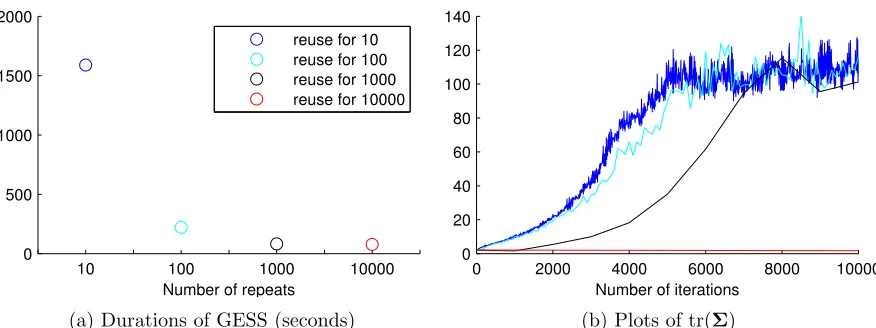
Figure 4: We used GESS to sample a multivariate Gaussian distribution in 100 dimensions for 104 iterations. We repeated this procedure four times, reusing the approxima-tion for 101, 102, 103, and 104 iterations. (a) Shows the durations (in seconds) of the sampling procedures as we varied the number of iterations for which we reused the approximation. (b) Shows how tr(Σ) changes over time in the four different settings.
5. Related Work
Our work uses updates on a product distribution in the style of Adaptive Direction Sampling (Gilks et al., 1994), which has inspired a large literature of related methods. The closest research to our work makes use of slice-sampling based updates of product distributions along straight-line directions chosen by sampling pairs of points (MacKay, 2003; Ter Braak, 2006). The work on elliptical slice sampling suggests that in high dimensions larger steps can be taken along curved trajectories, given an appropriate Gaussian fit. Using closed ellipses also removes the need to set an initial step size or to build a bracket.
The recent affine invariant ensemble sampler (Goodman and Weare, 2010) also uses Gaussian fits to a population, in that case to make Metropolis proposals. Our work differs by using a scale-mixture of Gaussians and elliptical slice sampling to perform updates on a variety of scales with self-adjusting step-sizes. Rather than updating each member of the population in sequence, our approach splits the population into two groups and allows the members of each group to be updated in parallel.
Population MCMC with parallel tempering (Friel and Pettitt, 2008) is another parallel sampling approach that involves sampling from a product distribution. It uses separate chains to sample a sequence of distributions interpolating between the target distribution and a simpler distribution. The different chains regularly swap states to encourage mixing. In this setting, samples are generated only from a single chain, and all of the others are auxiliary. However, some tasks such as computing model evidence can make use of samples from all of the chains (Friel and Pettitt, 2008).
stack supporting automatic differentiation is under development (Stan Development Team, 2012). We feel that this alternative line of work demonstrates the interest in more practical MCMC algorithms applicable to a variety of continuous-valued parameter spaces and is very promising. Our complementary approach introduces simpler algorithms with fewer technical software requirements. In addition, our two-population approach to parallelization could be applied with whichever methods become dominant in the future.
6. Experiments
In this section, we compare Algorithm 3 with other parallel MCMC algorithms by mea-suring how quickly the Markov chains mix on a number of different distributions. Second, we compare how the performance of Algorithm 3 scales with the dimension of the target distribution, the number of cores used, and the number of chains used per core.
These experiments were run on an EC2 cluster with 5 nodes, each with two eight-core Intel Xeon E5-2670 CPUs. We implement all algorithms in Python, using the IPython environment (P´erez and Granger, 2007) for parallelism.
6.1 Comparing Mixing
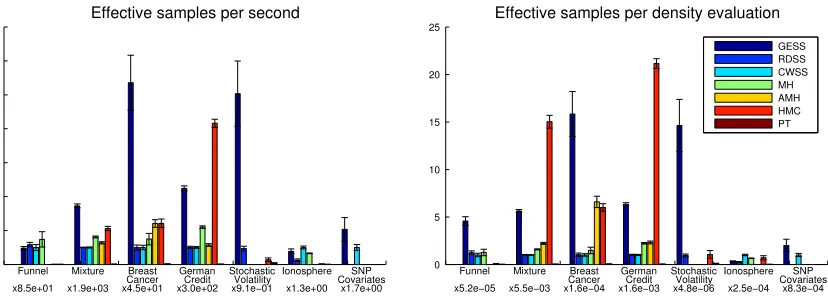
We empirically compare the mixing of the parallel MCMC samplers on seven distributions. We quantify their mixing by comparing the effective number of samples produced by each method. This quantity can be approximated as the product of the number of chains with the effective number of samples from the product distribution. We estimate the effective number of samples from the product distribution by computing the effective number of samples from its sequence of log likelihoods. We compute effective sample size using R-CODA (Plummer et al., 2006), and we compare the results using two metrics: effective samples per second and effective samples per density function evaluation (in the case of Hamiltonian Monte Carlo, we count gradient evaluations as density function evaluations).
In each experiment, we run each algorithm with 100 parallel chains. Unless otherwise noted, we burn in for 104 iterations and sample for 105 iterations. We run five trials for each experiment to estimate variability.
Figure 5 shows the average effective number of samples, with error bars, according to the two different metrics. Bars are omitted where the sequence of aggregate log likelihoods did not converge according to the Geweke convergence diagnostic (Geweke, 1992). We diagnose this using the tool from R-CODA (Plummer et al., 2006).
6.1.1 Samplers Considered
We compare generalized elliptical slice sampling (GESS) with parallel versions of several different sampling algorithms.
First, we consider random-direction slice sampling (RDSS) (MacKay, 2003) and coordinate-wise slice sampling (CWSS) (Neal, 2003). These are variants of slice sampling which differ in their choice of direction (a random direction versus a random axis-aligned direction) in which to sample. RDSS is rotation invariant like GESS, but CWSS is not.
A tuning period is used to adjust the MH step size so that the acceptance ratio is as close as possible to the value 0.234, which is optimal in some settings (Roberts and Rosenthal, 1998). This tuning is done independently for each chain. We also compare to an adaptive MCMC (AMH) algorithm following the approach in Roberts and Rosenthal (2006) in which the covariance of a Metropolis–Hastings proposal is adapted to the history of the “Markov” chain.
We also compare to the No-U-Turn sampler (Hoffman and Gelman, 2014), which is an implementation of Hamiltonian Monte Carlo (HMC) combined with procedures to auto-matically tune the step size parameter and the number of steps parameter. Due to the large number of function evaluations per sample required by HMC, we run HMC for a factor of 10 or 100 fewer iterations in order to make the algorithms roughly comparable in terms of wall-clock time. Though we include the comparisons, we do not view HMC as a perfectly comparable algorithm due to its requirement that the density function of the target distribution be differentiable. Though the target distribution is often differentiable in principle, there are many practical situations in which the gradient is difficult to access, either by manual computation or by automatic differentiation, possibly because evaluating the density function requires running a complicated black-box subroutine. For instance, in computer vision problems, evaluating the likelihood function may require rendering an image or running graph cuts. See Tarlow and Adams (2012) or Lang and Hogg (2012) for examples.
We compare to parallel tempering (PT) (Friel and Pettitt, 2008), using each Markov chain to sample the distribution at a different temperature (if the target distribution has densityπ(x), then the distribution “at temperaturet” has density proportional toπ(x)1/t) and swapping states between the Markov chains at regular intervals. Samples from the target distribution are produced by only one of the chains. Using PT requires the practi-tioner to pick a temperature schedule, and doing so often requires a significant amount of experimentation (Neal, 2001). We follow the practice of Friel and Pettitt (2008) and use a geometric temperature schedule. As with HMC, we do not view PT as entirely compara-ble in the absence of an automatic and principled way to choose the temperatures of the different Markov chains. One of the main goals of GESS is to provide a black-box MCMC algorithm that imposes as few restrictions on the target distribution as possible and that requires no expertise or experimentation on the part of the user.
6.1.2 Distributions
In this section, we describe the different distributions that we use to compare the mixing of our samplers.
Funnel: A ten-dimensional funnel-shaped distribution described in Neal (2003). The first coordinate is distributed normally with mean zero and variance nine. Conditioned on the first coordinatev, the remaining coordinates are independent identically-distributed normal random variables with mean zero and varianceev. In this experiment, we initialize each Markov chain from a spherical multivariate Gaussian centered on the origin.
uniformly at random within a hypercube of edge length four. In this experiment, we initialize each Markov chain from a spherical multivariate Gaussian centered on the origin.
Breast Cancer: The posterior density of a linear logistic regression model for a binary classification problem with thirty explanatory variables (thirty-one dimensions) using the Breast Cancer Wisconsin data set (Street et al., 1993). The data set consists of 569 data points. We scale the data so that each coordinate has unit variance, and we place zero-mean Gaussian priors with variance 100 on each of the regression coefficients. In this experiment, we initialize each Markov chain from a spherical multivariate Gaussian centered on the origin.
German Credit: The posterior density of a linear logistic regression model for a binary classification problem with twenty-four explanatory variables (twenty-five dimensions) from the UCI repository (Frank and Asuncion, 2010). The data set consists of 1000 data points. We scale the data so that each coordinate has unit variance, and we place zero-mean Gaus-sian priors with variance 100 on each of the regression coefficients. In this experiment, we initialize each Markov chain from a spherical multivariate Gaussian centered on the origin.
Stochastic Volatility: The posterior density of a simple stochastic volatility model fit to synthetic data in fifty-one dimensions. This distribution is a smaller version of a distribution described in Hoffman and Gelman (2014). In this experiment, we burn-in for 105 iterations
and sample for 105iterations. We initialize each Markov chain from a spherical multivariate Gaussian centered on the origin and we take the absolute value of the first parameter, which is constrained to be positive.
Ionosphere: The posterior density on covariance hyperparameters for Gaussian process regression applied to the Ionosphere data set (Sigillito et al., 1989). We use a squared expo-nential kernel with thirty-four length-scale hyperparameters and 100 data points. We place exponential priors with rate 0.1 on the length-scale hyperparameters. In this experiment, we burn-in for 104iterations and sample for 104 iterations. We initialize each Markov chain from a spherical multivariate Gaussian centered on the vector (1, . . . ,1)T.
SNP Covariates: The posterior density of the parameters of a generative model for gene expression levels simulated in thirty-eight dimensions using actual genomic sequences from 480 individuals for covariate data (Engelhardt and Adams, 2014). In this experiment, we burn-in for 2000 iterations and sample for 104iterations. We initialize each Markov chain from a spherical multivariate Gaussian centered on the origin and we take the absolute value of the first three parameters, which are constrained to be positive.
6.1.3 Mixing Results
0 2 4 6 8 10 12
14 Effective samples per second
x8.5e+01 x1.9e+03 x4.5e+01 x3.0e+02 x9.1e−01 x1.3e+00 x1.7e+00 Funnel Mixture Breast German Stochastic Ionosphere SNP
Cancer Credit Volatility Covariates
0 5 10 15 20
25 Effective samples per density evaluation GESS RDSS CWSS MH AMH HMC PT
x5.2e−05 x5.5e−03 x1.6e−04 x1.6e−03 x4.8e−06 x2.5e−04 x8.3e−04 Funnel Mixture Breast German Stochastic Ionosphere SNP
Cancer Credit Volatility Covariates
Figure 5: The results of experimental comparisons of seven parallel MCMC methods on seven distributions. Each figure shows seven groups of bars, (one for each distri-bution) and the vertical axis shows the effective number of samples per unit cost. Error bars are included. Bars are omitted where the method failed to converge according to the Geweke diagnostic (Geweke, 1992). The costs are per second
(left) andper density function evaluation (right). Mean and standard error for five runs are shown. Each group of bars has been rescaled for readability: the number beneath each group gives the effective samples corresponding to CWSS, which always has height one.
One reason for the rapid mixing of GESS is that GESS performs well even on highly-skewed distributions. RDSS, CWSS, MH, and PT propose steps in uninformed directions, the vast majority of which lead away from the region of high density. As a result, these algorithms take very small steps, causing successive states to be highly correlated. In the case of GESS, the multivariate t approximation builds information about the global shape of the distribution (including skew) into the transition operator. As a consequence, the Markov chain can take long steps along the length of the distribution, allowing the Markov chain to mix much more rapidly. Skewed distributions can arise as a result of the user not knowing the relative length scales of the parameters or as a result of redundancy in the parameterization. Therefore, the ability to perform well on such distributions is frequently relevant.
These results show that a multivariate tapproximation to the target distribution pro-vides enough information to greatly speed up the mixing of the sampler and that this information can be used to improve the convergence of the sampler. These improvements occur on top of the performance gain from using parallelism.
6.2 Scaling the Number of Cores
D= 50 K =C K = 2C K = 3C K = 4C K = 5C C= 20 10−0.5±10−0.4 10−1.2±10−1.5 10−1.5±10−1.8 10−1.7±10−1.8 10−1.6±10−1.6 C= 40 10−0.8±10−0.9 10−2.6±10−2.6 10−1.9±10−1.9 10−1.8±10−1.8 10−2.4±10−2.6 C= 60 10−1.6±10−1.5 10−1.6±10−1.7 10−2.1±10−2.2 10−2.1±10−2.2 10−2.2±10−2.4 C= 80 10−1.3±10−1.1 10−2.4±10−2.8 10−2.4±10−2.4 10−2.1±10−2.4 10−2.3±10−2.5 C= 100 10−1.6±10−1.7 10−1.7±10−1.7 10−2.0±10−2.0 10−2.2±10−2.4 10−2.5±10−2.3
D= 100 K =C K = 2C K = 3C K = 4C K = 5C
C= 20 10+0.3±10+0.2 10−1.3±10−2.2 10−1.7±10−2.1 10−1.9±10−2.2 10−2.4±10−3.5 C= 40 10−1.1±10−1.1 10−1.9±10−2.1 10−2.5±10−3.2 10−2.5±10−2.6 10−2.7±10−3.0 C= 60 10−1.7±10−2.0 10−2.5±10−2.8 10−2.8±10−3.0 10−2.9±10−3.4 10−2.9±10−3.1 C= 80 10−2.1±10−2.7 10−2.7±10−2.8 10−2.7±10−3.0 10−2.9±10−3.2 10−3.1±10−4.0 C= 100 10−2.4±10−2.6 10−2.8±10−3.3 10−3.0±10−3.5 10−3.0±10−3.6 10−2.9±10−3.0
D= 150 K =C K = 2C K = 3C K = 4C K = 5C
C= 20 10+2.3±10+1.4 10+2.3±10+1.7 10+1.4±10+1.0 10+0.5±10+0.2 10−0.7±10−1.0 C= 40 10+2.1±10+1.6 10−0.1±10−0.0 10−1.1±10−1.2 10−1.4±10−1.4 10−1.8±10−1.7 C= 60 10+1.3±10+0.7 10−1.2±10−1.2 10−1.6±10−1.5 10−1.9±10−2.0 10−1.7±10−1.6 C= 80 10−0.0±10−0.0 10−1.7±10−1.8 10−2.2±10−2.3 10−1.9±10−2.0 10−2.1±10−2.6 C= 100 10−0.7±10−1.0 10−1.8±10−2.1 10−1.9±10−2.1 10−2.0±10−2.1 10−2.3±10−2.3
D= 200 K =C K = 2C K = 3C K = 4C K = 5C
C= 20 10+2.8±10+2.5 10+3.0±10+2.4 10+3.1±10+2.1 10+3.1±10+1.9 10+3.0±10+1.5
C= 40 10+3.1±10+1.6 10+3.1±10+1.7 10+2.7±10+1.6 10+1.1±10+0.6 10−1.4±10−1.6 C= 60 10+3.1±10+1.6 10+2.6±10+1.8 10−0.6±10−0.8 10−1.7±10−2.0 10−2.0±10−2.8 C= 80 10+3.1±10+1.7 10+0.7±10+0.1 10−1.7±10−2.3 10−1.9±10−1.9 10−2.1±10−2.5 C= 100 10+3.0±10+2.1 10−1.4±10−1.6 10−2.3±10−2.8 10−2.0±10−2.6 10−2.3±10−2.9
D= 250 K =C K = 2C K = 3C K = 4C K = 5C
C= 20 10+3.5±10+2.0 10+3.5±10+1.5 10+3.5±10+1.7 10+3.5±10+1.4 10+3.5±10+1.6 C= 40 10+3.5±10+2.3 10+3.5±10+1.3 10+3.5±10+1.6 10+3.5±10+2.1 10+3.6±10+1.8 C= 60 10+3.5±10+2.0 10+3.5±10+1.6 10+3.6±10+2.1 10+3.6±10+2.4 10+2.3±10+1.9 C= 80 10+3.5±10+1.6 10+3.5±10+1.9 10+3.5±10+2.2 10+1.1±10+0.8 10−0.8±10−0.9 C= 100 10+3.5±10+1.8 10+3.6±10+2.0 10+2.2±10+1.7 10+0.3±10+0.2 10−0.1±10−0.2
experiment, we consider all 125 triples (D, C, K) such that
D ∈ {50,100,150,200,250}
C ∈ {20,40,60,80,100}
K ∈ {C,2C,3C,4C,5C}.
It makes sense to let K be an integer multiple of C so that each core will be tasked with updating the same number of chains (the experiments in Section 6.1 set K equal to C).
For each triple (D, C, K), we sample aD-dimensional multivariate Gaussian distribution centered on the origin whose precision matrix was generated from a Wishart distribution with identity scale matrix andDdegrees of freedom. The distributions used in this experi-ment were modeled off of one of the distributions considered in Hoffman and Gelman (2014). We initialize GESS from a broad spherical Gaussian distribution centered on the origin, and we run GESS for 500 seconds. The first half of the resulting samples are discarded, and the second half of the resulting samples are used to estimate the vector σ = (σ1, . . . , σD), whereσdis the marginal standard deviation of thedth coordinate. For each triple (D, C, K), we run five trials. Figure 6 shows the resulting average squared error in the empirical esti-mate of σ after 500 seconds. Error bars are included as well.
When aggregating samples from K independent Markov chains, we would expect the
squared error of our estimator to decrease at the rate 1/K. However, in the setting of GESS, additional chains not only provide additional samples, but may enable the construction of a more accurate approximation to the target distribution thereby enabling the other chains to sample more effectively. In some situations, the presence of additional chains can even enable the sampler to converge in situations where it otherwise would not.
We can see this effect in Figure 6. Singling out the column corresponding to D= 200 andK = 3C, we notice that using either 20 or 40 cores, GESS fails to estimateσ, indeed the Markov chain fails to burn in during the allotted time (the average squared errors are 103.1 and 102.7 respectively). However, once we increase the number of cores to 60, 80, and 100,
GESS provides an accurate estimate of σ (the average squared errors are 10−0.6, 10−1.7, and 10−2.3 respectively). In this case, increasing the number of cores enabled our estima-tor to converge. This property contrasts sharply with many other approaches to parallel sampling. If a single Markov chain running MH will not converge, then one-hundred chains running MH will not converge either.
7. Discussion
In this paper, we generalized elliptical slice sampling to handle arbitrary continuous dis-tributions using a scale mixture of Gaussians to approximate the target distribution. We then showed that parallelism can be used to dynamically choose the parameters of the scale mixture of Gaussians in a way that encodes information about the shape of the target dis-tribution in the transition operator. The result is Markov chain Monte Carlo algorithm with a number of desirable properties. In particular, it mixes well in the presence of strong dependence, it does not require hand tuning, and it can be parallelized over hundreds of cores.
than the other algorithms on a variety of distributions, and we found evidence that the performance of GESS can scale superlinearly in the number of available cores.
One possible area of future work is reducing the overhead from the information sharing. In Section 4.5 we remarked that the synchronization requirement leads to faster chains waiting for slower chains. There are a number of factors which contribute to the difference
in speed from chain to chain. Most obviously, some chains may be running on faster
machines. More subtly, the slice sampling procedure performs a variable number of function evaluations per update, and the average number of required updates may be a function of location. For instance, Markov chains whose current states lie in narrow portions of the distribution may require more function evaluations per update. In each situation, the chains with the rapid updates end up waiting for the chains with the slower updates, leaving some processors idle. We imagine that a cleverly-engineered system would be able to account for the potentially different update speeds, perhaps by sending the chains in the narrower parts of the distribution to the faster machines or by allowing the slower chains to spawn multiple threads. Properly done, the performance gain in wall-clock time due to using GESS should approach the gain as measured by function evaluations.
In addition to using parallelism to distribute the computational load of MCMC, we saw that our algorithm was able to use information from the parallel chains to speed up mixing. One area of future work is extending the algorithm to take advantage of a greater number of cores. The magnitude of this performance gain depends on the accuracy of our multivariatetapproximation, which will increase, to a point, as the number of available cores grows. However, there is a limit to how well a multivariate tdistribution can approximate an arbitrary distribution. We chose to use the multivariate t distribution because it has the flexibility to capture the general allocation of probability mass of a given distribution, but it is too coarse to capture more complex features such as the locations of multiple modes. After some point, the approximation will not significantly improve. A more general approach would be to use a scale-location mixture of Gaussians, which could accurately approximate a much larger class of distributions. The idea of approximating the target distribution with a mixture of Gaussians has been explored by Ji and Schmidler (2010) in the context of adaptive Metropolis–Hastings. We leave it to future work to explore this more general setting.
Acknowledgments
We thank Barbara Engelhardt for kindly sharing the simulated genetics data. We thank Eddie Kohler, Michael Gelbart, and Oren Rippel for valuable discussions. This work was funded by DARPA Young Faculty Award N66001-12-1-4219 and an Amazon AWS in Re-search grant.
Appendix A
Algorithm 4 Computing the maximum likelihood multivariatetparameters
Input: I pointsxi (eachDdimensional)
Output: Maximum likelihood multivariatetparameters ν,µ,Σ
1: t←0
2: Initialize ν(0),µ(0), and Σ(0)
3: while|ν(t)−ν(t−1)|< do
4: Compute the distances from each point xi toµ(t) with respect toΣ(t)
δi(t) =xi−µ(t)
T
Σ(t)−1xi−µ(t)
5: Set
wi(t+1) = ν
(t)+D
ν(t)+δ(t)
i
6: Update the mean and covariance parameters via
µ(t+1) =
PI
i=1w (t+1)
i xi
PI
i=1w (t+1)
i
Σ(t+1) = 1
I
I
X
i=1
wi(t+1)
xi−µ(t) xi−µ(t)
T
7: Using the updated mean and covariance parameters, recompute the distance
δ(it+1)=
xi−µ(t+1)
T
Σ(t+1) −1
xi−µ(t+1)
8: Let ψbe the digamma function, and let
wi =
ν+D
ν+δi(t+1)
9: Set ν(t+1) by solving forν in the equation
−ψν
2
+ logν 2 +1 I I X i=1
(log (wi)−wi) +ψ
ν+D
2
−log
ν+D
2
=−1
10: t←t+ 1
References
Ryan P. Adams, Iain Murray, and David MacKay. The Gaussian process density sampler. In Advances in Neural Information Processing Systems 21, 2009.
Christophe Andrieu, Nando de Freitas, Arnaud Doucet, and Michael I. Jordan. Introduction to MCMC for machine learning. Machine Learning, 50(1):5–43, 2003.
Russell Bradford and Alun Thomas. Markov chain Monte Carlo methods for family trees using a parallel processor. Statistics and Computing, 6:67–75, 1996.
Steve Brooks, Andrew Gelman, Galin Jones, and Xiao-Li Meng, editors. Handbook of
Markov Chain Monte Carlo. Chapman and Hall/CRC, 2011.
Luc Devroye. Non-Uniform Random Variate Generation. Springer, 1986.
Simon Duane, A.D. Kennedy, Brian J. Pendleton, and Duncan Roweth. Hybrid Monte Carlo. Physics Letters B, 195:216–222, 1987.
Barbara E. Engelhardt and Ryan P. Adams. Bayesian structured sparsity from Gaussian fields. 2014. In Preparation.
Andrew Frank and Arthur Asuncion. UCI machine learning repository, 2010. URL http:
//archive.ics.uci.edu/ml.
Nial Friel and Anthony N. Pettitt. Marginal likelihood estimation via power posteriors.
Journal of the Royal Statistical Society B, 70(3):589–607, 2008.
Stuart Geman and Donald Geman. Stochastic relaxation, Gibbs distributions, and the
Bayesian restoration of images. IEEE Transactions on Pattern Analysis and Machine
Intelligence, 6:721–741, 1984.
John Geweke. Evaluating the accuracy of sampling-based approaches to the calculation of posterior moments. Bayesian Statistics, 4:169–193, 1992.
Walter R. Gilks, Gareth O. Roberts, and Edward I. George. Adaptive direction sampling.
The Statistician, 43(1):179–189, 1994.
Mark Girolami and Ben Calderhead. Riemann manifold Langevin and Hamiltonian Monte Carlo. Journal of the Royal Statistical Society B, 73:1–37, 2011.
Jonathan Goodman and Jonathan Weare. Ensemble samplers with affine invariance.
Com-munications in Applied Mathematics and Computational Science, 5(1):65–80, 2010.
Heikki Haario, Eero Saksman, and Johanna Tamminen. Componentwise adaptation for high dimensional MCMC. Computational Statistics, 20:265–273, 2005.
W. K. Hastings. Monte Carlo sampling methods using Markov chains and their applications.
Matthew D. Hoffman and Andrew Gelman. The no-U-turn sampler: Adaptively setting path lengths in Hamiltonian Monte Carlo. Journal of Machine Learning Research, 15: 1351–1381, 2014.
Chunlin Ji and Scott C. Schmidler. Adaptive Markov chain Monte Carlo for Bayesian variable selection. Journal of Computational and Graphical Statistics, 2010. To Appear.
Dustin Lang and David W. Hogg. Searching for comets on the World Wide Web: The orbit of 17P/Holmes from the behavior of photographers. The Astronomical Journal, 144(2), 2012.
Chuanhai Liu and Donald B. Rubin. ML estimation of the t distribution using EM and its extensions, ECM and ECME. Statistica Sinica, 5:19–39, 1995.
Jun S. Liu, Faming Liang, and Wing Hung Wong. The multiple-try method and local optimization in Metropolis sampling. Journal of the American Statistical Association, 95:121–134, 2000.
David MacKay. Information Theory, Inference, and Learning Algorithms. Cambridge Uni-versity Press, 2003.
Nicholas Metropolis, Arianna W. Rosenbluth, Marshall N. Rosenbluth, Augusta H. Teller, and Edward Teller. Equation of state calculations by fast computing machines. Journal of Chemical Physics, 21:1087–1092, 1953.
Iain Murray, Ryan P. Adams, and David MacKay. Elliptical slice sampling. Journal of
Machine Learning Research: W&CP, 9:541–548, 2010.
Radford M. Neal. Suppressing random walks in Markov chain Monte Carlo using ordered overrelaxation. Technical Report 9508, Department of Statistics and Department of Com-puter Science, University of Toronto, 1995.
Radford M. Neal. Regression and classification using Gaussian process priors. Bayesian Statistics, 6:475–501, 1998.
Radford M. Neal. Annealed importance sampling.Statistics and Computing, 11(2):125–139, 2001.
Radford M. Neal. Slice sampling. The Annals of Statistics, 31(3):705–767, 2003.
Radford M. Neal. MCMC using Hamiltonian dynamics. In Handbook of Markov Chain
Monte Carlo, pages 113–162. Chapman & Hall/CRC, 2011.
Fernando P´erez and Brian E. Granger. IPython: a System for Interactive Scientific
Computing. Computing in Science and Engineering, 9(3):21–29, May 2007. URL
http://ipython.org.
Martyn Plummer, Nicky Best, Kate Cowles, and Karen Vines. CODA: Convergence
diagnosis and output analysis for MCMC. R News, 6(1):7–11, 2006. URL http:
Pradeep Ravikumar, Martin J. Wainwright, Garvesh Raskutti, and Bin Yu. High-dimensional covariance estimation by minimizing `1-penalized log-determinant
diver-gence. Electronic Journal of Statistics, 5:935–980, 2011.
Gareth O. Roberts and Jeffrey S. Rosenthal. Markov chain Monte Carlo: Some practical implications of theoretical results. Canadian Journal of Statistics, 26:5–31, 1998.
Gareth O. Roberts and Jeffrey S. Rosenthal. General state space Markov chains and MCMC algorithms. Probability Surveys, 1:20–71, 2004.
Gareth O. Roberts and Jeffrey S. Rosenthal. Examples of adaptive MCMC. Technical report, Department of Statistics, University of Toronto, 2006.
Jeffrey S. Rosenthal. Parallel computing and Monte Carlo algorithms. Far East Journal of Theoretical Statistics, 4:207–236, 2000.
Vince G. Sigillito, Simon P. Wing, Larrie V. Hutton, and K. B. Baker. Classification of radar returns from the ionosphere using neural networks. Johns Hopkins APL Technical Digest, 10:262–266, 1989.
Stan Development Team. Stan: A C++ library for probability and sampling, version 1.0,
2012. URL http://mc-stan.org/.
William Nick Street, William H. Wolberg, and Olvi L. Mangasarian. Nuclear feature ex-traction for breast tumor diagnosis. In IS&T/SPIE 1993 International Symposium on Electronic Imaging: Science and Technology, volume 1905, pages 861–870, 1993.
Marc A. Suchard, Quanli Wang, Cliburn Chan, Jacob Frelinger, Andrew Cron, and Mike West. Understanding GPU programming for statistical computation: Studies in massively parallel massive mixtures.Journal of Computational and Graphical Statistics, 19:419–438, 2010.
Daniel Tarlow and Ryan P. Adams. Revisiting uncertainty in graph cut solutions. InThe 25th IEEE Conference on Computer Vision and Pattern Recognition, 2012.
Daniel Tarlow, Ryan P. Adams, and Richard Zemel. Randomized optimum models for structured prediction. In The 15th International Conference on Artificial Intelligence and Statistics, 2012.
Cajo J. F. Ter Braak. A Markov chain Monte Carlo version of the genetic algorithm
differential evolution: easy Bayesian computing for real parameter spaces. Statistical Computing, 16:239–249, 2006.
Luke Tierney. Markov chains for exploring posterior distributions. Annals of Statistics, 22 (4):1701–1728, 1994.