LOW CARBON EMISSION BUILDINGS IN MAURITIUS
Jaylina Rana,
Faculty of Engineering, University of Mauritius, Reduit, Mauritius.
Reshma Rughooputh,
Faculty of Engineering, University of Mauritius, Reduit, Mauritius.
ABSTRACT
A low carbon building can be defined as one where there are low net carbon emissions from all energy used. The Mauritian architecture comprises of very few low carbon emission building. The only well-known sustainable building is that of the Mauritius Commercial Bank located at Ebene in Mauritius. However, it has a carbon footprint due to the use of concrete as building material. According to a study of the market of cement in Mauritius by the Competition Commission of Mauritius (C.C.M., 2010), around 65% of the cement annually used goes into the construction of houses. Low-carbon emission buildings represent far more of a drastic change for Mauritius. The aims of this paper are to analyse the barriers to implementing low-carbon emission buildings in the Mauritius and produce a list of recommendations towards the implementation of low carbon buildings in Mauritius. The objective includes a questionnaire survey and an analysis of the implications of low carbon emission buildings as these pave the way towards the future.
Keywords: Low carbon, sustainability, Mauritius, carbon emission, buildings, questionnaires
1 Introduction
Low-carbon buildings (LCB) are specifically buildings which are designed with a view on the
reduction of Green House Gases (GHG); and can be defined as a building which emits significantly
less GHG than traditional buildings both in the construction and operation stage. Hence, during
construction, all the energy used for materials manufacturing, transport and waste should be
consumption, heating systems, waste water treatment and solid waste treatment should be
reduced and replaced by renewable energy sources.
Low carbon emission buildings offer many benefits as compared to traditional buildings.
People benefit from environmental improvements not only for aesthetic and health reasons, but
also as tax payers. For example, reducing water, energy, and materials use and siting buildings
close to public transportation reduce the demand for costly expansions of infrastructure- like water
treatment plants, utilities, landfills, and roads. On an even broader societal level, low carbon
building can enhance national security, by reducing a country‟s dependence for instance, on fossil
fuel imports. Beyond these important benefits to the whole society, low carbon buildings offer
benefits for design team members, contractors, occupants of the building, construction workers on
the project, developers, and owners. These benefits include: (1) Improved health, comfort, and
productivity/ performance of occupants and construction workers as well as related savings; (2)
Possible savings on construction costs, mainly through materials use reduction and savings on
disposal costs because of recycling, as well by downsizing mechanical equipment and avoiding
certain infrastructure extension fees; (3) Lower operating costs, from energy and water savings.
(4) Increased building value, it is important for owners and developers to remember that the
cheapest development is not necessarily the most profitable.
In addition, there are many issues to consider for the implementation of low carbon emission
buildings. These include (1) Site planning, (2) Environmental Architecture, (3) Energy
efficiency, (4) Water conservation, and (5) Smart use of construction materials. Sustainable site
planning generally involves a proper site selection and development of the surroundings.
Environmental Architecture refers to the design and orientation of a building on the selected and
proper site is very important for carbon reduction. It was found that 80% savings in heating
energy and improvements in indoor air quality and thermal comfort could be made in
Netherlands with the inclusion of passive solar design with no additional cost: and with an
additional 10% cost in construction, savings of 90% could be achieved. (Zydeveld.C, 1998).
In respect of energy efficiency, buildings are responsible for approximately 40% of the total
world annual energy consumption. (Omer, 2008). Most of this energy is for provision of lighting,
heating, cooling and air conditioning. 90% of energy consumption is over the operational lifespan
of the building. (Boyle, 2005). Improved water efficiency practices are also essential to low
increasing the water delivery and wastewater treatment systems. However, the cost of expanding
water delivery systems is escalating.
Additionally, smart use of construction materials is fundamental to the design and
construction of low carbon buildings. In Mauritius, the extensive use of concrete is the main
issue as it is composed of cement, water, aggregates and admixtures. However, cement in its
production releases large amounts of carbon dioxide and it uses a lot of energy as well.
Moreover, most of the items mixed in the concrete mixture are obtained from non-renewable
sources. Generally, the lighter materials help to reduce the energy use in the assembly of the
whole building. One of the major indicators of environmental impact of construction is the
embodied energy within a building; all the energy used during the production of materials, the
construction of buildings as well as the energy used for disposal or recycling of waste
materials. (Boyle, 2005).
In view of the above, the aims of this paper are (1) to analyse the barriers to implementing
low-carbon emission buildings in the Mauritius; (2) produce a list of recommendations
towards the implementation of same in Mauritius; and (3) and generate results from a
questionnaire survey conducted have also been included. The objective includes an analysis
of the implications of low carbon emission buildings.
2 Methodology
A questionnaire survey was carried out to determine the following key areas investigated:
Familiarity and Education on Low Carbon Concepts
Use of low carbon building elements
Barriers to Low Carbon Buildings in Mauritius
A general population of 1100 professionals is currently involved in the Mauritian
construction industry, segmented into two categories, namely the building sector (600
professionals) and the civil engineering industry (500 professionals) (Parvez 2010). The
sample size was determined based on a confidence level of 90% (with a corresponding
Z-score of 1.645), a margin of error of +/- 12% and a standard deviation of 0.5. The sample size
Necessary Sample Size = = = 47.
Following the above a questionnaire survey of 55 people from the public and private sectors
in Mauritius was carried out to gauge in statistics to validate the discussions put forward.
3 Results and Discussion
3.1 Familiarity and Education on Low Carbon Concepts
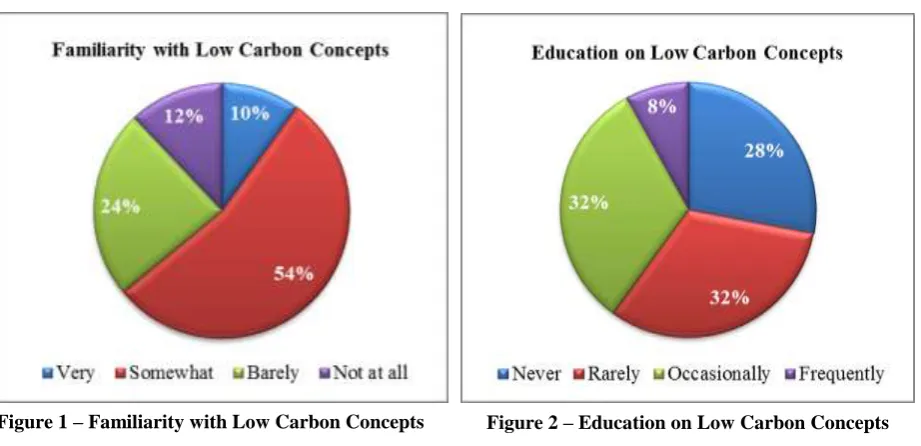
The survey revealed that the majority of the respondents were somewhat aware of the low
carbon concepts as shown in Figure 1. However, 12% were not familiar with the low carbon
concepts at all. There is clearly a big deficit in terms of a shared vision on sustainable
buildings for Mauritius both by the government and private sector.
This can partly be attributed to the lack of formal education on low carbon concepts. Figure
2 shows that more than half of the respondents were never or very rarely educated on
sustainability and low carbon concepts during their formal academic education. This confirms that
there is a significant lack of education and public awareness on low carbon buildings right from
the onset of professional training.
[image:4.595.75.536.530.753.2]3.2 Use of low carbon building elements
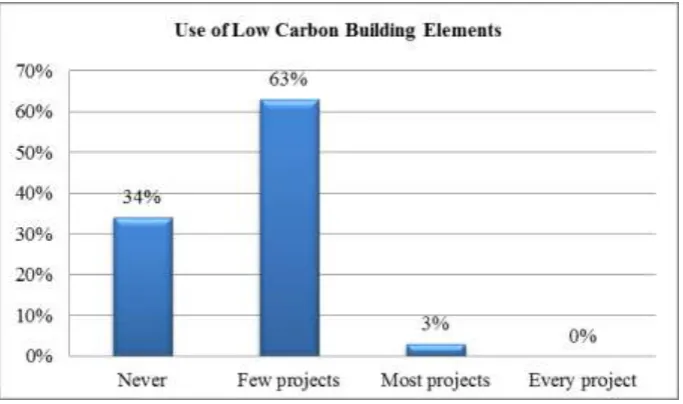
The findings from the survey also confirmed that the majority of private and public
professionals fail to implement low carbon building elements in their construction projects.
Figure 3 shows that 63% of the respondents had implemented low carbon building element in a
few projects only while 34% of the respondents had never used low carbon building elements in
[image:5.595.136.478.240.442.2]any of their projects.
Figure 3 – Use of Low Carbon Building Elements
This can be attributed to the lack of knowledge and education on low carbon concepts.
However a significant contributor to the dearth in low carbon buildings is the lack of incentives
for low carbon construction in Mauritius. Sustainable buildings are not given any additional
credits both by local authorities and the government when issuing. The existing legislations and
the Building Act do pave the way towards sustainable construction. Sustainable construction
guideline and energy rating systems adapted to the Mauritian context are still lacking. The
incentives for low carbon construction as well as proper guidelines, legislations and databases
such as energy audits and life cycle assessments are still far from acquired. (Mauritius Research
Council, 2012).
3.3 Barriers to low carbon buildings in Mauritius
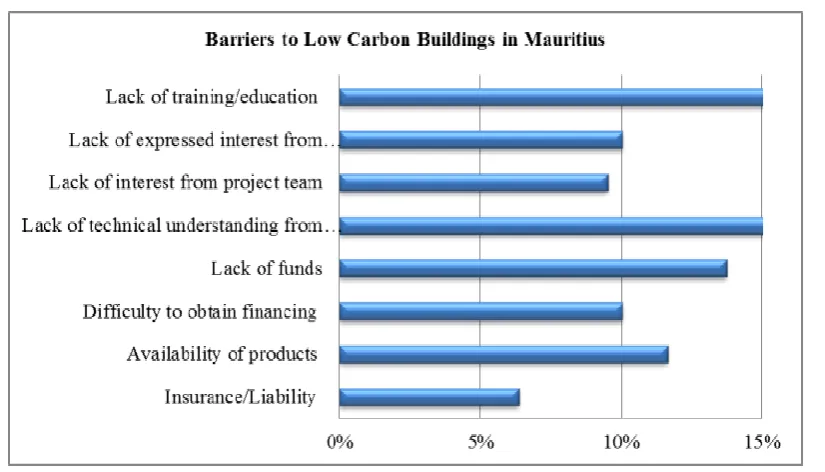
The survey revealed that the four major barriers to low carbon buildings in Mauritius are:
2. Lack of technical understanding in the construction team
3. Lack of funds
4. Availability of low carbon products
Other barriers included lack of interest from project team, lack of expressed interest from
clients and promoters, difficulty in obtaining finance and Insurance/Liability problems with
[image:6.595.104.517.242.478.2]offering warranty on non-standard materials and methods. The findings are shown in Figure 4.
Figure 4 – Barriers to Low Carbon Buildings in Mauritius
In Mauritius, it has been noted that most of the professionals from the construction industry
are not making use of low carbon building techniques for various reasons ranging lack training
and education about low carbon emission building concepts, lack of industrial workshops and
discussions on the subject as well as lack of interest from designers and members of the design
team. Furthermore, the big majority of the industry workers have not been trained about the issues
concerning low carbon emission buildings.
This can be explained by the lack in demand for low carbon buildings and lack of available
information. The main sources of information for local construction workers are the media and
personal research on the internet. Financing institutions are not helping to make the innovation as
and financers. Clients and promoters are also unwilling to invest in low carbon emission buildings
due to the high initial cost; the payback time appears to be too far in time for their finances. Low
carbon products are not readily available off the shelf on the Mauritian market and usually prove
out more costly than traditional products. For example, the use of re-usable formwork has a very
high initial cost and a longer procurement time as compared to traditional timber formworks used
all across construction sites. Lack of technical understanding; most probably because of the lack of
training of the industry‟s professionals have not helped towards the sustainable construction goal
set forward by the government.
Different possibilities could be brought forward concerning the barriers involved in
implementing low carbon buildings in Mauritius, ranging from lack of products, insurance
problems, lack of financing institutions as well as lack of interest from designers and the following
can be observed: (1) The insurance/ liability problems to offer warranty on low carbon materials
could affect the development of low carbon in Mauritius; (2) the extra cost of the project or the
unwillingness of clients/ promoters to pay for low carbon projects is very much a major barrier to
the development of low carbon construction in Mauritius; (3) clients and promoters willingness to
such projects is also very much a barrier as most of the modern owners and occupants in Mauritius
are not agreeable to pay higher costs in the construction stage to benefit during occupancy; (4) the
availability of low carbon products and materials is very much a barrier as these materials are not
available easily in Mauritius or the price is very high for some; (5) the ability for financing
institutions such as banks to give incentives and loans for such projects are evolving, a reputed
bank in Mauritius has launched the „Green Loans‟ as from the end of last year; so this might be
overcome in the near future; (6) Mauritius, being very new to the low carbon building concepts;
(only one building constructed) there is definitely a lack of information about low carbon
concepts, which could be used by professionals to encourage clients/ promoters to opt for low
carbon design. Due to this low level of information, building professionals have not been trained
nor educated for low carbon concept; thus no professional firm is available in Mauritius to
undertake such projects ranging from design to construction. The design teams on projects are also
lacking very much interest into low carbon concepts due to the low demands from clients/
promoters for such designs; and (7) one of the major barriers to sustainable construction in
Mauritius being the lack of courses and education given to the industry‟s professionals for low
carbon techniques and concepts; this could prevent the clients/ promoters from being interested in
4 Conclusions and Recommendations
The high initial cost of low carbon concepts through high cost of sustainable is not helping to
achieve this innovation in the Mauritian construction sector. The lack of interest from financing
institution to give grants and incentives to promoters and clients have also contributed to the very
slow development in this issue, where the high initial costs have to be financed completely by the
owners and the payback period seem too long to most of the industry‟s professionals without
proper incentives.
The lack of training and courses from the leading institutions in the country has also been a major
drawback to the development of low carbon in the construction industry. This has caused a big
deficit in the level of information needed by designers and promoters to launch such projects in the
near future. People doing the marketing of residential projects seem to be hesitant about the way
forward to explain to new occupants the benefits of low carbon to lack of information and
education on the subject.
The extra cost, on a modern house in Mauritius appears too much to invest for promoters and
clients without guarantees and incentives from the financing institutions and the Government. The
private and public sectors have not received the required help of the Government of Mauritius
concerning sustainable constructions; no incentives nor public awareness workshops and
presentations have been made across the last 5 years. Most inhabitants of the country are unwilling
to invest in low carbon buildings due to their unawareness of the global problems where low
carbon seems to be the lone path to a bright future.
The “Maurice Ile Durable-MID” project has been launched in Mauritius to help achieve
sustainability but however, no firm steps have been taken by the Government to start moving
along the path of low carbon or sustainable construction. No reduction of taxes on low carbon
materials, nor incentives on low carbon loans, and neither the education of the younger generations
to show the benefits of low carbon and help them achieve this innovation. All these have
contributed to the lack of interest from the construction industry‟s professionals and workers; even
the professional bodies in the construction field ranging from quantity surveyors, architects to
engineers, the way towards low carbon construction seems to be a very long one with the pace the
The extra cost of investment between a low carbon building and a traditional one can be reduced
considerably through awareness of the government and the industry‟s stakeholders to encourage
the demand for low carbon emission buildings. This innovation is highly required with the amount
of problems the country‟s is facing with lack of energy, pollution and need for renovation of many
buildings across the island. Banks and financing institutions need to be pushed forward by the
Government to help promoters and clients insure their initial investments in low carbon buildings
and see the benefits in the future.
In light of the above findings, the following recommendations are made in respect of the
implementation of low carbon buildings in Mauritius.
1. Setting up of a national agenda towards low carbon
The Government needs to set out clear goals and objectives to achieve carbon reductions with
firm targets in terms of time, responsibilities, population awareness and the private sector‟s
involvement. This will help the industry towards innovation and help Clients/ Promoters to move
in with the demands. In other countries like Germany, Australia, the government has set out an
agenda to stop their country‟s dependency on fossil fuels. With this incentive from the
Government in our country, the stakeholders, being public or private will help achieve these goals.
2. Establishment of policies and legislations to encourage carbon reduction
The cost of low carbon materials namely solar equipment can be made tax free to reduce
their costs same as it is done in many countries worldwide. Furthermore, the public or private
stakeholders could set a fix rate for the buying of surplus energy produced from solar equipment
where investors could benefit from the installation of solar panels and recover their investments.
This could help the country reduce its dependency on fossil fuels and increase its renewable
energy produced as well as returns on investments for promoters.
3. Education on low carbon benefits
Education is the most important factor towards any innovation. The education of the
population as a whole, independent of their age groups and professional affiliation should be
encouraged. The whole population and communities should be educated about low carbon
4. Public Procurement
The public sector should be the leading sector towards carbon reduction; projects
performed by the government in the construction sector should be aimed at low carbon buildings
with tenders inviting consultants and contractors thus forcing the change in the industry. Private
companies interested to work on all those public funded projects will have to acquire knowledge
and techniques on low carbon construction. Above all, this technique will prove beneficial in the
long run for the public funds as the cost is recovered in the future occupancy of the buildings.
5. S e t t i n g u p o f National Guidelines and Rating System on low carbon buildings
The government needs to set forward a national rating system to assess the performance of
buildings and allocating marks to sustainable buildings which would enhance their market value.
This could help to encourage promoters to go for low carbon emission buildings.
5 Acknowledgements
The authors wish to thank Deelan Umanee for his contribution to this paper.
6 References
A Coordinated Research Perspective on Sustainable Buildings in Mauritius [Online] Available
at: http://www.mrc.org.mu/document2012/nationalgroup/NERG-FINAL%202Feb2012.pdf
[Accessed on 3rd Feb. 2013].
Boyle, C. A. (2005). Sustainable buildings. Proceedings of the ICE-Engineering
Sustainability, 158(1), 41-48.
Maurice Ile Durable [Online] Available at: http://www.gov.mu/portal/sites/mid/aboutMID.htm
[Accessed on 27th July 2013]
Omer, A. M. (2008). Energy, environment and sustainable development. Renewable and
sustainable energy reviews, 12(9), 2265-2300.
Parvez, T., 2010. The causes of delay with focus on high rise building during the
implementation of a car free town project. MSc. University of Mauritius.
Zydeveld, C. (1998). From simple design principles to 4000 solar homes factor 4 in energy