U
NDERSTANDING THE
R
OLE OF
L
OW
G
LASS
T
RANSITION
T
EMPERATURE
E
XCIPIENTS IN THE
M
ITIGATION OF
A
MORPHISATION
ON
M
ECHANICAL
P
ROCESSING
being a thesis presented for the degree of
Doctor of Philosophy in Pharmaceutics
at the
University of Dublin, Trinity College
by
Kieran Hubert Gallagher
B.Sc. (Pharm.), MPharm, P.Grad.Cert. (Statistics), M.P.S.I.
under the supervision and direction of
Professor Anne Marie Healy
B.Sc. (Pharm.), Ph.D., M.P.S.I., F.T.C.D
.
D
ECLARATIONThis thesis is submitted by the undersigned author to the University of
Dublin, Trinity College, for the examination for the degree of Doctor of
Philosophy. This thesis has not been submitted as an exercise for a degree at
any other university and is entirely the work of the undersigned author,
except where duly acknowledged and with the aid of editorial advice from
Professor Anne Marie Healy. It is agreed that this thesis may be deposited in
the University’s open access institutional repository, subject to Irish
Copyright Legislation and Trinity College Library conditions of use and
acknowledgement.
Signed
S
UMMARYThe aim of this research was to further an understanding of the ability of low glass transition temperature (Tg) crystalline excipients, in particular the dicarboxylic
acids, to mitigate the amorphisation of high Tg active pharmaceutical ingredients
(APIs) on comilling and to explore the possibility of mitigating amorphisation during other unit processes including blending and compaction. The APIs used were budesonide (BD), sulfadimidine (SDM) and acyclovir (ACV) based on both their high Tg values and their tendency to amorphise on milling at room temperature (RT).
The excipients chosen were the dicarboxylic acids succinic acid (SA), glutaric acid (GA), adipic acid (AA) and pimelic acid (PA) in addition to the low Tg polyol
mannitol (MAN). The excipients were chosen based on their low Tg values and
consequent ability to resist amorphisation on milling. In addition, previous studies have highlighted the ability of the dicarboxylic acids in particular to effect mitigation of amorphisation on comilling. However, the mechanism by which these excipients exert this effect has, to date, not been further explored.
The amorphisation of SDM was initially studied in the absence of a low Tg excipient,
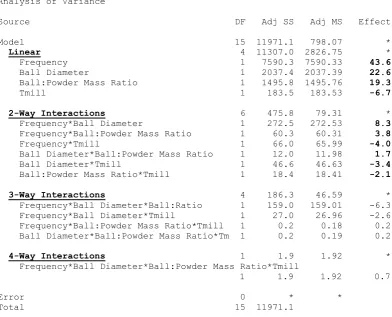
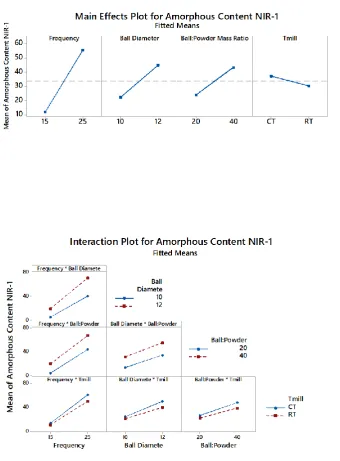
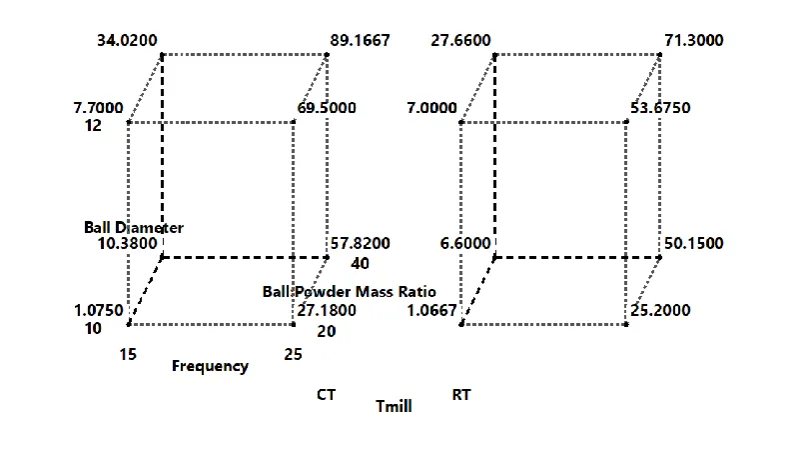
in two types of ball mill, a planetary ball mill (PBM) and a vibratory ball mill (VBM). While an increased amorphisation kinetic was observed on milling at RT in the VBM relative to the PBM, both ball mill types led to a similar partial amorphisation (80% amorphous content) of SDM. However, reducing the temperature of the milling operation in both ball mill types led to an increase in the amorphisation of the API. The effect of the milling parameters which affect the level of mechanical energy imparted was assessed relative to the milling temperature in the VBM in a design of experiment analysis. Additionally, the surface chemistry changes on milling of SDM at high and low intensity were assessed by inverse gas chromatography (iGC). Each of the low Tg crystalline excipients were also milled alone and each excipient
remained crystalline on milling as demonstrated by PXRD and DSC analysis. However, both MAN and PA underwent polymorphic transformations to metastable polymorphic forms. In addition, the dispersive surface energies on milling of the low Tg excipients were assessed by iGC analysis.
Milling of crystalline BD in the absence of a low Tg excipient in the VBM at both RT
and cryo-temperature (CT) led to the amorphisation of the API, leading to a Tg on
modulated DSC analysis of 89 °C. In contrast, comilling crystalline BD in the VBM at RT with each of the low Tg dicarboxylic acids led to varying levels of crystalline BD
particular, GA was found to completely mitigate amorphisation of BD, followed by PA (72% crystallinity) and AA (21% crystallinity) which exhibited partial abilities to mitigate amorphisation of BD. In contrast, both SA and MAN were unable to mitigate amorphisation of BD to any extent on comilling. In contrast to RT comilling studies, comilling crystalline BD with each of the excipients at CT led to the amorphisation of BD in each case highlighting the importance of the mill temperature in the mitigation of amorphisation on comilling. Tg reduction of the
composites formed on comilling at RT and CT was determined by modulated DSC analysis, in addition to spectroscopic evidence for hydrogen bonding interactions. Phase separation from the cryomilled composites was also analysed by DVS analysis. In addition, the solubility of each of the diacid excipients in amorphous BD was determined in addition to the Tg of the glass solutions saturated with excipient
formed on co-melt quenching.
Crystalline SDM was partially amorphised in the PBM at RT, and the milled SDM (mSDM) was subsequently comilled with each of the dicarboxylic acids and MAN in the VBM at RT. The level of Tg reduction on comilling was determined by modulated
DSC analysis and evidence for hydrogen bonding interactions was assessed by FTIR analysis, which was found to be strongest for GA. The solubility of each of the diacids in amorphous SDM was determined by the zero enthalpy extrapolation method, in addition to the Tg of the glass solutions saturated with excipient formed
comilled with GA, PA and MAN at both RT and CT in the VBM. While comilling at RT with GA led to a cocrystal, comilling with PA led to the regeneration of form I ACV and comilling with MAN led to the amorphisation of ACV. In contrast, comilling at CT led to the amorphisation of ACV in each of the composite systems. The Tg
reduction of the co-cryomilled composites was determined by modulated DSC analysis and crystallisation from the co-cryomilled composites was also investigated under humidity accelerated conditions.
Co-blending amorphous SDM did not lead to a hydrogen bonding interaction with GA, in contrast to the interaction observed on comilling. In addition, no polymorphic transformation of β-GA into the metastable α-polymorph was observed on co-blending, in contrast to the comilled composite. The propensity of compaction to lead to the crystallisation of amorphous BD was also studied by compaction of the amorphous composites formed on co-cryomilling BD with each of the diacids SA, GA, AA and PA. However, no crystallisation of BD from the amorphous composites was observed on co-compaction.
The analysis suggested that the ability of the low Tg excipients to drive Tg reduction
of the high Tg API down to the temperature of the milling operation was important
in terms of their respective abilities to mitigate amorphisation on comilling. The inability of MAN to drive reduction in Tg, and consequent inability to mitigate
amorphisation on comilling, was possibly due to immiscibility in the liquid/ glass solution state. However, the relative abilities of the diacids to drive Tg reduction,
and subsequent differences in abilities to mitigate amorphisation, could not to be accounted for by either a miscibility barrier or to differences in the thermodynamics of interaction on mixing in the liquid/ glass solution state. The difference in the relative abilities of the diacids to drive Tg reduction by mechanical
means (relative to the Tg of the saturated glass solutions formed by melt quench)
T
ABLE OF
C
ONTENTS
Acknowledgements ... i
Abbreviations ... iii
Selected Presentations and Publications Associated With This Work ... vii
ORIGIN AND SCOPE ... 1
CHAPTER 1 INTRODUCTION ... 5
Overview of The Solid State ... 6
Unit Processes and Formulation Design ... 6
The Crystalline and Amorphous States ... 8
Formation of the Amorphous State – Mechanical vs Thermal Activation ... 11
Factors Affecting Crystallisation from the Amorphous State ... 13
Mechanical Activation – Phase Transformations in Single Component Systems on Mechanical Processing ... 14
Generation of Static vs Dynamic Disorder on Milling and Solid-State Characterisation ... 14
Mechanical Activation on Milling – Temperature of the Mill Relative to the Tg of the Material ... 16
Mechanical Rejuvenation on Milling – Mechanically Induced Ageing and Regeneration of Crystalline Order from a Quench-Cooled Glass ... 19
Mechanical Activation on Compaction and Blending ... 20
Composite Molecular Systems ... 20
Composite Crystalline Systems ... 21
Composite Amorphous Systems ... 24
Driven Molecular Alloys – Potential for Mitigation of Amorphisation on Comilling ... 26
Towards a Rationalisation of Mechanically Induced Phase Transformations – The Effective Temperature on Milling ... 30
Crystalline to Amorphous Transformations Induced Mechanically ... 30
CHAPTER 2 MATERIALS AND METHODS ... 33
2.1 Materials ... 34
2.2 Controlled Temperature and Relative Humidity Environments ... 35
2.3 Unit Operations ... 36
2.3.1 Milling ... 36
2.3.2 Compaction ... 37
2.3.3 Blending ... 37
2.3.4 Spray Drying ... 38
2.3.5 Physical Mixture Preparation ... 38
2.3.6 Melt Quenching ... 38
2.4 Analytical Techniques ... 38
2.4.1 Differential Scanning Calorimetry ... 38
2.4.2 Thermogravimetric Analysis ... 39
2.4.3 Attenuated Total Reflectance Fourier Transform Infrared Spectroscopy ... 40
2.4.4 Near Infrared Reflectance Spectroscopy... 40
2.4.5 Powder X-Ray Diffractometry ... 40
2.4.6 Dynamic Vapour Sorption ... 41
2.4.7 Inverse Gas Chromatography (iGC) Surface Energy Analysis ... 43
2.4.8 BET N2 Surface Area Analysis ... 45
2.4.9 Polarised Hot Stage Microscopy ... 46
2.4.10 Scanning Electron Microscopy ... 46
2.4.11 Laser Light Diffraction Particle Size Analysis ... 46
2.4.12 Experimental Determination of the Solubility of Crystalline Excipients in Amorphous Low Molecular Weight API at 25 °C ... 46
2.4.13 Melting Point Depression Analysis of SDM with Excipients and Computation of the Excess Thermodynamic Functions ... 47
2.4.14 Determination of the Activation Energy of Crystallisation from Amorphous Composite Systems by Ozawa/ Kissinger Non-Isothermal Crystallisation Kinetics ... 49
2.4.15 Calculation of the Hildebrand Solubility Parameters ... 50
2.4.16 Graphing Software and Statistical Analysis ... 50
CHAPTER 3 MECHANICAL ACTIVATION STUDIES ON MILLING OF HIGH AND LOW T
GMOLECULAR PHARMACEUTICAL MATERIALS ... 53
3.1 Introduction ... 54
3.2 Solid State Characterisation of Crystalline and Amorphous Sulfadimidine ... 55
3.2.1 PXRD Analysis ... 55
3.2.2 DSC Analysis ... 56
3.2.3 Spectroscopic Analysis ... 58
3.2.4 Sorption Analysis ... 61
3.3 Comparison of the Effect of Mill Type and Temperature on Amorphisation Kinetics and Extent of Amorphisation on Milling ... 64
3.4 Design of Experiment on the Mechanical Activation of Sulfadimidine in the Vibratory Ball Mill ... 69
3.5 Analysis of Milling Induced Changes to the Surface Chemistry of Sulfadimidine by Inverse Gas Chromatography ... 79
3.6 Solid State Characterisation and Mechanical Activation Studies of the Low Tg Excipients ... 86
3.6.1 Mannitol ... 86
3.6.2 The Dicarboxylic Acids ... 89
3.7 Conclusions ... 100
CHAPTER 4 COMILLING STUDIES WITH BUDESONIDE AND LOW T
G EXCIPIENTS ... 1014.1 Introduction ... 102
4.2 Solid State Characterisation of Crystalline and Amorphous Budesonide 104 4.2.1 Thermal Analysis ... 104
4.2.2 Spectroscopic Analysis ... 105
4.2.3 Sorption Analysis ... 107
4.3 Comilling Studies of Crystalline Budesonide with Low Tg Excipients at Room temperature... 108
4.3.1 PXRD Analysis ... 108
4.3.2 DVS Analysis ... 111
4.4 Co-Cryomilling Studies of Budesonide with Low Tg Excipients ... 120
4.4.1 PXRD Analysis ... 120
4.4.2 Thermal Analysis ... 123
4.5 Phase Separation Studies from the Co-Cryomilled Driven Alloys ... 128
4.5.1 Budesonide and Glutaric Acid Co-Cryomilled Composite ... 128
4.5.2 Budesonide and Pimelic Acid Co-Cryomilled Composite ... 132
4.5.3 Budesonide and Adipic Acid Co-Cryomilled Composite ... 136
4.5.4 Budesonide and Succinic Acid/ Mannitol Co-Cryomilled Composites 139 4.6 Studies on Thermally Co-Activated Budesonide Alloys – Solubility and Tg Reduction ... 145
4.7 Conclusions ... 149
CHAPTER 5 STUDIES ON THE FORMATION AND PHYSICAL PROPERTIES OF
SULFADIMIDINE AND LOW T
G EXCIPIENT ALLOYS ... 1515.1 Introduction ... 152
5.2 Comilling Studies of Amorphous Sulfadimidine with Low Tg Excipients 153 5.2.1 PXRD Analysis ... 153
5.2.2 DSC Analysis... 156
5.2.3 FTIR Analysis ... 159
5.3 Studies on the Thermally Co-Activated Sulfadimidine Alloys – Solubility and Tg Reduction ... 163
5.4 Melting Point Depression Analysis – Miscibility and Excess Thermodynamic Functions of Interactions in the Liquid State ... 167
5.5 Crystallisation Studies of Sulfadimidine from the Cryomilled Driven Alloys ... 174
5.5.1 DVS Studies ... 174
5.5.2 Non-Isothermal Crystallisation Kinetics ... 186
CHAPTER 6 MECHANICAL ACTIVATION STUDIES ON MILLING OF ACYCLOVIR AND
COMILLING WITH LOW T
G EXCIPIENTS ... 1936.1 Introduction ... 194
6.2 Characterisation of Crystalline Acyclovir ... 196
6.2.1 Thermal Analysis ... 197
6.2.2 FTIR Analysis ... 198
6.2.3 DVS Analysis ... 200
6.2.4 SEM Analysis ... 202
6.3 Mechanical Activation Studies of Acyclovir ... 204
6.3.1 Mechanical Activation of Form I (Anhydrous) Acyclovir ... 204
6.3.2 Mechanical Activation of Form V (3:2 Hydrate) Acyclovir ... 206
6.4 Comilling Studies of Acyclovir with Low Tg Excipients ... 209
6.4.1 Comilling Acyclovir with Glutaric Acid ... 209
6.4.2 Comilling Acyclovir with Pimelic Acid ... 222
6.4.3 Comilling Acyclovir with Mannitol ... 226
6.5 Conclusions ... 231
CHAPTER 7 CO-BLENDING AND CO-COMPACTION STUDIES ... 233
7.1 Introduction ... 234
7.2 Characterisation of Blended Sulfadimidine and Co-Blending with Glutaric Acid ... 235
7.3 Co-Compaction of Budesonide with Dicarboxylic Acids ... 239
7.4 Conclusions ... 242
CHAPTER 8 GENERAL DISCUSSION ... 243
Mechanical Activation on Milling and Solid-State Characterisation ... 244
Comilling and Formation of the Driven Molecular Alloys ... 248
Mitigation of Amorphisation on Comilling – Correlation with Experimental Solubility, Calculated Hildebrand Solubility Parameters and Tg Reduction Relative to the Milling Temperature ... 248
Formation of the Driven Molecular Alloys in the Context of the Driven
Materials Theory ... 260
Phase Separation from the Driven Molecular Alloys ... 264
Humidity Accelerated Phase Separation from the Cryomilled Driven Alloys ... 264
Mitigation of Amorphisation on Comilling at Room Temperature – Mechanical Rejuvenation from the Reduced Tg Driven Alloys ... 266
Co-Blending and Co-Compaction Relative to Comilling ... 270
CONCLUSIONS & FUTURE WORK ... 273
REFERENCES ... 277
APPENDICES ... 299
A-I Additional Figures... 299
A-II Characterisation of the Sulfadimidine-Succinic Acid Cocrystal ... 310
A-IIICharacterisation of the γ-Polymorph of Pimelic Acid ... 313
A-IViGC Analysis Conditions ... 315
A-V Quantification of the Excess Thermodynamic Functions ... 316
A
CKNOWLEDGEMENTSI would like to thank my supervisor Anne Marie Healy for the guidance and support provided throughout my PhD and for allowing me to be a part of her research group, I very much appreciate the opportunity. I would also like to thank Science Foundation Ireland for providing the funding which made the research possible and which allowed me to attend conferences at home and abroad. I would like to thank Lidia for being available to address any problems in the lab.
A special thank you to Loli for all the advice, coffee and support down through the years, it was much appreciated. Also, a massive thank you to Peter O’Connell for all his invaluable help, discussions and advice. Thanks to all the postgrads in the pharmaceutics lab for being great company including Claire, David, Kate, Hannah, Jeremiah, Emer, Alan, Karl, Agnieszka, Naila and everyone else as well as to all in the TBSI of whom there are too many to mention. I’d also like to thank the postdocs, Zelalem, Dinesh, Valerio and Atif for making the lab an enjoyable place to be.
A
BBREVIATIONSAA Adipic acid ACV Acyclovir
AN* Modified Gutmann acceptor number
ATR Attenuated total reflectance
BCS Biopharmaceutical Classification System BET Brunauer-Emmet-Teller
BD Budesonide
BPR Ball to powder mass ratio ccm Cubic centimetres per minute
°C Degrees Celsius CT Cryo-temperature Dbal Ballistic jump
Dth Thermal jump
dm/dt Rate of change of mass with respect to time DN Gutmann donor number
DVS Dynamic vapour sorption DOE Design of experiment
DSC Differential scanning calorimetry Ea Activation energy
FID Flame Ionisation Detector GE Excess Gibbs energy
HE Excess enthalpy
ΔHc Enthalpy of crystallisation
ΔHm Enthalpy of melting
HPLC High performance liquid chromatography
Hz Hertz
J Joules
Ka Acid number
Kb Base number
LLD Laser light diffraction
MAN Mannitol
mDSC Modulated differential scanning calorimetry
m metre
mg Milligram
mm Millimetre
MPD Melting point depression mSDM Milled sulfadimidine
MQ Melt quench
NIR Near infrared spectroscopy Na Avogadro’s constant
PA Pimelic acid
PXRD Powder X-Ray diffraction R Universal Gas Constant RH Relative humidity
RHc Crystallisation relative humidity
RHc(10) Crystallisation relative humidity at 10% RH/hour ramp rate
RHg Glass transition relative humidity
RHg(10) Glass transition relative humidity at 10% RH/hour ramp rate
RT Room temperature SA Succinic acid SD Spray dried SDM Sulfadimidine
SE Excess entropy
StD Standard deviation
Tc Crystallisation temperature
Tg Glass transition temperature
Tp Crystallisation peak temperature
TGA Thermogravimetric Analysis TRE Trehalose
𝑇oi Melting transition temperature of pure ith component Tmill Operational temperature of the mill
Teff Effective temperature
Vm Molar volume
Vn Retention volume
w/v Weight per volume w/w Weight per weight
xe Mole fraction at the eutectic composition
xi Mole fraction of the ith component
𝛥fus𝐻oi Enthalpy of fusion of the pure ith component
ΔEv Energy of vaporisation
ΔCp Change in constant pressure heat capacity
γSD Dispersive surface energy of a solid
γLD Dispersive surface energy of a liquid
γi Activity coefficient of the ith component
α Alpha
β Beta
γ Gamma
δ Delta
φ Phi
θ Theta
S
ELECTEDP
RESENTATIONS ANDP
UBLICATIONSA
SSOCIATEDW
ITHT
HISW
ORKOral Presentations
All Ireland Schools of Pharmacy, Royal College of Surgeons in Ireland, Dublin,
March 2016 – “Mechanical Activation – Mitigation of Process Induced Amorphisation and Correlation with Excipient Solubility and Potential for Hydrogen Bonding Interaction”. [Kieran Hubert Gallagher, Dolores Serrano Lopez, Cliona Loughnane, Anne Marie Healy]
Poster Presentations
All Ireland Schools of Pharmacy, Trinity College Dublin, Dublin, April 2014 – “Investigating Cryo-Milling Induced Amorphisation of Sulfadimidine with Low Tg
Excipients”. [Kieran Hubert Gallagher, Dolores Serrano Lopez, Anne Marie Healy]
UK and Ireland CRS, University College Cork, Cork, April 2014 – “Understanding the Role of Milling Temperature and Composite Tg in Process Induced Amorphisation”.
[Kieran Hubert Gallagher, Dolores Serrano Lopez, Anne Marie Healy]
AAPS Annual Meeting and Exposition, San Diego, November 2014 – “Co-Processing with Low Tg Excipients: Towards a Mechanistic Understanding of the Role of Low Tg
Excipients in the Mitigation of Process Induced Amorphisation”. [Kieran Hubert Gallagher, Dolores Serrano Lopez, Anne Marie Healy]
All Ireland Schools of Pharmacy Conference, Queen’s University, Belfast, June 2015 – “Solid State Interaction as a Mechanism to Prevent Milling Induced Mechanical Activation”. [Kieran Hubert Gallagher, Dolores Serrano Lopez, Anne Marie Healy]
2016 European Inverse Gas Chromatography (iGC) Symposium, Imperial College London, UK, October 2016 – “Revealing Changes in Surface vs Bulk Physicochemical Characteristics of a Mechanically Activated Pharmaceutical Material by Correlation of iGC and DSC Analyses”. [Kieran Hubert Gallagher, Anne Marie Healy]
AAPS Annual Meeting and Exposition, Denver, Colorado, November 2016 – “Mitigation of Process Induced Amorphisation – Correlation with Excipient Solubility in Driven Molecular Alloys and Potential for Hydrogen Bonding Interaction”. [Kieran Hubert Gallagher, Dolores Serrano Lopez, Cliona Loughnane, Anne Marie Healy]
Publications
Curtin, V., Y. Amharar, K. H. Gallagher, S. Corcoran, L. Tajber, O. I. Corrigan and A. M. Healy (2013). "Reducing mechanical activation-induced amorphisation of salbutamol sulphate by co-processing with selected carboxylic acids." International Journal of Pharmaceutics 456(2): 508-516.
Amharar, Y., V. Curtin, K. H. Gallagher and A. M. Healy (2014). “Solubility of crystalline organic compounds in high and low molecular weight amorphous matrices above and below the glass transition by zero enthalpy extrapolation." International Journal of Pharmaceutics 472(1–2): 241-247.
R Serrano, D., K. H Gallagher and A. Marie Healy (2015). "Emerging nanonisation technologies: tailoring crystalline versus amorphous nanomaterials." Current Topics in Medicinal Chemistry 15(22): 2327-2340.
Origin and Scope
Active pharmaceutical ingredients (APIs) are commonly subjected to mechanical processing during routine pharmaceutical manufacture (Hüttenrauch, Fricke et al. 1985, Fisher 2006). One of the key micromeritic properties of an API which affects manufacturability and drug product performance (e.g. dissolution rate) is the particle size . As a consequence, unit processes such as milling are commonly employed in order to effect particle size reduction. However, milling has been shown to lead to the transformation of crystalline materials to higher energy amorphous states or to metastable polymorphic forms, termed mechanical activation (Descamps, Willart et al. 2008). The generation of amorphous regions in a crystalline API may have a significant influence on both the manufacturability and biopharmaceutical properties of the API including altered dissolution and bioavailability properties (Hancock and Zografi 1997). For this reason, the transformation of crystalline API to the amorphous state is, in many instances, an unintentional consequence of the milling operation.
The tendency of a material to amorphise on milling has been suggested to depend on the glass transition temperature (Tg) of the material, relative to the temperature
of the milling operation (Descamps, Willart et al. 2006, Descamps, Willart et al. 2007). In particular, it has been noted that milling at a temperature below the Tg
tends to lead to the amorphisation of the system, while milling at a temperature at or above the Tg tends to either lead to a polymorphic transformation or to result in
the material remaining in the unchanged crystalline state (Dujardin, Willart et al. 2013). As a consequence, many APIs with high Tg values well above RT tend to
amorphise when subject to mechanical stress on milling at RT. However, it has been shown that comilling in the presence of a second component can lead to the formation of amorphous glass solutions with a composite Tg intermediate to that of
either pure component (Nagahama and Suga 2002). This phenomenon suggests the possibility of reducing the Tg of a high Tg API down towards the temperature of the
mill by co-processing with a low Tg crystalline excipient, with consequent
promotion of the crystalline form. Indeed, previous studies have highlighted the ability of the dicarboxylic acids in particular to be successful in the mitigation of amorphisation on comilling with a range of high Tg APIs (Curtin, Amharar et al.
In addition to milling, the API may be subjected to further processing post-milling, which, for the formation of solid compacts, commonly involves blending of the API with excipients followed by compaction of the API: excipient composite. Indeed, blending (in the presence of glass beads) and compaction have been shown to induce the mechanical activation of APIs in addition to milling. In particular, blending of grisoefulvin in the presence of glass beads was shown to lead to the amorphisation of the API (Hockerfelt, Nystrom et al. 2009), while many instances of compaction-induced polymorphic transformations to metastable polymorphic forms have been described for pharmaceutical systems such as caffeine and carbamazepine (Lefebvre, Guyot-Hermann et al. 1986, Brittain 2002).
The scope of this thesis will be to:
Investigate the effect of the type of mill as well as the temperature of the mill relative to the ballistic variables which affect the mechanical energy imparted during milling on the amorphisation of the model high Tg API
sulfadimidine, utilising both surface and bulk characterisation techniques.
Establish the relative abilities of a range of low Tg dicarboxylic acid/ polyol
excipients to mitigate the amorphisation of the high Tg APIs budesonide and
acyclovir on comilling at both room temperature and cryo-temperature in a vibratory type ball mill.
Characterise the properties of the alloys formed on comilling in terms of the ability of the excipients to drive Tg reduction and the potential for hydrogen
bonding interaction and to characterise crystallisation from the amorphous composites formed on comilling from a crystallographic, spectroscopic and kinetic perspective.
Further an understanding of the mechanism(s) which account(s) for the relative abilities of the low Tg crystalline excipients to mitigate
amorphisation on comilling.
C
HAPTER
1
O
VERVIEW OFT
HES
OLIDS
TATEUnit Processes and Formulation Design
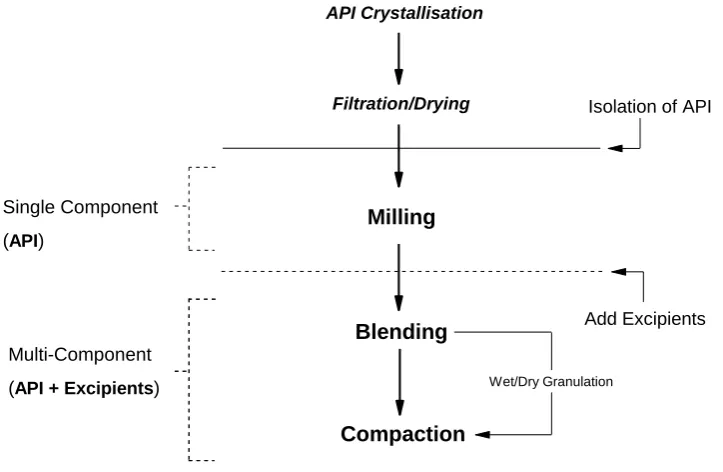
Routine drug product manufacturing commonly involves the processing of active pharmaceutical ingredients (APIs) in the solid state, both alone and in the form of composites on co-processing with excipients (Fisher 2006, Wikström, Carroll et al. 2008). Figure 1.1 shows a simplified flow diagram highlighting three key unit processes in the solid-state production of a tablet compact by direct compression. Milling is primarily utilised after crystallisation and isolation of the API in order to control particle size (Bentham, Kwan et al. 2004, Nakach, Authelin et al. 2004). Indeed, the particle size constitutes an important micromeritic property which has been shown to have an influence on the properties of powder systems of pharmaceutical relevance (Bosquillon, Lombry et al. 2001), including:
Manufacturability – powder flow, blend uniformity, compactability
Physical/ chemical stability – suspensions, powders for reconstitution
Biopharmaceutical properties – dissolution, bioavailability
During post-milling drug product manufacture, as highlighted in Figure 1.1, the drug will inevitably be mixed with excipients in the development of the final dosage form, and will be subject to blending and compaction steps. It has also been shown that such processes can also lead to the mechanical activation of an API. In particular, it has been shown that compaction can lead to polymorphic transformations to metastable polymorphs due to the very high pressures achieved during the compaction process as has been observed on compaction of caffeine and carbamazepine (Chan and Doelker 1985, Otsuka, Nakanishi et al. 1999). In addition, blending (in the presence of glass beads) has been shown to lead to the surface amorphisation of griseofulvin (Hockerfelt, Nystrom et al. 2009).
Figure 1.1 Simplified process flow diagram of the main unit operations involved in the formulation of a tablet compact of an API from the post-synthesis solution state.
The above mentioned solid state transformations point to the possibility of the addition of a crystalline functional excipient at the milling stage in order to potentially mitigate amorphisation during milling and possibly also during post milling stages of blending and compaction.
The active pharmaceutical ingredients sulfadimidine (SDM) and budesonide (BD) were chosen in this study as model active pharmaceutical ingredients (APIs), as
Multi-Component
(API + Excipients)
Filtration/Drying
Blending Milling
Compaction
API Crystallisation
Single Component (API)
Isolation of API
Add Excipients
[image:31.595.149.511.303.539.2]both APIs, with Tg values reported to be 78 °C and 89 °C respectively, have
previously been shown to undergo amorphisation on milling at room temperature (Dudognon, Willart et al. 2006, Caron, Tajber et al. 2011). Additionally, acyclovir (ACV) was chosen as a third model API. In contrast to both SDM and BD which do not exhibit polymorphism, ACV has been reported to exhibit polymorphism in the form of both true and pseudo-polymorphic forms and thus provided the opportunity to study the effect of co-processing low Tg excipients with a model
polymorphic API (Lutker, Quiñones et al. 2011).
The Crystalline and Amorphous States
As drug product formulation and manufacture commonly involves the manipulation of both API and excipients in the solid state, the physicochemical properties of the solid state and the analytical techniques used to characterise the solid state are of great importance in a pharmaceutical context. This was emphasised by Brittain who categorised the physical characterisation techniques used to assess the solid state properties of a powder system from the molecular level to the bulk level (Brittain 1995). Figure 1.2 highlights the properties of the common excipient mannitol from the molecular level to the crystallite level. According to the analysis by Brittain et al., the bulk properties of a powder system such as powder flow and compactability may be affected by the properties of the system at the different levels as shown in Figure 1.2, from the molecular to the individual crystallite to the bulk powder. At the molecular level, the functional groups present in the molecular structure govern the nature and strength of the inter-molecular interactions in the solid state and in organic molecular materials such interactions are commonly mediated through hydrogen bonding group interactions, in addition to the weaker dipole-dipole interactions and the van der Waals interactions of non-polar groups (Wegiel, Mauer et al. 2013). Vibrational spectroscopy is an importance characterisation tool at the molecular level and allows the characterisation of the nature of the interactions formed in the solid state and in addition changes to the nature of the intermolecular bonding on processing including the formation of hydrogen bonding group interactions in two component systems, in particular API-excipient interactions on processing (Konno, Handa et al. 2008).
(SRO) to long range order (LRO) (Newman and Zografi 2014). While SRO extends to nearest (molecule) neighbour and next nearest neighbour, LRO extends over a greater distance at the molecular scale. Intermolecular bonding gives rise to a supramolecular assembly of molecules in a repeating pattern, which gives rise to a crystal lattice structure with long range order in three dimensions with 14 different possible lattice types (Brittain 1995). X-Ray diffractometry, both single crystal and powder (PXRD), is an important characterisation technique allowing the determination of the crystal lattice structure of a molecular crystalline solid (Clas, Faizer et al. 1995). Indeed, PXRD can provide a quick identification technique for the characterisation of polymorphic forms and for the detection of crystalline phases in an amorphous matrix and is thus an important routine characterisation technique in a pharmaceutical context (Di Martino, Conflant et al. 1997).
Figure 1.2 Perspective on the emergent solid-state properties of mannitol with common characterisation techniques.
brittle fracture on milling led to improved compactability of the excipient (Koner, Rajabi-Siahboomi et al. 2015).
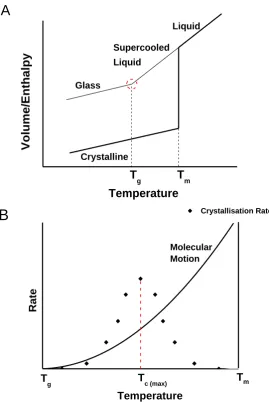
Figure 1.3A shows a simplified enthalpy temperature diagram of a pure substance highlighting that below the fusion temperature (Tm) of the material, the crystalline
state is the thermodynamically stable state. However, crystallisation is a kinetic phenomenon and the liquid state may persist on cooling below Tm leading to the
formation of a supercooled liquid. If the temperature of the system is cooled further at a sufficiently fast rate to prevent nucleation/ crystallisation, eventually the system will undergo a step change in heat capacity associated with a significant increase in the viscosity of the material and a reduction in molecular mobility, leading to the formation of the glass/ amorphous state (Hancock and Zografi 1997). The temperature at which this change occurs is termed the glass transition temperature (Tg). In contrast to the crystalline state, the amorphous state is
characterised by a lack of three dimensional long range order and may be characterised by only short-range order of nearest neighbour or next nearest neighbour (Newman and Zografi 2014).
Although crystallisation is thermodynamically favoured, the crystallisation rate low below the Tg is significantly reduced due to the decreased molecular mobility of the
system and the Tg thus represents a key characteristic of the amorphous state of an
API. Crystallisation is a kinetically controlled process that occurs in two stages, nucleation followed by crystal growth (Trasi and Taylor 2012). Figure 1.3B highlights that the maximum rate of crystallisation normally occurs at a temperature above the Tg and below Tm in the supercooled liquid region. The
nucleation rate has also been shown to exhibit a temperature maximum due to competition between thermodynamic and kinetic forces. As described by Trasi et al., the temperature of maximum nucleation usually lies at a lower temperature than Tc, but may occur at a similar temperature to the temperature of maximum
Figure 1.3 A) Enthalpy-temperature diagram highlighting the liquid, supercooled liquid, glass and solid states relative to two key transition temperatures, Tm and Tg and B) the variation in
the molecular mobility between Tg and Tm, highlighting the temperature of maximum rate of
crystallisation (Tc). [Adapted from reference (Hancock and Zografi 1997)]
Formation of the Amorphous State – Mechanical vs Thermal Activation
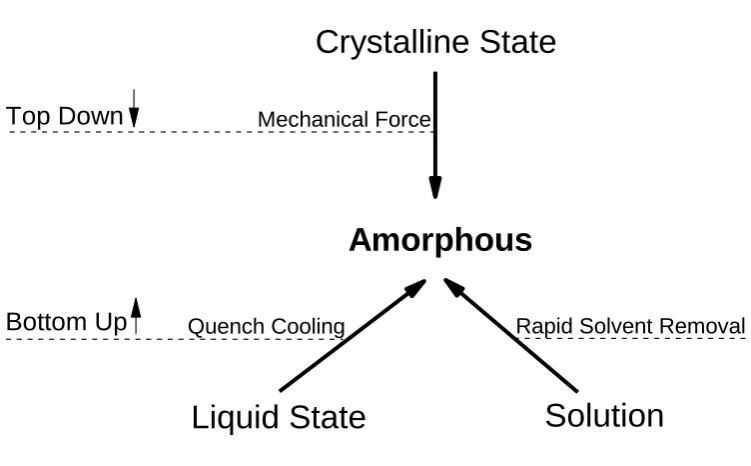
As highlighted in Figure 1.3, the amorphous state can be brought about by cooling from the liquid state below the glass transition temperature at a sufficiently fast rate in order to prevent nucleation and crystallisation in the supercooled liquid region (Baird, Van Eerdenbrugh et al. 2010). However, the amorphous state can also be brought about by other means, such as from solution, as highlighted in Figure 1.4. Spray drying is a common pharmaceutical process which can lead to the amorphisation of an API from solution, in particular, if the removal of solvent is sufficiently rapid to prevent nucleation and crystal growth in the increasingly
-200 -150 -100 -50 0 50 100
Vol
ume/Entha
lpy
Temperature
Supercooled
Liquid
Glass
Liquid
Crystalline
T
m
T
g
A
T
g
Molecular Motion
Tm
Crystallisation Rate
T
c (max)
Rate
Temperature
[image:35.595.189.459.75.478.2]concentrated solution as the solvent is removed (Corrigan, Healy et al. 2003, Tajber, Corrigan et al. 2005).
In addition to the formation of the amorphous state from molecularly dispersed systems such as from the liquid/ solution state, the amorphous state can also be brought about directly from the crystalline state by the application of a mechanical force, as for example during milling (Colombo, Grassi et al. 2009, Trasi, Boerrigter et al. 2010). As suggested by Willart et al., due to the weaker elastic constants relative to their metallic counterparts, molecular materials more easily undergo vitrification by mechanical means which has important consequences for the unintended formation of the amorphous state during routine processing of pharmaceutical materials (Willart, Descamps et al. 2008).
Figure 1.4 Comparison of three common routes of formation of the amorphous state, delineated according to formation from the ordered crystalline state (top down) or from the disordered melt/ solution state (bottom up).
Factors Affecting Crystallisation from the Amorphous State
The amorphous state is metastable from a thermodynamic perspective and will eventually transform to the thermodynamically stable crystalline form (Yu 2001). In addition to the thermodynamic driving force, Bhugra et al. highlighted the importance of the molecular mobility of an amorphous system in terms of the crystallisation rate from the amorphous state (Bhugra and Pikal 2008). Indeed, the thermal history of an amorphous system can have a pronounced effect on the stability of the system towards crystallisation (Kwok, Mauer et al. 2010, Wegiel, Mauer et al. 2013). Yoshioka et al. investigated the effects of physical ageing of indomethacin above and below its Tg on crystallisation from the amorphous state
(Yoshioka, Hancock et al. 1994).
Additionally, the different routes of formation, as highlighted in Figure 1.4, can also have an influence on the crystallisation behaviour of the amorphous state produced. Surana et al. compared the resistance to crystallisation of amorphous trehalose brought about by melt quench and spray drying and found an increased resistance to crystallisation in the melt quenched sample (Surana, Pyne et al. 2004). It has
Rapid Solvent Removal
Bottom Up
Top Down
Quench Cooling
Mechanical Force
Solution
Liquid State
been suggested that the amorphous state brought about by mechanical means may contain nano-cystalline domains and thus crystallisation from milled systems may occurs below the Tg on heating in a DSC scan (Descamps and Willart 2016). In
addition, a milled amorphous system can also have a high surface area, which can lead to different rates of surface and bulk crystallisation, with fast surface crystallisation relative to slower bulk crystallisation giving rise to a bimodal exothermic crystallisation peak (Chattoraj, Bhugra et al. 2011).
In addition, the presence of a second component can also have a significant effect on the crystallisation behaviour of an amorphous system. For instance, the formation of composite solid dispersion systems between API and high Tg polymer can lead to
the stabilisation of the amorphous state. Trasi et al. investigated the impact of polymer excipients on the nucleation and crystal growth of melt-quenched acetaminophen (Trasi and Taylor 2012). However, as highlighted by Taylor et al. alteration of Tg is not the only aspect of a second component on crystallisation
(Taylor and Zografi 1997). These authors found that significant inhibition of crystallisation of indomethacin was observed for low levels of PVP, even though the Tg of the system was relatively unchanged to that of pure indomethacin The
authors suggested that hydrogen bonding between the API was an important factor leading to the inhibition of crystallisation.
M
ECHANICALA
CTIVATION–
P
HASET
RANSFORMATIONS INS
INGLEC
OMPONENTS
YSTEMS ONM
ECHANICALP
ROCESSINGGeneration of Static vs Dynamic Disorder on Milling and Solid-State Characterisation
time. According to the analysis by Wildfong et al., accumulation of lattice dislocations above a critical density may lead to the amorphisation of the material (Wildfong, Hancock et al. 2006). In addition, the authors also highlighted that the persistence of an amorphous state generated on milling also depends on the inherent crystallisation tendency of the material, in addition to the temperature of the milling operation relative to the glass transition temperature of the material and the level of mechanical energy imparted during the milling operation.
The analysis by Wildfong et al. highlights the gradual nature by which the amorphous state is generated on milling resulting from mechanically induced crack propagation, crystallite fragmentation and lattice dislocations. Caron et al. characterised the solid-state amorphisation of α-lactose on milling in a planetary ball mill as a function of milling time (Caron, Willart et al. 2011). These authors quantified the amorphous content of α-lactose by both PXRD and solid-state NMR (13C CP-MAS) analyses. In addition, they also characterised the evolution of the glass
transition on DSC analysis as a function of milling time. Interestingly, the authors found that while both PXRD and ss-NMR quantification techniques correlated well with each other in terms of describing the kinetics of amorphisation, both analyses suggested a more rapid amorphisation kinetic relative to the emergence of the Tg in
the DSC thermogram. The authors suggested that both ss-NMR and PXRD analyses were sensitive to changes in the milled system such as crystallite fragmentation and the creation of surface defects, termed static defects. Static defects, however, in contrast to a true dynamic disordered amorphous state do not contribute to a Tg in
a DSC scan. The authors noted that careful selection and interpretation of analytical techniques is important in order to distinguish static defects from a true dynamic amorphous state.
are sensitive to both amorphous and crystalline regions (Newman and Zografi 2014).
Inverse gas chromatography (iGC) has been utilised to assess the surface changes to crystalline systems on mechanical processing. Planins̄ek et al. quantified the surface amorphous content of milled indomethacin by iGC analysis and correlated this with DSC analysis (Planins̄ek, Zadnik et al. 2010). The milling induced exposure of high energy facets on milling of paracetamol was investigated by Heng et al. (Heng, Thielmann et al. 2006). These authors concluded that paracetamol fractured along the lowest attachment energy plane with the exposure of facets with higher dispersive surface energy. Ho et al. investigated the effect of milling on the surface energy heterogeneity of mannitol as determined by iGC analysis and concluded that mannitol did not fracture along its lowest attachment energy plane on milling, but instead the excipient preferentially fractured along its shortest axis with consequent exposure of a hydrophilic facet associated with the 001 plane (Ho, Naderi et al. 2012). iGC analysis is thus a powerful tool allowing for the selective discrimination of changes to the surface chemistry of milled materials relative to bulk characterisation techniques.
Mechanical Activation on Milling – Temperature of the Mill Relative to the Tg
of the Material
The glass transition temperature of an amorphous material is a critical parameter regarding the stability of the material towards crystallisation (Hancock, Shamblin et al. 1995). In the context of milling induced amorphisation, empirical evidence has suggested the importance of the Tg of the material relative to the temperature of the
milling operation (Tmill) in determining the nature of the phase transformations that
occur on milling – namely amorphisation or polymorphic transformation (Descamps, Aumelas et al. 2015). In particular it has been suggested that milling below the Tg generally tends to lead to amorphisation while milling above the Tg
generally tends to lead to polymorphic transformations (Descamps, Willart et al. 2007). Indeed, there are many reports in the literature of compounds with a relatively high Tg that have been shown to undergo amorphisation on milling at RT
including trehalose, a disaccharide with a Tg of 120 °C, budesonide with a Tg of 89
°C, and griseofulvin with a Tg of 88 °C (Willart, De Gusseme et al. 2001, Willart,
Dujardin et al. investigated the relationship between the mill temperature and the Tg of the material with α-glucose (Dujardin, Willart et al. 2013). α-Glucose
represents an interesting compound in terms of the Tg/ Tmill correlation as the Tg of
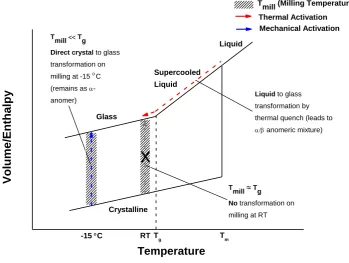
α-glucose lies close to RT at 38 °C. Figure 1.5 shows a simplified enthalpy temperature diagram of a material, such as α-glucose, whose Tg is close to RT.
Dujardin et al. studied the amorphisation tendency of α-glucose, and found that milling of α-glucose at RT did not lead to the amorphisation of the material, as evidenced by PXRD and DSC analysis. However, when the temperature of the mill was reduced to -15 °C (by placing the mill in a refrigerated room), the material underwent a milling induced crystalline to amorphous transformation, even though all ballistic variables which determine the mechanical energy input were maintained at the same level. In addition to highlighting the importance of the Tg of
the material relative to the temperature of the milling operation, Figure 1.5 also highlights the contrast between the direct amorphisation induced by milling relative to the amorphisation by melt quench from the liquid state which leads to mutarotation and the formation of an α/β-anomeric mixture (Dujardin, Willart et al. 2008). These authors also determined the crystallite size reduction as a function of milling time of α-glucose at both RT and at -15 °C. They suggested that reduction of the crystallite size below a critical crystallite size limit, which they determined to be approximately 200 Å for many materials (including both metallic and molecular materials), should lead to the amorphisation of the material. The authors found that on milling at -15 °C, a reduction in the crystallite size below this critical size was observed, while milling at RT did not lead to crystallite size reduction below this level. In addition, as the temperature of the mill at -15 °C was well below the Tg of
Figure 1.5 Simplified enthalpy temperature diagram of α-glucose highlighting both thermal and mechanical routes to the amorphous state. Note that mechanical activation only results in amorphisation if the the milling temperature is well below the Tg of the material.
In contrast, many low Tg materials have been observed to undergo polymorphic
transformation on milling. For example, De Gusseme et al. reported that fananserine, with a Tg of 19 °C, underwent a polymorphic transformation on milling
at RT to a metastable polymorphic form (De Gusseme, Neves et al. 2008). Sulfathiazole, with Tg of 55 °C has been reported to undergo a transformation to a
metastable polymorphic form on milling at RT in the planetary ball mill (Shakhtshneider and Boldyrev 1993). These authors also reported the detection of a partial amorphisation during the initial stages of milling. The polyols sorbitol and mannitol have also been observed to undergo polymorphic transformation on milling to thermodynamically metastable polymorphic forms (Willart, Caron et al. 2007). In an analysis similar to that performed on the structural transformations of α-glucose on milling, Willart et al followed the micro and nano-structural evolution of sorbitol on milling (Willart, Lefebvre et al. 2005). These authors determined the crystallite size of sorbitol as a function of milling time and found that the material never reached the computed critical crystallite size below which amorphisation would be expected to occur. Instead, a critical crystallite size was reached which led to transformation to the metastable polymorph and the authors hypothesised that
-200 -150 -100 -50 0 50
100 Mechanical Activation
Thermal Activation
T
millTg
Direct crystal to glass
transformation on milling at -15 °C (remains as -anomer)
T
mill»Tg
No transformation on milling at RT
-15 °C
Vo lu me /En thal p y Temperature RT Supercooled Liquid Glass Liquid Crystalline Tm Tg
Liquid to glass
transformation by thermal quench (leads to anomeric mixture)
x
this transformation was mediated by a transient amorphous intermediate which could not be detected experimentally.
Mechanical Rejuvenation on Milling – Mechanically Induced Ageing and Regeneration of Crystalline Order from a Quench-Cooled Glass
While many studies have investigated the effects of mechanical driving on the milling induced transformations of crystalline systems, Desprez et al. investigated the effect of mechanical driving on an amorphous API, by milling a previously melt-quenched sample of indomethacin (Desprez and Descamps 2006). The authors milled the amorphous sample of indomethacin, with a Tg of 42 °C, at different
Mechanical Activation on Compaction and Blending
In addition to milling, compaction has been shown to lead to polymorphic transformations in molecular materials (Brittain 2002). Mazel et al. highlighted the tendency of caffeine to undergo a polymorphic transformation from the metastable form I to the stable form II polymorph on compaction (Mazel, Delplace et al. 2011). In addition, compaction has been shown to lead to fragmentation of crystalline mannitol due to brittle fracture leading to the poor compactability properties of the excipient (Koner, Rajabi-Siahboomi et al. 2015). Interestingly, Thakral et al. highlighted the possibility of compression induced crystallisation from amorphous indomethacin (Thakral, Mohapatra et al. 2015). These authors found that under higher compaction pressures, the surfaces of tablets prepared from amorphous indomethacin underwent crystallisation at a higher rate relative to compacts formed under lower compaction pressures.
Dry mixing in the presence of glass beads has been shown to lead to the amorphisation of griseofulvin (Hockerfelt, Nystrom et al. 2009). These authors suggested that amorphisation occurred without particle size reduction, suggesting that the amorphisation was primarily surface related. In addition, Curtin et al. found that dry mixing of salbutamol sulphate with glass beads in a Turbula mixer at RT led to the complete amorphisation of the API after 24 hours (Curtin, Amharar et al. 2013).
C
OMPOSITEM
OLECULARS
YSTEMScomposite systems in the amorphous and crystalline states with both high and low molecular weight carriers. Here we will provide a brief review of commonly encountered composite systems formed between low molecular weight components including the simple crystalline eutectics, cocrystals and molecular salts in addition to co-amorphous composite systems.
Composite Crystalline Systems
Figure 1.6 shows a typical eutectic phase diagram of a two component system, in which both components are miscible in the liquid state and immiscible in the solid state (Chiou and Riegelman 1971, Cherukuvada and Nangia 2012). In the simplest case, at a unique composition corresponding to the eutectic composition, the composite system will display a single melting event at a reduced temperature, the eutectic temperature, relative to the melting temperature of either pure component. Upon cooling from the eutectic melt, each of the components crystallises into their respective crystalline phases as a result of their solid insolubility, resulting in the formation of a eutectic solid. In contrast to a simple physical mixture of the two components, due to the formation from the liquid solution state, the eutectic solid formed can have a significantly altered microstructure (Zhu, Taylor et al. 2010). The altered microstructure of such a solid eutectic system can lead to altered physico-chemical properties including increased dissolution rate of a hydrophobic API in the presence of a hydrophilic second component (Chiou and Riegelman 1971).
Figure 1.6 Phase Diagram of a hypothetical two component system showing eutectic formation with complete miscibility in the liquid state and negligible solubility in the solid state.
At compositions either side of the eutectic composition, such as the red tie-line shown in Figure 1.6, in which component A is in excess of the eutectic composition, heating a physical mixture at point a below the eutectic temperature eventually leads to a melting event at point b. This is followed by a subsequent liquidus melting of the major component A, at point c. Indeed, the temperature of the liquidus melting event at c, is dependent on the composition of the system with a reduction in the melting temperature of the major component with increasing concentration of the minor component. The compositional dependence of melting point depression has been modelled by the Schroeder-van Laar equation for an ideal mixture (i.e. where cohesive and adhesive interactions are balanced) (Nessim 2000, Rai and Pandey 2004), as shown in Equation 1.1
ln[𝑥i𝛾i] = −𝛥fus𝐻i
o
t𝑅𝑡 [
1
𝑡𝑇𝑡−
1
tTio ]
Equation 1.1
where xi is the mole fraction of the ith component, γi is the activity co-efficient of the
ith component (γi = 1 for an ideal mixture), ΔfusHio is the enthalpy of melting of the
-200 -150 -100 -50 0 50 100
Solid A + Liquid Solution Solid B +
Liquid Solution
c
Te T
e
1 b
Tm(B)
T
emp
er
atu
re
Mole Fraction A
Tm(A)
a
0 x
e
Liqiud Solution
pure ith component, Tio is the melting temperature of the pure ith component, T is
the experimental (liquidus) melting temperature and R is the universal gas constant. While the Schroeder-van Laar equation, where γi = 1, represents an ideal
system where cohesive and adhesive forces are balanced, deviation from ideality is commonly observed in real systems, and such deviation from ideality is accounted for by the inclusion of the activity coefficient in Equation 1.1 (Meltzer and Pincu 2012). The activity coefficient has been used to assess the thermodynamics of interaction in the liquid state between miscible components, through computation of the excess thermodynamic functions, i.e. the excess Gibbs energy, GE, the excess
entropy, SE and the excess enthalpy, HE which have been interpreted as a measure of
the nature of the non-ideal interactions in the liquid state (Gupta, Agrawal et al. 2012). The details of the equations used to compute the excess thermodynamic functions are described in Chapter 2, Section 2.4.13.
with the greater the pKa difference the greater the ionic/ salt character of the solid composite (Childs, Stahly et al. 2007).
In addition to cocrystal and molecular salt systems, solid solutions have also been reported in molecular systems, in which a second component exists within the crystalline structure of a major component in which the second component either replaces a parent molecule (substitutional) or may be situated in the interstitial spaces between molecules of the parent compound (Cherukuvada and Nangia 2014). Solid solutions are, however, more common in the metallurgical field as with organic molecular composites, only components which are isomorphous lead to the formation of solid solutions as the components must be structurally similar to allow incorporation of the minor substituent into the crystal lattice of the parent molecule (Cherukuvada and Nangia 2014).
Composite Amorphous Systems
As highlighted in Figure 1.6, quench cooling from the melt at a rate fast enough to prevent nucleation and crystallisation of the supercooled liquid can lead to the generation of the amorphous state. In addition, quench cooling from a binary melt solution can lead to the generation of an amorphous glass solution in a manner similar to that previously described for single component systems (Willart, Descamps et al. 2006). Indeed, the formation of a glass solution with a single composite Tg intermediate to that of either pure component provides evidence that
the components are miscible and that both components are mixed at the molecular level, in contrast to a simple physical mixture of the two components (Takeda, Murata et al. 1999). The Tg of glass solutions of miscible components shows
compositional dependence, as modelled by the Gordon-Taylor law (Gordon, Rouse et al. 1977). The Gordon-Taylor law is based on regular solution theory as applied to binary glass solutions and as such suggests that ideal mixing of two components has no enthalpic contribution as the cohesive and adhesive forces are balanced in an ideal mixture. In contrast, ideal mixing of two miscible components always leads to a positive increase in the entropy of the system (Shamblin, Taylor et al. 1998). Takeda et al. studied the compositional dependence of the Tg of alcohol-alcohol and
significantly (negatively) from that predicted by the regular solution model, while the configurational entropy on mixing of the alcohol-alcohol glass solutions was in much better correlation with the regular solution model. These authors suggested that significant deviation was observed in the alcohol-amine composites due to significant differences in cohesive relative to adhesive interactions leading to structural ordering of like components.
In contrast to a glass solution which displays a single composite Tg intermediate to
that of either component, amorphous mixtures that do not display a composite Tg
provides an indication that the components are phase separated and not mixed at the molecular level (Korhonen, Pajula et al. 2017). The importance of miscibility in the formation of molecular level solutions has been emphasised by Shamblin in the formation of co-lyophilised amorphous sugar mixtures (Shamblin, Taylor et al. 1998). Indeed, solubility parameters have been used as a predictive tool of the miscibility of two components in the liquid state and by extension the amorphous state from calculation based methods based on the Fedors group contribution theory (Fedors 1974, Marsac, Shamblin et al. 2006). Liquid miscibility and by extension miscibility in the amorphous state of binary composites has been suggested if the difference in the solubility parameters of the two components is less than 7 MPa1/2 units while a difference of greater than 7 MPa1/2 units suggests
immiscibility (Janssens and Van den Mooter 2009, Korhonen, Pajula et al. 2017). While two components may be miscible in the amorphous state, it has been shown that one of the components may show limiting solubility in the second component, in particular if one of the components is highly resistant to amorphisation, as shown by Curtin et al. in the case of the diacids (Curtin, Amharar et al. 2013). These authors found that a reduced Tg glass solution on co-melt quenching was formed
only across a limited composition range of the diacids glutaric acid, adipic acid and pimelic acid with a range of APIs including sulfadimidine and salbutamol sulphate (Curtin, Amharar et al. 2013). In particular, these diacids remain crystalline when melt quenched alone and thus when co-melt quenched with API result in a glass solution only up to a certain composition – termed the solubility composition associated with a maximally reduced Tg. Amharar et al., however, devised a novel
D
RIVENM
OLECULARA
LLOYS–
P
OTENTIAL FORM
ITIGATION OFA
MORPHISATION ONC
OMILLINGWhile the original definition by Chiou and Riegelman referred only to solid dispersions brought about by the fusion and/ or solvent methods, the formation of composite molecular systems on milling has been extensively reported in the literature (Shakhtshneider, Vasiltchenko et al. 1996, Nagahama and Suga 2002, Allesø, Chieng et al. 2009). Indeed, the term driven materials/ driven alloys has been used in order to distinguish the composite alloy systems formed by mechanical means from those formed by non-mechanical (bottom up) methods such as quenching from the binary melt or from the solution state (Descamps, Willart et al. 2006). The formation of hydrogen bonded cocrystal synthons on comilling has been extensively reported in the literature and indeed the mechanosynthesis of cocrystals has been suggested as a green alternative to the screening of cocrystal forms relative to solvent based methods (Rehder, Klukkert et al. 2011, Bruni, Maietta et al. 2014).
In a comprehensive review, Friščić et al. suggested that the mechanism for the formation of cocrystal systems on milling can occur either through the molecular diffusion of one of the components in the vapour state followed by deposition onto the solid surface of the second component, through the formation of a eutectic melt (liquid) intermediate between two components with low melting temperatures or through the formation of a composite amorphous (glass solution) intermediate (Friščić and Jones 2009). In the first instance, Kuroda et al. reported on the formation of a cocrystal on exposure of 2,2’-biphenol to p-benzoquinone vapours and also suggested that the rate of formation was significantly enhanced if the two components were briefly milled. In relation to the second mechanism, the formation of a eutectic melt (liquid) intermediate on co-grinding was observed by Davey et al. in the formation of a cocrystal between benzophenone (Tm = 48 °C) and
diphenylamine (Tm = 53 °C) through the formation of a liquid state intermediate
between both components due to the reduced eutectic melting of 13 °C on contact, below the operational temperature (i.e. room temperature) of grinding.
system is likely to proceed through the generation of a composite amorphous intermediate induced by the mechanical energy of the mill (Friščić and Jones 2009). Jayasankar et al. highlighted the formation of a cocrystal between carbamazepine and saccharin on comilling at RT while, in contrast, the authors noted the formation of a co-amorphous composite on comilling at CT (Jayasankar, Somwangthanaroj et al. 2006). Characterisation of the post-milling co-crystallisation of the cryomilled amorphous composite indicated that crystallisation of the cocrystal occurred via an amorphous intermediate. Indeed, the authors also noted that the Tg of the
composite formed on co-cryomilling carbamazepine and saccharin was 41 °C and suggested the importance of the Tg of the amorphous composite, relative to the
temperature of the milling operation (Tmill), in determining whether the comilling
operation led to the formation of an amorphous composite on co-cryomilling, or the formation of a crystalline cocrystal on comilling at RT close to the Tg of the system.
Bruni et al. investigated the formation of a bumetanide cocrystal with 4-aminobenzoic acid and similarly suggested that the formation of the cocrystal on dry grinding, in the absence of a liquid drop of solvent, occurred via an amorphous composite intermediate (Bruni, Maietta et al. 2014).
In addition to the formation of cocrystal systems on comilling in which adhesive intermolecular interactions are primarily formed through non-ionic hydrogen bonds, comilling has also been shown to lead to the formation of molecular salts. As reported by Hasa et al., comilling vincamine with citric acid led to the formation of a molecular salt between the two components (Hasa, Perissutti et al. 2013). Paluch et al. reported on the formation of amorphous salts with defined stoichiometry between the dicarboxylic acid succinic acid and the zwitterionic compound ciprofloxacin in the planetary ball mill (Paluch, McCabe et al. 2013). Hu et al. performed an extensive comilling study of the sulfonamide sulfathiazole (STZ) with a variety of organic carboxylic acids (Hu, Gniado et al. 2014). STZ, with a Tg of 55 ˚C,
has been shown to undergo a polymorphic transformation on milling at RT with evidence for a partial initial amorphisation (Shakhtshneider and Boldyrev 1993). On comilling, Hu et al. found that STZ formed either a cocrystal with glutaric acid, a salt with malonic acid or co-amorphous composites with both citric acid and tartaric acid.
While Hu et al. did not report on the Tgs of the co-amorphous composites produced