
Journal of Criminal Law and Criminology
Volume 56
Issue 1
March
Article 8
Spring 1965
Recidivism Studied and Defined
Nathan G. Mandel
Beverly S. Collins
Mark R. Moran
Alfred J. Barron
Follow this and additional works at:
https://scholarlycommons.law.northwestern.edu/jclc
Part of the
Criminal Law Commons
,
Criminology Commons
, and the
Criminology and Criminal
Justice Commons
This Criminology is brought to you for free and open access by Northwestern University School of Law Scholarly Commons. It has been accepted for inclusion in Journal of Criminal Law and Criminology by an authorized editor of Northwestern University School of Law Scholarly Commons.
Recommended Citation
RECIDIVISM STUDIED AND DEFINED
NATHAN G. MANDEL,- BEVERLY S. COLLINS,b MARK R. MORAN, ALFRED J. BARRONd FREDERICK J. GELBMANN, CHARLES B. GADBOISf & PHILIP KAMINSTEINg
That a genuine need exists for studies of cidivism cannot be disputed. Without such re-search it is veritably impossible to compare the efficacy of correctional programs among the cor-rectional agencies and institutions of counties, states, and localities concerned with similar of-fender populations and their treatment. With these studies, it becomes feasible to focus atten-tion upon the offenders whom these programs reach. A dearly delineated design and a carefully detailed methodology are essential to effective replication of such research or program evaluation. Then, when aspects of a program are found to have significant value in the treatment process in one area, they can be expected to yield comparable results in other similar correctional settings.
A uniform definition of what constitutes re-cidivism is the only firm base upon which recidi-vism rates can be determined and compared with any degree of confidence. The reporting of these rates has heretofore lacked uniformity because of the absence of consensus in defining recidivism. This study seeks to make a contribution toward uniformity, which will make such reporting more generally useful. An important feature which has emerged from this work is a comprehensive and concise definition of what constitutes recidivism. The types of recidivism encountered in this study generated a system of nine operationally descrip
-tive categories which permit specific classification of all types of recidivism. These classes were ar-ranged in order of the seriousness of the violations they implied, and for the purposes of this study
I Director of Research, Minnesota Department of
Corrections.
" Research Analyst, Minnesota Department of Corrections.
I Associate Superintendent, Minnesota State
Re-formatory for Men.
d Clinical Psychologist, Minnesota State
Reforma-tory for Men.
e Director, Reception and Diagnostic Center, Di-vision of Youth Conservation, Minnesota Department of Corrections.
f Social Service Supervisor, Minnesota State
Re-formatory for Men.
r Research Sociologist, Berkshire Farm Institute for
Training and Research, Canaan, New York.
each recidivist was placed in the category which described his most serious offense after release from the reformatory.
SETTING oF THE STUDY
The Minnesota State Reformatory for Men (re-ferred to as MSRM), located at St. Cloud, Min-nesota, is a maximum security facility operated primarily for the treatment of young felons from age 16 to 30. It is the only male reformatory in the state, and it receives offenders of all classifica-tions. The minimum legal admission age is 16, although in a few instances individuals under 16 have been admitted to the Youth Reception Center
-for diagnostic purposes. The average age is 22
years. All men 21 and over at the time of their conviction are committed directly to the institu-tion by the District Court as adult offenders. All sentences are indeterminate. Those convicted by the District Court prior to their 21st birthday are committed by the Court to the Youth Conserva-tion Commission. These offenders are admitted to the Youth Reception Center for diagnostic services and disposition.
Training programs and job placement oppor-tunities for all inmates are supervised primarily
by the institution's departments of education and
vocational training, industries, maintenance, and construction. Whenever possible, production is de-emphasized in favor of training. This is, how-ever, least true in the motor vehicle license plate plant, the farm, and the correctional camps, where production schedules require priority. The extent and adequacy of training vary from one area of placement to another so that a uniform evaluation" of training effectiveness becomes virtually impos-sible.
An extensive psychological, social service, medi-cal, dental, religious, and recreational program is part of the diagnostic and treatment process.
RLSEARCH REPORTS
The Reformatory has a capacity of 1,050 men in cell blocks, dormitories, camps, and farm colony. Its wall encloses 55 acres with an additional 1,600 acre farm, and camps which comprise 1,850 acres. The average daily population is approximately 1,000, with the average number of admissions and releases being essentially equal and ranging from 55 to 60 inmates per month.
METHODOLOGY
In the report of a previous recidivism study completed at MSR.M, it was determined that a five year period was long enough for a reliable follow-up study;' accordingly, the present study employed such period for evaluating the degree of recidivistic behavior of the subjects studied. Since this was an ex post facto study, the fiscal year July 1, 1955, through June 30, 1956, was taken as the base period ,during which subjects released from MSRM would be selected. A roster of in-dividuals released during the study-release period was prepared from MSRM records. All of these subjects were included in the study except those individuals released to another confining juris-diction or on medical transfer to another institu-tion. The resulting study sample consisted of 446 subjects: 342 (76.68%) paroled; 49 (10.99%) re-leased on expiration of sentence; 47 (10.54%) discharged prior to expiration of sentence; 7
(1.57%) conditionally released; and 1 (.22%) re-leased due to commuted sentence. At the time of study-release the recidivists had served a mean sentence of 2.77 years and the non-recidivists a mean sentence of 2.96 years. Comparative median years served were 2.32 and 2.66 years, respectively. A schedule of variables was prepared, and all data were obtained from existing records with no direct personal contact being made with the sub-jects. Information was classified into the following three categories: pre-institutional data, intra-institutional data, and post-intra-institutional data. An exhaustive study was made of the records at all state agencies having information pertaining to the study population. To provide as complete a follow-up as possible, responses from the 50 states were obtained by requesting pertinent information from their Bureaus of Identification, Interstate Compact Administrators for the Supervision of Parolees and Probationers, governors, sheriffs, and police departments.
I Zuckerman, Barron & Whittier, A Follow-Up Study of M,.,nesota State Reformatory Inmates, 43 J.
Cm. L. C. .z P.S. 622 (1953).
Because the data obtained from this study gen-erated a series of classes which specifically and clearly defined types of recidivistic behavior, it was possible to analyze the data in terms of the assumed relative seriousness of the recidivism involved. The series of classes is as follows:
I. Convicted for the commission of a felony. II. Returned to custody as violator of parole for commission of an alleged felonious offense (not convicted).
III. Returned to custody as violator of parole rules for commission of a misdemeanor
(convicted or not).
IV. Returned to custody as violator of tech-nical parole rules only.
V. Convicted and sentenced for one or more misdemeanors (other than traffic), but not a parole violator.
VI. Convicted of one or more traffic violations resulting in fines of $100 or more, or jail or workhouse sentences of 30 days or
more, or both.
VII. Charged or fingerprinted or "wanted" for a felony, even though no record of con-viction is available.
VIII. Charged or fingerprinted for one or more misdemeanors (other than traffic), even though no record of conviction is avail-able.
IX. No finding of recidivism.
In the final determination of variation in the
RESEARCH REPORTS
chi square tables, Yates Correction for Continuity was applied.2
THE SAMPLE
Fifty-three variables detail the characteristics of the 446 subjects studied. Every effort was made to reconstruct each subject's correctional career from the date of his first known arrest to the day of his admission to MSRM. The Pre-Institutional data included arrests, probations, institutionaliza-tions, and paroles according to two age" groupings: Juvenile (through 17 years of age); and Youth-Adult (18 years of age and over). The Institutional items were categorized under admission social history; admission psychological testing (Minne-sota Multiphasic Personality Inventory, Intelli-gence Tests, and Stanford Achievement Test Scores); and intra-mural experiences some of which included educational grades earned, y oca-tional training, work record ratings, disciplinary privilege losses, and lock-ups. The Post-Institu-tional follow-up data included the traffic record as obtained from the State Highway Department, mental hospitalizations recorded by the state in-stitutions, and recidivism data from date of study-release to July, 1962.
FINDINGS AM CONCLUSIONS
Table 1 summarizes the distribution of all sub-jects by recidivism class at follow-up. These data indicate that 62.33 per cent of the study population were recidivists according to the criteria employed. This finding compares closely with the 52.8 per cent incidence reported by Stanley B. Zuckerman, et al., in a previous study carried out at MSRM. Because of time and economic limitations, it was not feasible to compare subjects within each re-cidivism class with those in each of the other classes.
The summary reviews-each variable in relation to the study population and then compares the
recidivist group with the non-recidivist group on
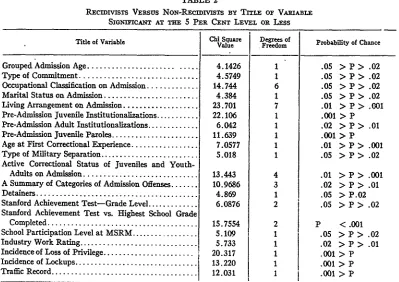
each variable. Fifteen of the 20 variables found to be significant pertained to pre-institutional characteristics. These variables, identified at the time of admission to MSRM, are described below.
2Yates, Contingency Tables Involving Small Numbers
and the x Test, RoYAL STATISTICAL SocIETY J. 217-35 (Supp. I).
Zuckerman, et al., supra note 1, at 634.
TABLE 1
DISTRIBUTION OF ALL SUBJECTS BY REcmivIsM
CLASS AT FoLLow-up
I Recidivists Non Recidivists
Class _
! f % f I ,%
1 181 40.58
I
I
14 3.14III 26 5.83
IV 17 3.81 V 35 7.85 VI 5 1.12
VII 1 .22
VIII 0
iX 167 37.44
Total ... 278 168
Pre-Inslitutional Factors
Admission Age. The mean and median admission
ages of the subjects were 23.58 and 22.09 years, respectively. There was a significant difference in the admission age between the recidivists and the non-recidivists. Of the recidivists, 80.92 per cent were less than 25 years of age, while 63.10 per cent of the non-recidivists were below that age. From observing these age differences, it may be inferred that there are factors involving increased maturity and stability which in the long run may be directly related to a. lower incidence of anti-social behavior after release. This variation in age between the two gcoups is also apparent from the significant difference in the type of District Court com-mitments to the Youth Conservation Commission as a youthful offender or directly to MSRM as an adult offender.
Occupation. A remarkable difference is apparent
from a comparison of the subjects' occupational skill level with that of the 1960 Minnesota male population. Almost 76 per cent of the subject group was in the unskilled occupational category, as opposed to 9.1 per cent of the Minnesota male population. The occupational skill level of the recidivists was found to be significantly below that of the non-recidivists. However, when the type of offense committed was analyzed in relation to the occupational skill level, no significant dif-ference was observed.
Marital Status. The rate of the subjects who
RESEARCH REPORTS
(23.2 per 100).4
The recidivists differ significantly from the non-recidivists in this respect, the re-cidivists showing a higher degree of "stability" on the criterion of marital status alone. It is not pos-sible to assess the meaning of this difference in terms of admission marital status alone without knowledge of the adequacy of marital relationship.
Living Arrangement. On admission only 45.77
per cent of the subjects were living in intact family situations (i.e., living with natural parents, wife, or wife and children). This suggests the high de-gree of family dismemberment or disruption that all subjects experienced prior to their MSRIM ad-mission. The non-recidivists show a remarkably significant tendency to come from more intact living situations than do the recidivists. This find-ijng supports the general assumption that criminals and delinquents are members of families which have experienced a high incidence of disintegra-tion.
Correctional History. The subject group was
ex-posed to a great variety and frequency of cor-rectional experiences prior to admission. Com-parison of the recidivists with the non-recidivists shows no significant difference in juvenile and youth-adult arrests or in juvenile or youth-adult probation. There is, however, a significant dif-ference in juvenile and youth-adult institution-alizations and juvenile paroles: for both institu-tionalization and parole, the recidivists had a significantly greater incidence than did the non-recidivists. No difference was found in youth-adult paroles. The recidivists exhibit a greater incidence of all types of pre-admission correctional experiences than do the non-recidivists.
The median age of all the study subjects at the time of their first formal correctional experience was 16.34 years. The recidivists were significantly younger than the non-recidivists at the time of their first formal correctional experience. The median age of the recidivists was 15.85 years and of the non-recidivists 17.42 years. It is particularly noteworthy that the recidivists were not only younger at the time of their first correctional ex-perience, but also were admitted to MSRM at a significantly earlier age.
Military Service. Over 50 per cent (225) of the
subjects experienced military service prior to ad-mission. This is an 11.75 per cent greater incidence
IPopulation, Marriages and Divorces and Rates: United States, 1920-56, 48 Vital Statistics Nat'l
Sum-maries 58 (April, 1958).
than for the Minnesota male population over 14 years of age.' The latter group includes an age range greater than the attained age of the subject population; therefore this difference is a conserva-tive estimate.
Of greater significance is the fact that of the subjects who experienced military service, 46.23 per cent received military separations under "con-ditions other than honorable" as compared with 5.8 per cent .for the general United States male population.6 There is definite support, therefore, for the belief that earlier patterns of personal mal-adjustinent among the subjects were carried over into their military service. The recidivists showed a significantly higher degree of maladaptive behavior in their military experience than did the non-recidivists, as indicated by the extent of their "other than honorable conditions" of separation. Obviously, the men separated from the military service under these conditions must be considered as having a poorer prognosis for satisfactory social adjustment after a penal experience than those men separated under honorable conditions. Both of these conclusions coincide with John W. Man-nering's earlier findingsY
Correctional Status. Upon admission, 49.1 per
cent of the subjects were already under some form of formal correctional commitment. They were admitted to MSRM either for having violated probation or parole, for being on an escape status, or for continued incarceration to serve a previously imposed sentence. The non-recidivists were sig-nificantly less likely to have been under some previous formal correctional commitment at the time of their admission. Because of the remarkable difference on this variable, the authors believe that formal correctional status on admission has a positive relationship to the prognosis of post-release recidivism.
Offense. Seven offenses accounted for 83.52 per
cent of all admission offenses. The most frequent admission offenses were: grand larceny, all de-grees-27.57 per cent; burglary, all degrees-16.82 per cent; using auto without owner's permission-13.45 per cent; forgery, all degrees-8.96 per cent; robbery, all degrees-7.41 per cent; assault, all
5
1U.S. BUREAU OF THE CENSUS, U.S. CENSUS OF POPULATION: 1960. GENERAL SOCIAL AND EcoNoic
CHARACTERISTICS, MINNESOTA 25-199 (Final Report PC (1)-25C, 1961).
6 Communication received from Office of Secretary
of Defense, 29 June 1962.
1 Mannering, Significant Characteristics of Recidi-vists, 4 N.P.P.A.J. 216 (1958).
RESEARCH REPORTS
degrees-4.71 per cent; and carnal knowledge, all degrees-4.60 per cent.
Offenses against property accounted for 67.69 per cent of all the offenses, as opposed to 17.68 per cent for offenses relating to chastity, morals, and decency; 13.45 per cent for offenses against person; and 1.12 per cent for offenses against public justice. The recidivists showed a significantly higher proportion of property offenses than did the non-recidivists, although this relationship was reversed for offenses relating to chastity, morals, and decency, and for offenses against person. An analysis of the offenses committed by recidivists during the study-period shows a consistent tend-ency for those who commit property offenses prior to admission to repeat an offense in the same cate-gory during follow-up. This pattern was not evi-dent for the other offense categories. These results coincide with the findings of Lloyd E. Ohlin,8 John W. Mannering,9 and Sheldon Glueck.1 "
At least half of the subjects who recidivated did so within the first 18 months following study-release. The mean time from study-release to the time that recidivists committed their most serious
offense, which resulted in assignment to a
recidi-vism class, was 24.72 months. The median time was 17.88 months. The mean time from release to the commission of the first recidivistic offense (seriousness notwithstanding) was only 17.37 months.
Detainers. .Eighty-nine of the subjects had known
formal warrants or hold orders for other offenses in effect against them at the time of their admis-sion. The recidivists accounted for 65 (73.03%) of the detainers filed which quite obviously reflects the greater degree of pre-admission anti-social behavior of the recidivists as compared with the non-recidivists.
Stanford Achievement Tests. The mean Stanford
Achievement Reading and Grade Level Score for all subjects to whom these tests were administered was 8.49 grades and 7.89 grades, respectively. The educational grade level actually completed by the total subject group was compared with their achievement level on the Stanford Achievement Test. Here, a highly significant difference emerged indicating that the actual Stanford Achievement level was markedly below the school grade com-pleted. In other words, the subject group was
80HmLIN, SELECTION FOR PAROLE 12 (1951). 9 Mannering, supra note 7, at 216-17.
10 S. & E. GLUECK, 500 CRIMINAL CAREERs 246-76 (1930).
unable to perform the work expected at the grade level which they had actually completed prior to admission.
When the SAT scores of the recidivists and the non-recidivists were compared, no significant dif-ference was observed for reading level achieve-ment. On grade level achievement, however, the difference was significant and showed the achieve-ment of recidivists to fall well below that of the non-recidivists.
Intra-Institutional Factors
MSRM Schooling. Over 32 per cent of the
sub-jects participated in some phase of the institution's formal educational program: 17.49 per cent took grade school courses; and 15.47 per cent enrolled in high school courses. The recidivists showed a significantly greater participation in the formal school program than did the non-recidivists, al-though the overall participation level of both groups in this program was considered very low. In these programs the non-recidivists achieved at a somewhat higher, but not significantly higher, level than did the recidivists. The findings related to institutional schooling thus failed to differentiate between the two groups.
Work Ratings. The only one of the five work
performance ratings for which the recidivists dif-fered significantly from the non-recidivists was "Industry." On this variable the non-recidivists earned the higher ratings. No particular inference can be drawn from this finding, however, because of the apparent rating problems which were in-herent in the relatively unstandardized rating sys-tem.
Discipline. Formal disciplinary measures for
violation of institutional rules were imposed on over 55 per cent of the subjects: 55.61 per cent received one or more privilege losses, and 32.06 per cent received one or more periods of lockup.
A remarkably significant difference was ob-served between the two subject groups in the ex-tent of privilege loss experienced during incarcera-tion. Approximately 64 per cent of the recidivists received this type of discipline as opposed to over 41 per cent of the non-recidivists. Not only were the recidivists more frequently disciplined by privilege losses than were the non-recidivists, but they were responsible for over 80.37 per cent of the 866 total privilege losses by the entire subject group.
RESEARCH REPORTS6
the 311 total lockups imposed on all subjects. Of the non-recidivist group, 21.43 per cent experienced lockup discipline versus 38.49 per cent for the recidivists.
Post-Institutional Factors
Traffic Violations. During the five year
study-period traffic violations were committed by 225 (50.45%) of the subjects. The State of Minnesota Highway Department statistics for 1956-1961 reveal that 25 per cent of the licensed drivers com-mitted violations. It is significant that the per-centage of violations by the Minnesota licensed driver population was one-half that of the subject group. This is especially meaningful in that many subjects had extended periods of incarceration during the follow-up period. During incarceration the subjects' violation "risk" was zero, whereas, the general driver population was exposed to its usual "risk" rate. The non-recidivists showed a significantly higher incidence of traffic violations after study-release than did the recidivists: 61.31 per cent versus 43:88 per cent. The fact that the recidivists were incarcerated a greater portion of the post-,release follow-up period than were
the non-recidivists was probably responsible for the recidivists' lower incidence of traffic violations or license revocations, since the recidivists ob-viously had a reduced exposure "risk" to traffic violation. For this reason, traffic violations are not useful to differentiate between recidivists and non-recidivists.
Minnesota Multiphasic Personality Inventory. A
specific attempt was made to determine whether the Minnesota Multiphasic Personality Inventory alone could be used as a factor in prognosticating recidivistic behavior of the study sample. There wereavrailabletothisresearch 372 admission MMPI profiles and 210 pre-release MMPI profiles per-taining to the 446 subjects under consideration.
Five clinical psychologists, who use the MMPI in daily practice, were requested independently to do a "blind sort" on admission MMPI profiles, and again or pre-release MMPI profiles. They were to indicate whether or not they would have pre-dicted recidivistic or non-recidivistic behavior after release for each profile examined. The criteria for recidivism and non-recidivism given them were the following: recidivist--an individual who is re-leased from the institution and continues to be a TABLE 2
RECID VmsTS VERSUS NON-RECDIViSTS By TInTLE OF VARIABLE
SiaNnizcA-T AT THE 5 PER CENT LEVEL oR LEss
Title of Variable Chi Square Degrees of
Value Freedom Probability of Chance
Grouped Admission Age ... 4.1426 1 .05 > P > .02
Type of Commitment... 4.5749 1 .05 > P > .02
Occupational Classification on Admission ... 14.744 6 .05 > P > .02
Marital Status on Admission ... 4.384 1 .05 > P > .02
Living Arrangement on Admission ... 23.701 7 .01 > P > .001
Pre-Admission Juvenile Institutionalizations ... 22.106 1 .001 > P
Pre-Admission Adult Institutionalizations ... 6.042 1 .02 > P > .01 Pre-Admission Juvenile Paroles ... 11.639 1 .001 > P
Age at First Correctional Experience ... 7.0577 1 .01 > P > .001
Type of Military Separation ... 5.018 1 .05 > P > .02 Active Correctional Status of Juveniles and
Youth-Adults on Admission ... 13.443 4 .01 > P > .001 A Summary of Categories of Admission Offenses ... 10.9686 3 .02 > P > .01 Detainers ... 4.869 1 .05 > P.02
Stanford Achievement Test-Grade Level ... 6.0876 2 .05 > P > .02
Stanford Achievement Test vs. Highest School Grade
Completed ... 15.7554 2 P < .001
School Participation Level at MSRM ... 5.109 1 .05 > P > .02
Industry Work Rating ... 5.733 1 .02 > P > .01 Incidence of Loss of Privilege ... 20.317 1 .001 > P Incidence of Lockups ... 13.220 1 .001 > P Traffic Record ... 12.031 1 .001 > P
[image:7.505.33.432.357.639.2]RESEARCH REPORTS
chronic lawbreaker or commits one or more serious
offenses; non-recidivist-an individual who is re-leased from the institution and has no record of an offense, or who commits one or more minor of-fenses such as any ordinary citizen might commit. The panel of judges consisted of a clinical psy-chologist from the Department of Psychiatry at University of Minnesota Hospitals, the Director of the Personality Study Center at the University
of Minnesota, the two psychologists at MSRM from the Division of Youth Corrections and the Division of Adult Corrections, and the Associate Warden for Treatment at the Minnesota State Prison. Agreement of three or more of the five judges on recidivism or non-recidivism was taken as the basis for consensus prognostication.
From the admission profiles, at least three out of five judges were able to predict recidivistic be-TABLE 3
REciDIviSTS VERsus NON-RECIDIVISTS By TITLE OF VARIABLE
NOT SIGNIFICANT AT THE 5 PER CENT LEVEL
Title of Variable
Race ... ... ...
Professed Religion on Admission ...
I
Intelligence Levels on Admission ... i Highest Educational Level Completed on Admission .... Marital Status of Natural Parents ...Pre-Admission Juvenile Arrests ... Pre-Admission Adult Arrests ... Pre-Admission Juvenile Probations ... Pre-Admission Adult Probations ... Pre-Admission Adult Paroles ... M ilitary Service ... ... Total Sentence ...
Intelligence Level Related to Admission Offense Category:
Against Property ... ... Relating to Chastity, Morals, Decency ... Against Person ...
Occupations Related to Admission Offense Category:
Against Property...
Relating to Chastity, Morals, Decency ... Against Person ...
Plea at Arraignment for Admission Offense ... Judges Admission MMPI Prediction with Actual
Re-cidivism ... Judges Pre-Release MMPI Prediction with Actual
Re-cidivism ... ... Stanford Achievement Test Reading Level ... High School Grades Earned ... Behavior-Work Rating... ... Attitude W ork Rating... ... Reliability Work Rating ...
Work Progress Work Rating ...
I
Total Work Rating ... . ...
Mental Hospitalization Experience... Camp or Farm Colony Placements ... Subjects Paroled from MSRM and Willow River Camp
Prior to Study-Release... Traffic Violation Point Record...
Type of Study-Release ...
Chi Square Degrees of Probability of Chance
Value I Freedom
3.742 3.275 1.824 5.103 3.6762
.232 .004 .944 .001 2.419 .363 6.296
1.1902 .1674 3.3693
.4654 1.0781 1.3920 .729
1.6358
2.5793 3.499
.890 1.211 .774 .646 .192 1.319 1.154 5.006
.0044 1.63 5.819
.10 > P > .05 .90 > P > .80 .50 > P > .30 .20 > P > .10 .10 > P > .05 .70 > P > .50 .50 > P > .30
.50 > P > .30
.98 > P > .95 .20 > P > .10 .50 > P > .30 .20 > P > .10
.30 > P > .20 .70 > P > .50 .10 > P > .05
.50 > P > .30 .30 > P > .20 .30 > P > .20 .50 > P > .30
.30 > P > .20
.20 > P > .10 .50 > P > .30 .50 > P > .30 .30 > P > .20 .50 > P > .30 .50 > P > .30 .70 > P > .50 .30 > P > .20 .30 > P > .20 .20 > P > .10
.95 > P > .90 .30 > P > .20 .20 > P > .10
[image:8.505.22.418.192.650.2]RESEARCH REPORTS
havior correctly for 61.14 per cent of the subjects who later became recidivists. They correctly pre-dicted non-recidivism for 53.8 per cent of the subjects who did not later become recidivists.
From the pre-release MMPI profiles, at least three out of five judges were able to predict re-cidivism correctly for 53.97 per cent of the actual recidivists, and correctly for 41.67 per cent of the actual non-recidivists. There was no significant difference in the judges' ability correctly to predict recidivism or non-recidivism from either admission or pre-release profiles.
Since the judges were aware that they were being asked to predict recidivism or non-recidivism for a group of individuals who served sentences as criminal offenders, they might have been expected to predict a higher incidence of recidivistic be-havior among the subjects.
Neither in admission nor pre-release profile com-parisons of recidivists and non-recidivists was there a statistically significant difference in the judges' ability to differentiate the recidivists from the non-recidivists; However, the results reveal that in fact they did not predict recidivism as fre-quently as it actually occurred.
The MMPI data do not appear to be of sig-nificant predictive value when used as the only measuring technique. This does not preclude its usefulness when it is utilized in conjunction with other measurements, clinical data, and other pre-dictive items. It is altogether feasible that an item analysis of the available data could identify items which might differentiate recidivists from non-recidivists. This possibility is presently being in-vestigated as a project apart from this study. Other investigators have and are still exploring the predictive usefulness of the MMPI as an indicator of delinquency and criminality.
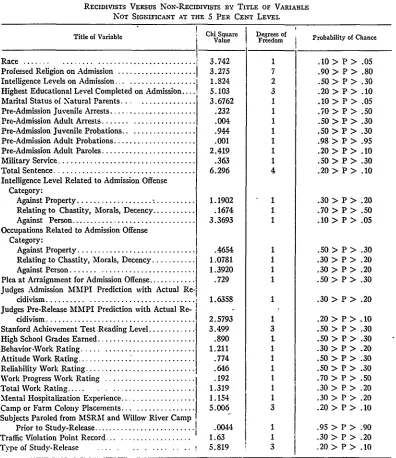
Table 2 summarizes all of the variables which statistically differentiated recidivists from non-recidivists at a confidence level of five per cent or better. Table 3 summarizes those variables which did not significantly differentiate between the two groups. Of the 53 variables tested for significant difference, 37.73 per cent (20) did differentiate recidivists from non-recidivists at the stated level of confidence. This percentage exceeds chance ex-pectancy.
DISCUSSION
Questions pertaining to recidivism, which are raised by the findings of this study, cannot be
an-swered only by an analysis of the characteristics of offenders, a review of the correctional experience and treatment, or the post-release behavior of the subjects studied. The effectiveness of correctional programs for the prevention of recidivism lies at the root of the entire contemporary philosophy underlying penal institutional treatment. For instance, when one examines the educational grade level completed by these subjects and views it in relation to the overwhelming lack of occupational skill, there is a clear implication that correctional programs alone cannot alleviate this formidable deficiehcy. Therefore, the community must accept the responsibility for developing programs which provide an opportunity to increase occupational skills. Because this study has shown that criminal offenders-and to an even greater degree recidi-vists-have this occupation handicap, such a pro-gram must be viewed as an important element in preventing criminality. It is not realistic to expect that a correctional institution such as MSRM can, during a relatively short period of confinement, effectively overcome the very obvious educational and vocational deficiencies with which the vast majority of offenders are faced. Because crime and delinquency appear to be directly related to a lack of achievement, it is of the highest importance that communities engage in educational programs that meet these obvious needs.
Any assessment of post-institutional "success or failure" must take into consideration many vari-ables which defy meaningful measurement by techniques presently available to research in this field. Accordingly, further investigatiohs must vigorously exploit any present methods that offer a way of quantifying observations that are made. Only through carefully planned research design and exhaustive inquiry will researchers be able to identify and measure those variables which can shed light upon the etiology and subsequent under-standing of the phenomenon of recidivism. How-ever, these alone are not enough. Researchers must develop among themselves the kind of communi-cation which will make it possible for individual efforts and findings to be synthesized into a total overview of the problem in all of its ramifications. It is in this context that the authors offer this study as one contribution to further understanding the baffling problem of defining recidivism, establish-ing insight into the etiology of recidivistic behavior, and identifying those offenders who may or may not be expected to become recidivists after ex-posure to correctional treatment.
![3,3,6,6 Tetraphenyl trans tricyclo[3 1 0 02,4]hexane](data:image/gif;base64,R0lGODlhAQABAIAAAP///wAAACH5BAEAAAAALAAAAAABAAEAAAICRAEAOw==)