N A N O E X P R E S S
Open Access
Positronics of subnanometer atomistic
imperfections in solids as a high-informative
structure characterization tool
Oleh Shpotyuk
1,2*, Jacek Filipecki
2, Adam Ingram
3, Roman Golovchak
1, Mykola Vakiv
1, Halyna Klym
1,4,
Valentyna Balitska
1,5, Mykhaylo Shpotyuk
1,4and Andrzej Kozdras
3Abstract
Methodological possibilities of positron annihilation lifetime (PAL) spectroscopy applied to characterize different types of nanomaterials treated within three-term fitting procedure are critically reconsidered. In contrast to conventional three-term analysis based on admixed positron- and positronium-trapping modes, the process of nanostructurization is considered as substitutional positron-positronium trapping within the same host matrix. Developed formalism allows estimate interfacial void volumes responsible for positron trapping and characteristic bulk positron lifetimes in nanoparticle-affected inhomogeneous media. This algorithm was well justified at the example of thermally induced nanostructurization occurring in 80GeSe2-20Ga2Se3glass.
Keywords:Nanomaterials; Subatomic void; Positron annihilation lifetime; Positronics; Trapping
Background
Progress in the modern nanomaterial science relies, to a great extent, on high-informative characterization probes sensitive to length scales of atomic and subatomic ranges. One of such probes is grounded on positronics, e.g., ana-lytical space-time continuum determination for electron interaction with its antiparticle, the positron.
This phenomenon realized as positron annihilation life-time (PAL) spectroscopy can be applied to study atomistic imperfections such as free-volume defects (vacancies, vacancy-like clusters, voids and void agglomerates, pores and even macroscopic cracks, etc.) in different solids des-pite their structural organization (crystals or glasses, fine-grained or coarse powders, ceramics or bulk alloys) [1-3]. In fact, such imperfections evolve subnanometer (ang-strom-scaled) low-electron-density spaces stretching far below characteristic sizes of a few bond lengths, a level which is beyond measuring possibilities for many direct ex-perimental structural probes (such as optical or electron microscopy). In application to semiconductors, this method
allows useful identification of intrinsic-free volumes owing to simple models considering competitive channels of posi-tron trapping from delocalized defect-free bulk states, deep ground states of positron traps (extended free-volume de-fects), and pick-off decaying of bounded positron-electron (positronium Ps) states [1,2]. But when dealing with nano-materials possessing nanostructural inhomogeneities, the PAL method seems too ambiguous in view of numerous complications in the adequate meaningful interpretation of the detected PAL spectra.
In this work, we shall analyze the possibilities of PAL technique (the positronics) to characterize free-volume void evolution processes caused by nanostructurization in nanoparticle-embedded substances, where intrinsic inclu-sions can affect both positron- and Ps-trapping channels in the overall balance of annihilation events possible in a host matrix.
Methods
It is well known that in a majority of nanostructurized systems, the PAL spectra typically yield three distinct lifetime componentsτ1,τ2, andτ3withI1,I2, andI3 rela-tive intensities (I1+I2+I3= 1) reflecting competitive in-put from positron and Ps-trapping channels [1,2]. * Correspondence:[email protected]
1Lviv Institute of Materials of SRC“Carat”, Stryjska str., 202, Lviv 79031, Ukraine 2
Jan Dlugosz University, Al. Armii Krajowej, 13/15, Czestochowa 42201, Poland
Full list of author information is available at the end of the article
The longest PAL component (τ3,I3) originates from the decaying of spin-triplet ortho-positronium o-Ps states in free-volume holes of the material. This process stretched intrinsically in a vacuum ending by emitting three γ-rays with theoretical lifetime of 142 ns, whereas in a matter, it is quenched in shorten lifetimes of a few nanoseconds be-cause of Ps interaction with electrons from a surrounding medium. As a result, the o-Ps annihilates extrinsically in a medium-emitting twoγ-rays, the process known as pick-off annihilation [1,2]. A simple empirical relation in the form of
τ3¼0:5⋅ 1− R
RþΔRþ
1 2π⋅sin
2πR RþΔR
−1
ð1Þ
with material-related parameter ΔR equivalent to elec-tron layer thickness for Ps penetration wall region of free-volume trapping void (1.66 Å) was proposed to ac-count for the o-Ps lifetimes τ3 in dependence on void radii Rin molecular substrates such as polymers, using infinite potential spherical model initially developed by S.J. Tao [4].
The intermediate PAL component (τ2, I2) results from positron (not Ps) annihilation from free-volume defect sites such as atomic and subatomic voids (vacancies, vacancy-like clusters, etc.). Being trapped by such defect, the positron annihilate with character lifetimesτ2=τd ran-ging from 0.2-0.3 to 0.5 ns [1]. This channel of positron annihilation is interbalanced by input from delocalized positrons annihilating directly from defect-free bulk states, thus forming a character two-state trapping scheme with compensating (τ1, I1) component and average positron lifetimeτavdefined as [5]
τav¼ηb⋅τbþηd⋅τd¼τ1⋅I1þτ2⋅I2; ð2Þ
where ηd and ηb is fraction of defect-trapped and
free-annihilated positrons, respectively (ηd= 1−ηb). Thus,
the shorterτ1component is only the reduced bulk life-time, which occurs to be directly connected with defect-free bulk positron lifetimeτbas
τb¼ τ1τ2
I1τ2þI2τ1: ð3Þ
In case of three-component fitting of PAL spectra, this situ-ation is disturbed by additional input in the first (τ1, I1) component from spin-singlet para-positronium p-Ps states, giving τp= 0.125 ns with relative population Ip=I3/3 for vacuum. So in reality, the annihilation from defect-free bulk states are admixed to p-Ps decaying channel, making essen-tial complication in a physical meaning of this component. That is why the direct correlations are not allowed often for this (τ1,I1) component and material-related parameters of the studied media [6,7].
In our model, we shall try to distinguish these inputs in the first PAL component to release“pure” feedback caused by nanosized free-volume positron traps themselves. Hence, by assuming an additive two-state positron-trapping model for these defect states, we obtain a realistic possibility of their quantitative parameterization. Like [8,9], we use the generalization procedure allowing transformation of the measured PAL spectra from three-term to two-term decom-position form.
Firstly, this analysis has to be applied to host matrix with-out embedded nanoparticles having (τ1host,I1host), (τ2host,I2host), and (τ3host, I3host) component inputs in three-term decom-posed row PAL spectrum (I1host+I2host+I3host= 1). This model can be easily transferred to two-term trapping one by removing Ip=I3/3 input of p-Ps annihilation withτp=
0.125 ns lifetime from the first channel and (τ3host,I3host) in-put from the third channel to the generalized trapping channel. Thus, we can estimate the contribution (τa,Ia) to
the first channel other than p-Ps:
τa⋅Ia ¼ τ1hostτ1host⋅I1hostI1host–τp⋅Ip; ð4Þ
Ia ¼ I1hostI1host–Ip: ð5Þ
Then, returning to nanoparticle-embedded sample having (τ1*,I1*), (τ2*,I2*), and (τ3*,I3*) inputs in three-term decomposed PAL spectrum (I1*+I2*+I3*= 1), we can find input from add-itional trapping channel (τint,Iint) assuming that the second channel is composed by theseint-sites and remainder of o-Ps-trapping sites taken like as in a host matrix, so that
I2 ¼ Iint þ I3IintþI3⋅ I2host=I3host
I2host=I3host; ð6Þ
τ2⋅I
2 ¼ τintτint⋅IintIint þ τ2hostτ2host⋅ I
2−Iint
ð ÞðI2−IintÞ: ð7Þ
By transferring three-term PAL spectrum into two-term one with (τa*, Ia*) and (τt*, It*) components like in host
matrix, we can find compensating (τn, In) input arising
from this additional trapping channel (τint, Iint). Under this condition, it seems quite reasonably to equilibrate the (τn·In) input in (τa*, Ia*) component (without p-Ps)
with the same as the (τint·Iint) input in (τ2*,I2*):
τn⋅ In
τa⋅
Ia ¼ τintτint⋅
IintIint
τ2 ⋅I2I2: ð8Þ
free-volume defects can be associated with pseudogap holes at the interface between the outer surface layer of agglomer-ated nanoparticles and innermost layer of surrounding host matrix (as it was well outlined in [8,9]). The bulk positron lifetime recalculated respectively to these components in full agreement to Equation 3 can be attributed to bulk positron lifetime of agglomerated nanoparticles. In case of highly monolith particles, this value tends towards bulk positron lifetime of corresponding substance, while in more loose media, it remains higher. The positron-trapping rate of nanoparticle-related trapsκdcan be also estimated in terms
of known two-state positron-trapping formalism [1-3]. Thus, the developed approach allows description of nanostructurization in terms of substitutional positron-Ps trapping within the same host matrix, e.g., the process, which occurs as a transformation of o-Ps-sites in a host matrix towards positron-trapping sites in a nanoparticle-modified material. By accepting a tightly connected nature of these PAL trapping sites, we can define conditionally this approach as coupling x3-x2-decomposition algorithm
to distinguish it fromconventional x3-decomposition pro-cedure, describing the PAL spectra in terms of admixed positron-Ps trapping. Under such transformation, the quantitative characteristics of these trapping sites them-selves as well as the occurring final balance in the PAL components are not so important. However, if the process of nanostructurization is stretched in principally the other way, by example, as modification in defect-free annihila-tion channel changing essentially PAL parameters describ-ing positron annihilation from delocalized Bloch states throughout a whole host matrix, this algorithm cannot be further applied (new channels of positron annihilation
appear in the final three-term decomposed PAL spectrum, which are not foreseen within this simplification proced-ure). So, this algorithm is expected to serve liketest indi-cator for nanostructurization nature in different types of materials, separating the processes of host matrix modifi-cation from“pure”interplay between positron- and o-Ps-trapping channels.
Results and discussion
[image:3.595.57.538.486.703.2]As an example, let us consider free-volume void evolution in 80GeSe2-20Ga2Se3glasses caused by thermal annealing at 380°C for 10, 25, and 50 h [10,11]. This thermal treat-ment is essential for controlled ceramization causing a possibility to stabilize constituting amounts of some nano-crystals (Ga2Se3, GeSe2and/or GeGa4Se8) in the final struc-ture of reproducible glass ceramics. The fundamental role of nanosized domains appear by phase separation between Ge- and Ga-rich regions. Higher stability of such thermally treated system is ensured due to its modified structure with some nanocrystallites; this process being arranged in two tightly interconnected stages [11-13]. Firstly, the nucleation of growing crystal phase in glassy environment occurs at the beginning of thermal annealing. Further, the nucleated phase grows into separate grains reaching greater sizes, but, in general, they do not exceed a characteristic nanosized level (a controllable crystal growth). In respect to two-term decomposed PAL spectra [10], the appeared nanocrystallites modify a free-volume structure of the glass leading to specific fragmentation of larger free-volume entities (posi-tron-trapping sites) into greater number of smaller ones with preliminary void nucleation at the initial stage of an-nealing. So, this process is not elementary, being composed
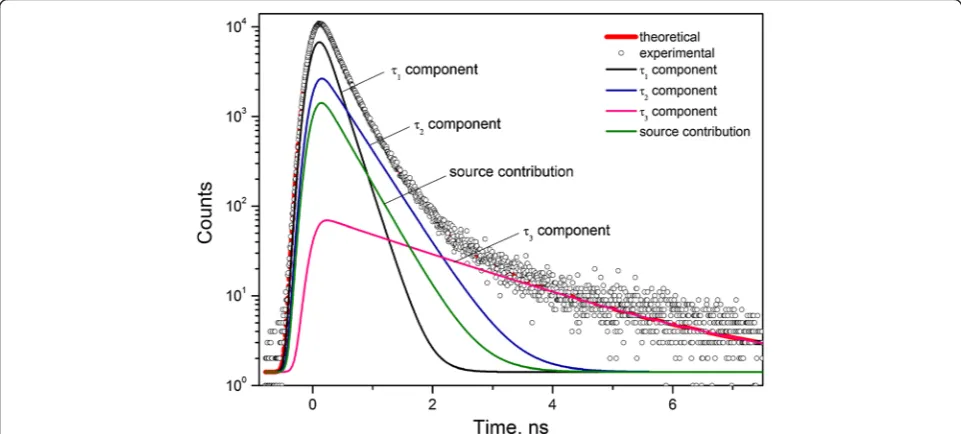
Figure 1Raw PAL spectrum of 80GeSe2-20Ga2Se3glass.Reconstructed from three-term fitting procedure at the general background of standard
of two principally different types of free-volume void evolution, the initial agglomeration followed by void frag-mentation at the final stages. The sizes of corresponding nanocrystalline inclusions estimated from most characteris-tic peak observed in the XRD patterns of thermally annealed samples in respect to known Debye-Scherrer equation testi-fies that they reach near 9 to 10 nm.
Typical raw PAL spectrum of initial 80GeSe2-20Ga2Se3 glass (not affected by thermal treatment) reconstructed from three-term fitting procedure at the general background of standard source contribution is shown in Figure 1 (the simi-lar spectra were obtained for all other samples). This PAL spectrum as a typical histogram of elementary positron an-nihilation events is characterized by a narrow peak and re-gion of long fluent decaying of coincidence counts in a time. Thus, the decaying behavior of such curve is represented by the sum of exponents with different time constants inversed to positron lifetimes [1-3]. The best-fit positron-trapping pa-rameters of the studied samples calculated within three-term fitting are given in Table 1.
Therefore, to apply the above coupling x3-x2-decom-position algorithm, the PAL spectra of host and thermally annealed 80GeSe2-20Ga2Se3 glasses were recalculated in terms of conventional three-component x3 fitting. It is ob-vious that third component related to o-Ps decaying plays no essential role in overall nanostructurization, being at the level of statistical deviation (I3≅0.031 ns), while τ3 lifetime slightly grows in all partially crystallized samples. In contrast, the second lifetime component τ2reveals an increase and simultaneousI2decrease in the initial stages of annealing (10 h) because of preliminary void expansion (void agglomeration) and further decrease in τ2lifetimes with simultaneous I2 increase during more prolonged
annealing (25 h and especially 50 h) testifying in a favor of increased number of smaller free volumes (void fragmentation).
In conventional mixed positron- and o-Ps-trapping modes, all samples demonstrate nearly the same average τav. and bulk τbpositron lifetimes (0.291 and 0.260 ns,
respectively). Such great value of bulk positron lifetime τb testify in a favor of rather loose packing of corre-sponding nanoparticles (bulk crystallites), which is caused by principal impossibility to distinguish inputs from different positron- and o-Ps-trapping modes.
The above coupling x3-x2-decomposition formalism allows this, since“pure”positron-trapping modes alone can be simply extracted at the general background of overall trapping processes as it is well demonstrated in Table 2 in respect to host and 10-h annealed 80GeSe2 -20Ga2Se3glasses.
The constancy in the intensity of third component (I3in Table 1) testifies that positron-trapping sites appear in addition to o-Ps ones, so they are being formed in the inter-stitial positions between them. But negative values of PAL componentIint.in the reconstructed final x2-spectrum in
re-spect to host glass indicate that realistic process is connected rather with void disappearing, which can be treated as case of void agglomeration. Indeed, under the condition thatI3*≅
I3host, the decreasing I2* intensities in Equation 6 provide negative values forIint. Thus, in full agreement with previous conclusion extracted from x2-decomposed PAL spectra [10], the Iint. intensities attain firstly negative values, this
[image:4.595.57.539.101.193.2]process being quickly saturated in a 50-h annealed sample. If we reconsider these results in respect to a 10-h annealed sample (the second line in Table 2), we can ob-serve two principally different tendencies in void evolution. Table 1 Fitting parameters and corresponding trapping modes
Sample, prehistory Fitting parameters PAL trapping modes
τ1
ns I
1
a.u. τ
2
ns I
2
a.u. τ
3
ns I
3
a.u. τ
av
ns τ
b
ns κnsd−1
Host glass 0.203 0.527 0.401 0.443 1.892 0.030 0.293 0.262 1.11
Annealed, 10 h 0.214 0.618 0.428 0.351 2.059 0.031 0.291 0.261 0.85
Annealed, 25 h 0.215 0.633 0.432 0.337 2.038 0.030 0.291 0.261 0.81
Annealed, 50 h 0.210 0.605 0.424 0.365 2.159 0.030 0.290 0.259 0.90
[image:4.595.56.540.645.725.2]These are determined within conventional x3-decomposition procedure for PAL spectra of host and thermally aged 80GeSe2-20Ga2Se3 glasses.
Table 2 PAL trapping modes for 80GeSe2-20Ga2Se3glasses
Sample, prehistory τn
ns τ
int
ns I
int
a.u. τ
b
ns κnsd−1 τnsn nsτint Ia.u.int τnsb κnsd−1
Host glass - - - 0.160 0.298 0.092 0.205 1.37
Annealed, 10 h 0.160 0.298 −0.092 0.194 1.10 - - - -
-Annealed, 25 h 0.181 0.302 −0.106 0.197 1.04 0.189 0.332 −0.014 0.226 0.87
Annealed, 50 h 0.158 0.269 −0.064 0.191 1.09 0.163 0.370 0.025 0.203 1.20
The glass annealed for 25 h is still affected by slight void ag-glomeration (Iint. =−0.014), while host and 50-h annealed
glasses are under obvious void fragmentation (appearance of new positron-trapping sites). The bulk positron lifetimes in all samples are smaller than previously observed τb≅ 0.260 ns [10], corresponding to positron trapping occurring just in the nanocrystalline particles itself. The appeared/dis-appeared interfacial free-volume voids are not too large, since the characteristic value of τint= 0.27 to 0.30 ns life-time can be associated with typical volumes of mono- or di-atomic vacancies in chalcogenide-like systems [1,3,14-16].
It is also worthwhile to mention that free-volume inter-facial voids in glassy samples affected by more essential fragmentation (50-h annealed samples taken in respect to 10-h annealed ones) are larger as compared with agglomer-ated free-volume voids (the corresponding value of defect-relatedτintlifetime reaches 0.370 ns). This finding occurs to be in good agreement with a known trend towards dimen-sional enlargement of such voids occurring under decrease in the nanoparticle sizes [17].
Conclusions
Positronics of atomistic imperfections such as free-volume interfacial voids in nanostructurized solids with positron-trapping modes changed by incorporated nanoparticles is developed as unified mathematical algorithm of substitu-tional positron-positronium trapping in the same host matrix. Within developed formalism, grounded on coup-ling x3-x2-decomposition procedure, the physical charac-teristics of nanostructurized media can be well calculated to estimate (1) the defect-related positron lifetime linked to interfacial void volumes responsible for positron trap-ping and (2) the defect-free bulk positron lifetime of the agglomerated nanoparticles.
Competing interests
The authors declare that they have no competing interests.
Authors’contributions
OS, RG, MV, HK, VB, and MS proposed an idea and methodological algorithm for the indication of nanostructurization nature in different types of materials, separating the processes of host matrix modification from interplay between positron- and o-Ps-trapping channels. AI, JF, and AK performed the experiments using positron annihilation spectroscopy for study of the model object (nanoceramized 80GeSe2-20Ga2Se3glass). All authors read and approved the final
manuscript.
Author details
1Lviv Institute of Materials of SRC“Carat”, Stryjska str., 202, Lviv 79031, Ukraine.2Jan Dlugosz University, Al. Armii Krajowej, 13/15, Czestochowa 42201, Poland.3Opole University of Technology, Ozimska str., 75, Opole 45370, Poland.4Lviv Polytechnic National University, Bandera str., 12, Lviv 79013, Ukraine.5Lviv State University of Vital Activity Safety, Kleparivska str., 35, Lviv 79007, Ukraine.
Received: 20 October 2014 Accepted: 19 January 2015
References
1. Krause-Rehberg R, Leipner H. Positron annihilation in semiconductors: defect studies. Heidelberg: Springer; 1999.
2. Jean YC, Mallon PE, Schrader DM. Principles and application of positron and positronium chemistry. New Jersey-London-Singapore-Hong Kong: World Sci Publ. Co. Pte. Ltd.; 2003.
3. Shpotyuk O, Filipecki J. Free volume in vitreous chalcogenide semiconductors: possibilities of positron annihilation lifetime study. Czestochowa: WSP; 2003.
4. Tao SJ. Positronium annihilation in molecular substances. J Chem Phys. 1972;56:5499–510.
5. Tuomisto F, Makkonen I. Defect identification in semiconductors with positron annihilation: experiment and theory. Rev Modern Phys. 2013;85:1583–631.
6. Dlubek G, Saarinen K, Fretwell HM. Positron states in polyethylene and polytetrafluoroethylene: a positron lifetime and Doppler-broadening study. Nucl Instr Meth Phys Res B. 1998;142:139–55.
7. Dlubek G, Clarke AP, Fretwell HM, Dugdale SB, Alam MA. Positron lifetime studies of free volume hole size distribution in glassy polycarbonate and polystyrene. Phys Stat Sol A. 1996;157:351–64.
8. Chakraverty S, Mitra S, Mandal K, Nambissan PMG, Chattopadhyay S. Positron annihilation studies of some anomalous features of NiFe2O4
nanocrystals grown in SiO2. Phys Rev B. 2005;71:024115-1-8.
9. Mitra S, Mandal K, Sinha S, Nambissan PMG, Kumar S. Size and temperature dependent cationic redistribution in NiFe2O4(SiO2) nanocomposites:
positron annihilation and Mössbauer studies. J Phys D Appl Phys. 2006;39:4228–35.
10. Shpotyuk O, Calvez L, Petracovschi E, Klym H, Ingram A, Demchenko P. Thermally-induced crystallization behavior of 80GeSe2-20Ga2Se3glass as
probed by combined X-ray diffraction and PAL spectroscopy. J Alloys Comp. 2014;582:323–7.
11. Calvez L, Lin C, Roze M, Ledemi Y, Guillevic E, Bureau B, et al. Similar behaviors of sulfide and selenide-based chalcogenide glasses to form glass-ceramics. Proc Spie. 2010;7598:759802-1–759802-16.
12. Calvez L, Ma H-L, Lucas J, Zhang X-H. Selenium-based glasses and glass ceramics transmitting light from the visible to the far-IR. Adv Mater. 2007;19:129–32.
13. Calvez L, Roze M, Ledemi Y, Ma H-L, Lucas J, Allix M, et al. Similar behaviors of sulfide and selenide-based chalcogenide glasses to form glass-ceramics. J Ceram Soc Jap. 2008;116:1079–82.
14. Shpotyuk O, Ingram A, Shpotyuk M, Filipecki J. Prediction of free-volume-type correlations in glassy chalcogenides from positron lifetime measurements. Nucl Instr Meth Phys Res B. 2014;338:66–71.
15. Shpotyuk O, Filipecki J, Shpotyuk M, Ingram A. Free volume evolution in chalcogenide glasses as probed by PAL spectroscopy. Solid State Ionics. 2014;267:38–43.
16. Shpotyuk O, Vakiv M, Shpotyuk M, Ingram A, Filipecki J, Vaskiv A. Free-volume correlations in positron-sensitive annihilation modes in chalcogenide vitreous semiconductors: on the path from illusions towards realistic physical description. Semicond Phys Quant Electron Optoelectron. 2014;17:243–51.
17. Nambissan PMG. Probing the defects in nano-semiconductors using positrons. J Phys Conf Ser. 2011;265:012019-1-15.
Submit your manuscript to a
journal and benefi t from:
7Convenient online submission 7Rigorous peer review
7Immediate publication on acceptance 7Open access: articles freely available online 7High visibility within the fi eld
7Retaining the copyright to your article