Survey on Offline Finger Print Verification System
Rimpi Suman
Faculty of CSE/IT department
Rayat Bahra Institute Of Engg & Nano Technology,
Hoshiarpur (146001)
Ramanpreet kaur
Faculty of CSE/IT department
Rayat Bahra Institute Of Engg & Nano Technology,
Hoshiarpur (146001)
ABSTRACT
The fingerprint verification, means where "verification" implies a user matching a fingerprint against a single fingerprint associated with the identity that the user claims. Biometrics can be classified into two types Behavioral (signature verification, keystroke dynamics, etc.) And Physiological (iris characteristics, fingerprint, etc.).Finger Print and signature is one of the first few biometrics used even before computers. Finger Print verification is widely studied and discussed using two approaches. On-line approach and offline approach. Offline systems are more applicable and easy to use in comparison with on-line systems in many parts of the world however it is considered more difficult than on-line verification due to the lack of dynamic information. This paper presents about offline biometric identification method that had more attraction in recent years because of its necessity for use in daily life routines and when the Finger Print needs to be immediately verified like bank checks, biometric attendance etc. In this paper we present, features types and recent methods used for features extraction in Finger Print verification systems and approaches used for verification in Finger Print systems. Finally, we suggest new interesting ideas to be incorporated in the future.
General Terms
Fingerprint verification, fingerprint matching, biometric
Keywords
Finger print verification techniques Image enhancement, feature extraction, image filtering, feature detection, security, fingerprint sensor.
I. INTRODUCTION
Biometric identification methods such as fingerprint, face recognition, iris scanning, signature and DNA analysis are increasing because of their unique features. Human being Identifications are necessary these days for our daily activities such as crossing international borders and entering any secure locations, besides the many other applications. At this point, we must require higher security levels with easier user interaction or user friendly which can be achieved using biometric verification or fingerprint identification.
Biometric verification helps us to recognize people based on their extracted physical or behavioral features. These features must have some properties such as uniqueness, permanence, acceptability, collectability, scalability, portability and the
cost to implement any biometric system.
Generally, there are two common biometric feature types:
1) Physical features: Which including face, fingerprint, brighten, ear, palm print, retina, hand, finger geometry and DNA. Most of these features are relatively static with the passage of time.
2) Behavioral features: This is including features that measure the action of the person such as speaking, motion of body and writing. These features are dynamic which change over time due to age effect and other developmental and enhancement factors. A fingerprint gradually appears as set of black lines that represent the high, peaking portion of the friction ridge skin, while the free space between these ridges appears as white space and are the low, shallow portion of the friction ridge skin.
II. STATE OF THE ART IN OFFLINE
FINGERPRINT VERIFICATION
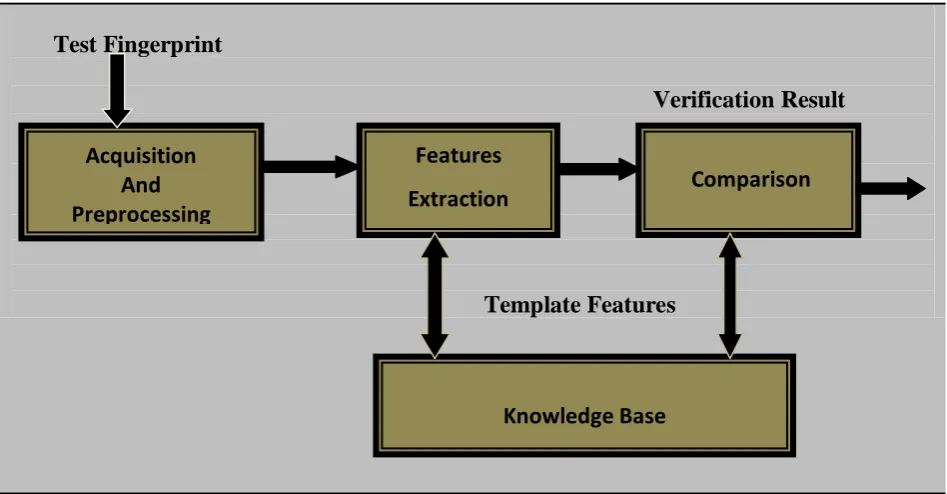
Approach: The state of the art in finger print verification follows a pattern that is similar to image processing with five steps as shown in figure1:
The input finger print are preprocessed, and then personal features are extracted and stored into the knowledge base, In the classification phase, personal features extracted from an inputted fingerprint are compared with template fingerprint stored in the knowledge base, to check authenticity of the test fingerprint.
Preprocessing
A preprocessing stage is done to improve the fingerprint image after scanning using a scanner device. This stage will influence the accuracy and reduce the computational time. It consists of two steps:
a)Fingerprint image Enhancement b)Fingerprint image Segmentation
a)Enhancement
:
This stage consists of Noise removal using any noise filter, Cropping the fingerprint image area Converting the image to binary image and Thinning using any suitable algorithm.
Figure 1: Finger Print Verification Work Flow
b) Segmentation
:
Which consists of finger print Extraction through extracting the smallest box that contains the fingerprint data the fingerprints height and width are determined and then the signature image is cropped and normalization which makes a standardization to the fingerprint size. the verification phase when the system reads a new input fingerprint image.
The main steps are:
Post Processing
In this stage, the system should extract the features from the reference set, create a template fingerprint and use it in the verification phase when the system reads a new input fingerprint image. The main steps are:
A) Features extraction
:It is the process of extracting the characteristics or attributes from an image. The pattern verification system accuracy depends mainly on the extracted features. The lines that flow in finger print pattern are called ridges. The blank space or gap between ridges is called valleys. We can classify the finger print verification systems in terms of extracted features into two kinds:
a) Global features: Global features describe the fingerprint image as whole. In this approach, the flow of ridges is compared at all locations between a pair of fingerprint images. The ridge flow constitutes a global pattern of the fingerprint. Two other features are sometimes used for matching: core and delta. Global features include different finger print patterns such as ARCH, LOOP and Whorl.
The core can be thought of as the center of the fingerprint
Patterns. The delta is a singular point from which three patterns deviate. [1] Three fingerprint patterns are shown in Figure: 2 [1]
a.1) Arch:
In which ridges flow at one end and flow out at opposite end. It can be categories asa. Plain arch
b. Tented arch
Plain arch: -
It starts from one side of a finger, and then ridge move upward a bit flow continually until reach at another end.
Tented arch: -
In this the ridges in the center that are not constant as in the case of the plain arch. It is as shown in figure a.1:
Figure a.1) Classification of Arch
Test Fingerprint
Verification Result
Template Features
Acquisition
And
Preprocessing
Features
Extraction
Comparison
[image:2.595.72.546.69.316.2] [image:2.595.315.542.534.666.2]Figure 2 Fingerprint patterns: arch, loop, and whorl. Fingerprint landmarks are also shown: core and delta.
a.2) Loop
: - In this pattern, the ridges enter at one side,
curve, and come back to the same side. It can be classified as shown in figure a.2.i.
Left slant Loop
: -
In this pattern, the ridges Enter at left side, curve, and come back to the same left Side.j.
Right slant Loop: -
-
In this pattern, the ridges Enter at right side, curve, and come back to the same right Side. As shown below:Figure a.2) Classification of Loop
a.3) Whorl: -
This pattern consists of spiral or series of
concentric circle. It can be classified as:i.
Plain whorl
: -There are at least two deltas and a ridge whose route can be curved, oval or round in shape.j.
Central Pocket Loop whorl: -
it is defined as a small circle of ridges in the middle of a whorl.l.
Accidental whorl: -
it is a combination of two different type of pattern with exception of plain arch. It consists of 2 or more delta fall into their own category. It is as shown below [image:3.595.333.536.389.689.2] [image:3.595.70.309.413.622.2]b) Local features
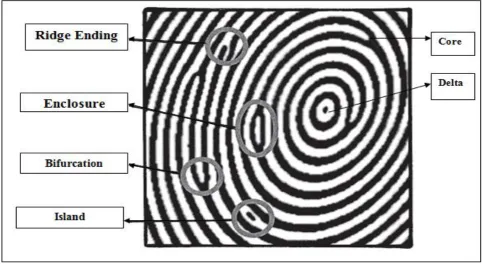
:The more microscopic of the approaches is called local processing of fingerprint such as minutiae matching. There are following minutiae types as shown in Figure 3
[image:4.595.55.538.138.402.2]Detail. A subset of the total amount of information available yet enough information to effectively search a large repository of fingerprints.
Figure 3: Fingerprint minutiae: ending and bifurcation.
b.1) Ridge ending
:
It is features which indicate terminate or end of ridge.b.2) Bifurcation
:
it is a feature which indicates a point at which ridge split into 2 parts.b.3) Enclosure:
Formation where ridge bifurcation and rejoin to be one in short distance.b.4) Island:
An Island is a line-type which stands alone. (i.e., does not touch another line-type and is totally contained in the pattern area of interest.)b.5) Delta:
It is a triangular-shaped pattern where
different fingerprint ridges meet.
b.6) Core:
c
ore point refers to the center area of a fingerprint. A fingerprint may have multiple cores or no coresIII. VERIFICATION
a)
Fingerprint recognition
Verification is typically used for positive recognition, where the aim is to prevent multiple people from using the same identity. Fingerprint verification is to verify the authenticity of one person by his fingerprint. There is one-to-one comparison in this case. In the identification mode, the system recognizes an individual by searching the templates of all the users in the database for a match. Therefore, the system conducts a one to-many comparison to establish an individual‟s identity [4].
b) Fingerprint Verification Techniques
Minutiae Extraction Technique:
I. The most widely used recognition technique minutiae-based matching, relies on the minutiae points extract the minutiae
II. Most of the finger-scan technologies are based on Minutiae. Minutiae based techniques represent the fingerprint by its local features, like terminations and bifurcations. This approach has been intensively studied, also is the backbone of the current available fingerprint recognition products [5].
2. Pattern Matching or Ridge Feature
Based Techniques
It is use to simply compares two images to see how similar they are. Pattern matching is usually used in fingerprint systems to detect duplicate.
3. Correlation Based Technique
-Let I(_x, _y, _) represent a rotation of the input image I by an angle _around the origin (usually the image center) and shifted by _x and _y pixels in directions x and y, respectively. Then the similarity between the two fingerprint images T and I can be measured as[6]
S(T,I)=
∆x, ∆y, Ɵ
Max
cc(T,I
(∆x ,∆y ,Ɵ)
)
Where CC (T, I) = TTI is the cross-correlation between T and I [8].
4. Image-based Techniques
Image based techniques tries to do matching based on the global features of a whole fingerprint image. It is an advanced and newly emerging method for fingerprint recognition. It is useful to solve some intractable problems of the first approach. [2].The minutiae-based approach contains many time-consuming steps and relies heavily on the quality of input images. In fingerprint images, however, minutiae are not always clear even though the information of ridge directions and inter-ridge distances is preserved. [13]. To avoid the drawbacks of minutiae based fingerprint verification system; the image-based fingerprint verification system has been described in which feature are extracted by using a bank of Gabor filters [15].
5.
Hybrid Fingerprint Verification Technique
This technique is combination of both Minutiae Based and Image (ridge) based technique to represent and match finger prints. A set of 8 Gabor filters, whose spatial frequencies correspond to the average inter-ridge spacing in fingerprints, is used to capture the ridge strength at equally spaced orientations. The proposed technique has the following features: (i) for constructing the ridge features map the entire image is taken into account (ii) after constructing ridge feature map the minutiae matching is used to determine the translation and rotation parameters relating the query and the template images for ridge feature map extraction; (iii) filtering and ridge feature map extraction are implemented in the frequency domain thereby speeding up the matching process; (iv) filtered query images are catch to greatly increase the one-to-many matching speed.[16]
IV. CONCLUSION
This paper is just a survey paper of offline fingerprint verification that‟s why we did not have any result of verification. This paper describes various different fingerprint verification techniques. We can use any of one technique from all these techniques to verify fingerprint. The main advantages for using offline finger print system are adaptability and implementation. It includes number of benefits i.e. easily to use, low cost of implementation, and the ease of embedding the system in organization without effecting existing system. In this paper we present a state-of-the-art for the latest methods used in offline finger print verification system. We categories the offline fingerprint
ending and bifurcation. We also summarized different approaches or techniques used for fingerprint verification.
V. FUTURE WORK
: The Finger print techniques and algorithm can improved by improving feature extraction and matching algorithms. There is lot of future research works in finger print verification such as using neural network approach.VI. ACKNOWLEDGMENTS
Our thanks to Dr. Manish Jindal who encourage and guide us for development of this paper. Special thanks to our parents, who were always positive about our output, were always with us in thick and thin and always pushing us further whenever we screwed up. And also thanks to my friends, who helped us with exploring the things, language of this paper.
VII. REFERENCES
[1] Fingerprint Verification Lawrence O‟Gorman Veridicom Inc. Chatham, NJ [email protected]
[2] An Efficient Multi Fingerprint Verification System Using Minutiae Extraction Technique, Chandra Bhan Pal, Amit Kumar Singh, Nitin, Amrit Kumar Agrawal, Department of CSE & IT, Jaypee University of Information Technology, Wakanaghat, Solan, H.P
[3] Finger print recognisation web page: www.biometrics.gov
[4] Manvjeet Kaur, Mukhwinder Singh, Akshay Girdhar, and Parvinder S. Sandhu, “Fingerprint Verification System using Minutiae Extraction Technique”, World Academy of Science, Engineering and Technology 46 2008.
[5] E. Hastings, “A Survey of Thinning Methodologies”, Pattern analysis and Machine Intelligence, IEEE Transactions, vol. 4, Issue 9, pp. 869-885, 1992.
[6] A. K. Jain, F. Patrick, A. Arun, “Handbook of Biometrics”, Springer Science+Business Media, LLC, 1st edition, pp. 1-42, 2008.
[7] Anil Jain and Lin Hong, (1996) „ On-line Fingerprint Verification‟, Proc. 13th ICPR, Vienna, pp. 596-600. [8] Manvjeet Kaur, Mukhwinder Singh, Akshay Girdhar,
andParvinde Sandhu,” FingerprintVerificationSystem using Minutiae Extraction Technique”, World Academy of Science, Engineering and Technology 46 2008.
[9] L. Hong, "Automatic Personal Identification Using Fingerprints", Ph.D. Thesis, 1998.
[10]M. A. Eshera and R. E. Sanders, “Fingerprint Matching System,” US Patent 5613014,1997.
[11]S. Ferris, R. L. Powers, and T. Lindh, “Hyperladder Fingerprint Matcher,” US Patent 5631972, 1997. [12]R. C. Gonzalez and Richard E. Woods, Digital Image
Processing, Addison-Wesley, Massachusetts, 1992. [13] “ Fingerprint Verification Using Wavelet And Local
Dominant Orientation” 1Bhushan D. Patil, 2Jayant V. Kulkarni, 2Raghunath S. Holambe( Email addresses:
[15]Zuniga and R. M. Haradick, Integrated Directional Derivative Gradient Operators, IEEE Trans. Systems,
Man, and Cybernetics, SMC-17, 1987,508-517.
[16]C. J. Lee, S. D. Wang, Fingerprint feature extraction using Gabor filters, Electron. Lett. 35 (4) 1999 288-290. [17] “A Hybrid Fingerprint Matcher” Arun Ross, Anil Jain,
James Reisman (rossarun, jain)@cse.msu.edu
[19]D. Maltoni, D. Maio, A. K. Jain, S. Prabhaker, “Handbook of
[20]Fingerprint Recognition,” Springer, New York, 2003.
[21]Manvjeet Kaur, Mukhwinder Singh, Akshay Girdhar, and Parvinder S. Sandhu, “Fingerprint Verification System using Minutiae
[22]Extraction Technique,” World Academy of Science, Engineering and Technology 46 2008.
[23]H. C. Lee and R. E. Gaensslen, “Advances in Fingerprint Technology,” Elsevier Science, New York, ISBN 0-444-01579-5.
[24] “Guide to Fingerprint Recognition” DigitalPersona, Inc. 720 Bay Road Redwood City, CA 94063 USA, http://www.digitalpersona.com
[25] “ ON SIMULTANEOUS LATENT FINGERPRINT MATCHING”
[26]Anush Sankaran, Mayank Vatsa and Richa Singh