N A N O E X P R E S S
Open Access
Intermatrix synthesis: easy technique permitting
preparation of polymer-stabilized nanoparticles
with desired composition and structure
Patricia Ruiz
1*, Jorge Macanás
2, María Muñoz
1and Dmitri N Muraviev
1*Abstract
The synthesis of polymer-stabilized nanoparticles (PSNPs) can be successfully carried out using intermatrix synthesis (IMS) technique, which consists in sequential loading of the functional groups of a polymer with the desired metal ions followed by nanoparticles (NPs) formation stage. After each metal-loading-NPs-formation cycle, the functional groups of the polymer appear to be regenerated. This allows for repeating the cycles to increase the NPs content or to obtain NPs with different structures and compositions (e.g. core-shell or core-sandwich). This article reports the results on the further development of the IMS technique. The formation of NPs has been shown to proceed by not only the metal reduction reaction (e.g. Cu0-NPs) but also by the precipitation reaction resulting in the IMS of PSNPs of metal salts (e.g. CuS-NPs).
Introduction
The development of preparative methods for the synth-esis of inorganic nanoparticles (INPs) with desired com-position, structure and properties remains to be one of the hottest topics in the Nanoscience and Nanotechnol-ogy fields. Due to their nanometric dimension, both the physical and the chemical properties of INPs substan-tially differ from those of the respective bulk materials, what can be successfully used to improve the desired characteristics of INP-containing materials [1,2]. Stabili-zation of INPs in various polymeric matrices allows for preventing INPs aggregation and also for controlling their size and growth rate [3]. Moreover, the resulting nanocomposites combine the properties of both NPs and polymer matrix allowing for instance, the dispersion (or dissolution) of nanocomposites in organic solvents. The resulting INP solutions (or inks) can be used for the tailored modification of functional surfaces of elec-trochemical devices such as, for example, sensors. Sulfo-nated polyetherether ketone (SPEEK) has been shown to be an appropriate polymer matrix for the intermatrix synthesis (IMS) of metal NPs (MNPs) and due to its high stabilizing efficiency it also provides effective
storage for a long period of time without any change in MNPs size. Highly stable (more than 1 year) SPEEK-MNP inks have been successfully used for modification of surfaces of electrochemical sensors [4-6].
The synthesis and application of various nanocompo-sites obtained by the incorporation of INPs inside a host polymer are intensively studied in both Polymer Science and Nanoscience and Nanotechnology fields [7,8]. Nanocomposites containing polymer-stabilized INPs (PSINPs) are examples of the nanocomposite materials of this type [4], which find numerous applications [5,9-15]. For example, CuS and PbS INPs-containing materials can be used as photovoltaic materials [16], quantum dots [17], or as active components in various electroanalytic devices [18,19].
The IMS technique [20-24] developed in our labora-tory has proved to be successfully applicable for the easy preparation of catalytically and electrocatalytically active PSINPs of zero-valent metals (e.g. Cu, Pd, Ag and others) and various nanocomposite materials on their base in the form of membranes, resins or fibres. This technique is characterized by certain technical advan-tages (such as the simplicity and the aquatic chemistry-based procedures) compared with other INPs synthetic methods [7,8,25,26]. It also provides enhanced distribu-tion of INPs near the surface of stabilizing polymer * Correspondence: [email protected]; [email protected]
1
Analytical Chemistry Division, Department of Chemistry, Universitat Autònoma de Barcelona, 08193 Bellaterra, Barcelona, Spain Full list of author information is available at the end of the article
nás J, Muraviev DN: submitted). Taking into account that some copper compounds (such as, for example, CuS) also demonstrate catalytic activity [27,28], our research has been focused on IMS of low-solubility-metal-salt-NPs (i.e. metal sulphide NPs) and nanocom-posites on their base. This communication reports the use of IMS of CuS and PbS INPs along with characteri-zation of the electrochemical properties of the resulting nanocomposite materials.
Experimental section
Chemicals
Metal salts (NaBH4, Pb(NO3)2, Na2S·9H2O, CuSO4·5H2O,
Pt(NH3)4](NO3)2and Ru(NH3)5](NO3)2all from Aldrich,
Munich, Germany), acids and organic solvents (all from Panreac, S.A., Castellar del Vallès, Spain) were used as received. The polymer (polyetherethersulfone, PEEK, Goodfellow) was also used without any pre-treatment. Bidistilled water was used in all experiments.
Methods
PEEK was sulfonated by following the procedure described elsewhere [29,30]. The casting of sulfonated PEEK (SPEEK) membranes was carried out from a 10% w/w solution of polymer in dimethylformamide (DMF) using a RK Paint Applicator (K Print Coat Instruments, Ltd. Litlington, Hertfordshire, United Kingdom). The IMS was applied to SPEEK membranes by sequential loading-reduction, loading-precipitation cycles or a com-bination of both. The loading of sulphonic groups was done using 0.1 M aqueous solutions for CuSO4 and Pb
(NO3)2 for the first loading, and 0.014 and 0.0024 M
solutions for Pt(NH3)4](NO3)2and Ru(NH3)5](NO3)2for
the second one. For the reduction/precipitation step, an aqueous solution of either NaBH4 or Na2S was used.
Samples of PSINPs-inks were prepared by dissolution of metal-loaded membranes in DMF (5% w/w) and drop-wise deposited onto the surface of graphite-epoxy com-posite electrodes [31] (GECE) followed by air-drying at room temperature before sensor evaluation. The electro-chemical characterization of INP-modified electrodes was carried out by a chronoamperometric technique, where a constant potential (-250 mV) in an acetic/acet-ate buffer media (pH 5) was applied. The calibration
Emission Spectroscopy (ICP-OES, Iris Intrepid II XSP, Thermo Elemental). A sample (approximately 5 mg) of
INP-containing nanocomposite was immersed inaqua
regia(1 ml) for complete digestion, filtered (through a 0.22 μm Millipore filter) and adequately diluted for ICP-OES analysis. Microscopic characterization of NPs was carried out by both TEM (JEOL 2011, Jeol Ltd., Tokyo, Japan) coupled with an energy dispersive spec-trometer (R-X EDS INCA) and scanning electron microscope (SEM) (Jeol JSM-6300, Jeol Ltd coupled with EDX (LINK ISIS-200, Oxford Instruments, Abing-don, Oxfordshire, United Kingdom or Hitachi S-570, Hitachi Ltd., Tokyo, Japan). To carry out the character-ization of a cross section of the PbS-PSNPs-SPEEK by SEM technique, nanocomposites samples were first fro-zen in liquid nitrogen for improving the breaking. GECE preparation has been described previously [31]. The current intensity in amperometric detection of H2O2was measured using a PC controlled Model 800B
Electrochemical Analyzer (CH Instruments, Austin, TX, USA) supplied with an auxiliary Pt electrode 52-671 (Crison) and a Ag/AgCl reference electrode (Orion 900200).
Results and discussion
obtaining INP-based nanocomposites of tuneable com-positions and structures.
One additional advantage of IMS technique deals with the fact that formation of NPs proceeds mainly by the periphery of the hosting polymeric matrix due to the action of Donnan exclusion effect [24]. This dis-tribution appears to be the most favourable in catalytic and electrocatalytic applications of INP-based nano-composites [21,24]. Therefore, IMS technique permits to produce a high variety of catalytically active nano-composites with high accessibility of reactants to cata-lytic centres.
Furthermore, it is also noteworthy that reduction reac-tion (Me12++ 2BH4- + 6H2O ® 7H2↑ + 2B(OH)3 +
Me1°) can be replaced by a precipitation reaction (Me12+
+ S2-® Me1S) if an ionic precipitating reagent bearing
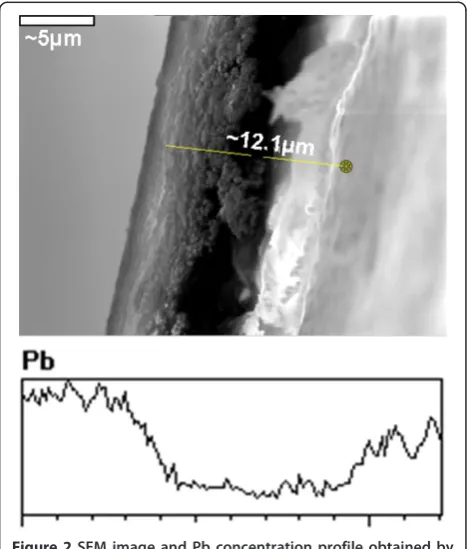
the charge of the same sign as that of the functional groups of the polymer (e.g. S2-) is used instead of a ionic reducing reagent (BH4-). As it is seen in Figure 2,
the distribution of PbS-NPs obtained by IMS is similar to that for zero-valent metal NPs, i.e. PbS-NPs are mainly located near the nanocomposite sample edges. The following important conclusion follows from the results obtained: in the course of IMS of INPs when using ionic reduction or precipitation reagents, the Don-nan exclusion effect appears to be the driving force responsible for the surface distribution of INPs (see EDS in Figure 2). The necessary condition in this case is the coincidence of the charge sign of ionic reagent with that of the functional groups of the hosting polymer.
Figure 3a, b, c shows SEM images of a SPEEK-CuS-PSNPs nanocomposite synthesized by the precipitation version of IMS technique. As it is seen, the aggregation of CuS-NPs on the surface of supporting polymer results in the formation of a sort of nanoplates typical for CuS [32]. However, as it can be seen in Figure 3d, e, dissolution of CuS- and PbS-PSNP-containing nanocom-posites in DMF leads to complete decomposition of these nanoplates into single INPs, which do not form
any visible aggregates. This confirms high stabilizing efficiency of the SPEEK matrix towards INPs.
[image:3.595.57.540.89.218.2] [image:3.595.305.539.408.683.2]Our recent results have demonstrated that when car-rying out two consecutives copper-loading-reduction cycles, the second copper-loading cycle is accompanied by the comproportionation reaction preformed after the first cycle Cu0-NPs and Cu2+ ions from the second metal-loading solution leading to formation of Cu+ions [6]. Under optimal conditions (optimal Cu2+ concentra-tion in the second metal-loading soluconcentra-tion), the Cu-NPs content inside the nanocomposite appears to be doubled Figure 1TEM images and EDS spectra of core shell Pt@Cu- (a, b) and core sandwich Ru@Pt@Cu-PSMNPs(c, d).
in comparison with that obtained after one Cu-loading-reduction cycle [6].
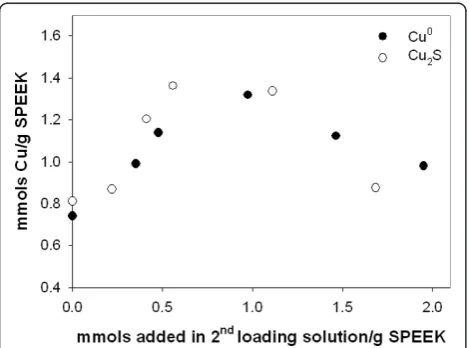
Figure 4 shows Cu0-NPs content inside the nanocom-posite membrane after two metal-loading-reduction cycles and Cu2S-NPs content after one metal-loading
reduction followed by the metal-loading-precipitation cycle. In both cases the total copper content in the membranes appears to be quite similar. At the same time, it is important to emphasize that the stability of Cu2S-NPs is far higher due to a far lower trend for
oxi-dation of Cu2S-NPs in comparison with Cu0-NPs.
One of the possible applications of nanocomposite materials containing Cu2S-NPs is their use as
catalyti-cally active elements in electroanalytical devices such as amperometric sensors [21,23,33,34]. The sensor modifi-cation can be achieved by two different ways: (i) by depositing an ink containing INPs onto the electrode surface or (ii) by depositing the INPs-free polymeric matrix followed by thein situIMS of INPs [4,21]. In the second case, the electrochemical response of the
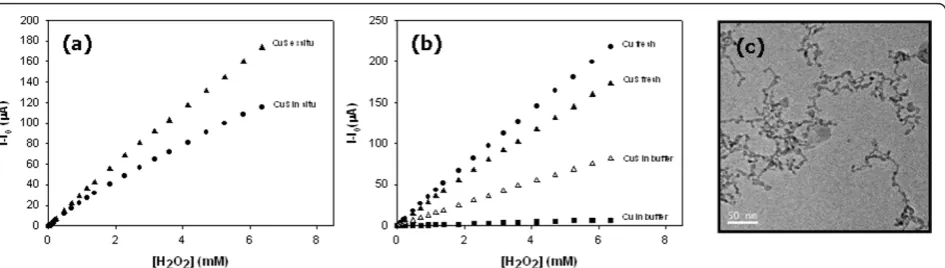
modified sensors appears to be lower than that of the sensors obtained by theex situ method (see Figure 5a). TEM characterization of PSNPs prepared by in situIMS shows the formation of a kind of nanowires (see Figure 5a) that could be responsible for the lower sensitivity of sensors since they are characterized by a lower surface area of INPs in comparison with well-separated spheri-cal NPs.
In the case of sensors modified using deposition onto the electrode surface of the PMNC-ink containing Cu0 or CuS (obtained after one copper-loading-precipitation cycle), reliable calibration curves were obtained for freshly prepared electrode sample in the range of 0.05-6.5 mM H2O2 as it can be seen in Figure 5b (see Cu
fresh and CuS fresh curves). In order to assess the elec-trode stability, the INP-modified elecelec-trodes were kept in acetic/acetate buffer solution for 3 days. The results of this series of experiments are also shown in Figure 5b. As it is seen, the sensitivity of sensors modified with CuS-NPs decreases after the treatment in the buffer solution. However, the decrease of sensitivity in this case is far lower than that of sensors modified with Cu0 -NPs after identical treatment.
Conclusions
[image:4.595.59.540.90.205.2] [image:4.595.57.292.510.684.2]The main conclusion, which can be derived from the results of this study, concerns the possibility of applying the IMS technique not only for the preparation of zero-valent metal NPs but also for the synthesis of INPs of low solubility compounds (e.g. metal sulphides) using metal-loading-precipitation cycles. Another important point is the use of precipitating agents bearing the same charge as that of the functional groups of the polymer. This new version of IMS technique permits to achieve INPs distribution similar to that obtained using reduc-tion reacreduc-tions. The Donnan exclusion effect appears in both cases the main driving force responsible for this type of NPs distribution. The feasibility of preparing electroanalytical devices based on these new PMNCs Figure 3SEM images of cross section and surface of CuS nanocomposite (a-c) and TEM images corresponding to CuS- (d) and PbS-PSNPs (e) after their dissolution in DMF.
Figure 4Total Cu and Cu2S content in nanocomposites versus
has been successfully proved. The resulting ampero-metric sensors showed a relatively high sensitivity and a much higher stability against oxidation than those pre-pared using Cu -PMNCs.
Abbreviations
DMF: dimethylformamide; GECE: graphite-epoxy composite electrodes; INPs: inorganic nanoparticles; IMS: intermatrix synthesis; MNPs: metal NPs; NPs: NanoParticles; PSINPs: polymer-stabilized INPs; PSNPs: polymer-stabilized nanoparticles; SEM: scanning electron microscope; SPEEK: sulfonated polyetherether ketone; TEM: transmission electron microscopy.
Acknowledgements
This study was supported by the research grants INTAS Ref. No. 05-1000008-7834 and MAT2006-03745, 2006-2009 from the Ministry of Science and Technology of Spain. Special thanks are given to Servei de Microscopia from Universitat Autònoma de Barcelona. J. Macanás thanks the support of Ministry of Science and Innovation (Juan de la Cierva Program). TNT-2010 Organizing Committee is acknowledged for the student grant to P. Ruiz.
Author details
1Analytical Chemistry Division, Department of Chemistry, Universitat
Autònoma de Barcelona, 08193 Bellaterra, Barcelona, Spain2Chemical Engineering Department, UPC, 08222 Terrassa, Barcelona, Spain
Authors’contributions
PR carried out the nanocomposites synthesis and characterization. JM participated in the interpretation of the results. MM and DNM conceived of the study, and participated in its design and coordination. All authors read and approved the final manuscript.
Competing interests
The authors declare that they have no competing interests.
Received: 4 November 2010 Accepted: 15 April 2011 Published: 15 April 2011
References
1. Schmid G:Clusters and Colloids. From Theory to ApplicationsWeinheim: VCH; 1994.
2. De Jongh LJ:Physics and Chemistry of Metal Cluster CompoundsDordrecht: Kluwer; 1994.
3. Simonsen SB, Chorkendorff I, Dahl S, Skoglundh M, Sehested J, Helveg S:
Direct Observations of Oxygen-induced Platinum Nanoparticle Ripening Studied by In Situ TEM.J Am Chem Soc2010,132(23):7968.
4. Macanás J, Farre M, Muñoz M, Alegret S, Muraviev DN:Preparation and characterization of polymer-stabilized metal nanoparticles for sensor applications.Phys Stat Solidi A2006,203(6):1194.
5. Muraviev DN, Macanás J, Farre M, Muñoz M, Alegret S:Novel routes for inter-matrix synthesis and characterization of polymer stabilized metal nanoparticles for molecular recognition devices.Sens Actuator2006,
B118(1-2):408.
6. Ruiz P, Muñoz M, Macanás J, Muraviev DN:Intermatrix Synthesis of Polymer-Copper Nanocomposites with Tunable Parameters by Using Copper Comproportionation Reaction.Chem Mater2010,
22(24):6616-6623.
7. Pomogailo AD:Polymer-immobilised nanoscale and cluster metal particles.Russ Chem Rev1997,66(8):679.
8. Rozenberg BA, Tenne R:Polymer-assisted fabrication of nanoparticles and nanocomposites.Prog Polym Sci2008,33:40-112.
9. Karttunen M, Ruuskanen P, Pitkänen V, Albers WA:Electrically Conductive Metal Polymer Nanocomposites for Electronics Applications.J Electron
Mater2008,37(7):951.
10. Cioffi N, Torsi L, Ditaranto N, Tantillo G, Ghibelli L, Sabbatini L, Bleve-Zacheo T, D’Alessio M, Zambonin PG, Traversa E:Copper Nanoparticle/ Polymer Composites with Antifungal and Bacteriostatic Properties.Chem
Mater2005,17(25):5255.
11. Nadagouda MN, Varma RS:Synthesis of Thermally Stable Carboxymethyl Cellulose/Metal Biodegradable Nanocomposites for Potential Biological Applications.Biomacromolecules2007,8(9):2762.
12. Muraviev DN, Ruiz P, Muñoz M, Macanás J:Novel strategies for preparation and characterization of functional polymer-metal nanocomposites for electrochemical applications.Pure Appl Chem2008,
80(11):2425.
13. Macanás J, Ouyang L, Bruening ML, Muñoz M, Remigy JC, Lahitte JF:
Development of polymeric hollow fiber membranes containing catalytic metal nanoparticles.Catal Today2010,156(3-4):181-186.
14. Dotzauer DM, Dai J, Sun L, Bruening ML:Catalytic membranes prepared using layer-by-layer adsorption of polyelectrolyte/metal nanoparticle films in porous supports.Nano Lett2006,6(10):2268-2272.
15. Ouyang L, Dotzauer DM, Hogg SR, Macanás J, Lahitte JF, Bruening ML:
Catalytic hollow fiber membranes prepared using layer-by-layer adsorption of polyelectrolytes and metal nanoparticles.Catal Today2010,
156(3-4):100-106.
16. Saunders BR, Turner ML:Nanoparticle-polymer photovoltaic cells.Adv
Colloid Interface Sci2008,138:1.
17. Ullrich B, Xiao XY, Brown GJ:Photoluminescence of PbS quantum dots on semi-insulating GaAs.J Appl Phys2010,108:013525.
18. Myung Y, Jang DM, Cho YJ, Kim HS, Park J:Nonenzymatic Amperometric Glucose Sensing of Platinum, Copper Sulfide, and Tin Oxide
[image:5.595.65.538.88.222.2]Nanoparticle-Carbon Nanotube Hybrid Nanostructures.J Phys Chem C 2009,113:1251.
Figure 5Calibrations curves of electrochemical responses towards H2O2with (a) CuS-PSNPs-based amperometric sensors synthesized
shell nanoparticles.Phys Stat Solidi A2008,205(6):1460.
24. Alonso A, Macanás J, Shafir A, Muñoz M, Vallribera A, Prodius D, Melnic S, Turta C, Muraviev DN:Donnan-exclusion-driven distribution of catalytic ferromagnetic nanoparticles synthesized in polymeric fibers.Dalton Trans 2010,39(10):2579.
25. Macanás J, Ruiz P, Alonso A, Muñoz M, Muraviev DN:Ion-exchange assisted synthesis of polymer-stabilized metal nanoparticles.InSolvent
Extraction and Ion Exchange: A Series of Advances Chapter 1. Volume 20.Boca
Raton: Taylor & Francis; 2011.
26. Campelo JM, Luna D, Luque R, Marinas JM, Romero AA:Sustainable Preparation of Supported Metal Nanoparticles and Their Applications in Catalysis.ChemSusChem2009,2(1):18-45.
27. Astruc D:Nanoparticles and CatalysisWeinheim: Wiley-VCH; 2008. 28. Raevskaya AE, Stroyuk AL, Kuchmii SYa, Kryukov AI:Catalytic activity of CuS
nanoparticles in hydrosulfide ions air oxidation.J Mol Catal A2004,
212(1-2):259-265.
29. Linkous CA, Anderson HR, Kopitzke RW, Nelson GL:Development of new proton exchange membrane electrolytes for water electrolysis at higher temperatures.Int J Hydrogen Energy1998,23(7):525-529.
30. González-Bellavista A, Macanás J, Muñoz M, Fàbregas E:Polysulfone as an alternative material to PVC in the design of ion-selective electrodes.Sens
Actuator B2006,115(2):691-696.
31. Céspedes F, Martínez-Fabregas E, Alegret S:New materials for electrochemical sensing I. Rigid conducting composites.Trends Anal Chem1996,15:296.
32. Liu J, Xue D:Solvothermal synthesis of copper sulfide semiconductor micro/nanostructures.Mater Res Bull2010,45(3):309.
33. Rodríguez MC, Rivas GA:Highly Selective First Generation Glucose Biosensor Based on Carbon Paste Containing Copper and Glucose Oxidase.Electroanalysis2001,13(14):1179.
34. Li J, Yuan R, Chai Y, Zhang T, Che X, Xin :Direct electrocatalytic reduction of hydrogen peroxide at a glassy carbon electrode modified with polypyrrole nanowires and platinum hollow nanospheres.Microchim Acta 2010,171(1-2):125.
doi:10.1186/1556-276X-6-343
Cite this article as:Ruizet al.:Intermatrix synthesis: easy technique permitting preparation of polymer-stabilized nanoparticles with desired
composition and structure.Nanoscale Research Letters20116:343.
Submit your manuscript to a
journal and benefi t from:
7 Convenient online submission
7 Rigorous peer review
7 Immediate publication on acceptance
7 Open access: articles freely available online
7 High visibility within the fi eld
7 Retaining the copyright to your article