N A N O E X P R E S S
Template Route to Chemically Engineering Cavities at Nanoscale:
A Case Study of Zn(OH)
2Template
Dapeng Wu•Yi Jiang•Junli Liu•Yafei Yuan•
Junshu Wu•Kai Jiang •Dongfeng Xue
Received: 17 June 2010 / Accepted: 19 July 2010 / Published online: 1 August 2010
ÓThe Author(s) 2010. This article is published with open access at Springerlink.com
Abstract A size-controlled Zn(OH)2template is used as a case study to explain the chemical strategy that can be executed to chemically engineering various nanoscale cavities. Zn(OH)2octahedron with 8 vertices and 14 edges is fabricated via a low temperature solution route. The size can be tuned from 1 to 30lm by changing the reaction conditions. Two methods can be selected for the hollow process without loss of the original shape of Zn(OH)2 template. Ion-replacement reaction is suitable for fabrica-tion of hollow sulfides based on the solubility difference between Zn(OH)2 and products. Controlled chemical deposition is utilized to coat an oxide layer on the surface of Zn(OH)2 template. The abundant hydroxyl groups on Zn(OH)2 afford strong coordination ability with cations and help to the coating of a shell layer. The rudimental Zn(OH)2 core is eliminated with ammonia solution. In addition, ZnO-based heterostructures possessing better chemical or physical properties can also be prepared via this unique templating process. Room-temperature photo-luminescence spectra of the heterostructures and hollow structures are also shown to study their optical properties.
Keywords TemplateZn(OH)2octahedron Ion-replacement reactionChemical deposition
Introduction
Owing to the potential applications in the fields of drug delivery, catalysis, artificial cell, lightweight fillers and protection for the light- or chemical-sensitive materials, hollow structures have received increasing research inter-ests [1–6]. So far, hollow structures have been synthesized by means of various methods, among which template directing is the most straightforward way to yield hollow structures effectively. The commonly used templates include polystyrene (PS) latex spheres, silica spheres, carbon colloid spheres, gas bubbles and emulsion droplets [7–13]. Self-template routes by Kirkendall effect and Ostwald ripening have also been applied to realize hol-lowing process [14–17]. However, the general synthesized hollow products are mostly spheres. Although several previous works have been devoted to synthesize non-spherical hollow structures [18–22], it still remains a challenge to fabricate well-defined nonspherical hollow structures especially with tunable size.
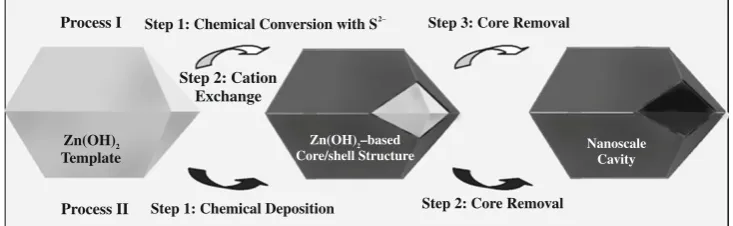
ZnO has drawn great attention due to its applications in short wave length photonic devices [23–27]. In this paper, we design a general strategy to fabricate nanoscale cavity in functional materials. Zn(OH)2 octahedron template is taken as a case study, as shown in Fig.1. Zn(OH)2 octahedra with controllable diameters were first prepared in low temperature aqueous solution. A series of ZnO-based heterostructures and octahedral hollow structures were then fabricated by using Zn(OH)2 octahedra as promising sacrificial template. Taking advantage of the inherent properties of this hard template, two strategies were applied to construct hollow structures. ZnS and Ag2S hollow octahedra were obtained via chemical con-version. SiO2 and CeO2 hollow octahedra were synthe-sized through a controlled deposition. Moreover, the
D. WuY. JiangJ. LiuY. YuanK. Jiang (&) College of Chemistry and Environmental Science, Henan Normal University, 47 Jianshe Road, 453007 Xinxiang, China e-mail: [email protected]
J. WuD. Xue (&)
Department of Materials Science and Chemical Engineering, School of Chemical Engineering, Dalian University of Technology, 158 Zhongshan Road, 116012 Dalian, China e-mail: [email protected]
diameters of the Zn(OH)2 octahedron can be easily tuned from *1 to *30lm, which makes it a promising tem-plate to synthesize a wide range of octahedral hollow structures with tunable sizes.
The merits of using Zn(OH)2as template are as follows: (1) it provides a unique template to synthesize nonspherical hollow structures; (2) the good solubility of Zn(OH)2 facilitates the surface chemical conversion; (3) owing to its inherent amphoteric habit, both alkaline and acid solution can be used to remove the inner core according to the nature of the outside coating materials; (4) due to the abundant hydroxyl groups which exhibit strong combining ability, positive charged metal cations could be enriched on the surface of the template without surface modification; (5) the diameter of the template can be tuned from*1 to *30lm by slightly altering the reaction condition. Moreover, after a low temperature calcination (135°C), this Zn(OH)2template can be easily converted into ZnO crystal, which can transform the intermediate Zn(OH)2/ shell structures into ZnO-based heterostructures. Therefore, Zn(OH)2octahedra can be used as a promising hard tem-plate for synthesizing nonspherical hollow structures and ZnO-based heterostructures.
Experimental
(1) Synthesis of the Zn(OH)2 template: Octahedral Zn(OH)2 template (3–4 lm in diameter) was obtained using a convenient way. 0.83 g Zn(NO3)26H2O was first dissolved into 15 mL distilled water, and then mixed with 10 mL aqueous solution containing 0.96 g NaOH under stirring. Then, the clear solution was placed in 50°C water bath for 2 h. In order to control the diameter of the tem-plate, the reaction parameter was slightly adjusted. For 25–30lm Zn(OH)2octahedron, 15 mL 0.19 M Zn(NO3)2 solution was kept in ice water bath (0°C), and then mixed
with 10 mL aqueous solution containing 0.96 g NaOH. The solution was aged under room temperature water bath for 2 days. For 5–7lm Zn(OH)2 octahedron, 15 mL 0.19 M Zn(NO3)2solution was mixed with 10 mL 0.24 M NaOH solution. The solution was placed in 30°C water bath for 20 h. For 1–2lm Zn(OH)2 octahedron, 0.02 g poly(vinylpyrrolidone) (PVP) was added 15 mL 0.19 M Zn(NO3)2 solution. The mixture was stirred under room temperature for 30 min. Subsequently, 10 mL 0.24 M NaOH solution was added dropwise. The solution was placed in 30 °C water bath for 12 h. All the white pre-cipitation was collected by centrifugation and washed thoroughly with distilled water and absolute ethanol sev-eral times. The product was dried in vacuum for 6 h at 50°C.
(2) Synthesis of hollow structures: for ZnS hollow structure, 200 mg Zn(OH)2template (3–4lm in diameter) was dispersed in 40 mL 0.20 M Na2S solution and stirred for 12 h in a 70°C oil bath. Then, dark gray precipitation was centrifuged and subsequently placed in 25% (wt) ammonia solution for 50 min under mild stirring. Finally, the as-prepared products were centrifuged, washed with distilled water and absolute ethanol several times. The as-prepared sample was dried in vacuum for 6 h at 50°C. For Ag2S hollow structure, after the surface of the template was sulfured by the Na2S solution, the participation was washed thoroughly with water to eliminate the S2-in the product. Then, the core/shell product was placed in 30 mL 0.05 M AgNO3 solution. The suspension was stirred for 30 min under room temperature to obtain black products, and then the pH value of the solutions was adjusted to 2 by several drops of diluted HNO3. Another 20 min was allowed to obtain Ag2S hollow octahedron. Finally, the product was washed by water and ethanol several times and dried in vacuum for 8 h at 60°C. For Synthesis of SiO2 hollow structure, 200 mg Zn(OH)2template (1–2lm in diameter) was dispersed into 20 mL ethanol, then 9 mL water and Zn(OH)2
Template
Zn(OH)2–based
Core/shell Structure Nanoscale Cavity
Step 1: Chemical Deposition Step 2: Core Removal Step 1: Chemical Conversion with S2−
Step 2: Cation Exchange
Step 3: Core Removal
Process I
Process II
Fig. 1 The scheme for constructing hollow octahedron by using Zn(OH)2 as template. Process I: Surface chemical conversion of
Zn(OH)2 template with S2- [Step 1]. Cation exchange can be
performed on the surface of Zn(OH)2/ZnS architectures, generating
various Zn(OH)2/sulfide core/shell structures [Step 2]. A core removal
results in various nanoscale sulfide cavities. Process II: Chemical deposition on Zn(OH)2template [Step 1], following a core removal
[image:2.595.114.481.61.174.2]0.5 mL, 25% (wt) ammonia was added. The as-formed suspension was placed into ultrasonic irradiation and 0.5 mL TEOS was added. The mixture was subsequently stirred at room temperature for 3 h, the final white product was collected by centrifugation and washed with water and absolute ethanol for several times. The product was dried in vacuum at 80°C for 3 h and treated with 0.10 M HCl to remove the inner template. The SiO2 hollow octahedron was collected by centrifugation, washed with water and absolute ethanol and dried in vacuum at 80°C for 3 h. For Synthesis of the CeO2 hollow structure, 200 mg as-pre-pared Zn(OH)2octahedron template (1–2lm in diameter) was dispersed into 16 mL alcohol by ultrasonic irradiation. Then, 2 mL double-distilled water containing 0.50 mmol Ce(NO3)3was added. The solution was stirred for 30 min to form a homogenous suspension. Subsequently, 5 mmol urea was added into the suspension and stirred for another 30 min to dissolve the urea completely. Then, the sus-pension was placed into an oil bath at 60°C for 12 h under vigorous stirring. The final white product was collected by centrifugation, washed thoroughly with distilled water and absolute ethanol several times and dried in vacuum for 5 h at 50°C. Then, the as-prepared product was annealed at 150°C for 2 h to generate light yellow ZnO/CeO2 het-erostructure. Finally, the heterostructure was washed with 0.10 M HCl to remove the inner ZnO core and obtain CeO2 hollow octahedron.
Characterization
The phase purity of the products were characterized by X-ray diffraction (XRD) patterns, using a Bruker advance-D8 XRD with Cu Ka radiation (k =0.154178 nm). The accelerating voltage was set at 40 KV with a 100 mA flux. Scanning electronic microscopy (SEM) images were taken on JEOL JSM-6390LV. Low-magnification transmission electronic microscopy (TEM) images were obtained from JEOL JSM-100 while the high-resolution transmission electron microscopy (HRTEM) and selected-area electron diffraction (SAED) images were taken on FEI Tecnai G220. Thermogravimetry and differential scanning calo-rimetry (TG–DSC) of the samples were carried out with a Netzsch STA 409 PC analyzer at a heating rate of 10°C/min. Fourier transform infrared spectroscopy (FT-IR) spectra were recorded on a Bio-Rad FTS-40 Fourier transform infrared spectrometer. The photoluminescence (PL) was performed on JASCO FP-6500 fluorophotometer at room temperature.
Results and Discussion
[image:3.595.177.544.409.714.2]Figure2a shows a SEM image of the Zn(OH)2template synthesized by decomposing the Zn(OH)42- precursor
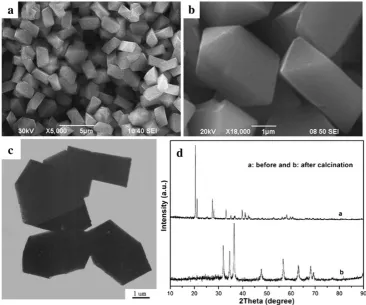
Fig. 2 aLow- andb high-magnification SEM images of Zn(OH)2octahedra,cTEM
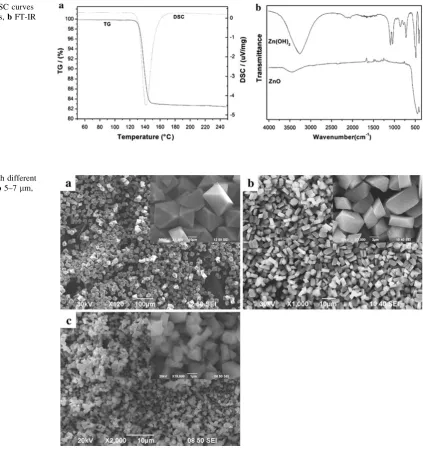
directly in a low temperature aqueous solution (50°C). The diameter of the octahedra is uniform and at 3–4lm. The magnified image (Fig.2b) reveals that the as-prepared particle has unique octahedral shape with 8 vertices and 14 edges. The crystals are well defined with smooth surface, which can be confirmed by the corresponding TEM image shown in Fig.2c. The XRD patterns in Fig.2d show that all of the diffraction peaks of the template can be perfectly indexed to orthorhombic Zn(OH)2 (JCPDS Card No. 74-0094). While the diffraction peaks of the annealed sample match well with hexagonal wurtzite ZnO (JCPDS Card No. 79-0205). The TG and DSC curves, displayed in Fig.3a, suggest that this template remains stable before 100°C and experiences a steep weigh loss around 135°C. The weight loss ratio is about 17.5% which accords with
[image:4.595.121.545.267.718.2]theory calculation (18.3%), indicating the probable formula for this template is Zn(OH)2. From the FT-IR spectrum of the template (Fig.3b), the strong absorption around 3,400 cm-1 corresponds to the O–H stretching from the hydroxyl groups located on the surface of Zn(OH)2 parti-cles. These hydroxyl groups exhibit good combining ability toward the positive charged metal cations, which can lead to the enrichment of the metal cations on the surface of the template. Figure3b also represents the comparative FT-IR spectrum of the ZnO sample after calcination. The peak around 3,400 cm-1 is substantially abated. Though many researches have been done to tailor the shape and size of the materials to enrich their properties, controllable fabri-cation still remains a big challenge in material science. The average diameter of Zn(OH)2 octahedra can be readily
Fig. 3 aTG and DSC curves of Zn(OH)2products,bFT-IR
spectra
Fig. 4 Zn(OH)2with different
sizesa25–30lm,b5–7lm,
tuned in a large range by altering the reaction parameters. All of the as-prepared Zn(OH)2octahedra are uniform and the diameters are approximately at 25–30, 5–7, and 1–2lm, respectively (Fig.4). To our knowledge, this is the first time to study the size control over Zn(OH)2crystal and fabricate hollow structures by using Zn(OH)2 octahe-dron as sacrificing template. By using these templates, a series of hollow structured materials with controllable sizes can be fabricated.
Two strategies were applied to fabricate different octa-hedral hollow structures by using Zn(OH)2 as templates. Transition metal sulfides were prepared through a facile chemical conversion. Zn(OH)2 templates were directly immersed into 0.20 M Na2S solution, leading to core/shell Zn(OH)2/ZnS structures (Fig.5a), which were clearly observed after an ammonia treatment for 10 min (Fig.5b). The diameter of the core/shell structure is almost
[image:5.595.189.544.57.478.2]unchanged. Figure5c shows the low magnified SEM image, the diameter of hollow structure is 3–4 lm. From the inset of Fig.5c, a broken part can be seen. The hole can serve as the entrance for sensitive materials such as med-icine molecules or proteins. The corresponding TEM image is depicted in Fig.5d. The interior of the products is completely hollowed and the shell is comprised of numerous nanoparticles. The whole conversion process was recorded by XRD patterns (Fig.5e). After the core was thoroughly removed, only ZnS diffraction peaks existed with cell constanta =5.406 A˚ which is consistent with the standard value (JCPDS Card No. 05-0566). In order to promote the chemical conversion, high solubility Zn5(CO3)2(OH)6was used as a sacrificing template instead of ZnO. For the same purpose, a thioglycolic acid-assisted route was also used to activate the Zn2?on the surface of inert ZnO template [28, 29]. In our case, except the well Fig. 5 aZn(OH)2coated with a
layer of ZnS,bcore/shell structure after reacted with ammonia for 10 min,c low-magnification SEM image and
solubility of Zn(OH)2 (Ksp=1.2910-17), the Na2S solution with a high pH value (12) also played a positive role in promoting the reactivity of the precursor by con-verting the Zn(OH)2 into more reactive ZnO22- on the template surface. In the later core-removing step, ammonia solution was used instead of the widely used NaOH or KOH [30, 31]. Due to the strong coordination ability of NH3, the core-removing duration can be dramatically reduced. Moreover, the good volatility and solubility of ammonia make it easier to be evacuated from the final product. PL measurements were performed for optical characterization of the hollow ZnS shell powder. The sample is photoexcited at 350 nm. As shown in Fig.5f, two major peaks can be observed, one at 466 nm caused by sulfur bond dangling at the interface of ZnS grains, the other at about 548 nm, which may be originated from surface states and various point defects. The strong-defect-related signal implies that ZnS nanoshells contain more defects.
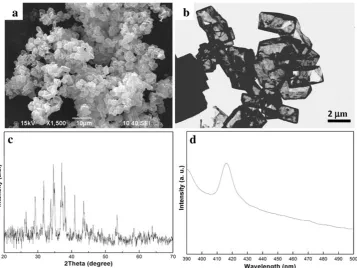
During chemical conversion, the driven force for the chemical conversion is attributed to the gap between the solubility of Zn(OH)2and ZnS. ZnS crystal (Ksp=2.939 10-25) is more thermodynamically stable and has lower solubility than Zn(OH)2, thus the conversion process moves forward. Based on this point, the method can be also utilized to fabricate other transition metal sulfides via a similar chemical conversion [32, 33]. The Zn(OH)2/ZnS core/shell structure was immersed into AgNO3 solutions to generate uniform Ag2S (Ksp=6.69910-50) hollow octahedra, as shown in Fig.6a, b. The XRD pattern
(Fig.6c) reveals that all the diffraction peaks can be readily indexed as monoclinic Ag2S in good agreement with the literature (JCPDS Card No. 14-0072). PL spec-trum in Fig. 6d has only one emission peak at about 418 nm, indicating that these Ag2S shells can be good candidates for optoelectronic applications. Therefore, it is reasonable to deduce that, after appropriate modification to this method, hollow octahedra of more thermodynamically stable transition metal sulfide (e.g., CuS, Bi2S3, Sb2S3, PbS) with a lower Kspthan ZnS can be well obtained.
[image:6.595.186.544.444.712.2]A controlled chemical deposition was also utilized to coat a layer of silica onto Zn(OH)2template. The coating technique has been detailedly described in recent work [34]. Based on the coordination ability of the hydroxyl groups, the mineralization of the cations can occur on the template to form a layer of SiO2without additional surface modification. After treated with diluted HCl, SiO2hollow structure was generated. Figure 7a is the low-magnifica-tion SEM image of the as-prepared SiO2product which is uniform and the diameter is 1–2lm. The magnified SEM image (Fig.7b) reveals the hollow interior of the octahe-dra. Moreover, there are broken parts on the hollow par-ticles which may serve as the intake entrance for drug delivery or DNA storage. The thickness of the shell is measured to be about 30 nm. Figure7c displays a TEM image of the products. The silica hollow structures are octahedral in shape and the thin shell can well support the hollow structure. ZnO/SiO2 core/shell architectures can also be obtained by facile heat treatment of corresponding Zn(OH)2/SiO2 precursors. ZnO and SiO2 nanomaterials
Fig. 6 aSEM,bTEM image,
cXRD pattern (JCPDS Card No. 14-0072) of the as-prepared Ag2S hollow structure,dPL
emission spectrum of Ag2S shell
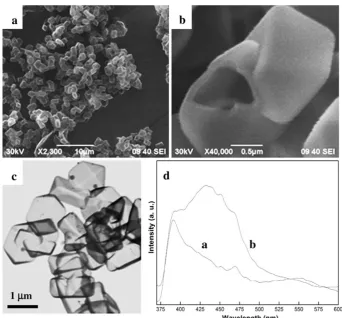
have been of interest for construction of many gas- and biosensing devices because of their biocompatibility, high chemical stability, and low cost. Therefore, ZnO/SiO2 composite structures are of great significance toward the bio- or medical related fields. During the structural change from bared ZnO to ZnO/SiO2 core/shell, variation of optical properties can be observed with PL spectra shown in Fig.7d. The intensity of visible emission peak at 433 nm increases sharply, suggesting important applica-tion of ZnO/SiO2core/shell in photoelectric and biosensing devices. Detailed work is being carried out to tailor the thickness and the porosity of the silica shell for the potential applications in drug delivery and controlled release. In addition, taking advantage of the function groups located on the template surface, a similar route in an ethanol–water system could also be utilized to synthe-size other inorganic hollow compounds [35]. For example, CeO2 hollow octahedra were also synthesized through a similar method (Fig.8), indicating the generality of the chemical deposition route. SEM image in Fig.8a shows that the product consists of uniform CeO2 hollow shells grown in a large scale. XRD pattern in Fig.8b is consistent with the standard literature values (JCPDS Card No. 34-394). Under the stimulation of 310 nm laser, the PL
spectrum of the CeO2 shells has a strong emission band with the center at about 410 nm (Fig.8c), which is ascri-bed to hopping from different defect levels to O 2p band. It is believed that these CeO2shells may have find potential applications in displays, sensors, and photosensitive devices.
Conclusions
A general template route has been designed to chemically engineering nanoscale cavities, which provides a simple scheme for the fabrication of highly crystalline hollow nanostructures with tailorable size. Zn(OH)2 octahedra were facilely synthesized at low temperature. Then, they were used as sacrificial template to construct octahedral hollow structures with controlled sizes. Two strategies can be adopted to fabricate different types (sulfides and oxides) of octahedral hollow structures. In addition, Zn(OH)2can be transformed into ZnO via a low temperature calcination. Therefore, ZnO-based heterostructures possessing better chemical or physical properties can also be prepared via this facile templating process. These nanostructures can be Fig. 7 The as-prepared SiO2
hollow octahedra:alow and
bhigh magnification SEM image,cTEM image.dPL spectra of (a) ZnO and (b) ZnO/ SiO2core/shell structures
[image:7.595.201.544.54.372.2]of special interest for a variety of applications, including catalysis, gas sensing, and nanoelectronics.
Acknowledgments This work was supported by the National Nat-ural Science Foundation of China (20571025) and Henan Innovation Project for University Prominent Research Talents (2005KYCX005).
Open Access This article is distributed under the terms of the Creative Commons Attribution Noncommercial License which per-mits any noncommercial use, distribution, and reproduction in any medium, provided the original author(s) and source are credited.
References
1. V.V. Sokolova, I. Radtke, R. Heumann, M. Epple, Biomaterials
27, 3147 (2006)
2. F. Caruso, R.A. Caruso, H. Mo¨hwald, Science282, 1111 (1998) 3. J. Liu, H. Xia, D. Xue, L. Lu, J. Am. Chem. Soc. 131, 12086
(2009)
4. D.E. Bergbreiter, Angew. Chem. Int. Ed.38, 2870 (1999) 5. J. Liu, D. Xue, Adv. Mater.20, 2622 (2008)
6. J. Liu, F. Liu, K. Gao, J. Wu, D. Xue, J. Mater. Chem.19, 6073 (2009)
7. S.W. Kim, M. Kim, W.Y. Lee, T. Hyeon, J. Am. Chem. Soc.124, 7642 (2002)
8. Z.Y. Guo, F.L. Du, G.C. Li, Z.L. Cui, Chem. Commun.25, 2911 (2008)
9. K. Sablon, Nanoscale Res. Lett.3, 265 (2008)
10. F. Gu, C.Z. Li, S.F. Wang, M.K. Lu, Langmuir22, 1329 (2006) 11. B. Khlebtsov, L. Dykman, V. Bogatyrev, V. Zharov, N.
Khlebt-sov, Nanoscale Res. Lett.2, 6 (2007)
12. A.M. Collins, C. Spickermann, S. Mann, J. Mater. Chem. 13, 1112 (2003)
13. W.J. Li, X.X. Sha, W.J. Dong, Z.C. Wang, Chem. Commun.20, 2434 (2002)
14. H.J. Fan, M. Knez, R. Scholz, D. Hesse, K. Nielsch, M. Zacha-rias, U. Gosele, Nano Lett.7, 993 (2007)
15. Y.D. Yin, C.K. Erdonmez, A. Cabot, S. Hughes, A.P. Alivisatos, Adv. Funct. Mater.16, 1389 (2006)
16. P. Ghosh, T. Soga, K. Ghosh, T. Jimbo, R. Katoh, K. Sumiyama, Y. Ando, Nanoscale Res. Lett.4, 1171 (2009)
17. H.G. Yang, H.C. Zeng, J. Phys. Chem. B108, 3492 (2004) 18. S. Jiao, L. Xu, K. Jiang, D. Xu, Adv. Mater.18, 1174 (2006) 19. I. Avramov, Nanoscale Res. Lett.2, 235 (2007)
20. X.W. Lou, C. Yuan, Q. Zhang, L.A. Archer, Angew. Chem. Int. Ed.45, 3825 (2006)
21. K.S. Krishna, G. Vivekanandan, D. Ravindera, M. Eswara-moorthy, Chem. Commun.46, 2989 (2010)
22. H.G. Yang, H.C. Zeng, Angew. Chem.116, 6056 (2004) 23. J. Wu, D. Xue, Mater. Res. Bull.45, 295 (2010) 24. J. Wu, D. Xue, Mater. Res. Bull.45, 300 (2010) 25. P. Lu, D. Xue, Surf. Rev. Lett.17, 261 (2010) 26. J. Wu, D. Xue, Mod. Phys. Lett. B23, 3943 (2009)
27. C. Yan, J. Liu, F. Liu, J. Wu, K. Gao, D. Xue, Nanoscale Res. Lett.3, 473 (2008)
28. C. Yan, D. Xue, J. Phys. Chem. B110, 7102 (2006) 29. C. Yan, D. Xue, J. Phys. Chem. B110, 25850 (2006)
30. L. Gu, X. Cao, C. Zhao, Colloid Surf. A: Physicochem. Eng. Asp.
[image:8.595.185.544.57.391.2]326, 98 (2008)
Fig. 8 aSEM image and
bXRD pattern (JCPDS Card No. 34-394) of the as-prepared CeO2hollow structure.cPL
spectrum of CeO2shell
31. R. Yi, G. Qiu, X. Liu, J. Solid State Chem.182, 2791 (2009) 32. Y.F. Zhu, D.H. Fan, W.Z. Shen, J. Phys. Chem. C112, 10402
(2008)
33. Y.F. Zhu, D.H. Fan, W.Z. Shen, Langmuir24, 11131 (2008)
34. F. Li, X. Huang, Y. Jiang, L. Liu, Z. Li, Mater. Res. Bull.44, 437 (2009)
35. H. Qian, G. Lin, Y. Zhang, P. Gunawan, R. Xu, Nanotechnology