IJPSR (2018), Volume 9, Issue 1 (Research Article)
Received on 08 May, 2017; received in revised form, 14 July, 2017; accepted, 25 July, 2017; published 01 January, 2018
FORMULATION AND EVALUATION OF FLOATING BEADS OF OFLOXACIN USING ELECTRON MICROSCOPY
A. Mohan*1, G. Sangeetha 1 and R. Gundamaraju 2
Department of Pharmaceutics 1, Gautham College of Pharmacy, R. T. Nagar, Sultanpalya, Bangalore - 560032, Karnataka, India.
Department of Physiology 2, Faculty of Medicine, University of Malaya, Kuala Lumpur - 50603, Malaysia.
ABSTRACT: Floating Drug delivery systems are designed to prolong
the gastric residence time after oral administration. Ofloxacin is an antibacterial fluoroquinolone, widely prescribed in gastric and duodenal ulcers. It exhibits pH dependent solubility, more soluble in acidic pH and slightly soluble in neutral or alkaline pH. Precipitation of the drug occurs in the intestine, which adversely affects the absorption in the lower sections of the intestine. So there is a need for systems that reside in the stomach over a relatively long period and release the active compound in a sustained manner. The aim of the present study was to develop a delivery system wherein the retention of Ofloxacin could be achieved for increasing local action in the gastric region against Helicobacter pylori, with the development of rice bran oil entrapped zinc pectinate beads containing Ofloxacin. Various formulations of floating beads of Ofloxacin were developed using polymers like Low Methoxy Pectin alone and in combination with rate controlling polymers such as Gellan Gum, Karaya Gum and Xanthan Gum. The beads were prepared by emulsion gelation method. Rice bran oil was used to impart buoyancy to the beads due to its low density. The beads were spherical in nature and beads formulated with a mixture of Low Methoxy Pectin and Gellan Gum showed the highest drug content and drug entrapment. The buoyancy studies on the beads proved that a minimum of 25% w/w of rice bran oil was required to impart satisfactory buoyancy to the beads.
INTRODUCTION: Most of the oral dosage forms possess several physiological limitations such as variable gastrointestinal transit, because of variable gastric emptying, leading to non uniform absorption profiles, incomplete drug release and shorter residence time of the dosage form in the stomach.
QUICK RESPONSE CODE
DOI:
10.13040/IJPSR.0975-8232.9(1).318-27
Article can be accessed online on:
www.ijpsr.com
DOI link: http://dx.doi.org/10.13040/IJPSR.0975-8232.9(1).318-27
This leads to incomplete absorption of drugs having an absorption window in the upper part of the small intestine, as once the drug passes down the absorption site, the remaining quantity goes unabsorbed. All the above requirements can be met and effective delivery of the drugs to the absorption window, for local action and for the treatment of gastric disorders such as gastro-esophageal reflux, can be achieved by floating drug delivery systems (FDDS). Floating drug delivery system (FDDS) or hydro-dynamically balanced systems (HBS) have a bulk density, lower than gastric fluids and thus remains buoyant in the stomach without affecting the gastric emptying rate for a prolonged period of
Keywords:
Antibiotic, Absorption window, Gastric residence time,
Polymer mixture, Stomach
Correspondence to Author: Dr. Arti Mohan
Professor and Head
Department of Pharmaceutics, Gautham College of Pharmacy, R. T. Nagar, Sultanpalya, Bangalore - 560032, Karnataka, India.
time. While the systems are floating on the gastric contents, the drug is released slowly at a desired rate from the system. This results in an increase in the Gastric residence time (GRT) and a better control of fluctuations in plasma drug concentrations in some cases. Ofloxacin is a broad-spectrum antibiotic that is active against both Gram positive and Gram-negative bacteria. Formulation of FDDS of H2 antagonists can be applied for effective treatment of gastric and duodenal ulcers and for the eradication of the Helicobacter pylori from the stomach.
MATERIALS AND METHODS:
Materials: Ofloxacin was a gift sample from Apex formulations Pvt. Ltd, Ahmedabad, Gujarat, India whereas Gellan gum was a gift sample from Sigma Aldrich chemicals, Hyderabad, India and Xanthan gum was purchased from Sigma Aldrich, USA. Karaya gum was obtained from Morning Star Enterprises, Mumbai, Maharashtra, India and Rice bran oil from Sri Anjanaya Agrotech Pvt. Ltd, Harihar, Karnataka, India. All other chemicals and reagents used were of analytical grade.
Methods:
Development of Calibration Curve: Ofloxacin equivalent to 100 mg was dissolved in 100 ml of 0.1 N hydrochloric acid buffer (pH 1.2) to get a stock solution A. 10 ml was pipetted out and the volume was made upto 100 ml with 0.1 N hydrochloric acid buffer to get a stock solution B.
From the stock solution B, aliquots were diluted to10ml with 0.1 N hydrochloric acid buffer to get 1 to 8µg/ml solutions and measured at 294.5nm. (Spectrophotometer UV-1601, Shimadzu, Japan) 1.
Drug Polymer Compatibility Studies:
Differential Scanning Calorimetry (DSC): Physical mixture of Ofloxacin and other polymers were subjected to compatibility studies using Differential Scanning Calorimetry (DSC-60, Shimadzu, Japan). The heating rate was kept at 10 °C/ min up to 350 °C. Nitrogen gas was used forpurging at 30 ml/min.2
Fourier Transform Infrared Spectroscopy
(FTIR): Spectra of drug and polymers were taken and analyzed for any major interaction using IR spectrophotometer (Shimadzu, model 840, Japan). These were done qualitatively in order to assess the pattern of peaks and for comparison purposes 2.
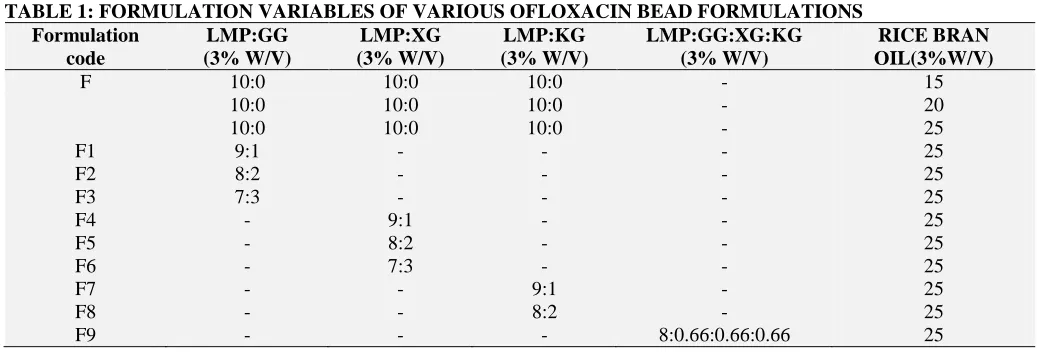
[image:2.612.46.572.499.675.2]Preparation of Floating Zinc Pectinate Beads: Ofloxacin, LMP, GG, XG and KG were passed through sieve no 80 separately. Ofloxacin (20% w/w of dry polymer weight) was dissolved in distilled water. LMP (3% w/v) alone and polymer mixtures (3% w/v) containing LMP and GG, LMP and XG, and LMP and KG in three different ratios were dissolved in above dispersion and one formulation was prepared with only polymer mixtures (3% w/v) containing GG, XG, KG and LMP.
TABLE 1: FORMULATION VARIABLES OF VARIOUS OFLOXACIN BEAD FORMULATIONS Formulation
code
LMP:GG (3% W/V)
LMP:XG (3% W/V)
LMP:KG (3% W/V)
LMP:GG:XG:KG (3% W/V)
RICE BRAN OIL(3%W/V)
F 10:0 10:0 10:0 - 15
10:0 10:0 10:0 - 20
10:0 10:0 10:0 - 25
F1 9:1 - - - 25
F2 8:2 - - - 25
F3 7:3 - - - 25
F4 - 9:1 - - 25
F5 - 8:2 - - 25
F6 - 7:3 - - 25
F7 - - 9:1 - 25
F8 - - 8:2 - 25
F9 - - - 8:0.66:0.66:0.66 25
To the above mixture rice bran oil (25% w/w) was added and stirred to form a homogeneous emulsion. The drug-loaded emulsion was extruded through a 23 G syringe needle into zinc chloride solution (5% w/v) maintained under gentle agitation.
Table 1 lists the formulation variables for different formulations of Ofloxacin loaded floating beads. Blank beads without Ofloxacin were also prepared using the same technique 3, 4.
Evaluation of Physicochemical Parameters of Floating Beads of Zinc Pectinate:
Determination of Bead Diameter: The diameter of a sample of gel beads (25 beads) of each formulation was determined using a dial thickness meter.
Drug Content: An accurately weighed sample of beads (100mg) was crushed in a mortar and added to100ml of 0.1N hydrochloric acid buffer (pH 1.2) and kept overnight under stirring to elute complete drug from the polymer matrix. It was filtered and analyzed at of 294.5nm (UV spectrophotometer, 1601, Shimadzu, Japan) against blank bead mixture, which was treated similarly. The drug content of each formulation was recorded as mg/100mg of gel beads 5.
Drug Entrapment Efficiency: The percentage drug entrapment efficiency (% EE) of each bead formulation was calculated using the following equation: 5
EE (%) = Actual Drug Content X 100 Theoretical Drug Content
Determination of Swelling Index: The swelling behavior of the zinc pectinate beads was studied in 0.1 N HCl (pH 1.2) buffer. Approximately 100mg of beads were taken in a dissolution basket and weighed (W1); the baskets along with the beads were immersed in 0.1N HCl buffer. The weight (W2) of the basket along with the beads was determined for 8 h: every 30 minutes for the first 2 h, and then every h after that. The swelling index (SI) of each formulation was calculated using the following equation:
% SI = W2 – W1 X 100 W1
Buoyancy Studies: The time between the introduction of the FDDS into the medium and its buoyancy to the upper one third of the dissolution vessel (floating lag time) and the time for which the formulation constantly floated on the surface of the medium (floating duration) were measured
simultaneously as a part of dissolution studies by visual observation 6.
In vitro Drug Release Studies: In vitro release
characteristics of ofloxacin floating gel beads (n = 3) were evaluated employing USP XIV dissolution testing apparatus 2 (paddle method) using 500ml of 0.1 N HCl buffer as dissolution medium maintained at 37 ± 0.5 °C. The contents were stirred at 50 rpm. A 5ml aliquot of the solution was withdrawn at predetermined time intervals for 8 h and fresh 5ml dissolution media was replaced to maintain sink condition. The sample aliquots were analyzed at a wavelength of 294.5 nm7.
Stability Studies: Stability studies were carried out according to ICH guidelines by storing the formulation F1 at 40 ± 2 °C and relative humidity 75 ± 5% for a period of two months in a programmable environmental test chamber (CHM-10S, Remi Instruments Ltd., Mumbai, India). The samples were withdrawn at 30 and 60 days and analyzed for the drug content, floating behavior and
in vitro drug release 8.
Scanning Electron Microscopy (SEM):
Morphological examination of the surface and external structure of the dried beads of formulation F1, F4 and F7 (Both drug loaded and blank beads) was performed using a scanning electron microscope (SEM) (model JEOL, JSM-840A). The samples were gold coated prior to the scanning 9.
RESULTS AND DISCUSSION:
Development of Calibration Curve: Concentration
[image:3.612.314.565.573.732.2]and absorbance obtained for standard plot of Ofloxacin in 0.1 N hydrochloric acid buffer (pH 1.2) are shown in Fig. 1.
Drug Polymer Compatibility Studies:
Differential Scanning Calorimetry (DSC): The DSC themograms of physical mixture of Ofloxacin and the polymers showed that characteristic peaks of polymers and Ofloxacin peaks were still present
in the physical mixture but slightly shifted from their original positions as shown in Fig. 2. The findings indicate that the drug and polymers are compatible with each other.
FIG. 2: DSC THERMOGRAM OF PURE OFLOXACIN, OFLOXACIN AND LMP, OFLOXACIN, LMP AND GG, OFLOXACIN, LMP AND KG, OFLOXACIN, LMP AND XG, OFLOXACIN, LMP, GG, KG AND XG
Fourier Transform Infrared Radiation (FTIR): All the above bands associated with the pure drug are present in the FTIR spectra of drug in combination with gellan gum, karaya gum and
xanthan gum as seen in Fig. 3. This shows that there is no chemical interaction taking place between drug and excipients.
[image:4.612.120.519.130.369.2] [image:4.612.119.495.469.718.2]Evaluation of Physicochemical Parameters of Floating Beads of Zinc Pectinate:
Determination of Bead Diameter: The prepared beads were almost spherical and translucent. The mean surface diameter of 10 formulations was between 1.691 ± 0.022 (mean ± SD) and 2.099 ± 0.041 (mean ± SD).
[image:5.612.48.570.164.313.2]Drug Content, Drug Entrapment Efficiency and Swelling Index: The percent drug content, entrapment efficiency and swelling index for various Ofloxacin floating bead formulations is shown in Table 2.
TABLE 2: CHARACTERIZATION OF FLOATING ZINC PECTINATE BEADS
Formulation Code Mean diameter ± SD (mm) Drug content (mg) % EE % Swelling Index
F blank 1.691±0.022 - - -
F 1.693±0.015 2.437±0.037 57.49 0.74
F1 1.751±0.023 1.236±0.017 78.81 2.42
F2 1.841±0.022 1.620±0.054 69.16 1.79
F3 1.898±0.018 1.551±0.114 72.13 2.21
F4 2.193±0.017 1.681±0.023 76.20 1.01
F5 1.836±0.018 1.621±0.063 60.61 3.75
F6 2.057±0.069 1.362±0.035 74.28 1.22
F7 2.009±0.027 1.713±0.111 65.40 2.10
F8 2.099±0.041 1.417±0.027 62.98 1.74
F9 2.008±0.063 1.434±0.240 58.95 0.72
Buoyancy Studies: The floating ability of prepared beads was evaluated along with dissolution studies. The beads without oil sank immediately in 0.1 N HCl (pH 1.2), while beads containing sufficient
amount of rice bran oil (25%) demonstrated instantaneous and excellent floating properties (Table 3).
TABLE 3: BUOYANCY CHARACTERISTICS OF FLOATING BEADS
Formulation Code Amount of oil (%w/w) FLT (min) Floating Duration (h)
F Blank - NF NF
F 10 NF NF
F 15 NF NF
F 25 0 24
F1 25 0 24
F2 25 0 24
F3 25 0 24
F4 25 0 24
F5 25 0 24
F6 25 0 24
F7 25 0 24
F8 25 0 24
F9 25 0 24
In vitro Drug Release Studies: In vitro drug
release study of Ofloxacin floating beads was carried in 0.1N HCl (pH 1.2), for a period of 8 h. In the 0.1N HCl, the beads exhibited a biphasic release profile as an initial rapid drug release phase
[image:5.612.50.564.659.754.2](burst effect) followed by a sustained, gradually increasing drug release phase after 1 h extending up to 8 h. Formulation F contained only LMP could not sustain the Ofloxacin release up to 8 h. It released complete drug at the end of 4 h (Table 4).
TABLE 4: IN VITRO RELEASE CHARACTERISTICS OF FORMULATION F
Serial Number Time (h) SQRT Log time Cum. % drug release Log % drug remaining Log % drug release
1 0 0 - 0 2 -
2 0.5 0.7071 -0.3010 65.92±1.71 1.5325 1.8190
3 1 1 0 74.47±2.20 1.4071 1.8721
4 1.5 1.2247 0.1760 82.01±0.77 1.2550 1.9139
5 2 1.4142 0.3010 86.26±1.04 1.1481 1.9358
6 3 1.732 0.4771 93.56±0.99 0.8089 1.9711
TABLE 5: IN VITRO RELEASE CHARACTERISTICS OF FORMULATIONS
Time (h) Cumulative % drug release
F1 F2 F3 F4 F5 F6 F7 F8 F9
0 0 0 0 0 0 0 0 0 0
0.5 47.46±1.59 36.98±2.00 44.59±3.05 45.89±0.94 30.74± 47.71±1.28 40.16±0.96 32.6±1.91 32.6±1.91 1 51.68±1.52 45.55±2.73 52.33±2.29 57.21±2.17 43.50±2.96 58.12±1.04 44.84±0.91 38.78±0.99 40.09±0.15 1.5 58.01±1.56 52.62±1.23 57.47±0.57 59.51±3.02 46.37±2.60 61.28±1.52 49.91±2.28 44.76±0.76 45.13±0.79 2 60.36±2.25 57.15±3.35 59.89±1.46 63.16±1.98 48.34±1.05 63.94±3.49 52.77±2.56 47.47±0.37 47.47±0.37 3 68.36±1.88 61.1±3.42 61.59±1.04 66.49±2.06 51.01±3.13 66.39±0.98 55.92±0.62 51.15±1.03 51.15±1.03 4 71.6±1.84 65.65±3.51 63.81±2.59 68.27±3.01 53.14±2.69 68.37±1.84 58.67±0.68 55.13±0.59 55.13±0.59 5 77.65±0.27 69.07±1.47 66.83±2.58 71.97±1.81 54.86±0.60 71.71±1.29 60.89±1.07 57.92±0.62 57.92±0.62 6 78.48±0.84 70.28±0.91 69.71±0.32 75.58±1.14 56.66±2.42 73.50±0.98 63.78±0.96 60.44±1.51 58.87±0.51 7 83.05±3.47 73.09±1.082 72.52±1.08 78.78±0.37 58.96±1.19 75±0.24 66.59±0.27 63.47±3.21 60.66±0.57 8 87.51±1.14 74.33±0.04 74.76±1.90 80.74±4.11 59.85±2.15 76.41±2.89 68.52±0.96 66.00±1.16 62.40±1.87
Formulations containing GG; F1, F2 and F3 released 87.51%, 74.33 and 74.76% of drug, formulations containing XG; F4 and F5 released 80.74% and 59.85% of the drug, formulations containing KG; F6, F7 and F8 released 76.41%, 68.52% and 66.00% of the drug and the formulations containing GG, XG and KG; F9 released 62.40% of the drug at the end of 8 h respectively. Hence on the basis of in vitro
dissolution studies formulation F1 was chosen as the best formulation giving 87.51% of drug release till 8 h (Table 5).
Analysis of Release Pattern: To analyze the drug release from the beads, the in vitro dissolution data was fitted to 10, 11:
a) Zero order (Cumulative percentage drug released
vs Time).
b) First order (Log cumulative percentage drug remaining vs Time).
c) Higuchi release model (Cumulative percentage drug released vs Square root of time).
[image:6.612.58.565.409.554.2]d) Korsemeyer and peppas model (Log percentage drug released vs Log time) as shown in Table 6.
TABLE 6: KINETICS OF RELEASE PATTERN S. no. Formulation
code
R2 for zero order equation
R2 for first order equation
R2 for higuchi equation
n value for peppas equation
R2 for peppas equation
1 F 0.606 0.944 0.870 0.198 0.998
2 F1 0.683 0.922 0.887 0.225 0.986
3 F2 0.657 0.980 0.880 0.246 0.983
4 F3 0.567 0.762 0.793 0.170 0.979
5 F4 0.583 0.823 0.815 0.185 0.976
6 F5 0.567 0.695 0.810 0.206 0.915
7 F6 0.503 0.715 0.753 0.154 0.967
8 F7 0.604 0.779 0.832 0.189 0.995
9 F8 0.692 0.840 0.899 0.247 0.995
10 F9 0.634 0.774 0.863 0.226 0.988
Stability Studies: In view of potential utility of the formulation, stability studies were carried out on formulation F1 for two months according to ICH guidelines. At the end of each month, the
formulations were subjected to drug assay, floating behavior and in vitro release studies. The results are shown in Table 7.
TABLE 7: STABILITY STUDY OF FORMULATION F1
Time Drug content
± SD (mg)
Floating behavior Drug release at the
end of 8h
FLT (min) Floating duration (h)
Zero month 1.236±0.017 0 24 87.51±1.14
First month 1.222±0.021 0 24 80.21±1.21
Second month 1.182±0.056 0 24 75.32±1.32
Scanning Electron Microscopy: The scanning electron microscopy of blank and drug loaded
[image:6.612.52.570.642.706.2]FIG. 4: SCANNING ELECTRON MICROSCOPY OF (A) EXTERNAL AND (B) SURFACE MORPHOLOGY OF DRUG LOADED FLOATING BEADS (F0)
FIG. 5: SCANNING ELECTRON MICROSCOPY OF (A) EXTERNAL AND (B) SURFACE MORPHOLOGY OF DRUG LOADED FLOATING BEADS PREPARED USING GELLAN GUM (F1)
FIG. 6: SCANNING ELECTRON MICROSCOPY OF (A) EXTERNAL AND (B) SURFACE MORPHOLOGY OF DRUG LOADED FLOATING BEADS PREPARED USING XANTHAN GUM (F4)
[image:7.612.108.509.55.194.2] [image:7.612.103.515.229.372.2] [image:7.612.110.507.406.547.2] [image:7.612.107.505.582.722.2]DISCUSSION:
Drug Polymer Compatibility Studies:
Differential Scanning Calorimetry (DSC): The DSC thermograph of pure Ofloxacin showed one endothermic peak at 274.5 °C. The DSC thermo-grams of physical mixture of Ofloxacin and the polymers showed no characteristic peaks of the polymers, and Ofloxacin peaks were still present but slightly shifted from their original positions which could be due to an ionic interaction and this characteristic features of drug melting suggested no problem of incompatibility.
Fourier Transform Infrared Radiation (FTIR): FTIR spectra showed that there is no chemical interaction taking place between drug and polymers.
Preparation of Floating Zinc Pectinate Beads: Pectin with low degree of esterification (DE) can form gel by ionotropic gelation with Zn2+ ions. When an emulsion of rice bran oil containing pectin was dropped into zinc chloride solutions, spherical gel beads were then formed instantaneously in which intermolecular cross-links were formed between the metallic zinc ions and negatively charged carboxyl groups of the pectin molecules (Fig. 8).
FIG. 8: PROPOSED MODEL OF
EMULSION-GELATION PROCESS BY WHICH THE OIL
ENTRAPPED ZINC PECTINATE GEL BEADS ARE FORMED
It was found that homogenization of emulsion is a must as without homogenization; the oil separated from the pectin solution despite being mixed by stirrer. Pectin helped to emulsify the mixture of water and oil phase during the homogenization process. However the emulsifying property was limited when the oil concentration was increased to more than 30% w/w.
At and above this concentration the oil started eluting from the beads. The oil-entrapped beads were spherical, translucent and slightly yellowish. It was found that a minimum of 25% w/w rice bran oil was necessary to impart satisfactory buoyancy to the beads 12-14.
Evaluation of Physicochemical Parameters of Floating Beads of Zinc Pectinate:
Determination of Bead Diameter: The formed beads were spherical. The mean particle diameter of the blank oil entrapped zinc pectinate beads containing no drug were found to be 1.691 ± 0.022 (mean ± SD), but the added materials were responsible for the change in the size of the zinc pectinate beads 15.
Drug Content: The drug content was found to be between 2.437 ± 0.037 and 1.434 ± 0.240
Drug Entrapment Efficiency: The percentage drug entrapment efficiency (% EE) of the beads was obtained in the range of 57.49% to 78.81%. Formulation F1 showed the highest drug entrapment and formulation F showed the lowest entrapment of drug. The low drug entrapment efficiency of the F formulation may be attributed to the highly porous nature of the zinc pectinate matrix, due to which the drug may diffuse back into the cross linking solution from the bead matrix during cross linking period. The drug entrapment also increases with addition of the copolymers into the bead formulation. Here zinc chloride was used as cross linking agent, as, calcium chloride reacted with Ofloxacin and tends to solubilize the drug in the cross linking medium itself 16.
Determination of Swelling Index: The swelling behavior study of the beads was performed in 0.1 N HCl. No change in the swelling ratio of the beads in 0.1 N HCl was observed. The beads were also not swollen much or eroded during the dissolution studies in 0.1 N HCl. Thus, from these results, it could be assumed that the drug release was not under the control of the swelling behavior but rather was controlled by the dissolution of the Ofloxacin in the dissolution medium and diffusion of the Ofloxacin through polymer matrix 17.
[image:8.612.47.301.442.592.2]HCl (pH 1.2), while beads containing sufficient amount of rice bran oil (F to F9) demonstrated instantaneous and excellent floating ability. It was found that a minimum of 25% w/w of rice bran oil was necessary to impart buoyancy to the gel beads. Thus, floating ability was found to be directly related to the amount of oil entrapped in the polymer matrix. The beads remained afloat throughout the study period (8 h) and the beads continued to float till 24 h (Table 3). It was found that varying the polymer and copolymer concentrations in the bead formulations did not affect the floating lag time or the floating duration of the beads in the dissolution media.
In vitro Drug Release Studies: According to the in
vitro drug release profile of all the bead formulations (F to F9) by conventional method, the gel beads in the 0.1 N HCl (pH 1.2), exhibited a biphasic release profile as an initial rapid drug release phase was followed by a slower and sustained, gradually increasing drug release phase after 1 h.
The results show that incorporation of rate controlling polymers such as GG, KG and XG to the bead formulations can sustain the drug release from the oil entrapped zinc pectinate beads. Incorporation of these copolymers into the zinc pectinate matrix increases the viscosity of the polymers matrix and correspondingly decreases the drug release. Results also show that as the concentration of the copolymers increases in the formulation, the viscosity of the polymer matrix is enhanced and more sustaining drug release is observed.
Kinetics of Drug Release: The in vitro release data of all the batches were fitted to zero order, first order, Higuchi and Korsemeyer and Peppas equations. It was observed that for the formulation F, F1 and F2 the r2 was higher when fitted to first order equation (r2 = 0.944), which indicates that a first order release from the formulation F, whereas all the other formulations, F3 to F9 followed Higuchi model. The n values of the Korsemeyer-peppas model for all the formulations was found to be less than 0.5 (n < 0.5), so it suggested that the drug release from the beads followed fickian (case I) diffusion.
Stability Studies: At various time intervals, samples were evaluated for the stability studies. There were no more difference in the drug content and the floating properties at the various sampling intervals. The in vitro drug release profiles were super imposable which confirms the stability of the product.
Scanning Electron Microscopy: The beads (both blank and drug loaded) were spherical and the external surface was smooth with slightly rougher surface / shrinkage which could be due to drying. The internal surface of the blank beads shows sponge-like nature with little droplets of entrapped oil which imparts buoyancy to the beads. In the drug loaded beads the internal surface is slightly spongy due to the drug and rate controlling polymer are uniformly dispersed in the polymer matrix 18.
CONCLUSION: The aim of the present study was to develop a delivery system wherein the retention of Ofloxacin could be achieved for increasing local action in gastric region against Helicobacter pylori. Therefore the present investigation is concerned with the development of rice bran oil entrapped zinc pectinate beads containing Ofloxacin, which after oral administration were designed to prolong the gastric residence time, thus to increase the bioavailability of the drug.
ACKNOWLEDGEMENT: The authors are thankful to Apex formulations Pvt. Ltd, Ahmedabad, Gujarat for providing the generous gift of Ofloxacin and Gautham College of Pharmacy, Bengaluru, for providing us with the facilities needed during our course of study.
CONFLICT OF INTEREST: None declared.
REFERENCES:
1. Pasupuleti C, Mohammad AS, Rasheed N, Umadevi K and Duggi A: Simultaneous Formulation, Estimation and Evaluation of Ofloxacin Microbeads Asian J. Pharm. Ana 2016; 6(3): 167-82.
2. Zhang C, Xu M, Tao X, Tang J, Liu Z, Zhang Y, Lin X, He H and Tang X: A floating multiparticulate system for Ofloxacin based on a multilayer structure: In vitro and
in vivo evaluation. Int J Pharm 2012; 430(1-2): 141-50. 3. Kumar A and Mundada S: Design and Development of
sustained release floating beads of Metronidazole using natural polymers. SF Drug Del Res J 2017; 1(1): 1-9. 4. Kaur B, Sharma S, Sharma G, Saini R, Singh S, Nagpal M,
Jain UK and Sharma M: A Review of Floating Drug Delivery System. Asian Journal of Biomedical and Pharmaceutical Sciences 2013; 03(24): 1-6.
5. Lorena S, Lorella G, Paolo M and Franco P: Calcium Alginate and Calcium Alginate-Chitosan Beads Containing Celecoxib Solubilized in a Self-Emulsifying Phase Scientifica 2016; 01(1): 1-9.
6. Satheeshbabu BK and Sarvaiya GL: Gastroretentive Drug Delivery System of Famotidine: Formulation and In vitro
Evaluation of oil entrapped calcium pectinate gel beads. Indian J Pharm Sci 2016; 78(2): 203-209.
7. Sangeetha et al.: Formulation and evaluation of encapsulated floating beads containing the Famotidine as a model drug. IJPSR 2016; 7(10): 4222-4229.
8. Mazzo DJ: International stability testing: 1st ed., Illinois: Interpharm press 2005.
9. Prasad SK, Tanwar M, Sharma A, Singhal M and Sharma A: Preparation and optimization of oral floating alginate gel beads of Famotidine. IJPSR 2012; 3(02): 4-8.
10. Siepmann J, Peppas NA: Modelling of drug release from delivery systems based on hydroxyl Propyl Methyl cellulose (HPMC). Adv.drug delivrev 2001; 48: 139-57. 11. Seera L, Domenech J and Peppas NA: Drug transport
mechanism and kinetics from molecularly designed poly (acrylic acid –g-ethylene glycol) hydrogels. Biomaterials 2006; 27: 49-57.
12. Soradech S, Petchtubtim I, Thongdon AJ and Muangman T: Development of Wax-Incorporated Emulsion Gel Beads for the Encapsulation and Intragastric Floating Delivery of the Active Antioxidant from Tamarindus indica L. Molecules 2016; 21(3): 380.
13. Kashikar VS and Gonjari ID: In situ gelling systems of Ofloxacin: Comparative performance of in vivo precorneal drainage and pharmacokinetic study. Asian J Pharm 2013; 7(1): 15-20.
14. Dafe A, Etemadi H, Zarredar H and Mahdavinia GR: Development of novel carboxymethyl cellulose/k-carrageenan blends as an enteric delivery vehicle for probiotic bacteri. Int J Biol Macromol 2017; 97: 299-307. 15. Pandey A, Kumar G, Kothiyal P and Barshiliya Y. A
Review on current approaches in gastro retentive drug delivery system. Asian Journal of Pharmacy and Medical Science 2012; 2(4): 60-77.
16. Tomasz O, Bartłomiej M, Anna F, Mirosław S, Wojciech B and Marcin K: Design and characteristics of gellan gum beads for modified release of meloxicam Drug development and Industrial Pharmacy 2017; 43(8): 55-59. 17. Chandel et al.: Floating Drug delivery System: A Better Approach. International Current Pharmaceutical Journal 2012; 1(5): 110-118
18. Chandana P,Mohammad AS, Rasheed N, Kathula U and Duggi A: Simultaneous Formulation, Estimation and Evaluation of Ofloxacin Microbeads Asian Journal of Pharmaceutical analysis 2016; 6(3): 1-7.
All © 2013 are reserved by International Journal of Pharmaceutical Sciences and Research. This Journal licensed under a Creative Commons Attribution-NonCommercial-ShareAlike 3.0 Unported License. This article can be downloaded to ANDROID OS based mobile. Scan QR Code using Code/Bar Scanner from your mobile. (Scanners are available on Google Playstore)
How to cite this article: