BIROn - Birkbeck Institutional Research Online
Pancs, R. and Nikandrova, Arina (2015) Dynamic project selection. Working
Paper. Birkbeck College, University of London, London, UK.
Downloaded from:
Usage Guidelines:
Please refer to usage guidelines at or alternatively
ISSN 1745-8587
Department of Economics, Mathematics and Statistics
BWPEF 1505
Dynamic Project Selection
Arina Nikandrova
Birkbeck, University of London
Romans Pancs
University of Rochester
April 2015
Birkb
eck Worki
ng
Papers i
n
Economi
cs
&
Fina
Dynamic Project Selection
Arina Nikandrova and Romans Pancs
∗April 2015
Abstract
We study a normative model of an internal capital market, used by a company
to choose between its two divisions’ pet projects. Each project’s value is initially
un-known to all but can be dynamically learned by the corresponding division. Learning
can be suspended or resumed at any time and is costly. We characterize an
inter-nal capital market that maximizes the company’s expected cash flow. This market
has indicative bidding by the two divisions, followed by a spell of learning and then
firm bidding, which occurs at an endogenous deadline or as soon as either division
requests it.
Keywords: internal capital market, irreversible project selection
JEL codes: D82, D83, G320, G310.
∗Nikandrova ([email protected]) is at Birkbeck; Pancs ([email protected]) is at the University
1
Introduction
A corporate finance textbook (e.g., Webster, 2003, Chapter 12) would recommend that a
company invest in a project if and only if the project’s internal rate of return exceeds the
cost of capital. If companies operated in this manner, their investment decisions would be
independent across projects within the company, conditional on the projects’ cash flows.
In practice, such independence is an exception rather than the rule (Ozbas and
Scharf-stein,2010).
Investment decisions can be interdependent for two reasons: projects may be mutually
exclusive, or internal capital, used to finance these projects, may be scarce. We use the
term “internal capital market” to describe a project-selection mechanism that deals with
either situation. We are interested in the design of an optimal internal capital market.
We focus on problems in which project values are initially unknown but can be learned
over time. Before deciding which project to finance, a company carries out due diligence
on each project. If due diligence were unnecessary or infeasible, optimal project selection
would be trivial because the company would immediately choose the project with the
highest expected value, without any deliberation.
The situation in which Universal Music Group found itself in 2011 fits our model’s
environment exactly. Universal was considering two alternative projects: the purchase of
EMI Music and the purchase of Warner Music Group.1 Purchasing both was infeasible, if
only because of antitrust concerns. Assessing the profitability of each purchase required
costly due diligence by the teams of lawyers, consultants and accountants, to evaluate
music catalogs, potential synergies, and antitrust risks.
EMI is based in London; Warner Music is based in New York. Universal
(headquar-tered in Santa Monica) also happens to have two divisions: one in London and one in
New York. Universal could charge the London division with carrying out due diligence
1See
pertaining to the purchase of EMI and could charge the New York division with carrying
out due diligence pertaining to the purchase of Warner Music. Our first question asks
how Universal should orchestrate its divisions’ due diligence to maximize its expected
cash flow.
The example of Universal carries one further complication. The London division
fa-vors buying EMI because this purchase would increase the influence of the London
di-vision. The New York division similarly favors buying Warner Music. If Universal’s
headquarters cannot monitor each division’s due diligence, then each division is likely
to be strategic when deciding whether to follow the headquarters’ recommendations
re-garding due diligence (moral hazard) and when deciding whether to report truthfully the
outcomes of its due diligence (adverse selection). Hence, our second question asks how
the optimal policy can be implemented in the presence of both moral hazard and adverse
selection.
To address the two design questions raised above, we study Universal’s problem in an
auction-like environment. HQ (the headquarters) allocates an item (the requisite funds
to pursue an acquisition) to one of two divisions, denoted by D1 and D2. The value
of each division’s project (the profitability of the acquisition) is either 0 or 1 and is
dis-tributed independently across the two divisions. Initially, each division has a belief about
its project’s value and revises this belief as it learns (carries out due diligence).
Time is continuous, and the time horizon is infinite. At each instant, each division can
learn at a cost. A division’s learning affects the arrival intensity of “good news,” which
reveals the project’s value to be 1. The alternative, “no news,” means that the project’s
value can be either 0 or 1 and causes the division to revise its value estimate downward.
HQ maximizes the expected cash flow, defined as the expected value of the winning
project net of both divisions’ expected cumulative costs of learning. Assuming HQ can
directly control each division’s learning, observe learning outcomes, and select the
0.0
0.2
0.4
0.6
0.8
1.0
0.0
0.2
0.4
0.6
0.8
1.0
q
1q
2I
Division 1
learns
Division 2
learns
Division 2
wins
Division 1
wins
Division 1
learns
Division 2
learns
both divisions learn
[image:6.612.125.493.71.456.2]x
1
x
2
Figure 1: An optimal policy’s prescription for each pair(x1,x2) of the project’s expected
values.
problem’s solution—an optimal policy—is this paper’s first contribution. The second
contribution is the optimal policy’s implementation in the presence of moral hazard and
adverse selection.
Figure1summarizes an optimal policy when the cost of learning is sufficiently small.2
This optimal policy is stationary and prescribes, for every pair(x1,x2)of the two projects’
expected values, whether either division should win immediately, and if not, which
divi-sion should learn. Normalizingx2 ≥x1, four prescriptions are possible:
1. Division 2 wins immediately
D2wins immediately wheneverx1andx2are either both close to 0 or both close to 1.
In this case, there is little uncertainty about each project’s value, and so learning is
not worth the cost. D2 also wins immediately whenever x2 is substantially larger
thanx1. In this case, there is little uncertainty about the fact that the value of project 2
exceeds the value of project 1, so learning is unlikely to affect the decision regarding
which project to select and hence is suboptimal.
2. Division 2 learns
D2 learns when x1 and x2 are close to each other (so that which project is more
valuable is highly uncertain), and when bothx1andx2are far away from 0 and 1 (so
that each project’s value is highly uncertain). In this case, the need for information
is so great that it is worthwhile to ask D2 to learn first, and to plan on also asking
D1to learn later if D2does not observe good news. Asking D2to learn without ever
planning to ask D1to learn is suboptimal, as is explained below.
D2’s learning is more informative than D1’s, which suggests that asking D2to learn
may be optimal. Indeed, because x2 > x1, D2stands a higher chance of observing
good news than D1 does. At the same time, a spell of no news leads to a rapid
downward revision of D2’s belief because a likely event—the arrival of good news—
has failed to occur. Either way, as D2learns, its belief changes fast.
Asking only D2 to learn, without planning to ask D1 to learn later on, amounts to
committing to choose D2’s project. Such a commitment is suboptimal because D2’s
belief is a martingale, and consequently, D2’s learning entails costs, but does not
affect the (ex-ante) expected value of D2’s project. By contrast, if D2’s learning, with
positive probability, is followed by D1’s learning, then the selected project’s identity
is contingent on the outcomes of learning, thereby justifying learning.
Both divisions learn simultaneously if (i)x1 =x2(i.e., which project is more valuable
is unclear), (ii) x1 and x2 are sufficiently large (i.e., learning by either division is
rather informative), and (iii) x1 and x2 are bounded away from 0 and 1 (i.e., each
project’s value is highly uncertain).
4. Division 1 learns
D1 learns whenever the values ofx1and x2 are complementary to those described
in scenarios1–3. In this case, by having D1learn, HQ bets on having D1observe the
good news. HQ is “insured” by D2, which does not learn, and whose project can be
selected if D1observes no news.
We show that the described optimal policy is implementable in the presence of moral
haz-ard and adverse selection. That is, the prescriptions of the optimal policy coincide with
equilibrium outcomes of a carefully constructed dynamic game, called optimal auction
game. In this game, each division learns privately and hence must be motivated to
con-form with the optimal policy. The optimal auction begins with indicative bidding: each
division publicly announces a real number, which does not directly affect the division’s
payment or the chances of getting its project selected. HQ uses the announced indicative
bids to compute the firm-bidding deadline, which HQ then publicly announces. Until the
deadline, each division can learn and, irrespective of whether it is learning, may be asked
by HQ to pay a fee for the right to remain in competition. At any time, either division
may request early firm bidding. Firm bidding takes the form of the second-price auction,
which determines the divisions’ payments and the winning project.
The fees and the firm-auction rules are chosen to ensure that each division pays the
“externality” that its participation imposes on the other division, by analogy to a
Vickrey-Clarke-Groves mechanism. Each division thus becomes a “residual claimant” to the cash
flow. As a result, at equilibrium, each division’s indicative bid equals its prior belief about
its project’s value. Furthermore, each division learns as prescribed by the optimal policy
bid is its final belief about its project’s value. Thus, the highest expected-value project is
selected.
Our paper contributes to two literatures: corporate finance literature on internal
cap-ital markets and economic theory literature on irreversible project selection in the
pres-ence of uncertainty, including the literature on auctions with information acquisition. The
assumptions underlying our model of the internal capital market are motivated by the
vision described byStein(1997).3 In particular, because internal capital is scarce (e.g.,
be-cause of informational frictions associated with raising outside capital), not all profitable
projects can be financed and so HQ must ration. At the same time, even unprofitable
projects may end up being financed (e.g., because of HQ’s empire-building tendencies),
and so HQ invests all available internal capital. Accordingly, we assume that HQ selects
exactly one project.
Existing literature on internal capital markets is predominantly positive. Among the
positive models, in addition to Stein (1997), are Harris and Raviv (1996), Rajan et al.
(2000), Scharfstein and Stein (2000), de Motta (2003), andInderst and Laux (2005). The
only normative dynamic model of an internal capital market that we are aware of is that
ofMalenko(2012). Whereas our focus is on learning about, and selection from, two given
projects, Malenko (2012) studies selection from dynamically arriving projects and does
not model learning.
The economic theory literature on irreversible project selection can be interpreted to
model internal capital market. The real-option approach, exemplified by the work of
Dixit and Pindyck (1994), assumes that the values of projects evolve exogenously. We
extend their approach to situations in which these values evolve endogenously, as a result
of learning. Learning is the focus of multi-armed bandit problems (Bolton and Harris,
1999;Keller et al.,2005;Klein and Rady,2010). Bandit problems model reversible project
selection because a selected arm can be unselected as new information arrives. In the 3For a textbook introduction to internal capital markets, seeTirole(2006, Section 10.5) andGertner and
bandit problems in which no new information can ever justify unselecting an arm (and so
investment irreversibility is irrelevant), there is no way to incorporate the cost of learning
in a manner consistent with our model.4
Persico(2003),Compte and Jehiel(2007),Crémer et al.(2009),Shi(2012), andKrähmer
and Strausz (2011) analyze information acquisition in auctions, but do not investigate
situations in which learning can occur over an infinite horizon, information is cumulable
over time, and no structure is imposed on the timing of learning. The richness of the set
of admissible learning policies distinguishes our model and leads to novel insights. For
example, the insight that sometimes it is optimal for the higher-expected-value division
to learn would be lost in a model with a one-off chance to learn. The richness of the policy
set comes at a cost; we work with a rather special, good-news, learning technology.
Athey and Segal (2007) andBergemann and Välimäki (2010) are our inspirations for
the auction implementation of the optimal policy.
The rest of the paper is structured as follows. Section 2 describes the environment.
Section3conjectures and informally justifies an optimal policy. Section4verifies the
con-jecture by appealing to the viscosity-solution techniques. Section5describes the optimal
policy’s implementation in a dynamic auction. Section6concludes.
2
Model
Time is continuous and is indexed byt≥0. The time horizon is infinite.
Valuations
HQ holds an indivisible item, which it values at zero. HQ allocates this item to one of
two divisions, indexed byi∈ N ≡ {1, 2}and denoted by Di. Di’s valuationvi ∈ {0, 1}is
4The challenge within the bandit framework is to make the cost of learning vanish once an irreversible
a random variable with Pr{vi =1} = Xi(0), for some prior beliefXi(0) ∈ [0, 1], i ∈ N. Valuationsv1andv2are statistically independent.
Learning
At any timet, each Di can acquire information about vi, orlearn. Let ai be the indicator function with values in {0, 1} such that ai(t) = 1 indicates that Di learns at time t. The cumulative cost of learning incurred by Di from time 0 to timetisc
Rt
0 ai(s)ds, for some
cost parameterc >0.
Di’s learning process{ai(t)| t≥0}, denoted by ai, controls the arrival-intensity pro-cess{λai(t)vi |t ≥0}of a Poisson process Niai(t) |t ≥0 that has Niai(0) = 0, where
λ > 0 is interpreted as the precision of learning. The event when Niai(t) is incremented is called good news(about vi). The event when Niai(t) is not incremented is called no
news. Because the event Nai
i (t) > 0 can occur only if vi = 1, the good news reveals
vi =1. Processes N1a1 and N2a2 are assumed to be independent.
DefineXai
i (t), Di’s time-ttype, orbelief, to be the expectation ofviconditional on the information revealed up to timetand on some learning process ai:
Xai
i (t)≡E
vi |
Nai
i (s) |0≤s ≤t =E
vi | Niai(t)
.
The last equality in the display above obtains because Nai
i (t)summarizes all the history that is relevant for learning about vi. For any learning-process profile a ≡ (a1,a2), the
tuple Xa(t) ≡ Xa1
1 (t),X
a2
2 (t)
is a time-ttype profile. By construction (by the Law of
Iterated Expectations), the processXais a martingale.
The Evolution of Types
For anyt andt0 > t, Di’s typeXiai(t0) is derived fromXiai(t)by application of the Bayes rule. According to the Bayes rule, Nai
i (t0) > 0 impliesX ai
i (t0) = 1, whereas N ai
implies
Xai
i (t0) 1−Xai
i (t0)
= X
ai
i (t) 1−Xai
i (t)
e−λRtt0ai(s)ds. (1)
For future reference, let us describe the stochastic type process Xai
i in its differential form. BecauseXai
i is not conditional onvi, it is convenient to define the good-news Pois-son process ˜Nai
i whose arrival intensity is also unconditional, and equals λai(t)X ai
i (t). The stochastic differential equation forXai
i becomes
dXai
i (t) = 1−X ai
i (t)
d ˜Nai
i (t)−λai(t)Xiai(t) 1−X ai
i (t)
dt (2)
subject to Xai
i (0) = Xi(0). The differential representation in (2) is a difference of two terms. The first term is the upward jump in the belief caused by the arrival of good news.
The second, negative, term is the downward revision of the belief caused by the failure of
the good news to arrive during learning; the magnitude of this revision follows from the
Bayes formula in (1).
An Optimal Policy
The environment is stationary, and so no generality is lost by focusing on stationary
poli-cies. A (stationary) policyis a tuple(α,τ), where the learning policy α ≡ (α1,α2) maps
a type profile x ≡ (x1,x2) into learning decisions (α1(x),α2(x)) in {0, 1}2\(0, 0), and
where τ is the stopping time that designates when the item is allocated to the
highest-type division.5 A policy(α,τ)induces the type process denoted by{Xα,τ(t) | t≥0}. A policy (α,τ) is admissible if the learning process {α(X(t))| t≥0}, induced by
the learning policy α, is predictable and integrable,6 and if, for every i ∈ N and every
5No generality is lost by requiring that at least one division learn at any time until the item has been
allocated;(α1(x),α2(x))6= (0, 0).
6A continuous-time stochastic process ispredictableif it is measurable with respect to the
σ-algebra
generated by all left-continuous adapted processes. In the current setting, predictability means that the induced learning process is adapted with left-continuous paths; that is, at everyt,α(X(t)) =α(X(t−)),
where X(t−) ≡ lims→t,s<tX(s). In other words, when armed with an admissible policy(α,τ) and
Xi(0) ∈ [0, 1], the stochastic differential equation (2) has a unique strong solution.7 A policy(α,τ)and an initial type profilexinduce the expectedcash flow
J(x,α,τ)≡E "
max i∈N
Xα,τ
i (τ) −c
∑
i∈NZ τ
0 αi(X
α,τ(s))ds| Xα,τ(0) = x #
. (3)
For every initial type profilex, thevalue functionφis defined by
φ(x) ≡sup α,τ
J(x,α,τ), (4)
where the maximization is over all admissible policies. An optimal policy (α∗,τ∗) is
defined to satisfyφ(x) = J(x,α∗,τ∗)for allx.
3
A Conjectured Optimal Policy and Value Function
An optimal policy and the induced value function are conjectured by appealing to HJBQVI
(Hamilton-Jacobi-Bellman Quasi-Variational Inequality), a continuous-time analogue of
the Bellman equation. The conjecture is subsequently verified using the viscosity
ap-proach.
Define the effective cost ˆc ≡c/λ, the cost of learning per unit of precision. The optimal
policy will be shown to depend on c and λ only through ˆc. Inspired by the divisions’
symmetry (except for their prior beliefs), a symmetric optimal policy and a symmetric
value function are conjectured. Hence, whenever the description of a policy or a value
function is restricted to the case in which x2 ≥ x1, the symmetric case x2 < x1 follows
immediately.
foresee, however, the jump inXthat may occur att(Xis not left continuous) or whether the item will be allocated at timet(even though adapted,τneed not be predictable).
7Protter(1990, Chapter V) discusses the conditions for existence and uniqueness of strong solutions to
3.1
HJBQVI
Define an open convex set Ω ≡ (0, 1)2, whose closure is ¯Ω. On the boundary ∂Ω of
Ω, immediate allocation is trivially optimal; the identity of the division with the highest
valuation is known;x ∈ ∂Ωimpliesφ(x) = max{x1,x2}. It remains to findφonΩ.
Any candidate value function, denoted by u, must satisfy HJBQVI, which can be
de-rived as the limit of the Bellman equation for the corresponding discrete-time model as
the length of each time period goes to zero. This derivation is standard and gives
min i∈N
ˆ
c+xi(1−xi)
∂u(x) ∂xi −
xi(1−u(x)),u(x)−xi
=0, x ∈ Ω (5)
and theboundary condition
u(x) =max
i∈N {xi}, x ∈ ∂Ω. (6)
The quasi-variational-inequality (QVI) component of (5) isu(x) ≥max{x1,x2}. QVI
requires that the value provided by a candidate value functionube at least as high as the
value that can be obtained from immediately allocating the item.
The Hamilton-Jacobi-Bellman (HJB) component of (5) is
min i∈N
ˆ
c+xi(1−xi)
∂u(x) ∂xi −
xi(1−u(x))
=0, x ∈ Ω.
HJB requires that, whenever u suggests the suboptimality of immediate allocation (i.e.,
u(x) > max{x1,x2}), some division, say, Di, learns, andusatisfies the no-arbitrage con-dition
c+ λxi(1−xi)
∂u(x) ∂xi
| {z }
payoff revision due to no news
= λxi(1−u(x))
| {z }
payoff revision due to good news
, x∈ Ω. (7)
contin-uation value in response to that decline. The right-hand side of (7) is the expected arrival
intensity λxi of good news times the discrete change 1−u(x)in the continuation value in response to the arrival of good news. Thus, condition (7) is essentially definitional; it
requires any candidate value function to promise zero expected change in the payoff from
following a candidate optimal policy. In other words, any expected change in the future
payoff must be incorporated into the current expected payoff.
To admit the possibility that a value function is nondifferentiable on a null set (which
will be the case in our problem), we define a solution concept that ignores the points of
nondifferentiability.
Definition 1. A functionu∗ : Ω →Ris ageneralized solutionof, org-solves, HJBQVI if
u∗satisfies HJBQVI almost everywhere inΩ.
Our conjecture for φ on Ω is denoted by F. It is constructed to g-solve HJBQVI and
satisfy the boundary condition (6). In principle, multiple functions may g-solve HJBQVI
subject to the boundary condition. The constructed conjecture is recommended by the
economic intuition for the underlying policy and, eventually, the verification argument.
The qualitative features of Fvary with the magnitude of ˆc, and so three cases are
distin-guished.
3.2
Learning Is Prohibitively Costly:
c
ˆ
≥
c
2The Conjecture
It is natural to conjecture that if the cost of learning exceeds some threshold, then, at any
type profilex, it will be suboptimal to ask any division to learn. Instead, the item will be
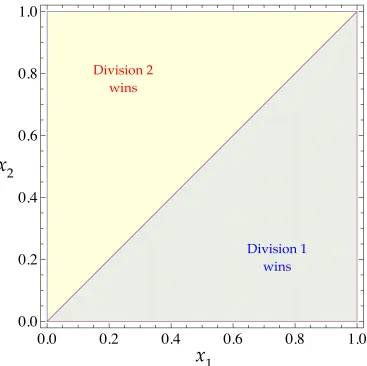
optimally allocated immediately to the highest-type division, as is illustrated in Figure2.
The associated conjectured value function is
0.0
0.2
0.4
0.6
0.8
1.0
0.0
0.2
0.4
0.6
0.8
1.0
q
1q
2Division 2
wins
Division 1
wins
x
2
[image:16.612.126.493.189.555.2]x
1
Define the relevant effective-cost threshold to bec2= 12, or equivalently,
c2 ≡inf
c0 ≥0| inf
0≤x1≤x2≤1
c0−x1(1−x2) ≥0
. (8)
Thresholdc2in (8) is motivated by the infinitesimal look-ahead rule (Ross,1970, Section
9.6), which is a continuous-time counterpart of the one-step look-ahead rule in
discrete-time stopping problems. The thresholdc2in (8) is the smallest (effective) costc0such that,
at any type profilex with x2 ≥ x1 (which is a normalization), HQ prefers allocating the
item immediately to the highest-type division (D2) to having the lowest-type division (D1)
learn forδ →0 units of time, at cost λc0δ, and only then allocating the item to whomever
by then has been revealed as the highest-type division. The revealed highest-type division
is D1if and only if it observes the good news, which occurs with probabilityx1 1−e−λδ
.
With the complementary probability, D2of typex2remains the highest-type division. The
inequality associated with HQ’s stated preference is
x2 ≥ −λc0δ+x1
1−e−λδ+1
−x1
1−e−λδx
2, (9)
which leads to the inequality in (8) whenδ →0.
The Conjecture G-Solves HJBQVI
Lemma 1. Suppose that learning is prohibitively costly, orcˆ≥c2. The conjectured value function
F(x) =max{x1,x2}g-solves HJBQVI subject to the boundary condition.
Proof. SubstitutingFinto HJBQVI (5) and recalling the conventionx2 ≥x1yields
min{cˆ−x1(x1−x2), 0} =0, x ∈ Ω,
which is implied by ˆc≥c2and the definition ofc2in (8).
by Definition1, Fg-solves HJBQVI.
It is immediate that Fsatisfies the boundary condition (6).
3.3
Learning Is Moderately Costly:
c
1≤
c
ˆ
<
c
2The Conjecture
If the (effective) cost ˆc of learning is below the threshold c2, defined in (8), asking some
division to learn is optimal, which follows from the infinitesimal look-ahead perturbation
formerly ruled out by (9). Further, it is natural to conjecture that any type profile x at
which learning occurs hasx1andx2close to each other, so that it is quite uncertain which
division has a higher value, and has bothx1andx2sufficiently far away from 0 and 1, so
that there is considerable uncertainty about each division’s value.
Which division learns depends on x and ˆc. For now, we focus on the case in which
c1 ≤ cˆ < c2, wherec1 ≈0.047. Then, whenever learning occurs, the lower-type division
learns. The thresholdc1is the unique solution of8
log(1−
√c
1)2
c1
= 2
1−√c1
. (10)
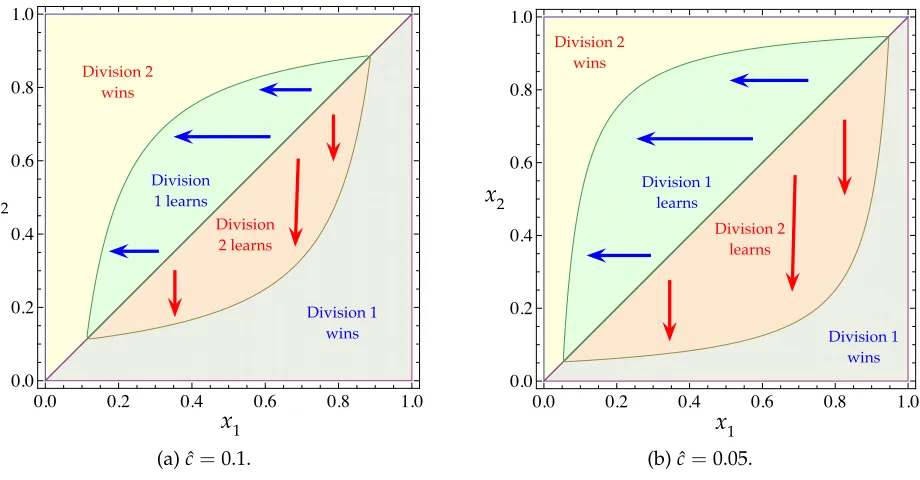
The conjectured optimal policy is illustrated in Figure 3. To demarcate the set of type
profiles at which D1 learns—the lens-shaped region in the figure—normalize x2 ≥ x1.
Define a type threshold for D1as a function of D2’s type:
b(x2) ≡ cˆ
1−x2
. (11)
In Figure3, D1learns if x1 > b(x2); otherwise, D2wins immediately. When D1 learns, it
wins if and only if it observes the good news. Becauseb is increasing in ˆc, the lower the
cost of learning, the larger the set of type profiles at which some division learns.
8Equation (10) admits no interpretation by inspection and emerges from a condition that ensures that
0.0 0.2 0.4 0.6 0.8 1.0 0.0
0.2 0.4 0.6 0.8 1.0
q1 q2
Division 1 learns
Division 2 learns Division 2
wins
Division 1 wins x2
x1
(a) ˆc=0.1.
0.0 0.2 0.4 0.6 0.8 1.0 0.0
0.2 0.4 0.6 0.8 1.0
q1
q2 Division 1 learns
Division 2 learns Division 2
wins
Division 1 wins x2
x1
[image:19.612.80.540.240.480.2](b) ˆc=0.05.
Figure 3: The optimal policy’s prescription for each type profile when the learning cost is moderate; c1 ≤ cˆ < c2. Within the lens-shaped region, one of the divisions learns. The
In order to see the intuition for why the lower-type division, say D1, is the one that
learns, note that asking D1 to learn amounts to betting on D1’s observation of the good
news. This bet’s upside is to see D1 observe the good news and then let it win. The bet’s
downside is bounded by D2’s type. If D1 observes no news for a sufficiently long period
of time, HQ lets D2win. Because D2 does not learn, its type does not deteriorate and so
ensures against the downward revisions of D1’s type.
The rest of the subsection is concerned with demonstrating, in Lemma 3, that the
conjectured value function F associated with the described conjectured policy g-solves
HJBQVI. In the course of this demonstration, the origins of the boundarybin (11) and of
the thresholdc1in (17) are explained.
The Conjecture G-Solves HJBQVI
A critical element in the proof of the conjectured policy’s optimality is an optimal
stop-ping problem referred to as the V-auxiliary problem, defined in (11). This problem is
solved by b of (11). In this problem, consistent with the conjectured optimal policy, D1,
the lower-type division, learns up to some optimally chosen deadline t ≥ 0. At t or as
soon as D1 observes the good news, learning stops, and the division with the highest
revised type wins. The value of the V-auxiliary problem is denoted by V and will be
observes the good news,” the functionVis defined
V(x) ≡ sup t≥0
x1
1−e−λt
| {z }
payoff from D1’s winning
+x2
1−x1
1−e−λt
| {z }
payoff from D2’s winning
− x1c
Z t
0 sλe
−λsds
| {z }
expected cost of learning ifF
− ct1−x1
1−e−λt
| {z }
expected cost of learning if notF
= sup
t≥0
1−(1−x2)
1−x1
1−e−λt
−c
(1−x1)t+x1
1−e−λt λ
,(12)
where the last equality is obtained by computing the integral and simplifying.
It is convenient to change variables in (12). Instead of maximizing over the deadline
t, maximize over D1’s corresponding threshold type, denoted byz. The relationship
be-tween the deadline and the threshold type is found by the Bayes rule, as in (1):
z
1−z = x1
1−x1
e−λt.
Substitutingzfrom the display above into the expression forV in (12) yields
V(x) ≡ sup z∈[x1,0)
1−(1−x1) (1−x2)
1−z −cˆ(1−x1) [ϕ(x1)−ϕ(z)]
, (13)
where
ϕ(s)≡ s
1−s +ln s
1−s, s ∈(0, 1).
In (13), the term 1−(1−x1) (1−x2)/(1−z)is the expected payoff from eventually
al-locating the item, either to D1 (as soon as D1 observes the good news) or to D2 (if D1
never observes the good news). The term ˆc(1−x1) [ϕ(x1)−ϕ(z)]is the expected cost of learning.
0.0
0.2
0.4
0.6
0.8
1.0
0.0
0.2
0.4
0.6
0.8
1.0
q
1q
x
22
x
1
ˆ
V
I
[image:22.612.125.495.68.439.2]b
(
x
2
)
Figure 4: Each of the depicted setsI and ˆV depends on ˆcand collects the type profiles at which the conjectured optimal policy makes identical prescriptions. The setsI and ˆV are separated by the functionb.
type set
ˆ
V ≡ nx ∈ [0, 1]2 | b(x2) <x1 ≤x2
o
, (14)
and the complementary set
I ≡ nx ∈ [0, 1]2 | x1 ≤x2
o
Vˆ. (15)
These sets are depicted in Figure4.
if x ∈ I, and
V(x) =1−(1−x1) (1−x2)
1−b(x2) −
ˆ
c(1−x1) [ϕ(x1)−ϕ(b(x2))] (16)
if x ∈Vˆ. The policy that achieves V has D2win immediately if x ∈ I and has D1learn if x ∈ Vˆ.
Proof. The thresholdb(x2), defined in (11), is derived using the infinitesimal look-ahead
rule for optimal stopping problems (Ross, 1970, Section 9.6). According to this rule, at
any type profilex, it is optimal for D1to learn if and only if learning for amountδ →0 of time and then allocating the item to the division with the highest revised type delivers a
weakly higher cash flow than immediately allocating the item to the higher-type division.
Assuming (and verifying shortly) that the infinitesimal look-ahead rule applies, D1
learns ifx ∈ Vˆ, and D2wins immediately ifx ∈ I. The threshold functionbemerges from
the indifference condition. Whenx1 =b(x2), HQ is indifferent between (i) allocating the
item to D2and (ii) having D1learn forδ →0 units of time and then allocating the item to the division with the highest revised type. This indifference condition is
x2 = lim
δ→0
−cδ+b(x2)
1−e−λδ+h1
−b(x2)
1−e−λδix
2
.
Computing the limit and simplifying gives b as defined in (11). The value function in
(16) is then derived from (13) assuming that the infinitesimal look-ahead rule applies as
described.
By Theorem 9.3 of Ross(1970), to ascertain that the infinitesimal look-ahead rule
in-deed applies, one must verify thatI is closed in the sense thatx ∈ I implies that, for any
x01 < x1, (x10,x2) ∈ I. The set I is indeed closed, by inspection of (14) and (15). Hence,
the infinitesimal look-ahead rule applies, and the desired result follows.
The thresholdc1in (17) emerges from the condition that, for any x ∈ Vˆ, rules out the
of time before the conjectured optimal policy is resumed. This deviation can be verified
to be unprofitable if and only if ˆc ≥c1, where
c1 ≡ min
c0 ≥0| min
0≤x1≤x2≤1
Φ x,c0
≥0
(17)
for
Φ(x, ˆc) ≡ 1−x2(1−x1) (ϕ(x1)−ϕ(b(x2))). (18)
The right-hand side of (18) depends on ˆc implicitly, through b(θ2) ≡ cˆ/(1−θ2). Here,
Φ is proportional to HQ’s payoff from having D1 learn as prescribed by the conjectured
policy less the payoff from asking D2 to learn forδ →0 and only then asking D1to learn
as prescribed by the conjectured policy. This payoff is nonnegative for all x ∈ Vˆ as long
as ˆc ≥ c1. LemmaB.1 of Appendix B proves that c1 defined in (17) can be equivalently
and more simply characterized as the unique solution of (10).
Lemma 3. Suppose that learning is moderately costly, or c1 ≤ cˆ < c2. The conjectured value
function F(x) = 1{x∈Vˆ}V(x) +1{x∈I}x2 g-solves HJBQVI and satisfies the boundary
condi-tion.
Proof. HJBQVI is verified by considering two cases: x∈ I andx ∈Vˆ.
1. Suppose x ∈ I, or equivalently, x1 ≤ b(x2), so thatF(x) = x2. As in the proof of
Lemma1, the implied HJBQVI equation is
min
i∈N {cˆ−x1(1−x2), 0} =0, x ∈ Ω
which holds true becausex1 ≤b(x2) = cˆ/(1−x2), byx ∈ I.
verified component by component of the min function:
min
ˆ
c+x1(1−x1)∂V∂x(1x) −x1(1−V(x)),
ˆ
c+x2(1−x2)∂V∂x(2x) −x2(1−V(x)),V(x)−x2
=0.
(a) To show
ˆ
c+x1(1−x1)∂
V(x)
∂x1 −x1(1−V(x)) =0, (19)
differentiateVin (16) to obtain
∂V(x) ∂x1
= 1−x2
1−b(x2)
+cˆ(ϕ(x1)−ϕ(b(x2)))−cˆ(1−x1)ϕ0(x1). (20)
Substitution of the above display and ofVinto (19) verifies the equality.
(b) The inequality V(x) ≥ x2 follows by “revealed preference,” that is, by
con-struction of the V-auxiliary problem.
(c) To show
ˆ
c+x2(1−x2)∂V(x)
∂x2 −
x2(1−V(x))≥0, (21)
apply the Envelope Theorem (Milgrom and Segal, 2002) to the definition ofV
in (16) to obtain
∂V(x) ∂x2 =
1−x1
1−b(x2).
Substituting the above display and (16) into (21), dividing by ˆc, and
substitut-ing the definition ofbyields an equivalent desired inequality:
Φ(x, ˆc)≥0, (22)
whereΦ is defined in (18). Because Φis increasing in ˆc, the inequality in (22)
holds for all admissible x if and only if ˆc is sufficiently large. Then, because
ˆ
definitive.
Fis non-differentiable only on a null subset of the 45-degree line in the type space. Hence,
by Definition1,Fg-solves HJBQVI, as desired. It is immediate that Fsatisfies the
bound-ary condition.
3.4
Learning Is Cheap:
c
ˆ
<
c
1The Conjecture
If the (effective) cost ˆc of learning falls below threshold c1, defined in (17), asking the
higher-type division to learn is no longer suboptimal. Intuitively, learning drives the
di-visions’ types apart, thereby helping HQ identify the highest-valuation division.
Learn-ing is faster for the higher-type division, say D2, which is more likely than D1to observe
the good news. If D2 observes the good news, its type jumps to 1. If D2 observes no
news, its type is revised substantially because an event deemed likely (the arrival of the
good news) has failed to occur. That is, in some informal sense, D2’s learning is more
informative than D1’s learning.
Because each division’s revised type is a martingale, the policy of asking only D2 to
learn and then selecting D2’s project regardless of the learning outcome does not affect the
project’s expected value but entails learning costs, and so cannot be optimal. Therefore,
D2’s learning can be optimal only if it is sufficiently long to potentially flip the ranking
of the divisions’ revised types. Lengthy learning can be optimal only if learning is
suffi-ciently cheap—which leads to the condition ˆc<c1—and only if the need for information
is sufficiently large. The need for information is large when the typesx1 andx2 are close
to each other (so that which project is more valuable is highly uncertain), when both x1
and x2 are far away from 0 and 1 (so that each project’s value is highly uncertain), and
whenx2is rather large (so that D2’s learning is rather informative).
0.0 0.2 0.4 0.6 0.8 1.0 0.0
0.2 0.4 0.6 0.8 1.0
q1
q2 Division 1
learns
Division 2 learns Division 2
wins
Division 1 wins Division 1
learns Division 2
learns
x2
x1
(a) ˆc=0.035.
0.0 0.2 0.4 0.6 0.8 1.0 0.0
0.2 0.4 0.6 0.8 1.0
q1 q2 Division 1
learns
Division 2 learns Div. 2
wins
Div. 1 wins Division 1
learns
Division 2 learns
x2
x1
[image:27.612.77.541.241.482.2](b) ˆc=0.015.
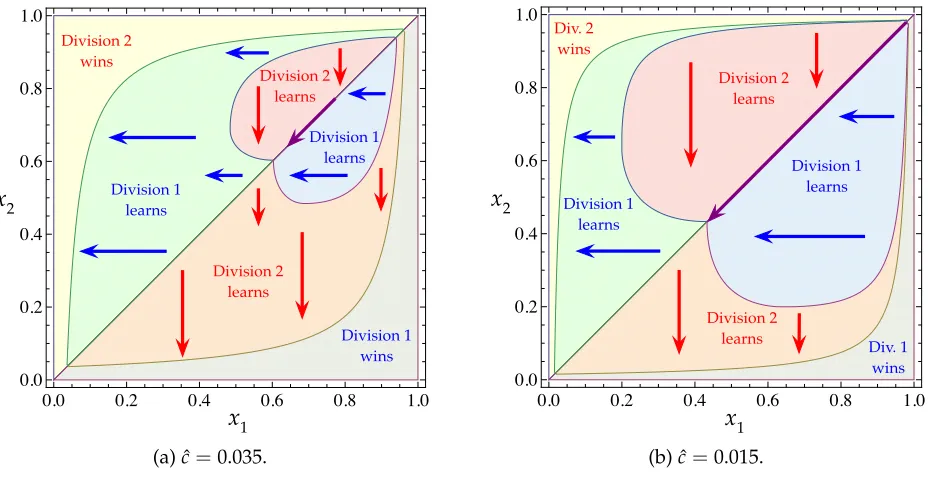
Figure 5: The optimal policy’s prescription for each type profile when the learning cost is small; ˆc < c1. Within the lens-shaped region (which encompasses the heart-shaped
heart-shaped region, the highest-type division learns. Elsewhere in the lens-shaped
gion, the lowest-type division learns. On the diagonal traversing the heart-shaped
re-gion, both divisions learn. If neither division learns, the highest-type division wins. The
boundary of the lens-shaped region is demarcated by functionbdefined in (11), as before.
The demarcation of the heart-shaped region is subtler and will be derived after additional
notation has been developed.
The Conjecture G-Solves HJBQVI
The economic intuition for D2’s occasional learning, supplied above, will be
comple-mented by a technical intuition. The notation required to formulate the conjectured
value function will be introduced along the way. The technical intuition can be
infor-mally viewed as the first step of a value-function-iteration-like procedure. Take the value
function in Lemma 3to be the initial guess for the value function for the case in which
ˆ
c <c1.
For every x ∈ Vˆ, Lemma 3 prescribes that D1 learn. This prescription induces the
value function that violates HJBQVI whenever ˆc < c1. In particular, inequality (22) in
Step2cof the lemma’s proof fails on thefailure set
F ≡ {x | Φ(x, ˆc) <0}. (23)
Figure 6aillustrates the failure set. On and only on F, infinitesimal learning by D2
fol-lowed by D1’s learning is a profitable deviation from the policy in which only D1 learns
on ˆV. The described identification of the failure set would be the first step in the
“value-function iteration process.”
Lemma6“patches” the failure setF by making D2learn on a certain set, calledpatch,
which is a strict superset ofF, as is illustrated in Figure6b. The infinitesimal episodes of
0.0 0.2 0.4 0.6 0.8 1.0 0.0
0.2 0.4 0.6 0.8 1.0
q1 q2 Division 1
learns
Division 2 learns
Division 1 wins
In the red region, profitable "one-off"
deviations exist.
x2
x1
F
(a) OnF, instead of asking the lower-type division to learn, HQ can achieve a higher payoff by mo-mentarily asking the higher-type division to learn and then reverting to asking the lower-type divi-sion to learn.
0.0 0.2 0.4 0.6 0.8 1.0 0.0
0.2 0.4 0.6 0.8 1.0
q1 q2
Division 2 learns bidder 2
wins
Division 1 wins
The patch exceeds the red region because linked deviations are more profitable than one-off ones.
x2
x1
F
[image:29.612.323.539.229.446.2](b) The heart-shaped patch (on which the highest-type division learns) exceedsF.
of these longer spells is more profitable for HQ than an infinitesimal episode (followed by
D1’s learning). As a result, even though on the boundary ofF, HQ is indifferent between
infinitesimal learning by D2and learning by D1 all the way, HQ strictly prefers a longer
episode of learning by D2 to learning by D1. The profitability of having D2 learn thus
extends beyond the failure set and to the patch.
What remains of ˆV once it has been patched is the new region on which we conjecture
that D1learns. This set is denoted by
V ≡V\ˆ (A ∪ B ∪ C), (24)
where the setsA,B, andC are depicted in Figure7and will be derived formally shortly.
To characterize the sets A,B, andC, we consider three more auxiliary stopping
prob-lems: A-auxiliary, B-auxiliary, and C-auxiliary. In each of these three problems, the goal
is to find the optimal amount of time that a division (or divisions) must learn before the
learning pattern is changed.
To formulate the C-auxiliary problem, used to characterize the setC, define the bounds
x ≡ 1− √
1−4 ˆc
2 and x¯ ≡
1+√1−4 ˆc
2 . (25)
TheC-auxiliary problemis defined on the set
ˆ
C ≡ nx ∈ [0, 1]2 | x≤ x1= x2 ≤x¯
o ,
which is a subset of ˆV. In this problem, both divisions learn until either observes the good
news or until both revised types reach some optimally chosen threshold. At that
thresh-old, the type profile entersV, and the strategy described in Lemma3is followed; that is,
0.0
0.2
0.4
0.6
0.8
1.0
0.0
0.2
0.4
0.6
0.8
1.0
q
1q
2x
2
x
1
¯
a
a
a
⇤
x
x
¯
b
(
x
2
)
u
(
x
1
)
d
(
x
1
)
w
(
x
1
)
I
V
A
B
[image:31.612.126.489.182.535.2]C
anyx ∈ Cˆ,
C(x1)≡ max
z∈[θ,x1]
1−(1−V(z,z))
1−x1
1−z
2
−2 ˆc(1−x1)2[σ(x1)−σ(z)]
| {z }
≡MC(z)
, (26) where
σ(s) ≡ 2s 1−s +
1 2
s
1−s
2
+ln s
1−s, s∈ (0, 1),
and where the maximand in (26) is denoted by MC(z), for future reference. The maxi-mand is constructed analogously to the maximaxi-mand in (13) and, to conserve space, will not
be written out in detail.
Lemma4characterizes a solution of the C-auxiliary problem in terms of the type
sub-set
C ≡
x ∈C |ˆ x1 ∈(a, ¯a) , (27)
where
a≡inf{z ∈ (x, ¯x)| Φ(z,z, ˆc)≤0} (28)
¯
a ≡max (
z∈ (a, ¯x)| 1−V(z,z)
(1−z)2 −2 ˆcσ(z) =
1−V(a,a)
(1−a)2 −2 ˆcσ(a)
)
. (29)
The origins ofaand ¯adefined above is revealed in the lemma’s proof.
Lemma 4. Normalize x2 ≥ x1. The value of the C-auxiliary problem in (26) satisfies C(x1) =
V(x1,x1)ifx∈ C\Cˆ , and satisfies
C(x1) =1−(1−V(a,a))
1−x1
1−a
2
−2 ˆc(1−x1)2[σ(x1)−σ(a)] (30)
if x ∈ C. The policy that achieves C has D1learn as in Lemma3if x ∈ C\Cˆ and has both divisions
learn if x ∈ C.
x
a
ax
z
M
CFigure 8: MC, the maximand in the C-auxiliary problem. The sign of dMC(z)/dz coin-cides with the sign ofΦ(z,z, ˆc).
suppressed, motivated by the observation that the maximizer in (26) depends onx1 only
through the restriction z ∈ [θ,x1]. To understand the solution of maxz∈[θ,x1]M
C(z), it
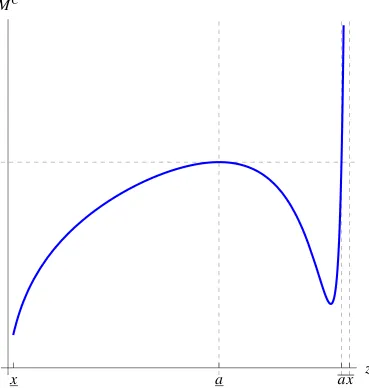
is instructive to study the shape of MC on [x, ¯x]. This shape is described by the sign of dMC(z)/dz, which, by differentiation, can be verified to coincide with the sign of
Φ(z,z, ˆc). Figure8illustratesMC.
Note thatΦ(x,x, ˆc) = Φ(x¯, ¯x, ˆc) = 1 (by direct substitution) and thatΦ(z,z, ˆc)is at first
decreasing in zand then increasing in z(by Lemma B.2 in AppendixB) and is uniquely
that, by the definition ofc1in (17) and by LemmaB.1, minzΦ(z,z,c1) = 0. BecauseΦis
strictly increasing in ˆc, ˆc <c1and minzΦ(z,z,c1) =0 imply Φ(z,z, ˆc) <0.
To summarize,Φ(z,z, ˆc)—and hence also dMC(z)/dz—first switches the sign from the positive to the negative and then from the negative to the positive. This
positive-negative-positive sign pattern implies that MC is wave-shaped, with local maxima ata, defined in (28), and ¯x, and with local minima at xand somewhere between aand ¯x. Moreover, by
LemmaB.4of AppendixB, ¯xis the unique global maximum, and soMC(x¯) >MC(a). Coupled with MC(x¯) > MC(a), the wave shape of MC implies the existence of a unique
¯
a ∈ (a, ¯x) such that MC(a¯) = MC(a). Condition MC(a¯) = MC(a) can be simplified to express ¯aequivalently (but still implicitly) by (29).
The derived properties ofMChave the following implications for the program inC(x1)≡
maxz∈[x,x1]M
C(z). When x
1 ∈/ (a, ¯a), MC is maximized on [θ,x1] at x1, and soC(x1) =
V(x1,x1); D1learns. When x1 ∈ (a, ¯a), MC is uniquely maximized on[θ,x1]ata, and so
C(x1) > V(x1,x1); both divisions learn until either division observes the good news or
until both types fall toa, whereupon D1learns.
To characterize the setAin Figure7, we formulate theA-auxiliary problemon the set
{x∈ (a∗,a]×[0, 1] | x2 ≥x1}.
In this problem, the choice is when to stop asking D2 to learn and instead adopt the
strategy described in Lemma3, which begins with D1learning. The value of this stopping
problem is, for anyx∈ Vˆ,
A(x)≡ max z∈[x1,x2]
1−(1−V(x1,z))
1−x2
1−z −cˆ(1−x2) [ϕ(x2)−ϕ(z)]
| {z }
≡MA(z;x 1)
, (31)
anal-ogous to those used in the construction ofVandCabove.
Lemma5characterizes a solution to the A-auxiliary problem in terms of the type
sub-set
A ≡ {x∈ (a∗,a]×[0, 1]| x2 ∈ (d(x1),u(x1))}, (32)
where
a∗ ≡inf{x1 ∈ [0, 1] | ∃x2∈ [x1, 1] s.t. Φ(x, ˆc) =0}, (33)
d(x1) ≡inf{z∈ [x1, 1]| Φ(x1,z, ˆc) ≤0}, x1 ∈ (a∗, ¯a), (34)
and, lettingb−1denote the inverse function ofb,
u(x1) ≡sup
z∈ hx1,b−1(x1)
i
|
1−V(x1,d(x1))
1−d(x1) −cˆϕ(d(x1))
= 1−V(x1,z)
1−z −cˆϕ(z)
, x1 ∈ (a∗, ¯a). (35)
The origin of the objects entering the definition ofAis revealed in the lemma’s proof.
Lemma 5. Normalize x2 ≥ x1. The value of the A-auxiliary problem in (31) satisfies A(x) =
V(x)if x ∈ (a∗,a]×[0, 1]\A,and satisfies
A(x) =1−[1−V(x1,d(x1))]
1−x2
1−d(x1) −
ˆ
c(1−x2) [ϕ(x2)−ϕ(d(x1))] (36)
if x ∈ A. The policy that achieves A has D1 learn as in Lemma3if x ∈ (a∗,a]×[0, 1]\Aand
has D2learn if x ∈ A.
Proof. Recall that the maximand in (31) is denoted by MA(z;x1). By differentiating, the
sign of dMA(z;x1)/dz coincides with the sign ofΦ(x1,z, ˆc). Hence, the argument
anal-ogous to the argument in the proof of Lemma4applies, except now, in Φ(x1,z, ˆc), only
one argument,z, varies.
x
d
H
x
1L
u
H
x
1L
x
z
[image:36.612.120.490.78.466.2]M
AFigure 9: MA, the maximand in the A-auxiliary problem. The sign of dMA(z;x1)/dz
coincides with the sign ofΦ(x1,z, ˆc).
of z, as depicted in Figure 9. By inspection of MA, for a given x1, a local maximum of
MA(z;x1)is given by (34).
Coupled with MA b−1(x1);x1
> MA(d(x1);x1) (by Lemma B.5 of Appendix B), the
wave shape ofMAimplies the existence of a uniqueu(x1) ∈ m(x1),b−1(x1)
such that
MA(u(x1);x1) = MA(d(x1);x1). Condition MA(u(x1);x1) = MA(d(x1);x1) can be
simplified to expressu(x1)equivalently (but still implicitly) as in (35).9
The derived properties ofMAhave the following implications for the program inA(x)≡
9As defined in (35),usatisfiesA(x1,u(x
maxz∈[x1,x2]M
A(z;x
1). When x2 ∈/ (d(x1),u(x1)), MA(·;x1)is maximized on [x1,x2]at
x2, and so A(x) = V(x). When x2 ∈ (d(x1),u(x1)), MA(·;x1)is uniquely maximized
on[x1,x2]atd(x1), and soA(x) >V(x).
To characterizeB, the remaining set in Figure7, we formulate a degenerate auxiliary
problem, theB-auxiliary problem. The problem is defined on the set
B ≡ {x∈ (a, ¯a)×[0, 1] | x2 ∈ (x1,w(x1))}, (37)
whereais defined in (28), ¯ais defined in (29), and
w(x1) ≡inf
n
z ∈ hx1,b−1(x1)
i
| V(x1,z) = B(x1,z)
o
, x1∈ (a, ¯a). (38)
The problem consists in having D2 learn until it observes the good news or until its
re-vised type drops down to D1’s typex1(the “choice” of this thresholdx1is the degenerate
decision), whereupon both divisions learn as prescribed by the C-auxiliary problem. This
policy’s value is
B(x)≡1−(1−C(x1))
1−x2
1−x1 −
ˆ
c(1−x2) [ϕ(x2)−ϕ(x1)]. (39)
The function B is constructed using the arguments analogous to those used in the
con-struction ofV,C, and Aabove.
We can now assemble the pieces.
Lemma 6. Suppose that learning is cheap, orcˆ<c1. The conjectured value function
F(x) = 1{x∈A}A(x) +1{x∈B}B(x) +1{x∈C}C(x) +1{x∈V}V(x) +1{x∈I}x2
g-solves HJBQVI and satisfies the boundary condition.
1. Suppose that x ∈ I, so that F(x) = x2. HJBQVI holds by Step 1 in the proof of
Lemma3.
2. Suppose that x ∈ V, so that F(x) = V(x). HJBQVI follows from the argument in
Step2in the proof of Lemma 3with one modification. Part2cof that step requires
the inequalityΦ(x, ˆc) ≥0. To show this inequality here, note thatΦ(x, ˆc) <0 ⇐⇒
x ∈ F, by the definition of the failure set F in (23). Because F ⊂ A ∪ B ∪ C (by
Lemmas B.5 and B.6) and V ∩(A ∪ B ∪ C) = ∅ (by the definition of V in (24)),
x ∈ V impliesx ∈ F/ . As a result,Φ(x, ˆc) ≥0 for allx ∈ V, as desired.
3. Suppose thatx ∈ C, so that F(x) = C(x2) and ∂F(x)/∂xi = (1/2)∂C(xi)/∂xi.10 HJBQVI in (5) will be verified component by component of the min function:
min
ˆ
c+ x2(1−x2)
2
∂C(x2)
∂x2 −x2(1−C(x2)),C(x2)−x2
=0.
(a) The inequality C(x2) ≥ x2 follows by “revealed preference.” By construction
of the C-auxiliary problem, C(x2,x2) ≥ V(x2,x2). By construction of the
V-auxiliary problem,V(x2,x2) ≥x2. Therefore,C(x2) ≥x2.
(b) To show
ˆ
c+ x2(1−x2)
2
∂C(x2)
∂x2 −
x2(1−C(x2)) =0, (40)
differentiateCin (30) to obtain
∂C(x2)
∂x2
= 2
1−x2
1−C(x2)−
ˆ
c x2
. (41)
Substitution of the above display and ofCinto (40) verifies the equality.
4. Suppose x ∈ A ∪ B. If x ∈ A, then F(x) = A(x). If x ∈ B, then F(x) = B(x).
10Note the notational convention according to which∂F(x)/∂x
i 6= ∂C(xi)/∂xi. The rationale is that ∂F(x)/∂xi is the change in the conjectured value function in response to a marginal change in a single
type, whereas∂C(xi)/∂xiis the change in the conjectured value function in response to identical marginal
HJBQVI is verified component by component of the min function:
min
ˆ
c+x1(1−x1) ∂F∂x(x1) −x1(1−F(x)),
ˆ
c+x2(1−x2)∂F∂x(x2) −x2(1−F(x)),F(x)−x2
=0.
(a) To verify
ˆ
c+x2(1−x2)∂
F(x)
∂x2 −x2(1−F(x)) =0, (42)
replaceFand∂F/∂x2in the display above byAand∂A/∂x2ifx∈ A, and byB
and∂B/∂x2if x∈ B. The function∂A/∂x2is obtained by differentiating (36):
∂A(x) ∂x2
= 1−V(x1,d(x1))
1−d(x1)
+cˆ(ϕ(x2)−ϕ(d(x1)))− cˆ
x2(1−x2)
.
The function∂B/∂x2is obtained by differentiating (39):
∂B(x) ∂x2
= 1−C(x1)
1−x1
+cˆ(ϕ(x2)−ϕ(x1))−
ˆ
c x2(1−x2)
.
(b) To showF(x) ≥ x2, it suffices to show F(x) ≥V(x)and, in order to conclude
thatV(x) ≥ x2by construction of the V-auxiliary problem, to show x ∈ A ∪
B =⇒ x∈ Vˆ. Hence, it will be shown that (i)A(x) ≥V(x)andB(x) ≥V(x),
and (ii)A ⊆ Vˆ and B ⊆Vˆ.
i. Whenx ∈ A, A(x)≥V(x)follows “by revealed preference,” by
construc-tion of the A-auxiliary problem.
When x ∈ B, showingB(x) ≥ V(x) is mildly more involved, but is also
essentially a revealed-preference argument, applied twice. In particular,
extend the A-auxiliary problem (originally defined on A) onto the set B.
Using the same arguments as in Lemma 5, this problem’s solution can be
verified to imply that, whenever x ∈ B, D2 learns until either he observes
prescription of the V-auxiliary problem is followed, delivering the
contin-uation valueV(x1,x1). So, by revealed preference, A(x) ≥V(x).
OnB, the B-auxiliary problem has the same threshold as the extended
A-auxiliary problem, but once this threshold has been reached, delivers a
higher continuation value, C(x1), with C(x1) ≥ V(x1,x1) by “revealed
preference” in the C-auxiliary problem. So, B(x) ≥ A(x), which,
com-bined with A(x) ≥V(x), givesB(x) ≥V(x), as desired.
ii. The inclusionA ⊆ Vˆ follows because LemmaB.5 shows that x1 ∈ (a∗,a)
implies u(x1) <b−1(x1). That is,u(x1), the upper boundary of setA, on
which the A-auxiliary problem is defined, lies strictly below b−1(x1), the
upper boundary of set ˆV.
The inclusion B ⊆ Vˆ follows because Lemma B.6 shows that x1 ∈ (a, ¯a)
implies w(x1)<b−1(x1). That is,w(x1), the upper boundary of setB, on
which the B-auxiliary problem is defined, lies strictly below b−1(x1), the
upper boundary of set ˆV.
(c) It will be shown that
ˆ
c+x1(1−x1)
∂F(x) ∂x1 −
x1(1−F(x))≥0. (43)
Ifx∈ A, apply the Envelope Theorem toAin (36) to obtain
∂A(x) ∂x1
= ∂V(x1,d(x1))
∂x1
1−x2
1−d(x1)
.
inequality (43) and dividing by ˆcyields the equivalent tentative inequality
1 ≥x1(1−x2) (ϕ(x2)−ϕ(d(x1)))
+ x1(1−x2)
(1−d(x1))cˆ
1−V(x1,d(x1))−(1−x1) ∂V(x1,d(x1))
∂x1
,
which further simplifies by substitutingV and ∂V/∂x1 using (19) and by
di-viding both sides by 1−x2:
1
1−x2 ≥x1(ϕ(x2)−ϕ(d(x1))) +
1 1−d(x1)
. (44)
Ifx∈ B, differentiateBin (39) and use the expression for∂C(x1)/∂x1to obtain
∂B(x1,x2)
∂x1
= 1−x2
(1−x1)2
1−C(x1)−
ˆ
c x1
.
Substituting the above display and the definition ofBin (39) into the tentative
inequality (43) leads, once again, to the tentative inequality (44).
If x2 = d(x1), the inequality (44) holds trivially, as equality. To show that
the inequality holds also forx2 > d(x1), it suffices to show that its left-hand
side increases inx2 faster than its right-hand side. Indeed, the left-hand side’s
derivative, which is 1/(1−x2)2, is larger than the right-hand side’s derivative,
which is
x1ϕ0(x2) =
x1
x2(1−x2)2
,
byx1< x2. Thus, the tentative inequality (44) is definitive, as desired.
3.5
Synthesis
To summarize, theconjectured value functionis
F(x) =
x2 ifc2 ≤cˆ
1{x∈V}V(x) +1{x∈I}x2 ifc1 ≤cˆ<c2
1{x∈A}A(x) +1{x∈B}B(x)
+1{x∈C}C(x) +1{x∈V}V(x) +1{x∈I}x2
if ˆc <c1,
(45)
where A, B,C, andV are defined, respectively, in (36), (39), (30), and (16).
The underlying conjectured optimal policy can be read off Figure 2 when c2 ≤ cˆ,
Figure3whenc1 ≤cˆ<c2, and Figure5when ˆc <c1.
4
Verification of the Conjectured Value Function
Theorem 1. The conjectured value function F in (45) is the sought value function; that is,φ=F.
By implication, the conjectured optimal policy is indeed optimal.
The theorem’s proof builds on several intermediate results and is distilled toward the
end of the section.
4.1
The Big Picture
Continuous-time modelling enables us to compute explicitly HQ’s value function and
derive the implied optimal policy. In addition, the statements of the results are not
con-taminated by provisos stemming from the indivisibility of information increments, which
would be inherent in any discrete-time formulation. The cost of the continuous-time
ap-proach is the unfamiliar mathematics required to rigorously justify the results. In
number of technical conditions are also invoked. Therefore, before delving into the formal
analysis, we informally outline the main ideas and relate continuous-time optimization
to its familiar discrete-time counterpart.
Consider the dynamic programming principle (DPP). DPP says that HQ’s value today
equals HQ’s expected continuation value at an arbitrary future stopping time plus the
flow payoffs enjoyed until that time. These intervening flow payoffs and the eventual
continuation value depend on the intervening controls, which are chosen to maximize
HQ’s value today. This statement of DPP is the same in both continuous and discrete
time and relies on the same backward-induction argument. The argument requires either
a finite horizon or discounting. We impose neither. However, without loss of generality,
we could have imposed a finite horizon. Indeed, if learning is protracted, eventually,
beliefs become so precise that further learning cannot possibly justify its costs. So DPP
holds in our setting.
One can show that DPP holds if and only if the DPP equation holds for the
small-est possible positive stopping time. In a discrete model, this smallsmall-est time is one period,
and the corresponding DPP equation is known as the Bellman equation. In a continuous
model, the smallest time is operationalized by taking limits, thereby obtaining a
differen-tial counterpart of the Bellman equation, known as the HJBQVI equation. Taking limits
is delicate, however, because limits may not exist, even under natural “technical”
condi-tions. That is, the value function need not be differentiable; it may have “kinks.” Kinks
are not an issue in discrete time, because the Bellman equation is not a differential
equa-tion.
In continuous time, kinks cannot be neglected. A candidate value function that solves
HJBQVI at all points of differentiability but with its kinks unrestricted may fail to be the
sought value function. That is, extraneous generalized solutions of HJBQVI are possible.
Enter viscosity solution, which uses HJBQVI to discipline the candidate value function
In our maximization problem, viscosity solution restricts upward kinks, but not
down-ward kinks.11 It is somewhat of a folk wisdom that, in maximization problems, value
functions abhor upward kinks. For instance, that, in a static problem, under natural
con-ditions, the value function admits no upward kinks can be seen graphically by taking the
upper envelope of the reward functions for various values of the control while varying the
state. Clausen and Strub (2012) show how upward kinks can be ruled out in a dynamic
problem (not related to ours).12 HJBQVI’s viscosity solution strengthens generalized
so-lution by imposing the requisite optimality restrictions on the kinks. A characterization
theorem obtains; the sought value function, and only this function, is the viscosity
solu-tion of HJBQVI.
The conjectured value function Fin (45) has no upward kinks at all, as will be shown.
(The downward kinks are where regions A and B border V in Figure 7 and on the
45-degree line except within the heart-shaped region in Figures 4 and 7.) So the viscosity
conditions on the kinks hold automatically. All that remains to verify is that HJBQVI
holds at all points of differentiability, which we have already done. Thus, the conjectured
value function is the viscosity solution of HJBQVI and hence is the sought value function.
To summarize, the conditions that viscosity solution imposes on kinks are substantive,
not technical. The economic content of these conditions is not peculiar to the
continuous-time model. In the discrete model, the same content is already embedded into the Bellman
equation, which is comprehensive because it is not restricted to the value function’s points
of differentiability. Just as, in discrete time, the value function is the unique solution
of the Bellman equation, in continuous time, the value function is the unique viscosity
solution of HJBQVI. This viscosity characterization of the value function is the essence of
the verification procedure, justified and performed in the remainder of this section.