Scholarly Research Journal for Interdisciplinary Studies, Online ISSN 2278-8808, SJIF 2016 = 6.17, www.srjis.com UGC Approved Sr. No.45269, SEPT-OCT 2017, VOL- 4/36
Copyright © 2017, Scholarly Research Journal for Interdisciplinary Studies EFFECT OF GLOMUS MOSSEAE ON GROWTH AND CHEMICAL COMPOSITION OF CAJANUS CAJAN (VAR. ICPL-87)
Kavita Singh Chaudhary1, Ph. D. & Rohit Kumar Singh2, Ph. D.
1
Astt. Prof- Microbiology, Government P.G.College, Noida, U.P.,
2
Astt. Prof (Chemistry), Pt JLN College, Banda
Effect of Glomus mosseae on growth and chemical composition of Cajanus cajan was investigated with different spore densities by placing the spores along with seed. Root colonization with the fungus has resulted in an increased vegetative growth, total chlorophyll content and uptake of nutrients viz., nitrogen, phosphorous, potassium, calcium and magnesium compared to non-mycorrhizal plants. Two hundred spores per plant was found to be optimum for root colonization and for obtaining maximum vegetative growth. Mycorrhizal plants recorded increased weights of fresh root, shoot and dry shoot over non-mycorrhizal plants.
Keywords- Glomus mosseae, Mycorrhiza, Cajanus cajan, root colonization
Introduction
Endomycorrhizal fungi have been shown to increase the ability of roots to absorb more
nutrients than non-mycorrhizal plants (Daft and Nicolson, 1969). Various studies conducted
in the past corroborate this hypothesis (Daft and Nicolson, 1969; Sitraramaiah and sikora,
1981). In the present study experiments were conducted to determine the response of Cajanus
cajan plants to different mycorrhizal spore levels of G. mosseae and also the chemical
composition of mycorrhizal and non-mycorrhizal Cajanus cajan plants. Pigeon pea (Cajanus
cajan) is a annual legume, grown in various states of India. It is considered to be an important
source of protein. The cultivated area of pigeon pea (Cajanus cajan) is rapidly expanding in
various parts of our country. About 80% of the world production of pigeon pea comes from
India. According to Bagyaraj et al. (1989) the VA, Mycorrhizal fungi can improve legume
growth through increased the way of phosphorous especially in soils of low fertility,
Manjunath and Bagyaraj (1984) also reported that the improvement in nodule number and
mass, acetylene reduction activity, shoot/root dry matter and total N and P uptake when
mycorrhizal fungi is inoculated with pigeon pea. It was considered worthwhile to screen and
select an efficient mycorrhizal fungus which can be used for inoculating pigeon pea in order
to improve plant growth and yield at low input cost.
Dr. Kavita Singh Chaudhary& Dr. Rohit Kumar Singh
(Pg. 8070-8075) 8071
Copyright © 2017, Scholarly Research Journal for Interdisciplinary Studies Materials and Methods
The composition of soil used for conducting the experiments was as follows- Sand 33.3%, silt
49%, clay 17.7%, bulk density 1.39 g/cm3, moisture holding capacity 28.6% at 1/3
atmosphere, organic matter 3.1%, pH 7.6, free ions 1.8 %, CEC (meg/100g) 17.00 and Ca:
Mg ratio 4:2. The Endomycorrhizal fungus Glomus mosseae was multiplied on Cajanus
cajan (cv. D 744 82 K) in damped sand in glasshouse. Mycorrhiza free plants were cultured
as controls in the same way. Chlamydospores were recovered from the mycorrhizal culture
by wet sieve method of Gerdemann and Nicolson (1963). The suspension was adjusted to
give spore concentration of 50,100,200 and 400 Chlamydospores. The spores were placed
along with the Cajanus cajan in the centre of one kilogram potted soil. Only one plant was
maintained per pot. Non-mycorrhizal plants received mycorrhizal free water suspension
collected from rhizospore soil. There were 10 replications for each treatment. The experiment
was terminated 45 days after planning. Fresh and dry shoot and root weights were recorded.
The roots were washed with water and root volume was determined by water displacement
method. The chlorophyll content was estimated spetrophotametrically according to the
method of Arnon (1949). The roots were stained with acid fuchain in lactophenol (Phillips
and Hayman, 1970). The percent mycorrhizal colonization was calculated by using the
method of Krishna and Dart (1984).
Total nitrogen was estimated by microkjeldhal method (Bremner, 1965). Phosphorous and
potassium from the diacid extract were estimated by Vanadomolybdo phosphoric yellow
colour method (Allen, 1989) or flame photometer, calcium and magnesium in diacids extract
were determined by ETDA method (Jackson, 1973).
Results and Discussion
Vegetative growth of mycorrhizal and non-mycorrhizal plants- Maximum fresh root
weight was recorded in Cajanus cajan plants colonized with the mycorrhizal fungus at spore
density of 400/pot. The results were highly significant at spore density of 50,100,200 and 400
when compared to non-mycorrhizal plants. The increase in fresh root weight at 50 spores was
about 281.05% when compared to non-mycorrhizal plants and maximum increase in fresh
root weight 396.43% was obtained at the highest 400 spores. The increase in fresh root also
Dr. Kavita Singh Chaudhary& Dr. Rohit Kumar Singh
(Pg. 8070-8075) 8072
Copyright © 2017, Scholarly Research Journal for Interdisciplinary Studies
The differences in fresh root weight between mycorrhizal and non-mycorrhizal plants were
highly significant. The plants supplied with the Endomycorrhizal fungus showed four to five
times fresher shoot weight than non-mycorrhizal plants (Table 1). There was an increase of
263.76% and 341% in fresh shoot weight at spore density of 50 and 400 mycorrhizal spores
respectively when compared to non-mycorrhizal control Cajanus cajan plants (Table1). The
increase in fresh shoot weight of Cajanus cajan plants at higher level spores of 200 and 400
were also highly significant.
There was constant increase in dry shoot weight when the spore density increased from 50 to
400 and the differences were significant at different spore densities. Mycorrhizal plants
produced four to five times more dry weight with an increase of 276% and 430% over
non-mycorrhizal plants. Maximum dry shoot weight was recorded with 400 spores. There were no
significant differences and spore density of 50 an 100 but dry weights differed significantly
with non-mycorrhizal plants at spore density of 200 and 400. There was a correlation of
increased root volume (246%) was recorded at mycorrhizal spore density of 400 spores. The
per cent increase in root volume was 192, 155 and 110% at spore densities 200, 100 and 50
respectively. The difference in root volume of Cajanus cajan plants were highly significant at
spore density of 100, 200 and 400 spore/pot. The results of this study clearly indicated that
increased vegetative growth of Cajanus cajan plants with increased mycorrhizal spore
density of 50 and 400 per plant. Daft and Nicolson (1969) found a positive correlation in
tomato growth at different mycorrhizal spore densities. Similar results were reported earlier
by Sitraramaiah and sikora (1981). They found that increased mycorrhizal spore density of G.
mossae from 50 to 1300 spores/pot increased the vegetative growth of cotton plants.
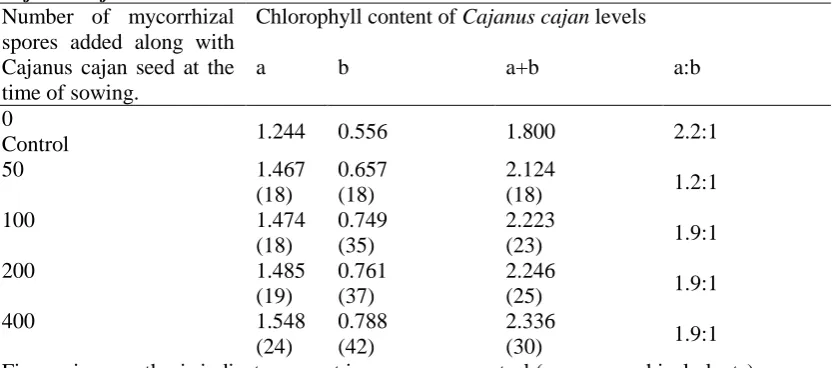
Inoculation with increased density of spores resulted in an increased total chlorophyll content
(chlorophyll ‘a’ and chlorophyll ‘b’). Maximum chlorophyll content was recorded from
plants inoculated with 400 spores. The total chlorophyll ‘a’content was increased from 19%
at spore density of 50 spores to 25% at spore density of 400 spores compared to
non-mycorrhizal plants. At 200 spore density the increase was 29% (Table 2). Similar results were
non-Dr. Kavita Singh Chaudhary& Dr. Rohit Kumar Singh
(Pg. 8070-8075) 8073
Copyright © 2017, Scholarly Research Journal for Interdisciplinary Studies
mycorrhizal plants and the plants inoculated with mycorrhizal fungus at 50 spores, but it
decreased to 1:9:1 at other higher spore density (100, 200 and 400 spore/plant).
Mycorrhizal root colonization
The mycorrhizal root colonization of Cajanus cajan roots at spore density of 50 was 60% and
at 100 spores/plant was 65%. At higher spore density of 200 and 400 there was increased root
colonization of 71 and 80%, respectively. Maximum root colonization was found at 400
spores/plant (80%) (Table 1). The per cent root colonization was maximum (35%) at 400
spores/plant. Sitarmaiah and Sikora (1981) reported a close relationship between initial
inoculum spore concentration and root colonization. However, Daft and Nicolson (1969)
tested 3 to 225 mycorrhizal spore concentrations per plant and found that all spore
concentration stimulated tomato vegetative growth.
Chemical Composition
At spore concentration of 50 spores/plant there was 21% increase in nitrogen content of
Cajanus cajan plants. The increased nitrogen content was 49, 72 and 90% at 100, 200 and
400 spore/ml, respectively (Table 3). Phosphorous content was also increased by 20.37% at
50 spores. At 100 and 200 spores phosphorus level the increase was 24.07 and 35 percent.
the increase was maximum (70%) at spore density of 400. There were striking difference in
potassium content between mycorrhizal and non-mycorrhizal plants. The potassium content
was 58% more at 50 chlamydospores and increased to 91% at 400 chlamydospore level.
There was a 55% increase in calcium content at 50 mycorrhizal spore level and increased to
69 and 100% at 200 and 400 mycorrhizal spores respectively. The percentage in magnesium
content at spore density of 50 was 50% over non-mycorrhizal plantsand it increased to 100%
spore density of 200 and 400 (Table 3). Hatting, et al. (1973) indicated that the mycelia net
work of G. mosseae enabled to remove more minerals from a large soil volume extending
beyond the immediate vicinity of the root surface.
References
Arnon, D.I, 1949, Copper enzymes in isolated chloroplasts of poly-phenol-oxidase in Beta vulgaris.
Plant Physiology 24:1-15
Bagyaraj D.J., Byra Reddy M. S. and Nalini P.A. 1989. Selection of efficient inoculants V A
Mycorrhizal fungus for leucaena. Forest Ecol. Management27: 81-85
Bremner, J.M. 1965. Methods of soil analysis vol. 2. Chemical and microbiological methods. Am.
Soc. Agron. Madison, Wilconsin.
Daft, M.J. and T.H. Nicolson. 1969. Effects of Ednogone mycorrhiza on plant growth. III. Influence
Dr. Kavita Singh Chaudhary& Dr. Rohit Kumar Singh
(Pg. 8070-8075) 8074
Copyright © 2017, Scholarly Research Journal for Interdisciplinary Studies
Gardemann J.W. and T.H. Nicolson. 1963. Spores of mycorrhizal Endogone sp. Extracted from soil
by sieving and decanting. Trans. Br. Mycol. Soc. 46:235-244.
Hatting, M.J., L.E. Gray and J.W. Gerdmann. 1973. Uptake and translocation of 32p labeled
phosphate to onion roots by Endomycorrhizal fungi. Soil Sci. 166:383-387
Jackson, M.L. 1973. Soil chemical analysis Prentice Hall Inc. New Jersey, USA.
Krishna, K,R. and P.J. Dart. 1984. Effect of mycorrhizal inoculation and soluble phosphorus
fertilizer on growth and phosphorus uptake of pearl millet. Pl. Soil 81:247-256
Manjunath A. and Bagyaraj D.J. 1984: Response of pigeon pea and cow pea to phosphate and dual
inoculation with vsesicular arbuscular mycorrhiza and Rhizobium. Trop. Agric. 614 :48-52.
Philips, J.M and D.S. Hayman. 1970. Improved procedures for clearing roots and staining parasitic
and vesicular- arbuscular mycorrhizal fungi for rapid assessment of infection. Trans. Br. Mycol. Soc. 55:158-161
Sitaramaiah, K. and R.A. Sikora. 1981. Influence of Glomus mosseae inoculum concentration on
Rotylenchulus reniformis population dynamics and cotton growth. Third International Symposium on Plant Pathology, N.D. Dec. 14-18, 1981.p 105-106.
Effect of G.fasciculatum at different spore levels on root colonization and vegetative growth of Cajanus cajan
No. of
mycorrhizal spores added along with
Cajanus cajan seed
Total root infection (%) Length of root infection (%) Root Volume (ml) Fresh root weight (g) Fresh shoot weight (g) Dry shoot weight (g) 0
(Control) - - 3.4 1.69 3.98 0.75
500 60 18 7.2
(112) 6.44 (281) 14.52 (265) 2.81 (275)
100 65 23 8.6
(153) 6.92 (309) 14.97 (276) 2.82 (276)
200 71 33 9.9
(191) 7.30 (332) 15.78 (296) 3.58 (377)
400 80 35 11.8
(247) 8.39 (396) 17.52 (340) 3.97 (429)
S.Em - - 1.14 0.92 1.64 0.31
C.D. at 1% - - 4.70 3.85 6.54 1.28
C.D. at 5% - - 2.80 2.80 4.75 0.93
Dr. Kavita Singh Chaudhary& Dr. Rohit Kumar Singh
(Pg. 8070-8075) 8075
Copyright © 2017, Scholarly Research Journal for Interdisciplinary Studies
Table 2. Effect of G.fasciculatum at different levels of leaf chlorophyll content of
Cajanus cajan
Number of mycorrhizal spores added along with Cajanus cajan seed at the time of sowing.
Chlorophyll content of Cajanus cajan levels
a b a+b a:b
0
Control 1.244 0.556 1.800 2.2:1
50 1.467
(18)
0.657 (18)
2.124
(18) 1.2:1
100 1.474
(18)
0.749 (35)
2.223
(23) 1.9:1
200 1.485
(19)
0.761 (37)
2.246
(25) 1.9:1
400 1.548
(24)
0.788 (42)
2.336
(30) 1.9:1
Figures in parenthesis indicate percent increase over control (non-mycorrhizal plants).
Table 3. Effect of G.fasciculatum on chemical composition of Cajanus cajan
Concentration of
mycorrhizal spores
Chemical composition
N(%) P(%) K(%) Ca(%) Mg(%)
0
Control 1.09 0.054 0.88 0.27 0.08
50 1.32 0.65 1.39 0.42 0.12
100 1.63 0.067 1.46 0.41 0.13
200 1.88 0.073 1.61 0.51 0.16
400 2.07 0.092 1.68 0.54 0.16
[image:6.595.92.509.127.311.2]