MAR-APR, 2015. VOL. III/XVII www.srjis.com Page 3180
EFFECT OF ONE YEAR FACE-TO-FACE B.ED. PROGRAMME ON
TEACHING COMPETENCY
Dr. Deepa Sikand Kauts, Associate Professor,
MGN college of Education Jalandhar
Dr. Varinder Kaur, Assistant Professor,
GTB Khalsa College of Education, Dasuya (Hoshiarpur)
The study investigated the effect of one year face-to-face B.Ed. programme on the teaching competency
of the teacher interns in relation to type of institutions, academic streams and university system. The sample
constituted of 1256 teacher interns belonging to science and humanities streams drawn from fifteen education
Colleges from two universities i.e. Guru Nanak Dev University Amritsar and Panjab University Chandigarh
were selected from government-aided and self-financed. The effect of execution of B.Ed. programme on the
teaching competency of the teacher interns was studied with the help of a pre-test, post-test experimental design
with 2×2×2 factorial design taking gain scores of the teaching competency as dependent variable. The results
revealed that teacher interns of self-financed institution exhibited significantly higher gain in the teaching
competency than their counterparts in government-aided institutions. Teacher interns studied in Panjab
University Chandigarh exhibited significantly higher gain in teaching competency than their counterparts Guru
Nanak Dev University Amritsar as an outcome of B.Ed. programme. Whereas teacher interns following different
academic streams were did not differ gain significantly in their teaching competency.
The interaction effects between institution types and academic streams, between academic streams and
university system on the gain scores of teaching competency were reported significant. But the interaction effect
between university system and institution types was not reported significant.
Keywords: Teacher Education, Teacher Interns, Teaching Competency.
MAR-APR, 2015. VOL. III/XVII www.srjis.com Page 3181 INTRODUCTION:
Teacher is a paradigm shift in the teacher education in the lamentation of quality downturn in the 1970s and the 1980s. That was mostly centred on the burgeoning B.Ed. courses, which were mostly considered as substandard and inadequate in quality.
The NCTE succeeded in regulating these courses during the first couple of years of its existence. Recently it has been noticed that fast diversion towards commercialization in education has led to mushroom growth of Colleges of Education. There has been manifold expansion in the number of training colleges and university departments which train graduate and post-graduate and post-graduate teachers. At the time of independence we had only 20 universities with about 500 affiliated colleges having a total student enrolment of about 2.5 Lac. The estimated number of universities at present has crossed 300 mark with about 15000 affiliated colleges and over 96 Lac students as a shocking surprise to many. The entire country knew how teacher education institutions were approved and what was happening in the name of preparing teachers who would be entrusted with shaping the future generations in comprehensive development of their personalities. The Annual Status of Education Report (ASER) 2012 is out and has already generated discussion on the state of education in the country. A quick survey of some figures seem to point to a mix of a movement forward – especially in terms of infrastructure and broad enrolment ratio – and a certain movement backward in terms of learning skills and teacher performance. It would be perhaps useful to have a brief look at some of the findings and to note with alarm the fact that the principal investigators of the report feel that there is indeed a „deepening crisis in education‟, especially mass education in the country. And this crisis, they feel, is like „an unseen and quiet killer disease‟ of which the government, education policy makers and educationists in the country ought to take serious cognisance.
MAR-APR, 2015. VOL. III/XVII www.srjis.com Page 3182 percentage of people above the age of 65 will be 39% in the US, 53% in Germany, and 67% in Japan. According to, International Organization Paper, India by contrast will have only 19% above the age of 60. This data shows that India has a demographic dividend of a younger population as compared to developed countries which is great opportunity for India. But it poses a challenge as well as. To attain wealth and a reputed status, a nation must make it a point thatthat a critical mass of people move into the higher education system. For India this task is more challenging with the fact that 46% of India‟s schoolchildren dropout before they get a middle school.
Due to fast degeneration of values in our country improvement of quality of education is required. In 2007, the ministry of Women and Child Development (MWCD) released a study report on child abuse. It is estimated that 150 million girls and 73 million boys under 18 have been subjected to child abuse. A Global School-Based Student Health Survey found that 20% and 65% of school going children reported having been verbally and physically bullied in the last 30 days. In 2002 there were 53,000 reported cases of child homicide. India was ranked 94th out of 176 countries in Transparency International‟s 2012 Corruption Perception Index (CPI) released on 5 December 2012. The youth in India have been in a mood of frustration and confusion and they do not know whom to follow as their ideals. The country does not provide them attitudinal environment which would give youth the opportunities-to-show their strength ability. This is due to the lack of quality of teachers who can focus, integrate values with delivery of content through innovative and focussed curriculum transaction strategies. It is not helping in the development of wholesome personality of the learner. So, there is need to analyse the factors which can help in preparing teachers with teaching competency who not only can teach effectively but develop students into citizens who are competent in their „Planning‟, „Presentation‟, „Closing‟, „Evaluation‟ and „Managerial and to work for learners, society, country and human values.
MAR-APR, 2015. VOL. III/XVII www.srjis.com Page 3183 to improve the quality of our Teacher Education Programs. There are many candidates who are „eligible‟ to become teachers; very few possess the required competencies.
Streaming regular face to face teacher education programs with restricted intakes will not be abundant to meet this requirement. There is a need too look outside the prevailing models to reach out a large number of teachers waiting to be trained while meeting the quality prerequisites.
TEACHING COMPETENCY
A major concern in school education is the quality and relevance of education being imparted to young learners. Every learner is supposed to acquire mastery level learning in identified competency areas. NCTE has analysed the existing curriculum of teacher education from the point of view of competency areas. It has emerged that to enhance the quality of school education equal emphasis needs to be given to competencies, commitment and willingness to perform.
There are two divergent approaches to defining “competencies”. In one of them, “competencies” denote a set of conscious, trainable skills and abilities which make a teacher effective. In the other, “competencies” are addressed in the context of changeability and uniqueness of each and every educational situation and mean a repertoire of knowledge, personal features (responsibility and ethical engagement) and educational techniques (Czerepaniak-Walczak, 1997; Gołębniak, 1998).
MAR-APR, 2015. VOL. III/XVII www.srjis.com Page 3184 performance and the desired level of performance. Need is a discrepancy between what is and what ought to be. Research findings suggest that the teacher professional competency as „those of knowledge, abilities and beliefs a teacher possesses and bring to – the teaching situation. Teacher Professional Competency differs from Teacher Performance and Teacher in that it is a stable characteristic of the teacher that does not change appreciably when the teacher moves from the one situation to another (Medley, 1982). National Policy on Education (1986) has also recommended that norms of accountability should be strictly followed with incentives for the good performance and disincentives for the non performance, Teacher education through suggested reform under NCTE may produce human teacher resources for better and brighter self-reliant future India. Teacher education is the vehicle for preparing those who wish to practice in the teaching profession. Hayon (1989) said that the teachers who posses professional and interpersonal skills are more effective in their classrooms in terms of students behaviour, attitude and achievement.
MAR-APR, 2015. VOL. III/XVII www.srjis.com Page 3185 education institutions and the establishment of the national commission for teacher standards in Serbia (Zgaga, 2006). According to Fives and Buehl (2008), Zgaga (2006) and Koster (2005), competencies are to be defined in consultation with teacher educators, student–teachers and school practitioners (primarily teachers and head teachers). In this way, the main actors are given an opportunity to assist in shaping a frame of reference for professional competency and are therefore more likely to make use of it.
The present study is an attempt to study the effect of teacher preparation programme on the teacher competency and its dimensionsgiven by NCTE that are planning, presentation, closing, evaluation and managerial.
OPERATIONAL DEFINITION OF KEY WORD
"A competency has come to stand for a skill, behavior, or performance expected of a trainee at the completion of training". Teaching Competency in the present study has been defined within the framework of NCTE that is being competent in the process of teaching and learning in respect of teaching skills that are planning, presentation, closing, evaluation and managerial. There are five skills of teacher competency identified by Passi & Lilita (1994) constituting teaching competency of a teacher, to be measured by scale of General Teaching Competency Scale (GTCS). The scale measure teaching competency in terms of following five dimensions:
a) Planning- Exist when objectives and content selection is appropriate, selected content is properly organized and Audio-Visual material chosen are appropriate by teacher.
b) Presentation- Exist when question are appropriate, concept and principles are explained properly, pupils‟ attention is secured and maintained, black-board work is good by teacher.
c) Closing- Appears when present knowledge is linked up with past knowledge and assignment given to the pupils is appropriate.
MAR-APR, 2015. VOL. III/XVII www.srjis.com Page 3186 e) Managerial- Emerges when both attending and non-attending behaviors of the
pupils are recognized and classroom discipline is maintained by teacher.
OBJECTIVE
To study the effect of face to face B. Ed programme on the Teaching Competency among
teacher interns. HYPOTHESES
1. There is no significant difference in the teaching competency of the teacher.interns of government-aided and self-financed B.Ed. colleges; of science and humanities streams; of Guru Nanak Dev University Amritsar and Panjab University Chandigarh.
2. There is no interaction between type of institutions and academic streams; of academic streams and university systems; types of institutions and university systems on the gain scores of the teaching competency among teacher interns. 3. There is no interaction among types of institutions, academic streams and
university systems on the gain scores of the teaching competency among teacher interns.
SAMPLE
In order to conduct the study, 1256 teacher interns belonging to science and humanities streams drawn from fifteen education Colleges from two universities i.e. Guru Nanak Dev University Amritsar and Panjab University Chandigarh were selected from government-aided and self-financed colleges.. Fifteen Colleges from each university are selected randomly out of self-financed or government-aided Institutions and Academic streams i.e. science and humanities.
TOOLS USED
MAR-APR, 2015. VOL. III/XVII www.srjis.com Page 3187 DESIGN AND PROCEDURE
MAR-APR, 2015. VOL. III/XVII www.srjis.com Page 3188 ANALYSIS AND INTERPRETATION
The means of sub-groups for 2×2×2 factorial design on teaching competency gain scores were calculated and have been presented in the Table 1 below:
TABLE 1
MEANS OF SUB-SAMPLE GROUPS OF ANOVA FOR 2×2×2
FACTORIAL DESIGN FOR TEACHING COMPETENCY GAIN SCORES
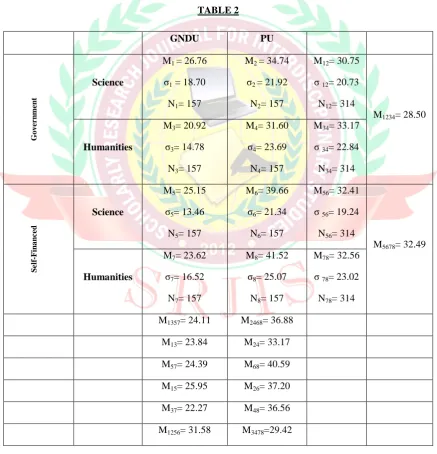
[image:9.595.79.517.253.708.2]In order to analyse the variance, the obtained scores were subjected to ANOVA. The results have been presented in the Table 2 below:
TABLE 2
GNDU PU
Go v er n me n t Science
M1 = 26.76
σ1 = 18.70
N1= 157
M2 = 34.74
σ2 = 21.92
N2= 157
M12= 30.75
σ 12= 20.73
N12= 314
M1234= 28.50
Humanities
M3= 20.92
σ3= 14.78
N3= 157
M4= 31.60
σ4= 23.69
N4= 157
M34= 33.17
σ 34= 22.84
N34= 314
S el f-Fi n a n ce d Science
M5= 25.15
σ5= 13.46
N5= 157
M6= 39.66
σ6= 21.34
N6= 157
M56= 32.41
σ 56= 19.24
N56= 314
M5678= 32.49
Humanities
M7= 23.62
σ7= 16.52
N7= 157
M8= 41.52
σ8= 25.07
N8= 157
M78= 32.56
σ 78= 23.02
N78= 314
M1357= 24.11 M2468= 36.88
M13= 23.84 M24= 33.17
M57= 24.39 M68= 40.59
M15= 25.95 M26= 37.20
M37= 22.27 M48= 36.56
MAR-APR, 2015. VOL. III/XVII www.srjis.com Page 3189
SUMMARY OF ANOVA FOR 2×2×2 FACTORIAL DESIGNS ON
TEACHING COMPETENCY GAIN SCORES
Sources of Variation Df SS MSS F-ratio
Institution Type (A) 1 4983.594 4983.594 12.665**
Academic Stream (B) 1 1468.024 1468.024 3.731
University System (C) 1 51196.235 51196.235 130.104**
Institution Type × Academic Stream (A × B) 1 1694.753 1694.753 4.307*
Academic Stream × University System(B × C) 1 3708.522 3708.522 9.424**
Institution Type × University System (A × C) 1 726.335 726.335 1.846
Institution Type × Academic Stream × T University System (A × B × C)
1 9.047 9.047 .023
Within 1248 491089.210 393.501
Total 1256 1723031.455
*Significant at the 0.01 level confidence ** Significant at the 0.01 level confidence
MAIN EFFECTS
INSTITUTION TYPE, ACADEMIC STREAMS AND UNIVERSITY SYSTEM
(A, B and C)
It may be observed from the Table 2 that F-ratios for the difference between means of teaching competency gain score of two types of the institution namely, government-aided and self-financed B. Ed. colleges, students belonging to Panjab university and Guru Nanak Dev university, were found to be significant at the 0.01 level of confidence, whereas, F-ratio for the difference between means of teaching competency gain scores of students belonging to humanity and science stream; was not found to be significant.
MAR-APR, 2015. VOL. III/XVII www.srjis.com Page 3190 and belonging to Panjab University Chandigarh exhibited significantly higher gain in teaching competency than their counterparts in self-financed institutions and Guru Nanak Dev University Amritsar as outcome of B. Ed. programme.
The results are in tune with the findings of Das and Jangira (1988), Kumar (1991), Barnett (1994) and Chardenas (2000).
On the other hand, the examination of the corresponding group means from the Table 1 suggests that the mean gain scores of teaching competency of science and humanities Stream were found to be comparable as outcome of B.Ed. face-to-face programme.
TWO ORDER INTERACTION
INSTITUTION TYPE × ACADEMIC STREAMS (A × B)
It may be observed from the Table 2 that F-ratio for the interaction between institution type and academic streams on the gain scores of teaching competency gain scores was found to be significant at the 0.01 level of confidence.
To further analyze the significance of difference in various cells, t-ratios have been computed to know the inter cell differences due to which F-ratio for the interaction have been found to be significant and are presented below in the Table 3:
TABLE 3
t- RATIOS FOR THE DIFFERENCE IN MEANS OF VARIOUS CELLS OF 2×2 DESIGN ON THE GAIN SCORES OF TEACHING COMPETENCY
Mean group Mean Mean SEd D t-ratio
M12-M56 30.75 32.41 1.596 1.66 0.22
M12-M34 30.75 33.17 1.642 4.49 2.73**
M12-M78 30.75 32.56 1.75 1.82 1.04
M56-M34 32.41 33.17 1.583 6.15 3.88**
M56-M78 32.41 32.56 1.69 0.16 0.10
M34-M78 33.17 32.56 1.736 6.31 3.63**
MAR-APR, 2015. VOL. III/XVII www.srjis.com Page 3191 **significant at the 0.01 level of confidence
M12-Science (Govt.), M56-Science (Self-Financed), M34-Humanities (Govt.), M78-Humanities (Self-Financed)
[image:12.595.74.526.237.666.2]It may be observed from the Table 3 that means of sub-groups of gain scores of teaching competency reveals that t-ratios are significant for sub-group namely M12- M34, M 56-M34 and M34-M78 at the 0.01 level of confidence. The further examination of means from the Table 1 suggests that:-
1. B.Ed. interns of humanities streams of government-aided institutions showed significant gain in teaching competency than B. Ed. interns of science streams of government-aided as well as self-financed institutions, B.Ed. interns of humanities streams of self-financed institutions.
ACADEMIC STREAM × UNIVERSITY SYSTEM (B × C)
It may be observed from the Table 2 that F-ratio for the interaction between academic streams and the university system on the gain scores of teaching competency was found to be significant at the 0.01 level of confidence.
MAR-APR, 2015. VOL. III/XVII www.srjis.com Page 3192
TABLE 4
t- RATIOS FOR THE DIFFERENCE IN MEANS OF VARIOUS CELLS OF 2×2 DESIGN ON THE GAIN SCORES OF TEACHING COMPETENCY
Mean group
Mean Mean SEd D t-ratio
M15-M37 25.15 22.37 1.276 3.68 2.88**
M15-M26 25.15 37.20 1.532 11.25 7.34**
M15-M48 25.15 36.56 1.676 10.61 6.33**
M37-M26 22.27 37.20 1.513 14.93 9.87**
M37-M48 22.27 36.56 1.659 14.29 8.61**
M26-M48 37.20 36.56 1.276 3.68 2.88**
*significant at the 0.05 level of confidence
**significant at the 0.01 level of confidence
M15- Science (GNDU), M37- Humanities (GNDU), M26- Science (PU), M48- Humanities (PU) It may be observed from the Table 4 that means of sub-groups of gain scores of teaching competency gain scores reveals that t-ratios are significant for sub-group namely M15- M37, M15-M26, M15-M48, M37-M26, M37-M48 and M26-M48 at the 0.01 level of confidence. The further examination of means from the Table 1 suggests that:-
1. B.Ed. interns of science and humanities streams studied from Panjab University Chandigarh exhibited significant gain in teaching competency than their counterparts in science stream of Guru Nanak Dev University Amritsar.
2. B.Ed. interns of science streams studied from Panjab University Chandigarh as well as Guru Nanak Dev University Amritsar exhibited significant gain in teaching competency than their counterparts in humanities stream of Guru Nanak Dev University Amritsar.
MAR-APR, 2015. VOL. III/XVII www.srjis.com Page 3193 It may be observed from the Table 2 that F-ratio for the interaction between institution type and university system on gain scores of teaching competency, was not found to be significant at the 0.05 level of confidence.
There is no interaction among institution types and university system on the gain scores of teaching competency among teacher interns.
THREE ORDER INTERACTION
INSTITUTION TYPE × ACADEMIC STREAM × THE UNIVERSITY SYSTEM
(A × B × C)
It may be observed from the Table 2 that F-ratio for the interaction between means of professional commitment gain scores of types of the institution, streams and the university system was not found to be significant at the 0.05 level of confidence.
There is no interaction among institution types, academic streams and university system on the gain scores of professional commitment among teacher interns.
DISCUSSION OF FINDINGS AND EDUCATIONAL IMPLICATIONS
1. As an outcome of face-to-face B.Ed. programme, self-financed institutions and Panjab University Chandigarh infused significantly higher gain in „Teaching Competencies‟ than their counterpart studied in government-aided institutions and belonging to Guru Nanak Dev University Amritsar. The students belonging to different streams exhibited comparable „Teaching Competencies‟.
MAR-APR, 2015. VOL. III/XVII www.srjis.com Page 3194 seminar/conferences, presenting research papers, writing research papers, pursuing further studies, etc. with an intention to get a job in a government college of education. This may also be the reason for their better teaching competencies. This is corroborated by the finding of the study conducted by like Gupta and Kaur (1993) also find that teachers who applied teaching techniques in the classroom and evaluated the lesson they taught, were found to be highly competent.
Face-to-face B.Ed. programme of Panjab University Chandigarh is showing more teaching effectiveness towards B.Ed. interns than Guru Nanak Dev University Amritsar because Panjab Unversity Chandigarh is providing a outstanding platform to train the teaching competencies of their B.Ed. interns. Panjab University Chandigarh conducts activities „Skill-in-Teaching‟ and „On the Spot Preparation of Teaching Aids‟ competition in the 2 tier system. For this purpose Panjab University Chandigarh divided their teacher education institutions in Zones. Firstly, B.Ed. interns of teacher education institutions compete at Zonal level and secondly, at inter-zonal level. For the achievement of positions in the university, institutions try to prepare their participants with complete skills and teaching competencies but on the contrary, Guru Nanak Dev University Amritsar has no such type of platform to excel the teaching competencies of their B.Ed. interns.
Henceforth, the implication is to impose strict measures on Guru Nanak Dev University, Amritsar w.r.t. diversification of the co-curricular and teaching related activities at zonal and inte-zonal level. This will help in developing teahing competencies among B.Ed. interns.
2. The finding revealed that as an outcome of face-to-face B.Ed. programme, teacher interns of humanities streams of government-aided institutions showed significant gain in „Teaching Competencies‟ than teacher interns of science streams of government-aided as well as self-financed institutions, B.Ed. interns of humanities streams of self-self-financed institutions.
MAR-APR, 2015. VOL. III/XVII www.srjis.com Page 3195 not spending much time for participation in those activities. Thus, participation in different co-curricular activities provide help to the humanities students in practising different skills and environment of government-aided institution help for the nourishment of the different skills. Broh (2002) revealed that students‟ participation in co-curricular activities in general is
associated with an improved grade point average, higher education aspiration, increased
attendance and reduced absenteeism. Marsh and Kleitman (2002) also established that
students who participated in co-curricular activities performed better academically than
students who did not participate. Adeyemo‟s (2010) view that besides creating a school
culture and promoting school spirit, co-curricular activities have been found to have a
relationship with students‟ academic performance, development of responsibility, discovering
their abilities and interest, self-discipline and leadership skills. Karim, Lodhi & Usman
(2011) found in government schools mostly they have large grounds in their schools but the management does not arrange sports and games in schools. Private school teachers have the chance to show their capabilities in different spheres by means of co curricular activities because in private schools frequently these activities are arranged by management.
In this context, there seems to be need to enrich laboratories, providing exposure to different activities and competitions so that all students develop enriched attitude and teaching competency.
3. The finding revealed that as an outcome of face-to-face B.Ed. programme, teacher interns of science and humanities stream studied from Panjab University Chandigarh exhibited significant gain in „Teaching Competencies‟ than their counterparts in science and humanities stream of Guru Nanak Dev University Amritsar.
MAR-APR, 2015. VOL. III/XVII www.srjis.com Page 3196 Amritsar has no such type of platform to excel the teaching competencies of their B.Ed. interns.
Therefore, the implication is to impose strict measures on Guru Nanak Dev University, Amritsar w.r.t. teaching related activities at zonal and inte-zonal level. This will help in developing teaching competencies among B.Ed. interns.
REFERENCES
Adeyemo S.A. (2010). The relationship between students‟ participation in school based
extracurricular activities and their achievement in physics. International Journal of Science
and Technology Education Research, 1(6), 111-117.
Biddle, B. J. (1964). The integration of teacher effectiveness research. Contemporary Research on Teacher Effectiveness. New York: Holt, Reinehart and Winston.
Boekaerts, M. (1991). Subjective competence, appraisals and self-assessment. Learning and Instruction, 1, 1-17.
Broh, B.A. (2002). Linking extracurricular programming to academic achievement: Who
benefits and why? Sociology of Education, 75(1), 69–91.
Cooper, J., Jones, H., & Weber, W. (1973). Specifying teacher competencies. Journal of Teacher Education, 24, 17-23.
Fives, H., & Buehl, M. M. (2008). What do teachers believe? Developing a framework for examining beliefs about teachers‟ knowledge and ability. Contemporary Educational Psychology, 33(2), 134–176.
Gupta, A., & Kaur, S. (1993). Teaching competency a factor analysis. Indian Journal of Applied Psychology. 30(2), 5-10.
MAR-APR, 2015. VOL. III/XVII www.srjis.com Page 3197 Karim, R. A., Lodhi, F. A., & Usman M. (2011). Facilities of Government & Private Secondary School Teachers of Karachi, Pakistan: A comparative Analysis. International Journal of Academic Research in Business and Social Science, 1,193-202.
Marsh H., & Kleitman S. (2002). Extracurricular school activities: The good, the bad and
the nonlinear. Harvard Educational Review, 74(4), 464-514.
Medley, D.M. (1982). Teacher effectiveness, In H.E. Mitzel (Eds.), Encyclopedia of Educational Research (Vol. 4, pp. 1894-1903). New York: The Free Press.
Medley, D. M., & Mitzel, H. E. (1963). Measuring Classroom Behavior by Systematic Observation.” In N. L. Gage (Eds.), Handbook of Research on Teaching. Chicago: Rand McNally.
MHRD, NPE (1986). Programme of Action (1992). Department of Education, New Delhi.
Mullar Fohrbnoadt et al (1978). Reality Shocks for Beginning Teachers.
National Council for Teacher Education (1998). Curriculum Framework for Quality Teacher Education. New Delhi.
National Council for Teacher Education (2009). National Curriculum Framework for Quality Teacher Education: Towards Preparing Professional and Humane Teacher. New Delhi.
NCTE. (1998).Curriculum Framework for Quality Teacher Education. New Delhi: National Council for Teacher Education.
National Policy on Education (1986). Ministry of Human Resource Development, New Delhi: Govt. of India.
MAR-APR, 2015. VOL. III/XVII www.srjis.com Page 3198 Paul, S. (1999). Relationship Between Job Satisfaction and Teaching Competence of the Secondary School Teachers of Cachar District of ASSAM- A study. Journal of All India Association of Educational Research, 2(1&2 March & June), 70.
Peklaj, C. (2006). Cooperative activity and its potential in tertiary education. Horyzons of Psychology, 15(3), 37-50.
Shah, R. A., & C.B. Sultana (1999-2000). Grassroots biannual research journal. Pakistan study center, 22, 72-78.
Thomas, A.M. (1991).Classroom interaction. ELBS: Oxford University.
Verma, I.B. (1968). An Investigation into the Impact of Training on the Values, Attitudes, Personal Problems and Adjustment of Teachers. Ph.D. Education, Agara University.
Vora, P. (1998). Effective Teaching of Concepts: Theory and Application. Perspectives in Education, 14(3), 155-160.