ISSN: 1992-8645 www.jatit.org E-ISSN: 1817-3195
TOWARDS A SELF-ADAPTIVE AGENT-BASED
SIMULATION MODEL
1YIM LING LOO, 2ALICIA Y.C. TANG, 3AZHANA AHMAD, 4AIDA MUSTAPHA
1
Centre for Agent Technology, College of Information Technology, Universiti Tenaga Nasional, Jalan
Ikram-Uniten, 43000 Kajang, Selangor, Malaysia.
2
Dr., Department of Systems and Networking, College of Information Technology, Universiti Tenaga
Nasional, Jalan Ikram-Uniten, 43000 Kajang, Selangor, Malaysia.
3
Dr., Department of Software Engineering, College of Information Technology, Universiti Tenaga
Nasional, Jalan Ikram-Uniten, 43000 Kajang, Selangor, Malaysia.
4
Dr., Faculty of Computer Science and Information Technology, Universiti Tun Hussein Onn Malaysia,
86400 Parit Raja, Batu Pahat, Johor, Malaysia.
Email: [email protected], [email protected], [email protected], [email protected]
ABSTRACT
Agent-based simulation (ABS) modelling has been a widely applied approach for simulating domain-specific phenomena. Currently, parameters and environments are simulated by a domain-domain-specific model that is strictly used proprietarily by the ABS model developer. This causes inflexibility towards extension of the developed ABS model, which will further result in difficulties for validation and verification of the robustness and reliability of the ABS model. To address this issue, this paper proposes a self-adaptive ABS model that is capable of modelling cross-domain phenomena by selecting the required parameters based on the environment. The capability to self-adapt will allow the model to be easily extended and replicated. The self-adapt capability is enabled by a governing algorithm within the model and is conceptually illustrated through a case study of crime report process ABS modelling.
Keywords: Self-adaptive Model, Agent-based Simulation Model, Processes Simulation, Extensive Model,
Model Reuse and Replication
1. INTRODUCTION
Agent-based simulation (ABS) is an approach
for modelling dynamic environments with
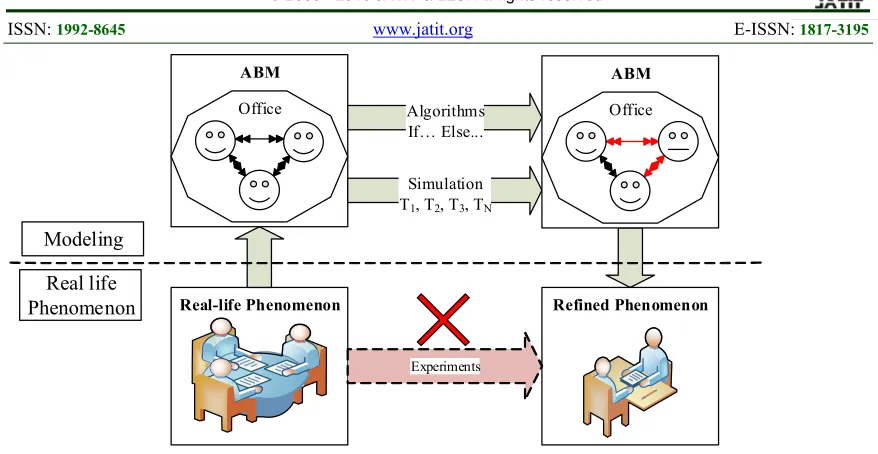
interactive individuals. This approach is known to best model different real-life phenomena at the highest level of imitation [1]-[5]. ABS modelling enable testing of real-life phenomena without the need of setting up costly experiments. For example,
consider a real-life phenomenon of three
individuals interactively communicating with one another in an office. Instead of acting out the phenomena in a series of repeating experiments to refine the events. ABS can be used to model the interactions of three agents in an office environment as shown in Figure 1.
ISSN: 1992-8645 www.jatit.org E-ISSN: 1817-3195
the problems of replication and reuse of ABS models hence affecting the robustness of the ABS model [13],[14].
To address the issues of validation and verification and replication and reuse in ad-hoc or domain-specific ABS modelling, this paper proposes a new conceptual model of a self-adaptive ABS. The remainder of this paper is organized as follows. Section 2 discusses research efforts to date on extensible ABS model and the differences with the proposed self-adaptive ABS model. Section 3 presents the self-adaptive ABS model. Section 4 discusses a case study applying the self-adaptive ABS model. Finally, Section 5 concludes with indication for future directions.
2. RELATED WORKS: ADDRESSING THE
GAPS
Limitations of being ad-hoc or domain-specific, difficulty in validation, verification, extensibility and customizability as well as replication and reuse are becoming more evident. A number of research in ABS modelling has been found to address the limitations of ad-hoc or domain-specific ABS [11],[12],[15]. The focus has been on developing a generic simulation platform or framework that allows plug-ins of different ABS models for non-domain-specific simulation as shown in Figure 2(a).
As illustrated in Figure 2(a), the generic ABS framework receives input from three ABS models (A, B, C) of different domains, namely Registrar of University, Transportation and Security. The framework is then used to simulate for achieving a specific objective. For instance, DYNAMOD [11] allowed different digital business ABS models to be plugged-in to the framework in order to simulate a common market phenomena. Bagneris [12], plugged-in different financial marketing ABS for financial predictions of different domains to address limitations of replication and reuse. Likewise, Bosse et al. [7], simulate ambient intelligence with a generic ABS framework tested with three different environment.
DANUBIA [15] also used a generic ABS framework for evaluating sustainability of future
water resources management alternatives.
TransiTUM [8] used a generic ABS framework for multi-scaled coupling pedestrian simulation, which
emphasized on accurate results through
extensibility capability of an ABS model. Similarly, Luo et al. [9] brought up the issue through a generic
ABS framework for modelling human-like
behaviours and decision making. In general, all of the mentioned works emphasized on the need of
extensible, replicable and reusable capability and the importance of validation and verification in a generic ABS framework. A summary of different works addressing different limitations are tabulated in Table 1.
Table 1: Related Works Addressing Different Limitations in Existing ABS Models.
Past ABS model limitations
Related works addressing the limitations.
1.Ad-hoc or domain-specific
Zutshi et al. [11]; Biedermann et al. [8]; Bagneris [12]; Hennicker et al. [15]; Luo et al. [9] 2.Validation and
verification
Bagneris [12]; Hennicker et al. [15]
3.Extensible or
customizable model
Biedermann et al. [8]; Zutshi et al. [11]; Bagneris [12]; Hennicker et al. [15]; Luo et al. [9]
4.Replication and reuse Schreinemachers and Berger [16]; Hennicker et al. [15]; Bosse et al. [7]
Nonetheless, developing a new ABS model to be plugged-in the generic ABS framework is not a direct task. The input models come from domain-specific environment with their own set of parameters and the need of developing new models for different domain-specific simulation purposes is not solved. Thus, research efforts has progressed towards real-time or run-time modelling to accommodate dynamic systems that change parameters from time to time. Dynamic systems that apply such approach are complex overhead crane schedules in [17] and notification sending to different parameters of computer and mobile phone in [18].
ISSN: 1992-8645 www.jatit.org E-ISSN: 1817-3195
3. PROPOSED SELF-ADAPTIVE
AGENT-BASED SIMULATION MODEL
A self-adaptive ABS modelling aims to solve the need for developing separate ABS models to cater different domains. Based on the existing generic ABS framework as shown in Figure 2(a), a self-adaptive modelling algorithm is proposed to collectively model the input domains and automatically produce separate ABS models for simulation execution as illustrated in Figure 2(b). For feasibility purpose, certain scopes of simulation objectives are established for the proposed self-adaptive ABS model. As discussed in earlier research work [19],[20], a self-adaptive ABS model is feasible to model processes or chains of process from different domains. Modelling of phenomena that does not involve processes such as predictions, human intelligence or mechanical kinematics are not included in this study.
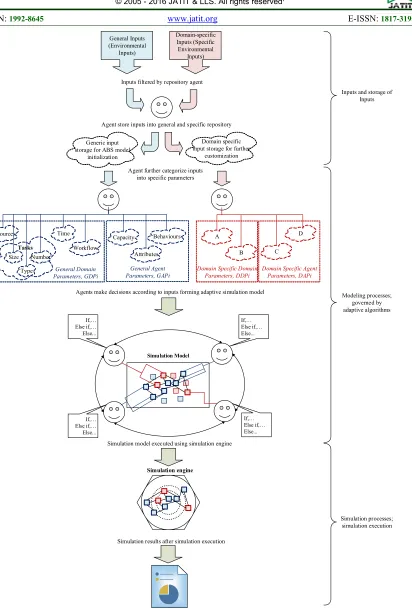
The self-adaptive ABS model is further refined of its feasibility with common parameters involved in the processes as discussed in our earlier work [19],[20]. It is worth noting that even with processes from different domain, similar parameters are used in the ABS model and these are termed as general inputs or parameters within this paper. However, apart from similar parameters used, there are specific parameters used only for the certain simulation purpose. Thus, these parameters are termed as domain-specific inputs or parameters within this paper. Hence, with the scopes and terminologies implied, a conceptual self-adaptive ABS model is constructed and illustrated in Figure 3.
The proposed self-adaptive ABS modelling in Figure 3 aims to automatically sort, categorize and arrange data or parameters inserted from different input domains. To achieve this, an agent will function as filterAgent(), to filter all the inputs and categorize them into general and domain-specific input categories. After initial categorization of inputs, storageAgent() categorizes and stores all the inputs into different parameter categories which are further categorized into domain and agent parameters into repository.
In Figure 3, General domain parameters, GDP consists of Resources, R, Task Size, TS, Task Type, TT, Number of Tasks, TN, Time, T and Workflow, W. General agent parameters, GAP, consists of Agent Capacity, C, Agent Attributes, A, and Agent Behaviours, B. In a nutshell, GDP and GAP can be denoted as follows;
GDP = {Ri, TS, TT, TN, Ti, Wi} (1)
GAP = {Ci, Ai, Bi} (2)
where,
i = {1, 2, 3, 4, …}
It is the domain-specific parameters DDPi and
DAPi, in the self-adaptive ABS model that supports
model extension and customization. storageAgent()
creates new domain-specific domain, DDPi and
agent parameters, DAPi, to store inputs not belong
to GDP or GAP, for ABS modelling and execution. ABS model is constructed by modelAgent() based on the inputs categorized and stored. After the modelling process, a simulation engine will execute the ABS models. This approach addresses the limitations of ad-hoc or domain-specific ABS models by allowing different simulation models to be constructed concurrently. At the same time, this approach solves current research limitations of having to build a new ABS model for different domains.
However, as parameters differ between
domains, a reasoning algorithm has to govern storageAgent() and modelAgent() for parameters storage and modelling of desired simulation objective. This reasoning algorithm is also self-adaptive. The algorithm enables self-adaptive ABS model to autonomously construct ABS model, tailored to desired simulation domain and
phenomena. The self-adaptive algorithm is
explained in Section 3.1
3.1 A Self-Adaptive Algorithm
Self-adaptive algorithm governs storageAgent() and modelAgent() on the reasoning activities of input categorizations and modelling. The algorithm ensures model to store parameters and model ABS specifically to desired domain and phenomenon so that simulated models will not be ambiguous with other domains or phenomena. The top-level of the algorithm is as follows;
The self-adaptive algorithm:
Start
Prompt input from user Define: Domain
GetDomain(Domain) = DDPi(D) Check repository for history
if NewDomain(NewDomain) == TRUE, then
Define: General and
Domain-Specific Domain and Agent
Parameters
Define: Processes
If GDP(Workflows) OR GDP(Time) == NULL , then
Halt Else,
ISSN: 1992-8645 www.jatit.org E-ISSN: 1817-3195 storageAgent() define General
Domain Parameters
If GDP(Resources)i == NULL, then GDP(R) = 0
Else,
GDP(Resources)i= GDP(R) If GDP(TaskSize) == NULL, then
GDP(TS) = 0 Else,
GDP(TaskSize)= GDP(TS) If GDP(TaskType) == NULL, then
GDP(TT) = 0 Else,
GDP(TaskType)= GDP(TT)
If GDP(NumberofTask) == NULL, then
GDP(TN) = 0 Else,
GDP(NumberofTask)= GDP(TN) storageAgent() define General Agent Parameters
If GAP(Attributes)i == NULL, then
GAP(A) = 0 Else,
GAP(Attributes)i = GAP(A) If GAP(Behaviour)i == NULL, then
GAP(B) = 0 Else,
GAP(Behaviour)i = GAP(B) If GAP(Capacity)i == NULL, then
GAP(C) = 0 Else,
GAP(Capacity)i = GAP(C) If DDPi == NULL then,
DDPi = 0 Else,
storageAgent() declare New DDPi Parameter
storageAgent() define New DDPi If DAPi == NULL then
DAPi = 0 Else,
storageAgent() declare New DAPi Parameter
storageAgent() define New DAPi
Else if NewDomain(NewDomain) == FALSE
Then
Define: General and
Domain-Specific Domain and Agent
Parameters
Define: Processes
If GDP(Workflows) OR GDP(Time) == NULL, then
GDP(Workflows)i =
GDP(WHistory)
GDP(Time)i = GDP(tHistory) Else,
GDP(Workflows)i = GDP(W) GDP(Time)i = GDP(t)
storageAgent() define General Domain Parameters
If GDP(Resources)i == NULL, then GDP(R) = GDP(RHistory)
Else,
GDP(Resources)i = GDP(R) If GDP(TaskSize) == NULL, then
GDP(TS) = GDP(TSHistory) Else,
GDP(TaskSize) = GDP(TS) If GDP(TaskType) == NULL, then
GDP(TT) = GDP(TTHistory) Else,
GDP(TaskType) = GDP(TT)
If GDP(NumberofTask) == NULL, then
GDP(TN) = GDP(TNHistory) Else,
GDP(NumberofTask) = GDP(TN) storageAgent() define General Agent Parameters
If GAP(Attributes)i == NULL, then
GAP(A) = GAP(AHistory) Else,
GAP(Attributes)i= GAP(A) If GAP(Behaviour)i == NULL, then
GAP(B) = GAP(BHistory) Else,
GAP(Behaviour)i= GAP(B) If GAP(Capacity)i == NULL, then
GAP(C) = GADP(CHistory) Else,
GAP(Capacity)i= GAP(C) If DDPi == NULL then,
DDPi = DDPiHistory Else,
storageAgent() declare New DDPi Parameter
storageAgent() define New DDPi If DAPi == NULL then
DAPi = DAPiHistory Else,
storageAgent() declare New DAPi Parameter
ISSN: 1992-8645 www.jatit.org E-ISSN: 1817-3195
In the algorithm, initialization of domain is crucial. It determines whether storageAgent() will store inputs and modelAgent() to model ABS with existing records in repository or not. If new domain is entered, all the inputs are stored and modelled new without historical inputs. Different parameters are defined by storageAgent() based on inputs of GDP and GAP received. If there are any inputs
found not belonging to GDP and GAP, DDPi and
DAPi are initialized and defined by storageAgent().
Amongst all the different parameters, Workflows, W and Time, T, are the most important inputs. They will determine final simulation results for processes modelled. Thus, the simulation halts if both or one of the input does not exist.
However, if input domain is found to be existing in the self-adaptive ABS model by filterAgent(), the inputs will be stored and modelled accordingly and compared with the historical inputs. If there is no new input, parameters’ values are defined from historical input which is noted with “History” at the end of each parameter. This is the difference in inputs storing and modelling between new domains and existing ones. Ability to model new and historical inputs address extensive capability of the model to cater new inputs and parameters for larger or different objectives and scopes of desired ABS.
In order to ensure the proposed model and algorithm function as claimed, three case studies are exclusively selected to be modelled. The three case studies are crime investigation report process,
new student registration procedures and
transportation requests processes. These three case studies reflect the divergence in nature and domain from each other to test self-adaptive nature of the model. Real data are acquired from each case study for validation and verification of simulation results purposes. The simulation model is expected to be able to model the three case studies as similar to the real data acquired.
One of the case study is used to give an enhanced illustration of self-adaptive algorithm and ABS model being put to application. The application is explained in Section 3.2.
3.2 Application of the Self-Adaptive ABS
Model: A Case Study of Crime Report In this section, a specific case study as an input to the self-adaptive ABS model is used to further illustrate the applicability of the self-adaptive ABS model. The case study is mainly about simulation of processes took place for a crime report and investigation of a car theft happened in Universiti Tenaga Nasional. Considering that there was a car theft at a parking bay of Engineering Faculty on
Monday morning, 28 December 2015. Victim of the theft upon realization at 11:30am, went to Security Department to lodge a crime report. Investigation officer of the Security Department then interviewed the victim to acquire details and
proceed straight to the crime scene for
investigation. Considering that the domain exists in repository, the model is expected to model the processes as well as resources and time taken for the case to be fully reported and adjourned for further actions. From the information above, inputs inserted will be as follows;
• Car theft
• Universiti Tenaga Nasional Engineering
Faculty parking bay
• Monday, 28 December 2015
• Security Department
• A victim
• An investigation officer
Suppose storeAgent() found that the defined domain, Security Department, is an existing domain in the repository, self-adaptive algorithm will appear as follows;
The algorithm:
NewDomain(NewDomain) == FALSE Then
Define: General and
Domain-Specific Domain and Agent
Parameters
Define: Processes
GDP(Workflows)i = GDP(WHistory) GDP(Time)i = GDP(tHistory)
storageAgent() define General Domain Parameters
GDP(R) = GDP(RHistory) GDP(TS) = GDP(TSHistory) GDP(TT) 1 = “Major”
GDP(TT) 2 = “Major Theft” GDP(TaskType)1 = GDP(TT) 1 GDP(TaskType)1 = GDP(TT) 2 GDP(TN) = GDP(TNHistory)
storageAgent() define General Agent Parameters
GAP(A)1 = “IO” GAP(A)2 = “V”
GAP(Attributes)1 = GAP(A) 1 GAP(Attributes)2 = GAP(A) 2 GAP(B) = GAP(BHistory) GAP(C)1 = 1
GAP(Capacity)1 = GAP(C) 1
storageAgent() declare New DDPi Parameter(WorkingDay)
ISSN: 1992-8645 www.jatit.org E-ISSN: 1817-3195 storageAgent() declare New DDPi
Parameter(Environment)
Environment(Env) = “UNITEN”
Considering storageAgent() found specific historical inputs from repository for GDP and GAP
and new DDPi from the new inputs, the
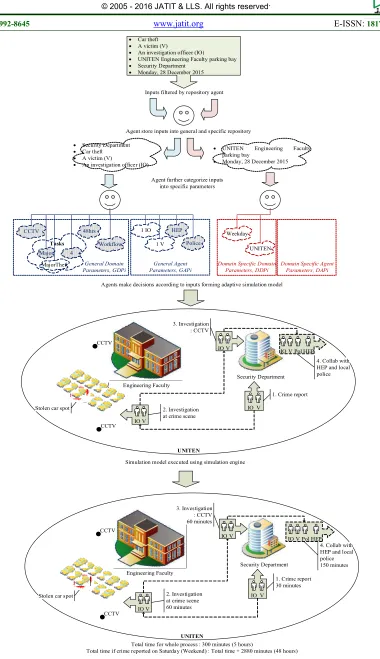
self-adaptive ABS model will be as constructed in Figure 4. filterAgent() categorizes the inputs, namely, security department, car theft, a victim and an investigation officer are general inputs while UNITEN Engineering Faculty and crime reported
on weekday is a domain-specific input.
storageAgent() then categorize and store the inputs into different parameters, which in this case study, car theft is categorize as a “Major Theft” in Task Type, TT, a victim, “V” and an investigation officer, “IO” in agent attributes, A. storageAgent() detects Security Department as an existing domain and therefore fetching historical parameter records into the model, which are labelled in shaded-cloud
shape, “CCTV”, “Major”, “4”, “48hrs”,
“Workflow”, “HEP” and “Police” respectively, as illustrated in Figure 4.
Upon completion of parameters categorization and storage, modelAgent() proceeds to model the simulation according to Workflow and specific parameter values. The ABS model is illustrated in Figure 4. Simulation results of total time for different processes and whole process of crime report is as illustrated in Figure 4. The new parameter of “Weekday”, a major crime report made on Weekday takes a shorter processing time, as UNITEN HEP does not function on weekends.
Through the illustrative application of the case study on the self-adaptive ABS model, it is conclusive that the self-adaptive ABS model is extensible and replicable with the ability of modelling an ABS based on new and historical inputs. The ABS model is self-adaptive, as the algorithm and the architecture accommodate automatic ABS modelling and execution tailored to specific desired phenomena. The proposed self-adaptive ABS model goes one step further from the current ones by addressing ad-hoc or domain-specific limitations without having the needs of manual ABS model development.
4. CONCLUSION AND FURTHER WORKS
An agent-based simulation framework should be extensible and replicable in nature rather than being domain-specific in order to better reflect real-life phenomena. This paper proposes a self-adaptive ABS model that allows automatic simulation modelling of processes from different domains
without having to develop new ABS models for every new phenomena. A self-adaptive algorithm enabling the nature is proposed and feasibility of the model with integration of the algorithm is illustrated through ABS modelling of a case study of crime report process in Universiti Tenaga Nasional. It was shown in the application that the proposed model is able to model the case study with only data inputs instead of model integration. In future works, the proposed self-adaptive ABS model will be tested with three domains; education, security and transportation. The simulation results will be compared with real data acquired for each case study. It is hoped that the self-adaptive modelling algorithm is able to diminish modelling efforts with more accurate simulation results.
5. ACKNOWLEDGEMENTS
This work is sponsored by Kementerian Pengajian Tinggi, Malaysia under the Fundamental Research Grant Scheme (FRGS).
REFERENCES:
[1] Klügl, Franziska, and Ana LC Bazzan.
"Agent-based modeling and simulation." AI Magazine 33, no. 3 (2012): 29.
[2] Macal, C. M., & North, M. J. “Agent-based
modeling and simulation”. In Winter
Simulation Conference. Winter Simulation Conference. December 2009. pp. 86-98.
[3] Macal, Charles M., and Michael J. North.
"Introductory tutorial: Agent-based modeling and simulation." In Simulation Conference (WSC), Proceedings of the 2011 Winter, pp. 1451-1464. IEEE, 2011.
[4] Edmonds, Bruce, and Ruth Meyer.
“Simulating Social Complexity, A Handbook”.
Springer, Berlin, 2013. ISBN:
978-3-540-93812-5 (Print) 978-3-540-93813-2 (Online).
[5] Edmonds Bruce (2001) The Use of Models -
making MABS actually work. In Moss S and
Davidsson P (Eds.) Multi-Agent-Based
Simulation, Lecture Notes in Artificial Intelligence 1979: 15-32. Berlin: Springer-Verlag.
[6] Bandini, S., Manzoni, S., & Vizzari, G.
“Agent based modeling and simulation: an informatics perspective”. Journal of Artificial Societies and Social Simulation. 2009. 12(4), 4.
[7] Bosse, Tibor, Mark Hoogendoorn, Michel CA
Klein, and Jan Treur. "An agent-based generic
ISSN: 1992-8645 www.jatit.org E-ISSN: 1817-3195
Constructing Ambient Intelligence, pp. 93-103. Springer Berlin Heidelberg, 2008.
[8] Biedermann, Daniel H., Peter M. Kielar,
Oliver Handel, and André Borrmann.
"Towards TransiTUM: A generic framework
for multiscale coupling of pedestrian
simulation models based on transition zones." Transportation Research Procedia 2 (2014): 495-500.
[9] Luo, Linbo, Suiping Zhou, Wentong Cai,
Malcolm Yoke Hean Low, and Michael Lees. "Toward A Generic Framework for Modeling Human-like Behaviors in Crowd Simulation." 2009.
[10]Jones, Spencer S., and R. Scott Evans. "An agent based simulation tool for scheduling emergency department physicians." In AMIA Annual Symposium Proceedings, vol. 2008, p.
338. American Medical Informatics
Association, 2008.
[11]Zutshi, Aneesh, António Grilo, and Ricardo
Jardim-Gonçalves. "A Dynamic Agent-Based Modeling Framework for Digital Business Models: Applications to Facebook and a
Popular Portuguese Online Classifieds
Website." In Digital Enterprise Design &
Management, pp. 105-117. Springer
International Publishing, 2014.
[12]Bagneris, Jean-Charles. "FMS, a Generic
Framework for Agent-Based Financial
Markets Simulations." Available at SSRN 2149543 (2012).
[13]Axelrod, Robert. "Advancing the art of
simulation in the social sciences." In Simulating social phenomena, pp. 21-40. Springer Berlin Heidelberg, 1997.
[14]Heath, B., Hill, R., & Ciarallo, F. “A survey of agent-based modeling practices (January 1998 to July 2008)”. Journal of Artificial Societies and Social Simulation, 2009. 12(4), 9.
[15]Hennicker, Rolf, Sebastian S. Bauer, Stephan
Janisch, and Matthias Ludwig. "A generic
framework for multi-disciplinary
environmental modelling." PhD diss.,
International Environmental Modelling and Software Society, 2010.
[16]Schreinemachers, Pepijn, and Thomas Berger.
"An agent-based simulation model of human–
environment interactions in agricultural
systems." Environmental Modelling &
Software 26, no. 7 (2011): 845-859.
[17]Graunke, Adam, Gabriel Burnett, Charles Hu,
and Glen Wirth. "Decision support model to evaluate complex overhead crane schedules." In Proceedings of the 2014 Winter Simulation Conference, pp. 1608-1619. IEEE Press, 2014.
[18]Morin, Brice, Olivier Barais, Jean-Marc
Jezequel, Franck Fleurey, and Arnor Solberg. "Models@ run-time to support dynamic adaptation." Computer 42, no. 10 (2009): 44-51.
[19]Loo, Y.L., Alicia Y.C. Tang and Azhana
Ahmad, "The Gap of Current Agent Based Simulation Modeling Practices and Feasibility of a Generic Agent Based Simulation Model", International Journal of Advanced Computer Research (IJACR), Volume-5, Issue-19, June-2015, pp.115-123.
[20]Loo, Y.L., Alicia Y.C. Tang and Azhana
Ahmad, " Identifying Key Factors in Agent Based Simulation Model on Processes in Time
Constrained Environment", International
ISSN: 1992-8645 www.jatit.org E-ISSN: 1817-3195
Real-life Phenomenon ABM
Office
Simulation T1, T2, T3, TN
Algorithms If… Else...
Refined Phenomenon
Modeling
Real life Phenomenon
Experiments
ABM
[image:8.612.87.526.67.294.2]Office
Figure 1: Real Phenomena Modelled through Agent-Based Modelling Approach.
Self-Adaptive ABS Model Domain A
Registrar
(b) Proposed Self-Adaptive Agent-based Simulation Model
Simulation Results
Domain B Transport
Domain C Security
Input
Input
ABS Model B Transport
ABS Model C Security
Simulation Results
Simulation Results Domain A
Registrar
Generic Agent-Based
Simulation Framework Domain B
Transport
ABS Model B Transport
Domain C Security
ABS Model C Security ABS Model A
Registrar
(a) Current Generic Agent-based Simulation Modeling Simulation Results
Simulation Results
ABS Model A Registrar
Adaptive Modelling Algorithms
[image:8.612.91.503.365.535.2]ISSN: 1992-8645 www.jatit.org E-ISSN: 1817-3195
Simulation Model
Generic input storage for ABS model
initialization
Domain specific input storage for further
customization
Capacity
Attributes Behaviours Time
Workflow
Tasks
Size
Type Number Resources
General Inputs (Environmental
Inputs)
Domain-specific Inputs (Specific Environmental
Inputs)
Agent store inputs into general and specific repository Inputs filtered by repository agent
Agent further categorize inputs into specific parameters
General Domain Parameters, GDPi
General Agent Parameters, GAPi
A
B
D
C
Domain Specific Agent Parameters, DAPi Domain Specific Domain
Parameters, DDPi
Agents make decisions according to inputs forming adaptive simulation model
Simulation model executed using simulation engine
Simulation results after simulation execution If,… Else if,… Else... If,…
Else if,… Else...
If,… Else if,… Else...
If,… Else if,… Else...
Inputs and storage of Inputs
Modeling processes; governed by adaptive algorithms
Simulation processes; simulation execution
[image:9.612.106.518.63.673.2]Simulation engine
ISSN: 1992-8645 www.jatit.org E-ISSN: 1817-3195
UNITEN • Security Department
• Car theft
• A victim (V)
• An investigation officer (IO)
• UNITEN Engineering Faculty parking bay
• Monday, 28 December 2015
1 IO
48hrs
Workflow Tasks
Major
MajorTheft
4 CCTV
• Car theft
• A victim (V)
• An investigation officer (IO)
• UNITEN Engineering Faculty parking bay
• Security Department
• Monday, 28 December 2015
Agent store inputs into general and specific repository Inputs filtered by repository agent
Agent further categorize inputs into specific parameters
General Domain Parameters, GDPi
General Agent Parameters, GAPi
Weekday
UNITEN
Domain Specific Domain Parameters, DDPi
Agents make decisions according to inputs forming adaptive simulation model
Simulation model executed using simulation engine
Domain Specific Agent Parameters, DAPi
1 V
1. Crime report 30 minutes
Stolen car spot
Engineering Faculty
Security Department
CCTV CCTV
IO V 2. Investigation
at crime scene 60 minutes IO V
3. Investigation : CCTV 60 minutes
IO V
4. Collab with HEP and local police 150 minutes IO V Pol
UNITEN
1. Crime report
Stolen car spot
Engineering Faculty
Security Department
CCTV CCTV
IO V 2. Investigation
at crime scene IO V
3. Investigation : CCTV
IO V
4. Collab with HEP and local police IO V Pol
Police HEP
Total time for whole process : 300 minutes (5 hours)
Total time if crime reported on Saturday (Weekend) : Total time + 2880 minutes (48 hours) HEP
[image:10.612.120.500.58.717.2]HEP