A SKETCH BASED IMAGE RETRIEVAL: A REVIEW
OF LITERATURE
HUDA ABDULAALI ABDULBAQI 1'4, GHAZALI SULONG 2, SOUKAENA HASSAN HASHEM 3
1'2
Faculty of Computing, University Technology Malaysia, 81100 Skudai, Johor Bahru, Malaysia
3 Computer Science Department, University Of Technology, Iraq, Baghdad
4The University of Mustansiriya ,College of Science, Computer Dep., Iraq
E-mail: [email protected], [email protected], [email protected]
ABSTRACT
This survey paper reviews the development of Content Based Image Retrieval (CBIR) field and especially the sketch based image retrieval (SBIR) as a core issue. An image is retrieved from the database in several ways in user queries. SBIR is one of the efficient and important methods which are not necessary to have a high skill to draw the query sketch. First, we review the feature extraction, features based matching, and indexing which represents the base of recall images. We also present in the concluding section general limitations of how the methods deal with the image retrieval and our views in image retrieval based on sketch query, which is also the future direction.
Keywords: SQbs, Content Analysis And Indexing, Indexing methods, Image Descriptors, Sketch Based Retrieval.
1. INTRODUCTION
Recently, the big photos are world widespread
and highly used by the digital work's users, especially when the difficulty of obtaining high quality photos becomes hard and harder as the users need to. So, the necessity of finding what would satisfy them motivates them to invent new ways to reach their goals. The method they depended on is called text-Based image Retrieval. Historically, the text- Based system had appeared in 1970, [2]. This way requires a number of features as keyword annotation [3].
This step is normally prepared in lab by
unperfected manually annotated. This point is seen
as a defect in this system, besides, the text based system is subjective and limited beside its negative points. This also forced the engaged researchers to develop a new method called (CBIR) Content Based Image Retrieval. This system has more features than the former system, which then was used to enter the (DBMS) Data Base Management System field, which is restricted and greatly depends on human text annotation only. This system contains color, shape as well as texture. Research has recorded high range level since the 1980s, the first time it has been created. With all this new great, well-done job, enables to get rid of all text-based system obstacles as a first step to the easier and better system, The matter is changed,
with CBIR, this system mainly depends on what is given features of color, shape, texture, and with all visual inputs the first person who provides an exceptional work was Chang in 1984. His way in resulting good featured-photo is by indexing and abstracted method for photographing database retrieval [4].
This database includes photos, elements, and all pictures related factors. In order to build photo indexes and abstract process, objects are accurately created for carrying on pictures object clustering and for the category. Research with their non-stopped hard work are always keen on making the best in this field in order to overcome the
difficulties concerning the picture clarity,
moreover, users sometimes don't have sufficient and / or suitable inputs to get the picture they want through CBIR and the unavailable request for such query photos again led the researchers to create another better system to conduct for this purpose[1].
expressed by SBIR through shape only while it needs more than that to be expressed by CBIR, it needs is shape and color. As well [1].
This system adds new interesting variety of hand drawing style and even more flexibility to the query users.
The goods of this system are that, it gives wide space and abstract for the users to express their desires. This system gathers two aspects together, smart technical act and the fabulous art because it needs a wide art experience [2]. Now it is used in different fields, remote sensing, fashion, crime prevention, publishing, medicine, architectures and others.
This paper aims to introduce the problems and challenges competently with the CBIR systems in general and especially SBIR, to describe the methods of solutions, applications, and to display the existing research in this area. Then it`s introduce the overview of the basic concepts of the CBIR in (Section 2). (Section 3) presents the SBIR and the main challenge of retrieval, image that depends on descriptor of features extractions, matching based on features and the recall image based on indexing, while (Section 4) contains the conclusions and unsolved problems of this area.
2. CONTENT BASED IMAG RETRIEVAL
(CBIR) is a technique that used to view image features like (color, shape, texture) to find a query image in a large size of the database. (Torres at 2006) The retrieval images process, including, low level (content based features) and high level (semantic based features) [5].
The difficulties of CBIR lie in reducing the differences of contents based feature and the semantic based features. This problem in giving efficient retrieval images guide the researchers to use (CBIR) system ,to take global color and texture features to reach, the better retrieval, where others used local color and texture features [6].
The idea of Region Based Image Retrieval (RBIR) from image segmentation on the basis region to give better performance [7].
Several low level feature extraction algorithms were also developed, most of them works are with common features. This overview will introduce some of them.
2.1. Common Feature (Color, Shape and
Texture)
Descriptors which represented color and used as invariant color , features color space, histogram, and moments color coherence dominant color, these
features give the brightness and geometry view as a result of an image retrieval process [8].
The idea t of the moment, which represent the main factor in color distribution by using an image retrieval system as a method for choosing a query image by calculating color histogram and comparing it with the stored image database [9].
The main two shape characteristics are bound-based and region-based , which are computed for every object specified in the database, Yasmin at 2013 proposed the geometric details of image which can provide us the local shape features, which have a large area in CBIR systems applications [10]. Also, a part of color features of the shape can be calculated from the image segmentation. The main shape feature of any image is one of the invariant features (translation, rotation, and scale) along the axis.
Many different available methods improved to extract and represent textures from image property which can be characterized basically into space- based, frequency-based models, and texture signatures, which they are defined in term of granularity, directionality and repetitiveness [5].
Co-occurrence matrix is a method to give the spatial relationships which belong to gray-level in an image. Its work by defining the position of the cell (i, j) in the matrix, then locking for the possibilities of finding the same levels of gray pixels in two relative positions.
2.2. Semantic Gap
The relationship between low level features (color, shape, texture, object detection) and high
level user features (abstract, objects, event)
categories defined by Wang. CBIR indexes the
images by using the low-level features, then displays an interpretation opposition between image description and high-level semantics, this process call semantic gap. The researchers tried to bridge the semantic gap by proposing many techniques [11].
2.2.1 Object metaphysics
Semantic used to define the image. This
2.2.2. Machine intelligence
This method estimates the value of output based on a set of inputs. Datta used a decision tree as a model to be a query set of images, to classify database images into two classes relevant and irrelevant. [4]
2.2.3 Relevance feedback
The machine learning algorithm technique applied to attain the user feedback. The relevance feedback mechanism will be at work when the query represents an image, sketch and text and the system return the request image, the users check the relation between the return system to image and the query request [4].
2.2.4. Semantic pattern
It is a set of general features that attends to images stored and in the database then this set of images will be calculated. Liu at 2007 generates a Semantic Visual Template (SVT), this method links low-level to high-level. This technique defines the initial specific concept of each object, finally the system collects a small set of the query sample, which is representing the best matching, depends on interaction with user and request [12].
2.3. Performance Measure
The image retrieval system is the main method for precision and recall graph which represents the main way to evaluate and measure the performance.
Precision= no. Of relevant images retrieved /Total no. Of image retrieved.
Recall= no. Of relevant images retrieved / no. Of relevant images in the database.
3. SKETCH BASED IMAGE RETRIEVAL
(SBIR).
Sketch-based image retrieval (SBIR) is a relevant means of querying large image databases. All of researches focus on how to solve the gap between sketch and image matching problem. A lot of ways are discussed or discovered about this gap. Recently, we have reviewed bellow a method that deal with the main three points of sketch based image retrieval.
3.1. Features Extraction
In large scale database usually visual features SBIR technique is used to find query image, many researchers tried to deal with the
features of images. By using many types of descriptors as follows.
Tensor descriptor proposed for matching that constructs the sketch and the full color image precisely in the preprocessing stage and also adapted EHD descriptor for MPEG-7, he is noting that performance upstanding of EHD descriptor in qualitative evaluation. The proposal (Tensor) descriptor looks better than a MPEG-7 edge histogram descriptor in matches for a given query sketch according to the result. Also Tensor description used to locate photo using a sketch description of the object. The proposed descriptor can be improved to be enhanced by exploring colored sketches, constructing more elastic models for object localization [14], [15].
The method which found that histogram descriptor (EHD) can almost look better for less information sketches, while in other cases gating better results can be done by giving more details. The method represents the best multi-level solution using invariant features to transform SIFT. With this retrieval categories response gives the user a huge choice to select from more output groups [16]
Evaluated the (ARP, EHD) descriptor deals with fast, large, scale sketch based image retrieval. These descriptors constrict both of the full color image and sketch undergo. This precisely in the same preprocessing steps, first searches for a structure which it is similar with image then the best image clustering based on Majority color distribution. Then, the descriptor ARP evaluates the band of reference images selection from collection of images, then creates identical sketch for each reference image, measuring on what the descriptor returns reference image, when querying (sketch), depending on the structure of the image which encodes the main gradient orientation in the selected image area automatically[17]
The Standard Histogram of Oriented Gradients (SHOG developed to be stored in most imported sketched feature lines in the (HOG)
This descriptor is based on the bag-of-features approach and use the benchmark to explain that this descriptor is better than the other descriptor. The suggested benchmark sketch-based image retrieval systems have been suggested to use the data for evaluating performance in local features. The result shows that obtaining a negative correlation value when the user use few sketches which leads to week rank index [16], [17].
a (drawing domain) where he can draw the queries (sketches) which is representing the base of retrieval method. The proposed system describes a specific descriptor that can bridge the gap between sketch and colored image, making a chance for the active search. After a special sequence of preprocessing steps, the used descriptor that constructed and transformed full color image and sketch is to be compared. The used of the algorithm in the method of (EHD) descriptor is the same algorithm which used to accelerate and enlarge scales of sketch based image retrieval [18].
Image Preprocess
Result Feature vector
Stock index
Figure1: The Global Structure Of The System [18]
A method proposed to match the sketch example, with visual data from the document. And design a salient descriptor to take unique mapping from sketch images of documents. To achieve this proposal used feature Descriptor (SIFT) and codebook construction and indexing (EHD), and (HOG) used in SBIR to natural scenes retrieval.
They plan to determine cross validation
automatically to be adaptive technique [19] [14].
To combine GF-HOG descriptor to localize sketch objects into relevant image, the descriptor integrated with Bag Of visual Word (BOW) system that can be effected for sketch based image retrieval, GF-HOG are clustered from all images to form BOW codebook by K-means algorithm, from the special features (descriptors) local to point within dataset images create a codebook by Bag Of visual Word (BOW) techniques. Codebook based querying databases in the visual example QVE system is to be able for both retrieving images using sketched queries and localizing the position of the sketched object in those images [20].
The heretical region tree proposed to collect from the nodes, generated by choosing super pixels, arranged depending on scale range reaching two in
tire image. The retrieval pipeline output
considerable performance betterment leading descriptor (SIFT, SSIM) for visual search and (GF-HOG) result depending on single-scale Canny edge maps. They proposed to localize the sketched object within the matched image to almost minimal post-processing [21].
GF-HOG merged into a Bag of Visual Words
(BoVW) retrieval, and explains how this
combination may be employed both for powerful of SBIR, and for localizing sketched objects within an image to solve the Ambiguity attendant with the sketch. They depict Gradient Field HOG (GF-HOG); an adapted grade of the HOG descriptor fit for (SBIR). This work adopts a Bag of Visual Words (BoW) act to SBIR, incorporating an adapted state of the Histogram of Orientated Gradients (HOG) descriptor; Gradient Field HOG (GF-HOG). Is considered to be the verbalization of the art in Query by Visual example (QVE) image retrieval approaches [22].
To use the Edge Relation Histogram [ERH] as both global and local features to the proposed query by sketching retrieval, image, ERH focuses on the three issues, the first one is the relation among edge pixel, the second one is the scale rotation, shift and the third one is the symmetry invariant feature. His proposed method to detect edge images by feature extraction that applied to the original image, and matching the two features (sketch and image in the database) compared by calculating the similarity. This method gives a good accuracy which improved by using ERH descriptor that makes it possible to do retrievals that it does not care by size, position, rotation and mirroring [23].
Sketch Images (database)
Edged Detection
Feature Extraction
Features ( Database) Features
Similarity Measure
[image:4.595.76.272.291.446.2]Retrieval Result
Figure 2: Overview Of The Query-By Sketch Image Retrieval [23]
Displaying subsystem
processing subsystem
feature vector generating subsystem
Retrieval subsystem
database management
The shape descriptor for Sketch-Based Image
Retrieval merges feature information. The
supported regions define for each sketch point and makes the approach scale invariant when the limited support regions is countered to each point. It explains, that a new feature extraction depends on a pixel-scale local features that is used in (ERH) to sensitize the noise [24].
Table1: An Overview Of Descriptor Based Feature Extraction
3.2. Matching Based on Features
To get an acceptable sketch matching with the image, many researchers find different ways to reduce the gap between the sketch and the image through the chosen effective features.
A new algorithm for matching sketch to a photo proposed to Use a local feature-based method for matching facial sketch images to face photographs, a new matching algorithm is used in joining the holistic algorithm for hybrid matching. The first using SIFT feature descriptor to get all sketch and photo images and measures the distance of the SIFT descriptors between the sketches and photos, and the distance between descriptor vector feeler sketch and database of photos. It measures sample local point while the recognition are displayed by score level fusion of the two sketch matchers [25].
An improvement method proposed to match them as well as retrieval accuracy. In addition, it is applied to SIFT descriptor to match which eliminate the number of false, matching systems that helps users in searching, altering, and retrieving information from the Internet. In this proposed method, only a few prototype systems lists and index images in Web documents are available. To improve the list and indexing of images, developed a mechanism is a prototype system that discovers the content images in Web documents [26].
Photosketcher proposed as a method which is a combination of two main ideas , the first one
Descriptor Contribution Result Limitatio
n Tensor -EHD [14], [15] Clustering the addressed results of query sketch and retrieval images Used with the large image database. Batter than MPEG-7 edge histogram. Applie d with the
sketch without shadow.
SHoG [16] Store the most important
sketch features line
in the HOG
High performan ce in large
scale sketch Weak rank index occurs when few sketch applied EHD HOG SIFT [18]. Design a special descriptor mission to Handel the information gap witch Located between the sketch and the
color image Easy access to search tools. Need to modify the shape image edge.
GF- HOG BoW [20].
-Localize sketch objects in the relevant
image. - Improved the method by composite it with a BOW
Achiev ed high scores of retrieving images by using freehand sketch shape Weak performan ce in color
and flexible models for object localizatio n -GF-HOG BOVW [22].
- Applied the semantic of sketch to retrieve the images treat the ambiguous attendant with the sketch
High accuracy in retrieving images Doesn't include any limitation
ERH [23]. Improving retrieval accuracy by processing the local and global feature
Achieved successful deal with rotation, scale, shaft, symmetry and invariance
Used in small data base. -Weak performanc e color image. ERD
SRD [24]
Improvement method to ERH
witch used
features of near
and fare
divides the selected image into parts, and matching each part of the desired scene which may identify a part of the picture in the found collection. The second one enters few rough feature lines by a simple sketch and composes the interface which provides initial hints about the selected part. By using Gaussian Mixture models (GMM) the search of desired part can be computed as an optimal sum depending on Graph cut, combining these two methods producing the unneeded additional metadata, besides the raw images [15].
Sketching and photomontage proposed as a set for independent image collection, by using a text-label with the sketch, that indicates as a layout of required input. Annotated sketch keyword is the first process in image collection, such as internet image. For each input, the resulted is set of pictures witch filtered to contain the images that are easy to combine automatically and specify the position indicated by the text-labeled sketch [27]. A method for Photo sketcher proposed initially to make a new image containing features of simple sketch lines, and takes online image collection which no need an extra metadata. The final drawing can be decomposed to a key word and a standard text which they represent the base of operation. Photo sketcher provides interactive yield that users can redact and add more pictures in real time [13], [22].
A gradient vector field utilized to smooth the difference between image and sketch, using (BoW) model, to make easy retrieval, but their experiment was made in small database [28], [22].
The effective indexing of 2 million images proposed and tried to reach the Orientated chamfer Distance to measure the similarities with the sketch. The proposed technique can be decrees the false position of collisions by Enhance the algorithm
parallel architecture patch description
technique, also it's suggested to identify the patch with noisy by designing a descriptor deal with this problem [29].
Scalability and retrieval, image quality proposed to use hashing techniques which are easy retrieval, image from large database instead of that every image is exporting a single visual descriptor. It is used to generate pools of patch from overlapping
grids, the hashing technique facing by
retrieving near iterate in whence of shape image to sketch by designed to retrieve closer duplicated
[image:6.595.314.507.165.303.2]images to the sketches as much as small translation, as well [2].
Figure 3:Top5 result returned from the system in some queries [2].
A practical image retrieval system Developed to localize a region in an image which would be matched with the query image in contour the other thing he builds an effective index structure. One of the important things in retrieval, image is localizing a region in an image that must be matched with query image in contour. He improves an image retrieval system by finding out retrieved images which have similar objects with query, ignored their size and position, the two types of regions must be defined, the main one represent the Region Of Interested (ROI) that define only one image contains one object that similar to query but different in position and size. ROI deals with one object similar to the sketch saliently display in the complicated background for feature extraction using the two regions as nominee regions that useful to improve the retrieval performance [30].
SBIR and Domain Color Descriptor (DCD) used to design and create a CBIR system and introduce how can implement specific descriptor, that can bridge the information gap between a sketch and a colored image, to achieve based image retrieval and to achieve clustering, this method used package of Apache company[31] .
3.2.1 Matching Based On (Rotation, Scaling, Transformation)
by an efficiently histogram, this call (HELO). This descriptor is able to scale and translation transformation, the strategy of this method apply two normalization process using principle analysis after that using polar then using Polar coordinates. The two distance measures combine and give the performance of recall over 8.4 times under scale, translation and 2.6 times under rotation. But this method still keeps low performance under scale, translation, rotation and transformation [32].
CBIR received from Qbs system sketch by the extraction of the future from the provided sketch and IDM by using ARP, taking into account special distribution of edge, this method allows to some slopes by offering acceptable invariance from searches image, its merge QBS system with color information to find out a new interface and to activate the query process against rotation and transformation [20].
Table2: An Overview Of Descriptors Based Matching Features
3.3. Indexing Based Retrieval Images
The fast search in the large scale collection image depends on indexing, there's many
researchers deal with indexing to reach to the efficient indexing.
The shadow draw system which is using the Hash function randomly to exchange the descriptor, binary descriptors BICE will extract and translate each descriptor to min hash value with K size, its indexed by inverted lookup table, but the limitation of lookup table its takes large space in memory [33].
MindFinder system developed to enable
different actions for users to be flexible to the queries, by a bilateral interactive sketching and tagging by the interactive image search engine, for query matching developing object- based indexing and retrieval algorithm that represents a hash code for patches which termed as PCA Hashing[34].
Many methods of sketch based index retrieval structure called Edgel for sketch - based image search engine by indexing more than 2 million images proposed a process of the sketch by describing it in several contours that witch, including in the sketch , and each contours has a composition of many edge pixel (Edgels), each image in the database is converted to a shape image by edge and boundary detection in the matching steps by using corresponding raw contour-based matching algorithm.
To calculate the similarity between a sketch query
and natural images, and make sketch-based image retrieval scalable to millions of images TENSOR descriptor such as an Edgel system challenges a large scale of a sketch image , but it has the same differences from Edgel system. TENSOR is a descriptor based method while contort based method of Edgel system , and no index system design in TENSOR it’s linearly database used to replay query. [29]
Edgel system is still capable to affine invariant shape-to-image matching Edgel.
A new approach proposed to reduce the memory storage and competitive search accuracy. The proposed mobile sketch system that used distance transform (DT) approximates the features of the sketch information image. Then plan to these high-dimensional (DT) features for more compact binary hash bits by Very Sparse random projection (VSRP) method, because the sketch image retrieval systems usually support the adapted index structure of large-scale image dataset, which is largest the operation of the limited memory of
Descriptor Contribution Result Limitati
on
SIFT [ 25]
Matching the sketch to face photo.
High accuracy in
matching sketch with image= 95.59
Need to
specify all the details' in the sketch.
SIFT [26]
Extract the features automatically.
Reduce the time of retrieval images with
high accuracy.
Limited with the geometric shape
DCD [31]
Handel the informational gap which occurs between sketch and colored image
Not classical and effective retrieval process
The modification cannot be compared with a color image, or its edge representation HELO
[32]
Global edge is
independent for the sketch
and test
image
Improving scale, rotation time
Rotation & scale invariance have low performance
-ARP IDM [20]
Provide CBIR using the QBS system.
High performance accuracy
*Incorporate color *information doesn't exist
with the
mobile devices of the improvements by knowledge-based hashing methods [35].
Interactive paper and digital pen interface in query sketch, transferred the sketch automatically to the QBS system backend interactively. That means it can change the parameters of a query. In this case the interactive paper by using an ARP descriptor (also as a filter ) will get a brief and fast retrieval image by using Image Description Model IDM on the same edge map, to shorten time and by using the Edge Histogram Descriptor ( EHD) an assistant on the QBS to collect the descriptor contents on the local and global distribution applied on edge map or sketch. To compact and accelerate image retrieval using ARP and then used image Distortion Model (IDM) on the same edge map In order to decrease the required time. ARP can be used as a filter to select candidates and used IDM to re-rank these candidates then the Edge Histogram Descriptor (EHD ) as an assistance to the QBS which is compact descriptor centering on the local and global distribution an edge map or sketch to develop the system it can apply QbS to sketch-based video retrieval [36].
[image:8.595.308.516.162.514.2]
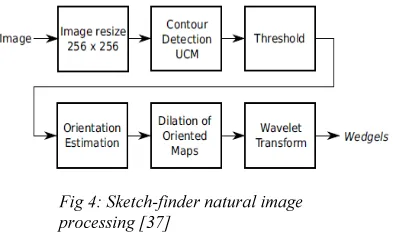
A proposed method named sketch finder, can be concentrated on sketch base image retrieval by using compressed domain indexing based on wavelet and speed retrieval efficient with saving memory. The proposed method allows to make the system effectively to comparison image and sketch and put sketch based image retrieval where pear sketch and images, contours are appearing and compared in the wavelet domain, this method proposed a new visual word structure for encoding image edges in the contours. The visual word composed spatial position of the wavelet coefficient. This word will be tagged and orientation of the edge, and about the similarity measured uses the compressed domain of the wavelets are matched between the contours of the image and sketch [37].
Table 3: An Overview Of Indexing Table 3: An Overview Of Indexing
4. CONCLUTION
This reviewer paper discusses the CBIR in general reaching specifically to the specific ways depending on low level (shape, color, texture) and high level (including semantic), in additional to shedding the light on the vital problems which is representing how to build the bridge between the low level and high level, called the semantic gap as appear from the latest research which presents several methods introduce this gap. The SBIR is discuses in base of indexing, feature extraction, matching and geometrical element (such as rotation, scaling, transformation) integrated with matching.
The latest researches in SBIR explained many descriptors applied on feature extraction to get a brief detail of features, also many researches include the use of descriptors in matching based on features, while some descriptors used to arrange affective indexing of image retrieval based on sketch festally and accurate . Some of the found problems still under study, to Limitations there
Approach Contributio n
Result Limitation
*PCA *hashing algorithm *Hamming encoder [34]
Flexibil ity design query between (query panel and data panel)
Enable to use multiple actions for flexible design .
MindFinder still use example query
Index structure called Edgel [29]
Buildin
g an
efficient index
Successfully built a real-time large-scale sketch-based image search
Engine
Doesn't use affine invariant shape-to-image matching
(DT) features [35]
Build a sketch-based image search framework for mobile devices
Reduces memory storage efficiency search accuracy.
Doesn't exists transformati
on and
mirror.
Contour Signature Mapping (UCM) [37]
-Used compresse d domain index. 2- compact the informatio n by wavelet coefficient
MSemory saving and speed retrieval efficiency.
[image:8.595.82.280.419.535.2]effected as flows HELO performance is working with different values of its parameters, but it is necessary to study SBIR more deeply in rotation invariance and multi-object sketch queries have not been studied sufficiently yet. For large scale sketch, TENSOR based image descriptor developed to be superior comparing with MPEG-7 EHD. But MPEG-7 EHD. SBIR system that used SHoG descriptor as a batter in benchmark, but it's unlikely because of the images selected in unspecified way and there is negative relations between users Ranking and descriptor Ranking .
The GH-HOG descriptor is better than SSIM, SIFT, HGOH descriptors of the retrieval, shape that based on sketch in Filker160 dataset and the ETHZ extended dataset. The QbS system helps the user to reach to the right images. This system can be more effective by combining color information and the digital interface ( digital pens). Edgel index successfully ranks the correct images at the top one but capable of affine invariant shape-to-image matching. On the mobile device built a sketch based image search this system Search of the features potential to be invariant translation, rotation and scale variations.
REFERENCES:
[1] O. Marques and B. Furht, “Content-Based Visual Information Retrieval,” 2001. [2] K. Bozas and E. Izquierdo, “Large Scale
Sketch Image Retrieval Using Patch Hashing,”Springer ISVC Part 1, LNCS 7431 , 2012, pp. 210–219.
[3] R. Davis, “Magic Paper:
Sketch-Understanding Research,” Computer (Long.
Beach. Calif)., Vol. 4, no. 9, Sep. 2007, pp. 34–41.
[4] R. Datta, D. Joshi, J. Li, and J. Z. Wang,
“Image retrieval,” ACM Comput. Surv.,
Vol. 40, no. 2, Apr. 2008, pp. 1–60. [5] S. Torres and A. X. Falcão, “Content-Based
Image Retrieval : Theory and Applications Abstract :” 1Institute of Computing, State University of Campinas, Campinas, SP, Brazil, RITA , Volume XIII , Número 2 , 2006.
[6] M. Banerjee, M. K. Kundu, and P. Maji, “Content-based image retrieval using
visually significant point features,” Fuzzy
Sets Syst., vol. 160, no. 23, Dec. 2009, pp. 3323–3341.
[7] P. S. Hiremath, “Content Based Image
Retrieval based on Color , Texture and Shape features using Image and its
complement,” International Journal of Computer Science and Security, Volume (1) : Issue (4) no. 1, 2008, pp. 25–35.
[8] G. Rafiee, S. S. Dlay, and W. L. Woo, “A
Review of Content-Based Image
Retrieval,” pp. 775–779, 2010.
[9] A. Chadha and N. Carolina, “Comparative
Study and Optimization of Feature- Extraction Techniques for Content based Image Retrieval,” vol. 52, no. 20, 2012, pp. 35–42,.
[10] M. Yasmin, M. Sharif, and S. Mohsin, “Use
of Low Level Features for Content Based Image Retrieval : Survey,” vol. 2, no. 11, 2013,pp. 65–75.
[11] H. H. Wang, “Semantic Gap in CBIR :
Automatic Objects Spatial Relationships extraction and representation,” International Journal Of Image Processing (IJIP), Volume (4): Issue (3) no. 4, 2010, pp. 192– 204.
[12] Y. Liu, D. Zhang, G. Lu, and W.-Y. Ma, “A
survey of content-based image retrieval
with high-level semantics,” Pattern
Recognit., vol. 40, no. 1, Jan. 2007 ,pp. 262–282.
[13] N. Goel and P. Sehgal, “A Refined Hybrid
Image Retrieval System using Text and Color,” vol. 9, no. 4, 2012,pp. 48–56.
[14] M. Eitz, K. Hildebrand, T. Boubekeur, and
M. Alexa, “A descriptor for large scale image retrieval based on sketched feature
lines,” Proc. 6th Eurographics Symp.
Sketch-Based Interfaces Model. - SBIM ’09, vol. 1, 2009 ,p. 29.
[15] M. Eitz, K. Hildebrand, T. Boubekeur, M.
Alexa, T. U. Berlin, T. Paristech, and L. Cnrs, “PhotoSketch : A Sketch Based Image Query and Compositing System PhotoSketch : A sketch based image query
and compositing system Additional
Materials,” , 2009, pp. 1–4.
[16] M. Eitz, K. Hildebrand, T. Boubekeur, and
M. Alexa, “An evaluation of descriptors for large-scale image retrieval from sketched
feature lines,” Comput. Graph., vol. 34, no.
5, Oct. 2010, pp. 482–498.
[17] M. Eitz, K. Hildebrand, T. Boubekeur, and
M. Alexa, “Sketch-Based Image Retrieval:
Benchmark and Bag-of-Features
Descriptors.,” IEEE Trans. Vis. Comput.
Graph., vol. 17, no. 11, Dec. 2010, pp. 1624–1636.
[18] B. Szanto, P. Pozsegovics, Z. Vamossy, and
Content-based image retrieval system using
sketches,” 2011 IEEE 9th Int. Symp. Appl.
Mach. Intell. Informatics, Jan. 2011, pp. 183–188.
[19] L. Tencer, M. Režnáková, and M. Cheriet,
“Sketch-based Retrieval of Document Illustrations and Regions of Interest,” 2013.
[20] M. Springmann, “Image Retrieval at
Memory ’ s Edge : Known Image Search based on User-Drawn Sketches,” 2011, pp. 1465–1468.
[21] P. Arbeláez, M. Maire, C. Fowlkes, and J.
Malik, “Contour detection and hierarchical
image segmentation.,” IEEE Trans. Pattern
Anal. Mach. Intell., vol. 33, no. 5, May 2011, pp. 898–916.
[22] R. Hu and J. Collomosse, “A performance
evaluation of gradient field HOG descriptor
for sketch based image retrieval,” Comput.
Vis. Image Underst., vol. 117, no. 7, Jul. 2013, pp. 790–806.
[23] Y. Kumagai, T. Arikawa, and G. Ohashi,
“Query-by-Sketch Image Retrieval Using Edge Relation Histogram,” , 2011,pp. 83– 86.
[24] H. Chatbri and K. Kameyama,
“Sketch-based image retrieval by shape points
description in support regions,” 2013 20th
Int. Conf. Syst. Signals Image Process. , Jul. 2013, pp. 19–22.
[25] B. Klare, A. K. Jain, and E. Lansing,
“Sketch to Photo Matching : A Feature-based Approach,” 2008.
[26] Anil K . Jain , Jung-Eun Lee , Rong Jin and
Nicholas Gregg “Content-Based Image Retrieval : Aa Application To Tatoo Images " Department of Computer Science & Engineering Michigan Sate University , East Lansing , Michigan 48824,” no. Fig 1, 2009, pp. 2745–2748.
[27] T. Chen, M. Cheng, P. Tan, A. Shamir, and
S. Hu, “Sketch2Photo : Internet Image
Montage.” Department of Computer
Science and Technology, Tsinghua
University, ACM SIGGRAPH ASIA, ACM
Transactions on Graphics,2009.
[28] Rui Hu , Tinghuai Wang , and John
Collomosse, “A bag -OF-Regions
Approach To Sketch-Based Image Retrieval " I.Conference and I. Processing Centre for Vision , Speech and Signal Processing University of Surrey , Guildford , Surrey , UK .,” , 2011, pp. 3661–3664.
[29] Y. Cao, C. Wang, L. Zhang, and L. Zhang,
“Edgel index for large-scale sketch-based
image search,” Cvpr 2011, Jun. 2011, pp.
761–768.
[30] R. Zhou, L. Chen, and L. Zhang,
“Sketch-based Image Retrieval on a Large Scale
Database Categories and Subject
Descriptors.” , Nara, Japan.MM’12,
October 29–November 2, 2012
[31] S. Pavani, T. V. N. Rao, and D. Shekar,
“Similarity Analysis Of Images Using Content Based Image Retrieval System,” vol. 2, no. 1, 2013.
[32] J. M. Saavedra and B. Bustos, “An
Improved Histogram of Edge Local
Orientations for Sketch-Based Image
Retrieval,” , 2010 , pp. 432–441.
[33] Y. J. Lee, C. L. Zitnick, and M. F. Cohen,
“ShadowDraw : Real-Time User Guidance for Freehand Drawing,” 2009.
[34] C. Wang, “MindFinder : Image Search by
Interactive Sketching and Tagging,” , 2010, pp. 1309–1312.
[35] K.-Y. Tseng, Y.-L. Lin, Y.-H. Chen, and
W. H. Hsu, “Sketch-based image retrieval on mobile devices using compact hash
bits,” Proc. 20th ACM Int. Conf. Multimed.
- MM ’12, , 2012, p. 913.
[36] R. Kreuzer, M. Springmann, I. Al Kabary,
and H. Schuldt, “An Interactive Paper and Digital Pen Interface for Query-by-Sketch Image Retrieval,” , 2012, pp. 317–328.
[37] C. A. F. P. Filho, A. D. A. Ara, and M.
![Figure 2: Overview Of The Query-By Sketch Image Retrieval [23]](https://thumb-us.123doks.com/thumbv2/123dok_us/8913234.960408/4.595.76.272.291.446/figure-overview-query-sketch-image-retrieval.webp)
![Figure 3:Top5 result returned from the system in some queries [2].](https://thumb-us.123doks.com/thumbv2/123dok_us/8913234.960408/6.595.314.507.165.303/figure-top-result-returned-queries.webp)