IMPROVEMENT WIRELESS DISTANT ACCESS
(APPLICATION ON SENSORS NETWORKS)
1N. MITTA, 1R. Elgouri, 1H. LAAMARI, 2M. BEN ATTOU
1
Electrical Genius & Energy Systems Laboratory, Department of Physics,
Faculty of Sciences, Kénitra-Morocco
2Research in Computing & Telecommunication Laboratory, Department of Computing,
Faculty of Sciences, Kénitra-Morocco
E-mail: [email protected], [email protected],[email protected],[email protected]
ABSTRACT
Generally, wireless sensors networks, and particularly those used in embarked computing, have answered with drastic temporal pressures. The optimization of the methods of access to the medium is the only way which push’s or set for bringing solution. Within effect, the technology IEEE 802.15.4 reposes on functionalities orientated to toward that problematic issue. However, a big number of holes unfortunately interfere and interrupt with that technology. A work of identification and resolution of these holes make the object of this article. In this objective, we propose an improvement of that method of access, where speech has given turn to every wireless sensor network that is economize energy.
Keywords : LP-WPAN, QoS, MAC, 802.15.4, ZigBee, Wireless Sensors Networks, Economy Of Energy.
1. INTRODUCTION
Few technologies of local or domestic wireless networks offer real guarantees on the temporal plan. Today, to replace a bus system by a wireless technology gives not very satisfactory results in general term of identical performances by investi-gating the works on the transport of the information with temporal strong pressures, we are being led to study the Quality of Service (QoS) for several tech-nologies of wireless networks and, force that is to find even when functionalities were envisaged (802.11PCF, 802.11e [1], 802.15.4GTS [2]), these technologies in general don’t offer completely guaranteed service. We therefore leaned over a resolution of type where speech is given in turn for every post office of network to allow a wireless network transportation of information in very strong temporal pressures [3-4]. In the first party, we introduce the main characteristics of network domesticate wireless IEEE802.15.4/ ZigBee in which we base our work for wireless sensors networks [5]. Then we will continue the rifts which we propose to fill in by introduction of an improve-ement of access to the medium allowing complete rationality, improvement which will be introduced
2. PRESENTATION: IEEE802.15.4 / ZIGBEE 2.1. Generality
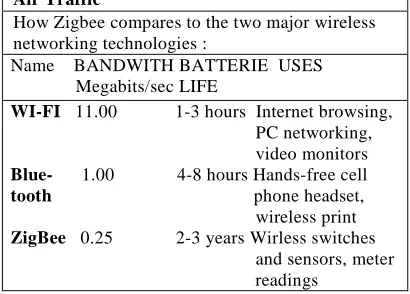
ZigBee is LP-WPAN (Low Power-Wire-less Personal Area Network) : it is a wirePower-Wire-less net-work with short range and with weak energy con-sumption (Table 1).
[image:1.612.315.520.578.725.2]It is characterized by some hundred of meters range maximum and a (250 kbits max) weak debit side. Norm was conceived to interconnect generically embarked units as sensors, in control units.
Table 1: Comparative Between The Wireless Protocols. Air Traffic
How Zigbee compares to the two major wireless networking technologies :
Name BANDWITH BATTERIE USES Megabits/sec LIFE
Table 2: Comparative Between Wireless Protocols Protocol ZigBee Bluetooth Wifi IEEE 802.15.4 802.15.1 802.11a/b/g Need in memory 4-32 kb 250 kb+ 1 Mb+
Autonomy with battery
Years Days Hours
Numbers of nodes
65000 7 32
Transfer speed 250 kb/s 1 Mb/s 11-54-108 kb/s
Range 70 m 10-100 m 300 m
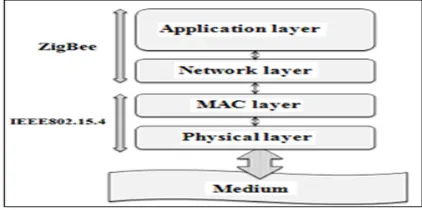
[image:2.612.314.520.257.342.2]Specification ZigBee [6-7] offers a possessing and light formal stack. It leans on norm IEEE 802.15.4 [1] for physical layers appearance and link and offers its upper own layers (network, etc) figure 1.
Figure 1: OSI Zigbee : Formal Stack.
The difference between ZigBee and the most part of other WPAN is at the level of the use of the medium; ZigBee is optimized for a weak use of the medium shared by all, for instance 0,1 % of time. Typically, a receiving broadcasting ZigBee module will occupy the medium during some millisecond in emission, wait possibly for an answer or a settle-ment, then will put on in wakefulness during long period before the following emission (they speak of drowsiness) which will take place at predetermined instant. This necessity introduces interesting resea-rch problems, notably at the level of layers link (time delay and stocking of messages, original access to the medium) and network (routing with respect energy pressures) [8]. ZigBee envisages two types of network entities: FFD (Full Function Device) implement the whole specification while RFD (Reduced Function Device) is lightened entities in an objective of lesser energy consum-ption [9] and lesser use memory for the micro-controller. Entities RFD are necessarily final nodes of network because the reduced stack implements the no mechanism of routing. Typically, a loaded sensor will be RFD and fed on batteries, while a
central processing unit of treatment, fed by a not
compelled source energetically (main powered),
FFD with the function of routing will be. IEEE 802.15.4 norm envisages two topologies: star (star – all nodes communicate with a central node called coordinator) or peer to peer (all nodes with range radio can communicate together without hierarchy). Formed network is called PAN. Above 802.15.4, the network layer of ZigBee allows the creation of gauze networks (mesh) reason of has to an auto-matic routing: it is gauze topology, or mesh topo-logy. These topologies are represented on the figure 2.
Figure 2: Topologies Of Network Proposes With IEEE 802.15.4 And Zigbee.
In accordance with IEEE 802.15.4, ZigBee can work on three bands of frequencies: 868 MHz (Europe), 915 MHz (North America) and 2.4 GHz (Worldwide). Norm envisages two different physic-cal layers (PHY), one for 868 / 915 MHz (PHY 868 / 915) and second for the 2.4 GHz (PHY 2450)) im-plementing a modulation with spread specter [10].
2.2 MAC layer
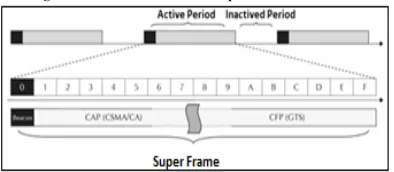
[image:2.612.92.303.303.408.2]super frame. Super frame consists of an active scoop (nodes can send and receive) and a scoop inactivates (nodes are in drowsiness). Active scoop is divided into 16 temporal slots of equal length; the beacon always occupies the slot 0 and allows the synchronization of all nodes range radio. Typically, the nodes of network wake up just before the slot 0 and put on in listening. In the reception of the beacon, they acquaint with the structure of super frame which starts and possible data in wait. If they have data neither to be sent out, nor to be accepted, they can drowse up to the following beacon; otherwise, they put on in wakefulness as soon as transaction (emission and/ or reception) is finalized. The figure 3 represents the structure of a super frame IEEE 802.15.4.
Figure 3: IEEE 802.15.4 Super Frame Structure.
The mode coordinated of 802.15.4, offers two methods of access within super frame: the first method of access is of type with contention. In this mode, accesses to the medium are made in a "classical" manner, in best-effort, according to the CSMA/CA protocol. This mode of access to the medium is always possible and a party of super frame must be systematically devoted to this mode. This part of super frame is called CAPE, for Contention Access Period. The second access method, optional, is said without contention where accesses to the medium are controlled by the coordinator. This mode can be used by the nodes which apply for it, and, if the network capacity allows it, the coordinator will be able to allocate one or several slots in a particular node. We speak about temporal devoted slots, or GTS [13], for Guaranteed Time Slots here. GTS, optional, occupies the last slots of super frame. We call this party of super frame the period of access without contention or CFP, for Contention Free Period. This mode without contention makes a reservation of bandwidth and can give certain temporal guarantees. The super frame beginning, via CAPE, always stays in free access by CSMA/CA to allow the transport access to requiring not or enough
association requests in network can make only in CAPE. It is therefore primordial to restrict the size of CFP.
2.3 The access method faults
802.15.4, by the GTS mechanism, allow some privileged nodes to be spared by the collisions phenomenon. Our proposal is to reinforce this mechanism by the implementation of an access method to the medium where the speech is given in turn for every network sensor, as it can be requested for a sensors network in an industrial environment with temporal strong pressures. With effect as we have seen it, the getting of a reservation of the medium is conditioned by two points:
- Network should not be saturated. Its capacity is not infinite but norm provides no possibility toward coordinator of a star « to reserve in priori » a part of the bandwidth with certain nodes which they could qualify as "critic".
- First asking the first serving, what is not a policy of allowable sharing out in Quality of Service.
The call of the reservation request (GTS.request) generates a frame which is sent to the coordinator by using the CSMA protocol. This protocol working in best-effort, it does not allow to be certain that request will reach up to the coordinator because guarantee on the attachment of a node with network.
As part of an industrial application, it would be useful to be able to guarantee a debit side and a delay of transmission for certain nodes described to be critics. So, other weaknesses appear:
A node, if it succeeds in joining network and in acquiring guarantees which it wants in allowed time however, it cannot keep its acquisition. With effect, in the present state of norm, a suite of GTS is allocated for a maximum of 14 super frames and cannot be supported without starting again the process of request entirely (new generation of
GTS.request in best-effort, etc). It is not therefore
possible to assure the continuity of guaranteed service.
If it is possible to appoint several GTS to the same node in the same super frame, it is not on the other hand planned it will affect GTS both super frames, to see even less (the conservation of an access which speech is given to everything in turn for every sensor of network less frequent).
of communication between two coordinators, who decide, each of their side, to allocate GTS in their nodes.
So, in the light of what has just been recalled, the mechanism of reservation of the medium could be ameliorated. Basic principles must be kept and made stretcher: distribution and sharing out of GTS have to win in suppleness; the mechanism must be able to be more dynamic. Besides, the coordinators who live together in the same zone of range and the same channel must be able to be exchanged of information on the sharing out of GTS to restrict collisions in CFP.
3. A PROTOCOL ELABORATION
In the previous section, we underlined that the mechanism of reservation of the medium offered by IEEE is interesting, but could be ameliorated. In order to do that, we offer an access improvement where speech is given in turn for every sensor of network by introducing following functionalities: In 802.15.4, just the final nodes can ask for GTS for themselves. In our proposal, a coordinator can allocate GTS to any correspondent, even if this one is not linked to this coordinator yet. We shall call this GTS allocated by anticipation PDS, for
Previously Dedicated Slot later. It will allow to
accomplish associations in network where speech in turn for every sensor of network.
In 802.15.4, no mechanism of synchroniza-tion between coordinators is envisaged to assure that two GTS are not allocated at the same ins-tant by two different coordinators who live together in the same zone of range radio and on the same channel.
In 802.15.4, allocated GTS is present in every super frame. In our proposal, every GTS can be present, in the choice, in all super frames, in super frame on two, one of four or one of eight, etc. They will speak of several noted reservations levels n, with, for instance, n=0, 1, 2 or 3. A level of reservation n = 0 will reserve a slot in every super frame (the most well brought up frequency), until at a level n=3 every eight super frames (the weakest frequency).
In 802.15.4, GTS is allocated for a number restricted by super frames, the continuation of the lease not being able to make that by a complete process resumption of request. Besides, this request being performed via a protocol contention (where
every wishing sensor speech attracts random emis- sion data), the continuity of service cannot be guaranteed. In our proposal, GTS is allocated with- out temporal border, up to the reception of a request of slackening from the concerned node or a notific- ation of slackening from the coordinator (time-out on stagnation, for instance).
3.1 Cohabitation problems of several stars on a common medium
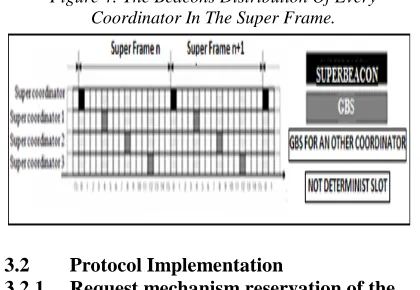
[image:4.612.311.521.411.556.2]If several coordinators of the same network live together in the same zone and on the same channel, the decisions of attribution of GTS must be collectively made. It is therefore impossible to consider a network in several stars as a simple conglomeration of stars managed individually. In our proposal, we suggest to centralize requests of GTS on an only node: the super coordinator. It will be also made responsible for dividing the other coordinators beacons of network to avoid the beacons collisions, what regulates at once the problem of the hidden coordinator. The super coordinator distributes GTS devoted to beacons to every coordinator as the figure represents 4 it. We shall call this GTS devoted to beacons GBS, for Guaranteed Beacons Slots.
Figure 4: The Beacons Distribution Of Every Coordinator In The Super Frame.
3.2 Protocol Implementation
3.2.1 Request mechanism reservation of the medium
To be able to grant GTS in one of its nodes, a coordinator must first send a request to the super coordinator and acquire a positive answer. Alone the super coordinator has an exhaustive vision from the sharing out of the medium for
2nMAX super frames to come. Considering our
try to randomize issue of data (all chain must fol- low the same logic so that result is logical!). To be made, dialogues between super coordinator and coordinators set up in GBS, coordinators being within reach the super coordinator. In our proposal,
GTS.requests messages will be included in the
payload field (payload) of beacon frame. The answers of the super coordinator are also put, in the following super beacon.
3.2.2 Anticipation allocations: Determinist arrivals in network
Our objectives in terms of access to the medium implicate that all operations accomplished on network are logical. In this objective, and as we recalled it more high, our proposal envisages a reservation possibility of slots in anticipation. This functionality is necessary to guarantee the network ownership in each stages of its functioning; it is possible because considered network is “few” all potential entities which compose it. Because of this functionality, the super coordinator can reserve some slots for the critical nodes. This reservation becomes a reality by the attribution of GTS in a node before its arrival, for instance as an example, for inter-beacon space of 122,88 ms, a reservation by anticipation with a level n = 3 allows to practice the arrival of a certain node every 983,04
ms (about all seconds) for 1/128 -th (0,78%) of lost
bandwidth.
3.2.3 A policy of access by default
In 802.15.4, the possible presence of CFP in super frame is pointed in frame beacon. If the beacon does not specify it, nodes can use the entirety of super frame in contention mode. In our proposal, a slot which is not announced as GTS should not be considered as freely useful because it can be reserved in another star. Because of this or that it is necessary that the coordinator informs expressly its nodes of the freely useful slots as part of one access with contention (CAPE).
4. SIMULATION RESULT
We have implemented the protocol offered as layer 2 and followed the parametric propagation model in defining a physical layer implementation which manages collisions and effect of capture [14], two types of routing protocols were adopted the hierarchical routing with and without shortened. The offered protocol makes responsible for taking back up to EOLSR [15] an indication of link break.
On the NS3 basis (Network Simulator 3) free software simulation by discreet event broadly used in academically research and in industry which makes available protocols models of wireless and wired networks as UDP,TCP/IP, the 802.11 MAC layer, the 802. 15. 4 MAC layer, as it is possible to add it models corresponding to all levels protocols of the model OSI (Open Systems Interconnection). With its graphic interface named NAM (Network AniMator), allowing illustrating networks functi-onnning and activity (trams exchanges, nodes pos-itioning, nodes displacement). We have developed graphic software inspired by works [16-17] which allows from several scenarios to generate traffic of
leaves (sensors and/oractuatorshaving an
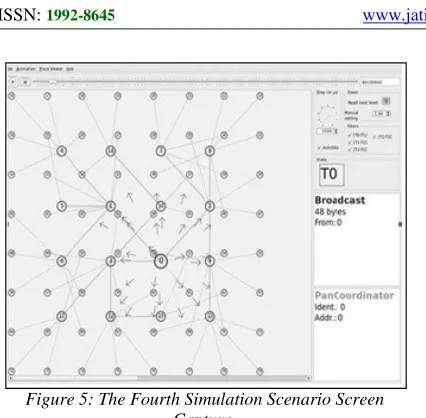
applica-tion role to be performed) for example with 16 frames by leaf and 1 frame by second of 25 bytes. The figure 5 shows the results in capture form of screen, a first scenario of 9 coordinators and 25 leaves, a second scenario of 9 coordinators and 36 leaves, a third scenario of 16 coordinators and 49 leaves, a fourth scenario of 16 coordinators and 64 leaves, a fifth scenario of 25 coordinators and 81 leaves. The figure 5 shows us a screen capture of this software. We can identify links family, time space in which they are (this capture shows that they are during the synchronization period because
T0 indication), information concerning frame in the
Figure 5: The Fourth Simulation Scenario Screen Capture.
[image:6.612.313.523.157.314.2]The number of collisions with monitoring for each of scenarios bar charts according to (figure 6)
Figure 6: Collisions Numbers Simulation.
We determined that with effect of segmentation (our mechanism of temporal division) the guaran-teed relay diminishes the contention during period of routing. We also formalized the quantity of traffic by the following curves (figure 7):
Figure 7: Traffic Quantity Simulation.
[image:6.612.92.302.346.488.2]is clear and 20 KB receipts furthermore between the point A and the point B. To measure delays from end to end we simulated an archetype which it is introduced by the figure 8 mentioned below.
Figure 8: End To End Simulation.
We had 7 coordinators with 1 active leaf by coordinator, and an intra-star (coordinator and all the leaves which are associated with it) of 92.16 ms, relay of 30.72 ms with a global cycle of 1.877s (multiple of 320 µs). The delay from start to finish exceeds the duration of a cycle (1.8 seconds) due to the adjournment of contrive (See the figure 9 below).
Figure 9: End To End Simulation.
[image:6.612.318.518.447.533.2] [image:6.612.94.298.572.718.2]
Figure 10: Gain energy analytics.
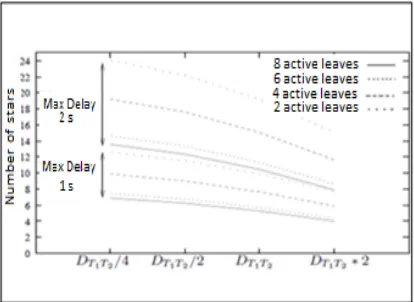
We notice different period values of ina- ctivity [T3; T0], 8 active leaves by cycle and by coordinator.
On the size of networks and the delay limited i.e with the number of coordinators and the num-ber of active leaves by coordinator according to expected limited delay and by taking into account the cases worst is put frames (frames generated towards the end of activity period). We had the following results:
Table 3: According intervals duration to the size of the network.
Coordinators Number
Number of active leaves by coordinator
Delay
intra-star (sec)
Delay of [T0,T1]
(sec)
Delay of [T1,T2]
(sec)
50 8 0.05 1.2 3.5
50 6 0.045 1.2 3.25
50 4 0.03 1.2 2.5
50 2 0.02 1.2 1.5
30 8 0.05 0.528 2.1
30 6 0.045 0.528 1.95
30 4 0.03 0.528 1.5
30 2 0.02 0.528 0.9
10 8 0.05 0.112 0.7
10 6 0.045 0.112 0.65
10 4 0.03 0.112 0.5
10 2 0.02 0.112 0.3
For the point A as on the figure for [T2; T3] =
[T1; T2], we can see a network of 5 stars with 8
[image:7.612.316.523.192.343.2]active leaves by star cycle.
Figure 11: Network size and limited delay.
[image:7.612.315.517.435.591.2]The check of simulation follows. The figure bellowing give 5 stars of 8 active leaves by star, an intra-star of 50 ms with the relay of 20 ms, according to a global cycle of 748 ms.
Figure 12: Simulation check in star
Figure 13: Simulation check in sticks.
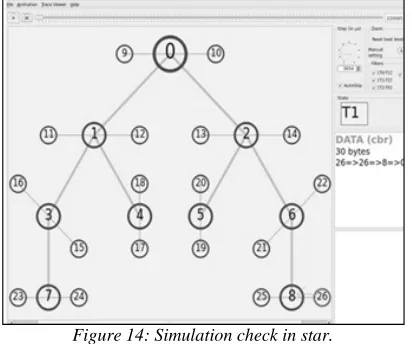
And for 9 stars with 2 active leaves by star, an intra-star of 20 ms and relay of 10 ms and a
global cycle of 491.68 ms. 100 frames were sent
[image:8.612.94.302.336.697.2](100 received frames), in periodic production of a frame per second and each of the frames is received within one second.
Figure 14: Simulation check in star.
Figure 15: Simulation check in sticks.
In this work, we proposed an improvement method of access of the WPAN 802.15.4 to assure an answer in A limited time in particular for applications requiring a strong QoS. Our work it is limited to the layer 2 and part of the hypothesis that the physical layer is very strong. We were also able to notice by simulation the obvious fact of the temporal performances transports using access type.
Our works will carry according to the model ITU-RP123-4[18] on prototype based on ZeegBee
components of FreescaleTM to analyze the made
improvements performances.
REFERENCES
[1] IEEE Computer Society 802 .15 .4 IEEE
Standard for Information technology, 2003. [2] IEEE Computer Society 802.11 IEEE Stand- ard for Standard for Information technologie. [3] A.van den Bossche, T.Val, E. Campo “ Proto- typing and Performance Analysis a Qos MAC Layer for Industrial Wireless Networks”vol.9, n°4, 2008.
[4] R. A Uthra “ QoS routing in wireless sensor
networks”, ACM 2012.
[5] M.A. Matin, M.Islam “An Overview of Wire- Less Sensor Networks”, International Confe- rence on Computer Networks and Commu- nication, Vol.35, n°9, 2012.
[6] Zig Bee Standard Organisation.“ Zigbee Spe- cification”,Document 054374r1, Jan. 2008. [7] ZigBee Alliance. Web, www.zigbee.org.
[8] N.Dehankar, P.Patil, G.Agarwal, A.Gaikwad
“Survey on Energy Consumption in Wireless sensor Network“ IJERT, Jan. 2013 edition. [9] J.D Sinha, S. Barman “Energy Efficient Rou- ting Mechanism in Wireless Sensor Network” Recent Advances in Information technology
(RAIT), 1St International Conference 2012.
[10] C. Guilleminot et al. “ A contribution to a Virtual Prototyping for a Spread Spectrum Te- lecommunication System Using VHDLAMS” BMAS 05, San Jose, USA, Sept. 2005. [11] P. Huang , L. Xiao,S. Soltani, M.Mutka, “The Evolution of MAC Protocols in Wireless Sen- sor Networks “, Communications Surveys & Tutorials, IEEE Fev. 2013.
[image:8.612.93.299.364.536.2]works” Internal Journal of Computer Appli- cations,Vol.44, n°18, Apri. 2012.
[13] A. Kouba, A. Cunha, and M. Alves “A Time Division Beacon Scheduling, Mechanism for IEEE 802.15.4/Zigbee Cluster-TreeWire- less Sensors Networks” Poly. Institute of Porto Tech Rep. TR-070401, Apr. 2007. [14] A.Guitton, F.Delobel,and M.Misson “Imple-
mentation Details for the Lower Layers of an LP-WPAN Simulation Framework” In-
ternational of Wireless Communication (IJWCS), 2009.
[15] S. Mahfoud, P. Minet, “EOLSR: An Energy Efficient Routing Protocol in Wireless ad hoc and Sensor Networks” Journal of Inter- connect ion Networks, vol.9, n°4, 2008.
[16] F. Delobel, A. Guitton, M. Misson, W.
Dargie“ Minimization of the Diffusion Del- ay of a Tree-Based Wireless Sensor Netwo- rk”, IEEE Global Communications Conference, Dec. 2011.
[17] S. Mahfoudh, P. Minet, M. Misson, I. Amd- ouni “ Node Coloring and Color Conflict
Detection in Wireless Sensor Networks”, Rev. Future Internet n°2, pages 469-504, 2010.
[18] S. Benferhat, Misson, and F. Jacquet, “Study of Traffic Conditions for Fleet of Mobile Moving within a Wireless Cell in Industrial Environment ” in MIC CCA, Moshakara International Conference Co-