NETWORK SELECTION IN HETEROGENEOUS WIRELESS
ENVIRONMENT USING DECISION MAKING
ALGORITHMS-TOPSIS AND PROMETHEE
1
KSS ANUPAMA, 2DR S SRI GOWRI, 2DR B PRABHAKARA RAO
1
Associate Professor, Department of Electronics & Instrumentation, VRSEC, AP, INDIA
2
Professor, Department of Electronics & Communication, SRKIT, AP, INDIA
3Vice Chancellor In-charge& Rector, JNTUK Kakinada, AP, INDIA
E-mail: [email protected], [email protected], [email protected]
ABSTRACT
Forthcoming wireless environment is a fusion of numerous networks with diverse technologies deployed by individual operators. In such an environment, innovative network selection methodologies are required not only to provide “always best connected” service to mobile users but also to maximize network operator’s revenue. To fulfill such requirements, multiple attributes from each network are to be systematically assessed. Consequently network selection becomes an issue of multiple attribute decision making (MADM). Various MADM algorithms have been proposed for use in network selection decision process. This paper compares the performance of PROMETHEE (Preference Ranking Organization Method for Enrichment Evaluations) an outranking MADM algorithm with TOPSIS (Technique for order of Preference by Similarity to the Ideal Solution (TOPSIS), a classical MADM algorithm in selecting the best network in a heterogeneous wireless environment. It also analyzes the effect of PROMETHEE and TOPSIS algorithms on ranking abnormality and mobile terminal distribution among the networks during handoff. A combination of Analytic Hierarchy Process (AHP) and Entropy method is used to assign weights to the decision criteria. Simulation results show that PROMETHEE algorithm outperforms TOPSIS in network selection decision making.
Keywords: Network Selection, Handoff Decision, MADM, PROMETHEE, TOPSIS.
1.
INTRODUCTIONIn the next generation wireless environment, various wireless (WLAN, WPAN, WLAN, and WIMAX) and cellular networks (GSM, EDGE, UMTS, LTE, GERAN, UTRAN) with diverse technologies coexist to provide any where any time service to the multimode terminal subscriber (MS). In such a heterogeneous environment the MS can achieve seamless mobility by switching its connections from one network to another network through a process called handoff1. Switching connections between networks of same technology is called Horizontal Handoff and of different technologies is called Vertical Handoff.
The vertical handoff process is a three step procedure i.e., discovering the networks, handoff decision making and execution. Initially the multimode mobile terminal identifies the networks along with their services, within its vicinity. In the decision phase, the mobile device selects the best
network from the available networks for handoff. Then, the execution phase re-routes the connections from the current network to the selected network. This work focuses on the network selection step, which is an important key in maximizing end user satisfaction in heterogeneous wireless environment.
Network selection is the process of identifying the best network from multiple available networks during handoff decision. The decision to select the best network depends on various factors such as, QoS capabilities of the available networks, traffic class requirements, mobile terminal properties and user preferences. Consequently the network selection process depends on a combination of multiple attributes rather than a single parameter.
PROMETHEE2 and TOPSIS3 for network selection decision making in a heterogeneous wireless environment. A combination of AHP4 and Entropy methods5 are used to determine the weights of the decision criteria. The effect of PROMETHEE and TOPSIS algorithms on network selection, ranking abnormality and load distribution is investigated.
In most of the existing MADM based vertical handoff decision algorithms, load distribution i.e distribution of multimode mobile terminal among the networks during handoff decision is not given prior consideration. Load distribution is an important system aspect, which when not given proper consideration will have an adverse effect on end users satisfaction. In this paper load distribution is accounted for and a solution through adjustment of criterion weights is proposed.
The rest of the paper is organized as follows. Section 2 presents work related to vertical handoff decision algorithms based on the MADM approach. Section 3 describes the application of TOPSIS and PROMETHEE algorithms in network selection. Section 4 compares the performance of the algorithms in terms of ranking abnormality and load distribution among the available networks. Finally, the conclusions and future work are presented in Section 5.
2.
RELATED WORKSince its inception in 1970’s, MADM methods have been widely used in network selection decision making. Some of the most extensively used MADM algorithms are “Simple Additive Weighting (SAW), Elimination and Choice Translating Priority (ELECTRE), Weighted Product Model (WPM), VlseKriterijumska Optimizacija I Kompromisno (VIKOR), AHP, TOPSIS and PROMETHEE”.
R.Tawil6 et.al proposed a “Distributed Vertical Handoff Decision” scheme, incorporating the “SAW” method. The novelty of the scheme is, utilizing dropping probability parameter as handoff decision criterion and reducing the computing processing load by delegating handoff decision making process to the visiting networks.
Bari7 et.al presented a modified “ELECTRE” algorithm that provides complete ranking of the networks in application scenarios where the utility of some attributes is non-monotonic.
S.S.A.Kolli8 et.al compared the performance of the two MADM methods “PROMETHEE” with “AHP” in terms of consistency, ranking
abnormality, robustness and accuracy and showed that PROMETHEE is more suitable than AHP in network selection decision making.
A.Sagora9 et.al proposed an access network selection algorithm that concatenates two MADM methods, the AHP and TOPSIS. Crucial parameters such as received signal strength and resource availability are not considered in the selection process.
C.R.Perez10 et.al studied a set of MADM algorithms “SAW, WPM, TOPSIS, VIKOR, ELECTRE, GRA, and AHP”, and made the following observations: “In handoff decision normalization process plays a key role. Both dynamic and adaptive processes are required for efficient utilization of network resources”. However there is no suggestion regarding a suitable normalization process to be used in specific traffic class.
Mobile terminal distribution among the networks during handoff decision is an important system aspect that has not been given proper consideration in most of the existing network selection decision making algorithms. If large number of the MS’s selects the same network for handoff, then that network becomes loaded and may result in handoff dropping. This paper proposes a solution to the problem of load distribution through adjustment of criterion weights.
3.
APPLICATION OF PROMETHEE AND TOPSIS ALGORITHMS IN NETWORK SELECTIONPROMETHEE belongs to a family of outranking methods developed by Brans et al. in 1986.It is designed to deal with multi criteria problems with finite set of solutions. It is simple in conception and application compared to other methods for multi criteria analysis. The basic principle of PROMETHEE algorithm is “pair-wise comparison of the alternatives” in order to rank them with respect to a number of conflicting criteria. Several PROMETHEE methods exist, such as PROMETHEE I for partial ranking, PROMETHEE II for complete ranking and PROMETHEE III for interval based ranking. This paper focuses on PROMETHEE II algorithm to provide complete ranking of the alternatives.
the positive ideal solution and the farthest distance from the negative ideal solution. The algorithm calculates positive and negative ideal solutions based on the attribute values available for each alternative.
To evaluate the performance of PROMETHEE and TOPSIS algorithms in network selection, an application scenario of four heterogeneous networks UMTS1, UMTS2, WiFi, and WiMAX is considered. In such a scenario a MS is assumed to be connected to UMTS1 network and is traversing through an area overlapped by three more networks UMTS2, WiFi, and WiMAX. So, four networks are available simultaneously to the MS. The MS has to select the best network from the available networks for handoff. For selection process PROMETHEE and TOPSIS algorithms are applied. Decision is based by assessing various criterions from each network: Cost (CB), Allowed Bandwidth (AB), Packet Delay (D), Packet Jitter (J), Network Utilization (U) and Packet Loss (L). The decision criteria values at the time of network selection are shown in Table 1.
Table 1: Decision Criteria Values
3.1. Assignment of Weights
Weights are measures of relative importance of criteria. Both PROMETHEE and TOPSIS algorithms require weights to be assigned to each criterion. Most of the existing network selection algorithms have employed AHP methodology for assigning weights to the criterion. AHP is a subjective weighting method, in which weights are assigned according to the knowledge and perception of the decision maker. However the dynamics of the criterion are not reflected in the assignment of weights. In order to utilize the subjectivity of the decision maker and objectiveness of the performance values, this paper employs a combination of AHP and Entropy methods for assigning weights to each criterion. AHP method is employed to estimate the subjective weights of criterion in accordance to QoS requirements of the current traffic class and Entropy method to determine the objective weights. Then the two weights are combined to obtain the comprehensive weights.
3.2. AHP
AHP is defined as “A theory of measurement through pair wise comparisons and relies on the judgment’s of experts to derive priority scales.” The AHP procedure for weight determination consists of the following steps.
Construct pair-wise comparison matrix (PWCM)
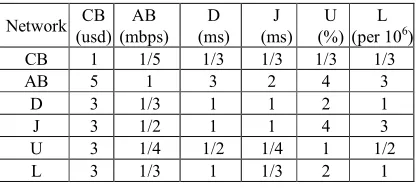
[image:3.595.305.513.303.398.2]i.e. perform pair wise comparison of the criterion at each level. For each pair, within each criterion award a score, on a scale between 1 and 9 to the better option, and a reciprocal of this value to the other option in the pair. The pair wise comparison matrix for streaming traffic is shown in Table 2.
Table 2: PWCM for Streaming Traffic.
Determine the geometric mean of each row for each matrix and normalize the results obtain the weights for each criterion
=
∑
= Mi i
i
i GM GM
W
1 (1)
Where GMi is the geometric mean of the ith row.
Check the consistency of a pair wise comparison by using consistency ratio (CR)
RI CI
CR = / (2)
Where CI is the Consistency Index and RI is the Random Index.
If the CR is less than or equal to 0.1, the pair wise comparison is considered acceptable or else the subjective judgment is revised.
3.3. Entropy Method
It is an objective weighting method that assigns weights according to the value of each criterion and does not depend on decision maker's subjective judgment. This establishes the entropy method as an unbiased evaluation procedure, and the same holds true for the weights obtained for the criteria.
Step 1. Normalize the decision parameters in Table1.
/ 1
m
i j ij i i j
b =a
∑
= a(3) Network CB
(usd) AB (mbps)
D (ms)
J (ms)
U (%)
L(per 106) UMTS1 85 1.8 43 9 90 40 UMTS2 120 0.6 55 10 80 70 WiFi 7 10 115 15 70 58 WiMax 20 10 100 6 50 60
Network CB (usd)
AB (mbps)
D (ms)
J (ms)
U (%)
L (per 106) CB 1 1/5 1/3 1/3 1/3 1/3
AB 5 1 3 2 4 3
D 3 1/3 1 1 2 1
Step 2. Compute an entropy value Eij
1 ln ln
m
ij i ij ij
E b b n
=
= −
∑
(4)
Step 3. Calculate the degree of divergence dj
d
j= −
1
E
ij (5)Where j = 1, 2... m
Step 4. Compute the weights for all criteria by additive normalization
1
n
ej j j ij
w
d
d
=
=
∑
(6)
Step 5. Combine AHP weight waj and entropy weights wej to obtain the comprehensive weights wj of the criterion.
1
n
j aj ej aj ej
j
w
w w
w w
=
=
∑
(7)
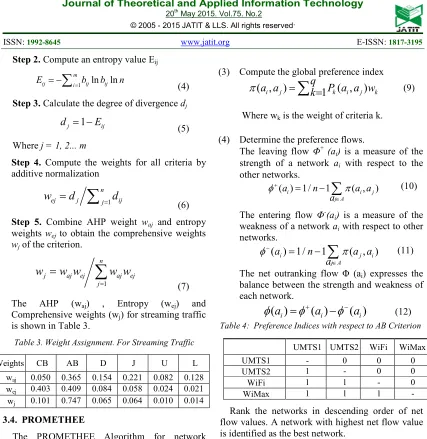
The AHP (waj) , Entropy (wej) and
Comprehensive weights (wj) for streaming traffic
is shown in Table 3.
Table 3. Weight Assignment. For Streaming Traffic
3.4. PROMETHEE
The PROMETHEE Algorithm for network selection decision making is given below.
(1) Perform pair wise comparisons between all the networks with respect to all the criterions listed in Table 1,
d a a
k( , )
i j=
f a
k( )
i−
f a
k( )
j (8)Where dk(ai,aj), is the difference between two networks ai and aj with reference to criterion ‘k’.
(2) Use an appropriate preference function to translate the difference dk into a preference Pk of a network aiover another network aj on a given criterion fk.
[image:4.595.85.512.73.512.2]A usual preference function is applied to obtain the preference of one particular network over another network on a given criterion. The preference indices of streaming traffic for allowed bandwidth criterion are shown in Table 4
.
(3) Compute the global preference index
( ,
a a
i j)
q
k
1
P a a w
k( ,
i j)
kπ
=
∑
=
(9)Where wk is the weight of criteria k.
(4) Determine the preference flows.
The leaving flow Φ+ (ai) is a measure of the strength of a network ai with respect to the other networks.
( ) 1/ 1 ( , )
i i j
j A
a n a a
a
φ+ π
∈
= −
∑
(10)The entering flow Φ-(ai) is a measure of the weakness of a network aiwith respect to other networks.
( ) 1 /
1
(
, )
i j i
j A
a
n
a a
a
φ
−π
∈
=
−
∑
(11)The net outranking flow Φ (ai) expresses the
balance between the strength and weakness of each network.
( )
φ
a
iφ
+( )
a
iφ
−( )
a
i=
−
(12)
Table 4: Preference Indices with respect to AB Criterion
Rank the networks in descending order of net flow values. A network with highest net flow value is identified as the best network.
3.5. TOPSIS
The following steps describe the TOPSIS algorithm for network selection.
(1) Normalize the decision criterion dij acquired from the four candidate networks and listed in Table 1.
1
/ n
ij ij ij
i
z d d
=
=
∑
(13)
(2) Generate the weighted normalized matrix by multiplying the normalized decision criterion zij with its assigned weight wk
r
ij=
z w
ij k (14)(3) Determine the positive ideal solution V+ and negative ideal solution V-
Weights CB AB D J U L
waj 0.050 0.365 0.154 0.221 0.082 0.128
wej 0.403 0.409 0.084 0.058 0.024 0.021
wj 0.101 0.747 0.065 0.064 0.010 0.014
UMTS1 UMTS2 WiFi WiMax
UMTS1 - 0 0 0
UMTS2 1 - 0 0
WiFi 1 1 - 0
1 2
(
,
,...
n)
V
+=
R R
+ +R
+ (15)1 2
(
,
..
n)
V
−=
R
−R
−R
− (16)For beneficial criteria,
Ri+=max(rij) and Rj-=min(rij) For non beneficial criteria
Ri+=min(rij)and Rj-=max(rij) (4) Calculate the similarity distance
2 1
( ) , 1, 2...
n
j i ij
j
S + R+ r j n
=
=
∑
− =(17)
2 1
(
)
1, 2...
nj ij i
j
S
−r
R
−j
n
=
=
∑
−
=
(18)
(5) Calculate the relative closeness to the ideal solution:
*
/ (
),
1, 2...
j j j j
C
=
S
−S
++
S
−j
=
n
(19)
(6) Rank the networks according to the descending order of Cj*.
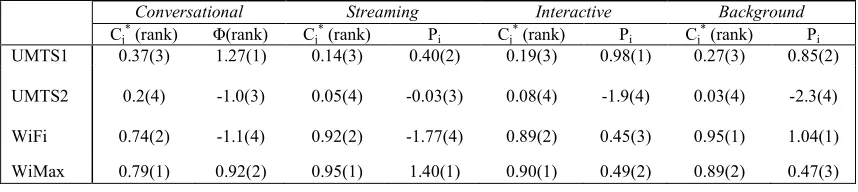
(7) Table 5 presents the "Φ" the net flow values of PROMETHEE, "Cj*" the relative closeness to
the ideal solution of TOPSIS and ranking of the networks for the four traffic classes i.e., Conversational, Streaming, Interactive and Background.
The results indicate that for the same set of network decision criterion values, the selected network varies with the type of traffic class. The ranking order of PROMETHEE is different from that of TOPSIS for conversational traffic.
UMTS1 is selected as best network by PROMETHEE and WiMAX by TOPSIS. For conversational traffic delay and jitter are the most important parameters. As depicted in Table 1, at the time of decision making, the jitter values of all the available networks are low and close to each other. In such a case the effect of jitter on decision
making is nominal. Also, the delay offered by UMTS1 network is low when compared to UMTS2, WiFi and WiMAX networks. So selection of UMTS1 as best network by PROMETHEE is completely justifiable.
For streaming and background traffic both PROMETHEE and TOPSIS selected WiMAX and WiFi networks respectively but differed in network selection for interactive traffic class.UMTS1 network is selected by PROMETHEE and WIMAX by TOPSIS. For interactive traffic class packet lossis the decisive criteria. Low packet loss ensures good quality of service. From the data presented in Table 1 it is clear that Packet loss is less in UMTS1 network when compared to WiMAX network. So in case of interactive traffic class TOPSIS algorithm did not make good decision in ranking and PROMETHEE algorithm network selection is more admissible.
4. PERFORAMANCE COMPARISON AND RESULTS
Simulations are performed to compare the performance of PROMETHEE with that of TOPSIS.
4.1. Simulation 1
In this stimulation ranking abnormality problem is investigated. Ranking abnormality is a condition which produces a change in ranking order of the networks due to the inclusion or exclusion of a network. This has an adverse effect on the robustness of the algorithm. Unfortunately most of the MADM algorithms including PROMETHEE and TOPSIS suffer from ranking abnormality.
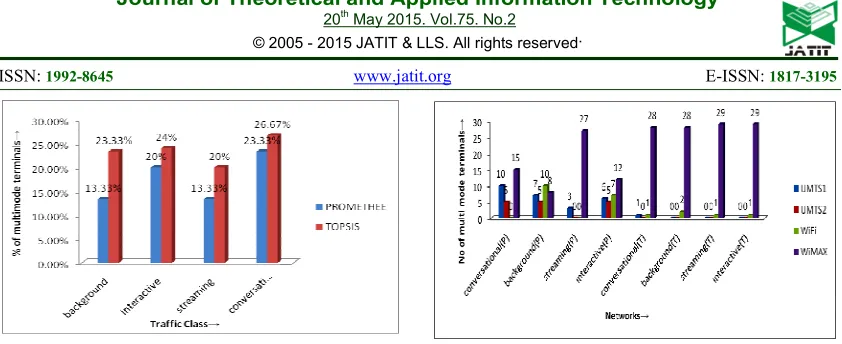
[image:5.595.82.511.654.750.2]To study the effect of ranking abnormality on PROMETHEE and TOPSIS ranking orders, network selection is performed at 30 vertical handoff decision points for each traffic class. From each ranks obtained, the least ranked network is removed and network selection is performed again. From the results depicted in Fig.1, it is observed that the average ranking abnormality produced by PROMETHEE algorithm is less when compared to TOPSIS for all the four traffic classes.
Table 5: Ranking order of the Network
Conversational Streaming Interactive Background
Cj* (rank) Φ(rank) Cj* (rank) Pi Cj* (rank) Pi Cj* (rank) Pi
UMTS1 0.37(3) 1.27(1) 0.14(3) 0.40(2) 0.19(3) 0.98(1) 0.27(3) 0.85(2)
UMTS2 0.2(4) -1.0(3) 0.05(4) -0.03(3) 0.08(4) -1.9(4) 0.03(4) -2.3(4)
WiFi 0.74(2) -1.1(4) 0.92(2) -1.77(4) 0.89(2) 0.45(3) 0.95(1) 1.04(1)
Figure 1: Ranking Abnormality of the Four Traffic Classes
With PROMETHEE ranking abnormality problem occurred in cases where the crucial parameters had values that are close to each other. For example, in case of streaming traffic class, bandwidth is the important parameter. If networks ranked 1 and 2 have bandwidth values that are in close proximity, then the removal of the worst network from the candidate list resulted in rank swapping between the networks, thus causing ranking abnormality.
In case of TOPSIS, when least ranked network is removed from the candidates list, the normalized attribute values of all the networks will change. As these values form the base for all other computations in the algorithm, a change in the ranking order is inevitable. However ranking abnormality is not observed in cases where the principal parameters of the selected network had high values in comparison to other network attributes.
4.2.Simulation 2
In this simulation the effect of PROMETHEE and TOPSIS algorithms on distribution of multimode terminals among the networks during handoff is investigated. Application of PROMETHEE or TOPSIS algorithms causes the multimode terminal to identify the best network among the available networks.
[image:6.595.89.510.77.249.2]Suppose more number of mobile terminals select the same network for handoff, than that particular network will be loaded and may result in an increase of handoff dropping rate. Moreover from network provider point of view, the remaining networks resources are underutilized resulting in revenue drop. So, for effective utilization of network resources and for reducing probable handoff dropping rate, mobile terminals must be effectively distributed among the networks during handoff.
Figure 2: Load Distribution among the Networks
To investigate the effect of PROMETHEE and TOPSIS algorithms on load distribution among the networks, network selection is performed by 30 multimode terminals located randomly at various handoff decision points in the heterogeneous environment. The load distribution results for the four different traffic classes are shown in Fig. 2.
The results depicted in Fig. 2 show that, with PROMETHEE algorithm no loading effect is produced on the networks for conversational, background and interactive traffic.
All the available networks are selected by the multi mode terminals except in case of conversational traffic, where WiFi network is not selected. For streaming traffic most of the multi mode terminals selected WiMAX as the best network for handoff. So loading of WiMAX network is observed only in streaming case.
Whereas, with TOPSIS 93% of the multimode terminals selected only WiMAX network for all types of traffic. So this network is over loaded, irrespective of traffic class. Consequently all the handoff requests will not be serviced resulting in handoff dropping and wastage of UMTS1, UMTS2, and WiFi network resources.
Load balancing among networks can be achieved by assigning more importance to network utilization criterion. Generally while assigning weights, more importance is given to QoS parameters, and network utilization criterion is considered low in the hierarchy.
This may lead to load imbalance and subsequent handoff call dropping due to lack of resources. So, while assigning weights, a tradeoff is required between network utilization and QoS parameters in order to achieve fair distribution of mobile terminals among the networks.
weight assigned to network utilization criterion is 0.05 i.e 5% of the total weight. This weight is gradually increased up to 25%. As the weight is increased other networks UMTS1, UMTS2, WiFi got selected as shown in Fig. 3. PROMETHEE algorithm resulted in fair distribution of multimode terminals among the networks; in contrast load distribution could not be achieved with TOPSIS algorithm. When the weight is increased beyond 25% no change is observed in the network selection patterns.
Figure 3:Load Distribution for Streaming Traffic
Application
5. CONCLUSION
Network decision making in heterogeneous networks considering multiple criteria is a complex issue. In this work, two MADM algorithms PROMETHEE and TOPSIS are applied to the problem of network selection and the effect of the algorithms on ranking abnormalities and multimode terminal distribution among the networks during handoff is investigated. AHP in conjunction with Entropy method is used for assigning weights to the criteria.
Simulation results show that the ranking order of the networks determined by PROMETHEE and TOPSIS are dissimilar for conversational and interactive traffic classes. However the best network selected by PROMETHEE algorithm for the four traffic classes is found to be more acceptable than that of TOPSIS in terms of QoS requirements. Also, the average ranking abnormality produced by PROMETHEE algorithm is found to be less when compared to TOPSIS. Moreover fair distribution of mobile terminals among the networks during handoff is achieved by PROMETHEE algorithm through network utilization criterion weight adjustment. TOPSIS algorithm in spite of its simplicity and ease of use was unable to reduce load balancing anomaly. Finally, the performance of PROMETHEE algorithm is more effective than TOPSIS in network selection, ranking abnormality and load distribution among the networks. Future research
work includes the study of tradeoffs in application QoS requirements and load distribution among the networks during handoff decision making.
REFERENCES:
[1.] M.Stemm and R.H, Katz, “Vertical Handoffs in Wireless Overlay Networks”, ACM Mobile Networks (MONET) Special Issue on Mobile Networking on the Internet, vol.3,1988,pp.335-350.
[2.] J. P. Brans, P. Vincke, and B. Mareschal, “How to select and how to rank projects: the Promethee method,” European Journal of Operational Research, vol. 24, no. 2,1986, pp. 228–238.
[3.] K.P. Yoon, C. Hwang, “Multiple attribute decision making: an introduction”, SAGE, USA, 1995.
[4.] T. L. Saaty “Decision Making for Leaders: The Analytic hierarchy Process for Decisions in a Complex World”, RWS Publications, 1988. [5.] Xu Jiuping, Wu Wei. “Multiple attribute
decision making theory and methods”,
Tsinghua university press. 2006
[6.] R. Tawil, G. Pujolle, O. Salazar, “Vertical Handoff Decision scheme using MADM for wireless networks”, IEEE Wireless Communications and Networking Conference (WCNC 2008) , Las Vegas (USA),March31-April03,pp. 2789–2792.
[7.] F. Bari and V. Leung, “Application of ELECTRE to Network Selection in a
Heterogeneous Wireless Network
Environment”, Wireless Communications and Networking Conference (WCNC2007), Hong kong, March11-15,2007, pp.3810-3815. [8.] K.S.S.Anupama, S.Sri Gowri, B.Prabhakara
Rao, T.Satya Murali “A PROMETHEE Approach for Network Selection in Heterogeneous Wireless Environment”,
International Conference on Advances in Computing, Communications and Informatics (ICACCI2014), Greater Noida (India), September24-27, 2014, pp.2560-2564,
[9.] A.Sgora, D.D. Vergados, P. Chatzimisios, “An Access Network Selection Algorithm for Heterogeneous Wireless Environments”, in IEEE Symposium on Computers and
Communications (ISCC),
Riccione(Italy),June22-25,2010,pp. 890–892. [10.] C.R.Perez and Victor.M. Ramos R. “On the
effectiveness of multi-criteria decision mechanisms for vertical handoff” International Conference on Advanced Information
Networking and Applications