A SURVEY OF CONGESTION DETECTION AND
AVOIDANCE TECHNIQUES FOR TCP CONGESTION
CONTROL
1LEE CHIN KHO, 2XAVIER DÉFAGO, 3YASUO TAN, 4YUTO LIM
School of Information Science, Japan Advanced Institute of Science and Technology (JAIST), Ishikawa-ken, 923-1292, JAPAN
E-mail: [email protected], [email protected], [email protected], [email protected]
ABSTRACT
With the emergence of novel network applications, the non-stop growing traffic is starting to experience
unexpected scenarios of network congestion. This paper comprehensively reviews congestion control
techniques of the mostly used TCP variants. Those variants have been developed over a period of three
decades. New classifications are made for those variants based on device entity, characteristic, and
association. The survey also describes the parameters that are used in each variant and how the
parameters are used to update of TCP congestion window size. Furthermore, congestion detection and
avoidance techniques that are implemented in those variants are also investigated and classified. Among
the contribution of this survey, the majority of variants studied here were found to be sender-centric.
Keywords: TCP, Congestion Control, Congestion Detection, Congestion Avoidance, Device Entity
1. INTRODUCTION
Internet [1] appears to be a great success for information sharing among people, at the same time Internet also faces numerous unsolved
problems. Network congestion [2] is one of the
unending problems that is depending on insufficient capacity of the underlying sub-network for the demanded amount of data transfer which is rapidly
increasing. This growth of demand eventually
might go beyond the Internet’s capacity and Service Providers’ ability to efficiently deliver the huge
Internet traffic. As a result, Internet might tend to
face tremendous and unpredictable network
congestion. Network congestion might be avoided
if technologies can keep increasing networking bandwidths, fast enough and never stop increasing. Still imperfect routing sometimes fails to balance the traffic. This causes congestion in the over utilized portions of the network.
When incoming traffic demand to some sub-network (node or link) exceeds the capacity of that sub-network (buffers and output capacity), congestion starts from that point and spreads along its links. Data crossing that sub-network would suffers from prolonged delays (buffer waiting) eventually leading to timeouts (loss rate).Internet has controlled network congestion for almost three
decades to some degree. Still, Internet users
sometimes experience poor performance due to
congestion. Therefore, researchers are still trying
to find better alternative solutions to eradicate
congestion completely without sacrificing
utilization.
Transmission control protocol (TCP) the core protocol of Internet provides a reliable delivery of a data stream in between two communicating
devices. To achieve a degree of reliable data
transmission under the congested network, different congestion control variants were designed. The first congestion control design (variant) was introduced by Van Jacobson in 1988 using end-to-end congestion control mechanisms. In his design, there are four congestion control stages: slow start, congestion avoidance, fast retransmit and fast recovery. Together with the techniques handling these four stages, they form the basic TCP flow and congestion control. Later, other TCP variants were designed to increase network throughput not just for congestion but also for other network conditions. These TCP variants include features like early
congestion detection, available bandwidth
detection, and loss type estimation. With these features, a sender can detect congestion state, buffer utilization, loss events and route condition changes to ensure network resources are fully utilized.
Recent research includes TCP/Network
Coding [3], history-based TCP throughput
prediction [4], and neural networks model in TCP
throughput estimation [5]. Such research
networks, network coding, prediction, machine
learning, neural networks, optimization theory and so on.
The vast development of TCP variants lead to many surveys that have been conducted by researchers. Those surveys can be generally
classified into three different perspectives;
performance in general, performance in certain
network environments, and with specific
parameters.
The first perspective, TCP general
performance compare between different TCP variants. Westwood, NewReno, and Vegas were surveyed by L. A. Grieco et al. [6]. Similarly, H. Jamal et al. [7] compared a standard TCP Reno to various variants and also classified the variants into loss-based, delay-based, and mixed loss-delay based.
The second perspective, many surveys studied how different TCP variants perform in different network environments. A. A. Hanbali et al. [8] have discussed wireless issues and the major factors involved in TCP congestion control over mobile ad hoc networks (MANET).Similarly, H. Balakrishnan et al. [9] compared protocol categories of end-to-end, link-layer, and split-connection of TCP congestion control over wireless networks. K. S. Reddy et al. [10] delved into high-speed network, considering TCP variants such as BIC, CUBIC, FAST TCP, HSTCP, Layered TCP, STCP, and XCP.
The last perspective, A. Afanasyev et al. [1] collected and described a comprehensive set of TCP variants and mechanisms that optimize various parameters in different network environments. The survey also explained each TCP variant, its strengths and weaknesses.
Unlike previous surveys, this survey compares existing TCP variants with respect to the
controlling device entity, characteristic and
association. This can give a quick view of the types of TCP variants and their relationship. Association of the variants is important here because it allows the researches to understand the evolution and the importance of congestion control in current and future networks. In addition, this survey discusses TCP congestion detection in terms of the evolutionary chain and compares the variants according to the device of detection such as duplicated acknowledgement (ACK) and round trip time (RTT). Packet loss for duplicated ACK, and delay for RTT are used as indicator to detect the congestion in the network. Last, we consider TCP congestion avoidance (CA) techniques in terms of
dependency on congestion window size (cwnd).
This allows us to know how the TCP variants work in controlling the transmission rate to avoid congestion.
In our previous work [11], we classified nearly thirty existing TCP variants based on the criteria of the controlling device entity (sender,
receiver, both), the variants characteristics
(complexity degree, congestion problem, and features), and the network environment (wired, wireless, high-speed/long-delay, and low priority of data transfer). In this survey, we extend our classification and associate TCP variants and also classify congestion detection and avoidance
techniques based on their detection scope and cwnd
respectively.
The objective of this survey is to review the major end-to-end TCP variants. TCP variants from 1988 to 2014 are collected, classified and analyzed. The variants considered in this research are the same set considered in all the previous surveys [1-10] as a representative set for all TCP variants.
The rest of this survey is organized as follows. Section 2 discusses comprehensively TCP variants by looking at three different classifications; device entity, characteristic, and association. Section 3 and 4 explain the congestion detection and avoidance techniques of TCP variants, respectively. At last, this survey is concluded in Section 5.
2. CONGESTION CONTROL OF TCP
VARIANTS
In this section, TCP variants is discussed
according to three different perspectives: device
entity, characteristic and association.
2.1. Device Entity
TCP variants can be classified into four types according to the controlling device entity, i.e.,
sender, receiver, sender-or-receiver, and
sender-and- receiver. The classification of the studied TCP
variants among the four types, is shown in the top part of Table 1.
Window (cwnd) based on a window based
mechanism to ensure the number of transmission bytes does not exceed network capacity.
The idea of having the congestion and flow controlled at the receiver side was introduced in 1997 [1],[12-15]. This way is also called receiver-centric control protocol (RCP). The RCP uses the same window based mechanism similar to SCP, but data-acknowledgement message exchange is no longer applicable. RCP uses request-data message exchanges for data transfer, in which a receiver sends an explicit request packet to the sender for requesting the data packets to be sent. This way, the sender only can transmit its data packets according to the transmission rate that is requested by the receiver. The receiver uses the incoming data packet as an acknowledgement to its previous request for data. According to [16], TCP performance can be significantly improved by using the RCP approach.
Unlike SCP and RCP, Y. Shu et al. [20] have proposed an alternative approach, called a mobile-host-centric transport protocol (MCP). In MCP, the device of control can function as either SCP or RCP at a specific period of time. If the mobile station is the sender, then the data-acknowledgement message exchange is adopted. When the mobile station is the receiver, the request-data message exchange is applied. In particular, when the mobile station is the receiver, a flag
m_flag of a synchronization packet is set to one to
notify other senders to use receiver-centric control. Otherwise, when the mobile station is the sender, it
sets m_flag to be 0 and then sender-centric control
is adopted.
Another type of controlling device entity is known as hybrid centric protocol (HCP), which was introduced by K. Shi et al. [25]. TCP mechanisms are coordinately controlled by both the sender and the receiver at the same time. For example, the receiver performs the function of flow control and participates in congestion control by computing
cwnd. Then, the sender uses the receiver’s
information to adjust the size of cwnd. In HCP,
TCP congestion control can reduce the waiting time of the sender to alleviate the impact of timeout problem of MCP [25].
2.2. Characteristic
To elaborate the characteristics of the TCP variants in this section, three subsections; feature, complexity degree, and network domain are used. The classification of TCP variants based on their characteristics is showed in Table 2.
2.2.1. Feature
Except for Tahoe, all of the TCP variants have four fundamental algorithms of TCP congestion control. Originally Tahoe had only 3 of those algorithms. V. Jacobson has refined Tahoe by adding the fast recovery algorithm and called the new TCP as Reno in 1990 [1]. New Reno is the enhancement of Reno. Reno unable to control network congestion efficiently because it focuses on detecting the packet loss of a single TCP transmission. It can't detect multiple packet loss. Variants which also cannot handle multiple packet loss includes Tahoe, Reno, and Vegas. This is due to the fact that those variants avoid congestion by using the feedback information (ACKs), which is referred to as primary feedback. To mitigate this problem, New Reno and its extension variants include a new feature, called multiple losses handling to detect loss of more than one packet at a time. Multiple losses handling uses partial feedback information or extended feedback information. The estimation/prediction feature is added to some TCP variants to predict congestion status. The estimation parameters include bandwidth, transmission rate, and queue delay. Table 2 shows in the second part, that most of the TCP variants studied include both
features; multiple losses handling and
estimation/prediction.
2.2.2. Complexity degree
Complexity degree defines in this paper as a difficulty in terms of implementation complexity of the TCP variant. High complexity referred to TCP variants using; the core four algorithms plus both the estimation and multiple loss detection features. While medium complexity lack the estimator feature. The low complexity is restricted to variants with only the core algorithms. As we can observe from Table 2, more than half of the TCP variants studied have a high complexity degree.
2.2.3. Network domain
In this section, TCP variants are
distributed into four overlapping network domains,
namely wired network, wireless network,
high-speed/long delay network, and low priority of data
transfer network [1]. TCP is originally designed for
Table 1: The Characteristics Of TCP Variants And Distribution Among The Different Types Of Device Entity
denotes a selected column None mentioned references are all [1]
congested intermediate wireless terminal. Other solution uses intermediate wireless terminal to separate the cause of packet loss whether wireless or wired environments.
In addition, standard TCP variants may not be very efficient in high-speed/long-delay networks. In this kind of networks, the data packets are transmitted but not yet received at the receiving side due to the long distance end-to-end transmission. Those data packets shouldn't be treated as a real packet loss. This problem is also referred to as a bandwidth-delay product (BDP).
A low priority data transfer network is the network which consists of high and low priorities data flows. Both TCP-Nice and TCP-LP are designed to provide a guarantee of transmission rate for the low priority data flows even though in the presence of the high priority data flows.
In Table 1, the TCP variants with high complexity degree are often belonging to the network domain of wireless networks and high-speed with long-delay networks.
2.3. Association
The association of TCP variants is depicted in Fig. 1. Tahoe was the first introduced TCP variant with congestion control. However, the core three
algorithms of Tahoe reduce cwnd to 1 when packet
loss is detected which can lead to significant throughput degradation. Fast recovery (FR)
algorithm was introduced in Reno to halve cwnd
and hold the new value until no duplicated acknowledgements are received within a specific period of time. Reno evolved into five different TCP variants that are specifically targeted for wired and wireless environments. The first two, NewReno and SACK solved multiple losses in the wired environment by introducing the partial ACK and selective ACK respectively. The third, TCP-Real implement contention detection and congestion avoidance in wireless environment. The four, Vegas uses the queue length measurement to determine the buffer utilization to determine the congestion status and reacts proactively. Vegas quantify congestion status before an actual congestion using estimation, then uses packet delay
to update cwnd. The last one, TCP- FIT performs
gracefully in both wireless and high speed/long delay network by parallel TCP technique.
A few TCP variants are extended from Vegas. For example, New Vegas included rapid window convergence algorithm to reduce the convergence time and increase the network utilization of the high-speed/long-delay environment. FAST TCP is a scalable TCP variant of Vegas, but it defines a
periodic fixed rate cwnd and a delay-based
Figure 1:The Association Of TCP Variants
transmission rate, and cwnd management algorithm
is also adopted. Nice targets low priority data transfer domain considers all standard TCP variants. The proactive method allows the Nice to consume the network resource for the low priority data flows when the high priority data flows are not used. ICTCP designed to handle the problem of incast congestion by adjust the TCP receiver window before packet loss happen.
One of the Reno family members, NewReno has been extended to a large number of new TCP variants for all kinds of network environments HS-TCP, Hybla, Libra, STCP,
Illinois, Fusion,
CTCP, Africa, BIC, and CUBIC are the enhanced NewReno versions for high-speed/long-delay. The
enhanced features include AIMD of cwnd and
queuing delay, semi-independent of RTT, packet pair technique, MIMD congestion avoidance policy,
binary cwnd search, and so on.
Besides the extension of NewReno to high-speed/long-delay environments, NewReno also expands for wireless environment, for instance Westwood, Casablanca, DOOR, and TD-FR. In
Westwood, a bandwidth estimation algorithm is added to speed up the fast recovery stage. This bandwidth estimation algorithm has an inherent concept of Vegas, whereby the RTT and the amount of transmitted data packets are used to
calculate the data transfer rate. Parameters of cwnd
and slow start threshold, sssthresh in Westwood are
then set near to the estimated data transfer rate when the packet loss is detected. Furthermore, three TCP variants, i.e., TCPW BR, TCPW CRB and Fwestwood are evolved from the Westwood. TCPW BR and TCPW CRB add the features of the predominant packet loss identification and the loss based estimation in the Westwood's congestion
control algorithm, respectively. Fwestwood
implements the fuzzy controller approach to enhance performance in wired network with high error rate.
On the other side of Westwood,
DOOR includes the out of order detection and
instant recovery and TD-FR uses time delayed fast recovery algorithm to improve the packet reordering problem.
A number of TCP variants is developed by merging the concepts and ideas from different TCP
variants together. For instance, CTCP is
constructed by implementing the network stage estimation of Vegas and adding slow and scalable
cwnd calculation of HS-TCP. Meanwhile, Africa is
built by implementing the network stage estimation of Vegas and the switching fast and slow mode of HS-TCP. Fusion is another integration of TCP variants from the Vegas, NewReno, and the Westwood. In the Fusion, the features of network buffer estimation from Vegas and achievable rate from Westwood are implemented. Fusion also
maintains NewReno’s congestion control
mechanism.
Other TCP variants like DSACK, which is the extension of SACK for the wireless environment and RCP approach. DSACK requires the receiver to acknowledge each receipt of a duplicate packet to the sender in order to avoid the problem of misinterprets out of order delivery data packet problem. Two TCP variants do not come from the association root of the standard TCP variants, i.e., MCP and TFRC. MCP uses cross-layer scheme, whereas TFRC uses different way of congestion control mechanism by fixing the transmitting size of the data packets, but TFRC triggers data sending rate in terms of packet per second in response to network congestion status.
In overall, Table and Fig. 1 shows that nearly 79% of the 34 TCP variants are SCP, and only one TCP variant is MCP. Furthermore, about 41% of the 34 TCP variants are for high-speed/long-delay environments, about 32% is for wireless environments, and the rest of percentage is for wired and low priority data transfer environments. In the association of TCP variants, most of the TCP variants of high-speed/long-delay environment evolved from the TCP variants of the wired environments.
3. CONGESTION DETECTION OF TCP
VARIANTS
The congestion detection plays an
important role in TCP congestion control mechanism. In this section, the scope of the congestion detection of TCP variants can be classified into two fundamental categories, namely
loss based (L) and delay based (D). Fig. 2 shows
the evolutionary chain that exhibits the scope of the congestion detection in TCP variants. Loss based is
Figure 2:A Evolutionary Chain Of TCP Variants That
Shows The Detection Scope Of The Congestion Control
the earliest reactive method used in the congestion control to detect the congestion network status. Loss based is originally built to amend the reliable end-to-end transmission at the transport protocol to deal with the congestion problem. In the normal operation of TCP protocol, the receiver transmits an ACK message to the corresponding sender upon receiving the data packet successfully. When the sender receives three duplicate ACK messages consecutively from the same receiver, this indicates that the transporting network is congested [1],[17].
The method used in the loss based tends to face the long delay of the sending ACK message. As a result, the loss based method cannot detect the congestion problem properly. To overcome this problem, the delay based that works as a proactive method is introduced by the Vegas. In the delay based, the network parameter, i.e., RTT that is used to measure the average end-to-end delay depicts the time required for sender to transport the data packets to reach the destination. RTT parameter can be also interpreted as a parameter to know the
network congestion status. Through this RTT, cwnd
is calculated as a function that is varying with the difference of RTT to reflect to the network congestion status.
calculated upon reception of the ACK message. In
particular, the amount of acknowledged data by the ACK message is divided by the time elapsed since the last ACK message received. The TCP variants that fall under this detection scope are Westwood, the TCPW BR, and the TCPW CRB.
On the other hand, a hybrid based that is defined as the combination of both loss based and delay based (LD) is also introduced right after the LBE. Duplication ACK or RTT parameter cannot solely determine the network congestion status. Therefore, hybrid based was developed to overcome the weakness of either the loss based or the delay based. In hybrid based, TCP variants use the delay based to identify the network status of the connection. When the network is congestion is suspected, congestion is further confirmed by using the loss based method. Veno is a typical example of the hybrid based. However, TCP Fusion combines hybrid based and bandwidth (LDBE) estimation to determine the congestion status.
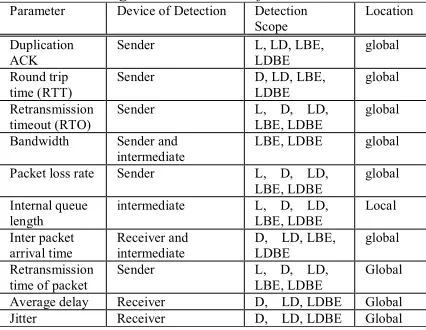
So far, the detection scope of the TCP variants is discussed. Selecting an appropriate parameter is an essential to justify the network congestion status. In this paper, the list of the parameters that used in the congestion detection of TCP variants is shown in Table 2.
The detection parameters that use in each congestion detection scopes are mainly selected based on several factors, which includes network structure, traffic pattern, transmission rate, network application, QoS requirements, and congestion probability [26]. In this paper, the congestion parameters are further classified into the device of detection, detection scope, and locality and globality. The device of detection describes a terminal that involves in detecting the congestion parameters. The terminal can be a sender, a receiver, or an intermediate. From the Table 2, most of the congestion parameters are performed at the sender side. Only three congestion parameters are detected by the receiver or the intermediate. We also can find out that most of the congestion parameters are used for the delay based method and estimation technique. As we can observe from Table 2, only the parameter of the internal queue length is local. Local means that a parameter is measured within a device and uses for the purpose of itself to justify the congestion status. This allows the faster response to the congested node, but it needs the per-flow state information at local node, which limited its scalability. Whereas global means that a parameter is measured from the sender, the receiver, and the intermediate. The global parameter that is shared among the network devices is used to
identify the congestion status of a network. This will result in congestion control reacts slowly to the congestion. The congestion information in the intermediate nodes has to travel towards the receiver and then backward to the sender. Then, only the sender can adjust the transmission rate to release the congested networks.
In summary, several of detection
parameters are used in congestion status
[image:7.595.300.513.370.535.2]determination, but this determinability might sometimes not accurate. This is because the congestion detection parameters such as duplication ACK, RTT, bandwidth and packet loss rate are mainly based on the feedback of acknowledgement packets. The acknowledgement packets can be lost or delayed due to non-congestion factors during the transmission. As a result, the congestion status might be misestimated and results in unnecessary congestion control handling or missing.
Table 2: A Comparison Of Parameters That Are Used In The Congestion Detection Of TCP Variants
Parameter Device of Detection Detection Scope
Location
Duplication ACK
Sender L, LD, LBE, LDBE
global
Round trip time (RTT)
Sender D, LD, LBE,
LDBE
global
Retransmission timeout (RTO)
Sender L, D, LD,
LBE, LDBE
global
Bandwidth Sender and intermediate
LBE, LDBE global
Packet loss rate Sender L, D, LD, LBE, LDBE
global
Internal queue length
intermediate L, D, LD, LBE, LDBE
Local
Inter packet arrival time
Receiver and intermediate
D, LD, LBE, LDBE
global
Retransmission time of packet
Sender L, D, LD,
LBE, LDBE
Global
Average delay Receiver D, LD, LDBE Global Jitter Receiver D, LD, LDBE Global
4. CONGESTION AVOIDANCE OF TCP
VARIANTS
In this section, CA algorithm of the TCP
variants is discussed. In CA algorithm, the cwnd
size is the main component parameter to be
controlled and monitored. Generally, cwnd starts
with exponentially increase in slow start stage. When the network congestion is detected, TCP congestion control will enter into the CA stage, in
which the cwnd is reduced and slowly increased
according to the additive or multiplicative way. Except for Tahoe, all the TCP variants in the CA
stage immediately reduce cwnd to half then
increase cwnd based on the its own policy either
additive increase (AI) or multiplicative increase
(MI). Tahoe directly set the cwnd size to zero when
Table 3: The Dependency Of Previous Cwnd Size When
The CA Algorithm Of TCP Variants Is Used
Dependency of Old cwnd Size
Function, f (cwnd)
w/ Condition w/o Condition Direct
Dependent
Vegas, Nice, Vegas A, Veno, New Vegas, STCP, Africa, TCP-Real, FAST TCP, CTCP, Hybla, IIIinois, Libra, Fusion, Westwood (Mode 1), TCPW, BR (Mode 1), TCPW CRB (Mode 1), ICTCP
Tahoe, Reno, NewReno, SACK, LP, Casablanca, HS-TCP, TD-FR, DS ACK, DOOR, MCP, TCP-FIT
Indirect Dependent
Westwood (Mode 2), TCPW BR (Mode 2), TCPW CRB (Mode 2), FWestwood
None
The mathematical representation of AI and
MI used in increment the cwnd size in CA
algorithm is offered in this section. The main effect
of the method uses in increment cwnd size will
impact the network throughput, while avoiding the network returns back to congestion in the short period of time.
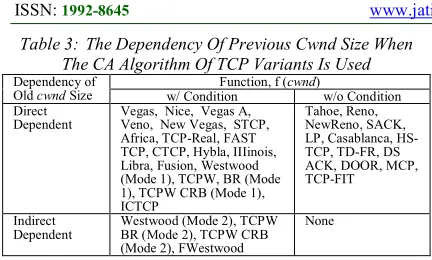
Table 3 classifies the TCP variants based
on the effect of their previous cwnd size when CA
algorithm is used. Dependency in Table 3 refers to
the function of cwnd that depends on the old cwnd
or not in order to decide the new cwnd size in the CA algorithm. The condition refers to the function
of cwnd being bounded by any constraints or not.
From the Table 3, we can observe that most of the
functions of cwnd depend on the old cwnd. For
example, Tahoe starts to update the new cwnd size
without condition based on cwndnew = cwndold +
1/cwndold when the packet loss is detected. But,
Vegas will need to ensure the product of χ =
cwndold ×RTT-RTTmin/RTT is fulfilled the condition
in order to enter the CA stage. If χ is positive, the
cwnd is decrease by one-eighth; if χ is negative or
zero, cwndnew = cwndold + 1. Meanwhile, only
Westwood, TCPW BR, and TCPW CRB are using
other parameters to determine the new cwnd with
condition in their CA algorithms.
Table 4 shows the methods of AI, MI, and
equation-based of the function, f(cwnd). Some TCP
variants consist of two modes in their CA algorithms, e.g., Westwood, TCPW BR, TCPW CRB, TCP-Real, Africa, CTCP, and Fwestwood. These two modes are operating in CA algorithms depend on the some constraints and conditions. The first component and second component of the function, f(cwnd) is defined as α and β to represent
the increment policies of additive and
multiplicative, respectively. α in the additive
increase is totally depending on the old cwnd size.
And β in the additive increase is depending on the
zero, constant, scaling, quotient, and other. If β is
zero, the new cwnd is equal to the old cwnd. If β is
constant, the new cwnd can be a function that varies
with a fixed value, such as Libra, Vegas, Vegas A,
New Vegas, and Nice. If β is scaling, e.g., γ ×
cwndold, the new cwnd can be a function that varies
with a factor. For instance, γ = 0.125 in STCP and γ
= 0.01 in Africa (Mode 1). If the β is equal to a
quotient, e.g., ω/cwndold, the new cwnd size can be
a function that varies with ω, in which can be 1. If
β is otherwise, the new cwnd size can be a function
that varies with an estimation value. On the other
hand, α in the multiplicative increase can be
divided into two types, i.e., bandwidth estimation (BE) and rate estimation (RE). But, these two types
of multiplicative increase share the common β of
RTTmin. An alternative method that is found in
Table 5 is an equation-based method. In this
equation-based method, the new cwnd is
determined by a new form equation, which depends
on the maximum or minimum limit of cwnd size
and the computed end-to-end throughput.
In summary, the function, f(cwnd) of CA
algorithms are mainly depends on network structure, traffic pattern, type of application, and QoS requirement. In other words, the multiplicative
increase policy of new cwnd can recover the
[image:8.595.304.515.467.750.2]network throughput faster than additive increase policy. However, the multiplicative increase policy easily causes the network to be congested again.
Table 4: The Methods Of Additive Increase, Multiplicative Increase, And Equation-Based Of The
Function, F(Cwnd)
Method f(cwnd) TCPVariant
α β
Additive Increase(AI)
cwndnew= α+β
cwnd Zero Westwood(Mode 1), TCPW BR(Mode 1), TCPW CRB (Mode 1), TCP-Real*(Mode1), FWeastwood* (Mode 1)
cwnd Constant Vegas, Vegas A, New Vegas, Nice, FAST TCP, Fusion(Mode 2), ICTCP *, TCP-FIT (Mode 1)
cwnd Scaling STCP,Africa,(Mode 2), CTCP(MODE 1), TCP-FIT(Mode 2)
cwnd Quotient Tahoe, Reno, NewReno, SACK, HS-TCP, TD-FR*, DSACK*, Veno, DOOR***, Hybla, Libra, Africa(Mode 1), TCP-Real*(Mode 2), CTCP(Mode 2), Fusion(Mode 3), MCP**
cwnd Other IIIinois Multiplicative
Increase(MI)
cwndnew=α×β
BE RTTmin Westwood(Mode 1), TCPW BR(Mode 2), Fwestwood(Mode 2), BE RTTmin TCPW CRB (Mode 2) Equation-based cwnd BIC,CUBIC,
5. CONCLUSION AND FUTURE WORK
The amount of data demanded for transfer might be more than the available bandwidth of a sub-network leading to congestion. In other words, congestion occurs when the available bandwidth is not enough for the requested amount of data. This survey extensively reviewed TCP congestion control variants with their congestion detection and avoidance mechanisms. This survey shed the light on the future possible inadequacy of the aforementioned TCP variants to handle the communication demand of the ever growing traffic.
We have summarized the association of TCP variants shows that most of the TCP variants are biased toward the SCP method. It is the type to which the first deployed variant belongs. Later it was thoroughly extended and modified more than the other variant. This can mainly be attributed to the fact that it existed longer than the other variants. Future TCP variants might better focus on extending the latest combined SCP and RCP methods, this can facilitate fine-tuning according to the different network environments. The parameters that are used in the congestion detection stage are limited in a number and some of them are highly dependent on one or more of the others. The network congestion detection accuracy achieved using those parameters have only been slightly improved during the last few decades. The majority of the well-known TCP variants only modify the pre-existing equations mostly with different coefficients.
In summary, this survey has reviewed the classifications and association of TCP variants in depth. This survey also further investigated congestion detection and avoidance techniques. The survey can provide valuable hints for network research, to know how the congestion detection and avoidance techniques are associated.
Previous surveys were too deeply detailed that easily loses the main idea. Other surveys focus only on one particular network condition or topology.
Unlike previous surveys, this survey focuses on the concepts of congestion control techniques more than the details. That helps getting the overall picture without being indulged into details that is not necessary in this state.
The association between the variants is also shown in this research as time relation of the evolution of variants. The bigger cluster of the variants shows clearly that NewReno (during the last 11 years) is still by far the variant of choice by most researchers and similarly network designers.
Similarly Loss based detection is the choice of most TCP variants designers and standards organizations.
Once a clear idea of congestion techniques is reached according to this survey, through comparison with simulations or networking logs of real traffic network is due. Future variants are recommended to start with NewReno again as the base for modification with its loss based detection. Finding some of the good modifications in other variants and add them back, would come out with new more suitable variants.
REFRENCES:
[1] A. Afanasyev, N. Tilley, P. Reiher, and L.
Kleinrock, “Host-to-host congestion control for TCP,” IEEE Commun. Surveys and Tutorials, vol. 12, no. 3, pp. 304--342, May 2010.
[2] M. Allman, “TCP Congestion Control,”
RFC5681, Sept. 2009.
[3] J. K. Sundararajan, D. Shah, M. Medard, S.
Jakubczak, M. Mitzenmacher, and J. Barros, “Network coding meets TCP: theory and implementation,” Proc. IEEE, vol. 99, no. 3, pp. 490--512, Mar. 2011.
[4] S. Vazhkudai, J. Wu, and I. Foster, “Predicting
the performance of wide area data transfer,” Proc. IEEE Int. Parallel and Distributed Processing Symp., Ft. Lauderale, FL, Apr. 2002. DOI:10.1109/IPDPS.2002.1015510.
[5] S. M. H. Shah, A. U. Rehman, A. N. Khan, and
M. A. Shah, “TCP throughput estimation: A new neural networks model,” Proc. Int. Conf. on Emerging Tech., Islamabad, pp. 94--98, Nov. 2007.
[6] L. A. Grieco and S. Mascolo, “Performance
evaluation and comparison of Westwood, New Reno, and Vegas TCP congestion control,” ACM SIGCOMM Comp. Commun. Review, vol. 34, no. 2, pp. 25--38, Apr. 2004.
[7] H. Jamal and K. Sultan, “Performance analysis
of TCP congestion control algorithm,” Int. J. of Comp. and Commun., vol. 2, no. 1, pp. 30--38, 2008.
[8] A. A. Hanbali, E. Altman, and P. Nain, “A
survey of TCP over Ad Hoc Netw.,” IEEE Commun. Surveys and Tutorials, vol. 7, no. 3, pp. 22--36, June 2005.
[9] H. Balakrishnan, V. N. Padmanabhan, S.
[10] K. S. Reddy and L. C. Reddy, “A survey on
congestion control protocols for high speed network,” Int. J. of Comp. Sci. and Netw. Security, vol. 8, no. 7, pp. 44--53, July 2008.
[11] K. L. Chin, X. Defago, Y. Tan, and A. O. Lim,
“A taxonomy of congestion control techniques for TCP in wired and wireless networks,” Proc.
IEEE Symp. on Wireless Tech. and
Applications, Kuching, Malaysia, pp 22--25, Sept. 2013.
[12] H. Y. Hsieh, K. H. Kim, Y. Zhu, and R.
Sivakumar, “A receiver centric transport protocol for mobile hosts with heterogeneous wireless interfaces,” Proc. MobiCom 2003, New York, USA, pp. 1--15, Sept. 2003.
[13] R. Gupta, M. Chen, S. McCanne, and J.
Walrand, “A receiver-driven transport protocol for the web,” Telecommun. Syst., vol. 21, no. 2--4, pp. 213-230, Aug. 2002.
[14] P. Mehra, C. Vleeschouwer and A. Zakhor,
“Receiver-driven bandwidth sharing for TCP and its application to video streaming,” IEEE Trans. on Multimedia, vol. 7, no. 4, pp. 740--752, Aug. 2005.
[15] V. Tsaoussidis, and C. Zhang, “TCP-Real:
Receiver-oriented congestion control,” J. of Comp. Netw., vol. 40, no. 4, pp.477--497, Nov. 2002.
[16] N. T. Spring, M. Chesire, M. Berryman, V.
Sahasranaman, T. Anderson, and B. Bershad,
“Receiver based management of low
bandwidth access links,” Proc. INFOCOM 2000, Tel-Aviv, Isael, vol. 1, pp. 245--254, Mar. 2000.
[17] Z. Wang and J. Crowcroft, “Eliminating
periodic packet losses in 4.3 - Tahoe BSD TCP congestion control,” ACM Comp. Commun. Rev., vol. 22, no. 2, pp. 9--16, Apr. 1992.
[18] L. Xu, K. Harfoush, and I. Rhee, “Binary
increase congestion control (BIC) for fast long-distance networks,” Proc. INFOCOM 2004, Hong Kong, vol. 4, pp. 2514--2524, Mar. 2004.
[19] S. Biaz, and N. H. Vaidya, “Differentiated
service: a new direction for distinguishing congestion losses from wireless losses,” Tech. Rep., Auburn University, pp.1--15, Feb. 2003.
[20] Y. Shu, W. Ge, N. Jiang, Y. Kang, and J. Luo,
“Mobile host centric transport protocol for EAST experiment,” Proc. 15th IEEE-NPSS Real Time Conf., Betavia, IL, pp. 1--8, Apr. 2007.
[21] G. Marfia, C. Palazzi, G. Pau, M. Gerla, M.
Sanadidi, and M. Roccetti, “TCP Libra:
deriavation, analysis, and comparison with other RTT-fair TCPs,” J. of Comp. Netw., vol. 54, no. 14, pp. 2327--2344, Oct. 2010
[22] J. Wang, J. Wen, J. Zhang, and Y. Han,
“TCP-FIT: an improved TCP congestion control
algorithm and its performance,” Proc.
INFOCOM 2011, Shanghai, China, pp. 2894--2902, Apr. 2011.
[23] H. Wu, Z. Feng, and Y. Zhang, “ICTCP: Incast
congestion control for TCP in data-center networks,” IEEE/ACM Trans. on Networking, vol. 21, no. 2, pp. 345--358, Apr. 2013.
[24] Z. T. Alisa, and S. R. Qasim, “A fuzzy based
TCP congestion control for wired networks,” Int. J. of Comp. Application, vol. 89, no. 4, pp. 36--42, Mar. 2014.
[25] K. Shi, Y. Shu, O. Yang, and J. Luo, “Receiver
assistant congestion control in high speed and lossy networks,” Proc. 16th IEEE-NPSS Real Time Conf., Beijing, China, pp. 91--95, May 2009.
[26] H. Sheikhi, M. Dashti, and M. Dehghan,