R E S E A R C H
Open Access
Developing a guideline for clinical trial protocol
content: Delphi consensus survey
Jennifer Marie Tetzlaff
1*, David Moher
1,2and An-Wen Chan
3Abstract
Background:Recent evidence has highlighted deficiencies in clinical trial protocols, having implications for many groups. Existing guidelines for randomized clinical trial (RCT) protocol content vary substantially and most do not describe systematic methodology for their development. As one of three prespecified steps for the systematic development of a guideline for trial protocol content, the objective of this study was to conduct a three-round Delphi consensus survey to develop and refine minimum content for RCT protocols.
Methods:Panellists were identified using a multistep iterative approach, met prespecified minimum criteria and represented key stakeholders who develop or use clinical trial protocols. They were asked to rate concepts for importance in a minimum set of items for RCT protocols. The main outcome measures were degree of importance (scale of 1 to 10; higher scores indicating higher importance) and level of consensus for items. Results were presented as medians, interquartile ranges, counts and percentages.
Results:Ninety-six expert panellists participated in the Delphi consensus survey including trial investigators, methodologists, research ethics board members, funders, industry, regulators and journal editors. Response rates were between 88 and 93% per round. Overall, panellists rated 63 of 88 concepts of high importance (of which 50 had a 25thpercentile rating of 8 or greater), 13 of moderate importance (median 6 or 7) and 12 of low importance (median less than or equal to 5) for minimum trial protocol content. General and item-specific comments and subgroup results provided valuable insight for further discussions.
Conclusions:This Delphi process achieved consensus from a large panel of experts from diverse stakeholder groups on essential content for RCT protocols. It also highlights areas of divergence. These results, complemented by other empirical research and consensus meetings, are helping guide the development of a guideline for protocol content.
Keywords:Randomized controlled trials, Delphi consensus survey, SPIRIT Initiative, Protocols, Clinical trials, Reporting guideline
Background
The protocol of a randomized clinical trial (RCT) serves many purposes. Protocols provide investigators with a document to guide trial conduct; trial participants with a detailed description of trial methodology; research ethics committees/institutional review boards (REC/IRBs) with a foreknowledge of predefined safeguards to protect par-ticipants’ interests and safety; research funders with a means of assessing proposed methods; and systematic
reviewers and others with a description of prespecified methods to evaluate potential biases [1-8]. To fulfill these purposes, protocols must be clear, detailed and transparent.
Unfortunately, many protocols do not adequately de-scribe important methodological details such as alloca-tion concealment (59%) [9], primary outcomes (25%) [1], power calculations (27%) [3] and sponsor and investiga-tors’roles in aspects of trial conduct [10] - all of which have been associated with exaggerated effect sizes and potential bias in trials. The lack of transparency and in-complete description of methods makes critical assess-ment of trials difficult.
* Correspondence:[email protected]
1
Ottawa Methods Centre, Clinical Epidemiology Program, Ottawa Hospital Research Institute, 501 Smyth Road, Ottawa, ON K1H 8L6, Canada Full list of author information is available at the end of the article
Reporting guidelines have been developed to help im-prove deficiencies in research reports [11-18]. A recent systematic review examined 40 guidelines for trial proto-cols; only 20% included any description of their meth-odological development process. Of those reporting consensus methods, none described formal processes for achieving consensus among stakeholders (for example Nominal consensus technique, Delphi consensus) and none described a systematic consideration of empirical evidence for guideline development [19]. Additionally, recommendations differed considerably across guidelines and many did not include concepts supported by empir-ical evidence. These inconsistencies and deficiencies have implications for those preparing, using, and review-ing clinical trial protocols.
An international group of researchers launched the SPIRIT (Standard Protocol Items: Recommendations for Interventional Trials) Initiative in 2007, with the primary aim of increasing the transparency and completeness of trial protocols. The main product of this initiative is a checklist of key items to address in protocols of clinical trials. This guideline is being developed with systematic and transparent methodology.
In line with current recommendations [20], three
com-plementary methods were specified a priori to develop
the SPIRIT checklist: 1) a Delphi consensus survey in-volving key expert stakeholders in the development and use of clinical trial protocols; 2) a systematic review of empirical evidence supporting the importance of specific checklist items; and 3) face-to-face consensus meetings to develop and finalize the SPIRIT Statement and its associated explanatory document. This paper describes in detail the first component of this research.
Methods
The objective of this study was to develop and refine minimum content for RCT protocols by expert consen-sus. We conducted a three-round electronic Delphi sur-vey. Ethics approval was obtained through the Children’s Hospital of Eastern Ontario.
Selection of participants
Invited expert panellists represented the main stake-holders involved in clinical trials: investigators, metho-dologists, statisticians and senior study coordinators from academia, pharmaceutical industry and govern-ment; REC/IRB members; members of funding and regulatory agencies; and major healthcare journal edi-tors. Experts had to meet the following predefined cri-teria [21]: relevant knowledge and experience; capacity, willingness and sufficient time to participate; and ability to communicate effectively in English. Participants were selected based on expertise and, where possible, were ranked and selected according to objective criteria
(trialists were required to be an author on a minimum of five English-language RCT publications over the past 10 years).
We identified potential panellists using a multistep, iterative approach [22], which included nomination/ snowballing, authors of relevant methodological re-search and the Institute for Scientific Information’s ‘Highly cited researchers in clinical medicine’[23]. This search was supplemented by specific location-based PubMed searches and targeted Internet searching to increase geographical distribution and areas of panellist expertise. Our objective was to include approximately 100 panellists (40 trialists/clinicians, 20 methodologists, 15 study coordinators, 10 ethics board heads/members, 10 funding/regulatory agency representatives and 5 healthcare journal editors) to enable detection of any divergent opinions between experts groups.
Selection of preliminary items
An initial list of 59 potential checklist items was col-lated based on existing protocol guidance [19] and known empirical evidence. Items were grouped under the following broad headings: a) General information; b) Introduction; c) Methods; d) Trial organization and administration; e) Ethical considerations; f ) Reporting and dissemination; and g) Other. Each item included a heading and description; wording and structure were kept similar to existing guidelines, where possible.
Delphi survey
All correspondence occurred via email or facsimile. Ap-proximately two weeks before the survey was adminis-tered (August 2007), we informed potential participants of the objectives of the SPIRIT Initiative and Delphi process, and invited them to participate. We solicited reasons for declining, where relevant. Participant ano-nymity and confidentiality of responses were ensured; individual responses were known only to the moderator (JT). Each survey round was conducted over five to six weeks: one week for pilot testing, three weeks for re-sponse acquisition (including two reminders prior to the round closing date) and one week for collating the results and preparing the subsequent round.
Each candidate item was rated in at least two rounds. In each round, respondents were asked to rate items on a 10-point scale (or‘No judgement’) for their suitability for in-clusion in a minimum checklist for RCT protocols. A
rat-ing of one corresponded to ‘unimportant - should be
dropped as an item to consider’and ten corresponded to
collected demographic information (occupation/field and place of employment) and panellists’self-rated level of ex-pertise in participating in this process.
Round 2 of the survey contained all Round 1 items grouped categorically by median scores rounded to the
nearest whole number (median≥8; 6≤median≥7;
me-dian≤5). No changes were made to checklist items,
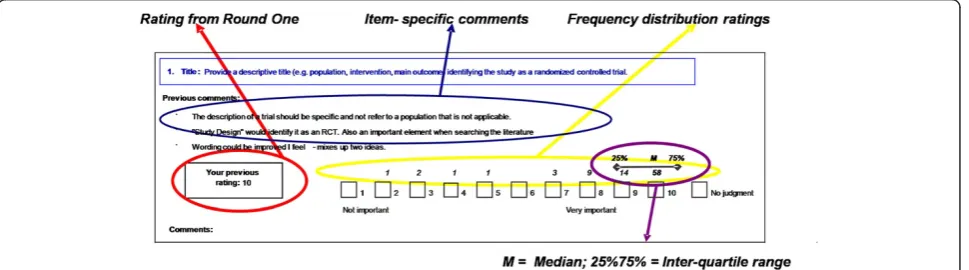
aside from the addition of newly nominated items from Round 1, which were drafted to include a heading and description; as before, wording and structure were kept similar to existing guidelines, where possible. For each item, panellists were provided with their previous rating, group summary ratings (medians, interquartile ranges (IQRs) and frequency distributions) and anonymized free text comments from Round 1 (Figure 1). They were asked to re-rate the items and respond to existing com-ments, if desired. Panellists were informed that, follow-ing Round 2, consensus would be defined by the
consistency of median scores between rounds (median≥
8 = high importance, median≤5 = low importance) and
the absence of significant issues noted in text comments. The third and final round presented results of items reaching consensus (Parts 1 and 2) and three sections requiring additional feedback. Part 3 included items introduced in Round 2 (to be rated as before: from 1 to 10). Parts 4 and 5 included items requiring a third round of feedback: those rated of moderate importance (me-dian 6 to 7) after two rounds (Part 4; Figure 2a) and items where comments suggested that single items con-tained multiple concepts of differing importance (Part 5; Figure 2b). For the latter, concepts were delineated and respondents were asked to rate each subitem separately. Each item in Parts 4 and 5 had the following response options:‘Include’,‘Exclude’or‘Unsure’.
Analysis
Medians and IQRs were calculated for each item.
Sub-group analyses were explored by respondents’
occupa-tion and self-rated expertise.
Results
Delphi participants
Invitations to participate in the Delphi survey were sent (by email) to 167 experts; we received a response from 123 experts, of which 104 (85%) accepted the invitation. Reasons for declining (n = 19; 15%) were too busy/unable (n = 15), not interested (n = 1) or no reason provided (n = 3). Of the panellists agreeing to participate, eight were unable to respond to either Round 1 or 2 and were not invited to par-ticipate in Round 3. Thus, ninety-six experts comprised the final panel.
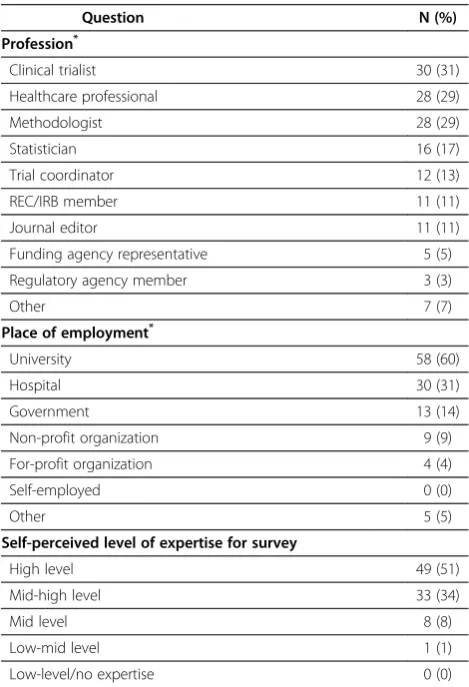
Panellists met oura priorigoals for profession/expertise representation (Table 1). Eighty-nine (93%) panellists from 17 countries responded to Round 1; 86 (90%) panellists from 17 countries responded to Round 2; and 84 (88%) panellists from 16 countries responded to Round 3 of the survey. Seventy-seven percent responded to all three rounds, 16% to two rounds and 7% to one round of the Delphi. Most initiated surveys had 100% completion; missing data were sparse and were clarified individually with the respondent.
[image:3.595.58.543.579.714.2]Delphi results
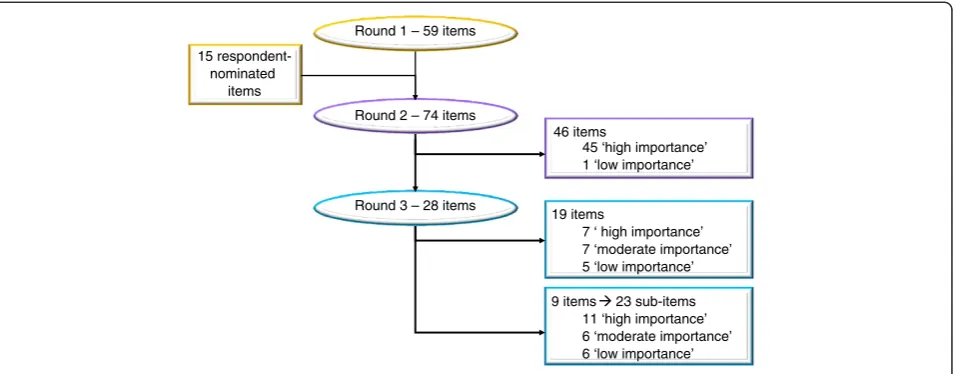
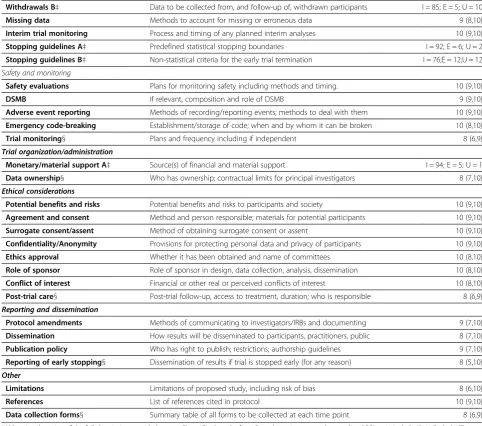
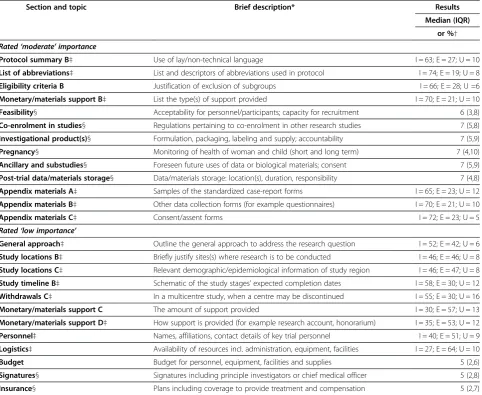
Figure 3 presents the flow of items through the Delphi and Tables 2 and 3 present the final results for each con-cept. In Round 1, respondents collectively rated 56 of the original 59 items with a median of 8 or greater, three with a median of 6 or 7 (Personnel, Logistics and Budget) and none with a median of 5 or less. All items were recircu-lated in Round 2, where consensus was achieved for 46 (78%) of the original 59 items; 45 items were considered to be of high importance and 1 (Budget) of low import-ance. The remaining items - four rated of moderate importance in Round 2 and nine where comments sug-gested that clarification was necessary - were recirculated for Round 3. Of the four rated of moderate importance,
three were ultimately recommended for exclusion
(General Approach, Personnel and Logistics). The fifteen panellist-nominated items (rated in Rounds 2 and 3; denoted by § in Tables 2 and 3) included seven with a
median of 8 or greater, six with a median of 6 or 7; and two with a median of 5 or less (Signatures, Insurance)
Where clarification was required after Round 2 (N = 9
items), panellists’ratings in Round 3 commonly
demon-strated differential support for specific subcomponents
(denoted by ‡ in Tables 2 and 3). For example, in
gen-eral, where items requested specific information plus a justification, respondents strongly favoured the main
concept but not the justification (for example Study
locations (Include (I) = 87%, justification: I = 46%) and
Eligibility criteria (I = 99%, justification: I = 66%)). The
four components of the item Monetary and material
support also received differing levels of support (source of support: I = 95%; type of support - material, financial: I = 70%; amount of support: I = 30%; how support is pro-vided: I = 35%).
Overall, the Delphi panellists rated 63 concepts of high importance (of which 50 had a lower quartile of 8 or more), 13 of moderate importance and 12 of low import-ance for inclusion in a minimum set of concepts for RCT protocols (Tables 2 and 3). Most items had narrow IQRs, suggesting agreement between panel members. However, some items had IQRs that spanned from recommendations to exclude the item (five or less) to recommendations to include the item (eight or greater), such as Reporting of early stopping, Ancillary and substu-dies, trial Feasibility, Signatures and plans to monitor the health of pregnant women and their children (Pregnancy). These items were very often associated with comments stating that the concept is important but is either too spe-cific for recommending in a minimum set for all trials or could be encompassed within another existing item.
Summary of text responses
Many general and item-specific comments were received during the three survey rounds and were retained for discussion by the SPIRIT group at subsequent face-to-face consensus meetings; examples are highlighted here.
[image:4.595.59.536.90.243.2]In general, many respondents stated that, although there were many items, most were important and hence rated highly. While some stated that there must be a ‘balance between guiding researchers and being too pre-scriptive’, others stated that a comprehensive list is more useful in light of the evidence for poor reporting in
Figure 2Example of questionnaire layout from Delphi Round 3 Parts 4 (A) and 5 (B).
Table 1 Characteristics of Delphi survey panellists (N = 96)
Question N (%)
Profession*
Clinical trialist 30 (31)
Healthcare professional 28 (29)
Methodologist 28 (29)
Statistician 16 (17)
Trial coordinator 12 (13)
REC/IRB member 11 (11)
Journal editor 11 (11)
Funding agency representative 5 (5)
Regulatory agency member 3 (3)
Other 7 (7)
Place of employment*
University 58 (60)
Hospital 30 (31)
Government 13 (14)
Non-profit organization 9 (9)
For-profit organization 4 (4)
Self-employed 0 (0)
Other 5 (5)
Self-perceived level of expertise for survey
High level 49 (51)
Mid-high level 33 (34)
Mid level 8 (8)
Low-mid level 1 (1)
Low-level/no expertise 0 (0)
*
[image:4.595.56.291.371.715.2]protocols and due to the ‘serious business’ of clinical trials that‘deserve(s) a detailed reporting at any stage’. A few respondents were concerned, however, about the possible increased burden on trialists. Some suggested that some concepts may be addressed in associated documents (for example contracts, statistical and Data and Safety Monitoring Board (DSMB) charters, labora-tory manuals) - with reference to such documents in the protocol - or through other sources (for example web-sites). Finally, some panellists suggested excluding items requiring repeated protocol amendments (for example Personnel, REC/IRB approval) to avoid jeopardizing trial
progress with required official amendments and
resubmissions.
Other general comments related to ambiguity of the term ‘protocol’, the desired scope of study designs that the checklist should address, and the potential need to define intended users of the protocol or checklist. Some noted that, while all items were potentially important elements, the importance of some may be relative to the target end user.
Item-specific comments consisted mostly of explana-tions to substantiate chosen ratings, suggested revisions, notes of potential overlap between and opportunities for merging items (for example Background, Rationale and Preliminary data; Risks, Harms and Adverse event reporting), and requests for clarification where items contained more than one concept or were vague. All comments were circulated to panellists in each round and delineations provided, where appropriate, in the final survey round.
Subgroup analyses
Subgroup analyses showed few differences between respondents by profession or level of self-perceived ex-pertise (not shown). As examples, REB/IRB members
and journals editors were more likely than other groups to support some concepts including a lay summary, a list of abbreviations, and justifications for study locations or eligibility criteria. There were no cases of bimodal results; rather, any differences were in the strength of support with overlapping IQRs. In some cases, the subgroup results enabled examination of the potential validity of additional comments. For example, while some panellists suggested that the items Logistics and Feasibility (which received low support overall) would be important to funding agencies but not to other end users, we found no difference between the opinions of our expert funding agency representatives and other groups for these items. This enabled greater insight and confidence for generating recommendations from the results.
Discussion
This Delphi survey produced rich information for further development of the SPIRIT Initiative, which aims to de-velop a guideline for clinical trial protocol content. Re-cent studies suggest that PubMed indexes over 6,000 RCTs annually [24] and this number has likely increased over time [25]. This finding does not account for trials indexed in other databases (between 20% and 70% of trials depending on the discipline [26]) and the minimum of 40% of trials not reaching full publication [27]. Given that all clinical trials should have a protocol, this Delphi and the SPIRIT Initiative have broad applicability.
Our panellists rated many concepts as highly import-ant for inclusion in RCT protocols, most of which had a strong majority favouring inclusion, indicating consensus within the panel (for example narrow IQRs). The im-portance of some of these concepts, such as allocation concealment, outcomes (including delineation of pri-mary outcomes), roles of sponsors, and conflicts of interest, are substantiated by strong empirical evidence
15 respondent-nominated
items
Round 2 – 74 items Round 1 – 59 items
Round 3 – 28 items
46 items
45 ‘high importance’ 1 ‘low importance’
19 items
7 ‘ high importance’ 7 ‘moderate importance’ 5 ‘low importance’
[image:5.595.62.540.89.276.2]9 items 23 sub-items 11 ‘high importance’ 6 ‘moderate importance’ 6 ‘low importance’
Table 2 Consensus - concepts of‘high importance’for minimum protocol content following two or three survey rounds
Section and topic Brief description* Results
Median (IQR)
or %†
General information
Title Descriptive title identifying study design 10 (9,10)
Trial identifier Unique number/name and registration information 10 (9,10)
Protocol version Version or amendment number and date 10 (8,10)
Protocol summary A‡ Short summary of proposed research I = 94; E = 5; U = 1
Names and addresses Names/addresses of primary investigators and sponsor 10 (8,10)
Table of contents List of contents and page numbers 8 (5,9)
Introduction
Rationale Outline topic and provide justification for study 10 (9.5, 10)
Background of the study Summary of all previous studies (that is, a SR or reference) 10 (9,10)
Preliminary data Describe preliminary studies (for example by investigators) 9 (8,10)
Objectives Specific objectives and hypotheses for the study 10 (10,10)
Study location(s) A‡ Description of intended sites(s) I = 87; E = 11; U = 2 Methods
Participants
Population Target and study population and source of the latter 10 (9,10)
Eligibility criteria A‡ Description of inclusion and exclusion criteria (participants) I = 99; E = 1; U = 0
Sample size Estimated number; calculations and assumptions 10 (10,10)
Recruitment Process of recruitment (for example advertisements) and enrolment 9 (8,10)
Design
Type of study Description of type/design and trial framework (for example superiority) 10 (10,10)
Study timeline A‡ Diagram of participants’procedures and visits through trial stages I = 84; E = 10; U = 6
Sequence generation Method used to generate random sequence; details of any restriction 10 (9,10)
Allocation concealment Method used to implement random sequence and whether concealed 10 (10,10)
Random implementation Who will generate sequence, enrol participants and assign to groups 10 (8,10)
Blinding Who (for example participants/investigators/outcome assessors) 10 (10,10)
Interventions
Interventions A‡ Precise details; how they will be administered (for example dosage, form) I = 99; E = 1; U = 0
Interventions B‡ Justification of control I = 87; E = 8; U = 5
Schedule of interventions Number and duration of treatment periods including run-in, washout 10 (10,10)
Concomitant interventions List of relevant treatments permitted or not before or during trial 10 (9,10)
Risks/Harms Known or potential risks for each study intervention 10 (10,10)
Data collection / management
Outcomes Describe and define primary and secondary outcomes 10 (10,10)
Data collection Methods, instruments and timing of data collection and recording 10 (9,10)
Biological specimens§ Laboratory evaluation, specimen collection, storage and shipping 8 (6,9)
Validation of instruments§ Reliability/validity of instruments or plans to establish validation 8 (6,9)
Follow-up Plans including description and schedule of visits and logistics 10 (9,10)
Data management Plans for data entry, editing, coding and storage 8 (7,9)
Quality control Methods for quality of outcome assessment and data records 9 (8,10)
Compliance Procedures and measures to monitor participant compliance 9 (8,10)
Statistical methods
Statistical methods Methods for primary/secondary outcomes and additional analyses 10 (10,10)
associating them with risk of bias in trials [2,8,28-34]. Other concepts are supported by more pragmatic, regu-latory or ethical rationale. Importantly, many of these concepts are often not described in protocols of RCTs [1,3,9,10,35]. This may be, in part, because most existing protocol content guidelines do not recommend such concepts [19]. The reasons for the variation between existing guidelines and our results are unclear as most guidelines do not report their methods of development.
Our results also indicate where panellists favoured ex-cluding concepts and where a clear consensus was not attained. For the former, such as Budget and Logistics, the lack of support does not suggest that such items
should not be included in protocols; only that they may be context-specific (for example not necessary for journal publication of protocols) and thus are not appropriate in a minimum set of requirements. Examples of the latter include items where wide IQRs remained. We believe that a systematic review of the methodological literature is im-portant to complement the Delphi results and to guide and substantiate final recommendations.
[image:7.595.55.538.111.537.2]Beyond the utility of the Delphi results for trialists, REC/IRBs representatives, funding agencies and the SPIRIT group, this research may be relevant to those developing reporting guidelines and our experience has already helped shape the methodology of other ongoing
Table 2 Consensus - concepts of‘high importance’for minimum protocol content following two or three survey
rounds(Continued)
Withdrawals B‡ Data to be collected from, and follow-up of, withdrawn participants I = 85; E = 5; U = 10
Missing data Methods to account for missing or erroneous data 9 (8,10)
Interim trial monitoring Process and timing of any planned interim analyses 10 (9,10)
Stopping guidelines A‡ Predefined statistical stopping boundaries I = 92; E = 6; U = 2
Stopping guidelines B‡ Non-statistical criteria for the early trial termination I = 76;E = 12;U = 12 Safety and monitoring
Safety evaluations Plans for monitoring safety including methods and timing. 10 (9,10)
DSMB If relevant, composition and role of DSMB 9 (9,10)
Adverse event reporting Methods of recording/reporting events; methods to deal with them 10 (9,10)
Emergency code-breaking Establishment/storage of code; when and by whom it can be broken 10 (8,10)
Trial monitoring§ Plans and frequency including if independent 8 (6,9)
Trial organization/administration
Monetary/material support A‡ Source(s) of financial and material support I = 94; E = 5; U = 1
Data ownership§ Who has ownership; contractual limits for principal investigators 8 (7,10)
Ethical considerations
Potential benefits and risks Potential benefits and risks to participants and society 10 (9,10)
Agreement and consent Method and person responsible; materials for potential participants 10 (9,10)
Surrogate consent/assent Method of obtaining surrogate consent or assent 10 (9,10)
Confidentiality/Anonymity Provisions for protecting personal data and privacy of participants 10 (9,10)
Ethics approval Whether it has been obtained and name of committees 10 (8,10)
Role of sponsor Role of sponsor in design, data collection, analysis, dissemination 10 (8,10)
Conflict of interest Financial or other real or perceived conflicts of interest 10 (8,10)
Post-trial care§ Post-trial follow-up, access to treatment, duration; who is responsible 8 (6,9)
Reporting and dissemination
Protocol amendments Methods of communicating to investigators/IRBs and documenting 9 (7,10)
Dissemination How results will be disseminated to participants, practitioners, public 8 (7,10)
Publication policy Who has right to publish; restrictions; authorship guidelines 9 (7,10)
Reporting of early stopping§ Dissemination of results if trial is stopped early (for any reason) 8 (5,10)
Other
Limitations Limitations of proposed study, including risk of bias 8 (6,10)
References List of references cited in protocol 10 (9,10)
Data collection forms§ Summary table of all forms to be collected at each time point 8 (6,9)
initiatives. Selecting potential panellists should be given adequate time and attention to ensure they meet the cri-teria suggested by previous guidance [21] as this is pivotal to both the internal and external validity (generalizability) of the Delphi results. Future endeavours should also con-sider empirically supported strategies to help increase re-sponse rates [36-42] including those used in the current study: survey prenotification/invitation to participate, per-sonalized invitations and surveys, notification of and
ad-herence to expected timelines, clear outline of
expectations including time-commitments, written com-mitment by panellists to participate (reply by email), follow-up reminders to non-respondents, provision of previous rounds’responses and assurance of confidential-ity. We also pilot tested each round, collected panellists’ comments and employed a flexible survey design. Using
an Internet-based tool may substantially increase Delphi efficiency and is recommended for future work.
Despite the many benefits of the Delphi consensus technique, the results are only as valid as the opinions of the experts constituting the panel. Even if consensus is attained, validating whether this consensus represents the ‘truth’is not possible, and we recognize that expert opin-ion remains among the lowest levels of empirical evi-dence [43]. To safeguard the validity of our results, we carefully selected a panel representing key stakeholders. Structured, predefined methods were employed to minimize biased response collation. Importantly, our panellists were experienced and committed to completing the process, increasing internal validity of the results.
[image:8.595.58.541.111.506.2]We chose the Delphi consensus method [21] for this work for several reasons: the research problem was felt Table 3 Concepts of‘moderate’or‘low’importance for minimum protocol content following two or three survey rounds
Section and topic Brief description* Results
Median (IQR)
or %†
Rated‘moderate’importance
Protocol summary B‡ Use of lay/non-technical language I = 63; E = 27; U = 10
List of abbreviations‡ List and descriptors of abbreviations used in protocol I = 74; E = 19; U = 8
Eligibility criteria B Justification of exclusion of subgroups I = 66; E = 28; U =6
Monetary/materials support B‡ List the type(s) of support provided I = 70; E = 21; U = 10
Feasibility§ Acceptability for personnel/participants; capacity for recruitment 6 (3,8)
Co-enrolment in studies§ Regulations pertaining to co-enrolment in other research studies 7 (5,8)
Investigational product(s)§ Formulation, packaging, labeling and supply; accountability 7 (5,9)
Pregnancy§ Monitoring of health of woman and child (short and long term) 7 (4,10)
Ancillary and substudies§ Foreseen future uses of data or biological materials; consent 7 (5,9)
Post-trial data/materials storage§ Data/materials storage: location(s), duration, responsibility 7 (4,8)
Appendix materials A‡ Samples of the standardized case-report forms I = 65; E = 23; U = 12
Appendix materials B‡ Other data collection forms (for example questionnaires) I = 70; E = 21; U = 10
Appendix materials C‡ Consent/assent forms I = 72; E = 23; U = 5 Rated‘low importance’
General approach‡ Outline the general approach to address the research question I = 52; E = 42; U = 6
Study locations B‡ Briefly justify sites(s) where research is to be conducted I = 46; E = 46; U = 8
Study locations C‡ Relevant demographic/epidemiological information of study region I = 46; E = 47; U = 8
Study timeline B‡ Schematic of the study stages’expected completion dates I = 58; E = 30; U = 12
Withdrawals C‡ In a multicentre study, when a centre may be discontinued I = 55; E = 30; U = 16
Monetary/materials support C The amount of support provided I = 30; E = 57; U = 13
Monetary/materials support D‡ How support is provided (for example research account, honorarium) I = 35; E = 53; U = 12
Personnel‡ Names, affiliations, contact details of key trial personnel I = 40; E = 51; U = 9
Logistics‡ Availability of resources incl. administration, equipment, facilities I = 27; E = 64; U = 10
Budget Budget for personnel, equipment, facilities and supplies 5 (2,6)
Signatures§ Signatures including principle investigators or chief medical officer 5 (2,8)
Insurance§ Plans including coverage to provide treatment and compensation 5 (2,7)
to benefit from expert opinion on a collective basis; a larger and more diverse group could be consulted than could effectively meet face-to-face due to expense, size and the logistics of group interaction; and the preserva-tion of participant anonymity allowed for open discus-sion. This method also shares the advantages of other integrative methods of knowledge translation [44] ideally resulting in a guideline that, beyond being founded on transparent and systematic methods, is externally valid and ultimately meets the needs of end users. We recom-mend this technique to others embarking on similar initiatives.
Conclusion
This Delphi consensus has provided a large volume of rich information to guide the development of the SPIRIT checklist, an evidence-based guideline for the content of trial protocols. By applying a formal consensus method and engaging experts from diverse areas, the results of which will be complemented by empirical evidence from the methodological literature, the aim is to collate guid-ance on important concepts to address in protocols. The SPIRIT Initiative ultimately aspires to help increase trans-parency and completeness of information in trial proto-cols, ideally helping to improve the reliability and validity of the medical literature guiding healthcare decisions.
Abbreviations
CONSORT: Consolidated Standards of Reporting Trials; IQR: interquartile range; RCT: randomized controlled trial; REC/IRB: research ethics committee/ institutional review board; SPIRIT: Standard Protocol Items: Recommendations for Interventional Trials.
Competing interests
The authors have declared that no competing interests exist. All authors are members of the SPIRIT Initiative Steering Group.
Authors’contributions
JMT, AWC and DM conceived the study and prepared the initial list of survey items. JMT designed and administered the survey, and collected and analyzed data. JMT wrote the first draft of the manuscript with input from all authors. All authors read and approved the final manuscript.
Financial disclosure
No direct funding was received for this study. The authors were personally salaried by their institutions during the period of writing (though no specific salary was set aside or given for the writing of this paper). Dr. Moher is supported, in part, by a University (of Ottawa) Research Chair. No funding bodies had any role in the study design, data collection, analysis, decision to publish or preparation of the manuscript.
Acknowledgements
We thank the Delphi panelists for their participation and for their dedication to seeing this process succeed. Their substantive feedback and support was very much appreciated given the significant request for their time.
Author details
1
Ottawa Methods Centre, Clinical Epidemiology Program, Ottawa Hospital Research Institute, 501 Smyth Road, Ottawa, ON K1H 8L6, Canada. 2
Department of Epidemiology and Community Medicine, Faculty of Medicine, University of Ottawa, 451 Smyth Road, Ottawa, ON K1H 8M5, Canada.3Women’s College Research Institute at Women’s College Hospital, University of Toronto, 790 Bay Street, Toronto, ON M5G 1N8, Canada.
Received: 31 March 2012 Accepted: 7 September 2012 Published: 24 September 2012
References
1. Chan AW, Hróbjartsson A, Haahr MT, Gøtzsche PC, Altman DG:Empirical evidence for selective reporting of outcomes in randomized trials: comparison of protocols to published articles.JAMA2004,291:2457–2465. 2. Dwan K, Altman DG, Arnaiz JA, Bloom J, Chan AW, Cronin E, Decullier E,
Easterbrook PJ, von Elm E, Gamble C, Ghersi D, Ioannidis JP, Simes J, Williamson PR:Systematic review of the empirical evidence of study publication bias and outcome reporting bias.PLoS One2008,3:3081. 3. Chan AW, Hróbjartsson A, Jørgensen KJ, Gøtzsche PC, Altman DG:
Discrepancies in sample size calculations and data analyses reported in randomised trials: comparison of publications with protocols.BMJ2008, 337:a2299.
4. Gluud LL:Bias in clinical intervention research.Am J Epidemiol2006, 163:493–501.
5. Bassler D, Ferreira GI, Briel M, Cook DJ, Devereaux PJ, Heels AD, Kirpalani H, Meade MO, Montori VM, Rozenberg A, Schunemann HJ, Guyatt GH: Systematic reviewers neglect bias that results from trials stopped early for benefit.J Clin Epidemiol2007,60:869–873.
6. Chan AW, Krleža-Jeric K, Schmid I, Altman DG:Outcome reporting bias in randomized trials funded by the Canadian Institutes of Health Research.
CMAJ2004,171:735–740.
7. Chan AW, Altman DG:Identifying outcome reporting bias in randomised trials on PubMed: review of publications and survey of authors.
BMJ2005,330:753–759.
8. Lexchin J, Bero LA, Djulbegovic B, Clark O:Pharmaceutical industry sponsorship and research outcome and quality: systematic review.BMJ
2003,326:1167–1170.
9. Pildal J, Chan AW, Hróbjartsson A, Forfang E, Altman DG, Gøtzsche PC: Comparison of descriptions of allocation concealment in trial protocols and the published reports: cohort study.BMJ2005,330:1049.
10. Gøtzsche P, Hrøbjartsson A, Johansen H, Haahr M, Altman D, Chan A:Ghost authorship in industry-initiated randomised trials.PLoS Med2007,4:e19. doi:10.1371/journal.pmed.0040019.
11. Plint AC, Moher D, Morrison A, Schulz K, Altman DG, Hill C, Gaboury I:Does the CONSORT checklist improve the quality of reports of randomised controlled trials? A systematic review.Med J Aust2006,185:263–267. 12. Smidt N, Rutjes AW, van der Windt DA, Ostelo RW, Bossuyt PM, Reitsma JB,
Bouter LM, de Vet HC:The quality of diagnostic accuracy studies since the STARD statement: has it improved?Neurology2006,67:792–797. 13. Schulz KF, Altman DG, Moher D, CONSORT Group:CONSORT 2010
statement: updated guidelines for reporting parallel group randomised trials.PLoS Med2010,7:e1000251.
14. Campbell MK, Elbourne DR, Altman DG, CONSORT group:CONSORT statement: extension to cluster randomised trials.BMJ2004,328:702–708. 15. Piaggio G, Elbourne DR, Altman DG, Pocock SJ, Evans SJW:Reporting of
noninferiority and equivalence randomized trials: An extension of the CONSORT statement.JAMA2006,295:1152–1160.
16. Gagnier JJ, Boon H, Rochon P, Moher D, Barnes J, Bombardier C:Reporting randomized, controlled trials of herbal interventions: an elaborated CONSORT statement.Ann Intern Med2006,144:364–367.
17. Bossuyt PM, Reitsma JB, Bruns DE, Gatsonis CA, Glasziou PP, Irwig LM, Moher D, Rennie D, de Vet HC, Lijmer JG, Standards for Reporting of Diagnostic Accuracy Group:The STARD statement for reporting studies of diagnostic accuracy: explanation and elaboration. The Standards for Reporting of Diagnostic Accuracy Group.Croat Med J2003,44:639–650. 18. von Elm E, Altman DG, Egger M, Pocock SJ, Gøtzsche PC, Vandenbroucke JP:STROBE Initiative: The Strengthening the Reporting of Observational Studies in Epidemiology (STROBE) statement: guidelines for reporting observational studies.Lancet2007,370:1453–1457.
19. Tetzlaff JM, Chan A-W, Kitchen J, Sampson M, Tricco AC, Moher D: Guidelines for randomized controlled trial protocol content: a systematic review.Syst Rev2012,1:43.
20. Moher D, Schulz KF, Simera I, Altman DG:Guidance for developers of health research reporting guidelines.PLoS Med2009,7:e1000217. 21. Adler M, Ziglio E:Gazing into the oracle: the Delphi method and its
22. Delbecq AL, Van de Ven AH, Gustafson DH:Group techniques for program planning: A guide to nominal group and Delphi processes. Glenview, IL: Scott, Foresman, and Company; 1975.
23. Institute for Scientific Information (ISI):Web of Knowledge [v 3.0]. ISI Highlycited.com [http://isiwebofknowledge.com/].
24. Chan AW, Altman DG:Epidemiology and reporting of randomised trials published in PubMed journals.Lancet2005,365:1159–1162.
25. Hopewell S, Dutton S, Yu L-M, Chan A-W, Altman DG:The quality of reports of randomised trials in 2000 and 2006: comparative study of articles indexed in PubMed.BMJ2010,340:723.
26. Dickersin K, Scherer R, Lefebvre C:Identifying relevant studies for systematic reviews.BMJ1994,309:1286–1291.
27. Scherer RW, Langenberg P, von Elm E:Full publication of results initially presented in abstracts.Cochrane Database Syst Rev2007,2:MR000005. 28. Pildal J, Hróbjartsson A, Jørgensen KJ, Hilden J, Altman DG, Gøtzsche PC:
Impact of allocation concealment on conclusions drawn from meta-analyses of randomized trials.Int J Epidemiol2007,36:847–857. 29. Wood L, Egger M, Gluud LL, Schulz KF, Jüni P, Altman DG, Gluud C, Martin
RM, Wood AJ, Sterne JA:Empirical evidence of bias in treatment effect estimates in controlled trials with different interventions and outcomes: meta-epidemiological study.BMJ2008,336:601–605.
30. Kunz R, Vist G, Oxman AD, Kunz R, Vist G, Oxman AD:Randomisation to protect against selection bias in healthcare trials.Cochrane Database Syst Rev2007,2:MR000012.
31. Bekelman JE, Li Y, Gross CP:Scope and impact of financial conflicts of interest in biomedical research: a systematic review.JAMA2003, 289:454–465.
32. Kjaergard LL, Als-Nielsen B:Association between competing interests and authors’conclusions: epidemiological study of randomised clinical trials published in the BMJ.BMJ2002,325:249–253.
33. Bhandari M, Busse JW, Jackowski D, Montori VM, Schunemann H, Sprague S, Mears D, Schemitsch EH, Heels-Ansdell D, Devereaux PJ:Association between industry funding and statistically significant pro-industry findings in medical and surgical randomized trials.CMAJ2004, 170:477–480.
34. Golder S, Loke YK:Is there evidence for biased reporting of published adverse effects data in pharmaceutical industry-funded studies?Br J Clin Pharmacol2008,66:767–773.
35. Gøtzsche PC, Hróbjartsson A, Johansen HK, Haahr MT, Altman DG, Chan A-W:Ghost authorship in industry-initiated randomised trials.PLoS Med
2007,4:0047–0052.
36. Edwards PJ, Roberts I, Clarke MJ, DiGuiseppi C, Wentz R, Kwan I, Cooper R, Felix LM, Pratap S:Methods to increase response to postal and electronic questionnaires.Cochrane Database Syst Rev2009,3:MR000008.
37. Dillman DA:Mail and internet surveys: The Tailored Design Method. New York: John Wiley; 1999.
38. Linstone HA, Turoff M:The Delphi Method: techniques and applications [book on the internet]. Linstone and Murray Turoff: Harold A; 2002. 39. Keeney S, Hasson F, McKenna H:Consulting the oracle: ten lessons from
using the Delphi technique in nursing research.J Adv Nurs2006, 53:205–212.
40. Okoli C, Pawlowski SD:The Delphi method as a research tool: an example, design considerations and applications.Inf Manage2004, 42:15–29.
41. Rattray J, Jones MC:Essential elements of questionnaire design and development.J Clin Nurs2005,16:234–243.
42. Skulmoski GJ, Hartman FT, Krahn J:The Delphi method for graduate research.J Inf Technol Educ2007,6:1–21.
43. Evans D:Hierarchy of evidence: a framework for ranking evidence evaluating healthcare interventions.J Clin Nurs2003,12:77–84. 44. Canadian Institutes of Health Research:A guide to researcher and
knowledge-user collaboration in health research. http://www.learning.cihr-irsc. gc.ca/mod/resource/view.php?id=157.
doi:10.1186/1745-6215-13-176
Cite this article as:Tetzlaffet al.:Developing a guideline for clinical trial protocol content: Delphi consensus survey.Trials201213:176.
Submit your next manuscript to BioMed Central and take full advantage of:
• Convenient online submission
• Thorough peer review
• No space constraints or color figure charges
• Immediate publication on acceptance
• Inclusion in PubMed, CAS, Scopus and Google Scholar
• Research which is freely available for redistribution