Journal of Chemical and Pharmaceutical Research, 2015, 7(2):351-356
Research Article
CODEN(USA) : JCPRC5
ISSN : 0975-7384
Influence of fly ash on performance of high concentration cemented backfill
material in coal mine
Yang Baogui, Li Yongliang, Dang Peng, Peng Yanghao and Wang Yukai
Faculty of Resources and Safety Engineering, China University of Mining and Technology, Beijing
_____________________________________________________________________________________________ABSTRACT
In order to solve the problem of coal mining under villages, high concentration cemented backfill mining is employed in Xinyang Mine. Fly ash is the important factor that affects high concentration cemented backfill material’s performance. To determine the reasonable proportion of fly ash in backfill material, the material’s mechanical and transmission performance was analysed with the dosage of 18%, 20%, 22% and 24%. The results showed that the strength of the backfill body increases with the dosage’s increase, but the growth is not obvious; the frictional resistance also increases, and the local resistance decreases first and then increases, and the dosage of fly ash has greater influence on frictional resistance than local resistance; the reasonable proportion of fly ash that meets the backfill material’s mechanical and transmission performance is 20%.
Key words: high concentration cemented backfill; fly ash; strength of the backfill body; transport resistance
_____________________________________________________________________________________________
INTRODUCTION
1 Grading analysis and chemical composition of fly ash
Fly ash which is formed by burning pulverized coal is a kind of hybrid material similar to the gray matter of the volcano; it is mainly composed of solid waste discharged by coal-fired power plants, smelting industry and chemical industry; it occupies a large area of land, pollutes the environment and harms the health of local people. Fly ash of high concentration cemented backfill material in Xinyang Mine comes from nearby power plants. In order to research the influence of fly ash on performance of filling material, it is necessary to understand its physical and chemical properties. Analysis of particle size and chemical composition is as follows.
1.1 Grading analysis of fly ash
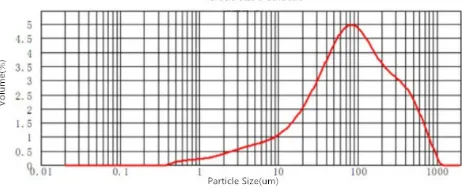
[image:2.595.185.416.244.342.2]Particles in fly ash have different structures and morphologies; the actual fly ash is a kind of hybrid particle swarm of various particles; the difference and quality of fly ash depend largely on these particles. The MALVERN HYDRO 2000MU granulometer was used to analyze the particle size of fly ash in the laboratory; the results were shown in Figure 1. From the results of the particle size analysis, particles’ thickness of fly ash is evenly distributed, which is helpful to increase the liquidity of filling slurry and suitable to prepare high concentration cemention filling slurry.
Figure 1: Grain size analysis results of fly ash
1.2 Chemical composition of fly ash
Energy spectrum semi-quantitative analysis was used to analyze the chemical composition of fly ash; the results were shown in Table 1.
Table 1: Semi-quantitative analysis results of fly ash energy spectrum
chemical composition Al2O3 SiO2 S K2O CaO TiO2 Fe2O3 Total mass percent (%) 31.89 56.89 0.66 1.39 1.84 1.95 5.38 100
From Table 1, 80% of the fly ash sample is composed of SiO2 and Al2O3; they are the main source of the activity of
fly ash. The higher the content of soluble SiO2 and Al2O3 in fly ash is, the better the fly ash’s activity is; if there is
water, they will react with CaO to form a water rigid solid. When the content of Fe2O3 is 5.38%, it is beneficial to
forming glass beads. When the content of CaO is 1.84%, it is beneficial to promoting the formation of hydration products and exciting the activity of fly ash. When the content of K2O is 1.39%, it is beneficial not only to
accelerating the hydration reaction of cement, but also to exciting the activity of fly ash and promoting the second reaction of fly ash and Ca(OH)2 which is formed by cement hydration. A kind of material of hydraulic gelatum
performance is formed; that is hydrated calcium aluminate and hydrated calcium silicate; and it will increase the strength and durability of cement paste[5] . Precisely because of it, fly ash is widely used as the filling material in coal mines.
2 Influence of fly ash on mechanical performance of high concentration cemented backfill material in coal mine
The author's team researched and analyzed the reasonable proportion of high concentration cemented backfill material through a lot of indoor experiments. The results showed that when the mass content of filling slurry is 80%, the dosage of ordinary portland cement is 10%, the dosage of fly ash is from 20% to 24% and the dosage of gangue is from 46% to 50%; the preparated filling slurry’s mobility and the filling body’s strength are much better. On this basis, the influence of different fly ash’s content on the mechanical performance of backfill material was further researched.
Table 2: The influential test of different dosage of fly ash on packing material mechanical performance
test number content of various experiment materials(unit:%)
ordinary portland cement fly ash gangue water
1 10 18 52 20
2 10 20 50 20
3 10 22 48 20
4 10 24 46 20
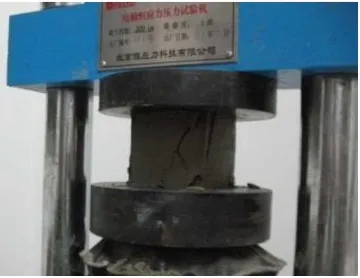
[image:3.595.218.398.227.366.2]After the filling material was prepared well, pour the slurry made by mixing into the standard metal mould test whose size is 10cm×10cm×10cm; after demoulding, maintain them in the standard curing box; use the compression-testing machine (shown in Figure 2) to determine their uniaxial compressive strengths of these test blocks whose curing ages were 1d、3d、7d、28d. There were not less than three filling blocks of every curing age; take the average of test results; the test results are shown in Figure 3.
Figure 2: Uniaxial compressive strength test equipment
Figure 3: The relationship between strength of backfill body and curing age
By analysis of the test results: when the dosage of fly ash is identical, the strength of the backfill body increases with the curing age’s increase, the late strength is significantly greater than the early strength; when the dosage of fly ash is different, the strength of the backfill body increases with the dosage’s increase, but the growth is not obvious.
3 Influence of fly ash on transmission performance of high concentration cemented backfill material in coal mine
High concentration cemented backfill material must meet the following two requirements during transportation: the filling slurry in the pumping line can flow in low pressure and the pipe blockage accident can’t occur; when the filling slurry arrives in the goaf by pipeline, its physical state changes within allowed limits and the bleeding and segregation phenomena can’t occur. The filling slurry’s transmission performance can be measured by its collapsed slump; its conveying stability can be measured by its bleeding rate[7-10]. In Xinyang Mine, the pipeline distance of the filling system is much longer and the content of the filling slurry is much higher, which causes that the resistance loss during transportation is great. Now, the pipe loop experiment is an important means of researching the resistance loss of the filling slurry during transportation. In order to research the influence of fly ash on transmission performances of high concentration cemented backfill material, the pipe loop experiment of the filling material is done.
0 1 2 3 4 5
1d 3d 7d 28d
S
tr
en
g
th
/
M
P
a
[image:3.595.165.430.399.531.2]3.1 Pipe loop experimental scheme of filling material
The pipe loop experimental device mainly includes the pulping system, the pump pressure system, the measurement system, the control system and so on. The pump pressure system’s main component is a concrete pump (its model is HBT80) and its theoretical conveying capacity is 80m3/h; the material of transmission pipelines is a general seamless steel pipe whose inner diameter is 150mm. The measurement system mainly has four pressure sensors which is used to monitor the frictional resistance loss and local resistance loss of fly slurry during transportation. Among these four sensors, the distance of two of them which are used to monitor the frictional resistance loss is 6 meters and there is a one-meter bend between the two remaining sensors which are used to monitor the local resistance loss.
Before the pipe loop experiment, the collapsed slump and bleeding rate of the filling slurry of different fly ash’s dosages are measured respectively and the results are shown in Figure 4 and Figure 5.
Fig.4 Effect of fly ash quantity on slump
Fig.5 Effect of fly ash quantity on bleeding rate
From Figure 4 and Figure 5, the collapsed slump and bleeding rate of filling slurry reduces gradually with the fly ash dosage’s increase. The reason is that the fly ash, as the cementing material, has great dependence on water; with the filling slurry’s concentration keeping unchanged, the larger the fly ash’s dosage is, the more water it adsorbs, the poorer the filling slurry’s mobility is, the less water it separates out. When the dosage of fly ash is 24%, the collapsed slump is the least, so the mobility is very poor; that isn’t beneficial to long distance transportation by pipeline, so the pipe loop experiment focuses on analysis of filling slurry’s resistance loss during transportation when the dosage of fly ash is 18%, 20% and 22%. In each group of different fly ash’s dosages, the dosage of ordinary portland cement is 10%, the dosage of admixture is about 1.5%, the concentration’s change of high concentration slurry is controlled in a small range (78%~79%).
3.2 Analysis of test results
In the pipe loop experiment of filling slurry, each experiment was done several times and took the average as the experimental result; the specific experimental results are shown in Table 3.
From Table 2: when the dosage of fly ash is unchanged, during transportation by pipeline, the frictional resistance loss and local resistance loss of filling slurry both increase with the concentration’s increase of slurry; and the concentration of filling slurry has greater influence on frictional resistance than local resistance. When the dosage of fly ash is 22% and the concentration of filling slurry reaches 78.5%, the increase amplitude of resistance loss begins to expand; so further improving the concentration of filling slurry isn’t beneficial to pipeline transportation.
210 220 230 240 250 260 270
18% 20% 22% 24%
S lu m p / m m
Dosage of fly ash
0 1 2 3 4 5 6
18% 20% 22% 24%
B le ed in g r at e / %
Table 3 Backfill slurry pipeline transportation resistance loss of different dosage of fly ash
dosage of fly ash (%) concentration of slurry (%) frictional resistance loss(kPa) local resistance loss(kPa)
18 78.5 19.17 3.76
79 23.83 4.08
20 78 14.99 2.14
78.5 20.12 3.11
22
78 19.97 2.40
78.3 23.19 2.74
78.5 26.24 3.30
78.7 33.20 4.78
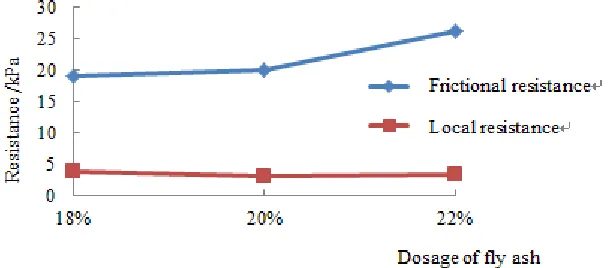
When the concentration of filling slurry is 78.5%, the influence of fly ash’s dosage on resistance loss of pipeline transportation is shown in Figure 6.
Fig.6 The influence of dosage of fly ash on backfill slurry pipeline transportation resistance
From Figure 6: during transportation, the local resistance loss of filling slurry first decreases and then increases with the dosage’s increase of fly ash; when the dosage of fly ash is from 20% to 22%, the local resistance loss changes little. The frictional resistance loss increases gradually with the dosage’s increase of fly ash; the frictional resistance loss when the dosage of fly ash is 22% is significantly greater than that when the dosage of fly ash is 20%. In high concentration cemented backfill mining of long distance, the dosage of fly ash shouldn't be greater than 20%.
High concentration cemented backfill mining of coal mines requires reasonable strength of filling material; it can not only support the stope roof and control the surface subsidence, but also be easy to pump and have good transportation performance. Combined with the above analysis results, when the dosage of fly ash in high concentration cemented filling material is 20%, good mechanical performance and transmission performance can be guaranteed.
CONCLUSION
Through mechanical property test of filling material and pipe loop experiment of filling slurry, the obtained conclusions are as follows:
(1)Under the same conditions, the strength of backfill body increases with the dosage’s increase of fly ash, but the growth is not obvious.
(2)When the dosage of fly ash in high concentration filling material is unchanged, during transportation, the resistance loss of filling slurry increases with the dosage’s increase of fly ash, the concentration of filling slurry has greater influence on frictional resistance loss than local resistance loss.
(3)During transportation of the high concentration filling slurry, the frictional resistance increases with the dosage’s increase of fly ash; the local resistance decreases first and then increases with the dosage’s increase of fly ash; the dosage of fly ash has greater influence on frictional resistance than local resistance.
(4)When the dosage of fly ash in high concentration filling material is 20%, the filling material has good mechanical performance and transmission performance.
REFERENCES
[1] QIAN Ming-gao; XU Jia-lin; MIAO Xie-xing,Journal of China University of Mining & Technology.Green technology in coal mining.,2003, 32(4), 343-347.
[3] YANG Bao-gui; WANG Jun-tao; LI Yong-liang,Coal Science and Technology.Backfill coal mining technology with high concentrated cementing material in underground mine., 2013, 41 (8), 22-26.
[4] ZHANG Lei; LV Xian-jun; JIN Zi-qiao, Mining Research and Development.Study of applications of fly ash to cemented backfilling in mine., 2011, 31(4), 22-25.
[5] ZHANG Qin-li; GUO Jiang; WANG Xin-min, New technology of cemented fly ash and crude tailingsfill.1999, 51(2), 5-7.
[6] FENG Ju-en; GUO Sheng-mao, Research on application of fly ash as filling cementing materials., 2001, (5), 10-11.
[7] ZHAOCai-zhi; ZHOUHua-qiang; BAIJian-biao, Metal mine. Experimental research on fly ash total-tailing paste filling.,2006, (12), 4-6.
[8] YANG Baogui; HAN Yuming; YANG Pengfei, Research on ratio of high concentration stowing material in coal mine., 2014, 42 (1), 30-33.
[9] LIU Youtong.Filling mining technology and its application, Metallurgical Industry Press, Beijing, 2001.