A case study of the Introduction of Computer Science in NZ schools
1TIM BELL, University of Canterbury
PETER ANDREAE, Victoria University of Wellington ANTHONY ROBINS, University of Otago
For many years computing in New Zealand schools was focused on teaching students how tousecomputers, and there was little opportunity for students to learn about programming and computer science as formal subjects. In this paper we review a series of initiatives that occurred from 2007 to 2009 that led to program-ming and computer science being made available formally as part of the National Certificate in Educational Achievement (NCEA), the main school-leaving assessment, in 2011. The changes were phased in from 2011 to 2013, and we review this process using the Darmstadt model, including describing the context of the school system, the socio-cultural factors in play before, during and after the changes, the nature of the new standards, the reactions and roles of the various stakeholders, and the teaching materials and methods that developed. The changes occurred very quickly, and we discuss the advantages and disadvantages of having such a rapid process. In all these changes, teachers have emerged as having a central role, as they have been key in instigating and implementing change.
Categories and Subject Descriptors: K.3.2 [Computer and Information Science Education]: Computer Science education
General Terms: Design
Additional Key Words and Phrases: High school, Computer science education, Darmstadt model
ACM Reference Format:
Tim Bell, Peter Andreae, and Anthony Robins, 2014. A case study of the Introduction of Computer Science in NZ schools.ACM Trans. Comput. Educ.0, 0, Article 0 ( 2013), 30 pages.
DOI:http://dx.doi.org/10.1145/0000000.0000000
1. INTRODUCTION
In 2011 New Zealand introduced Computer Science as a mainstream subject available to students in their final three years of high school [Bell et al. 2010; Bell et al. 2012]. Like several other countries, prior to this introduction the focus had been on teaching students tousecomputers rather than to be developers; at best, some schools taught a little programming.
The new Computer Science content that was introduced not only covers a much improved programming focus but also gives students the chance to explore a range of computer science topics beyond programming, including algorithms and complex-ity, human-computer interaction, encryption, artificial intelligence, formal languages,
1
This case study is partly based on prior studies: [Bell et al. 2010; Bell et al. 2012; Thompson et al. 2013; Thompson and Bell 2013]
Authors’ addresses: Tim Bell, Department of Computer Science and Software Engineering, University of Canterbury; Peter Andreae, School of Engineering and Computer Science, Victoria University of Wellington; Anthony Robins, Computer Science Department, The University of Otago.
Permission to make digital or hard copies of part or all of this work for personal or classroom use is granted without fee provided that copies are not made or distributed for profit or commercial advantage and that copies show this notice on the first page or initial screen of a display along with the full citation. Copyrights for components of this work owned by others than ACM must be honored. Abstracting with credit is per-mitted. To copy otherwise, to republish, to post on servers, to redistribute to lists, or to use any component of this work in other works requires prior specific permission and/or a fee. Permissions may be requested from Publications Dept., ACM, Inc., 2 Penn Plaza, Suite 701, New York, NY 10121-0701 USA, fax+1 (212)
869-0481, or [email protected]. c
2013 ACM 1539-9087/2013/-ART0 $15.00
computer graphics and more. These topics are not intended to be covered in a great deal of detail; the emphasis is on breadth rather than depth, with the main goal being to enable students to understand what computer science is about, and thus to help them make informed career choices with an understanding of computer science that is beyond just programming [Denning and McGettrick 2005]. The topics that appear in the standards are loosely based on the ACM/IEEE computer science curriculum [Cas-sel et al. 2008; Sahami et al. 2013], and provide students with an overview of the kinds of topics that computer scientists have expertise in.
In addition to making the subject visible in schools, the changes were delivered in a way that provided assessment that could count towards academically-oriented qual-ifications (e.g. entrance to university), as previously the qualqual-ifications available were not appropriate for the more academic students, and thus such students were often advised to avoid computing at school, which in turn provided them with the wrong im-pression of the nature of the discipline of computer science as a non-academic subject. The new content was phased in very quickly, and a significant challenge with this wide range of topics and highly compressed timescale has been to prepare teachers to deliver a range of material that few of them have encountered before. Teaching programming (which few teachers were experienced with) presents a unique set of challenges well known in the Computer Science Education literature, and many of the topics outside of programming lacked a body of coherent resources for teaching.
In this paper we will look at how these challenges were addressed and identify lessons learned from the changes, we will report on the current state of uptake of the new standards and the reactions of the various stakeholders, and we will make recommendations for others going through similar transitions. Some of the statistics reported here are from a survey of teachers at the start of 2012 [Thompson et al. 2013], which was repeated in May 2013 [Thompson and Bell 2013], asking the same questions to see how teachers’ views had changed, and to collect data on the new standards that had been made available between the two surveys. We refer to them below as the 2012 and 2013 surveys respectively; the 2012 survey reflects the situation after one year of teaching the standards, and the 2013 survey was late enough in the year to pick up information on the full three years over which the new content was released. The sur-veys were announced through a national digital technology teachers’ mailing list, and comparative statistics were made by taking only submissions from teachers in schools that made submissions to both surveys. More details about the methodology and initial results are available in the earlier report [Thompson et al. 2013].
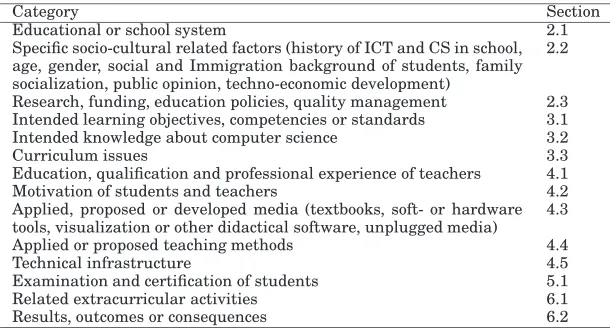
This paper addresses the main issues using headings from the “Darmstadt model” [Hubwieser et al. 2011], with specific subsections for each of the issues in the model. Table I lists the sections where each is discussed.
Section 2 introduces the context of computing in New Zealand high schools, and the process by which computer science was introduced. Section 3 gives details about the new content, and Section 4 discusses the process by which it was implemented. Section 5 reviews issues surrounding assessing the subject in the New Zealand context, and Section 6 reviews how various stakeholders responded to the new standards. We conclude with a summary of key issues and lessons learned from the process of the change in Section 7.
2. COMPUTING IN NZ SCHOOLS
disci-Table I. Index of sections relating to the Darmstadt model
Category Section
Educational or school system 2.1
Specific socio-cultural related factors (history of ICT and CS in school, age, gender, social and Immigration background of students, family socialization, public opinion, techno-economic development)
2.2
Research, funding, education policies, quality management 2.3 Intended learning objectives, competencies or standards 3.1
Intended knowledge about computer science 3.2
Curriculum issues 3.3
Education, qualification and professional experience of teachers 4.1
Motivation of students and teachers 4.2
Applied, proposed or developed media (textbooks, soft- or hardware tools, visualization or other didactical software, unplugged media)
4.3
Applied or proposed teaching methods 4.4
Technical infrastructure 4.5
Examination and certification of students 5.1
Related extracurricular activities 6.1
Results, outcomes or consequences 6.2
pline. This heavy use of computers for purposes other than teaching computer science gave decision makers false confidence that computing education was being addressed in the education system, and made it difficult for those who were concerned about teaching computer science to make a case for change. Combined with the view held among some computer scientists that teaching programming badly might do more harm than good, it was not unusual for academics to advise that computing not be taught at all [Koblitz 1996]. The vocationally-oriented courses that transpired also led to a view among academically oriented students that they should avoid computing at school, as the qualifications available were not suitable for entrance to university or getting scholarships, and by the time they were leaving school they would be doing well in other subjects and be more naturally inclined to carry on in those subjects.
In this section we first review the context of education in New Zealand, and then look at the process that led to computer science being introduced as an academically rigorous subject in schools.
2.1. Educational or school system
The population of New Zealand is around 4.4 million people, with 342 secondary schools and 155 “composite” schools (schools that are a mixture of primary and sec-ondary classes, typically small rural schools that might not offer all year levels). Be-cause New Zealand is relatively small, is independent, and has a unified education system under the control of the Ministry of Education, the country is able to introduce innovations in education relatively quickly. In the case of computer science, the time from when a panel was convened to look at concerns about the lack of computer science in schools, to the time when computer science started being taught was 2 years and 2 months. The fast time frame was partly due to the opportunity to build on a framework that had already been developed, but also was driven by a sense that the window of opportunity needed to be seized while there were government officials and contractors who understood the issues and had permission to act, teachers who were willing to help make changes, and support for change from tertiary education institutions and industry. All of this occurred in an environment where the various stakeholders were willing to work in partnership with each other.
[image:3.612.154.459.104.269.2]old). The main school leaving qualification for students is the “National Certificate of Educational Achievement” (NCEA), which is the main focus in Years 11 to 13 of high school for most students. The NCEA qualification is flexible, and can be endorsed in various ways depending on combinations of small modules (referred to as “standards”) that students pass. The standards that are used for assessing NCEA are typically equivalent to a few weeks of work in a course, with students usually taking about 5 courses at a time. The standards are usually taken in years 11 to 13 of a student’s schooling, which are categorised as levels 1 to 3 for assessment, and confusingly, the curriculum on which teaching is based is referred to as levels 6 to 8.
In New Zealand two separate agencies manage high school assessment and teaching respectively. The standards for assessment are managed by the New Zealand Qualifi-cations Authority (NZQA), which is a government agency that is responsible for qual-ity assurance of assessment for secondary and non-universqual-ity tertiary qualifications. It works closely with the Ministry of Education, which is responsible for shaping and resourcing the education system, and in this context provides resources and support for teaching the subjects.
The NCEA qualification allows schools to put together courses to suit local inter-ests and the needs of students, based on a selection of the relatively small assessment standards (note that the standards only specify the knowledge or skills that are to be assessed; this obviously influences the content to be taught, but there is a separation in principle). Students gain credits by achieving the standards, which are generally worth 3 to 6 credits each. One credit corresponds to about 10 hours total of teaching, home-work and assessment. Several standards are grouped together for a course to make up about 18 to 24 credits; 80 credits must be passed each year to be awarded NCEA (amongst other requirements), with students typically gaining about 100 credits; 120 credits corresponds to a full workload in a year. The combinations of standards are flexible, so (for example), a computing course might combine a programming standard with a web page standard to investigate web programming, but the same program-ming standard might be combined with an electronics standard in a different course to explore robotics. Full details of the requirements for NCEA are available from the NZQA website.2 There are two types of standards: unit standards, and achievement
standards. Unitstandards are competency based, having a simple pass/fail outcome, and are generally associated with a skill that a student can either demonstrate or not. Achievement standards can be passed at three levels: Achieved (A), Merit (M), and Excellence (E).Achievementstandards tend to be favoured by more academically-oriented students, and are important for gaining entrance to university and applying for scholarships. Unitstandards are primarily associated with Polytechnics and Pri-vate Training Establishments, but high schools have been able to offer many of them. The New Zealand school year starts in January/February (the end of summer), and student results are released in January of the following year, so the academic year corresponds to the calendar year. The changes discussed here were introduced in the 2011 to 2013 school years, so at the time of writing (mid 2013) all of the changes have been introduced, but student results are available for only the first two years. The two teacher surveys that we have used reflect the situation at the end of the first year of changes (start of 2012), and part way through the third year (May 2013), by which time all the standards were available.
2.2. Specific socio-cultural related factors
In this section we explore the origins of the new computer science standards, and how public perception lagged behind the changes. Socio-cultural factors are affected by
mis-2
understandings about what computer science is (both in the school system and with the general public), nervousness among teachers at having to teach new topics that are outside of their experience and have not been taught before, and the range of confusing terminology surrounding the discipline — even the word “technology” is understood in some contexts to mean only digital devices, whereas the New Zealand curriculum adopts a broad definition of “intervention by design to expand human possibilities.” Combined with the strong views that many people hold about education, and the im-portance of getting curriculum design right, these factors inevitably create tensions, and a key element of the successful deployment of a new curriculum in New Zealand is that the many parties involved have taken the time to listen to each other and find commonalities that have made progress possible.
2.2.1. History of ICT and CS in schools.From 1974 to 1985, programming was able to be taught in NZ high schools through the maths curriculum. However, it did not emerge as a discipline connected to computer science, and despite concerns being raised [Sallis et al. 1990; Brown 1998; Savidan 2003], the subject in schools became dominated by using computers as a tool. One local approach to foster interest in schools, started in 1995, was the University of Waikato scholarship for final year school students, who could take written and practical exams to win a scholarship that included access to advanced courses at the university. This has continued to the present, but is mainly of interest to students in the Waikato region.
In 1995 a new school curriculum was introduced that included “technology” as a learning area, and ICT was defined within that area with a broad and literal view of it being about “information” and “communication,” but there were concerns that schools were not engaging with the topic [Savidan 2003]. Some progress had been made towards a broader and deeper approach to computing in the curriculum, such as the “Fluency in IT” (FITNZ) project [Clear and Bidois 2005], but mapping such proposals onto a new national technology curriculum that was being released in 2007 was proving to be problematic.
Around this time the only national assessment available in computing was through
unitstandards, and these tended to be focused on applied computing rather than the discipline of computing and developing new systems — the titles of unit standards include “Produce simple desktop published documents using templates,” “Produce a spreadsheet from instructions using supplied data” and “Find information using the Internet.” Some programming unit standards were available e.g. “Create and use sim-ple command sequences in a computer language” (a level 1 standard), and “Create a computer program to provide a solution” (level 3). However, these standards did not expose students to the richness of the discipline of computer science, and had a fairly dated view of what a program might be.
Another problem with theunitstandards was that they were a simple pass/fail as-sessment and are generally associated with skills-based courses. For academically ori-ented students this was unattractive because it did not afford the opportunity to build up a portfolio of grades that could be used to distinguish their achievements when applying for university and/or scholarships. Academically inclined students favoured
achievementstandards, available for subjects such as maths and physics, where stu-dents could get a grade of Achieved, Merit or Excellence, and could demonstrate their ability as a high achiever.
Two major changes were initiated in 2007. The first was a new curriculum for New Zealand schools3, which provided general guidelines in eight learning areas, one of
which was technology. Technology had been introduced to the curriculum in 1995, but had significant revision for the new curriculum released in 2007. The learning area of technology provided generic assessment tools for teaching subjects ranging from food technology to digital technology, which meant that computing was not a subject area of its own, and the same kind of assessment criteria had to be used for a large range of technologies (such as meal planning and software development).
The second change in 2007 was that the FITNZ project [Clear and Bidois 2005] project led to a new “Digital Technologies Guidelines” project4which piloted new
mate-rial for teaching computing-related topics in schools. The DTG project proposed seven “strands” for computing in schools: Electronics & controls, Programming & software, Digital information, Digital media, Digital infrastructure, Digital society, and Digital concepts & tools. From 2007 to 2010 the DTG guidelines were piloted in three phases, with 14, then 60 and finally 120 schools.
However, in 2008 after the first phase of the DTG, and as the generic technology cur-riculum was being considered, concerns were raised by teachers, industry and tertiary institutions.
Industry and tertiary concerns were raised through a report released in April 2008 from the New Zealand Computer Society [Grimsey and Phillipps 2008] (the NZCS is the main national organisation for computing professionals; it has since changed its name to the Institute of IT Professionals NZ, or IITP). The report addressed two main questions: how appropriate the assessments in the technology curriculum were for preparation for a degree in computer science, and how appropriate they were for students who were going to be computer users. The main concerns in the report were around the use of generic “technology” standards that were designed to cover a range of technologies, with broad titles such as “Develop a technological solution to address a given brief” and “Present an outcome developed through technological practice,” and the use of language that refers to physical materials that does not obviously relate to computing, such as “batch production” of the final product. There was also concern about the cognitive level required by the standards, and the assumption that “the food technologist, the wood worker, computer scientist and IT technician use the same cognitive skills in each of their disciplines.” The computing requirements could be in-terpreted as a major software engineering project, which is quite a different enterprise to, say, designing and building a wind turbine for charging batteries on a boat. The report concluded that computer science should not be taught as a part of the technol-ogy curriculum, and pressed for computer science to have its own specific standards that relate to topics beyond programming, giving many examples from international sources (such as the CSTA and ACM curricula) including algorithms, AI, the limits of computation, and user interface design. It also recommended that the subject be made available in a way that would “appeal to brighter students.”
Concerns were also raised through a national teachers’ association; in a newsletter on 15 May 2008 the Post-Primary Teachers’ Association (PPTA) announced in a bul-letin “members on the group have become concerned about the workload expectations around the DTG, the tight and unsympathetic timelines and the lack of relevance of the resources they are being required to develop,” and advised members to not partici-pate “pending assurances about the development of a better process.” However, by the end of June it was reported that “teachers have now withdrawn their protest after the ministry agreed to tackle some of their concerns.”
3http://nzcurriculum.tki.org.nz/Curriculum-documents/The-New-Zealand-Curriculum 4
In August 2008 a second report appeared that had been commissioned by the Min-istry of Education and written by three teachers [Carrell et al. 2008]. It considered the state of computing education, particularly in the context of the recent changes and the “disparity between graduate numbers from tertiary education and the employment needs of industry,” a phenomenon that was also a concern in the US and UK with plum-meting enrolments in computer science at a time when demand for graduates was growing. The report observed that “there is a lack of teacher confidence because the subject Computing is perceived to be second rate, is uncoordinated, under resourced, unsupported, lacking in a professional body, and in dire straits.” It recommended that a solution could be built on the existing work done on the DTG, and in the curriculum computer science should have its own standards, either in a separate learning area, or as a separate set within the technology curriculum. The issue of teacher profes-sional development was also raised: “investment in teachers in our subject area is long overdue,” and there was a call for a national subject association to support teachers.
These concerns resulted in the Ministry of Education calling together a “Digital Technologies Experts Panel” (DTEP) representing industry, tertiary and High Schools, to develop a plan to address the issues raised in these two reports. The panel first met in November 2008, and by mid 2009 it had produced a body of knowledge and rec-ommendations for a way forward5. The panel’s report included a joint announcement
between the panel and Ministry of Education, indicating that the recommendations were broadly accepted and would be actioned urgently (to be used in schools in 2011).
The DTEP report distinguished between “ICT as a discipline” and “ICT as a tool,” noting that the discipline was needed for the country to be an innovator. It recom-mended that a new area called “Digital Technologies” should be developed, which ide-ally would be a learning area of its own, but because of the time this would take, should initially sit within the Technology curriculum, but with its own achievement standards.
The general structure of the DTG areas was kept, but the Programming & software area was renamed “Programming and Computer Science” to make computer science visible as a discipline, and to indicate that it is more than programming. Retaining the term “computer science” in the title required some vigilance, as decision makers editing the standards might not see any difference between “programming” and “com-puter science,” and thus remove the latter in the interest of conciseness; or educators involved in the process might be comfortable with programming but concerned about introducing unknown topics that seem overly academic, and prefer to make it less visi-ble. For similar reasons, when a four-letter abbreviation was required a case was made to call it “PRCS” rather than the initial “PROG” that was chosen. It was helpful to have simple examples on hand to demonstrate what is meant by computer science, and in-dustry advocates who had achieved well because of their computer science background were also helpful.
Building on the DTG, rather than starting from scratch, meant that the new ma-terial could be delivered taking advantage of the existing momentum achieved by the DTG. The DTEP report also called for assessment standards that were academically challenging and would help students to meet entrance standards for tertiary study, and urgent professional development for teachers.
At the same time, the Ministry of Education was in the middle of an extensive review of all curriculum areas which involved revising or rewriting all the Achieve-ment Standards used in secondary schools, with significant changes in the Technology area. Most importantly, they were introducing a range of new knowledge and skills
standards to complement the generic standards. In response to the recommendations from the DTEP and other reports, it introduced a new subject of Digital Technologies into the Technology curriculum area and formed groups to write new resources and new Achievement Standards for Digital technologies, alongside the revision of exist-ing standards in other parts of technology.
A key result of all this work was a matrix of assessment standards6 that includes
a set of generic technology standards, but has specific standards in four areas of tech-nology: Construction and Mechanical Technologies (focuses on making and knowing how to make products and devices), Design and Visual Communication (focuses on where visual literacy and creative thinking is developed, using visual communication techniques), Digital Technologies (focuses on applying and knowing about computer science, electronic and digital applications), and Processing Technologies (focuses on formulating and knowing how to formulate processed products).
The Digital Technologies standards allow schools to offer a range of different com-puting related courses, but most importantly allow academically strong courses that address programming and computer science in a way that will lead into academic study in computer science and software engineering at the tertiary level. Furthermore, some of the generic technology standards can be used within a digital technologies context and be combined with the Digital Technologies standards to put together a course that teaches subject knowledge, and then applies or reflects on it in a practical environ-ment. An example of a generic standard that could be used this way is “Demonstrate understanding of the ways a technological outcome, people, and social and physical environments interact,” in which students might look at issues such as privacy and equity in a digital environment.
2.2.2. Public opinion.A significant challenge for schools has been to shake off the per-ception of computing, arising from the previous curriculum, as a non-academic subject that is not appropriate for students heading for tertiary qualifications, and containing little that most students do not know already. Some of the new courses are now too challenging for those who would have been encouraged to take computing previously, and it has been important to keep options in place for those who do need to learn how tousecomputers rather than develop new systems. At the same time, it has been hard to change the perception of the courses fast enough to attract a new group of students, including those who are heading for university qualifications. For example, for schools that were reported in both the 2012 and 2013 surveys, 45% reported that a significant number of students took the course who lacked the academic ability to do it well in the first survey, and in 2013 the figure was 46% for the same schools (although we note that the number who felt they attracted a significant number of highly capable stu-dents rose from 41% to 50%.) It is a challenge to communicate the changes clearly to students and their parents because they are getting information from a wide variety of sources, such as career counsellors, deans, principals, parents and the press, and not all of those sources will necessarily understand the changes.
A strong media campaign is required to address this; in New Zealand there were a number of press releases and public articles announcing the changes and explaining their value to students, industry and the country, but there were still two parallel public perceptions. For example, in March 2012, over a year after the new standards had been deployed, a teacher was quoted in the media saying “the current ministry-provided ICT curriculum for senior students (Years 11, 12, and 13) focuses on outdated and ‘static’ IT skills, instead of general ‘IT thinking’ like programming theory, strategy, and logic; which would prepare students for higher education in ICT and careers in
6
the sector,”7 and in April 2013 a student wrote an opinion piece that appeared in a
major newspaper saying that “Information and communications technology (ICT) has been trampled by English, maths and the sciences as a subject that yields no value in progressing to the next stage of education.”8
Having champions in the media (such as high-achieving industry people) is a valu-able way to address misunderstandings about the courses, but another issue is that their terminology may not match the courses that are being offered. The key phrase that was needed to promote the changes in schools was “Computer Science and Pro-gramming,” since that is the name of the standards that were put in place, but often media articles would mention terms like ICT, Information Science, computing, cod-ing and software engineercod-ing, all of which are legitimate terms, but do not link di-rectly to the offerings in schools. One initiative to address this was a brochure and web site made available to schools to help them promote the connection between the new courses and the employment opportunities for students.9Also, the Ministry of
Educa-tion is launching a “VocaEduca-tional Pathways” project to help students become more aware of the options available to them.10
2.3. Research, funding, education policies, quality management
From the early 1990s the CS Unplugged project (at the University of Canterbury in Christchurch, University of Waikato in Hamilton and Victoria University in Welling-ton) had developed experience in communicating computer science without using computers, and in environments where little time was available to learn program-ming [Bell et al. 1995; Bell et al. 2012b]. While this did not drive the changes, it had provided a base of expertise working with schools that provided confidence that ad-vanced topics from computer science could be communicated to school students with-out first requiring them to have significant programming skills, and was influential in making it possible to have computer science as a separate standard that was not dependent on programming standards. Also, because it had been used with primary school children who were able to work with concepts from computer science, it gave some confidence that high school students would be able to do so as well.
Research on teaching introductory programming had been carried out at the univer-sity of Otago since the early 2000s, which provided considerable background to inform the design of school programming standards [Robins et al. 2003; Rountree et al. 2004; Garner et al. 2005; Robins 2010].
Similarly from the mid 2000s various initiatives to promote robotics in schools had been independently established, the main one being RoboCup Junior11, which runs
annual regional and national competitions for schools involving hundreds of pupils. Robotics promotes programming and a range of other engineering and technology skills, and this practical experience with schools (at both primary and secondary lev-els) informed the design of the new programming standards.
Research underpinning the changes in the technology learning area of the school curriculum, focusing on the broad area of technology more than computing in partic-ular, includes a review of teachers adapting to the 1995 introduction of technology in the curriculum [Compton and Jones 1998] and reviews and case studies and the de-velopment of a framework for technology assessment [Compton and Harwood 2003; Compton and France 2007]. The research previously mentioned that focuses more on
7
http://computerworld.co.nz/news.nsf/news/govt-failing-ict-teachers-says-tech-educator 8http://www.stuff.co.nz/technology/digital-living/8577142/Education-not-in-sync-with-IT-goal 9
Published on http://csanz.ac.nz
10http://youthguarantee.net.nz/vocational-pathways/ 11
computing and computer science in the curriculum [Clear and Bidois 2005; Grimsey and Phillipps 2008; Carrell et al. 2008] provided the data to drive political change.
The computer science standards have been tracked through two major research projects: a detailed analysis of student work [Bell et al. 2012a] and a survey of teach-ers to identify good practices and issues during the transition [Thompson et al. 2013]. Outcomes from this research are discussed below, including results from an updated survey of the teachers.
Student work is assessed by the NZQA government agency, which tracks student performance and makes general statistics publicly available online.12 Some of these
statistics are reported later in this document.
Funding, of course, bears on the deployment of the new standards in several ways. The development of the new standards required a budgetary commitment from the Ministry of Education, which included costs for bringing together experts to develop the standards, exemplars and guides. There has been little central government fund-ing for schools for professional development (PD) of teachers specifically relatfund-ing to the transition. All schools are expected to set aside some of their budget for PD, and it is up to each individual school how to deploy it, with predictably variable results, particularly given that administrators might not understand how much help teachers might need to teach the new standards. (There is also a limited contestable pool for whole school programmes, but this cannot be applied to PD within a specific subject area.) There has, however, been indirect support from the Ministry of Education in various ways as described in Section 4.1. Some sponsorship for PD has been forthcom-ing from industry, particularly from Google Inc. for fundforthcom-ing the CS4HS PD workshops, also described in Section 4.1, and development of the “CS Field Guide” (Section 4.3).
3. DETAILS OF THE NEW STANDARDS
In this section we describe the eight new achievement standards that comprise the “Programming and computer science” strand of Digital Technologies, and discuss some of the issues that arose around details of the standards.
3.1. Intended learning objectives, competencies or standards
The official source for the new standards is the New Zealand Qualifications Authority (NZQA), and all Digital Technologies standards can be accessed via http://www.nzqa. govt.nz/ncea/assessment/search.do?query=Digital+Technologies.
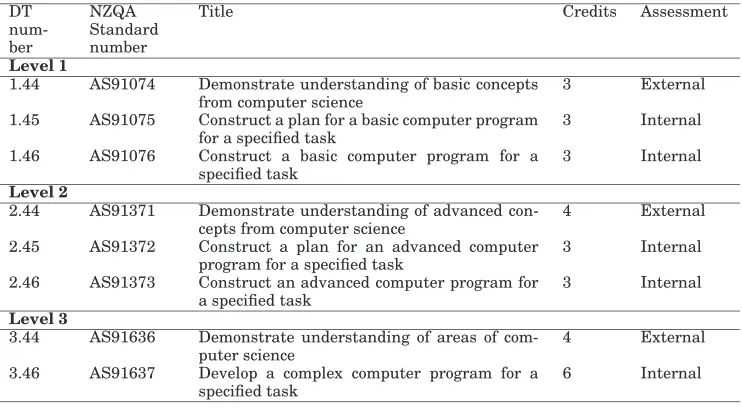
Table II summarises the “Programming and computer science” standards. There is a stream of the standards that focus on programming (1.45, 1.46, 2.45, 2.46 and 3.46), and another stream that are focused on topics from computer science (1.44, 2.44 and 3.44). In principle the computer science standards can be taught without the program-ming standards, but most classes combine them, or teach only programprogram-ming. For ex-ample, in the 2013 survey, only 17.7% of teachers reported teaching the 3.44 standard without the 3.46 standard, and at level 1 the corresponding proportion was only 9.1%. In contrast, 80.0% of the teachers using 3.46 (programming) are also using 3.44.
Theprogrammingstandards are all “internal,” which means that they are assessed by the teacher, with external auditing (moderation) to ensure consistency. The com-puter sciencestandards are all “external,” which means that the they are assessed by an anonymous appointed marker (or group of markers), organised by NZQA. There are requirements for a minimum number of external credits on a student’s record to meet various criteria and endorsements; it is therefore important that the computer science standards are external, since this encourages teachers to include them in their courses
Table II. Achievement standards in the “Programming and computer science” strand of Digital Technologies
DT num-ber
NZQA Standard number
Title Credits Assessment
Level 1
1.44 AS91074 Demonstrate understanding of basic concepts from computer science
3 External
1.45 AS91075 Construct a plan for a basic computer program for a specified task
3 Internal
1.46 AS91076 Construct a basic computer program for a specified task
3 Internal
Level 2
2.44 AS91371 Demonstrate understanding of advanced con-cepts from computer science
4 External
2.45 AS91372 Construct a plan for an advanced computer program for a specified task
3 Internal
2.46 AS91373 Construct an advanced computer program for a specified task
3 Internal
Level 3
3.44 AS91636 Demonstrate understanding of areas of com-puter science
4 External
3.46 AS91637 Develop a complex computer program for a specified task
6 Internal
(although the external credits might be obtained in standards other than these ones, since there are few rules about how standards can be combined to create a course). The external assessments are done by students submitting reports that should reflect their experience with the topic, rather than an exam. This is discussed further in Sec-tion 5.1.
Each credit represents a nominal 10 hours of student work (both in and out of class time), each standard is usually 3 or 4 credits, and about 18 to 24 credits are required to make up a course, so even if a class does all the programming and computer science standards for a level it will typically only be about half a course. The difference can be made up with either generic technology standards (looking at broader issues in computing, or technology in general), or with other digital technology standards, such as electronics, media (including web design) and information. The small number of credits means that it is a lot easier to slip a computer science standard into a course even if they are not the main focus (for example, a course on web design could use them to create a coherent course that includes programming and interface evaluation), and this has the benefit of exposing more students to the topic, even if they would not have chosen it themselves (although we note that in the surveys many teachers commented that the number of credits is too low for the amount of work required).
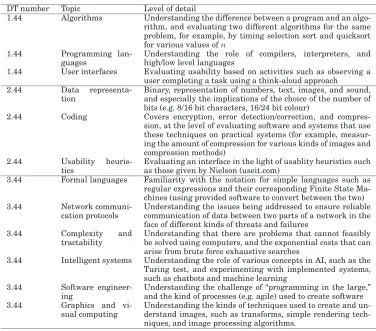
Each of the computer science standards covers topics in computer science, generally corresponding to areas of the ACM/IEEE curriculum [Sahami et al. 2013]. Table III identifies the main topics for each standard. For 1.44 and 2.44, all topics must be addressed by a student to achieve the standard. For 3.44, students need only look at two of the topics in detail; since the goal of the standards is to give students an understanding of what computer science is, the process of choosing the two topics will usually be an opportunity to review the breadth of the field, without creating too much “busy” work for students to look at each of the topics in detail.
perfor-Table III. Topics in the computer science standards
DT number Topic Level of detail
1.44 Algorithms Understanding the difference between a program and an algo-rithm, and evaluating two different algorithms for the same problem, for example, by timing selection sort and quicksort for various values ofn
1.44 Programming
lan-guages
Understanding the role of compilers, interpreters, and high/low level languages
1.44 User interfaces Evaluating usability based on activities such as observing a user completing a task using a think-aloud approach
2.44 Data
representa-tion
Binary, representation of numbers, text, images, and sound, and especially the implications of the choice of the number of bits (e.g. 8/16 bit characters, 16/24 bit colour)
2.44 Coding Covers encryption, error detection/correction, and
compres-sion, at the level of evaluating software and systems that use these techniques on practical systems (for example, measur-ing the amount of compression for various kinds of images and compression methods)
2.44 Usability
heuris-tics
Evaluating an interface in the light of usablity heuristics such as those given by Nielson (useit.com)
3.44 Formal languages Familiarity with the notation for simple languages such as regular expressions and their corresponding Finite State Ma-chines (using provided software to convert between the two)
3.44 Network
communi-cation protocols
Understanding the issues being addressed to ensure reliable communication of data between two parts of a network in the face of different kinds of threats and failures
3.44 Complexity and
tractability
Understanding that there are problems that cannot feasibly be solved using computers, and the exponential costs that can arise from brute force exhaustive searches
3.44 Intelligent systems Understanding the role of various concepts in AI, such as the Turing test, and experimenting with implemented systems, such as chatbots and machine learning
3.44 Software
engineer-ing
Understanding the challenge of “programming in the large,” and the kind of processes (e.g. agile) used to create software
3.44 Graphics and
vi-sual computing
Understanding the kinds of techniques used to create and un-derstand images, such as transforms, simple rendering tech-niques, and image processing algorithms.
mance and scalability. However, they are not required to implement the algorithms, although more capable students could be encouraged to do so. It would be reasonable for students to understand how selection sort works through animations or physical demonstrations, and they might even be able to understand the principle of quick-sort, but the key concept being taught is that the wrong algorithm can be significantly slower than a carefully chosen one. Likewise, for usability the main goal is for students to become sensitive to how even the most polished interface can have usability issues, and that this is an important area to master when designing interfaces, but they are not required to design and implement an interface.
The list of topics at level 3 can look daunting to teachers without a background in computer science, but there are ways to approach each topic without requiring a strong background, and yet still understanding the key issues surrounding the topic.
[image:12.612.120.496.101.432.2]and objects with encapsulation, but not inheritance) and a simple GUI implementation with event handling.
For level 1 and 2, the tasks are split into two parts: designing a program for a task, and implementing a design as a program. The “design” standards (1.45 and 2.45) in-volve producing an “algorithmic structure” which can be written in informal English, pseudocode, or a graphical format. The “implementation” standards involve construct-ing a workconstruct-ing program in a programmconstruct-ing language and testconstruct-ing and debuggconstruct-ing it. The two would normally be taught together, but having separate standards makes it possi-ble for a student show their relative strengths in the two areas (for example, a student might not be able to come up with a good design, but could show that they can imple-ment a program given a design, and thus get credit for the 1.46 standard only even though they attempted both). This split is somewhat controversial, and the reasons for it and the problems with it will be discussed in a later section.
At levels 1 and 2, drag-and-drop languages are allowed (Scratch is popular at level 1, with many schools moving to text-based languages at level 2). At level 3, students must use a text-based programming language (Python is the most popular language at levels 2 and 3).
3.2. Intended knowledge about computer science
Part of the purpose of the new topics being introduced to schools is to provide students with some grounding in CS concepts, but the primary goal is giving them exposure to the topic, providing the opportunity for them to find out if it is something they might be passionate about. Significant factors in the declining interest in CS amongst school students in western countries include the widespread misunderstanding of the subject and the career [Woratschek and Lenox 2009; Tucker 2010], and the confusion of the discipline of computing with learning how to use the computer as a tool. Providing a lightweight overview of the topic is intended to counter this by giving students the opportunity to explore a broad range of areas of computer science without taking the risk of committing too much time to engage with the subject. The relatively small number of credits also helps because the material can be integrated in existing courses rather than having to be a course in itself.
Another important reason to keep the amount of content fairly light is that uni-versities currently accept students with little or no computing background, so if some students who happened to do CS at high school had done up to three substantial years on the topic, this could create a diversity of incoming students that would be difficult to cater for. If the first year university course starts with introductory programming then the specialist students would be bored, and if it assumes three years of CS background, it would be beyond what less-prepared students could cope with. The net effect could be to significantly reduce the number of students taking CS at university level!
Importantly, starting small enabled the topics to be deployed quickly, reducing the time needed for teacher training, developing supporting resources, and administrating the new programme. In the long-term when CS has become well established at high school this may become less of an issue, and computer science in schools could grow more into a more substantial programme, to be comparable with subjects like physics, where a substantial high school background is usually assumed for students who wish to study it at university.
3.3. Curriculum issues
Here we explore three curriculum issues that come up as a result of the changes.
3.3.1. Workload and preparation.The number of credits that each standard is worth has been the topic of considerable debate. NZQA has guidelines that restrict the number of credits, and the benefit of a lower number of credits is that the standard can be more easily combined with others to expose more students to the topic. However, teachers have repeatedly reported that the amount of work done by students to meet the new standards is out of proportion with other learning areas. This may be partly due to the subject being new, and the effort required by all involved in this unfamiliar area is higher, and it will also be affected by the fact that students are meeting the topic for the first time quite late in their schooling (whereas other subjects such as maths will have been gradually scaffolded from very early on).
Some have taken an optimistic view, that the subject will be seen as challenging but worthwhile; in the 2013 survey comments one teacher observed: “. . . most (by far) students do cope, and even if they really want [Merit or Excellence] but don’t actually think at that level (like I said, it is hard), they accept that just having the Standard means an awful lot.”
The focus of the changes has been on NCEA, as this is where standards are set. However, since this only touches the last three years of school, the next challenge will be to introduce some of the concepts earlier, which can significantly reduce the pressure on students once they reach NCEA, and also provides more awareness of the subject earlier on. In the 2013 survey one teacher commented: “This year my year 9 students did the the same HTML learning as my year 11 students using the CodeAvengers website and they produced equal results in less time.” Younger students can be more open to learning the new ideas, partly because of their developmental stage, and partly because they are not under pressure to learn for assessment.
Teachers are permitted to teach this material earlier, and it can fit into existing broad curricula guidelines, but in the absence of formal guidance it is up to each indi-vidual to work out how to achieve it. Once the advanced curriculum has settled it is likely that more work will be done to explore more structured approaches to introduce programming and computer science earlier in the curriculum.
3.3.2. Choice of programming language.The choice of programming language has been left to teachers, and this has been useful since they can choose languages that will work in their context. This choice of languages was reported in both the 2012 and 2013 teacher surveys. For level 1 programming (Year 11) the most popular language has been Scratch, and this increased from being used by 47% of teachers in 2012 to 62.4% in 2013. Python was the second most popular language, increasing from 4.1% in 2012 to 25% in 2013; this is most likely due to it being popular beyond level 1, and only few teachers choosing to use it at the introductory level rather than starting with Scratch and then switching. JavaScript was not used by any respondents in 2012, but 16.3% were using it in 2013, almost certainly due the recent availability of the online “CodeAvengers” lessons that were written specifically for the standards (see Section 4.3).
There are some questions around the transition from a drag-and-drop language (such as Scratch or AppInventor) to a text-based language, as this is not a trivial step. A text based language is not required until level 3, but if a drag-and-drop language is used at level 2 then students have a lot of catching up to do in their final year. In par-ticular, AppInventor may be more motivating for level 2 students, but if they intend to advance to level 3, they would be advised to learn a text-based language instead. This reflects concern elsewhere that languages like Scratch may get students into bad habits [Meerbaum-Salant et al. 2011], although if a drag-and-drop language was not permitted for level 1 then the uptake would likely have been significantly less.
3.3.3. Split programming standards.The separation of the programming standards into two parts (design and implementation) has caused much discussion. The design com-ponent (e.g. 1.45) involves specifying variables and their types, the program structure, and how the program should be tested. The implementation component (e.g. 1.46) in-volves implementing the program in a suitable language, documenting the program (which might be comments in the code), and debugging it.
The two are clearly interdependent, and the intention is that students would do both together, and ideally intertwined (i.e. design and implement more than one program). The benefit of the separation is that a student can get credit for one even if they do not achieve sufficiently well with the other, but the level 3 standard combines both aspects, since by that level one would expect that students could do both tasks. At level 1, weaker students in the class might focus only on the implementation, and be provided with substantial design guidance.
Another reason for a split is purely political: as a general policy, the ministry officials’ strong guidance was that each standard should be 3 or 4 credits, corresponding to 30 or 40 hours of learning and assessment time. Given that a first course in programming is typically several times larger than this, to get a reasonable number of hours on the topic it would need to be spread across more than one standard.
The split also makes it easier for teachers who are teaching a broad course across several strands of digital technologies to include at least some component of program-ming and computer science. For example, it is more likely that a small programprogram-ming standard could be included in an embedded electronics course or a digital media course. For such teachers, especially those without a background in programming or computer science, a single large standard might have been perceived as too much of a commit-ment.
A pedagogical reason for the particular split into “design” and “implementation” was to emphasise the importance of design by having half the credits associated with the design process. This was intended to counter the tendency of new programmers to jump into coding without thinking carefully, and to spend all their time attempting to modify their program until it works. A related pedagogical argument for this split is that many students find the design aspect particularly difficult when they start pro-gramming and need large amounts of help. Since students either get all the credits for a standard or none, splitting the standards in this way means that a student who failed the algorithm design component could be provided with a design outline which would still allow them to attempt the implementation standard to get part of the credits, and gain some appreciation for what programming is about.
At level 2 the difference is not so great, with only 6% of teachers offering only 2.46 without 2.45, and 1,171 students attempting 2.45 and 1,482 (27% more) attempting 2.46. At level 3 students are required to take both combined.
A counterargument to the split approach is that at this level students should be able to design and implement simple programs, so that making it possible to do just the im-plementation standard will lead to students who have experienced a very limited and inadequate version of “programming.” It is intended that the material in the matching standards be covered together, but as long as it is split into separate standards this can never be guaranteed. A problem in practice is that, as noted above, standards can be passed at different levels. The requirements specified for both plan (e.g. 1.45) and program (e.g. 1.46) are different at each level, and reasonably specific. Hence there is a problem with those students who are attempting the implementation standard (e.g. 1.46) in isolation (or after having failed the planning standard). Although the official advice is that students should be given Excellence level plans, there is some confu-sion about this, since, for example, a student who is combining the two standards and working at a Merit level would have a worse plan (their own Merit level plan) than one who had failed the 1.45 standard, or else would have to abandon their own plan and use a given one. Clearly the quality of the plan supplied will significantly influence the quality of the program produced, and thus contribute to determining student achieve-ment. In their current form the standards do not address this difficult question, and as a result there is uncertainty in schools about how to deal with this, which can lead to inconsistent grading between schools. From a pedagogical perspective this seems quite unsatisfactory.
4. IMPLEMENTATION
In July 2009 the DTEP panel recommended an urgent deployment of new achieve-ment standards, and by January 2011 students were attending classes that used the new standards. This rapid deployment left very little time for teachers to prepare, and although ideally a designated programme for new teachers would have been put in place [Ragonis et al. 2010], there was neither the time nor resources to recruit new teachers, so the pressure was on for existing teachers to upskill. To add to the chal-lenge, during that period the city of Christchurch experienced a series of major earth-quakes that closed schools and universities for several weeks, and brought about major disruption that continues to the present (it has been claimed to be the fourth largest insurance event in world history, and the most damaging earthquake was on 22 Feb 2011, the month that schools had just started classes using the new standards).
In this section we review issues relating to the implementation.
4.1. Education, qualification and professional experience of teachers
The 2012 survey [Thompson et al. 2013] found that 60% of the digital technology teach-ers were aged 50 or older. This means that it is an experienced group (68% had 10 years or more classroom experience), which they were able to use to make decisions about deploying the new standards. However, few had significant computing qualifications, with 47% reporting only rudimentary programming skills and 12% unable to program, and only 56% reported having any specific qualification in the computing field. 22% had some sort of computing degree, which provided a core of teachers who could assist with peer support.
Considerable effort was put into helping teachers develop confidence and competence with the new standards. Below is a list of the main efforts, in decreasing order of use by teachers as reported in the 2013 survey [Thompson and Bell 2013]:
Teachers’ association. A national teachers association, the “New Zealand Associa-tion for Computing, Digital and InformaAssocia-tion Technology Teachers” (NZACDITT), was formed in March 2009, and from the start played a key role in teacher prepa-ration and advocacy. Teachers were able to share ideas, resources and concerns through a discussion group and a website, as well as local and national meetings.
National CS4HS (computer science for high school) workshops. The CS4HS events are annual two- and three-day workshops sponsored by Google Inc., held at a uni-versity and run by uniuni-versity staff and experienced teachers. These have been run internationally to engage teachers in computer science and computational think-ing in general [Blum and Cortina 2007; Bort and Brylow 2013], but the NZ events started in December 2011, and were very specifically focused on the new standards.
Local teacher organisation meetings. Clusters of teachers (sometimes already started as part of the DTG, or even existing prior to that) organised regular meet-ings to share ideas.
Peer support. Many teachers valued individual peer support from a colleague (pos-sibly in the same school or nearby).
Formal course. Some teachers had undertaken personal study in a formal course. A long term course is particularly valuable for learning programming, as this is not easily learned in a short block course (in fact, Peter Norvig has argued that it takes some years13).
Official events. Several events were organised by the Ministry of Education, such as professional development meetings.
University contacts. A network of university contacts was set up, where one aca-demic at each of the country’s eight universities was nominated as a local contact who could provide advice to local teachers, including finding senior students who could speak to classes.
Personal study. Some teachers undertook personal study using informal resources, such as online training.
Industry visits to schools. Industry programs were set up for school visits, where schools can arrange for professionals to talk to a class. Two programmes are avail-able in New Zealand: FutureInTech14 initiated by IPENZ (Institution of
Profes-sional Engineers New Zealand), and ICT-Connect15, run by the IITP (formerly
called NZCS, the organisation that sponsored the report that called for curriculum changes [Grimsey and Phillipps 2008]).
Online resource guide. A guide was developed early in the transition process, funded jointly by the Ministry of Education and all computer science departments in New Zealand universities [Murugesh et al. 2010]. The guide was published on the NZACDITT website.16
Online “CS Field guide”. An online site that is intended to have a similar role to a student textbook was developed, called the “Computer Science Field Guide”. It is an open-source interactive site that is being developed to provide information at the level required for the new computer science standards, including notes for teachers. Initially just over a third of the new topics were supported by the site, with more
13
http://norvig.com/21-days.html 14http://www.futureintech.org.nz/ 15
http://www.ictconnect.org.nz/
being added so that eventually it will cover all the material in the computer science standards.17
Helpline. A confidential “helpline” was piloted through the universities, where teachers could ask questions that they might not be comfortable asking in public because of their lack of confidence. It has had a little use, but most teachers seem to be comfortable with asking questions in the NZACDITT forum (which has fostered a supportive environment), or by approaching experts directly (such as the university contacts).
University study. A post-graduate education course that is available for teachers to learn by distance, and obtain a formal qualification in teaching computer science.
University students in class. Some teachers have obtained professional develop-ment funding from their school which they have used to hire a senior computer science student to teach beside them in the class. The teacher provides the class-room management skills, and they learn from the student in an authentic context.
From the 2013 survey it was clear that resourcing for professional development (PD) is a major issue, with only 42% reported receiving “good” financial support to under-take PD, 50% reported receiving “partial” support, and 7% were expected to fund their own PD. In the free-form comments, one of the most often mentioned issues was a lack of time or opportunities for professional development, with some teachers feel-ing overwhelmed or exhausted by the changes. Others have reported enjoyfeel-ing the new opportunities and stimulation of more interesting topics to teach.
Free-form comments in the survey indicated a high value was placed on ready-to-use content. Although many disparate resources have been identified, teachers bene-fit greatly from material designed specifically for the local standards. Some local re-sources for this were mentioned favourably, including the CodeAvengers online pro-gramming lessons18, Python and Java workbooks written specifically for the new
stan-dards19, and the online “Computer science field guide”20.
4.2. Motivation of students and teachers
4.2.1. Student motivation.The main evidence of student interest is the number who have participated in the assessments. Table IV shows the number of students who attempted each of the new standards in 2012 (the level 3 standards were not available until 2013), with the largest uptake being level 1 programming, where 3,865 students attempted the 1.46 standard. There were about 61,000 students in New Zealand in year 11 in 2012, which means about 6% of those students have attempted a standard in programming. Given that there are 497 schools in New Zealand that might have year 11 students (in 2012), and that the membership of NZACDITT is about 216 people (in July 2013), and that the membership includes teachers who are not teaching the new standards, many students will not have had the opportunity to attempt the standard at their school, and so this number is as much an indication of availability as student interest.
The pass rates for the new standard (around 70%) are typical for NCEA, although we note that the number of Excellence grades is higher for the programming standards than for computer science. This may be partly due to the nature of the topic (program-ming courses often have bimodal outcomes [Robins 2010]. Note also that at each level more students attempt the implementation standards (1.46 and 2.46) than planning
17Student access is currently through http://csfieldguide.org.nz/. 18
http://www.codeavengers.com/ 19http://www.cs.otago.ac.nz/schools/ 20
Table IV. Students sitting and grades achieved for programming and computer science standards in 2012
Standard Number Not Achieved Achieved Merit Excellence
of results # % # % # % # %
1.44 Basic concepts 953 307 32.2 365 38.3 166 17.4 115 12.1
1.45 Plan program 2,531 738 29.2 850 33.6 447 17.7 496 19.6
1.46 Implement program 3,865 1,070 27.7 1,314 34.0 792 20.5 689 17.8
2.44 Advanced concepts 693 208 30.0 300 43.3 136 19.6 49 7.1
2.45 Plan program 1,171 377 32.2 377 32.2 191 16.3 226 19.3
2.46 Implement program 1,482 474 32.0 399 26.9 268 18.1 341 23.0
(1.45 and 2.45), a difference of 1,334 at level 1 and 311 at level 2. These students may have been given a plan to implement, but we do not know what level of plan they are being given, so this is an unknown influence on outcomes. A further factor may be the method of assessment, where programming is assessed internally during the year, whereas computer science is a report handed in at the end of the year. The analysis of student work for 1.44 revealed that some had clearly run out of time or made a rushed attempt, presumably by leaving the work too late [Bell et al. 2012a].
Participation increased between 2011 and 2012; in 2011 there were 2,213 students who passed the 1.46 programming standard, and in 2012 there were 2,795, a 26% increase. Computer science increased by a larger percentage, from 440 to 646 (47%), probably reflecting a more cautious uptake with the unknown subject in the first year. Also, the number achieving level 2 programming in 2012 (1,008) was only 46% of those achieving level 1 the previous year (2,213), indicating a large number who have just dabbled in the subject, while the number of students achieving computer science in-creased 10% from 440 achieving 1.44 in 2011 to 485 achieving 2.44 in 2012 (level 1 is not a strict pre-requisite for level 2), which shows a substantial increase in interest in that area, probably helped by the better provision of resources by the second year. While the numbers seem small, this would represent a significant proportion of com-puter science enrolments in New Zealand universities, and bodes well for increased numbers if the students continue in the subject.
4.2.2. Teacher motivation.Adoption of the new standards was not compulsory, but many teachers took on the new standards; the 2012 survey [Thompson et al. 2013] showed that the main motivation of the early adopters was to provide better opportunities for students (90%), although most also indicated that they were personally interested in the subjects (62%), that they thought it was good for the country (45%) or simply the right thing to do (47%). Only 8% were motivated by school management’s require-ments, reflecting the grass-roots nature of the changes.
4.3. Applied, proposed or developed media
For level 1 programming (1.45 and 1.46) the Scratch language (which was the most popular) already has a lot of teaching resources available, and free online resources are appearing for other languages. Two other resources were developed to support the new programming standards. One is a set of four programming textbooks21, one for
each of level 2 and 3, each in Python and Java (more than 100 schools in New Zealand signed up to receive them by July 2013). The other is the “CodeAvengers” interactive website22, which offers lessons in JavaScript that cover the programming standards
for level 1, 2 and 3 (about 65 schools have signed up for the CodeAvengers JavaScript courses by July 2013).
21http://www.cs.otago.ac.nz/schools/ 22
Both of these resources were initially offered at no charge while they were being developed, with a gradual release of sections as they became available. They are now available at a nominal fee (except CodeAvengers level 1 is free).
For the computer science topics, the task of developing resources to support teach-ers has largely fallen on the univteach-ersities, and the computer science departments in the main universities in New Zealand contributed to developing support mate-rial [Murugesh et al. 2010], initially producing a list of thousands of resources that could be used to teach these topics at high school level, plus guidance for teachers. The resource guide included resources and teaching guides from the CSTA repository (http://csta.villanova.edu), CITIDEL (http://www.citidel.org), CS4FN (http://cs4fn.org), CS Unplugged (http://csunplugged.org) and CS Inside (http://csi.dcs.gla.ac.uk/). Other sources included suggestions gleaned from teacher mailing lists and guides for teach-ing computer science in other countries. Some of these resources were originally in-tended for outreach, and would need to be adapted for teaching a course that is being assessed [Bell et al. 2012a].
This collection became overwhelming, and spurred the development of an online “textbook” (funded by Google Inc.), which was released as a beta version in January 2013. It is an on-line open-source interactive resource that covers the topics at an appropriate level for school students and provides extensive guidance for teachers23.
The “Field Guide” currently has just enough material to cover topics that teachers need the most help with, but ultimately it will be broadened to cover all of the computer science topics for NZ schools, and beyond, as resourcing permits.
Another source of resources (the best of which are being collected into the “Field guide”) was a course on CS education being run at Canterbury university for fourth year students [Bell and Lambert 2011]. The purpose of the course was to give the students a general background in communicating their discipline, but for their major project students were encouraged to develop a resource to meet a pressing need for delivering the new curriculum, and this resulted in teaching plans for level 1 and 2 computer science that have been widely used in New Zealand, as well as resources to help deliver specific topics. Students in the course were motivated by their own experience in high school to improve the situation in schools, and found it rewarding when their assigned work ended up having a positive effect for hundreds of students.
4.4. Applied or proposed teaching methods
While teachers are free to use whatever teaching methods are appropriate for their environment, most will appreciate strong guidance and ready-to-use resources, partic-ularly given the large amount of new material that they need to learn themselves, and then prepare to teach. This was particularly important because of the short lead-in time to prepare for teaching the new material, and the lack of prior training teachers had in the new topics. The more pre-packaged teaching material was, the easier it was for teachers to adopt it, and so there was a strong motivation to deliver such material to teachers to support the changes. The result of this was the books and on-line re-sources described in Section 4.3; these rere-sources gradually appeared and were refined during the time that the standards were phased in.
Teaching methods for the computer science topics were heavily driven by the nature of the assessment, which was required to be a personalised report of 14 pages max-imum (see Section 5.1 for more details). Because the writing of the report isn’t done under exam conditions, students need to show authenticity by personalising the expe-rience (an early examiner’s report says that they need to hear the “student voice” in the document). To teach this effectively, the teacher needs to guide the student on
choos-23