Transformational Leadership:
Is It Time For A Recall?
Mei Lee
University of Salford, United Kingdom
Abstract:
The purpose of this paper is to re-examine the two most prominent approaches to leadership: transformational leadership and inspirational leadership. Based on a review of the relevant literature, it is evident that the very concept of transformational leadership is ambiguous. The literature review also suggests that the idea of transformational leadership is being overshadowed by the model of inspirational leadership which despite its imperfections is more potent in practice. The paper draws on a comparison between these two approaches and argues that inspirational leadership is more practical and suitable in dynamic or non-business environments.
Paper Type: Viewpoint
Introduction
Leaders are not necessarily elected formally, provided that the aspirant leader can guide followers and align their efforts toward the achievement of a common goal (Goffee and Jones, 2006) they can become accepted as leaders. This view, however, doesn’t allow for the power that leaders gain by stimulating their followers. Northouse (2013) believes that leaders can inspire others to see and interpret reality differently and can motivate followers to make extra efforts to achieve organisational goals. Similarly, Yukl (2012) believes leaders build the confidence of their followers, either by sending out motivational messages or by creating a positive emotional atmosphere. The study of leadership is concerned with how leaders lead and, more importantly, how they influence, motivate and inspire their followers.
Bass (1985: 31) refers to this impact on followers when he says, “[a] transformational leader motivates us to do more than we originally expected to do”. Like most leaders, transformational leaders set goals for their followers to pursue but transformational leadership takes a further step because followers are encouraged to transcend their self-interest to achieve a common goal while also developing their skills to accomplish targets beyond that common goal (Bass, 1985; Rafferty and Griffin, 2004; Northouse, 2013). It can be seen therefore that transformational leadership aims to transform followers into selfless and self-motivated individuals.
Leadership literature sheds further light on transformational leadership. According to Burns (1978: 20), transformational leadership occurs “when one or more persons engage with others in such a way that leaders and followers raise one another to higher levels of motivation and morality”. In his view transformational leaders should give moral uplift to their followers. Influenced by Burns, Bass (1985) introduced three different but related components of transformational leadership: charisma, intellectual stimulation and individualised consideration. Charisma is personal power or personal magnetism that leads to acceptance and liking by followers. Intellectual stimulation is an ability to increase followers’ awareness of problems and their capacity to suggest possible solutions addressing them. Individualised consideration is an ability to evaluate individual potential and help people to realise their promise. A revised version of transformational leadership replaces the term “charisma” with “idealised influence” and added another component, which he referred to as ‘inspirational leadership’. Inspirational leadership is the ability to arouse followers’ emotions. Together these four components; intellectual stimulation, individualised consideration, idealised influence and inspirational leadership, are known as the ‘four I’s’ of transformational leadership.
behaviours transcend conventional managerial behaviours which place much weight on contractual obligations.
The merits of transformational leadership
Transformational leadership has number of significant merits and has attracted a long history of empirical research. First, there is credible evidence that transformational leadership is an effective form of leadership at the organisational level (Nemanich and Keller, 2007), industrial level (García-Morales et al., 2012; Howell and Avolio, 1993; Liao and Chuang, 2007) and national level (Howell and Avolio, 1993; Jung et al., 2008; Walumbwa et al., 2005). Mounting numbers of studies have demonstrated that transformational leadership is positively correlated with improved organisational performance in terms of productivity (Howell and Avolio, 1993), profit (Hofmann and Jones, 2005) and customer satisfaction (Liao and Chuang, 2007). Further research on transformational leadership indicates that there is a positive correlation with organisational innovation (García-Morales et al., 2012; Matzler et al., 2008; Jung et al., 2008), job satisfaction (Braun, et al., 2013; Nemanich and Keller, 2007; Walumbwa et al., 2005) and staff retention (Avey et al., 2008; Green et al., 2013; Tse et al., 2013).
Second, transformational leadership puts a stronger emphasis on vision (Bass, 1988). The vision is created based on collective interests rather than the interests of a leader and so becomes a focal point (Northouse, 2013; Tucker and Russell, 2004). According to Conger (1991), the core of transformational leadership is the creation of an inspiring vision that instils a sense of identify and a sense of purpose into followers. While pursuing the vision followers learn how they fit in with the organisation or society in general (Northouse, 2013). This aspect of leadership is crucial as it enables people with diverse backgrounds to work productively together towards a shared goal while caring out effectively various, sometimes conflicting, roles and functions within an organisation.
Last but not least, transformational leadership speaks of change. Transformational leaders transform their followers: by inducing them to go beyond their own self-interest, by increasing their awareness of particular issues and by encouraging them to develop themselves (Yukl, 2012). Transformational leadership is concerned with changing or modifying organisational systems to accommodate the vision rather than working within the limitations of the existing system (Howell and Avolio, 1993). It is also concerned with transforming organisational performance either from poor to satisfactory performance or from acceptable to excellent (Bass and Riggio, 2006; Mullins, 2007; Pawar, 2003; Tucker and Russell, 2004).
Critiques of transformational leadership
2002; Yukl, 1999). Bass’s writing highlights a strong heroic bias in transformational leadership. For him, transformational leadership is a flawless, perfect and idealised form of leadership. In response to critics discussing the dark sides of transformational leaders, Bass differentiates between transformational leadership and pseudo-transformational leadership. The ‘Hitler problem’, for instance, is often debated in the leadership literature and critics of transformational leadership contend that Hitler was a transformational leader who exploited his emotional appeal in a negative way. To distinguish transformational leaders who are ethical, Bass (1999: 15) refers to the unethical transformational leader as “transformational’’. He insists pseudo-transformational leaders are different from pseudo-transformational leaders because moral development is an essential characteristic of a truly transformational leader (Bass, 1999). However, Bass fails to specify how to deal with pseudo-transformational leaders or more importantly, how to identify pseudo-transformational leaders who masquerade as transformational leaders. Initially, the pseudo-transformational leader may behave like a transformational leader and the unethical or immoral side of the pseudo-transformational leader only emerges at a later stage. Clearly, Bass’s view of transformational leadership is akin to the ‘great man theory’, which diverges from Burns’ original view of transformational leadership. This heroic leadership bias may naturally have detrimental consequences such as blind trust from followers (Shamir, 1995) and autocratic behaviour by leaders (Northouse, 2013).
According to Bass (1999: 9), “[the] transformational leader emphasizes what you can do for your country”. That is to say, transformational leadership is about how followers can contribute to the organisation, not vice versa. A transformational leader will influence followers to exert extra and exceptional efforts in order to achieve the common goal (Bass, 1999; Burns, 1978; Howell and Avolio, 1993). In this view, the influence is assumed to be “unidirectional, and it flows from the leader to the follower” (Yukl, 1999: 292). The danger of such unidirectional influence is that, it “makes the followers more susceptible to deception” (Mullins, 2007: 383). Moreover, transformational leaders aim to “get people’s thoughts off distributional questions and refocus them on common goals or communal interests” (Keeley, 2004: 167, emphasis in original). This implies that the leaders are putting themselves above followers’ needs, which is “antidemocratic” (Northouse, 2013: 203). Bass refutes this criticism and maintains that transformational leadership can be democratic and participative. However, the strong impression that transformational leaders are autocratic and antidemocratic remains.
Finally, the model of transformational leadership is criticised as lacking in ‘conceptual clarity’ (Northouse, 2013: 202) which in its turn leads to ambiguity in measuring and explaining the effectiveness of transformational leadership (MacKenzie et al., 2005; Northouse, 2013; Pawar, 2003; Yukl, 1999). The four components of transformational leadership as advocated by Bass have substantial overlap (Northouse, 2013; Richards and Clark, 2005; Yukl, 1999). The authoritative writers on transformational leadership use the terms ‘inspirational motivation, ‘inspirational leadership’, ‘idealised influence’ and ‘charisma’ and ‘charismatic leadership’ loosely to refer to a composite latent construct of transformational leadership (see for example, Bass, 1985 and 1999; Bass and Steidlmeier, 1999; Howell and Avolio, 1993). In contrast MacKenzie et al. (2005) claim that these four components should not to be used interchangeably and are conceptually distinct. MacKenzie et al. (2005) continue to argue that in reality it is not uncommon to imagine a leader who is able to demonstrate consideration to followers (e.g. exhibit idealised consideration) but is not able to display a sense of power and confidence (e.g., exhibit idealised influence). This example however represents a slightly different conceptualisation of transformational leadership, leaving the question remaining: how should transformational leaders exercise or perform these four components? Though Bass refers to these four components as crucial to transformational behaviour, he fails to explain how transformational leaders can make use of the four components. Therefore, as noted by Yukl (1999), the ambiguity in defining the four components of transformational leadership and their employment creates doubts about their construct validity.
Transformational Leadership vs. Inspirational Leadership
In proposing the concept of transformational leadership, Bass (1999) includes inspirational leadership as one the components. A closer examination of the meaning of the four components of transformational leadership shows that the concept of ‘inspirational leadership’ is central to the other three components (Bass, 1988; Millward, 2005). By its very nature, transformational leadership is about transformation but there is always resistance to change. This makes it essential for transformational leaders to develop the ability to overcome resistance by inspiring people, that is, to exhibit inspirational leadership. According to Bass, the inspirational leader “employs persuasive appeals and arouses emotional acceptance” (Bass, 1988: 22). Such inspirational appeal aims to generate enthusiasm and develop commitment (Yukl, 1999), which constitute the main role of the transformational leader. In relation to this, some may consider transformational leadership as being eclipsed by inspirational leadership. Is this the case and if so, what are the factors or conditions enabling inspirational leadership to overshadow transformational leadership?
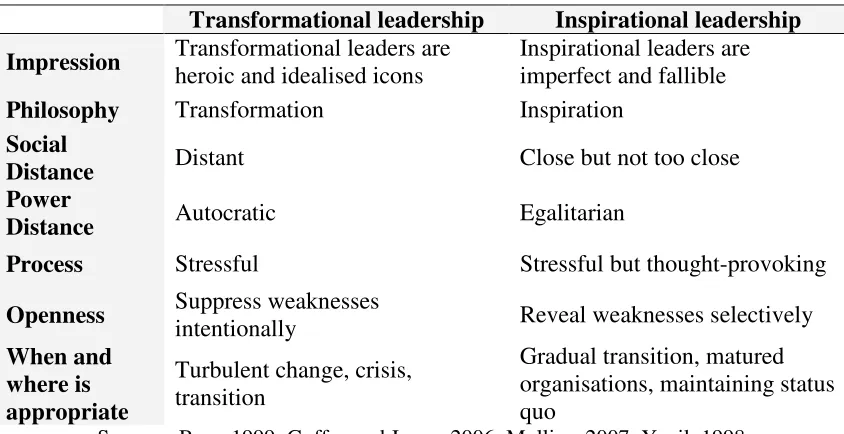
Inspirational leaders inspire others to do more than they want and have to do. Similarly to transformational leaders, inspirational leaders enthuse and arouse others both emotionally and intellectually. Both types of leaders recognise followers as “educable” (Graham, 1991: 109) and willing to be educated. Instead of seeing followers as an undifferentiated crowd, both inspirational leaders and transformational leaders see their followers as individuals who are “capable of constructive creativity” (Graham, 1991: 109). Furthermore, both inspirational and transformational leaders aim to help their followers to realise their potential (Bass, 1988; Goffee and Jones, 2006), genuinely showing concern for their followers (Bass and Riggio, 2006; Crouch, 2005; Goffee and Jones, 2006; London, 2002) and stimulating followers to think critically about a problem or situation (Bass and Riggio, 2006; London, 2002; Rafferty and Griffin, 2004). At this point, transformational leadership and inspirational leadership can be seen as having much in common. There are however considerable differences between these two approaches to leadership which are summarised in Table 1.
Table 1: Differences between Transformational Leadership and Inspriational Leadership
Transformational leadership Inspirational leadership
Impression Transformational leaders are
heroic and idealised icons
Inspirational leaders are imperfect and fallible
Philosophy Transformation Inspiration
Social
Distance Distant Close but not too close
Power
Distance Autocratic Egalitarian
Process Stressful Stressful but thought-provoking
Openness Suppress weaknesses
intentionally Reveal weaknesses selectively
When and where is appropriate
Turbulent change, crisis, transition
Gradual transition, matured organisations, maintaining status quo
Sources: Bass, 1999; Goffee and Jones, 2006; Mullins, 2007; Yagil, 1998
While transformational leadership is concerned with transforming followers into high performers, inspirational leadership aims to inspire followers to higher achievements (Adair, 2009; Avramenko, 2014). Transformation usually entails a complete makeover and a concomitant resistance to change. Because of this, transformational leaders are often seen as change agents since they are often involved in turbulent change or crisis (Bass, 1999). In contrast, inspiration does not always entail change. The term ‘inspire’ is defined as meaning ‘Fill (someone) with the urge or ability to do or feel something, especially to do something creative’ (Oxford Dictionary). That is to say, inspirational leadership is about giving new momentum to followers, either in developing or mature organisations. Accordingly, inspirational leaders are rarely portrayed as change agents although they are supportive of change.
inspirational leaders selectively and personally inspire their followers (Olivier, 2003). Olivier’s claim is derived from the theory of critical mass, where an adequate momentum in a social system can bring about a swift change (Rogers, 2003). Inspirational leaders carefully select and inspire an initial, small group of followers. These chosen few then spread the word to the remaining population. It is worth noting that inspirational leadership does not seek for full-scale transformation in the vein of transformational leadership. It sees it as both unnecessary and impractical to change the mindset of the whole population because there is always resistance to change and “habitual critics” (Olivier, 2003: 106). Provided that more than half of the population take on board the vision of inspirational leader, the leader can then move the organisation forward.
Consequently, the process of inspiring followers is thought-provoking and challenging whereas the process of transformation is often stressful; the process of transformation is stressful because “followers may exhaust themselves in their attempts to fulfil the [high] expectations set out by the leader” (Porter and Bigley, 2001: 287). On the other hand, the process of inspiration is thought-provoking since it primarily depends on the “inspired moment” (Adair, 2009: 128), a situation where latent talent is unleashed. However, inspirational leaders may also bring some pressure or stress to their followers (Adair, 2009), which, in turn, offsets the positive impacts of inspirational leadership.
Another distinction is based on the social distance between leaders and followers. A series of studies conclude that the distance between leader and followers has an impact to leadership effectiveness (Goffee and Jones, 2006; Howell et al., 2005; Shamir, 1995). Theoretically, distant leaders “would tend to behave homogenously with followers” (Antonakis and Atwater, 2002: 684), distant leaders see their followers as anonymous individuals, an undifferentiated herd, and are thereby insensitive to individual developmental needs. This also implies that ‘ideal’ leaders are close to their followers. However, frequent contacts allow followers to observe weaknesses and inconsistencies in the leader’s behaviour (Shamir, 1995). This is particularly problematic for transformational leaders because there is an assumption that transformational leaders are extraordinary people (Northouse, 2013; Tourish and Pinnington, 2002; Yukl, 1999). Admitting or revealing weaknesses makes a leader mundane, fallible or even vulnerable. Following this line of reasoning, social distance is essential to enable transformational leaders to retain their influence and prestige. As Bass (1997: 4) states, “leaders who are close to their followers, in particular, who can lose all their reputation with just one episode of hypocrisy or shading of the truth”. This indicates that transformational leaders should not only be distant from their followers but also may also be fraudulent since they need to suppress their weaknesses.
revealing weaknesses certainly destroys the illusion that leaders are extraordinary persons but it also shortens the social distance between leaders and followers. As Yagil (1998) argued, a socially close leader appears more human and fallible than a socially distant leader.
From another point of view, revealing weaknesses makes an inspirational leader ordinary or even mundane. Although this may minimise the distance between leader and follower, it is likely that the follower would be less dependent or loyal to the leader since the leader becomes an average person for whom the follower has little respect. Therefore, Goffee and Jones (2000: 68) maintain inspirational leaders “deliberately use their difference to maintain a social distance”. For Goffee and Jones (2000), it is important for inspirational leaders to signal their distinctiveness and detach themselves from their followers from time to time, so that “followers will push themselves if their leader is just a little aloof” (ibid: 70). Together the above pints mean that being a successful inspirational leader involves more than just inspiring followers; it is a more complex role which needs to be undertaken skilfully.
Concluding Remarks
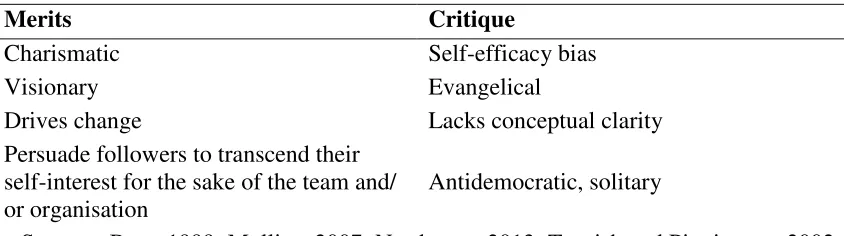
[image:8.595.88.510.447.565.2]Transformational leadership has been proven to be effective in ensuring organisational success (García-Morales et al., 2012; Howell and Avolio, 1993; Liao and Chuang, 2007; Nemanich and Keller, 2007). In spite of this, transformational leadership is not without its limitations. Table 2 summarises the merits and critique of transformational leadership.
Table 2: Merits and Criticism of Transformational Leadership
Merits Critique
Charismatic Self-efficacy bias
Visionary Evangelical
Drives change Lacks conceptual clarity
Persuade followers to transcend their self-interest for the sake of the team and/ or organisation
Antidemocratic, solitary
Sources: Bass, 1999; Mullins, 2007; Northouse, 2013; Tourish and Pinnington, 2002
transformational leaders become evangelical if they overemphasise realisation of the vision. Charisma is certainly one of the strengths of transformational leaders; but it can lead to a self-efficacy bias (Gist, 1987; Gist and Mitchell, 1992) if they overestimate themselves and regard themselves as superior.
Is transformational leadership eclipsed by inspirational leadership? On the basis of the arguments presented, the answer is affirmative. The very concept of transformational leadership is ambiguous. The four components of transformational leadership as advocated by Bass can be measured with the Multifactor Leadership Questionnaire (MLQ). However, their construct validity becomes doubtful since these four components have significant overlap (Yukl, 1999). It is also unclear how transformational leaders lead, even if they acquire all four components associated with this approach to leadership. Furthermore, it is questionable whether transformational leadership will fit into stable organisations which are maintaining the status quo and their success. Do market leaders need a transformational leader?
In contrast to transformational leadership, inspirational leadership has greater conceptual clarity. The actual concept of inspirational leadership is more comprehensible. Inspirational leadership is about inspiring others “to face and overcome [the] rigors of the journey” (Adair, 2009: 107). Inspirational leaders deliberately arouse their followers to move on, either in crisis or in maintaining status quo. Indeed, in today’s stressful business environment, there is an urge to continuously rejuvenate the team, organisation or industry at large. And this is where and how inspirational leadership takes place.
References
1. Avramenko, A. (2014), “Inspiration at work: is it an oxymoron?”, Baltic
Journal of Management, Vol. 9, No. 1, pp.113 – 130.
https://doi.org/10.1108/BJM-07-2013-0110
2. Adair, J. (2009), The inspirational leader: how to motivate, encourage &
achieve success. London: Kogan Page.
3. Antonakis, J. and Atwater, L. (2002), “Leader distance: a review and a proposed theory”, Leadership Quarterly, Vol. 13, No. 6, pp. 673-704. https://doi.org/10.1016/S1048-9843(02)00155-8
4. Avey, J. B.; Hughes, L. W.; Norman, S. M.; Luthans, K. W. (2008), “Using positivity, transformational leadership and empowerment to combat employee negativity”, Leadership & Organization Development Journal, Vol. 29, No. 2, pp. 110-126. https://doi.org/10.1108/01437730810852470
5. Bass, B. M. (1985), “Leadership: Good, Better, Best”, Organizational
Dynamics, Vol. 13, No. 3, pp. 26- 40.
6. Bass, B. M. (1988), “The Inspirational Processes of Leadership”, Journal of
Management Development, Vol. 7, No. 5, pp. 21-31.
https://doi.org/10.1108/eb051688
7. Bass, B. M. (1997), The ethics of transformational leadership. University of Maryland: James MacGregor Burns Academy of Leadership.
8. Bass, B. M. (1999), “Two Decades of Research and Development in
Transformational Leadership”, European Journal of Work and Organisational
Psychology, Vol. 8, No. 1, pp. 9–32.
https://doi.org/10.1080/135943299398410
9. Bass, B. M. and Riggio, R. E. (2006) Transformational Leadership. Routledge.
10.Bass, B. M. and Steidlmeier, P. (1999), “Ethics, character, and authentic transformational leadership behaviour”, Leadership Quarterly, Vol. 10, No. 2, pp.181-217. https://doi.org/10.1016/S1048-9843(99)00016-8
11.Braun, S.; Peus, C.; Weisweiler, S. and Frey, D. (2013), “Transformational leadership, job satisfaction, and team performance: A multilevel mediation model of trust”, Leadership Quarterly, Vol. 24, No. 1, pp. 270-283.
https://doi.org/ 10.1016/j.leaqua.2012.11.006
12.Burns, J. M. (1978), Leadership. New York: Harper and Row.
13.Conger, J. A. (1991), “Inspiring others: the language of leadership”, Academy
of Management Executive, Vol. 5, No. 1, pp. 31-45.
https://doi.org/10.5465/AME.1991.4274713
14.Crouch, N. (2005), “Inspirational leadership”, in: Jolly, A. (Ed.) From Idea To
Profit: How To Market Innovative Products and Services. Kogan Page
Publishers. pp. 67-72.
15.García-Morales, V. J.; Jiménez-Barrionuevo, M. M. and Gutiérrez-Gutiérrez, L., (2012), “Transformational leadership influence on organizational
performance through organizational learning and innovation”, Journal of
Business Research, Vol. 65, No. 7, pp. 1040-1050.
https://doi.org/10.1016/j.jbusres.2011.03.005
16.Gist, M. E. (1987), “Self-Efficacy: Implications for Organizational Behavior and Human Resource Management”, Academy of Management Review, Vol. 12, No. 3, pp. 472-485. https://doi.org/10.5465/AMR.1987.4306562
18.Goffee, R. and Jones, G. (2000), “Why Should Anyone Be Led by You?”,
Harvard Business Review, Vol. 78, No. 5, pp. 62-70.
https://doi.org/10.1225/5890
19.Goffee, R. and Jones, G. (2006), Why Should Anyone Be Led by You?, Boston: Harvard Business School Publishing.
20.Graham, J. W. (1991), “Servant-leadership in organizations: Inspirational and moral”, Leadership Quarterly, Vol. 2, No. 2, pp. 105-119.
https://doi.org/10.1016/1048-9843(91)90025-W
21.Green, A. E.; Miller, E. A. and Aarons, G. A. (2013), “Transformational Leadership Moderates the Relationship Between Emotional Exhaustion and Turnover Intention Among Community Mental Health Providers”, Community
Mental Health Journal, Vol. 49, No. 4, pp 373-379.
https://doi.org/10.1007/s10597-011-9463-0
22.Hetland, H.; Sandal, G. M. and Johnsen, T. B. (2008), “Followers' Personality and Leadership”, Journal of Leadership & Organizational Studies, Vol. 14, No. 4, pp. 322-331. https://doi.org/10.1177/1548051808315550
23.Hofmann, D. A. and Jones, L. M. (2005), “Leadership, Collective Personality, and Performance”, Journal of Applied Psychology, Vol. 90, No. 3, pp. 509-522. https://doi.org/10.1037/0021-9010.90.3.509
24.Howell, J. M. and Avolio, B. J. (1993), “Transformational Leadership, Transactional Leadership, Locus of Control, and Support for Innovation: Key Predictors of Consolidated-Business-Unit Performance”, Journal of Applied
Psychology, Vol. 78, No. 6, pp. 891–902.
https://doi.org/10.1037/0021-9010.78.6.891
25.Howell, J. M.; Neufeld, D. J. and Avolio, B. J. (2005), “Examining the relationship of leadership and physical distance with business unit performance”, Leadership Quarterly, Vol. 16, No. 2, pp. 273-285. https://doi.org/10.1016/j.leaqua.2005.01.004
26.Jung, D.; Wu, A. and Chow, C. W. (2008), “Towards understanding the direct and indirect effects of CEOs' transformational leadership on firm innovation”,
Leadership Quarterly, Vol. 19, No. 5, pp. 582-594.
https://doi.org/10.1016/j.leaqua.2008.07.007
27.Keeley, M. (2004), “The trouble with transformational leadership: Toward a federalist ethic for organisations”, in: Ciulla, J. B. and Burns, J. M. (Ed.)
Ethics, the Heart of Leadership. London: Greenwood Publishing Group. pp.
149-174.
28.Liao, H. and Chuang, A. (2007), “Transforming Service Employees and Climate: A Multilevel, Multisource Examination of Transformational
Psychology, Vol. 92, No. 4, pp. 1006-1019. https://doi.org/10.1037/0021-9010.92.4.1006
29.London, M. (2002), Leadership Development: Paths to Self-insight and
Professional Growth. New Jersey: Lawrence Erlbaum Associates.
30.Ludeman, K. and Erlandson, E. (2004), “Coaching the Alpha Male”, Harvard
Business Review, Vol. 82, No. 5, pp. 58-67.
31.MacKenzie, S. B.; Podsakoff, P. M.; Jarvis, C. B. (2005), “The Problem of Measurement Model Misspecification in Behavioral and Organizational Research and Some Recommended Solutions”, Journal of Applied
Psychology. Vol. 90, No. 4, pp. 710-730.
https://doi.org/10.1037/0021-9010.90.4.710
32.Matzler, K.; Schwarz, E.; Deutinger, N.; Harms, R. (2008), “The Relationship between Transformational Leadership, Product Innovation and Performance in SMEs”, Journal of Small Business & Entrepreneurship, Vol. 21, No. 2, pp. 139-151.
33.Millward, L. (2005), Understanding Occupational and Organizational
Psychology. London: Sage Publication.
34.Mullins, L. J. (2007), Management and organisational behaviour. 8th ed. Harlow: Financial Times Prentice Hall.
35.Nemanich, L. A. and Keller, R. T. (2007), “Transformational leadership in an acquisition: A field study of employees”, Leadership Quarterly, Vol. 18, No. 1, pp. 49-68. https://doi.org/10.1016/j.leaqua.2006.11.003
36.Northouse, P. G. (2013), Leadership: theory and practice, 6th ed., London: Sage Publication.
37.Olivier, R. (2003), Inspirational Leadership: Henry V and the Muse of Fire;
Timeless Insights from Shakespeare's Greatest Leader, London: Spiro Press.
38.Pawar, B. S. (2003), “Central conceptual issues in transformational leadership research”, Leadership & Organization Development Journal, Vol. 24, No. 7, pp. 397-406. https://doi.org/10.1108/01437730310498596
39.Porter, L. W. and Bigley, G. A. (2001), “Motivation and Transformational leadership: some organisational context issues”, in: Erez,M.; Kleinbeck, U. Thierry, H. (Ed.) Work Motivation in the Context of a Globalizing Economy. London: Lawrence Erlbaum Associates, pp. 279-291.
41.Rickards, T. and Clark, M. (2006), Dilemmas of Leadership. UK: Taylor & Francis.
42.Rogers, E. M. (2003), Diffusion of Innovation, 5th ed., New York: The Free Press.
43.Shamir, B. (1995), “Social distance and charisma: Theoretical notes and an exploratory study”, Leadership Quarterly, Vol. 6, No. 1, pp. 19-47.
https://doi.org/10.1016/1048-9843(95)90003-9
44.Tourish, D. and Pinnington, A. (2002), “Transformational leadership, corporate cultism and the spirituality paradigm: an unholy trinity in the workplace”, Human Relations, Vol. 55, No. 2, pp. 147-172.
https://doi.org/10.1177/0018726702055002181
45.Tse, H.H.M.; Huang, X. and Lam, W. (2013), “Why does transformational leadership matter for employee turnover? A multi-foci social exchange perspective”, Leadership Quarterly, Vol. 24, No. 5, pp. 763-776. https://doi.org/10.1016/j.leaqua.2013.07.005
46.Tucker, B. A. and Russell, R. F. (2004), “The influence of the
transformational leader”, Journal of Leadership & Organizational Studies, Vol. 10, No. 4, pp.103-111. https://doi.org/10.1177/107179190401000408
47.Walumbwa, Fred O.; Orwa, Bani; Wang, Peng; Lawler, John J. (2005), “Transformational leadership, organizational commitment, and job
satisfaction: A comparative study of Kenyan and U.S. financial firms”, Human
Resource Development Quarterly, Vol. 16, No. 2, pp. 235-256.
https://doi.org/10.1002/hrdq.1135
48.Yagil, D. (1998), “Charismatic leadership and organizational hierarchy: Attribution of charisma to close and distant leaders”, Leadership
Quarterly, Vol. 9, No. 2, pp. 161-176.
https://doi.org/10.1016/S1048-9843(98)90003-0
49.Yukl, G. (1999), “An evaluation of conceptual weaknesses in transformational and charismatic leadership theories”, Leadership Quarterly, 10, No. 2, pp. 285–305. https://doi.org/10.1016/S1048-9843(99)00013-2
50.Yukl, G. (2012), “Effective Leadership Behaviors: What We Know and What Questions Need More Attention?”, The Academy of Management
Perspectives, Vol. 26, No. 4, pp. 66-85.