www.editada.org
Informatics, 11(1), Jan-April 2020, 106-114. ISSN: 2007-1558.
_______________________________________________________________________________________
© Editorial Académica Dragón Azteca S. de R.L. de C.V. (EDITADA.ORG), All rights reserved.
Numerical study of a cross flow heat exchanger varying the transverse and longitudinal
space to increase heat transfer
Elva Reynoso-Jardón1, Gustavo Urquiza2, Oscar Tenango-Pirin1, Yahir Mariaca-Beltrán1, Manuel
Nandayapa1
1 Industrial and Manufacturing Eng. Dept., Universidad Autónoma de Ciudad Juárez, Juárez, Chih., México. 2 Centro de Investigación en Ingeniería y Ciencias Aplicadas (CIICAp)-UAEM, Morelos, México.
[email protected], [email protected], [email protected], [email protected]
Abstract. In this paper a numerical study of a cross flow heat exchanger varying the transverse and longitudinal space to increase heat transfer is presented. The numerical study consists of varying the transverse and longitudinal space to increase heat transfer to a heat exchanger, which 143 geometries are considered. In addition, each of these geometries are analyzed for 3 materials: stainless steel, copper and titanium. Moreover, a physical model of a heat exchanger is developed and consist of a section of a heat exchanger for simulation purpose. The physical model is solved by the governing equations of the phenomenon in the heat exchanger, that consists in momentum, continuity and energy equations. From the thermal point of view, the most efficient configuration was certified with a copper material with a pressure drop of 200 Pa and values of Xl = 0.024m and Xt = 0.064m. The numerical study is solved by Fluent applied to the physical model of a heat exchanger.
Keywords: Heat exchanger, heat transfer coefficient, pressure drop.
Article Info
Received Dec 26, 2018 Accepted Sep 11, 2019
1
Introduction
A heat exchanger is a device designed to transfer heat between two media, usually between two fluids. The complexity of these devices is due to their geometric configuration. The distribution and position of the tubes that make up the exchanger allow a temperature difference, which causes heat transfer between a cold fluid and a hot fluid. Heat exchangers are used in industrial applications such as space shuttles, airplanes, cars, the food industry, hydroelectric plants, among others. The design of heat exchangers is commonly performed using empirical equations related to heat transfer, geometric parameters and efficiency. If it is desired to modify the exchanger geometrically, the empirical equations may no longer be valid depending on the degree of modification, so it is not possible to accurately predict the behavior of the fluid.
On the other hand, Computational Fluid Dynamics (CFD) is a solution technique that allow to carry out evaluations of changes in the geometry of the exchanger. The CFD is a branch of fluid dynamics that is responsible for solving heat transfer flow problems numerically using computers. In addition, the current computing capabilities make the CFD a useful tool for the calculation of phenomena, where they interfere with mechanics and heat transfer of fluids in engineering such as heat exchangers.
Many researchers have been using CFD to obtain numerical results. One of the pioneers in the design of heat exchangers was Zukauskas et al. [1,2] who with their monographs discuss the heat transfer and the flow behavior that goes through different arrangements of tube banks. Beale and Spalding [3] developed simulations that describe the behavior of heat flow and transfer within arrangements of tube banks of a heat exchanger. The main arrangements of tube banks were the following configurations: square, triangular and quadrangular arrangement rotated. The results found were representative of the cross flow and heat transfer mechanisms at a low Reynolds number.
107
In the paper of Sahin et. al [8], they investigated 7 different arrangements of tubes, considering the angle of inclination of the blade, longitudinal space and oval shape of the tubes, to improve heat transfer and decrease pressure drop. Numerical simulations for tube arrangements were performed in 3D using Fluent computer software. The results showed that the oval shape of the tube and the angle of 30° of inclination, improve the heat transfer to 1.42W, the total in the pressure drop was 8.21 Pa. Therefore, the study concluded that the oval shape and the angle of inclination of the fin at 30° is the most efficient for the improvement in heat transfer.
A numerical study of the four-cylinder cross-flow heat exchanger placed in quadrangular form, in 2D and 3D was conducted in [9]. The 3D numerical simulation of the heat exchanger was performed using the Fluent computer software. The results were: the ideal distance between tubes was L/D=4 and a Reynolds number of 200. It was also concluded that the 3D numerical simulation completely represented the phenomenon to determine a new design of the exchanger.
Also, Sayed et al. [10] conducted an experimental and numerical study to calculate the heat transfer and efficiency of a cross-flow heat exchanger using wing-shaped tubes placed in a staggered configuration at different angles of attack. The results indicated that the heat transfer was increased when the angle of attack was varied from 0° to 45°, while the opposite situation occurred when there were angles between 135° and 180°. Therefore, the investigation concluded that the increase in efficiency was obtained at low Reynolds numbers and at 0° angle of attack.
A numerical study of a heat exchanger with different arrangements, among which the circular, ellipsoidal and wing-shaped tubes were selected, was conducted in [11]. All tube arrangements were tested under similar operating conditions with the intention of finding a new optimal design form to improve heat transfer. The numerical analysis was carried out in 2D and using CFD. In the investigation, the effects of pressure drop and enthalpy were determined, including heat transfer correlations for each different arrangement of tubes.
This paper presents suggestions for the best geometry that minimizes the total entropy generation. Based on the literature review, the objective of this work is to perform a numerical study of a cross flow heat exchanger varying the type of material to avoid degeneration of the material; the transverse and longitudinal space, to increase heat transfer; as well as to reduce the pressure drop for the application in hydroelectric power plants.
1.1 Nomenclature
De - External diameter (m) Dh - Hydraulic diameter (m) Di – Inner diameter (m) F - Fanning friction factor
h - Convection heat transfer coefficient Nu - Nusselt number
Pr – Prandtl number Re – Reynolds number
U - Global heat transfer coefficient (W/m2 K) v - Airspeed (m/s)
Vmax - Maximum speed (m/s) Xt – Longitudinal distance Xl – Transversal distance ∆p – Pressure drop ρ - Density (kg/m3).
2
Physical Model of Heat Exchanger
108
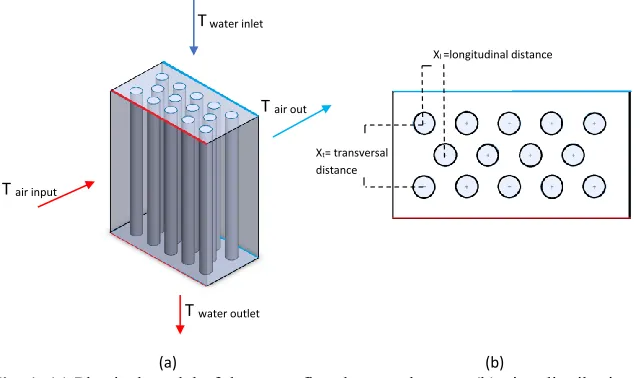
Fig. 1. (a) Physical model of the cross-flow heat exchanger, (b) pipe distribution.
Having described the physical model for the study, it was considered to take a section of the heat exchanger to perform the numerical study. taking the total geometry implies using a large number of nodes, distributed over the computational domain and using more computational resources. Therefore, only 6 rows of tubes were considered as the representative quantity to study the behavior of the air that passes through them from the entrance to the exit of the exchanger and 3 columns were chosen due to the triangular arrangement. This quantity of tubes was taken from the middle part of the exchanger with the following dimensions: width L = 0.22 m, length W = 0.11 m and height h = 2 m.
Once the section of the exchanger under analysis was chosen, a mesh was made. The geometry was processed in the ICEM software. Changes were made in the geometry, varying the transverse space from 0.064 to 0.054 m and in longitudinal space from 0.032 to 0.020 m, obtaining a total of 143 geometries. With the measurements of the established section, three materials (copper, stainless steel and titanium) for the walls of the exchanger are considered for the numerical analysis.
3
Governing Equations of the Phenomenon in the Heat Exchanger
The phenomenon presented in a heat exchanger involves the hot air that flows through the pipes and the water that passes through them; This phenomenon requires a mathematical representation of the turbulent movement of the fluid. The mathematical representation of the heat exchanger is summarized in a set of equations of conservation of mass, amount of movement and energy, [12]. Due to the speeds of the hot air passes through the pipes and the water inside them, a Reynolds number value was determined for both water and air, hence a turbulence model is required. The k-ε model [13] was chosen for the representation of the turbulence phenomenon.
Mass conservation equation:
𝜕𝑢𝑖
𝜕𝑥 = 0 (1)
Momentum conservation equation:
𝜕(𝜌𝑢𝑖𝑢𝑗)
𝜕𝑥𝑗
= −𝜕𝑃
𝜕𝑥𝑖
+ 𝜕
𝜕𝑥𝑗
(𝜇𝜕𝑢𝑖 𝜕𝑥𝑗
+ 𝜌𝑢𝑖′𝑢𝑗′) (2)
Energy conservation equation:
𝜕(𝜌𝑇) 𝜕𝑥𝑖
+𝜕(𝜌𝑢𝑖𝑇) 𝜕𝑥𝑖
= 𝜕𝑇
𝜕𝑥𝑖
(𝑘 𝐶𝑝
𝜕𝑇 𝜕𝑥𝑖
) (3)
(a) (b)
T water inlet
T air out
T air input
T water outlet
Xl =longitudinal distance
Xt= transversal
109
where xi represents the spatial coordinate, ui is the velocity in the direction i, ρ is the density of the fluid, µ the molecular viscosity, P represents the pressure, T represents the temperature.
Model K-ε
Turbulent kinetic energy k equation: 𝜕 𝜕𝑥𝑖
(𝜌𝑘𝑢𝑖) =
𝜕 𝜕𝑥𝑗
[(𝜇 +𝜇𝑡 𝜎𝑘
)𝜕𝑘
𝜕𝑥𝑗
] + 𝐺𝑘+ 𝐺𝑏− 𝜌𝜀 − 𝑌𝑀+ 𝑆𝑘 (4)
Equation of turbulent energy dissipation ε: 𝜕
𝜕𝑥𝑖
(𝜌𝜀𝑢𝑖) =
𝜕 𝜕𝑥𝑗
[(𝜇 +𝜇𝑡 𝜎𝜀
) 𝜕𝜀
𝜕𝑥𝑗
] + 𝐶1𝜀
𝜀
𝑘(𝐺𝑘+ 𝐶3𝜀𝐺𝑏) − 𝐶2𝜀𝜌 𝜀2
𝑘 + 𝑆𝜀 (5)
From these equations, Gk represents the generation of kinetic energy of turbulence due to the average velocity gradients. Gb is the generation of kinetic energy of turbulence due to buoyancy. Ym is the contribution of fluctuating dilatation in turbulence according to the general dissipation rate.
The turbulent viscosity µt is calculated by combining k and ɛ as follows:
𝜇 = 𝜌𝐶𝜇
𝑘2
𝜀 (6)
The constants of the model C1ɛ, C2ɛ, Cµ, σk y σɛ and have the following values.
𝐶1𝜀 = 1.44, 𝐶2𝜀= 1.92, 𝐶𝜇= .09, 𝜎𝑘= 1.0, 𝜎𝜀= 1.3
4
Parameters of Interest to Determine Values of U
To determine the different values to calculate the global coefficient of heat transfer, maximum speed, and pressure drop, [14] is used:
𝑈 = 1
1 ℎ𝑤
𝐷𝑒
𝐷𝑖+
𝐷𝑒𝐿𝑛 (𝐷𝐷𝑒 𝑖)
2𝑘 +
1 ℎ𝑎
(7)
where the convection heat transfer coefficient of both sides is given by equation (8)
ℎ =𝑁𝑢 𝑘
𝐷ℎ
(8)
For the calculation of the Nusselt number for water and air, they were calculated as follows respectively, according to Sadik Kakaҫ [14].
𝑁𝑢𝑤=
(𝑓2) 𝑅𝑒𝑤 𝑃𝑟𝑤
1.07 + 12.7 (𝑓2)
1 2
(𝑃𝑟𝑤
2
3− 1)
110 𝑁𝑢𝑎= 0.031 𝐶𝑛 𝑅𝑒𝑎0.8 𝑃𝑟𝑎0.4(
𝑃𝑟𝑎
𝑃𝑟𝑤𝑎𝑙𝑙
)
0.25
(𝑋𝑡 𝑋𝑙
)
0.2
(10)
where, f is the friction factor, Re is the Reynolds number and Pr is the Prandtl number and is expressed as:
𝑓 = (1.58 𝐿𝑛 𝑅𝑒𝑤− 3.28)−2 (11)
𝑅𝑒 =𝑣𝐷ℎ𝜌
𝜇 (12)
𝑃𝑟 =𝐶𝑝𝜇
𝑘 (13)
The Reynolds number for the air part was calculated using the maximum speed; which was evaluated for two cases: When 2AD> AT, with equation (14) and 2AD <AT with equation (15). While the maximum water speed is that obtained by numerical simulation such as:
𝑉 𝑋𝑡
𝑋𝑡− 𝐷𝑒 𝑎𝑚𝑎𝑥 (24)
𝑉 𝑋𝑡
2(𝑋𝐷− 𝐷𝑒)𝑎𝑚𝑎𝑥 (35)
The pressure drop (
𝛥𝑝
) is a measure of the resistance that the tubes offer to the flow over them and is determined from the equation.𝛥𝑝 = 𝑁𝑓𝑥𝜌𝑉𝑚𝑎𝑥
2
2
(46)
where, f is the friction factor, and x is the correction factor.
5
Computational Model of the Heat Exchanger
To carry out the numerical study, the commercial software Fluent was used in which the heat transfer of turbulent flow in 3D of a heat exchanger was modeled. The flow was considered turbulent due to a Reynolds number of 358176; the temperature that was considered for the air flow was 57°C and a mass flow of 1.5 kg / s was assigned. For water inlet conditions, the temperature was 27°C and the mass flow of 0.5 kg / s. The turbulence model of two equations k-ε was used. The SIMPLE algorithm [15] and the upwind second order interpolation scheme were used for the numerical solution of the mathematical model. For the mesh convergence study, the configuration Xl = 0.032 and Xt = 0.064m was used, for which four meshes of 10260, 12460,13560,14678 cells were made. The type of mesh made was unstructured and for the convergence of mesh the methodology of Roache [16] was followed. An error of 0.008% was found when conducting the mesh independence study and therefore the 13560 cells mesh was considered to perform the temperature analysis in the heat exchanger. The choice of data to determine this error in the selection of the mesh was the pressure coefficient because it is an important factor that associates the pressure drop.
6
Results
111
as water outlet temperatures, air and wall temperature. Water and air temperatures were used to determine pressure drop values and overall heat transfer coefficient, of which the following results are presented.
6.1 Analysis of Results for the Pressure Drop
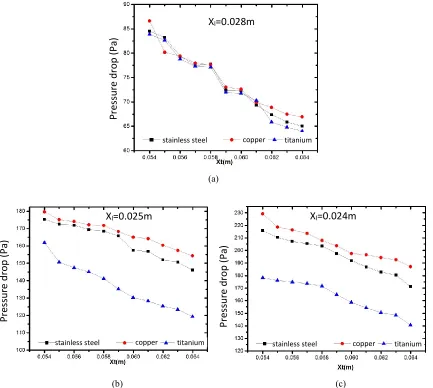
[image:6.612.92.525.290.678.2]for the calculation of the air pressure drop, equation 16 is a function of the velocity that runs through the arrangement of the tubes. When changing the size of the transverse (Xt) and longitudinal (Xl) space, it is observed that the pressure drop turns out to be more sensitive to these changes because the fluid velocity that passes through the arrangement of the tubes experiences an opposition to the passage of air among them. The effect of the variation of the pressure drop outside the transverse space of the tube is presented in figure 2. The results of figure 2 are presented for different longitudinal spaces and for 3 types of materials. In figure 2 (a) for the value of Xl = 0.028 m, the pressure drop behavior increased due to space reduction, the same occurs in cases where Xl = 0.025 and 0.024m (figure 2b and 2c). In general, it is observed that for 0.024≤Xl≤0.028m, the pressure drop decreases as the transverse space (Xt) increases. In particular for Xl = 0.024 and 0.025m, the titanium material has the lowest pressure drop values in the entire Xt interval. For Xl = 0.028m, there is no significant effect on the pressure drop due to the type of heat exchanger material. On the other hand, it is observed that in each of the materials (copper, titanium and stainless steel) as the transverse and longitudinal spaces change, the pressure drop behavior increases. The pressure drop results of the copper and stainless-steel is in the range of 180 to 230 Pa, for the transverse spaces of 0.054 to 0.064 m and for the titanium there are pressure ranges of 180 to 140 Pa.
Fig. 2. The effects of transverse and longitudinal space on the pressure drop. (a)
(b) (c)
X
l=0.025m
X
l=0.024m
X
l=0.028m
stainless steel copper titanium
stainless steel copper titanium stainless steel copper titanium
P
res
sur
e
d
ro
p
(P
a)
P
res
sur
e
d
ro
p
(P
a)
P
res
sur
e
d
ro
p
(P
112 6.2 Analysis for Global Heat Transfer Rate (U)
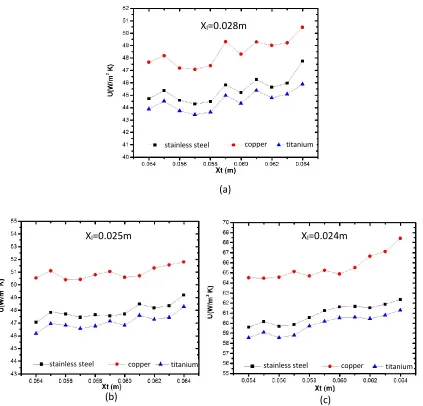
The global coefficient of heat transfer (U) is difficult to calculate because it should be considered mechanisms of convection at each side wall (hot and cold), and the thermal conductivity properties of the materials used as surface of heat transmission. The way to calculate the global heat transfer coefficient involves the air temperature, the water temperature and the heat transfer coefficient by conduction of each material. All this information was considered for the calculation of "U" by CFD. The results found by the CFD to determine the overall heat transfer coefficient (U) are shown in figure 3 according to Xt and three different values of Xl.
[image:7.612.93.516.274.680.2]The results found for U, in a space Xl = 0.028 m, show that copper tends to increase the value of the global heat transfer coefficient; on the other hand, stainless steel and titanium are below this value. However, when the value of Xl decreases, there is an increase in U, since the values increased from 35 to 69 W / m2 K. Therefore, the greatest benefit is found by decreasing Xl. In general, it is observed that for 0.024≤Xl≤0.028m, the global heat transfer coefficient increases as the transverse space (Xt) increases. In particular, for Xl = 0.024 and 0.025m, the titanium material has the lowest values in the increase in the global heat transfer coefficient over the entire Xt interval. For the copper material, values of U = 69 W / m2 were reached, observing the results of U for stainless steel does not turn out to be negligible when the geometry varies (Xt and Xl), since it reached a value of U = 62 W / m2 K and for the titanium of 60 W / m2 K. This means that when making the modification of spaces Xt and Xl the values of U increase significantly.
Fig. 3. Effect of transverse and longitudinal space on the global heat transfer coefficient.
X
l=0.028m
X
l=0.025m
X
l=0.024m
(a)
(b)
(c)
stainless steel copper titanium
113
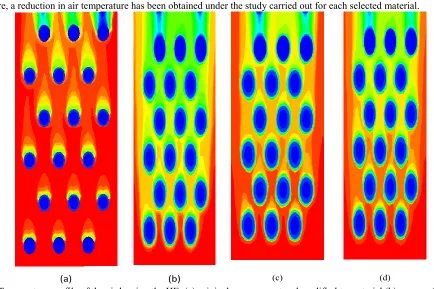
Figure 4 shows the pattern of air temperature at the outlet of the exchanger, considering the lowest pressure drop and the highest “U” value for the three materials under study. In addition, in figure 4 is noted that temperatures at the outlet of hot air heat exchanger have fallen considerably, taking the transverse space 0.064 m and 0.024m longitudinal space. In addition, it is appreciated that the hot air passing through the tubes achieves to lower its temperature to a value of 310, 315 and 317 K for the material of copper, stainless steel and titanium respectively.
[image:8.612.82.516.140.429.2]Therefore, a reduction in air temperature has been obtained under the study carried out for each selected material.
Fig. 4. Temperature profile of the air leaving the HE: (a) original arrangement and modified to material (b) copper, (c) stainless steel and (d) titanium arrangement.
7
Conclusions
A numerical study of a cross flow heat exchanger varying the transverse and longitudinal space to increase heat transfer was developed. Based on the numerical results, to improve the performance of the heat exchanger the global coefficient values heat transfer of 60, 62 and 69 W / m2 K for titanium materials, stainless steel and copper, respectively, were obtained. Finally, the best configuration from the thermal point of view was obtained with a copper material, which presented a pressure drop of 200 Pa with values of transverse and longitudinal space of the tubes of 0.024 and 0.064m, respectively. The temperatures of the fluid at the exit of the heat exchanger were reduced from 324 to 310 K. On the other hand, if the degeneracy damage of the material is considered, stainless steel is a good alternative due to its properties and can reduce the temperature up to 315 K.
References
1. Zukauskas, A.A.: Heat transfer from tubes in cross flow in Advances in Heat Transfer. Edited by Hartnett, J. P. and Irvine, T. F. Jr, New York Press (1972)
2. Zukauskas, A.A., Ulinskas, R.V.: Heat transfer efficiency of tube banks in crossflow at critical Reynolds numbers. Heat Transfer-Soviet Research. 10, 9-15 (1978). Doi: 10.1016/S0065-2717(08)70038-8
3. Beale, S.B., Spalding, D.B.: A numerical study of unsteady fluid flow in in-line and staggered tube banks. Transactions of the CSME. 13, 723-754 (1999). Doi:10.1006/jfls.1999.0231
4. Kang, H.C., Kim, M.H.: Effect of strip location on the airside pressure drop and heat transfer in strip fin-and-tube heat exchanger. Int J Refrig. 22, 302–312(1998). Doi:0.1016/S0140-7007(98)00062-0
5. Yun, J.Y., Lee, K.S.: Influence of design parameters on the heat transfer and flow friction characteristics of the heat exchanger with slit fins. Int J Heat Mass Transf. 43,2529–2539(2000). Doi:10.1016/S0017-9310(99)00342-7
6. Qu, Z.G., Tao, W.Q., He, Y.L.: 3D numerical simulation on laminar heat transfer and fluid flow characteristics of strip fin surface with X-arrangement of strip. ASME J. Heat Transfer 126 ,69–707(2004). DOI:10.1007/s00231-006-0227-2
114
7. Horvat , A., Leskovar, M., Mavko, B.: Comparison of heat transfer conditions in tube bundle cross-flow for different tube shapes. International Journal of Heat and Mass Transfer. 49 (2006).1027-1038. DOI:10.1016/j.ijheatmasstransfer.2005.09.030
8. Sahin, H.M., Dal, A.R., Baysal, E.: 3-D Numerical study on the correlation between variable inclined fin angles and thermal behavior in plate fin-tube heat exchanger. Applied Thermal Engineering. 27,1806-1816(2007). Doi:10.1016/j.applthermaleng.2007.01.011
9. Lam, K., Gong, W.Q., So, R.M.: Numerical simulation of cross-flow around four cylinders in an in-line square configuration. Journal of fluids and structures. 24 ,34-57(2008). DOI:10.1016/j.jfluidstructs.2007.06.003
10. Sayed, A.E., Emad, Z.I., Osama, M.M. , Mohamed, A.A.: Study of cross flow air-cooling process via water-cooled wing-shaped tubes in staggered arrangement at different angles of attack, Part 2: Heat Transfer Characteristics and Thermal Performance Criteria. International Scholarly and Scientific Research & Innovation. 7,1834-1847(2013). Doi:10.1016/j.ijheatmasstransfer.2005.09.030
11. Najla, E. G., Abdelhamid, K., Momammed, E. G., Ryan, B., Blanchard, R.: Numerical optimization of heat exchangers with circular and non-circular shapes. Case Studies in Thermal Engineering. 6,194-203(2015). Doi: 10.1016/j.csite.2015.09.006
12. Yakhot, V., Smith, L. M.: The renormalization group, the ε-expansion and derivation of turbulence models. Journal of Scientific Computing. 7,35–61(1992). Doi: 0885-7474/92/0100-0035506.50/0
13. Launder, B.E., Spalding, D.B.: The numerical computation of turbulent flows. Computer Methods in Applied Mechanics and Engineering.3,269-289(1974). Doi: 10.1016/0045-7825(74)90029-2
14. Kakaҫ, S., Liu, H.: Heat exchanger, selection, rating and thermal design.2da edn, PRESS, (2002) 15. Patankar, S.V.: Numerical Heat Transfer and Fluid Flow. Taylor & Francis, (1980)