ISSN 2373-7603 (Print) 2373-7638 (Online) Copyright © The Author(s). 2014. All Rights Reserved. Published by American Research Institute for Policy Development DOI: 10.15640/jmise.v1n2a2 URL: http://dx.doi.org/10.15640/jmise.v1n2a2
Risk Perception in the Correlation between the Tendency of Using Internet and Customers’ Willingness to Use Online Payment System
Herison Surbakti1
Abstract
This study aims to determine the extent of the influence of risk perception on the willingness of customers to use online payment system and online purchases, as well as to measure whether the experience and the tendency to use the internet have a significant effect in increasing the willingness of customers to use the online banking facilities and online payments. There are several things that affect the willingness of customers to use the online payment system services; those are, the tendency factor of using the internet and experience factor of using the internet. Those factors have a positive influence on the willingness of customers to use online payment system facility. Perception of risk in using the online payment system service facilities has a negative influence on the willingness of customers to use online payment system facility because the use of the internet has several types of risks that should be acceptable to customers. The tendencies to use the internet and the internet experience factors have a negative influence on the perception of risk in the willingness of customers to use online payment system facilities. Does the perception of risk have a mediation role in the relationship between the tendency to use and experience to use the internet to customers’ willingness to use online payment system? This is a kind of interesting question to study. This research uses a model from a previous study [22]. The willingness of using online payment system service is a big opportunity for the E-Business development, especially in Yogyakarta, Indonesia.
Keywords: Online payment system, risk perception, willingness to use online payment system services, e-business
1. Introduction
In a very tight competition among banks, customer decision factors become a serious concern[10],[32]. Each bank has various disclosure diverse to give everything as expected, like "A customer is a boss", "Customer decision is our goal", and so on.
Developmental in banking service system today is mostly done with information technology as the main device. The use of information technologies provide a wide range of convenience, facilities, and services for customers[4],[18]. The banks should be able to adapt quickly to implement the system of banking operations with the help of information technology in providing services for their customers. In addition, the service by using information technology must be supported by the ability of the company to create programs or tools that are easy to use by clients (user friendly).
One of the banking services using information technology facilities is the online banking in conducting online payments, or online payment system[30]. Online payment system is a new breakthrough in the world of banking company provided banking services to serve customers' financial transactions online, either a transaction using credit cards, debit cards, and online money transfer through online payment system[2],[26].
The ability of banking services in providing a good online payment system service will reduce the risk and provide a positive contribution to improve the use of online payment system in every financial transaction made by their customers. The use of online payment system services is believed to provide more benefits and convenience for the customer and for the company the use of a conventional financial transaction system.
1.1. Problems
1. Does the trend of using the internet and the experience of using the Internet
significantly affect the willingness of customers to use online payment system?
2. Does the tendency of using the internet and the experience of using the Internet
become a significant influence on the perception of the risk of the use of online payment system facility?
3. Is there a relationship between the tendency to use the Internet and the experience
of using the internet with the willingness of customers to use online payment system?
4. Does the risk perception of the online payment system services have a significant
1.2. Limitations
Limitations of the problems in this study are:
1. The respondents in this research are the bank customers who use the services of
Online payment system service in Yogyakarta, Indonesia.
2. The variables used in this study consist of:
a. The tendency to use the internet.
b. The experience of using the internet.
c. Perception of risk.
d. Willingness to use the online payment system facility.
1.3. Research Objectives
The purposes of this study are:
1. To determine the influence of the tendency of using the internet and the
experience of using the internet to the willingness of customers to use online payment system.
2. To determine the effect of the risks perception in using online payment system to
the customers' willingness to use online payment system.
3. To determine the mediating effect of perceived risk of using online payment
system in the correlation between the tendency to use the internet with the customers' willingness to use online payment system.
2. Literature Review
2.1. Information Technology
2.2. Theory of Reason Action (TRA)
Theory of Reason Action was introduced by Fishbein and Ajzen (1975), which helps researchers to understand and predict the attitudes and behavior of individuals[8]. TRA has successfully predicted and explained the behavior of different areas of study. The TRA theory is most often used as a theoretical model of the information system. Individual's performance of a particular behavior is determined by the purpose for running behaviors, and the destination is determined by attitude and subjective norm[8].
[image:4.516.142.372.308.388.2]Several specific factors in determining the behavior of technology acceptance are: behavioral intention to define the behavior, if behavioral intention combined with the attitude and subjective norm.
Figure 2.1: Theory of Reason Action (TRA) [8]
2.3. Theory of Planned Behavior (TPB)
TPB is an extension of the TRA by adding perceived behavioral control variables in addition to the behavior and subjective norm, to describe a situation in which the individual has no control over the desired behavior, as quoted by Chau and Hu[5]. King [21] was conducted research using the technology adoption TRA and TPB as the theoretical models but with emphasis on the TRA, while Chau and HU[5] were combined TPB with TAM.
TPB diagram is shown as Figure 2.2 below:
Figure 2.2 Theory of Planned Behavior[5]
2.4. Technology Accepance Model (TAM)
TAM was first introduced by Fred D. Davis in 1986; it is an adaptation of the TRA which was made specifically for modeling user acceptance of information systems [11]. According to Davis [8], The main goal of TAM is to provide a basis for tracing the influence of external factors on the beliefs, attitudes, and user goals. TAM has two basic foundations, namely Perception of usefulness (PU) and Perceived Ease of Use (PEOU). Two of the bases area major influence on the behavior of computer acceptance [23].
In general, users of the technology will have a positive perception of the technology provided. Negative perceptions will emerge as a result of the use of such technology ever tried. This means that developing a negative perception can be analyzed after the user had tried the technology, or inexperienced users become adversely users of these technologies. TAM model can be used as a basis for determining the necessary efforts to encourage the willingness to use technology. TAM diagram is shown as Figure 2.4 below:
2.5. Unified Theory of Acceptance and Use of Technology (UTAUT)
[image:6.516.143.367.280.394.2]UTAUT model proposed by Venkatesh et al.,[33] is a model which is based on the basic theories about the behavior of users of the technology and the technology acceptance models, which are TRA, TAM, TPB, Motivational Model, Personal Computer Utilization Model, Innovation Diffusion Theory, and STC. The model consists of four variables as determinants of the purpose and use of information technology which are performance expectations, effort expectancy, social influence, and support conditions. Four variables as moderators between determinants with the intended use of information technology, which are: gender, age, experience, and volunteerism. UTAUT diagram is shown as Figure 2.4 below:
Figure 2.4: Unified Theory of Acceptance and Use of Technology (UTAUT) [33]
2.6. Internet
2.7. E-Commerce
E-commerce is the activity of sale and purchase of goods / services through the internet facility[12]. E-commerce can be done by anyone with a business partner, without being limited by space and time. In the actual e-commerce activity implies the existence of a relationship between a seller and a buyer, transactions between businesses, and internal processes that support transactions with companies[13], [27], [35]. E-commerce has changed the way companies do business[6],[9]. E-commerce transactions flow according to Laudon and Laudon [24] as depicted in Figure 2.6 below:
Figure 2.5 E-Commerce Information Flow[24]
2.8. Online payment system Risk Management Services
[image:7.516.152.371.258.438.2]In this study, the research conceptual framework shown in figure 2.6 below:
2.9. Hypothesis
H1a: The tendencies to use the internet have a positive influence on the willingness to use online payment system.
H1b: Experience of using the internet has a positive influence on the willingness to use online payment system.
H2: Risks perception of using the online payment system facilities has a negative influence on the willingness to use online payment system.
H3a: The tendencies to use the internet have a negative influence on the perception of the risk in the use of the facilities of online payment system.
H3b: The experiences of using the internet have a negative influence on the perception of the risk in the use of online payment system.
H4a: The risk perception mediates the relationship between the tendency of internet use with the willingness to use online payment system.
H4a: The risk perception mediates the relationship between the experience of internet use with the willingness to use online payment system.
3. Research Method
1. The research was designed as a field research by collecting information (data)
from particular sampling directly done by researcher[7],[31].
2. Samples were 349 respondents who are customers of some banks in
Yogyakarta, Indonesia between the ages of 17 to 60 years old, and used the online payment system service at least 3 times in the last 2 years.
3. Variables:
a. The tendency to use the internet
b. The experience to use internet
c. Risk perception
d.Willingness to use online payment system and online payment
4. The method of data collection used questionnaire that was divided into three
parts:
a.The first part of the questionaire was about demographic characteristics of the
respondents including gender, age, level of education, the banks, using the internet within a week, the experience of using the internet.
b.The second part of the questionnaire related to perception of the risk of the
c.The third part was about willingness to use the online payment system service developed by Kuhlmeier and Knight[22], which consists of three questions.
d.The risk perception of the use online payment system was developed by the
Kuhlmeier and Knight[22], which consists of six questions.
e.The willingness to use the online payment system developed by Kuhlmeier
and Knight[22], which consists of three questions.
Instruments Technical Test
3.1. 1 The Validity Test
The validation test (validity test item) is a tool to test whether each of the questions really has revealed a factor or indicator which is going to be investigated. The higher the validity of a measuring instrument, the more precise the measurement tools on target. Guidelines used in maintaining an item are as follows: [15]
1. The collection of the item by the factor must be positive.
2. Errors (p) of the correlative coefficient maximum of 5%.
3. The method of validity test used by Pearson Product Moment as follows:
(Hadi, 2000:23).
= ∑ (∑ )(∑ )
{ ∑ |(∑ ) } ∑ (∑ )
In which:
rxy = correlative coefficient
x = items scores in the factor
y = sum of score from all items in the factor N = number of samples or the respondents
standard error (α) :0.05
With a significant level (α) =5%, then if rcount > rtable , the questionnaire that was
3.1. 2 The Reliability Test
To determine the level of reliability of items, the formula uses Alpha
Cronbach’s, where this formula can be used to test the reliability based on the
description of questionnaires. A reliable instrument which is expressed by Hair et
al.,[16] should have coefficient Alpha Cronbach > 0,06. The general Cronbach's Alpha
formula is:
rtt = 1
In which:
rtt = reliability coefficient
M = number of items
Vx = item variances
Vy = total variances
standard error (α) = 0.05
Data Analysis
The Mediation Regression
The formula of regression analysis to test the effect of mediation are as follows[3]:
a. The effect of Internet use tendency on the customers’ willingness to use
online payment system with risk perception as a mediating variable
M = α + βa The tendency of Internet usage + e…………1
Y = α + βb Perception + e ………2
Y = α + βc The tendency of Internet usage + e…………3
b. The influence of the internet use experience on the customers’ willingness to
use online payment system with risk perception as a mediating variable. c.
M = α + βa The tendency of Internet usage + e…………1
Y = α + βb Perception + e ………...…2
Symbols meaning:
Y = willingness to use online payment system facility
α = constants
βa-c = regression coefficient
X1 = the tendency of internet use
X2 = the experience of internet use
M = risk perception e = error standard
Risk perception is expressed as a mediating variable if:
> 1
Simple Linear Regression
The formula of simple linear regression analysis is as follows[3]:
Y = a + bX+ e
In which:
Y = dependent variable
a = constants
b = regression coefficient
X = independent variables
e = error standard
4. Implementation
4.1 The Validation Test
Terms of the validation test in this study are as follows[15]:
a. An instrument is valid if it has value rcount > rtable. rtable. The value was obtained
b. Tests use the error standard (α) 5%.
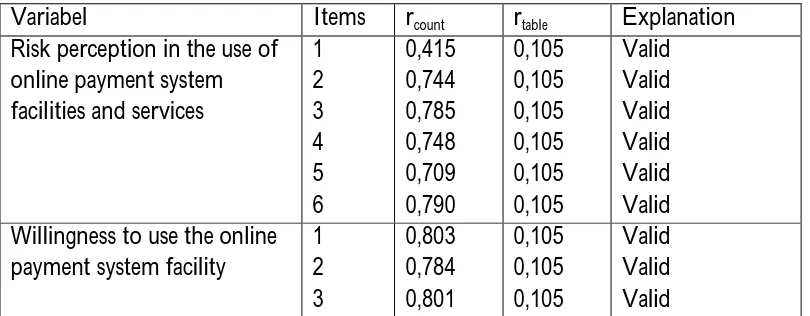
Tabel 4.1 Validation Test
Variabel Items rcount rtable Explanation
Risk perception in the use of online payment system facilities and services
1 2 3 4 5 6 0,415 0,744 0,785 0,748 0,709 0,790 0,105 0,105 0,105 0,105 0,105 0,105 Valid Valid Valid Valid Valid Valid Willingness to use the online
payment system facility
1 2 3 0,803 0,784 0,801 0,105 0,105 0,105 Valid Valid Valid
Test results in this study have value rcount > rtable, then all the items in this research
question is valid.
4.2 The Reliability Test
An instrument is valid if the value of Cronbach's Alpha > 0, 6[15], [16]. The summary of reliability test results is shown in Table 4.2 below:
Tabel 4.2 Reliability Test
Variabel Koef. Alpha
Cronbach
Limit of Koef. Alpha Cronbach
Explanation
Risk perception of Online payment system service facility users
0,883 0,6 Reliable
Willingness to use the online payment system facility
0,894 0,6 Reliable
[image:12.516.57.461.456.557.2]4.3 Analysis of Demographic Characteristics of Respondents
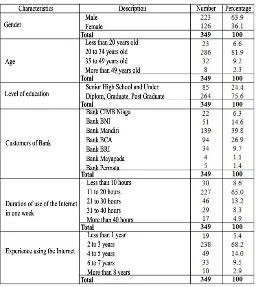
[image:13.516.135.391.292.579.2]The results of the demographic characteristics respondents analysis note that the majority of respondents in this study were male (63,9%), between the ages of 20 to 34 years (81,9%). Based on the characteristics of education level, the majority of respondents in this study were highly educated (Diploma, Graduate, Post Graduate) (75,6%), that most of them become customers of Bank Mandiri (39,8%). In a week, the majority of respondents used the Internet for 11 to 20 hours (65%), and had experience in using the internet for two to three years (68,2%). The data is shown in Table 4.3.
4.4 The Effect of Internet Usage Tendency to Willingness of Using Online Payment System
The results of the analysis is used to analyze wheter the variable of using the internet tendency had a positive influence on the willingness of customers to use online payment system.
4.5 The Effect of Internet Use to Willingness of Using Online Payment System
Regression results obtained regression coefficient (b) experience of using the internet variable to 0.312, which indicated that the experience of using the internet variable had a positive influence on the willingness to use online payment system facility. To prove whether the experiences of using the internet had a significant effect on the willingness to use online payment system facility, author used the t test.
Regression analysis obtained tcount values which was equal to 6,111 with probability (p)
0,000.
4.6 Risk Perception of Online Payment System in Willingness to Using Online
Payment System
Regression analysis obtained tcount value which was equal to -16,959 with
probability (p) 0,000. The results of this analysis indicated that the perception of risk in the use of online payment system had a significant effect on the willingness of customers to use online payment system facility. The influence of risk perception using online payment system indicated by the Adjusted R Square value which was equal to 0.452. This situation shows that the risk perception of the use of online payment system had the effect of 45.2% in determining the perception of the willingness of customers to use online payment system facility. And the rest (54.8%) willingness of customers to use online payment system was influenced by other factors not included in this model.
4.7 The Tendency of Using Internet Facilities with Online Payment System Risk
Perception
4.8 Experience in Using the Internet with Risk Perceptions of Online Payment System
Regression results obtained regression coefficient (b) the experience of using the Internet variable about -0,390 as shown in table 4.8. The results of this analysis showed that the variable experience of using the internet had a negative influence on the perception of the risk of the use of online payment system facilities. This condition shows that, the higher the respondents' experience in using the internet, the lower risk perception of respondents in using the online payment system facility.
4.9 The Test of Mediating Effect of Risk Perception in the Correlation Between
Internet Use Tendency and the Willingness To Use Online Payment System
Perception of risk is expressed as a mediating variable if:
This situation shows that the influence of the tendency of using the internet and the willingness to use online payment system facility is not mediated by perception of risks in using the online payment system facility. This condition indicates that the willingness of customers to use the online payment system facility will not decrease even if the customer knows the risk that he might receive when using the online payment system facility.
4.10 The Test of Risk Perception Mediating Effect of the Use of Online Payment
System in the Correlation between the Experience in Using Internet and the Willingness in Using Online Payment System
This situation shows that the tendency of using the internet to influence willingness to use online payment system is not mediated by perception of risks in using the online payment system facility.
5. Conclusion
Based on the results of data analysis of respondents in Yogyakarta city, Indonesia, author conclude that the results of the study are as follows:
1. The internet tendency to use internet had a significant effect in increasing the
willingness of customers to use online payment system facility. The influence of the tendency of using the internet to the customers’ willingness to use online payment system facilities was 13.9%.
2. The experience of using the internet had a significant effect in increasing the
willingness of customers to use online payment system facility. The influence of the experience of using the internet to customers’ willingness to use online payment system facilities was about 9.5%.
3. Risk perception of the use of online payment system facilities had a significant
effect in reducing the willingness of customers to use online payment system facility. Influence of the risk perception of the use of online payment system facilities to the willingness of customers to use online payment system was about 45.2%.
4. The tendency to use the internet had a significant effect in reducing the risk
perception of the use of online payment system facilities. Big influence on the tendency of using the internet usage of the risk perception of online payment system facilities was about 23.2%.
5. The experience of internet use had a significant effect in reducing the risk
perception of the use of online payment system facilities. The influence on the risk perception and the experience of using the internet with the use of online payment system was about 15%.
6. The risk perception of the online payment system facility use did not mediate
7. The risk perception of the online payment system use did not mediate the effect of Internet usage experience of the customers’ willingness to use the online payment system facility.
8. The risk perception did not mediate the relationship between the tendency of
using the internet, with a willingness to use the online payment system facilities. Meanwhile, the experience of using the internet had a significant effect on the willingness to use online payment system facilities.
6. References
Aberg, J. Dan Shahmehri, N., (2000). The Role of Human Web Assistants in Ecommerce: an Analysis and a Usability Study, Internet Research: Electronic Networking Applications and Policy, Vol. 10, No 2.
Aldridge, A., Forcht, K., dan Pierson, J., (1997), “Get Lingked or Get Lost: Markering Strategy for the internet”, Internet Research: Elektronic Applicatiion and Policy, Vol.17 No. 13.
Atmaja, Lukas Seia., (1997), Statistik Bisnis, Buku 2, Penerbit Andi Offset, Yogyakarta. Biswas, A., (1992), The Moderating role if Brand Familiarity in Reference Price Perception,
Journal of Business Research, Vol. 25. No.3.
Chau, P.Y.K., & Hu P.J., (2001), Examining the Technology Acceptance Model Usein Physician Accptance of Telemedicine Technology. Journal of Management Information Systems, Vol.20. No.4.
Chen, Z., dan Dubinzky, A., (2003), “A Conceptual Model of Perceived Consumer Value in E-Commerce: a Preliminary Investigation”, Pyschological and Marketing, Vol. 20. No. 4.
Cooper, D.R., dan Emory, C.W., (1997), Metode Penelitian Bisnis, Jilid I, Edisi Kelima, Penerbit Erlangga, Jakarta.
Davis, F.D., Bagozzi, R.P., Warsaw, P.R (1989), User Acceptance Of Computer Technology: A Comparison Of Two Theorical Models, Journal of Management Science, Vol.5. Desruelle, P. Dan Burgelman, C.J., (2001). The Impact of E-Commerce on The Value Chain,
The journal of Policy, Regulation and Strategy for Telecomunication, Information and media, Vol.3. No.6.
Dhall, D., Machandra, R., dan Argo, J., (2001) Embrassement in Consumer Purchase: The Role of Social Persence and Purchase Familiarity, Journal of Consumer Behavior, Harvad University Press, Baston.
Disahaw, M.T., Strong, D.M., (2002), Extending The Technology Acceptance Model With Task-Technology Model Construct, Journal of Information Management. Vol. 7. Ferraro, A., (1998). Electronic Commerce: The Issues and Challenges to Creating Trust and a
Positive Image in Consumer Sale on the World Wide Web, First Monday: Peeer- Reviewed Journal on the Internet, Vol. 3. No.6.
Haag, L.D., dan Keen, R.L., (1996), Task Technology Fit And Individual Performance. MIS Quaterly, Vol. 19.
Hadi, S., (2000), Analisis Butir Untuk Instrumen, Jilid1, Cetakan Lima, Yayasan Penerbit Fakultas Psikologi UGM, Yogyakarta.
Hair Jr., J.F.R.E. Anderson, R.L, Tatham, and W.C. Black., (2001), Multivariate Data Analysis: With Readings, 5th ed, Englewood Cliffs, New Jersey: Prentice-Hall, Inc.
Hermana, F., (2005), Pengaruh Faktor Kesesuaian Tugas-Teknologi Terhadap Kinerja Karyawan , Jurnal Riset Akuntansi dan Keuangan, Vol. 5. No. 2.
Hoffman, D.L., Novak, T.P., dan Peralt, M., (1999), Building Consumer Trus in Online Environments: The Case for Informational Privacy, Communication of the ACM, Vol. 42. No.4.
Indriantoro, N., (1999), Peranan Faktor Kecocokan Tugas-Teknologi Dalam Memperoleh Pengaruh Positif Teknologi Informasi Terhadap Kinerja Individual, Jurnal Ekonomi dan Bisnis Indonesia, Vol.3. No.3.
Kadir, D., (2003), Manajemen Sistem Informasi dan Teknologi Informasi, Penerbit E;xa Media Computindo, Jakarta.
King, J.D., (2003), Predicting Softwere Self Effcacy Among Business Students: A Preliminary Assesment, Journal of System Education, Vol.3.
Khulmeier, D., dan Knight, G., (2005), Antecedents it Internet-base Puschasin: a Multinational Study, Internet Marketing Review, Vol.22. No.4.
Lee, C.H., Oliver, R.L., dan Lamb, C.W., (2003), An Examination Of The Factors Contributing To Microcomputer Technology Acceptance, Accounting, Management and Information Technologies, Vol. 4. No.4.
Loudon, KC., dan Loundon, JP., (2002), “Exploring the determinants of retail service quality on the Internet”, Journal of Services Merketing, Vol.18 No.1.
Luo, X., (2002), Trust Oroduction and Privacy Concern on The Internet: a Framework Base on Relationship Marketing and Social Excange Theory, Industrial marketing Management, Vol. 31. No. 2.
Mäenpää, K., (2006), Clustering the Consumer on The Basis of Their Perception of The Internet Banking Services, Internet Research, Vol. 16.No.3.
Mitchell, V.W., dan Vassos, V., (1997), Perceived Risk and Risk Reduction in Holyday Perchase:a Cross-Cultural and Gender Analysis, Journal of Euromarketing, Vol.6 No.3. Raharjo, B. (2005), Keamanan Sistem Informasi Berbasis Internat. Penerbit PT Insan
Indonesia. Bandung.
Rogers, E. M. (1985), Diffusion of Innovations (4th Ed.). New York: he Free Press
Setianingsih, P., (1998), Pengaruh Sistem Kompterisasi Terhadap Perusahaan, Jurnal Ekonomi dan Bisnis Indonesia, Vol. 15, No.5.
Sugiyono., (2000), Metode Penelitian Bisnis, Cetakan 2, Penerbit CV. Alfabeta, Bandung. Sunardi., (2003), Analisis Faktor Yang dipertimbangkan Nasabah Dalam Mempersiapkan
Kualitas Layanan Bank Di Malang, Jurnal Ekonomi dan Bisnis, Vol. IX. No.1. Venkatesh, V.M., (2003), User Acceptance of Information Technology: Toward a Unified
View, Miss Quartely.
Wang, H., Lee, M., dan Wang, C., (1998), Consumer Privacy Concerns about Internet Marketing, Communication of ACM, Vol.41.No.3.
Weber, E.U., dan Hsee, C., (1998), Cross-Cultural in Risk Percepton, but Similarities In Attitudes Toward Perceived Risk, Managemenet Science, Vol.44.No.9.
![Figure 2.1: Theory of Reason Action (TRA) [8] 2.3. Theory of Planned Behavior (TPB)](https://thumb-us.123doks.com/thumbv2/123dok_us/9923624.494121/4.516.142.372.308.388/figure-theory-reason-action-tra-theory-planned-behavior.webp)
![Figure 2.2 Theory of Planned Behavior[5]](https://thumb-us.123doks.com/thumbv2/123dok_us/9923624.494121/5.516.147.376.124.223/figure-theory-of-planned-behavior.webp)
![Figure 2.4: Unified Theory of Acceptance and Use of Technology (UTAUT) [33]](https://thumb-us.123doks.com/thumbv2/123dok_us/9923624.494121/6.516.143.367.280.394/figure-unified-theory-acceptance-use-technology-utaut.webp)
![Figure 2.6 Research Model[22]](https://thumb-us.123doks.com/thumbv2/123dok_us/9923624.494121/7.516.152.371.258.438/figure-research-model.webp)