Physico-chemical Analysis of Ground Water Quality of
Chaibasa, Jharkhand with Special Reference to Nitrate
ARBIND PD PANDIT1, VISHNU S. SINHA2 and NANDJEE KUMAR3
1
P.G. Department of Chemistry, Tata College Chaibasa, INDIA.
2
P.G. Department of Botany, Tata College Chaibasa, INDIA.
3
Department of Botany,
Magadh University, Bodh Gaya, INDIA.
(Received on: January 23, 2014)
ABSTRACT
The Area under study, Chaibasa is situated in the West Singhbhum of Jharkhand State. The present study deals with physico-chemical parameter of ground water with special reference to Nitrate of five different areas of Chaibasa town and its adjoing area i.e. Khaparsai (S1), Meritola (S2), Kumhartoli (S3), Supalsai (S4) and
Madhutalab (S5). The groundwater parameters such as
temperature, pH, turbidity, electrical conductivity, alkalinity, dissolved oxygen, biochemical oxygen demand, total hardness, calcium, magnesium, phosphate, sulphate, nitrate, iron, chloride and fluoride were estimated in the samples to evaluate their quality. The data of physico chemical parameters are compared with WHO (1992) and IS: 10500 standards for drinking water. Our result revealed that concentration of DO, BOD, Total hardness, Calcium, magnesium, sulphate, turbidity, alkalinity, phosphate, iron and chloride are within permissible limits and Iron, phosphate are negligible in comparison to permissible limits whereas the concentration of Nitrate is higher at sampling areas S2 ,S3 and S5 .The concentration of Nirtate varied from20 to 60
Keywords: Groundwater, Physico-chemical parameter, Water
quality, Dissolved oxygen.
INTRODUCTION
Water is one of the most important and basic natural resources and forms about 75% of the matter of the earth crust and present in the form of marine water (Ocean and Sea) and fresh water (River, Lake, ponds, Streams and Ground water etc.).
Water is the prime requirement for life and used for drinking, bathing, recreation, irrigation, fisheries, navigation and power generation purposes etc. India receives 1800-1900 mm of rainfall annually. According to an estimate made by Indian central water commission (ICWC) for pollution control the total utilizable water from surface water sources is 690 cubic kms and ground water sources is about 452 cubic kms (Sud., 1997).
The management for waste water discharges from habitat centers, industries, agricultural activities etc to maintain the quality for various purposes.
India required 60% water for irrigation and 85% for drinking purposes which depends upon groundwater ; India is the largest user of ground water in using over 25% of the total global use of ground water. (Gautam and Kumar, 2010) India has more than 20 million bore wells in comparison to 0.2 million in USA.
The increasing human population has tremendously increased the demand of fresh water. The rapid growth of urban areas has affected the ground water quality due to over exploitation of resources and improper waste disposal practices. National Environmental Engineering Research Institute (NEERI), Nagpur has estimated that
a staggering 70 % of the available water in India is polluted (Sharma et al., 1996-1997).
Due to heavy mining activities in and around the district of west singhbhum, the quality of ground water may deteriorate further in future and no detailed investigation on ground water quality of this region has been carried out. Hence in the present study and investigation has been designed to understand the chemical characteristics of ground water of this region with special reference to nitrate.
AIM AND OBJECTIVE
The objective of the present investigation has been made to understand the chemical
characteristics of ground water quality of Chaibasa with special reference to nitrate.
STUDY AREA
Chaibasa is located in the West Singhbhum district of Jharkhand located at 22°-25° 15’ N Latitude and 83°-87°’ E Longitude. It is at a height of about 243.73 metre above the mean sea level. The average rainfall is about 1168 mm. The major rainfalls occur by south-west monsoon. Summer temperature shoots up to 44°c in the month of June and Winter falls down up to 7°c . The average relative humidity is about 56%.
for drinking purposes. The sampling stations are,Kharsai (SI),Meri Tola (S2), Kumhar Toli (S3) Supalsai (S4) and Madhu Talab(S5).
MATERIALS AND METHODS
The analysis of Phosphate, Iron, PH, Total Alkalinity, Calcium Hardness, Nitrate,
Nitrite, Ammonium, Fluoride, Residual-chlorine, chloride, Arsenic etc. were carried out by water testing kits which are supplied by Nice Chemicals (P)Ltd. Cochin, Kerala. The temperature of water samples were measured by thermometer (Celsius). The water analysis observed data were compared with the standard data provided by WHO for drinking purposes.
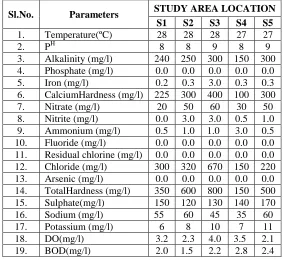
Table 1 : Showing different Physico-Chemical Parameters of Ground Water of Chaibasa.
Sl.No. Parameters STUDY AREA LOCATION
S1 S2 S3 S4 S5
1. Temperature(ºC) 28 28 28 27 27
2. PH 8 8 9 8 9
3. Alkalinity (mg/l) 240 250 300 150 300 4. Phosphate (mg/l) 0.0 0.0 0.0 0.0 0.0 5. Iron (mg/l) 0.2 0.3 3.0 0.3 0.3 6. CalciumHardness (mg/l) 225 300 400 100 300 7. Nitrate (mg/l) 20 50 60 30 50 8. Nitrite (mg/l) 0.0 3.0 3.0 0.5 1.0 9. Ammonium (mg/l) 0.5 1.0 1.0 3.0 0.5 10. Fluoride (mg/l) 0.0 0.0 0.0 0.0 0.0 11. Residual chlorine (mg/l) 0.0 0.0 0.0 0.0 0.0 12. Chloride (mg/l) 300 320 670 150 220 13. Arsenic (mg/l) 0.0 0.0 0.0 0.0 0.0 14. TotalHardness (mg/l) 350 600 800 150 500 15. Sulphate(mg/l) 150 120 130 140 170 16. Sodium (mg/l) 55 60 45 35 60 17. Potassium (mg/l) 6 8 10 7 11 18. DO(mg/l) 3.2 2.3 4.0 3.5 2.1 19. BOD(mg/l) 2.0 1.5 2.2 2.8 2.4
RESULTS AND DISCUSSION
The Physico-chemical characteristics of ground water are given in Table-1. and data are comparing with WHO (1992) and IS: 10500 standards for drinking water.
Temperature: Temperature of water plays important role for living beings. Quality of
water is also maintained by temperature. The temperature of different sampling station ranges from 27oC to 28oC
bicarbonates and hydroxides which occurs due to dissolution of minerals in the soil.The values of alkalinity ranges from 150 to 300 mg/l.
Iron: The concentration of iron varies from 0.2mg/L to 3.0 mg/Lwhereas permissible limit for iron is 0.3 to 1.0 mg/L.Only the sample S3 have higer value of iron (3mg/l).
Calcium Hardness: The value of calcium hardness varies from 100mg/l to 400mg/l.
Nitrate: The biochemical oxidations of nitrogenous substances coming from domestic wastes are main source of nitrate in Ground Water. The concentration of nitrate in present study varies from 20 mg/l to 60 mg/L which is higher the permissible limit of WHO health based guide line values. The concentrations of nitrate above 40mg/L cause Blue diseases in infants (Sharma, 1997).
Nitrite: It varies from 0.0 to 3.0 mg/l in the samples.
Ammonium: It varies from 0.5 to 3.0 mg/l Chloride : The chloride values ranges from 150 mg/L to 670 mg/L in the present sample. The permissible limit of chloride in drinking water is 250mg/L as suggested by WHO and ISI. The higher concentration of chloride may affect heart and kidney disease affected person (Patil et al., 2002)
Total Hardness: The temporary hardness of water is only due to dissolved of Calcium and Magnesium bicarbonate in water, where as permanent hardness is due to presence of chlorides of Calcium and Magnesium in water. The value of total hardness ranges
150 to 1500mg/L. However, there is no firm evidence suggesting drinking of hard water cause any adverse effect on health (Doctor
et al., 1998)
The observed values of sulphate, sodium, potassium, DO, BOD are within the permissible limits as per WHO guide lines for drinking water.
The values of phosphate, fluoride, residual chlorine and arsenic are observed negligible.
Table-2: Drinking water specification as per Is:10500-1993 revised
S. No
Parameters Desirable Limit
Permissible Limit in the absence of Alterane 6.5to8.5 No
Relaxation 3. Total Hardness as
CaCO3 (mg/L)
300 600
4. Iron(mg/L) 0.3 1.0
5. Chloride(mg/L) 250 1000
6. Fluoride(mg/L) 1.0 1.5
7. T.D.S(mg/L) 500 2000
8. Calcium(mg/L) 75 200
9. Magnesium(mg/L) 30 100
10. Nitrate(mg/L) 45 100
11. 11.
Sulphate(mg/L) Sulphate(mg/L)
200 200
400 400 12. Alkalinity(mg/L 200 600
13.* Sodium(mg/L) 75 -
14.* Potassium(mg/L 12 -
*As per WHO Guideline.
CONCLUSION
suggested by WHO for drinking water. The higher concentration of nitrate needs proper treatment before the use for drinking purposes.
SUGGESTION
The detail investigation may be carried out on other living organisms to avoid the hazardous/ injurious impact of the nitrate contamination.
REFERENCES
1. APHA. Standard methods for the Examination of water and wastewater, 17thEdition.American Public Health Association, Washington DC (1989). 2. BIS. Indian Standard specification for
Drinking Water, IS:10500, Bureau of Indian Standards, New Delhi (1998). 3. Dyaneshwari P and Meena D. Seasonal
variation ion DO and BOD of some lentic water bodies of Kolhapur city (MS) Geobios 33:70-72 (2006).
4. Doctor P B ,Paiyani C V, Desai N M, Kulkarni P K,Ruparelia and Ghosh SK. Physcio-chemical and microbial analysis of Dye contaminated river water. Ind. J.
Environ. Hlth.40 : 7-14 (1998).
5. ICMR. Manual of Standards of Quality of Drinking Water Supplies. Indian Council of Medical Research, New Delhi. Special Reports No.(44) 27 (1975).
6. ISI. Drinking water specification, Indian standard Institute, New Delhi (1991). 7. Kudesia V P. Water Pollution, Pragati
Prakashan, Meeret (1985).
8. Neeraj Verma. Studies on the drinking water and irrigation water resources of Industries state, Ph.D Thesis Barkatullah University, Bhopal (1994).
9. Nice Chemicals (p) Ltd. Cochin, Kerala. 10. Patil P R; Patil S K and Dhandae A D.
Studies on drinking water quality in Bhuswal corporation water supply (2002).
11. Sharma B K and Kaur H. Environmental Chemistry Third edition. Krishana Prakashan Media (P) Ltd, Meeret. Page No. Env. 30-32,Water 67-76 (1996-97). 12. Sud, Surender. Beware: Water is Fast
Becoming Scarce Yojana 41 (8) : 47- 48
(1997).
13. Sallae, A.J. Water borne diseases in Fundamental Principals of Bacteriology, 7th Edition, Tata McGraw Hill Publishing Company Ltd., New Delhi. (1975). 14. Senthilkumar RD; Narayansamy, R and
Ramkrishan K. Pollution studies on sugar mill effluent physic-chemicals characteristics and toxic metals. Poll.
Res. 20:93-97 (2001).