Title Implementing a technology roadmapping process in the service industry
The case of a contracted out governmental service
Place and date Deventer, November 27th 2013
Author R.D. (Robin) Barwegen Bsc.
Student number Twente s0170488
Student number Berlin 344031
E-mail [email protected]
University University of Twente
Program Business Administration
Track Innovation and Entrepreneurship
University Technical University of Berlin
Program Innovation Management and Entrepreneurship
Graduation committee Dr. ir. E. Hofman
University of Twente Business Administration
Dr. M.L. Ehrenhard University of Twente Business Administration
Prof. dr. K. Hӧlzle Uni versity of Potsdam
Innovation Management and Entrepreneurship
Prof. dr. J. Kratzer
Technical University of Berlin
Innovation Management and Entrepreneurship
Educational institutions
University of Twente Technical University of Berlin
“All you need is the plan, the road map, and the courage to press on to your destination.”
Robin Barwegen | Management summary i
Management summary
Introduction
Technology roadmapping has proven to be a useful method for enhancing the effectiveness of technology management. The method aims at identifying key market trends, determining the evolution of products or services and to recognize technological opportunities. The main advantage is that direct linkages among these aspects are created. After the identification of the key market trends it is determined how one should react upon these trends with products or services. Subsequently, technological opportunities are sought for which enable or create these products or services. Thereby an idea is obtained regarding the most promising services or products and technologies for the future.
Although the method has been widely spread within the manufacturing industry, its presence within the service industry is only in its infancy. Scholars advocate that technology roadmaps have to be customized according to the characteristics and context of a firm in order to obtain maximum benefit of the method. This means that technology roadmaps are highly context dependent and its transferability to other contexts is questioned. Research that tests the applicability of a suitable technology roadmap within the service industry is desirable. A handful of case studies have been conducted in order to fill this gap. However, these studies describe ex-post what has happened. It is not possible to follow the decision making process why certain variables are taken into account for the customization process and how the technology roadmapping process is adapted based on these variables. In addition, the conducted case studies have failed to take the complexity of services into account as the presented roadmaps are rather simplistic. This study aims at filling this gap.
Research design
At the same time a service-oriented firm had a practical problem because they had wanted to create an overview of which market trends they should follow the coming decade. In addition, they wanted to know how they should react upon these market trends with their services and technologies. In order to fulfill this practical wish and to contribute to the academic community an action research approach has been chosen. This had the aim of answering the following central research question:
What constitutes a suitable technology roadmapping process for a service-oriented firm?
In order to answer this research question a framework was designed. Through a literature study, consulting company documents, observations and validation meetings a technology roadmapping implementation plan was designed. Subsequently, this plan had to be implemented and based on four pillars of suitability evaluated. Thereafter conclusions should be drawn and recommendations had to be given.
Methods
ii Management summary | Robin Barwegen Theoretical framework
A literature review has been conducted to obtain an understanding of the most crucial aspects of designing and implementing a technology roadmapping process. The following definition has been used for a technology roadmap: “documents that recognize the key defining parameters of the markets, products, and technologies for one part of the business”. The architecture of a technology roadmap consists out of two key dimensions: the time frame and the layers of the roadmap. The layers act as the subjects of the roadmap, while the developments of these subjects are projected on a timeline.
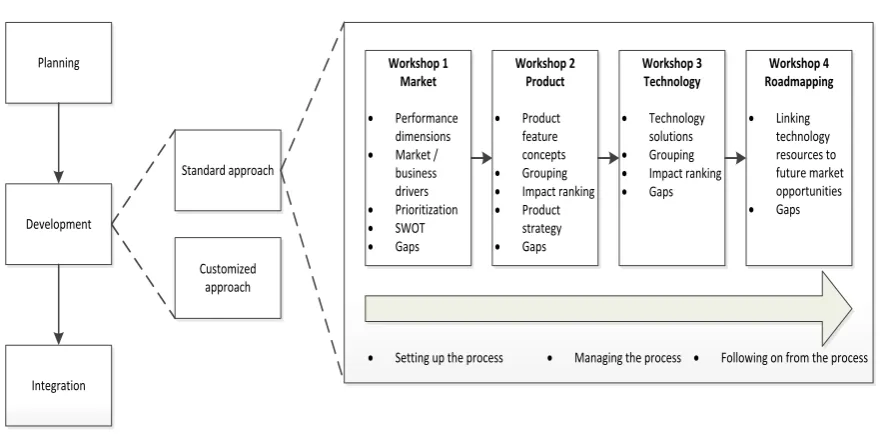
A technology roadmap is the outcome of a technology roadmapping process. This has been conceptualized as “a structured set of activities aimed at integrating short- and long-term knowledge from the market, products, services and technology, leading to a map of unfolding evolution of technologies and product or services that implement them to ensure that the required technologies will be available when needed”. The process consists out of three main phases. First, the planning phase has the purpose of creating awareness of the value and to develop an understanding of the method. Top-management support should be obtained and an implementation plan needs to be developed. The development phase encompasses the implementation of the technology roadmapping process. In this thesis this has been done through organizing a series of workshops, whereby each layer of the roadmap acted as the subject of one workshop. Experts were invited to analyze data and to share their knowledge which resulted in the creation of a roadmap. The last phase of the process is aimed at integrating the technology roadmapping process within the existing process of the firm. Thereby it should become an ongoing process.
A key aspect of the technology roadmapping process is the customization. Scholars advocate that a roadmap should be adapted to the characteristics and context of a firm to obtain an optimal result. Customization can be applied to the architecture and the process design. Customization of the architecture means that layers of the roadmap are added or deleted and that the timeframe is adjusted. Customization of the process design refers to adapting the agendas of the workshops in such a fashion that they lead to the desired outcome.
The last section of the theoretical framework was used to obtain an idea of the current state-of-the-art of technology roadmapping within the service industry. In the service literature the importance of the synthesis stream has been acknowledged. This stream focuses on bringing manufacturing and services research together instead of studying them separately. This led to the integration of the product-service system concept within technology roadmapping. The aim of these roadmaps is to integrate related services and products into one roadmap because single products are no longer sufficient to satisfy customer needs. Previous service roadmaps simply added a service layer to the generic roadmaps or substituted the product layer for a service layer.
Conclusion
Robin Barwegen | Management summary iii addition, the architecture has been customized in such a fashion that the main goal of the process has been achieved. It is concluded that the architecture has been customized properly based on the identified variables.
The third aspect of the process involved the customization of the process design. There were no large problems with the outcomes of the market, product-service and roadmapping workshops. However, during the technology workshop a problem did rise as a limited amount of technologies had been identified. Based on the scarcity of identified technologies combined with a doubt regarding the added value of the workshop it was decided to delete the system layer from the TRM architecture. Instead a technology-push workshop was organized which was in essence a gap analysis because this was not done in the previous workshop. The activities of each single workshop have led to appropriate results. This is important to consider because the output of one workshop serves as input for the following. This shows that the process design was properly developed.
The last step for assessing the suitability of the roadmap encompassed evaluating the success of the outcome. The roadmap gives the company a good view of how they should adapt their services and technologies in order to satisfy market drivers within the coming ten years. This indicates the overall success of the roadmap has been proven. Based on the evaluation of the identified variables, the customized architecture, the customized process design and the overall outcome it can be stated that for a first test-run the process has been successful. This supports the design of a suitable TRM process for a service oriented firm.
Compared to generic TRM frameworks the findings show that the TRM process within this service firm deviates in multiple ways. First, an integrated layer of products and services fits within a service firm because of the fading boundaries between products and services. Second, participants have to be pushed to go beyond the term of a long-lasting contract. Third, making a differentiation between the user and customer helps with identifying features in the product-service workshop. Fourth, technologies were relatively difficult to identify on the roadmap mainly because of the used methodology, the organizational structures and the nature of the service.
Recommendations
The following practical recommendations are given specifically for managers who manage or want to manage a TRM process within a service-oriented firm. First, for a manager of a firm where the concepts of products and services are used interchangeably it is helpful to implement an integrated product-service layer in their TRM process. The main advantage of this is that the focus is on the core offerings of a company. Second, managers of service oriented firms where the user differs from the customer are encouraged to make to same differentiation in the product-service layer. The application of this distinction helps to identify diverse features on the roadmap. Third, a practitioner of a service oriented firm is discouraged to implement a systems layer in their TRM process. The main reason for this is that the systems and architecture of a service are dynamic. This means that these change over time and that an assessment of how a feature influences the current architecture makes little sense as the architecture might look different at the time when the feature is implemented.
iv Management summary | Robin Barwegen
Robin Barwegen | Preface v
Preface
Innovation has been the focal point of interest during my study period. At the time that my master study in Twente came to its end the opportunity to enroll in the master program innovation management and entrepreneurship of Technical University of Berlin occurred. After two semesters with interesting courses the real deal still had to be done: writing the master thesis.
With the help of Katharina Hӧlzle’s connections I was fortunate to conduct a project at Toll Collect. The combination of theory and practice has been an ideal combination. Academic literature has been used as a solid foundation for the design of a technology roadmapping process. Subsequently, by actually implementing the process valuable information was obtained and conclusions could be drawn regarding service roadmapping. The fact that the implemented process had direct value for the company was certainly satisfying.
During the entire period of writing my master thesis I had a lot of support. As pointed out earlier, without the help of Katharina Hӧlzle I would probably not have got in touch with Toll Collect. In addition, her feedback and tips helped me a lot during the design of roadmapping process and writing my thesis. The feedback from Erwin Hofman, my supervisor from Twente, was also welcome. Especially his tips on the research design and structuring the thesis properly helped me a lot. My family, friends and girlfriend also deserve a note of credit here. I am sure that at some point I drove them crazy with my talk about roadmaps.
During my time at the company I have always felt welcome and the freedom of carrying out this project helped me with my professional development to a great extent. First of all, I would like to thank everyone at the PPM department. With Thies and Volker I have had great discussions and they supported me splendidly during the entire time of the process. I could always throw my ideas at Burkhard and get creative feedback. I would also like to thank Corinna for keeping an eye on the quality of the content of the roadmap and her ideas for the process. In addition, the support and input of Katharina, Klaus, Gunnar, Mark and Matthias has been great. Second of all, during my first two months I was located at the SUE department. Also there I had a lot of support from Michael, Stephan, Olaf, Gillian, Gerrit, Thomas, Jӧrg and Navina. Lastly, the quality of the roadmap falls or stands with experts who are present during the workshop. Therefore I would like to thank Christine, Thomas and Sandrafor their technical input.
Designing and implementing a technology roadmapping process has certainly been a challenge, but along the journey the results have been interesting and I hope this is reflected in the following thesis.
Robin Barwegen
Robin Barwegen | Table of contents 1
Table of contents
COLOPHON ... III
MANAGEMENT SUMMARY ... I
PREFACE ... V
TABLE OF CONTENTS ... 1
LIST OF FIGURES ... 3
LIST OF TABLES ... 4
LIST OF ABBREVIATIONS ... 5
1 INTRODUCTION... 6
1.1 PRACTICAL RELEVANCE ... 6
1.2 RESEARCH CONTEXT ... 6
1.3 RESEARCH OBJECTIVE ... 8
1.4 RESEARCH FRAMEWORK ... 8
1.5 RESEARCH QUESTIONS ... 8
1.6 CONCEPTUALIZATION ... 10
2 METHODOLOGY ... 12
2.1 RESEARCH STRATEGY ... 12
2.2 METHODS ... 13
2.3 DATA ANALYSIS ... 15
2.4 QUALITY OF ANALYSIS ... 16
3 THEORETICAL FRAMEWORK ... 21
3.1 TECHNOLOGY ROADMAP ... 21
3.2 TECHNOLOGY ROADMAPPING PROCESS ... 24
3.3 CURRENT STATE-OF-THE-ART IN TECHNOLOGY-SERVICE ROADMAPPING ... 31
4 FINDINGS ... 36
4.1 CUSTOMIZATION OF THE TRM ARCHITECTURE ... 36
4.2 CUSTOMIZATION OF THE PROCESS DESIGN ... 40
4.3 OUTCOME OF THE TRM PROCESS ... 47
5 DISCUSSION ... 48
5.1 CUSTOMIZATION OF THE TRM ARCHITECTURE ... 48
5.2 CUSTOMIZATION OF THE PROCESS DESIGN ... 49
5.3 OUTCOME OF THE TRM PROCESS ... 53
5.4 EVALUATION OF THE SUITABILITY ... 54
6 CONCLUSION ... 55
6.1 CONCLUSIONS ... 55
2 Table of contents | Robin Barwegen
6.3 GENERALIZIBILITY ... 57
7 CONTRIBUTIONS AND RECOMMENDATIONS ... 59
7.1 THEORETICAL CONTRIBUTIONS ... 59
7.2 MANAGERIAL RECOMMENDATIONS ... 60
7.3 FUTURE RESEARCH ... 61
7.4 REFLECTION ... 62
8 REFERENCES ... 63
9 APPENDICES... 71
9.1 APPENDIX A: OVERVIEW OF ACTIVITIES TC ... 71
9.2 APPENDIX B: DEFINITIONS OF TECHNOLOGY ROADMAPPING ... 74
9.3 APPENDIX C: INTERVIEW PROTOCOL ... 75
9.4 APPENDIX D: LOG OF MEETINGS ... 77
Robin Barwegen | List of figures 3
List of figures
FIGURE 1: RESEARCH FRAMEWORK ... 8
FIGURE 2: ACTION RESEARCH MODEL ADAPTED FROM SUSMAN & EVERED (1978) ... 13
FIGURE 3: THE APPLIED RESEARCH MODEL... 13
FIGURE 4: TAXONOMY OF ROADMAPS CREATED BY KAPPEL (2001) ... 22
FIGURE 5: GENERIC TRM FRAMEWORK (PHAAL & MULLER, 2009) ... 23
FIGURE 6: PHASES OF THE TECHNOLOGY ROADMAPPING PROCESS ... 24
FIGURE 7: PLANNING PHASE OF A TRM (BASED ON GUIDELINE OF GERDSRI ET AL., 2010) ... 25
FIGURE 8: DEVELOPMENT PHASE OF A STANDARD T-PLAN (PHAAL ET AL. 2003) ... 27
FIGURE 9: INTEGRATION PHASE OF A TRM PROCESS ... 28
FIGURE 10: PSS MODEL OF BAINES ET AL. (2007) ... 32
FIGURE 11: FIRST SERVICE ROADMAP OF KAMEOKA ET AL. 2006 ... 33
FIGURE 12: CUSTOMIZATION MODEL ... 36
FIGURE 13: FINAL LAYERS OF THE CUSTOMIZED TRM PROCESS ... 39
FIGURE 14: ACTIVITY OVERVIEW TC ... 71
FIGURE 15: AUTOMATIC TOLL COLLECTION... 71
FIGURE 16: MANUAL TOLL COLLECTION VIA INTERNET LOG-ON ... 72
4 List of Tables | Robin Barwegen
List of Tables
TABLE 1: DEFINITIONS OF MOST IMPORTANT USED CONCEPTS ... 10
TABLE 2: CRITERIA OF THE PRINCIPLE OF RCA ... 17
TABLE 3: CRITERIA OF THE CYCLICAL PROCESS MODEL ... 17
TABLE 4: CRITERIA OF THE PRINCIPLE OF THEORY ... 18
TABLE 5: CRITERIA OF CHANGE THROUGH ACTION ... 18
TABLE 6: CRITERIA OF LEARNING THROUGH REFLECTION ... 19
TABLE 7: AGENDA OF THE MARKET WORKSHOP ... 41
TABLE 8: AGENDA OF THE PRODUCT-SERVICE WORKSHOP ... 42
TABLE 9: AGENDA OF THE TECHNOLOGY WORKSHOP ... 43
TABLE 10: AGENDA OF THE TECHNOLOGY-PUSH WORKSHOP ... 45
TABLE 11: AGENDA OF THE ROADMAPPING WORKSHOP ... 46
TABLE 12: CONDITIONS FOR ASSESSING THE SUCCESS OF ACTION RESEARCH ... 57
TABLE 13: DEFINITIONS OF TECHNOLOGY ROADMAPPING ... 74
Robin Barwegen | List of abbreviations 5
List of abbreviations
CAR Canocial action research
e.g. Exempli gratia
EIRMA European Idustrial Research Management Association
PSS Product-service system
R&D Research and development
RCA Research-client agreement
6 Introduction | Robin Barwegen
1
Introduction
This chapter aims at introducing the topic of this master thesis. First the practical relevance of the study is presented. Subsequently the research context, research objective, research framework, research questions and the conceptualization are given.
1.1
Practical relevance
Germany is a major transportation hub within Europe. Every day thousands of trucks from all over Europe pass through the country and use the roads. Especially heavy trucks are a burden for the quality of the roads. Therefore the German government wanted to implement a method whereby trucks, weighing more than twelve tonnes, were charged per driven kilometer within Germany. The high specialization of this task made it difficult for the government to execute it entirely by themselves. In order to obtain funds for the maintenance of the roads a contract with an external company that had the responsibility of collecting the toll was made up in 2002. This company was Toll Collect (hereafter called TC).
TC is a consortium which is made up out of three shareholders. Daimler Financial Services AG is highly specialized in financial services and has 45% of the shares. Deutsche Telekom has the same amount of shares and is known for their expertise in telecommunication services. The remaining shares are owned by the French company Cofiroute. This firm manages the roads within the Western part of France and in exchange has been enabled to charge tolls. The bundling of knowledge and expertise of these companies enabled the creation of the world’s first stable and reliable satellite-based truck toll system. After a delay the system has been implemented on January 1st 2005. A more detailed overview of the activities of TC can be found in appendix A.
The service that TC delivers to the government is to transfer the toll on time. The obligations and duties that define this service have been captured in a binding contract. Thereby the activities that TC can perform are legally defined. It may do no more, no less. If the company wants to add or delete activities the contract needs to be renewed. Such contract renewals can take months or even years. An activity that the company wants to perform in two years has to be known and secured in the contract right now.
The contract is coming to its end in 2015 and the company wants to get an overview of the market trends they need to follow the coming decade. Subsequently, an overview needs to be created which displays how TC should react upon these drivers with its services and technologies. Thereby the company has the opportunity to fix certain features or activities in the contract which they want to carry out in the coming ten years. In order to achieve this goal a technology roadmapping process is going to be implemented. This method has the potential of establishing linkages among the most important market trends, the evolution of services and the development of technologies that enable these services in one overview.
1.2
Research context
Robin Barwegen | Introduction 7 caused an increasing pressure for service firms to compete on new offerings (Menor, 2000). Despite the increased growth and relevance of services it is one of the least studied and understood topics in the innovation management literature (Johnson et al., 2000; Menor et al., 2002; de Jong et al., 2003). Services have traditionally been described as “high-touch, low-tech”. However, the inclusion of technologies changed their nature drastically (Bitner et al., 2000). As a result the current tactics for the developments of new services are inadequate because they are typically undertaken in a non-systemic manner and our understanding of the critical resources and activities to develop new services is inadequate (Menor et al., 2002; Gustafsson & Johnson, 2003; Thomke, 2003; Berry et al., 2006).
A potential method to fill this gap is by using a technology roadmapping (TRM) process to enhance the effectiveness of technology management. Its popularity is explained by the fact that this method supports innovation and strategic decision making at the same time (Galvin, 1998; Vatananan & Gerdsri, 2004; Phaal & Muller, 2009). Previous used methods were short-term oriented and poor in identifying technologies needed to address market demands (Kostoff et al., 2004). Over time, technology roadmapping has proven to be effective for its long-term focus (Kappel, 2001), the identification of disruptive innovations (Kostoff et al., 2004), to perceive threats in the external environment (Phaal & Muller, 2009), to enhance communication within an organization (Kostoff & Schaller, 2001) and to include the strategic dimension (Albright & Kappel, 2003).
Despite the potential of the technology roadmapping method it has mainly been applied within the manufacturing industry (Wells et al., 2004; Fouskas et al., 2005). Several scholars (Groenveld, 1997; Phaal et al., 2004b; Lee & Park, 2005) advocate that technology roadmaps need to be customized to fit with the context and characteristics of a firm. This means that technology roadmaps are highly context dependent and therefore its transferability to other contexts, in this case to service oriented firms, is questioned (Phaal et al., 2004b). Therefore research that tests the applicability of a suitable technology roadmapping process within the service industries is highly desirable (Kim et al., 2008; Geum et al., 2011a). In this light, a handful of case studies have been performed in order to understand the phenomena of service roadmapping (Wells et al., 2004; Daim & Oliver, 2008; Tuominen & Ahlqvist, 2010). However, these studies describe ex-post what has happened and what have been the focal points in these cases. It is not possible to follow the researchers’ thoughts during the design or customization process. Studies that describe which characteristics of a service oriented firm demand attention and how the roadmap should be customized accordingly are missing. In addition, the conducted case studies have failed to take the complexity of services into account as the presented roadmaps are rather simplistic.
8 Introduction | Robin Barwegen
1.3
Research objective
The research objective of this thesis and the objective in this thesis are based on the presented research context in the previous paragraph.
The objective of the research is formulated in the following way:
“To obtain insight in what encompasses a suitable service-oriented technology roadmapping process by assessing the suitability of a customized technology roadmapping process which is customized for and implemented within a service-oriented firm.”
1.4
Research framework
According to Verschuren & Doorewaard (2007) a research framework is an illustration of the research objective and includes the necessary steps in order to achieve it. The research framework of this thesis is formulated as follows:
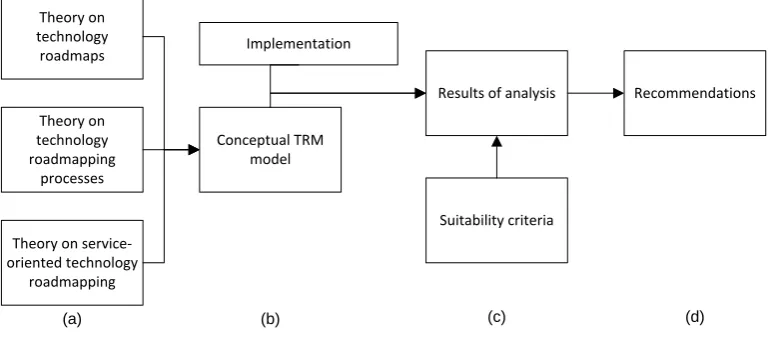
(a) A study of the theories of technology roadmaps, technology roadmapping processes and technology roadmapping within a service environment results in a conceptual model (b), to be used for the implementation of a technology roadmapping process within a service-oriented firm. (c) Four criteria of suitability are used for the evaluation of the implementation that subsequently results in (d) recommendations for designing and implementing a technology roadmapping process within a service-oriented firm. Figure 1 illustrates this research framework.
Theory on technology
roadmaps
Theory on technology roadmapping
processes
Theory on service-oriented technology
roadmapping
Recommendations Implementation
Conceptual TRM model
Results of analysis
(a) (b) (c) (d)
[image:20.595.72.458.392.569.2]Suitability criteria
Figure 1: Research framework
1.5
Research questions
The research objective has lead to the central research question which is captured in the following way:
Central research question
What constitutes a suitable technology roadmapping process for a service-oriented firm?
Robin Barwegen | Introduction 9 architecture, the success of customizing the process design and the success of the outcome. It is articulated within the scientific literature that a technology roadmapping process should be customized in order to fit with the characteristics and context of the firm (Groenveld, 1997; Phaal et al., 2004b; Lee & Park, 2005). Therefore the first aspect relates to whether the correct characteristics have been chosen in order to adapt the architecture of the TRM process. Phaal et al. (2004b) state that the actual customization process consists of both adapting the architecture, which refers to choosing the layers or subjects of the roadmap, and customizing the process design. This encompasses the adaption of agendas of the workshops. Last, Gerdrsri et al. (2010) argue that the success of a TRM process should be judged on to what extent the goal of initiating a TRM process has been achieved. Therefore these four criteria have been used to assess the suitability of the TRM process.
Sub questions
Seven sub-questions have been created which help with answering the central research question. These sub-questions have been designed in such a way that they are steering and efficient as Verschuren & Doorewaard (2007) explain. The first set of sub-questions concern the customization process of both the architecture and process design. The second set of sub-questions relate to evaluating the suitability of the implemented TRM process. Here the four pillars are taken into account. Both sets questions are helpful because they guide the research project towards developing a conceptual TRM model for TC and subsequently by evaluating this conceptual model.
For developing a suitable conceptual TRM process for TC the following sub-questions have been created:
1. Which characteristics of TC affect the customization of the architecture of a technology roadmapping process?
2. How do the identified characteristics of TC affect the customization of the architecture of a service-oriented technology roadmapping process?
3. How does the customized architecture subsequently affect the customization of the process design of a service-oriented technology roadmapping process?
In order to assess the extent to which the implemented TRM process was suitable for TC the following sub-questions have been developed:
4. To what extent has the architecture been customized based on the correct characteristics of TC? 5. To what extent has the architecture of the TRM process been customized properly?
10 Introduction | Robin Barwegen
1.6
Conceptualization
Having elaborated on the research questions of the thesis it becomes evident to conceptualize the terms that have been used. In order to create a clear understanding the main terms are explained.
1.6.1 General concepts
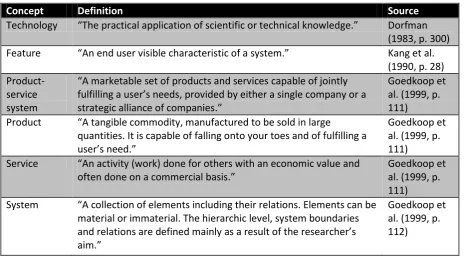
Important definitions of concepts that have been used in this thesis are presented in table 1.
Concept Definition Source
Technology “The practical application of scientific or technical knowledge.” Dorfman (1983, p. 300)
Feature “An end user visible characteristic of a system.” Kang et al.
(1990, p. 28)
Product-service system
“A marketable set of products and services capable of jointly fulfilling a user’s needs, provided by either a single company or a strategic alliance of companies.”
Goedkoop et al. (1999, p. 111)
Product “A tangible commodity, manufactured to be sold in large
quantities. It is capable of falling onto your toes and of fulfilling a user’s need.”
Goedkoop et al. (1999, p. 111) Service “An activity (work) done for others with an economic value and
often done on a commercial basis.”
Goedkoop et al. (1999, p. 111) System “A collection of elements including their relations. Elements can be
material or immaterial. The hierarchic level, system boundaries and relations are defined mainly as a result of the researcher’s aim.”
[image:22.595.70.537.167.423.2]Goedkoop et al. (1999, p. 112)
Table 1: Definitions of most important used concepts
1.6.2 Technology roadmapping process
In order to clarify the concept of a technology roadmapping process the term technology roadmapping is explored first. Phaal et al. (2004b, p. 31) explicitly mention knowledge management in their definition: “Technology roadmapping is a practical action-oriented tool for supporting knowledge management in an organization”. Garcia & Bray (1997, p. 9) clearly focus on the development of a map with technologies: “Technology roadmapping […] is an effective technology planning tool to help identify product needs, map them into technology alternatives, and develop project plans to ensure that the required technologies will be available when needed. Groenveld (2007, p. 50) emphasizes the integration of the strategic dimension in his definition: “Roadmapping is a process that contributes to the integration of business and technology and to the definition of technology strategy by displaying the interaction between products and technologies over time, taking into account both short- and long-term product and technology aspects”.
Subsequently, a process within a business context is “a structured, measured set of activities designed to produce a specific output for a particular customer or market. […] It has a specific ordering of work activities across time and space, with a beginning and an end, and clearly defined inputs and outputs” (Davenport, 1993, p. 5).
Robin Barwegen | 11 evolution of technologies, product and services that implement them to ensure that the required technologies will be available when needed”.
1.6.3 Technology roadmap
As the outcome of a technology roadmapping process is a technology roadmap it is subsequently necessary to conceptualize a technology roadmap. Although several different definitions exist (see appendix B), the definition of Kappel (2001, p. 41) will be used as this definition fits the best with the overall aim of the thesis. The inclusion of the service concept was lacking in all identified definitions. Therefore this was added to Kappel’s (2001) conceptualization: “A document that helps the viewer recognize the critical definitive factors in the market, product, service, and technology, which form a part of the business”.
1.6.4 TRM implementation
12 Methodology | Robin Barwegen
2
Methodology
This chapter contains the methodology that has been applied within this thesis. The research strategy is elaborated on first. The methods and data analysis are subsequently presented.
2.1
Research strategy
This section first described the selection of the research strategy and subsequently presents the general implementation strategy of this research strategy.
2.1.1 Selection of the research strategy
The type of research strategy should fit with the objective of the study. The objective of this study is twofold: doing research in order to answer the research question and to fulfill a practical need. The researcher is therefore actively engaged in designing and carrying out the TRM process. This is a typical objective of action research which is defined as “the active and deliberate self-involvement of the researcher in the context of his or her investigation” (McKay & Marshall, 2001, p. 49). Case studies and action research are related in the sense that the researcher is concerned with gaining an in-depth understanding of a particular phenomenon in real-world settings (Blichfeldt & Andersen, 2006). However, it should be taken into account that there are clear differences between the two approaches. Case researchers mostly use information from participants in to order to do research about phenomena prior to doing the study. Action researchers need to collaborate with participants during the study to successfully solve a practical problem. Additionally, case researchers are mostly targeting the academic community, while action researchers at the same time have an obligation to inform the people for whom they solved the practical problem. Grønhaug & Olsson (1999) explain that action researchers therefore tend to forget to report how they conducted their research in detail which diminishes their academic contributions. In order to increase the academic acceptance of their work action researchers should replace hypotheses with themes by presenting an intellectual framework of ideas in advance (Yin, 2003; Checkland & Holwell, 1998; Blichfeldt & Andersen, 2006). Generally, action researchers leave it up to the reader how to interpret their outcomes (Coghlan, 2003), while case researchers apply analytical generalizations of their results. In order to increase the value of their research it is therefore recommended that the action researcher explains the reason why his or her outcomes interest others (Coghlan, 200; Blichfeldt & Andersen, 2006).
2.1.2 Implementing action research
Robin Barwegen | Methodology 13 Diagnosing Action planning Action taking Evaluating Specifying learning
[image:25.595.70.351.70.281.2]Development of a client-system infrastructure
Figure 2: Action research model adapted from Susman & Evered (1978)
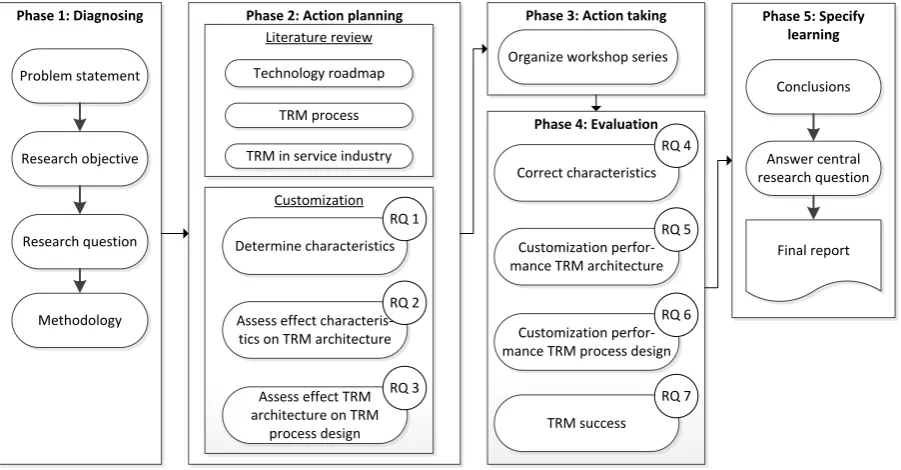
All five phases of the framework are necessary to carry out a comprehensive action research. The researcher starts with diagnosing the situation. A concrete problem statement is identified that subsequently leads to the research objective and question. A plan is developed and implemented to reach the objectives of the study and to answer the research question. Finally, the actions should be thoroughly evaluated and the lessons that were learned need to be specified. Figure 3 illustrates how the model of Susman & Evered (1978) has been applied. The following sections of this chapter explain these steps in-depth.
Phase 1: Diagnosing
Problem statement
Research objective
Research question
Methodology
Phase 2: Action planning Literature review
Customization
Phase 3: Action taking Phase 5: Specify
learning Answer central research question Conclusions Final report Technology roadmap TRM process
TRM in service industry
Assess effect TRM architecture on TRM
process design Assess effect characteris-
tics on TRM architecture Determine characteristics
RQ 1
RQ 2
RQ 3
Phase 4: Evaluation
Customization perfor-mance TRM process design
Customization perfor-mance TRM architecture
Correct characteristics RQ 4 RQ 5 RQ 6 TRM success RQ 7 Organize workshop series
Figure 3: The applied research model
2.2
Methods
[image:25.595.73.524.433.668.2]14 Methodology | Robin Barwegen
2.2.1 Case selection
The selection of cases is important when conducting an in-depth study as the generated theory is build on information derived from the cases. The selected case should address the purpose of the study, which is also known as purposive or judgmental sampling. This form of sampling is a form of non-probability based selection where the researcher judges the usefulness of the case in order to understand the studied issue and to answer the research questions (Babbie, 2007). The purpose of this type of sampling is to identify cases which possess characteristics which are relevant to the phenomenon being studied. Thereby the exploration of a particular phenomenon is enabled (Mays & Pope, 1995). In this case, the researcher wants to do research about the suitability of a TRM process within a service-oriented firm. Therefore a service-oriented firm has been chosen as the case.
2.2.2 Unit and level of analysis
In order to establish the scope of the research, the unit and level of analysis have to be considered (Yin, 2003). Units can be people, time periods, institutions, or almost anything else that is studied (Shadish et al., 2002). In this study the unit of analysis is the technology roadmapping process within a service oriented firm.
A distinction into different phase of the research led to differentiated levels of analysis. During the customization process the level of analysis will be TRM team while an expert panel is the level of analysis during the development phase. This expert panel will consist out of experts from different departments and therefore are an ideal level of analysis. During the evaluation process of the entire project the level of analysis will be the interviewees.
2.2.3 Data collection
To obtain sufficient data for drawing conclusions multiple data collection procedures are used. Multiple scholars have supplemented an action research strategy with case research methods (Iversen et al., 2004; Ray & Ray, 2006). Within action research the researcher and participants of the organization work closely together. By adopting case research methods the risk of uncontrollability and too much subjectiveness is reduced (Kock, 2004). This study has used four different data collection procedures: (1) interviews, (2) studying existing company documents, (3) observations and (4) focus groups. The use of multiple methods enhances data credibility and enables triangulation (Eisenhardt, 1989; Yin, 2003). The different data sources are one piece of the “puzzle”, whereby each piece contributes to the understanding of the complete phenomenon (Baxter & Jack, 2008).
2.2.3.1 Interviews
Robin Barwegen | Methodology 15 2.2.3.2 Studying existing company documents
The outcome of the action planning phase resulted into a customized TRM framework. The characteristics of the firm and the purpose of the roadmap affect this process. Therefore academic literature was consulted to check what type of generic framework is suitable for the specific purpose of the firm. Internal documents have been studied to find out the characteristics of the case that deviate and need customization. Additionally, once these characteristics had been found an additional literature study was conducted to explore the effect on service innovation and new service development. As Babbie (2007) explained internal documents are a valuable unobtrusive source of information because these sources are most likely of high quality.
2.2.3.3 Observations
The researcher was located within the organization for five months. During this period several meetings have been attended and five workshops have been organized. Babbie (2007) explains that it is vital to make full and accurate notes of what goes on. Therefore a log of all meetings has been kept (see appendix D). This log contains the dates, duration, names, positions of the participants and what was learned from these meetings. This log served to keep an overview of all the conclusions that were drawn during the meetings. Within this log references are made to documents with a more extensive elaboration of what happened during a meeting or workshop. These documents were written as soon as the meeting was over as Babbie (2007) recommended.
2.2.3.4 Focus groups
The focus group method is essentially a qualitative method which allows the researcher to question multiple individuals systematically and simultaneously. The participants are chosen on the basis of the relevance to the topic (Babbie, 2007). This method is used in the development phase as it is essential for the creation for introducing an appropriate technology roadmapping process at a service oriented firm. In order to obtain data from relevant different points of view, the participants of the focus group are chosen based on their expertise and is therefore a type of purposive sampling. Their expertise is linked to one of the different subjects of the roadmap. Thereby every subject has an expert within the focus group. Advantages of the approach are the flexibility, high face validity, speedy results and capturing real-life data in a social environment (Krueger, 1988). Every method has its disadvantages and this case the challenge lies in the moderating skills of the researcher (Babbie, 2007). Within a group of people the researcher will probably have less control than with the use of individual interviews and therefore they need special skills (Krueger, 1988). Other challenges are the fact that data is difficult to analyze and groups are difficult to assemble (Krueger, 1988). These challenges has been tried to overcome through the fact that the researcher was not the mediator during the workshops, therefore he was able to observe and document what happened. Although the mediator did not have experience with this particular method, he did have experience in mediating workshops. The assembly of the groups caused not that much trouble because attendance had been made obligatory for product managers that worked with the special product family. In addition, several employees of other departments were eager to join the workshops because they showed interest in the method and the research project.
2.3
Data analysis
16 Methodology | Robin Barwegen
processed, analyzed and interpreted in order to draw conclusions. Two analyses have been made, one for the development of the customized TRM framework and one to evaluate the actions that have been made.
2.3.1 Customization
A customization framework was developed to create a conceptual TRM process for TC. Several methods were used to look for indicators that could demand a customization of the generic TRM process. These were sought for through observations, reviewing academic literature and using secondary sources which were present within the organization. These were discussed within meetings to obtain the opinion of the TRM team who have a great understanding of the organization. Additionally, a feedback loop was included. This had the purpose of reviewing potential relevant variables that the experts had indicated within the validation meetings. This two-stage model enables triangulation of data. A total of seventeen meetings have been held to fit the TRM framework to the needs and characteristics of the organization.
2.3.2 Evaluation
The framework of Creswell (2009) was used for the evaluation process. This framework encompasses five steps that need to be taken.
1. Organizing and preparing the data for analysis. Summaries of all meetings have been documented in separate files. One central log was kept where all key points are displayed with a further reference to a detailed file of the meeting. Thereby the central log functions to keep the overall overview and if needed further details can be checked in the individual files. An overview of the central log can be found in appendix D.
2. Read through all the data. The development of the log enables to go through all the data in a convenient manner.
3. Coding. Transcripts of all evaluations have been developed and these have been open coded. This enables the researcher to check relevant codes during the analysis. As the evaluation interviews had been structured in the same way as the findings section in a thematic sense the data could be consulted in an efficient way.
4. Generate descriptions and themes and interrelate them. This step is very closely connected to the coding because the interviews had been structured into themes already. This resulted into the findings section.
5. Interpretation of the data. This step resulted into the discussion, conclusion and recommendation sections. In the discussion the data was interpreted compared to existing literature while the conclusion section displays the key findings. Additionally, managerial and theoretical recommendations were made based on the interpreted data.
2.4
Quality of analysis
The analysis of the quality of the research has been separated into two parts. Although some action researchers articulate that action research should be judged within its own terms, case study methods have been used for the collection of data. For the completeness of this analysis the validity and reliability are therefore discussed.
2.4.1 Action research quality criteria
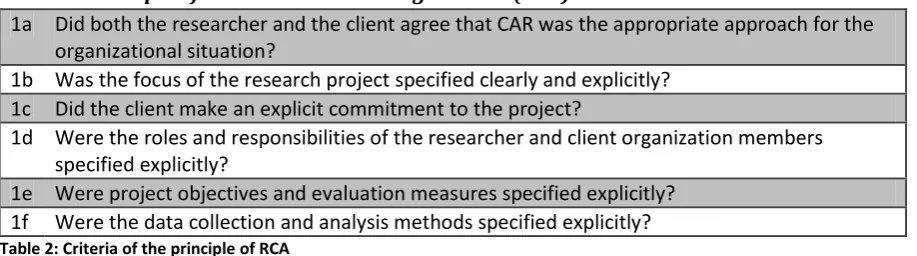
Robin Barwegen | Methodology 17 1993). Coughlan & Coghlan (2002) state that other types of research do not have fewer threats to validity than action research. However, the threats should be identified and assessed. The criteria developed by Davison et al. (2004) have been used to determine the quality of the action research. These criteria are based on the action research framework of Susman & Evered (1978) that was presented earlier. Davison et al. (2004) refer to canocial action research (CAR) which is the type of action research Susman & Evered (1978) have adopted. A table of the criteria is given first. Thereafter these criteria are discussed.
2.4.1.1 Principle of the Research-Client Agreement (RCA)
1a Did both the researcher and the client agree that CAR was the appropriate approach for the organizational situation?
1b Was the focus of the research project specified clearly and explicitly? 1c Did the client make an explicit commitment to the project?
1d Were the roles and responsibilities of the researcher and client organization members specified explicitly?
[image:29.595.71.530.200.328.2]1e Were project objectives and evaluation measures specified explicitly? 1f Were the data collection and analysis methods specified explicitly? Table 2: Criteria of the principle of RCA
Both the researcher and the client agreed that CAR was the appropriate approach the organizational situation. The organization had a practical challenge that demanded the introduction of TRM process while the researcher was interested in what constitutes an appropriate TRM process for a service oriented firm (1a). The focus of the research was specified clearly and explicitly. An initial meeting was devoted to determining the scope of the research. Subsequently, the researcher explicitly mentioned the research questions (1b). Commitment to the project was made through several means. First, the researcher was employed for five months for this specific task. Second, a TRM team consisting of three members was assembled. Third, resources were devoted to the facilitation of several workshops (1c). The roles and responsibilities of the researcher and client organization were specified. The two internal employees which made up the TRM team had the task of supporting the implementation of TRM process within the organization. They had the knowledge of the organization and services, while the researcher had the methodological knowledge (1d). The objectives and evaluation measures were explicitly specified. Two meetings during the start of the project had the aim to determine the exact objectives of the process. Subsequently, these objectives served as evaluation measures (1e). The data collection and analysis methods were explicitly mentioned. Chapter 2 is devoted to the research design and methodology (1f). From the given evidence can be derived that the principle of the research-client agreement was met to a high degree.
2.4.1.2 Principle of the Cyclical Process Model
2a Did the project follow the CPM or justify any deviations from it?
2b Did the researcher conduct an independent diagnosis of the organizational situation? 2c Were the planned actions based explicitly on the results of the diagnosis?
2d Were the planned actions implemented and evaluated?
2e Did the researcher reflect on the outcomes of the intervention?
2f Was this reflection followed by an explicit decision on whether or not to proceed through an additional process cycle?
2g Were both the exit of the researcher and the conclusion of the project due to either the project objectives being met or some other clearly articulated justification?
[image:29.595.68.531.621.760.2]18 Methodology | Robin Barwegen
The project followed the original research model which was a CAR process model. No deviations were made (2a). The researcher conducted a literature review first; hereafter a diagnosis was made of the organizational situation based on the literature review (2b). The diagnosis resulted in a customization framework which subsequently served as the action plan (2c). The action plan was implemented only to certain degree. During multiple workshop iterations were needed because there was not enough time left to complete all the activities. One workshop has been changed entirely. The actions were evaluated afterwards (2d). The researcher has reflected on the outcomes of the intervention extensively in chapters 5 and 6 (2e). An explicit decision whether an additional process cycle will follow has not been made yet. However, unofficial plans are currently developed to implement another process cycle for other product-families (2f). The contract of the researcher ran for the time of the process and the objectives had been reached by the time that the researcher left (2g). The principle of cyclical process can be judged as sufficient. Because of the deviation of the original plan the fourth workshop was not carried out. After the third workshop a decision was made to change the goal of the fourth workshop due to an insufficient outcome of the third workshop.
2.4.1.3 Principle of Theory
3a Were the project activities guided by a theory or set of theories?
3b Was the domain of investigation, and the specific problem setting, relevant and significant to the interests of the researcher’s community of peers as well as the client?
3c Was a theoretically based model used to derive the causes of the observed problem? 3d Did the planned intervention follow from this theoretically based model?
3e Was the guiding theory, or any other theory, used to evaluate the outcomes of the intervention?
Table 4: Criteria of the principle of theory
The project activities were guided through multiple guidelines published in academic journals. Additionally, methods for the workshop were also chosen based on academic conclusions of scientific papers (3a). The domain and specific setting of the organization were relevant for the interest of the research’s community. Purposive sampling was used to study a service oriented firm (3b). A model based on existing principles has been developed to identify and assess variables that demand customization of the generic product-technology framework (3c). The workshops were planned based on the customization framework (3d). The guiding theory proposed to conduct a review and to establish revision methods (3e). The above elaboration indicates that the principle of theory has been met.
2.4.1.4 Principle of Change through Action
4a Were both the researcher and client motivated to improve the situation?
4b Were the problem and its hypothesized cause(s) specified as a result of the diagnosis? 4c Were the planned actions designed to address the hypothesized cause(s)?
4d Did the client approve the planned actions before they were implemented?
4e Was the organization situation assessed comprehensively both before and after the intervention?
4f Were the timing and nature of the actions taken clearly and completely documented? Table 5: Criteria of change through action
Robin Barwegen | Methodology 19 products/services and technologies (4a). The diagnosis of the organizational situation led to a customized TRM framework which was subsequently implemented. Therefore the problem was specified according to the diagnosis (4b). The TRM process was designed in such a fashion that it, at least theoretically, fitted with the research question (4c). A series of seventeen meetings have been conducted to design the customized framework. This was done in collaboration with TRM team (4d). The implementation of TRM process was not done previously, so both the before and after situation have been assessed properly (4e). The researcher kept a log of all attended meetings and workshop. Time, date and content are specified in these documents (4f). The principle of change through action was met based on the given explanations.
2.4.1.5 Principle of Learning through Reflection
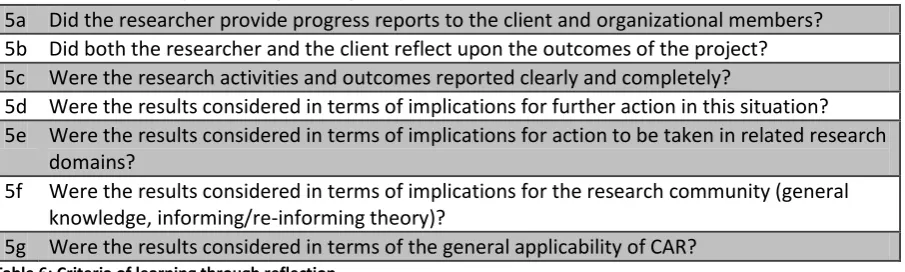
5a Did the researcher provide progress reports to the client and organizational members? 5b Did both the researcher and the client reflect upon the outcomes of the project? 5c Were the research activities and outcomes reported clearly and completely?
5d Were the results considered in terms of implications for further action in this situation? 5e Were the results considered in terms of implications for action to be taken in related research
domains?
5f Were the results considered in terms of implications for the research community (general knowledge, informing/re-informing theory)?
[image:31.595.74.527.233.369.2]5g Were the results considered in terms of the general applicability of CAR? Table 6: Criteria of learning through reflection
Several meetings with the head of the product management department have been held, together with seventeen meetings with TRM team. The organization was aware of the progress (5a). Several evaluation meetings have been held with employees of the organization. Additionally, a reflection of the researcher is presented in paragraph 7.4 (5b). Within the findings quotes of the evaluation interviews have been given that gives the reader the opportunity to make its own assessments and interpretations. However, due to a confidentiality agreement not all information could be specified. The assessment whether the results have been reported clearly is difficult to make by the researcher himself, however an extensive documentation of process has been made (5c). Practical and academic recommendations have been presented in chapter 7 (5d, 5e & 5f). An evaluation of the generalizibility of the findings has been provided in the conclusions section (5g). The outcomes of the criteria indicate that the principle of learning through reflection has been reached.
2.4.2 Validity and reliability
Validity refers to the extent to which an inference is supported by relevant evidence and reflects the real meaning of it (Babbie, 2007; Shadish et al., 2002). In qualitative research it is seen as the extent of how accurately the participants’ representations of a social phenomenon have been captured (Creswell & Miller, 2000). In order to judge the credibility of the study three types of validity are discussed.
20 Methodology | Robin Barwegen
reflexivity and pattern matching (Johnson, 1997). This study adopted several of these measures to ensure internal validity such as the use of multiple sources of data for triangulation. In addition, several feedback loops in form of validation meetings and interviews have been implemented in the research design.
Construct validity is used to assess to what extent was measured what was intended to measure (Babbie, 2007). This is important because constructs are the primary means to connect operational measures to theory in a study. Wrongly measured constructs can lead to misleading conclusions (Shadish et al., 2002). Therefore constructs should be created in such a way that it covers a concept completely and should not contain aspects that not fit with the concept (van Aken et al., 2007). In case based research construct validity can be enhanced by the use of multiple sources of evidence, establishing a chain of evidence and to have key informants review the draft case study report (Yin, 2003). In this case several measures have been used to ensure construct validity. A chain of evidence is established and multiple sources of evidence have been presented in the form of several reflections. Additionally, multiple key informants have reviewed drafts of the report.
External validity means the extent to which findings can be generalized to other persons, settings and times (Shadish et al., 2002). Generally, case studies are very weak in its generalization for two reasons. First, samples are rarely randomly selected in case studies and therefore are very limited in their reflection of a larger population. Second, generalizability is not the major purpose of qualitative research. The purpose is not to obtain general findings which are applicable to a larger population, but to gain understanding of a phenomenon in a unique setting (Johnson, 1997). The last certainly holds for this study, but through the transparency of the used methods other scholars can attempt to replicate the study. However, it should be taken into account that this study only encompasses one case which limits the external validity to a large extent.
Robin Barwegen | Theoretical framework 21
3
Theoretical framework
The theoretical framework consists out of three separate parts. First, the essence of a technology roadmap is explained. Subsequently, an elaboration is given on what constitutes a TRM process. Lastly, the current state-of-the-art of TRM within the service industry is given.
3.1
Technology roadmap
This section aims at explaining the most essential aspects of a technology roadmap. This is necessary because the outcome of this thesis leads to a technology roadmap.
3.1.1 Definition
The academic and practical interest in technology roadmapping has increased rapidly over the last decades (Vojak & Chambers, 2004). The concept has been interpreted in multiple manners. Taking a strict approach the definition only includes roadmapping activities that focus on product- or process-related technologies. The multi-level perspective on roadmapping which was developed by the European Industrial Research Management Association (EIRMA, 1997) is interpreted in a broader sense. This means that all roadmapping activities concerned with technologies, products, processes, functions, market agents, competencies, projects and further aspects are included under the umbrella of technology roadmapping (Moehrle et al., 2013). The technology roadmap that has been developed for this thesis has been build upon frameworks which adopted the latter concept. Therefore the broader concept of technology roadmapping is referred to here. The following definition of a technology roadmap is followed: “Documents that recognize the key defining parameters of the markets, products, services and technologies for one part of the business” (Kappel, 2001, p 41). In essence it is agreed upon that technology roadmaps are living and versatile documents that can be used to support strategic planning and technology foresight (Kostoff & Schaller, 2001; Phaal et al., 2004a; Cosner et al., 2007).
3.1.2 Related concepts
The flexible nature of roadmapping causes confusion and overlap with many other techniques and approaches (Phaal et al., 2005). Other approaches that are often related to technology roadmapping are methods such as foresight, futures, Delphi, scenario planning and other general approaches to technology strategy development (Phaal et al., 2004a). These techniques can be related to two different views for roadmapping, namely forecasting and planning.
Technology forecasting helps an organization by identifying reasonable goals for new development processes and includes industry specific information regarding competitive technologies. The aim of this tool is to increase the quality of technological decision making rather than making accurate forecasts. An accurate forecast for a technology with low strategic alignment has very limited value. Therefore technology forecasting should incorporate a strategic point of view (Kappel, 2001).
22 Theoretical framework | Robin Barwegen
3.1.3 Use of technology roadmaps
The major purpose of a technology roadmap is to portray relationships between evolving and developing markets, products and technologies over time and to align them with organizational objectives (Kappel, 2001; Kostoff & Schaller, 2001; Phaal et al., 2004a; Rinne, 2004; Gerdsri et al., 2010). By forecasting future trends and identifying gaps in the firm’s current technology levels and the aspired levels, the roadmap enables a firm to carry out specific research and development (R&D) projects with an appropriate timing plan to close these gaps (Geum et al., 2011a). It is especially useful in turbulent environments to scan the environment and track the performance of individual technologies (Phaal et al., 2004a). Additionally, roadmaps are used to help identify areas which have high potential, and to accelerate the transfer towards actual products (Kostoff & Schaller, 2001).
3.1.4 Application of technology roadmaps in practice
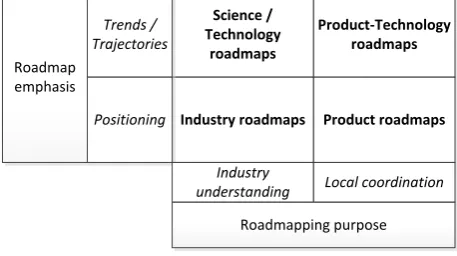
Roadmaps are applied on various levels (Petrick & Echols, 2004). To create structure out of all these different roadmaps Kappel (2001) created a taxonomy which includes different types of roadmaps with different targets and emphasis. Figure 4 shows an overview of the different types. The left part of the figure relates to the industry level, while the right part illustrates a firm level perspective.
Science / Technology
roadmaps
Product-Technology roadmaps
Industry roadmaps Product roadmaps
Roadmap emphasis
Trends / Trajectories
Positioning
Industry
understanding Local coordination
[image:34.595.71.300.317.445.2]Roadmapping purpose
Figure 4: Taxonomy of roadmaps created by Kappel (2001)
Science / Technology roadmaps are used in order to get a better understanding of the future by identifying specific trends and forecast (Kappel, 2001).
Industry roadmaps are the result of forecasts combined with an industrial context. These roadmaps focus on technical trust between different actors and on the shape of the competitive landscape. These roadmaps are driven by the need for an intercompany agenda, an inter-organizational supply chain, and large capital investment (Kappel, 2001).
Product-Technology roadmaps combine the marketplace, technological trends and specific product plans. This type of roadmap highlights the link between product generations and successive technology generations (Kappel, 2001).
Product roadmaps are used to apply focus for the specific direction and schedule of the evolution of products. The main aim of such a roadmap is to communicate with customers and employees (Kappel, 2001).
3.1.5 Dimensions of a technology roadmap
Robin Barwegen | Theoretical framework 23 External influences
Deliverables
Technology
Science, skills, know-how
Resources
Internal
External
[image:35.595.75.385.63.308.2]Time
Figure 5: Generic TRM framework (Phaal & Muller, 2009)
Phaal and Muller (2009) propose that the timeframe consists of five different periods of time namely past, short-, medium-, long-term perspectives and the vision. The absolute timeframe depends upon the business or system of the roadmap. For many firms the appropriate time horizon is ten years, although fast-moving sectors need a shorter time frame as their product cycles are relatively shorter (Cosner et al., 2007).
24 Theoretical framework | Robin Barwegen
3.1.6 Conclusion
A technology roadmap is a “document that recognizes the key defining parameters of the markets, products, services and technologies for one part of the business.” (Kappel, 2001, p 41). This definition has been adopted within this thesis because it relates to the broader term of technology roadmapping. Many scholars have based their frameworks on the broader term and because these frameworks are used as the basis for this thesis the TRM in its broader sense is also adapted here. From the elaborated paragraphs it becomes clear that several aspects are important to consider regarding the development of a TRM process.
The emphasis and purpose of a TRM process need to be identified to choose a generic framework of Kappel (2001).
A TRM architecture consists out of layers and a timeframe (Phaal et al., 2004b). When designing a TRM process these dimensions should be taken into account.
3.2
Technology roadmapping process
An in-depth elaboration of how the technology roadmapping process should be handled is described in the next parts. The total roadmapping process encompasses three phases, namely a planning, development and implementation phase. The work of several scholars is combined to create one roadmapping framework. Specific notion should be given to the study of Phaal et al. (2004a), which was used as the main source for the development phase, and the work of Gerdsri et al. (2010), which was the main source for the planning and implementation phase.
The technology roadmapping process was conceptualized in the introduction as: “A technology roadmapping process is a structured set of activities aimed at integrating short- and long-term knowledge from the market, products, services and technology, leading to a map of unfolding evolution of technologies and product or services that implement them to ensure that the required technologies will be available when needed”. Although this increases the understanding of the concept it is still interpreted rather broadly. This is illustrated in following paragraph by the fact that several approaches exist regarding the technology roadmapping process. Thereafter, an elaboration of the technology roadmapping process is given. Figure 6 shows a basic overview of the phases.
[image:36.595.72.433.529.579.2]Planning Development Integration
Figure 6: Phases of the technology roadmapping process
3.2.1 Multiple approaches to a technology roadmapping process