ANALYSIS USING THE BEHAVIOURAL MODEL OF SIGNAL DETECTION
A thesis submitted in fulfilment of the requirements for the Degree
of
Doctor of Philosophy in the
University of Canterbury by
Janine Elizabeth Ratson
CYL
7'65.2-. iAJ
3'
:3'1
102>(7
To Napoleon, Josephine, Nancy, Rebecca, EdRard, Eloise, Thomas, Samuel, Penelope, Oliver, Zoe, and Connie
Table of Contents
Chapter Page
List of T a b l e s . . . vi
List of F i g u r e s . . . ix
Acknowledgements. . . . .. xii
A bstrac t. . . . .. xi v One An Introduction to the Analysis of Drug Effects on Stimulus Control . . . . Sti mul us C o n t r o l . . . 2
Memory. . . 16
Drug Effects Rithin the Stimulus Control Paradigm.... 18
Free-Operant Discrimination Procedures . . . 19
Stimulus Generalization Procedures . . . 21
Discrete-Trials Procedures... 22
Assessment of Drug Effects on Memory . . . 25
Procedural Variables Affecting DMTS Performance . . . 27
Models of Pigeon Memory . . . 32
Concl usion. . . . . . . . 46
Two The Effect of Chlorpromazine on Stimulus Control Procedures Assessing Discrimination and Memory Functioning. . . . .. . . . .. . . . . .. .. . . . 47
General Behavioural E f f e c t s . . . 49
Escape and Avoidance Responding . . . 50
Stimulus Significance... 55
Acquisition and Extinction of Stimulus Control . . . 58
Free-Operant Discrimination Procedures . . . 68
Chapter
Two Discrete-Trials Procedures . . . 68
Three Four Five Delayed Discrimination . . . 72
Matching-to-Sample Procedures . . . 73
Delayed Hatching-to-Sample . . . 75
C o n c l u s i o n . . . 77
Application of the Theory of Signal Detection to the Analysis of Drug Effects . . . , ' , . . 78
Signal Detection Theory, . . . , . . . 79
Traditional Signal Detection Analy~es of Drug Effects. . . . . . . . 84
The Behavioural Model of Signal Detection . . . B6 The Behavioural Model of Signal Detection and the Analyses of Drug Effects . . . 96
A Signal Detection Analysis of the Effects of Chlorproma2ine on Remembering... . . . 97
Experiment 1 . . . 97
Method . . . , , . , ... , . . . '. . . .. 1
aa
Resul ts. . . . . . . . .. 1a
4 Discussion. . . . .. 137Investigation of the Model of Chlorpromazine Action. . . . 153
Experiment
2...
153Method. . . . . . . . . . .. 156
Results . . . 157
Discussion. . . . .. 167
Experiment 3 . . . 174
Chapter Five
Page
Di scussi on. . . .. 187
Six The Effects of Haloperidol on Discrimination and Seven Memory P r o c e s s e s . . . 191
Introduction. . . . .. 191
Escape and Avoidance Responding... 192
Free-Operant Discrimination Procedures . . . 194
Discrete-Trials Delayed Discrimination Procedures . . . . 195
Delayed Matching-to-Sample . . . 196
Signal Detection Analysis . . . 199
Summary. . . . .. 199
Experiment 4 . . . 299
Method. " . . . .. 299
Resul ts. . . . . .. 292
Discussion. . . . .. 229
General Discussion . . . . 239
Methodological Issues . . . 232
A Model of Drug Action . . . 237
Clinical Implications... 249
General Implications of the Findings... 245
List of Tables
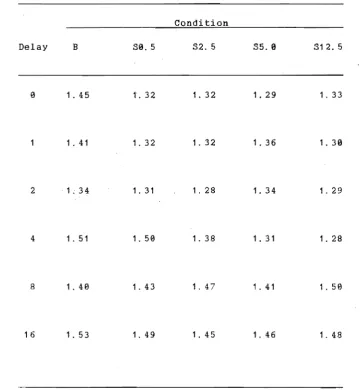
Hean Centre Key Latency (sec) Across Baseline and
Saline Conditions for Each Delay Interval . . . 107
2 Mean Side Key Latency (sec) Across Baseline and
Saline Condi tions for Each Delay IntervaL... 10a
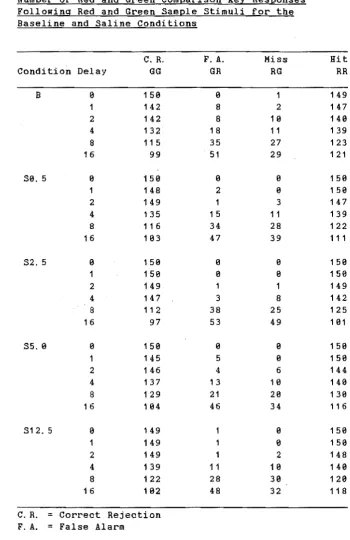
3 Number of Red and Green Comparison Key Responses Following Red and Green Sample Stimuli for the
Baseline and Saline Conditions . . . 110 4 Characteristics of the Composite Saline Condition . . . 116 5 Hean Centre Key Latency (sec) Across Composite Saline
and Drug Conditions for Each Del~y Value . . . 117
6 Hean Side Key Latency (sec) Across Composite Saline and
Drug Conditions for Each Delay Value . . . 118
7 Number of Red and Green Comparison Key Responses
Following Red and Green Sample Stimuli for the Composite
Saline and Drug Condi tions . . . 129
8 Parameters of the Decay Functions for the Composite
Saline and Drug Conditions . . . 128
9 Parameters of the Decay Functions for the Individual
Subjects . . . 132 19 The Grier Bft Index Across Composite Saline and Drug
Conditions for Each Delay Value . . . 135
11 The Responsivity Index Across Composite Saline and Drug
Conditions for Each Delay Value . . . 136 12 Parameters of the Decay Functions for Baseline 1 and
Red and Green Sample Stimuli for the Sample Stimulus
Condi tions . . . " 158 14 Point Estimates of Log Response Bias Across Sample
Stimulus Conditions for Each Delay Value . . . 159 15 Parameters of the Decay Functions for the Sample Stimulus
Conditions . . . 166 16 Parameters of the Decay Functions for Baseline 2 and
Baseline 3, . . . , . . . , . . . .. 170 17 Number of Red and Green Comparison Key Responses
Follofl'ing Red and Green Sample Stimuli in Baseline 4 •..•.• 177
18 Number of Red and Green Comparison Key Responses Follo'R'ing Red and Green Sample Stimuli orhen CPZ was
Administered in the FR10 and FRS condi tions . . . 180 19 Point Estimates of Log Response Bias Follofl'ing CPZ
Administration in the FR10 and FR5 Conditions . . . 181 29 Parameters of the Decay Functions for the THO Drug
Conditions . . . 186 21 Hean Centre Key Latency (CKL) and Side Key Latency (SKL)
(sec) Acoss Baseline and Saline Conditions for Each
Delay I n t e r v a l . . . 203 22 Number of Red and Green Comparison Key Responses
Follofl'ing Red and Green Sample Stimuli for the Baseline
and Saline Conditions . . . 205 23 Point Estimates of Log Response Bias Across Baseline
and Saline Conditions for Each Delay Interval . . . 206 24 Details of Response Failure for Each Subject . . . 210 25 Changes in the Mean Centre Key Latency (CKL) and Side
Page Conditions for Each Subject . . . 211 26 Number of Red and Green Comparison Key Responses
Following Red and Green Sample Stimuli for Each Subject ... 213 27 Point Estimates of Log Response Bias Across Drug
Conditions for Each Delay Interval . . . 214 28 Changes in the Hean Percent Correct Across the Saline and
Figure 2 3 4 5 6 7 8 9 10 11 12 13 14
List of Figures
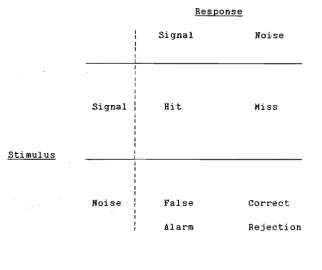
Stimulus-response combinations Hhen a signal-noise
discrimination is m a d e . . . S8
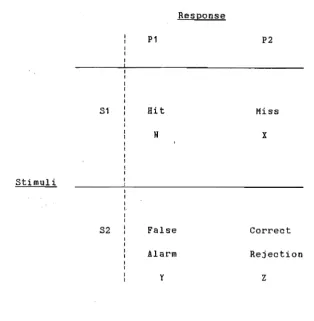
THo-choice discrimination procedure stimulus response
matrix. . . . .. 87 Point estimates of log response bias for the baseline
and saline condi tions. . . . .. 111. Point estimates of discriminability for the baseline
and saline condi ti ons. . . .. 113 Percent correct for the baseline and saline
condi tions. . . . . . . . .. 114 Point estimates of log repsonse bias for the composite saline and drug conditions . . . 121 Point estimates of discriminability for the composite
saline and drug conditions . . . 122 Percent correct for the composite saline and drug
condi tions. . . . .. 124 Hean percent correct for the delay intervals . . . 125 Hean percent correct for the composite saline and
drug condi tions. . . . . . . .. 126 Regression lines for the composite saline and drug
condi tions. . . . .. 129 Point estimates of discriminability for the baseline
and composite drug conditions for each subject . . . 138 The Grier A' index for the composite saline and
Figure Page drug condi ti ons. . . . . . . . . . . . . . . . . . . . . . . . . . . . . . . . . . . . . . .. 134 15 Point estimates of discriminability for Baseline 1
and Baseline 2 . . . 138 16 Point estimates of discriminability for the sample
stimul us condi tions . . . ". . . . . . . . . . . .. 160 17 Percent correct for the sample stimulus conditions .. , .. 162 18 Mean percent correct for the sample stimulus
condi tions . . . , 164 19 Mean percent correct for the delay intervals . . . 165 20 Regression lines for the sample stimulus conditions .... 168 21 Point estimates of discriminability for Baseline 2
and Baseline 3 . . . 169 22 Percent correrit for Baseline 3 and Baseline 4 . . . 178 23 Point estimates of discriminability for the FR10 and
FR5 drug condi tions. . . . . . . . . . . . . . . . . . . . . . . . . . . . . .. 182 24 Percent correct for the FR5 and FR19 drug conditions ... 184 25 Percent correct for baseline or composite saline and
drug conditions for
A.
FR5 and B. FR19 samplestimulus response requirements . . . 185 26 Regression lines for the FR5 and FR19 drug conditions .. 188 27 Point estimates of discriminability for the baseline
and saline conditions... 207 28 Percent correct for the baseline and saline conditions. 208 29 Data from subject number 6 for the saline and drug
conditions:
A.
Percent correctB.
Regression lines . . . 217 30 Data from subject number 10 for the saline and drugFigure
32
33
Page conditions: A. Percent correct B. Regression lines . . . 219 Data from subject number 9 for the saline and drug
conditions: A. Percent correct B. Regression lines . . . 221 Data from subject number 8 for the saline and drug
Acknowledgements
Many people have helped with the research presented in this thesis. My warmest thanks are extended to my two supervisors, Dr. Nirbhay Singh and Hr Neville Blampied, who provided support and
encouragement throughout this project. In particular, Nirbhay provided valuable assistance in setting up the project and Neville was always available to help with the inevitable day-to-day problems. My thanks are also extended to Geoff Rhite, Ivan Beale, Dianne McCarthy, Michael Davison, and Ray Kirk, for their advice at various stages of the
research.
It is unlikely the research could have been undertaken without computerized control of the pigeon chambers. My warmest thanks are extended to Robin Harrington of the Computer Services Centre who
designed and undertook the building of the interface unit, and who was al ways there to deal with any problems that arose wi th the computer. My thanks to Chris Van Halewyn and John Edwards who wrote the computer program to run the equipment and collect the data. A special thanks to Chris who mOdified the program many times to meet the changing needs of the research, frequently at short notice.
I wish to thank Simon Kemp who untangled the complexities of the Maximum Likelihood Program, and Paul Russell for his assistance in completing the analyses of variance.
Hy thanks go to Robert Irwin, Carol Allen, and Carol Stratford of the Reference Section at the Hain Library of the University of
Canterbury, who provided many of the papers cited in this thesis through the interloan service.
the experiments. I also wish to acknowledge the assistance of members of the technical staff at the Psychology Department: Ijan Beveridge for his help in the preparation of the drug solutions, Glenn Lewis Rho made tHo pigeon chambers, Robin Phillips for his preparation of the figures in this thesis, and Hinton Bell who assisted with the
maintenance of the PDP 11/10 computer.
A special thanks goes to my parents who have provided unfailing moral and financial support throughout my years as a student. Finally thanks to Chris for his concern and support, and especially for his enduring good humour.
This research Ras undertaken while I held the Roper Scholorship and Has supported by grants from the Department of Psychology,
Abstract
This thesis is concerned Rith the application of the behavioural model of signal detection to the analysis of the effects of
chlorpromazine (CPZ) and haloperidol on memory in pigeons. Memory is conceptualized as behaviour under delayed stimulus control. The
behavioural model of signal detection provides a Ray of determining a bias-free measure of discriminability and the extensions of the model to account for delayed discrimination performance alloH the locus of drug effects to be determined in a quantitative manner.
In Experiment 1, pigeons Rorked on a delayed matching-to-sample procedure Rhere the reinforcement rate Ras controlled to prevent the development of response biases. Five doses of CPZ Here administered (0.5-15.0 mg/kg). There Ras a significant dose-dependent decrease in matching performance at doses that had no significant effect on
measures of psychomotor performance. CPZ had no differential effect on matching performance as a function of the delay interval. Rhen the performance-by-delay interval data Rere fit to the negative
exponential and rectangular hyperbolic functions, in both cases there Ras a decrease in the initial discriminability but no change in the rate of decrement of discriminability. This suggested the drug Ras affecting the behavioural processes of discrimination, encoding, and retrieval and not memory or retention processes. This model of CPZ action Ras in agreement Rith previous research assessing the effect of CPZ on memory,
same behavioural processes, i. e., discrimination, encoding, and retrieval.
In Experiment 3 i t ~as shown that the effect of CPZ could be compensated for by increasing the sample stimulus response requirement prior to drug administration. This raised the baseline level of
performance and reduced the drugs' decremental effect on matching performance.
In Experiment t , t h e effects of haloperidol (0.06-0.30 mg/kg) Rere assessed, but due to insufficient data the method of analysis derived from the behavioural model of signal detection could not be applied. It was found that the drug caused a greater decrease in matching and psychomotor performance than CPZ at doses that were approximately equivalent to the doses of CPZ administered in EXperiment 1. Further the effect of haloperidol could also be characterized as a decrease in the initial discriminability but no effect on the rate of decrement in discriminability across the delay intervals.
The results are discussed in terms of methodological issues involved in the application of the behavioural model of signal
CHAPTER ONE
An Introduction to the Analysis of Drug Effects on Stimulus Control
Behavioural pharmacology is that branch of biological science that uses the tools and concepts of experimental psychology and of pharmacology to explore the behavioural actions of drugs (Thompson
&
Schuster~ 1968). The tools of experimental psychology are essentially the techniques used in the experimental analysis of behaviour and the tools of pharmacology are drugs. The discipline emerged in the late 1959's after early work by P. B. Dews demonstrated that environmental variables can modify the Hay in which drugs influence behaviour. Prior to that time, research on psychological effects of drugs had focused mainly on hOH topographically or functionally similar activities were affected by drugs (Branch, 1984). Following Dews' initial Hork there was a rapid increase in research as techniques derived from the experimental analysis of behaviour alloNed a systematic analysis of drug effects.
Thompson and Schuster (1968) outlined the goals of behavioural pharmacology as:
- the use of behavioural observation to "screen" new chemical compounds, in order to determine their potential usefulness in medical practice~
- the use of refined behavioural techniques for the experimental analYsis of the mechanisms of a drugs effect~ and
behavioural effect can be modified by many variables, for example the schedule of reinforcement, the training history and the presence or absence of pUnishment (Branch, 1984). Of particular interest in this thesis is the relationship between a drug's effects and stimulus control.
Stimulus Control
Behaviour can be conceptualized as the central component in a three term contingency of antecedent-behaviour-consequence. It is directly influenced or controlled by the events or stimuli that occur both before and after. The law of effect describes the qualitative and quantitative changes in behaviour ~hich are correlated with changes in the consequences for a particular behaviour. Research on schedule control is essentially concerned with this relationship. The study of stimUlUS control concerns the relationship between the changes in antecedent stimuli and the subsequent changes in behaviour. Stimuli that are correlated with the occurrence of a event can come to control that event. The covariation of stimuli and responses is known as
stimUlUS control. Stimulus control has been defined as H • • • the control
of learned behaviour by antecedent and concurrent environmental stimuli, as a joint function of the physical specification of the stimuli and the subject's past history." (Nevin, 1973, p. 115). This definition gives a flavour of the complexity of stimUlUS control. It stresses that control can be exerted by stimuli prior to the behaviour as well as during the behaviour and that both the exact nature of the stimUlUS and the subject's past history (Kith that and other stimuli) interact to determine control over behaviour.
immediately follows the stimulus. A pure eliciting stimulus is one that produces a specific reflex reaction but has no other effect. For example, stimuli that elicit protective responses in decerebrate organisms (air puff for blinking, touch for scratching) are close to being pure eliciting stimuli (Staddon, 1983),
These stimulus-response relationships can be distinguished from those which have to be learned. In the latter case the initial
presence of the stimuli has no effect on the behavioural pattern. It is only after repeated pairing of the stimulus and the response (Pavlovian conditioning), or after explicit training (in operant procedures) that the behaviour may come under the control of the previously neutral stimuli.
Formal procedures have been developed for the assessment and measurement of this learned stimulus control. These differ depending on the particular process being investigated. The acquisition of stimulus control is demonstrated by the emergence of different rates or patterns of responding in the presence of different stimuli. To the extent that behaviour changes in orderly, predictable and replicable ways as antecedent and concurrent stimuli are changed, behaviour can be inferred to be under the control of the stimuli. Following
acquisition of the discrimination, control may be further assessed by using generalization gradients to measure Rhich dimension(s) or
aspects of the training stimulus have acquired control over respondin~
stimulus control literature. It is not intended to be an exhaustive account but rather to give an indication of the fine-grained analysis which has occurred. This account draws heavily on major reviews of the stimulus control literature (Fantino
&
Logan, 1979; Hearst, Besley,&
Farthing, 1970; Honig&
Urcuioli, 1981; Nevin, 1973; Rilling, 1977; Schwartz, 1984; Beale, Davsion, Alsop,&
Elliffe, 1986)Methods for studYing stimulus control. The procedures used for studying stimulus control require the subject to respond
differentially in the presence of certain stimuli. In all procedures there are a minimum of tHO discrete stimuli, although one may be an implicit stimulus, defined by the absence of the explicit stimulus. Stimuli are. usually labelled 51 ... SX, or if variation in reinforcement or punishment are associated with them, 5+ and 5-. Discrimination training procedures can be classified in two Rays. First they can be free-operant or discrete-trials procedures and secondly the stimuli can be presented either simultaneously or successively.
In free-operant procedures, the rate at which the subject responds to various stimuli or differences in the pattern or
topography of responding, provides a measure of the degree of stimulus control. Rhen the stimuli are presented Simultaneously the procedure is analogous to a concurrent schedule. Rhen the stimuli are presented successively, responses can occur at various rates or be withheld, depending on which stimulus is present. This is a multiple schedule.
Some important effects and side effects of discrimination
training are observed during the acquisition of the discrimination, or during maintained steady-state discriminative performance in the
reinforcement density, and short-term within-session and between component contrast effects. One of the most intensively studied of these phenomenon is behavioural contrast. Reynolds (1961) discovered the phenomenon Rorking Kith pigeons on a multiple schedule alternating in the presence of red and green lights. When one schedule was changed to extinction, the rate of responding in the presence of the S- (the light associated with extinction) decreased. There ·Has also a
sUbstantial increase in the rate of responding under the unchanged schedule. This increase is an instance of positive behavioural contrast. Negative behavioural contrast also occurs i. e.) when
reinforcement is increased in the changed component, a decrease in the rate of responding in the unchanged component occurrs. Several factors are important in the determination of behavioural contrast:
- the difference in the rate of reinforcement between S+ and S-, the species studied,
the operant response selected for emission, - the degree of similarity between S+ and S-, and
- the amount of temporal separation between S+ and S- (Fantino
&
Logan, 1979).In discrete-trials procedures, the frequency with which the response is emitted by the subject is controlled by the experimenter. The measure of performance is response probability or proportion, rather than response rate or pattern. In a successive go-no go discrimination procedure, responding in the presence of S+ is
reinforced (go trials) and responding in the presence of S- is never reinforced (no-go trials). In a two-response successive discrimination procedure, a certain response is reinforced in the presence of one stimulus and a different response is reinforced in the presence of the other stimulus. In a discrete-trials simultaneous discrimination
has to make the response appropriate for the S+. Response rate is controlled in these discrete-trials procedures because the response probability is 1.0 on anyone trial.
Matching-to-sample procedures are more elaborate discrete-trials procedures. The basic procedure involves the presentation of a sample stimulus folloHed by tHo comparison stimuli. The subject's task is to respond to the comparison stimulus that "matches the sample". There are many variations of this basic procedure and these Hill be
discussed in detail later.
Generalization and discrimination. The tHO main processes within stimulus control are generalization and discrimination. If a response that has been conditioned in the presence of a certain stimulus is emitted when other similar stimuli are presented, then the control has generalized from the training stimulus to other stimUli. If the
response does not occur to the nen stimuli then discrimination has occurred. Generalization therefore is a reflection of less precise stimUlUS control and discrimination of more precise stimUlUS control. The processes of generalization and discrimination are usually studied by measuring generalization gradients, which display changes in
responding as stimUli are varied systematically about the training value( s) .
Generalization gradients. Hany important stimUlUS control phenomenon are observed only or principally in the generalization gradient. These include excitatory or inhibitory gradients, peak and area shift, and behavioural contrast effects on the maximum response rates observed in the generalization test.
presence of stimuli that are increasingly dissimilar to the training stimuli. Guttman and Kalish (1956) were the first to reliably measure the gradients of stimulus control generated by a single subject. They intermittently reinforced responding at the training stimulus while presenting the other test stimuli without reinforcement - this is known as the maintained generalization procedure. Using this procedure the subject emits enough responses to allow reliable generalization gradients to be generated.
The generalization gradient formed in a particular generalization test has certain characteristics. These are the area, height, slope, and form. The area is defined by the total gradient and as a result takes into consideration both the distribution of the responses and the range of test values. The height is the maximum level of
responding along the gradient and this most often occurs at the training value. Host often i t is the slope of the generalization gradient that is of most interest. A steep slope indicates strong control by the training stimulus (i. e., little generalization). A shallow slope indicates weaker control by the training stimulus (i. e., poor discrimination), or strong control by other stimuli on the
dimension. The form of the generalization gradient depends on the training procedure and on the characteristics of the stimuli - their discriminability and their similarity to the training value. For example, if the stimuli on either side of S+ are not equally similar to the S+, then the form of the gradient will be assymmetrical.
The data used to generate the generalization gradient need not be the response rate, although this is the measure that is commonly used. Other variables used can be the latency, probability, amplitude or the stimulus duration. Generally the gradients obtained from each of these measures are similar. In addition, the data can be presented in
generalization gradient. Data can be presented as:
1. the absolute number of responses at each of the test stimuli, 2. as a percentage of the total responding, or
3. a percentage of responding to S+.
Gradients after training Hith S+ alone. Of particular interest to researchers is the Nay in which the generalization gradient changes folloRirig various sorts of discrimination training. In the simplest case reinforcement is given for responding at a single stimulus (3+)
and responses during extinction in the presence of the S+ and other test stimUli are used to determine the generalization gradient. The variables that affect the shape of the generalization gradient obtained include:
1. the duration of trainin~
2. the schedule of reinforcement, and 3. the level of deprivation.
Interdimensional discrimination training. A second sort of
Inhibitory stimulus control. Gradients obtained around stimuli correlated with positive reinforcement have been traditionally
labelled excitatory. There is a decremental gradient of generalization to stimuli adjacent to the training value. The more rapid this
decrement, the greater is the excitatory control exerted by the training stimulus (relative to other stimuli). Inhibitory, or incremental, gradients also exist and can be obtained from stimuli that are correlated with extinction (S-). In this case the gradient is U-shaped with the minimum at the S-. There are several ways that these inhibitory gradients can be measured:
1. Responding can be established across a range of test values. Extinction for responding at some central value (S-) can be introduced followed by testing over the original test values. 2. Resistance-to-reinforcement (Hearst, Besley,
&
Farthing, 1970),where inhibitory stimuli have greater resistance to reinforcement. 3. Combined cue tests, and
4. Maintained generalization tests (Blough, 1975).
Interdimensional discrimination training also allows an
incremental or inhibitory gradient to be measured. By training with a S- on some dimension and a S+ that is on an orthogonal dimension, a gradient around S- can be measured in extinction. This procedure can be used to obtain gradients for both S+ and S- where opposite
reinforcement contingencies exist for two groups of subjects. It is generally found that the decremental gradients are steeper than the incremental gradients.
Incremental gradients can also occur when the S- is associated with a "leaner" schedule of reinforcement than the schedule the S+ is correlated with. Terrace (1972) has argued that in order to produce an incremental gradient there needs to be reduced responding to
to the subjects non-reinforcement for responses in the presence of S-. Using an errorless discrimination procedure Rhere the subjects never responded to S-, Terrace (1963) found no incremental gradients.
HORever subsequent research ShORS that incremental gradients can arise from such "errorless" discrimination learning (Rilling, 1977).
Dimensional stimulus control. Discrimination training can also occur betReen tHO points on the same stimulus dimension. This is knoRn as intradimensional discrimination training and involves the
differential reinforcement of responding at tRo values on the
dimension. There has been disagreement in the literature on the nature of the training required for the establishment of dimensional stimulus control. This Rill be briefly discussed before changes in the post-discrimination gradient folloRing intradimensional training are noted.
For Hull and Spence, reinforcement for responding in the presence of a single stimulus from the dimension of interest Ras sufficient to establish dimensional stimulus control. The response strength acquired by the S+ spread to the other stimulus values in proportion to their dimensional position relative to S+. Differential training Rould sharpen the post-discrimination gradient but such training per se Ras not necessary to establish dimensional stimulus control. This absolute vieR is in contrast to the relational approach taken by Lashley and Hade. They proposed that dimensional stimulus control Ras not
established Rithout differential training at tHO or more points on that dimension. In the absence of differential training the effects of reinforcement in the presence of an S+ Rould generalize to other
stimuli on the continuum, such generalization representing a failure to discriminate the distinguishing ~haracteristics of the stimuli.
gradient Mould support the Lashley-Rade theory and sloped gradients Mould support the Hull-Spence theory. HOMever both theories can account, at least in an ad hoc way, for the opposite findings. A
sloped gradient is explained by Lashley-Rade adherents by the presence of unintended sources of differential reinforcement. In some cases these sources can be isolated experimentallY, but in other instances the sources of the differential reinforcement are not readily
apparent. The occurrence of a flat gradient is explained by the Hull-Spence supporters in terms of control by incidental stimuli.
Generally i t has been concluded that differential experience Hith a stimulus dimension seems not to be a necessary precondition for that dimension to gain control of differential responding, which supports the Hull-Spence absolute theory of stimulus control.
Postdiscrimination gradients. Intradimensional discrimination training in which tHO stimuli lie on the same physical dimension
produces characteristic changes in the shape of the postdiscrimination gradient. The absolutist theory of Spence makes specific predictions concerning the shape of the PDG. The theory postulates that
intradimensional training would produce an excitatory gradient around the S+ and an inhibitory gradient around the S-. The net response strength at any point on the stimulus dimension is calculated by the algebraic sum of the excitatory and inhibitorY gradients at that point.
Following intradimensional discrimination training, changes in the shape of the PDG are found:
1. The gradient obtained after training is sharper, although Blough (1975) has shown that the sharpness of the generalization gradient depends in part on how the responding is sampled.
opposite to that of the S-. In addition, the area described by the generalization gradient shifts. Both peak shift and area shift are greater when the training stimuli are closer together.
The predictions from Spence's theory are in agreement with these findings but one prediction is not. Spence predicted that the height of the PDG would be less than that of a gradient obtained after single stimulus training. In fact the PDG typically has a higher peak, a manifestation in the generalization gradient of the phenomenon known as behavioural contrast. Some authors (Beale et al., 1996) have argued that since behavioural contrast is not specifically a intradimensional effect, then Spence's theory shouldn't be expected to predict it. Hhile peak shift, behavioural contrast and gradients of not-responding tend to occur under the same conditions this does not imply that they reflect the same underlying mechanisms.
A shortcoming of Spence's theory Rould appear to be its incompatability with the phenomenon of errorless discrimination
learning. Since there are no non-reinforced responses in the presence of the S-, there should be no gradient of non-responding and therefore no sharp PDG. The theory can still be applied to errorless
discrimination learning if the assumption is made that responses other than key-pecks, such as approaches to the key, are extinguished in the presence of the S-. Despite this problem, and the fact that the theory predicts transposition reversal "hen this phenomenon does not
generally occur (the transposition phenomenon Rill not be discussed here), the theory has provided the most durable and popular account of animal discrimination learning.
second approach to discrimination learning is the signal detection theory (SDT) model and this is beginning to rival the interacting-gradient model in scope and research interest (Hinson
&
Lockhead, 1976). The (SDT) model will be discussed in detail in Chapter Three.Attention. Stimuli are inherently and inevitably multi-dimensional, and i t is readily apparent that subjects in a
discrimination procedure attend only to certain aspects or dimensions of a stimulus. This finding can be used to explain failures in
stimUlUS control. A concept closely related to attention is that of stimUlus salience. In anyone situation, some stimuli gain control more rapidly than others Hhile other stimuli may apparently fail to gain control. Those stimuli that do gain control can be said to be more "salient" for the subject. Differences in salience account for the finding that Hhere a number of stimuli are equally correlated with reinforcement, some Kill acquire greater control than others
(Mackintosh, 1977).
Selective stimUlUS control can be demonstrated using transfer tests. Reynolds (1961) showed that of two pigeons trained using a white triangle on a red background as the S+, the responding of one was controlled by the triangle and the responding of the other was controlled by the red background. In addition, selective control has been demonstrated between cues from different modalities combined into a compound stimUlUS. Several aspects of a compound stimulus can exert control simultaneously and pretraining with a particular stimUlUS can alter its salience and make i t more likely that i t will be attended to.
this control. The temporal interaction of stimuli from these two dimensions determine the phenomenon of overshadowing, blocking and masking. Blocking may occur when the prior correlation of a competing stimulus with reinforcement prevents (blocks) the development of effective control by a criterion stimulus when the two are presented together. Overshadowing may occur when competing stimuli are presented simultaneously with criterion stimuli during training. The presence of the more intense or salient stimulus may interfere with the
acquisition and/or control by the less intense or salient stimulus. In a test for overshadowing, the stimulus control maintained by one
member of a compound stimulus is compared with that exerted by the same member in isolation. When competing stimuli are introduced during a generalization or transfer test, masking of the control gained by the criterion stimuli during training can occur.
These phenomenon raise the issue of where the locus of the selective action is. With blocking and overshadowing the selective process may take place at the input end of processing. However with masking the organism has already learnt the necessary discrimination but uses i t selectively depending on the other stimuli present at the time. Beale et al. (1986) conclude that both masking and overshadowing yield selective effects that are not simply due to competition among stimuli at the time of testing. They are also influenced by the discriminability and the relevance of the stimuli involved.
In summary, a major reason why some stimuli fail to show control over responding is that they are either overshadowed or masked by the presence of more salient stimuli. This also accounts for why
discrimination training is frequently necessary to establish control by relatively unsalient stimuli.
1. The degree of competition among the concurrently presented stimuli,
2. The relative discriminability of stimuli, 3. The relevance of stimuli,
4. The salience of stimuli, 5. The species of the organism,
6~ Prior experience with stimuli and the nature of that experience, 7. Stimulus response-contiguity,
8. Schedule of reinforcement, and 9. Amount of training
(Beale, et a1., 1986).
Before leaving this discussion two other issues related to stimulus control Rill be briefly mentioned.
Conditional discrimination. Complex discriminations may be established in which simple discriminations (i. e., responding in the presence of certain stimuli) can be brought under stimulus control, In these conditional discriminations, whether or not reinforcement can be obtained in the presence of a certain stimulus can depend on the
presence of a "higher-order" or a superordinate stimulus. The
matching-to-sample procedures, to be discussed in detail later, are an instance of conditional stimulus control. In this procedure the
relation between the comparison stimuli and reinforcement is
conditional on the colour of the sample stimulus. The sample stimulus can be regarded as the stimulus selecting which of the comparison stimuli will be correlated with reinforcement on anyone trial.
concepts become actual concepts, by singling out particular properties of stimuli as predictive of reinforcement, making them worthy of
attention, and definitional of a concept. Animals can acquire the abstract concepts of same and different, where the stimulus features used to classify the stimuli are dependent on the nature of the particular stimuli that are being classified. However this seems to depend on the nature of the training procedure used. Pigeons can learn the concepts of same and different and come under the control of the degree of difference betReen the wavelengths on the keys. The
matching-to-sample and oddity discrimination procedures generally do not ShOR evidence of this sort of conceptual behaviour. Hhile there is often some evidence of positive transfer from the training to test stimuli, this is far from complete (Nevin, 1973).
The acquisition of natural concepts has also been demonstrated in pigeons. A natural concept is one Khere there is a cluster of
features that describe the members. Not all of these is shared by each member but all members have more in common Kith each other than they do nith non-concept members. Pigeons can learn concepts such as vehicles, trees, human-made objects, and fish, and they seem to acquire these concepts more readily than concepts Kith clear-cut defining properties. Presumably this is because the concepts are characteri2ed by a host of different stimulus features and the pigeon can derive information from paying attention to many of the features.
Memory
memory (Honig, 197B). The concept of working memory can be analyzed within the frameKork of stimulus control, thereby providing an account of memory within the experimental analysis of behaviour. From this perspective, memory is conceptualized as the extent to Khich stimulus control is maintained over delays of various durations between
antecedent stimuli and responses. Remembering therefore is
discriminative behaviour under delayed stimulus control. Catania (1979) comments that memory within the behavioural framework is concerned with the Hays in which an organisms responding can be occasioned by some event or events in the past. Imposing a delay between a stimulus and the opportunity for a response does not necessarily alter the control of the response by that stimulus.
Working memory is in fact studied using the same procedures used in the study of discrimination processes, except that a delay occurs between the presentation of the "to-be-remembered" stimulus and the occasion for the response. Within this paradigm, Horking memory stores the information needed to respond on a particular trial. It is limited in capacity and only holds information for a short period of time. The behavioural processes involved in working memory have been identified, and the interval between the stimulus and response determines which processes are involved.
1. No-delay: If there is no delay between the sample stimulus and the occasion for response, then only discrimination processes are
involved.
2. Zero-delay: When the occasion for the response occurs immediately after the removal of the stimulus, i t is assumed that in addition to discrimination processes, encoding and retrieval processes also occur. Encoding has been defined by Catania (1979) as systematic relations between stimuli to be remembered at the subsequent responses
does when the response is later occasioned.
3. X-delay: Khen a delay of certain duration (X) occurs between the sample and the occasion for responding, the time-dependent process of retention and memory are presumed to be involved as well as
discrimination, encoding, and retrieval processes (Heise
&
Milar, 1984) .Long-term or reference memory is a stable knowledge base
containing information concerned with for example, which responses to make on a particular trial and Nhich trial outcomes Hill folloN. The characteristics of reference memory have been most successfully studied in animals using generalization test methods. Changes in the generalization gradients and in peak shift folloNing intradimensional training are seen as evidence of a decrement in reference memory (Thomas, Kindell, Bakke, Kreye, Kimose, & Aposhyan, 1985).
Drug Effects Hithin the Stimulus Control Paradigm
Although within the experimental analysis of behaviour there has been extensive fine-grained analysis of the processes of
generalization and discrimination, and to a lesser extent of memory, this theoretical and methodological knowledge has not been extensivelY utilized by behavioural pharmacologists. In analyzing the interaction betneen drugs and stimUlUS control, behavioural pharmacologists have been concerned with gross issues; for example, hON the degree of stimUlUS control is affected by drugs, hOH stimUlus control modulates drug effects, and the effect of drugs on internal and external
Free-Operant Discrimination Procedures
Operant discrimination has traditionally been defined by
differential responding in the presence of a S+ and a S-, Usually one stimulus signals the availability of reinforcement on a certain
schedule of reinforcement and the other signals extinction. Multiple schedules with two different component schedules, each operating in the presence of different stimuli, have also been frequently used in drug studies. Usually multiple schedules use fixed ratio and fixed interval schedules as the components. Although some interaction may exist between behaviours on the component schedules, the performance during the individual components retain most of the features of the performance of the animals working alone on that schedule (Ferster
&
Skinner; 1957). Hhen performance appropriate to one or other schedule occurs only in the presence of the corresponding stimulus, there is evidence of stimulus control (Catania, 1968), When performance under these schedules breaks dORn with drug administration, then the drug is presumed to be affecting stimulus control processes.Rate-dependency, There is a major limitation in using multiple schedule procedures for the analysis of drug effects. This concerns the phenomenon of rate-dependency, which occurs Khen a drug's effect on responding depends on the baseline rate of responding. Dews (1958a) in a study concerning the effects of metamphetamine, first suggested that a drug's effect could be predicted from the rate under non-drug conditions. The rate-dependency concept has been found to apply to a wide range of data and as a result provided the discipline of
Rere relegated to uninfluential positions. " ... An analysis of drug effects in terms of behaviour mechanisms such as stimulus control, type of reinforcement, or conditioned reinforcement is unnecessary for drugs do not interact independently Rith such mechanisms." (Branch, 1984, p. 515). HOR'ever data steadily accumulated revealing limitations in the rate-dependency concept. By the mid 1970's i t Ras apparent that response rate Ras not an exclusive predictor of drug effects. For example, i t Ras shORn that the type of consequences maintaining behaviour influences the drug's effect (Barrett, 1976; McKearney,
1974). In addition, data originally seen as supporting rate-dependency Rere reanalyzed and satisfying alternative explanations Rere found (Branch 8. Gollub, 1974; Gonzalez 8. Byrd, 1977).
An exhaustive accoun~ of the rate-dependency concept is beyond the scope of this thesis (for excellent revieRs see Branch, 1984; McKearney 8. Barrett, 1978; Robbins, 1981; Sanger 8. Blackman, 1976; Thompson, DeR's, 8. McKim, 1981), For the present purposes,
rate-dependency provides an alternative account of drug effects on multiple schedules. Since the non-drug response rate differs markedly betR'een the components of a multiple FR FI schedule, drug effects may be due to differential effects on the non-drug rate of responding. Therefore i t is difficult to separate the effects of drugs on discrimination processes from effects on baseline response rate. HOR'ever, multiple schedule procedures have been useful in the analysis of the
stimulus Generalization Procedures
Stimulus generalization procedures have been used to assess drug effects on stimulus control. The organism is trained to discriminate certain stimuli and generalization tests under drug and non-drug conditions can be used to determine the effect of the drug on the organism's ability to discriminate. Changes in the shape of the generalization gradients after drug administration indicate if the drug had an effect on discrimination. Decreased stimulus control Kould be evident from a flattening of the gradient.
The effect of drugs on stimulus generalization may depend on Khether the generalization is tested using a discrete-trials or a free operant generalization test. It has been found that LSD caused no change in the shape of the generalization gradient Khen response
probability Has measured in a discrete-trials procedure. HOHever, Hhen rate of responding Has used in a free operant generalization
procedure, the gradient Ras flattened folloRing doses Hhich produced decreases in high rates of responding (Dykstra
&
Appel, 197~).Robbins (1981) outlines hOH rate-dependency can affect the
results in a free operant stimulus generalization test. In a stimulus generalization test high and lOR rates of responding Kill occur. The highest rate Rill occur in the presence of the training stimulus and lOHer rates Kith stimuli increasingly different to the training stimuli. Therefore any drug effects may not be due to changes in sensory discriminative processes but rather to rate-dependency. A flattening of the generalization gradient Kould occur due to a decrease in the high rates of behaviour and an increase in the 10K rates. Again i t becomes apparent that the procedure used in the
Discrete-Trials Procedures
I t is apparent from the preceding discussion that in order to study the effects of drugs on stimulus control, i t is important to minimize the confounding effects of variations in response rate. Given this constraint, a discrete-trials procedure, where a single response is made in the presence of each stimulus, is a more appropriate method of studying discrimination than procedures in which the rate is
variable (Seiden
&
Dykstra, 1977), Discrete-trials procedures permit exact control or description of the time of occurrence and thepatterning of responses. Such procedures also make possible the experimental manipulation of the composition of the stimuli
controlling behaviour (Heise, 1975), In discrete-trials procedures differential behaviour may be a right or left lever press, right or left key pecks, right or left turns in a maze, or responding in the presence of one stimulus but not in the presence of another. The measure of responding in discretetrials procedure is a proportion -the number of stimulUS occasions on Hhich -the required response occurs relative to the total number of trials - rather than a rate (Appel
&
Dykstra, 1977; Seiden&
Dykstra, 1977). There are tHo main classes of discrete-trials procedures which are of interest here: discrete-trials discrimination procedures and matching-to-samp1e procedures.Discrete-trials discrimination procedures. In discrete-trials discrimination procedures, the discriminative stimuli are sometimes presented simultaneously in different locations. The type of response required on each trial is the same and only its location is controlled from trial to trial by differences in the discriminative stimUli. Drug effects on overall response output would presumably affect both
independently of effects on response rate or pattern (Xsir
&
Slifer, 1982), so long as responding does not cease all together.As previously mentioned the stimuli in discrete-trials procedures can be presented- one after the other in a successive procedure (eg., go-no go or two-response successive discrimination) or simultaneously where the subject has to make the appropriate response for the S+. In these discrete-trials procedures drug effects are apparent from
changes in the measure of responding which is usually percent correct. Heise and Milar (1984) note that even with discrete-trial
procedures, there exists a possible confounding of drug effects on response rate with drug effects on stimulus control. This is
particularly true of successive go-no go discrimination procedures where two stimuli are used, an S+ (go trial) stimulus and an S- (no go trial) stimulus. Since the control probability of responding is lower for no go trials than for go trials, selective drug effects on no-go trials responding could be considered a rate-dependent effect. This problem is avoided if two response procedures are used to examine drug effects on either the presence versus the absence of a stimulus or two values of a stimulus. For example, in both successive two-response and simultaneous discrimination, the rate of responding is controlled because the probability of response on anyone trial should be 1.00.
Matchinq-to-sample procedures. In simple, successive, or simultaneous discriminations the discriminative stimuli have an
discrimination (Lashley, 1938), the significance of the discriminative stimulus is not invariant, but changes in relation to the stimulus context in which i t appears. The correct response cannot be made solely on the basis of a single stimulus, but must be based on the properties of two or more stimuli (Cumming
&
Berryman, 1965).A discrete-trials procedure that has been used to establish conditional discriminations is matching-to-sample (MTS). A trial begins with the presentation of a stimulus (the sample stimulus) and after an appropriate response is made two or more comparison stimuli are presented. In order to obtain a reinforcer, the subject must respond to the comparison stimulus that "matches the sample"
(McMillan, 1981). Kith pigeons colours are often used as the stimuli. On a three key response panel the centre key may come on red and following a response to that key, the side keys may come on red and green. In this case a response to the red key would earn
reinforcement.
There are many variations of the MTS procedure nhich are
determined by the temporal or conditional relationship of the sample and comparison stimuli. Sometimes the sample stimulus is present when the comparison stimuli are presented, as in the above example, and the choice response is a recognition response, as i t occurs in the
presence of the previously presented sample. This is known as simultaneous MTS. Rhen the comparison stimuli are presented immediately after the sample stimulus has been terminated, the
which either a choice response (McPhail, 1989; Shimp
&
Moffit, 1977), or responding on a single key (Nelson&
Kasserman, 1978; Kasserman, Nelson,&
Larew, 1989) occurs in the presence of a single comparison stimulus. Khen an arbitrary relationship is established between the sample and comparison stimuli, the symbolic MrS procedure results. For example, a red sample stimulus may mean that pecking a comparison stimulus Kith black and white stripes Rill yield reinforcement (Kraemer & Roberts, 1984). In the oddi t"y MrS situation therelationship betReen the sample and comparison stimuli is one of opposites. If a red sample stimulus is presented followed by red and green comparison stimuli, then reinforcement Rould be obtained for a response to the green comparison key. As with other discrete-trials procedures the response measure is the accuracy of performance,
assessed using the percent correct measure. Changes in percent correct with drug administration are presumed to reflect altered stimulus control.
Assessment of Drug Effects on Memory
Of necessity, procedures used in the analysis of drug effects on memory have to be discrete-trials procedures as the time between the presentation of the stimuli and the occasion for the response has to be controlled. In memory experiments, stimulus control can be
manipulated by varying the physical characteristics of the to-be-remembered stimulus or more commonly by varying the delay. Stimulus control is typically greatest at no-delay, less at zero delay, and then progressively declines as the x-delay duration lengthens (Heise
&
Milar, 19B4). Procedures for eval uating memory can be divided into delayed response and delayed comparison procedures.procedures, the post-delay response is not entirely determined until after the delay, since some elements of the controlling stimuli are presented before the delay and some elements are presented after. In delayed response procedures i t is possible that the subject could rtbridge" the delay by means of overt mediational or coding responses during the delay. Since in delayed comparison procedures this cannot occur, i t has been argued that delayed comparison procedures are more representative of everyday memory situations CHeise
&
Hilar, 1984).Delayed matching-to-sample. Hhen a delay is interpolated betReen the sample and comparison stimUli in MTS the procedure is knORn as delayed matching-to-sample CDHTS), The procedure is useful as a method ror the study of concept formation and short-term memory, Concept rormation has been considered to be involved because operationally the pigeon must respond to the comparison stimUlUS "the same as" the
sample stimulus, although evidence that a matching concept has developed requires the meeting of other criteria as Rell (Zentall
&
Hogan, 1978). Short-term memory has been considered to be involved in DHTS because a delay intervenes betxeen the presentation of the sample stimulus and the comparison stimuli during xhich information about the sample stimulus must be retained (McMillan, 1981).Variations in the standard DMTS procedure exist including delayed symbolic matching-to-sample and titrating delayed matching-to-sample (TDMTS), TDHTS is a procedure Rhere the delay values that the subjects work at are not arbitrarily set by the experimenter but depend on the subjects performance. In the standard procedure (CUmming
&
Berryman, 1965) the delay betReen the sample and comparison stimUli is zero at the beginning of the session. The delay increments Kith correct performance and decrements Rith incorrect performance.study of animal short-term memory because i t allows rigorous manipulation of stimulus parameters and precise specification of stimulus and retention interval duration (Pontecorvo, 1983). The dominant theories of animal memory over recent years have draRn
heavily on the results of DHTS studies. It is therefore appropriate at this stage to revieM the main experimental findings and resulting theoretical accounts, since the DHTS procedure Rill be used in the experiments in this thesis.
Procedural Variables Affecting DHTS Performance
The major parameters of the DHTS procedure are the sample stimulus characteristics, the delay interval conditions and the intertrial interval (ITI) .. Variations in these parameters have consistent effects on matching accuracy.
A. Sample stimulus characteristics. Hatching accuracy is influenced by the number of stimuli used in the sample set. As the number of items in the sample set decreases, accuracy increases (Hason
&
Hilson, 1974). As the presentation time of the sample stimuliincreases, the matching accuracy also increases (Devine, Jones, Neville,
&
Sakai, 1972; Grant, 1976; Herman&
Gordon, 1974; Leith&
Haki, 1975; Haki&
Leith, 1973; Haki&
Leuin, 1977; Roberts, 1972; Roberts&
Grant, 1974; Roitblat, 1980; Shimp, 1976a).Khen sample stimuli are presented more than once the
interstimulus (lSI) is the time elapsed betReen successive repetitions of the sample stimulus. Roberts and Grant (1974) found that as the length of the lSI increased performance Ras adversely affected and that this was true regardless of the length of the first or second presentations of the sample stimuli.
Khen pecks are required on the sample key greater matching
Cumming, 1965). It has been found for pigeons that as the fixed ratio (FR) requirement on the sample key is increased matching accuracy improves (Cohen, Looney, Brady,
&
Aucella, 1976; Roberts, 1972; Sacks, Kamil, & Hack, 1972; Rilkie & Spetch, 1975). In addition, performance is facilitated if pigeons must respond in different ways to the sample stimuli to produce the comparison stimuli e.g.,1. By pecking at different spatial locations (Eckerman, 1970; Zentall, Hogan, HORard,
&
Hoare, 1975). For example, Zentall et al., (197S) found when pigeons had to respond with five key pecks to the centre key for one sample and five key pecks to a key located above the centre key for the other, performance was better than when no pecks Kere required to either sample, when five key pecks were required for both or when five pecks were required for one, and nothing for the other.2. By pecking with different response patterns (Cohen et al., 1976; Urcuioli, 1984). For example, Urcuioli (1984) showed that training pigeons to respond on a DRL schedule to one sample and a FR schedule to another greatly facilitated their performance.
3. By responding more often at one sample than another (Lyderson
&
Perkins, 1974; Paul, 1983). For example Lyderson and Perkins (1974) found matching performance was facilitated when a red sample stimUlUS required a FRS response and a green sample stimUlUS required a FR16 response.Two explanations have been proposed to account for the effects of differential sample response requirements. The first is that the
samples become more distinctive and discriminable and the second is that the differential response requirements may facilitate matching by introducing an additional cue for choice - that arising from the
the facilitation in matching produced by differential sample
behaviours arises from the additional cue these behaviours provide and not because they enhance discriminability.
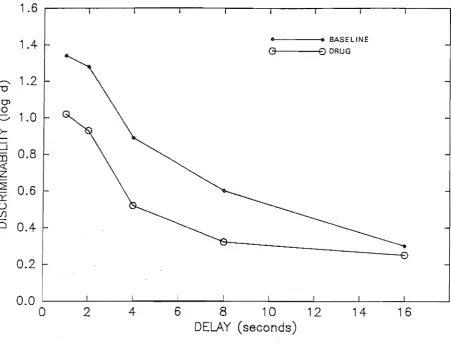
B. Delay interval length. Across a Nide variety of species i t has been shoRn that as the delay interval betKeen the sample and
comparison stimuli increases, there is a corresponding decrease in the accuracy of the animals performance. This is the case in pigeons
(Blough, 1959; Cumming
&
Berryman, 1965; Grant&
Roberts, 1973;Roberts, 1972; Roberts
&
Grant, 1974; Roberts 8. Grant, 1976; Zentall, 1973), in rats (Roberts, 1972; Hallace, Steinhert, Scobie S. Spear, 1980), monkeys (D' Amato S. Cox, 1976), and a dolphin (Berman S. Gordon, 1974). Kith pigeons a high level of performance can be maintained at 1-2 second delay and Kith ~ 18-15 second delay above chanceperformance can still be obtained (Zentall et a1., 1978). Rith a group of highly overtrained birds Grant (1976) reported greater than chance performance at delays up to 60 seconds.
C. Delay interval conditions. Several studies have found that houselight illumination during the delay interval interferes Kith matching accuracy both in pigeons (Grant S. Roberts, 1976; Maki, Moe 8.
Bierley, 1977; Roberts
&
Grant, 1978a) and in primates (D' Amato, 1973; D' Amato & 0' Neil, 1971; Etkin, 1972; Salmon & D' Amato, 1981), Although the level of delay interval illumination seems to be critical inobtaining the effect in primates (Salmon S. D' Amato, 1981), a change in delay interval illumination relative to the baseline condition appears to be a sufficient condition for producing the effect in pigeons
(Cook, 1980j Tranberg S. Rilling, 1980). A study by Thompson, Van Hemel, Rinston, and Pappas (1983) shORed that a change in baseline conditions Nas not a necessary condition.
Goldfarb, and Carley (1969) found the presence of the sample stimulus during the delay slightly facilitated matching, a novel stimulus produced a slight decrement and the incorrect stimulus produced a large decrement in performance. In a similar study Nith pigeons, i t Nas found that Navelength Nas more disruptive than a novel shape. Jans and Catania (19B0) found the operation of the feeder during the delay interval decreased matching performance relative to standard trials and on trials Nhere pecking at the key Nas alloNed during the delay, performance Nas enhanced relative to standard trials.
D. Directed forgetting. The accuracy of DHTS performance in pigeons can be influenced by the presentation of post sample cues to remember or forget (Grant, 19B1b; Grant, 1984; Kendrick, Rilling,
&
Stonebraker, 1981; Haki & Hegvik, 1980; Haki, Olsen, & Rego, 1981; Stonebraker&
Rilling, 1981; Stonebraker, Rilling,&
Kendrick, 1981). FolloHing the sample stimUlUS presentation one of tHO cues is given (e.g., a vertical or horizontal line). For one cue, (the "remember cue"), the standard procedure occurs and the comparison stimuli are presented, the other cue, (the "forget cue"), signals no comparison stimuli Hill be presented on that trial. After extensive training, probe trials to sample memory for the comparison stimuli areoccasionally interpolated, and i t is found that matching accuracy is significantly lONer on forget cue probe trials than on remember cue trials.
E. Schedules controlling comparison stimUlus termination. TNO stUdies have looked at the effects of various response requirements to the comparison stimUli. In both an oddity matching (Lydersen, Perkins,