Most literature on the locomotion of fishes has focused on the maximum performance of either rectilinear swimming at uniform velocities or the fast-start escape response. In contrast, routine swimming performance is poorly understood, despite the greater frequency of routine swimming relative to the higher-performance behaviors (Webb, 1994a,b). Routine swimming in many fish species consists of frequent maneuvers, including turning laterally (yaw) and dorsoventrally (pitch), rolling, starting, braking and hovering (Breder, 1926). Most studies of animal maneuvering performance have focused on lateral turning. In fact, Norberg and Rayner (1987) formally defined maneuverability as the ability to turn in a confined space and have used the length-specific minimum radius of the turning path (rpath/L, where L is total body length) as a measure of this performance. Webb (1994a) has advocated this limited definition of maneuverability for fishes.
Morphologies that facilitate or limit turning have been widely discussed, but the effects of many design features on turning performance remain poorly resolved (Gerstner, 1999; Schrank and Webb, 1998; Schrank et al., 1999; Webb et al., 1996). It has been suggested that a stiff body limits turning performance (Aleev, 1969; Fish, 1997, 1999). The results of several studies are consistent with this hypothesis. The rpath/L of a fish with a relatively stiff body, the yellowfin tuna Thunnus albacores (0.47), is an order of magnitude greater than the relative turning radii of two fish with more flexible bodies, the knifefish Xenomystus nigri (0.065) and the angelfish Pterophyllum eimekei (0.055) (Blake et al., 1995; Domenici
and Blake, 1997). Fish (1997) showed that the more flexible-bodied sea lion Zalophus californianus had a smaller rpath/L than seven more stiff-bodied species of cetaceans. Finally, Fish (1999) showed that the rigid-bodied whirligig beetle Dineutus horni has a higher rpath/L than more flexible fishes and aquatic mammals.
Nevertheless, Blake (1977) illustrated turning maneuvers of apparently small radii in two fishes with rigid bodies, the boxfishes (Ostraciidae) Lactoria cornuta and Tetrasomus gibbosus. Boxfishes are shallow-water, temperate and tropical fishes that are encased by a carapace of thickened, sutured scales modified into bony plates (Randall, 1972; Tyler, 1980). Because of this rigid armor, boxfishes cannot undulate their body anterior to the caudal peduncle. Consequently, boxfishes power both slow rectilinear swimming and turning maneuvers by oscillating or undulating the fan-shaped pectoral, dorsal and anal fins (Blake, 1977).
If boxfish can indeed turn with a small rpath, this would suggest that rpathis not a good measure of the actual radius of the space required to turn. A turn requires both the rotation of the animal and a translation of the center of rotation along a turning path. Letting reequal the effective radius of the turning animal (half the maximum projected diameter of the animal normal to the turning path), the minimum radius of the space required to turn, rspace, is re+rpath. For a rigid-bodied animal turning with rpath=0 (spinning with no translation), the minimum rspaceis L/2. At the least, a flexible fish with the same L and rpathas a rigid fish should be able to turn in a smaller space than the rigid fish simply by having a smaller re. Printed in Great Britain © The Company of Biologists Limited 2000
JEB2986
Whether a rigid body limits maneuverability depends on how maneuverability is defined. By the current definition, the minimum radius of the turn, a rigid-bodied, spotted boxfish Ostracion meleagris approaches maximum maneuverability, i.e. it can spin around with minimum turning radii near zero. The radius of the minimum space required to turn is an alternative measure of maneuverability. By this definition, O. meleagris is not very maneuverable. The observed space required by O. meleagris to turn is slightly greater than its theoretical
minimum but much greater than that of highly flexible fish. Agility, the rate of turning, is related to maneuverability. The median- and pectoral-fin-powered turns of O. meleagris are slow relative to the body- and caudal-fin-powered turns of more flexible fish.
Key words: swimming, turning performance, agility, curvature, kinematics, body stiffness, manoeuvrability, boxfish, Ostracion
meleagris.
Summary
Introduction
DOES A RIGID BODY LIMIT MANEUVERABILITY?
JEFFREY A. WALKER*
Department of Zoology, Field Museum of Natural History, 1400 S. Lake Shore Drive, Chicago, IL 60605, USA
*Present address: Department of Biological Sciences, University of Southern Maine, Box 9300, Portland, ME 04104-9300, USA (e-mail: [email protected])
Both measures of maneuverability, rpath and rspace, are important for the biology of fishes (see Discussion). To test whether and how body stiffness limits these two aspects of maneuverability, I measured both rpath and rspace in routine turns of a spotted boxfish Ostracion meleagris (Randall, 1972).
Materials and methods
A single, female Ostracion meleagris (Fig. 1) was purchased from a wholesaler in Chicago (total length, L=11.6 cm). The fish was allowed 2 days to acclimate to the test tank, a 37.8 l aquarium fitted with a mirror oriented at 45 ° to the tank bottom. Water temperature was 25 °C. Dorsal views of turning sequences were filmed with a Red Lake high-speed digital camera at 125 Hz and saved as AVI files. There were no explicit attempts to elicit turning behavior by startling the fish.
AVI files were converted to Apple QuickTime format and digitized in a version of the public-domain NIH Image software (developed at the US National Institutes of Health and available on the Internet at http://rsb.info.nih.gov/nih-image/) modified to facilitate the digitization of landmarks (available from the author upon request). Twelve turning sequences in which there was little dorsoventral translation were analyzed. Both sharp and gradual turns were analyzed. All analyzed turns were preceded by forward swimming and were through a cumulative turning angle of >150 °. Four landmarks were digitized every fifth frame (Fig. 1): the tip of the snout, a spot on the dorsal midline immediately anterior to the dorsal fin, the base of the caudal fin and the posterior tip of the caudal fin.
The center of rotation was determined from the snout and dorsal fin landmarks. One hundred equally spaced landmarks along the line segment connecting the snout and dorsal fin landmarks were constructed. The location of the center of rotation was estimated as the constructed landmark that traveled the smallest cumulative distance over the turning sequence. The instantaneous curvature, κ, which is a measure of the rate of rotation of the tangent to the path, was computed along the turning path by the parametric function:
κ=|x′y′′ −y′x″|/[(x′)2+ (y′)2]3/2,
where ′and ′′ reflect the first and second derivative of x or y with respect to distance along the turning curve. First and second derivatives of x and y were estimated using a quintic spline (Walker, 1998a) in the software QuicKurve (Walker, 1998b). The instantaneous radius of the turning curve, rpath, is simply the reciprocal of κ.
The snout and caudal fin tip paths were used to estimate the boundaries of the turning space. These boundaries were computed as the maximum perpendicular distance to either side of the midline axis in the initial frame (Fig. 2). These distances were found by rotating the snout and caudal fin tip landmarks by the angle between the midline axis of the first frame and a positive x vector. rspacewas then calculated as half the difference between the maximum and minimum y coordinates.
In addition to these two turning radii, several other variables were measured. Instantaneous turn angle, θ, was estimated as the angle between the midline segment connecting the snout and dorsal fin at time zero and the segment at time t. θwas
[image:2.612.341.526.139.481.2]Fig. 1. (A) Dorsal view of a female Ostracion meleagris. The four landmarks digitized are illustrated with white circles. (B) Construction of the midline axis of the fish and the angle, α, between the axis of the caudal fin and the median axis.
Fig. 2. Visual definition of rspace, the radius of the circle that fits the
space defined by the two lines parallel to the midline axis at the start of the turn and running through the two points reflecting maximum excursion of the body to either side of the starting midline axis.
J JJ
J J J J J J J J J J J J J J J J
EE E
E EE
E E
E E E E E
EE E E
E E
1 cm
[image:2.612.362.510.559.687.2]differentiated with respect to time using a quintic spline algorithm (Walker, 1998a) to determine the turning velocity,
ω. A normal acceleration coefficient, Cg, was computed as v2/r
pathg (Bandyopadhay, 1997), where v is the tangential velocity at κmaxand g is the acceleration due to gravity. Finally, the instantaneous angle, α, of the caudal fin, relative to the midline axis of the body was measured.
Results
Turn magnitudes ranged from 153.2 to 250.4 ° (Table 1). The distance traveled by the center of rotation ranged from 5.2 to 15.8 cm (0.44–1.36L). The time for these turns ranged from 1.04 to 2.76 s. Mean turn rate ranged from 76.1 to 147 ° s−1, while mean tangential velocity ranged from 2.7 to 8.1 cm s−1 (0.23–0.7 L s−1).
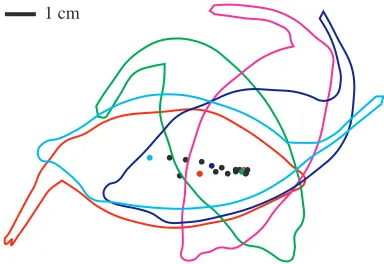
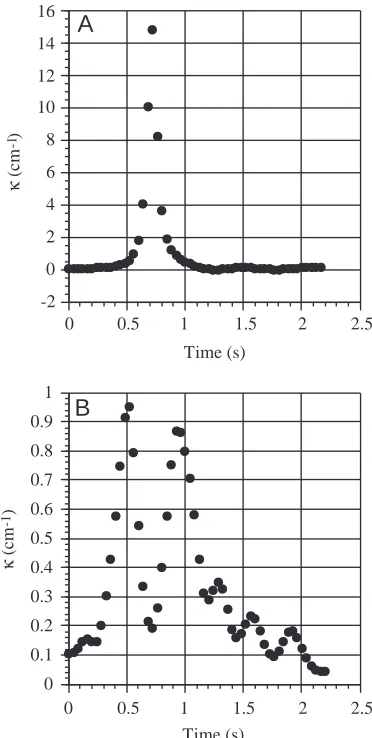
Although O. meleagris can perform hovering turns (rotation of the body without translation of the center of rotation), all analyzed turns included both translational and rotational components. Turning paths were not along the arc of a circle, which would require constant κthroughout the turn, but were characterized by an initial section with a low κ, a middle loop with a high κ, and a final section with a low κ(Figs 3, 4). While most of the sequences had single peaks of maximum curvature, three of the 12 sequences had two peaks of high curvature (Table 1; Fig. 4). In these double-peak turns, the loop section was characterized by an initial sharp 90 ° turn, followed by a short, straight path and then by a second sharp 90 ° turn. The
fish rotated during the intervals with low curvature, indicating that the body was spinning while sliding, or slipping, through the water (Fig. 3). κwas not constant during the loop of high curvature but instead peaked approximately half-way through the loop. rpathwas taken as the inverse of maximum curvature,
[image:3.612.346.538.73.205.2]κmax (Table 1). Minimum rpath/L of the loop section ranged from 0.0005 to 0.11. Minimum effective length, Le, during a turn was 8.3 cm. Minimum rspace/L ranged from 0.38 to 0.57, while rspace/Le, which has a theoretical minimum of 0.5, ranged from 0.53 to 0.8.
Table 1. Turning statistics for the 12 analyzed turning sequences
Period ∆T θT αmin Uo Umin ωmax ωavg
Type (s) (cm) (degrees) (degrees) (L s−1) (L s−1) rpath/L rspace/L (° s−1) (° s−1) Cg
Double 1.40 6.50 166.7 58.4 0.48 0.31 0.0802 0.47 153.1 119.1 0.0140
Single 1.04 7.40 153.2 46.9 1.14 0.09 0.0103 0.43 218.4 147.3 0.0474
Single 1.28 5.16 171.2 55.1 0.57 0.12 0.0140 0.40 148.7 133.8 0.0128
Double 2.12 14.07 250.4 81.2 0.67 0.35 0.0914 0.50 179.4 118.1 0.0158
Single 1.44 5.95 194.5 59.6 0.80 0.08 0.0005 0.40 200.5 135.0 0.1625
Double 1.96 15.82 222.8 89.9 0.58 0.41 0.1121 0.57 197.4 113.7 0.0193
Single 2.40 11.80 191.4 68.0 0.64 0.07 0.0024 0.39 106.8 79.7 0.0822
Single 1.76 10.03 176.8 56.6 0.80 0.21 0.0336 0.42 182.0 100.4 0.0181
Single 2.76 8.24 210.0 59.5 0.62 0.11 0.0179 0.38 132.9 76.1 0.0133
Single 2.52 6.93 212.1 58.4 0.61 0.10 0.0084 0.41 140.6 84.2 0.0142
Single 2.04 5.96 165.3 62.2 0.46 0.09 0.0059 0.44 116.9 81.0 0.0151
Single 1.84 6.47 170.6 58.2 0.62 0.11 0.0129 0.44 137.6 92.7 0.0106
Type refers to turns with one or two curvature peaks. Period is the time required for the turn.
∆Tis the total, cumulative distance traveled by the center of rotation during the turn.
θTis the total, cumulative rotation angle of the midline axis of the body.
αminis the minimum angle between the caudal fin and the midline axis.
Uois the tangential velocity of the center of rotation entering the turn.
Uminis the minimum tangential velocity of the center of rotation during the turn.
rpath/L is the length-specific turning radius, where L is total body length.
rspace/L is the length-specific radius of the space required to turn.
ωmaxis the maximum angular velocity of the midline axis.
ωavgis the average angular velocity over the turn.
Cgis the peak normal acceleration standardized by g.
[image:3.612.56.569.433.602.2]1 cm
Fig. 3. Displacement of the center of rotation over time for the sequence with rpath/L=0.0005, where rpathis the minimum radius of
Angular velocities changed throughout the turn. Peak ω, or
ωmax, ranged from 107 to 218 ° s−1. ωmaxalways occurred at or close to tmax, the time at which the turning curvature reaches its maximum. Tangential velocities changed throughout the turn, generally reaching a minimum near tmax. Cgvalues, which ranged from 0.01 to 0.16, were computed using the tangential velocity at tmax.
Howland (1974) suggested that rpathshould be independent of the tangential velocity entering the turn. Indeed, neither rpath nor rspacewas correlated with the tangential velocity entering the turn (rpath, r=−0.24, P=0.43; rspace, r=−0.17, P=0.59). In
contrast, both rpath and rspace were correlated with the tangential velocity at tmax (rpath, r=0.96, P<0.0001; rspace, r=0.87, P=0.0003). This correlation is expected; at the limit, when κmaxis infinite, the tangential velocity must fall to zero as the body stops and reverses direction. ωmaxwas correlated with the tangential velocity entering the turn (r=0.69, P=0.01) but not with the tangential velocity at tmax(r=0.49, P=0.11) nor with either rpathor rspace(rpath, r=0.36, P=0.25; rspace, r=0.41, P=0.18).
The angle, α, of the caudal fin relative to the midline axis of the body changed throughout the stroke, reaching a minimum, αmin, at or near the time of ωmax. In some turns, the minimum formed a distinct inverted peak, while in others the minimum was within a broad inverted plateau. αmin ranged from 46.9 to 68 ° for turns with single high-curvature peaks (Table 1). αminwas 58.4 °, 81.2 ° and 89.9 ° for the turns with two curvature peaks. Within turns, correlations between αand
ω ranged between −0.8 and −0.94. Among turns, αmin was significantly correlated with rpath and rspace (rpath, r=0.74, P=0.006; rspace, r=0.75, P=0.005). Excluding the double high-curvature turns, αmin was significantly correlated with ωmax (r=−0.77, P=0.015). These correlations suggest that the O. meleagris is partially controlling its turning kinematics by using the caudal fin as a rudder.
Discussion
The single O. meleagris individual sufficiently demonstrated that a rigid-bodied fish can perform lateral turning maneuvers of approximately 180 ° during forward locomotion with minimum turning radii, rpath, approaching zero. This observation should not surprise anyone who has watched boxfish swim. The O. meleagris turns question the use of rpath as a measure of turning space. rpath will only approximate the radius of the actual turning space if the midline axis of the fish follows the turning path throughout the turn. For tight turns, the midline axis of the O. meleagris cannot follow the turning curve because of its rigid body. Instead, the snout and caudal fin tip paths sweep out much larger spaces than the center-of-rotation path (Fig. 3).
The actual radius of the space required to turn is captured by rspace. The theoretical minimum rspacefor a turn is half the effective length of the fish, where the effective length is the major axis of the bent body. This minimum assumes that the fish is bent with constant curvature along its length and can maintain this curvature throughout the turn. A fish could turn with still smaller rspace if it effectively folded its body by passing a single, short wave of very high curvature down its body, as seems to occur in turning maneuvers of elongated, highly flexible fishes.
In the O. meleagris examined here, observed rspacefor the turns with single high-curvature peaks ranged from 6 to 60 % above the theoretical minimum. The observed values are higher than the minimum value, even for the turns with low rpath, because the fish failed to maintain a low rpaththroughout the turn. Casual observations suggest that O. meleagris can maintain a low rpath throughout a turn of 180 ° (and much higher), but these behaviors were not captured on digital video.
How do the minimum rpath/L (0.0005) and rspace/L (0.38) measured for this individual compare with those of other animals? For the stiff-bodied whirligig beetle Dineutus horni, minimum rpath/L was measured as 0.24 (Fish, 1999). For more flexible animals, rpath/L can be much lower. Mean rpath/L for the angelfish Pterophylum eimekei performing fast-start escape
κ
(cm
-1)
κ
(cm
-1)
JJJJJJJ
J J
J J
J
JJ
J
J
J
JJJ
J J
J JJ
J J
J
J
JJJJJJ
JJJJJJJJ
JJJJJJJJJJJJJ
0 1
0 0.5 1 1.5 2 2.5
0.9
0.8
0.5
0.4
0.3
0.2
0.1 0.7
0.6
Time (s)
JJJJJJJJJJJJJJJ
J J
J J
J
J J
JJJJJJJJJJJJJJJJJJJJJJJJJJJJJJJJJ
-2 0 2 4 6 8
0 0.5 1 1.5 2 2.5
12 14 16
10
Time (s)
[image:4.612.71.257.72.441.2]B
A
maneuvers was 0.065, but a minimum value has not been reported (Domenici and Blake, 1991). Domenici and Blake (1997) report an rpath/L of 0.055 for the knifefish Xenoystus nigri. Gerstner (1999) found minimum values of rpath/L between 0.02 and 0.05 for the median- and paired-fin (MPF)-powered turns and between approximately 0 and 0.05 for body-and caudal-fin (BCF)-powered turns of four species of coral reef fishes (foureye butterflyfish, Chaetodon capistratus; beaugregory damselfish, Stegastes leucostictus; ocean surgeonfish, Acanthurus bahanieusis; bluehead wrasse, Thalassoma bifasciatus). Minimum rpath/L was 0.09 for the California sea lion Zalophus californianus (Fish, 1997).
Turning curvatures along a turning path in the O. meleagris were not constant but were characterized by a sharp maximum approximately half-way through the turn. Among different animals, there is a continuum of turning styles, from quasi-uniform curvature turns along an arc of a circle to the highly non-uniform curvature turns of the boxfish. Unfortunately, there are not enough quantitative data from the literature to explore the relationship between maximum curvature within a path and the variability of curvatures along the path.
The only rspace values that I have found reported in the literature are from Schrank et al. (1999), who cleverly measured the minimum space required to turn by coercing fish to turn within tubes of different diameter. For turns of 180 °, mean rspace/L was approximately 0.11 for goldfish (Carassius auratus), 0.24 for silver dollar (Metynnis hypsauchen) and 0.26 for angelfish (Pterophylum scalare). The highest value, that for P. scalare, is more than three standard errors below 0.36, which is the minimum theoretical value for the individual O. meleagris analyzed here. Clearly, the flexible fishes can turn in smaller spaces than the rigid boxfish.
Webb (1994a) defined agility as the ability to quickly reorient the body and suggested turning rate, ω, as a measure of agility. The O. meleagris performed slow turns; the maximum instantaneous turning rate was 218 ° s−1, while the maximum turning rate averaged over the entire turn, ωavg, was 147 ° s−1. By comparison, ω
avgfor the whirligig beetle ranged from 400 to 4428 ° s−1. ω
avgfor the four coral reef fishes in the study of Gerstner (1999) ranged from approximately 100 to 1200 ° s−1 for MPF turns and from approximately 650 to 9200 ° s−1for BCF turns. The sea lion Z. californianus turned at rates ranging from 150 to 690 ° s−1(Fish, 1997). Five of the seven cetaceans (with generally stiffer bodies than the sea lion) analyzed by Fish (1997) had low ωavg, ranging between 25 and 200 ° s−1, although one of the species (the white-sided dolphin Lagenorhynchus obliquidens) had a maximum ωavg of 453 ° s−1.
In a comparison of ωavgacross a broad size range of flexible, aquatic animals, Fish (1999) showed that ωavgdecreases with L. The ωavgof two stiff-bodied vehicles, the whirligig beetle and the submarine USS Albacore, were six and eight times slower than the expected ωavgof flexible animals (based on a deviation from the least-squares regression). In comparison, the maximum ωavgfor the O. meleagris was 26 times slower
than the expected ωavg. The measurement of maximum ωavg for boxfish, in general, was not the goal of this study and there was no attempt to stimulate faster turns. The turning rate data are comparable, then, with the values for the reef fishes (Gerstner, 1999), cetaceans (Fish, 1997) and the whirligig beetle (Fish, 1999), but not with the fast-start escape values (Domenici and Blake, 1997), for which maximal performance is expected. Variation in ωavg among multiple individuals or species of Ostraciidae was also not measured. Nevertheless, the available O. meleagris data, in combination with those of Fish (1999), are consistent with the hypothesis that a stiff body limits agility (Fish, 1997, 1999).
There are at least three reasons why the rigid body of the boxfish should limit agility. First, the bony exoskeleton precludes the myotomal muscles from bending the cranial end of the body into the turn and the caudal end of the body away from the turn. Second, the rigid body results in a relatively high pressure drag resisting rotation because the angle of attack between the body and the local flow is close to 90 ° along the entire length of the body. Finally, the inability to bend the body does not allow the fish to reduce the body’s second moment of area about the dorsoventral rotational axis, resulting in high inertial resistance to rotation.
Using rpath as a measure of maneuverability, the O. meleagris was maximally maneuverable despite its stiff body. Using rspace, the O. meleagris was a poor maneuverer relative to more flexible fish. Importantly, both performance variables are important measures of maneuverability in its broader sense. rspaceshould be associated with the ability effectively to exploit confined spaces created by complex structure, such as the vegetated margins of lakes and rock and coral reefs. The ability to rotate with a low rpath, in contrast, allows an individual precise control of its orientation, which could be important for sampling individual prey, especially in environments with rapidly changing flow velocities.
Boxfish power turns by the combined oscillation and undulation of the pectoral, dorsal and anal fins (Blake, 1977). The high correlations between α and ω within turns and between αminand rpath/L among turns suggest that the caudal fin has a large influence on turning control by effectively acting as a rudder (Blake, 1977). The multiple control devices employed by maneuvering boxfish allow precise control of position and orientation, despite the rigid body.
R. Blob and two anonymous reviewers greatly improved the manuscript. This research was supported by Berkeley Research Associates and Office of Naval Research award N00014-99-1-0184 to M. W. Westneat and J.A.W. The initial ideas for this project were conceived while J.A.W. was supported by a National Science Foundation Postdoctoral Research Fellowship in the Biosciences Related to the Environment.
References
Aleev, Y. G. (1969). Function and Gross Morphology in Fish. Jerusalem: Israel Program for Scientific Translations. 268pp. Bandyopadhay, P. R., Castano, J. M., Rice, J. Q., Philips, B.,
Nedderman, W. H. and Macy, W. K. (1997). Low speed maneuvering hydrodynamics of fish and small underwater vehicles.
J. Fluids Eng. 119, 136–144.
Blake, R. W. (1977). On ostraciiform locomotion. J. Mar. Biol. Ass.
UK 57, 1047–1055.
Blake, R. W., Chatters, L. M. and Domenici, P. (1995). Turning radius of yellowfin tuna (Thunnus albacares) in unsteady swimming manoevres. J. Fish Biol. 46, 536–538.
Breder, C. M, Jr (1926). The locomotion of fishes. Zoologica 4, 159–291.
Domenici, P. and Blake, R. W. (1991). The kinematics and performance of the escape response in the angelfish (Pterophyllum
eimekei). J. Exp. Biol. 156, 187–205.
Domenici, P. and Blake, R. W. (1997). The kinematics and performance of fish fast-start swimming. J. Exp. Biol. 200, 1165–1178.
Fish, F. E. (1997). Biological designs for enhanced maneuverability: analysis of marine mammal performance. In Tenth International
Symposium on Unmanned Untethered Submersible Technology, pp.
109–117. Durham, NH: Autonomous Undersea Systems Institute. Fish, F. E. (1999). Performance constraints on the maneuverability
of flexible and rigid biological systems. In Eleventh International
Symposium on Unmanned Untethered Submersible Technology, pp.
394–406. Durham, NH: Autonomous Undersea Systems Institute. Gerstner, C. L. (1999). Maneuverability of four species of coral-reef
fish that differ in body and pectoral-fin morphology. Can. J. Zool. 77, 1102–1110.
Godin, J.-G. J. (1997). Evading predators. In Behavioral Ecology of
Teleost Fishes (ed. J.-G. J. Godin), pp. 191–236. New York: Oxford
University Press.
Hixon, M. A. and Beets, J. P. (1993). Predation, prey refuges and
the structure of coral-reef fish assemblages. Ecol. Monogr. 63, 77–101.
Howland, H. C. (1974). Optimal strategies for predator avoidance: the relative importance of speed and manoeuvrability. J. Theor.
Biol. 47, 333–350.
Norberg, U. and Rayner, J. M. V. (1987). Ecological morphology and flight in bats (Mammalia: Chiroptera): wing adaptations, flight performance, foraging strategy and echolocation. Phil. Trans. R.
Soc. Lond. B 316, 335–427.
Randall, J. E. (1972). The Hawaiian trunkfishes of the Genus Ostracion. Copeia 1972, 756–768.
Sancho, G. (1998). Factors regulating the height of spawning ascents in trunkfishes (Ostraciidae). J. Fish Biol. 53A, 94–103.
Schrank, A. J. and Webb, P. W. (1998). Do body and fin form affect the abilities of fish to stabilize swimming during maneuvers through vertical and horizontal tubes? Env. Biol. Fish. 53, 365–371.
Schrank, A. J., Webb, P. W. and Mayberry, S. (1999). How do body and paired-fin positions affect the ability of three teleost fishes to maneuver around bends? Can. J. Zool. 77, 203–210.
Sudekum, A. E., Parrish, J. D., Radtke, R. L. and Ralston, S. (1991). Life history and ecology of large jacks in undisturbed, shallow, oceanic communities. Fish. Bull. 89, 493–513.
Thompson, D. A. (1964). Ostracitoxin: an ichthyotoxic stress secretion of the boxfish, Ostracion lentiginosus. Science 146, 244–245.
Tyler, J. C. (1980). Osteology, phylogeny and higher classification of the fishes of the order Plectognathi (Tetraodontiformes). NOAA
Technical Report NMFS Circular 434.
Walker, J. A. (1998a). Estimating velocities and accelerations of animal locomotion: a simulation experiment comparing numerical differentation algorithms. J. Exp. Biol. 201, 981–995.
Walker, J. A. (1998b). QuicKurve. [WWW document]
http://jaw.fmnh.org/software/qs.html: Department of Zoology, Field Museum of Natural History, Chicago, USA.
Webb, P. W. (1994a). The biology of fish swimming. In Mechanics
and Physiology of Animal Swimming (ed. L. Maddock, Q. Bone and
J. M. V. Rayner), pp. 45–62. Cambridge: Cambridge University Press.
Webb, P. W. (1994b). Exercise performance of fish. In Comparative
Vertebrate Exercise Physiology: Phyletic Adaptations (ed. J. H.
Jones), pp. 1–49. San Diego: Academic Press.