Department of the Army Washington, DC, 10 June 1985
T
he purpose of this manual is to integrate survivability into the over-all AirLand battle structure. Survivability doctrine addresses when, where, and how fighting and protective battlefield positions are prepared for individual soldiers, troop units, vehicles, weapons, and equipment. This manual implements survivability tactics for all branches of the combined arms team.Battlefield survival critically depends on the quality of protection afforded by the positions. The full spectrum of survivability encompasses planning and locating position sites, designing adequate overhead cover, analyzing terrain conditions and construction materials, selecting excavation methods, and countering the effects of direct and indirect fire weapons. This manual is intended for engineer commanders, noncommissioned officers, and staff officers who support and advise the combined arms team, as well as combat arms commanders and staff officers who establish priorities, allocate resources, and integrate combat engineer support. The proponent of this publication is the US Army Engineer School. Submit changes for improving this publication on DA Form 2028 (Recommended Changes to Publications and Blank Forms) and forward it directly to Commandant, US Army Engineer School, ATTN: ATZA-TD-P, Fort Belvoir, VA 22060-5291.
THE AIRLAND BATTLEFIELD
The purpose of military operations in the next battle is to win. To achieve success, our forces must gain the initiative, deploy in depth, and stress agility and synchronization of activities and functions. Such an approach will prevent the enemy from freely maneuvering forces in depth to reinforce an attack, build up a defense, or counterattack. In the next fast-paced battle, our forces must protect themselves as never before from a wide range of highly technical weapons systems. Thus, in both the offense and defense, we will have to be ever-conscious of the enemy's ability to detect, engage, and destroy us. Careful planning and diligent work will enhance our ability to survive.
Survivability doctrine addresses five major points significant to the AirLand battlefield:
1. Maneuver units have primary responsibility to develop, position, and begin building their own positions.
2. The engineer's ultimate role in survivability is set by the maneuver commander controlling engineer resources.
4. Engineer support will concentrate on missions requiring unique engineer skills or equipment.
5. Survivability measures begin with using all available concealment and natural cover, followed by simple digging and constructing fighting and protective positions. As time and the tactical situation permit, these positions are improved.
The following AirLand battle conditions will shape our protection and survivability efforts:
•
• The need to win at the forward line of our own troops (FLOT), conduct deep battle operations, and overcome threats in the rear area.
• The use of effective firepower and decisive maneuver.
• The existence of a nonlinear battlefield resulting from dissolution of battle lines and areas due to maneuvering, and rapid dispersion from areas of nuclear and chemical weapons effects.
• Coordinated air/ground operations involving frequent movement by friendly troops. • Proliferation of nuclear and chemical tactical weaponry.
• Active reconnaissance, surveillance, and target acquisition efforts through visual, remote sensing radar, and tactical radio direction finding procedures.
• Reliance on electronic warfare as a combat multiplier.
THE THREAT
During the next battle, US forces are likely to encounter or work with nations of widely diverse political systems, economic capabilities, cultures, and armies. Whether the battle is with Warsaw Pact or Third World countries, US forces will be exposed to Soviet-style weaponry and tactics. The following outline of Threat tactics and battle priorities provides a key to understanding survivability requirements for US forces. (See Field Manuals (FMs) 2-1, 2-2, and 100-2-3 for more detailed information.)
DIRECT FIRE WEAPONS
The opposing Threat is an offensively-oriented force that uses massive amounts of firepower to enhance the maneuverability, mobility, agility, and shock of its weaponry. It seeks to identify and exploit weak points from the front to the rear of enemy formations. The tank is the Threat's primary ground combat weapon, supplemented by armored personnel carriers (APCs) and other armored fighting vehicles. Large mechanized formations are used to attack in echelons, with large amounts of supporting suppressive direct and indirect fire. To achieve surprise, Threat forces train to operate in all types of terrain and during inclement weather. Threat force
commanders train for three types of offensive action: the attack against a defending enemy, the meeting engagement, and the pursuit.
The Attack Against a Defending Enemy
envelopment, frontal attack, and flank attack. Penetration of enemy defenses is the ultimate objective in all three operations. The Threat force uses echeloned forces in this effort, and their goal is to fight through to the enemy rear and pursue retreating forces.
Threat attacks of strongly-defended positions will usually have a heavy air and artillery
preparation. As this preparation is lifted and shifted to the depths of the enemy, advance guard units conduct operations to test the strength of the remaining defenders. Critical targets are reduced by artillery or by ground attacks conducted by advancing armor-heavy main forces. These forces attack from the march unless they are forced to deploy into attack formations by either the defending force or terrain conditions. The Threat seeks to overwhelm its enemy by simultaneously attacking as many weak points as possible. If weak points cannot be found, the Threat deploys into concentrated attack formations, usually organized into two echelons and a small reserve. These formations are initially dispersed to limit nuclear destruction, but are concentrated enough to meet offensive norms for attack. The Threat attacks defensive positions in a column formation and continues the attack into depths of the defense. Threat regimental artillery directly supports battalions, companies, and platoons for the duration of the engagement.
United States Forces
United States defending forces conduct extensive survivability operations during an enemy attack. Preliminary activities include deliberate position construction and hardening for both weapons and command and supply positions. Alternate and supplementary positions are also located and prepared if time allows. Finally, covered routes between these positions are selected, and camouflage of all structures is accomplished.
The Meeting Engagement
The meeting engagement is the type of offensive action most preferred by Threat forces. It relies on a standard battle drill executed from the march using combined arms forces and attached artillery support. Threat doctrine stresses rapid maneuver of forces and attacking while its enemy is on the march--not when it is in a prepared defense. Attacking a defending enemy requires superiority of forces--a requirement the Threat seeks to avoid.
The meeting engagement begins as the Threat advance guard of a combined arms force makes contact with the enemy advancing force. As soon as contact is made, the Threat battle drill begins. When possible, the main Threat force maneuvers its advance guard to a flank and attacks. This preliminary maneuver is supported by a barrage from the Threat force organic artillery which has deployed at the first sign of contact. The Threat force then makes a quick flank or frontal attack on enemy forces as they advance support their engaged advancing forces.
United States Forces
When US forces are involved in a meeting engagement, survivability operations are needed, but not as much as in the deliberate defense. Hastily prepared fighting and protective positions are essential but will often be prepared without engineer assistance or equipment. Maneuver units must also use natural terrain for fighting and protective positions.
The Pursuit
The pursuit of retreating forces by a Threat advancing force takes place as leading echelons bypass strongpoints and heavy engagements and allow following echelons to take up the fight. After any penetration is achieved, Threat doctrine calls for an aggressive pursuit and drive into the enemy rear area. This often leaves encircled and bypassed units for follow-on echelon forces to destroy.
United States Forces
Survivability in retrograde operations or during pursuit by the Threat force presents a significant challenge to the survivability planner. During retrograde operations, protective positions--both within the delay and fallback locations--are required for the delaying force. Company-size delay and fall back fighting and protective positions are most often prepared. Planning and preparing the positions requires knowledge of withdrawal routes and sequence.
INDIRECT FIRE WEAPONS
Threat commanders want to achieve precise levels of destruction through implementation of the rolling barrage, concentrated fire, or a combination of the two. Combined with tactical air strikes and fires from direct fire weapons, these destruction levels are-
•
• Harassment with 10 percent loss of personnel and equipment; organizational structure is retained.
• Neutralization with 25 to 30 percent destruction of personnel and equipment; effectiveness is seriously limited.
• Total destruction with 50 percent or more destruction of personnel and equipment.
The Threat can plan for the total destruction of a strongpoint by delivering up to 200 rounds of artillery, or 320 rounds from their medium rocket launcher, per 100 meter square. Thus, the Threat force attacks with a full complement of direct and indirect fire weapons when targets of opportunity arise or when the tactical situation permits.
United States Forces
and construction materials available for the desired level of survivability is necessary. Therefore, priorities of construction are necessary. Covered dismounted firing positions and shelters
adjacent to large weapons emplacements are constructed by maneuver units, usually without engineer assistance. The maneuver commander must prioritize the construction of overhead cover for command, control, and supply positions.
NUCLEAR WEAPONS
Threat plans and operations for their nuclear systems are ranked in the following order:
•
• Destroy US nuclear delivery systems, nuclear weapons stocks, and the associated command and control apparatus.
• Destroy US main force groupings. • Breach US main lines of defense.
• Establish attack corridors within US battlefield boundaries.
Threat nuclear targeting plans are based on the use of massive amounts of supporting
conventional direct and indirect fire. These massive artillery barrages enable the use of Threat nuclear weapons systems against targets which conventional weapons cannot destroy or disable.
United States Forces
Due to the multiple effects of a nuclear detonation, survivability operations against nuclear weapons are difficult. Thermal, blast, and radiation effects require separate consideration when designing protection. However, fortifications effective against modern conventional weapons will vary in effectiveness against nuclear weapons.
CHEMICAL WEAPONS
Often, Threat forces may use massive surprise chemical strikes in conjunction with nuclear and conventional attacks. These chemical strikes are aimed at destroying opposing force offensive capability, as well as disrupting logistics and contaminating all vulnerable rear area targets.
United States Forces
United States (US) forces must plan to fight, as well as survive, on a chemical contaminated battlefield. Open or partially open emplacements afford no protection from chemical or biological attack. Personnel in open emplacements or nonprotected vehicles must use proper chemical protective clothing and masks to avoid chemical vapors and biological aerosols.
DEEP ATTACK
airborne/airmobile forces (battalion or regimental sizes) are deployed to strike targets in the enemy rear which are critical to the success of Threat forces. Additionally, covert reconnaissance missions or sabotage and harassment missions are accomplished by small Threat teams deployed in the rear. All of the Threat forces involved in a deep attack are trained and equipped to operate in contaminated environments.
Threat organization in the deep attack normally consists of the airborne/airmobile battalion for missions involving a long-range strike group. Operational maneuver groups will also conduct deep attacks using armor heavy forces. Organization for covert reconnaissance is normally a platoon-or company-size reconnaissance element.
United States Forces
When attacks on rear areas are made by Threat force aircraft, or by covert or overt airborne/airmobile forces, rear area activities are susceptible to many of the weapons encountered in the forward area. Thus, survivability of these rear area activities depends on adequate protective construction before the attack. Technical Manual (TM) 5-855-1 describes permanent protective construction in detail.
ROLE OF US FORCES COMMANDER'S ROLE
Commanders of all units must know their requirements for protection. They must also
understand the principles of fighting positions and protective positions, as well as the level of protection needed, given limited engineer assistance. Survivability measures are subdivided into two main categories: fighting positions for protection of personnel and equipment directly involved in combat; and protective positions for protection of personnel and equipment not directly involved with fighting the enemy. In order to protect their troops in the combat zone, commanders or leaders must fully understand the importance of fighting positions, both in the offense and in the defense. The initial responsibility for position preparation belongs with the maneuver commander's own troops. Even within the fluid nature of the AirLand battle, every effort to fortify positions is made to ensure greater protection and survivability.
ENGINEER'S ROLE
The engineer's contribution to battlefield success is in the five mission areas of mobility,
countermobility, survivability, general engineering, and topographic engineering. Although units are required to develop their own covered and/or concealed positions for individual and
Survivability on the modern battlefield, then, depends on progressive development of fighting and protective positions. That is, the field survivability planner must recognize that physical protection begins with the judicious use of available terrain. It is then enhanced through the continual improvement of that terrain.
In the Offense
In the offense of the AirLand battle, fighting and protective position development is minimal for tactical vehicles and weapons systems. The emphasis is on mobility of the force. Protective positions for artillery, air defense, and logistics positions are required in the offense and defense, although more so in the defense. Also, command and control facilities require protection to lessen their vulnerability. During halts in the advance, units should develop as many protective positions as possible for antitank weapons, indirect fire weapons, and critical supplies. For example, expedient earth excavations or parapets are located to make the best use of existing terrain. During the early planning stages, the terrain analysis teams at division, corps, and theater levels can provide information on soil conditions, vegetative concealment, and terrain masking along the routes of march. Each position design should include camouflage from the start, with deception techniques developed as the situation and time permit.
In the Defense
Defensive missions demand the greatest survivability and protective construction effort. Activities in the defense include constructing protective positions for command and control artillery, air defense, and critical equipment and supplies. They also include preparing individual and crew-served weapons positions and defilade fighting positions for fighting vehicles.
Meanwhile, countermobility operations will compete with these survivability activities for engineer assistance. Here again, maneuver commanders must instruct their crews to prepare initial positions without engineer help. As countermobility activities are completed, engineers will help improve those survivability positions.
Two key factors in defensive position fighting development are: proper siting in relation to the surrounding terrain, and proper siting for the most effective employment of key weapons systems such as antitank guided missiles (ATGMs), crew-served weapons, and tanks. Critical elements for protective positions are command and control facilities, supply, and ammunition areas since these will be targeted first by the Threat. The degree of protection for these facilities is
determined by the probability of acquisition,and not simply by the general threat. Facilities emitting a strong electromagnetic signal, or substantial thermal and visual signature, require full protection against the Threat. Electronic countermeasures and deception activities are mandatory and an integral part of all activities in the defense.
COMBAT/COMBAT SUPPORT ROLE
Light Infantry
Light infantry units include rifle, airborne, air assault, and ranger units. They are ideally suited for close-in fighting against a force which has equal mobility or a mobility advantage which is degraded or offset. Difficult terrain, obstacles, and/or weather can degrade a mobility advantage. Surprise or stealth can offset a mobility advantage. In restricted terrain such as cities, forests, or mountains, light infantry units are also a challenge to enemy armor forces.
Command and control facilities require protective positions. The defense requires fortified positions when terrain use is critical and when covered routes are required between positions.
Light forces readily use local materials to develop fighting positions and bunkers rapidly. Priorities are quickly established for position development-first to antitank and crew-served weapon positions, and then to command and control facilities and vital logistics positions. Artillery positions must have hardening improvements soon after emplacement is complete. In air assault units, aircraft protection is given high priority. Aircraft is dispersed and parapets or walls are constructed when possible.
Mechanized Infantry
Mechanized infantry operations in both the offense and the defense are characterized by rapid location changes and changes from fighting mounted to fighting dismounted. Mechanized infantry units normally fight integrated with tanks, primarily to destroy enemy infantry and antitank defenses. When forced to fight dismounted, such units need support by fire from weapons on board their APCs or infantry fighting vehicles (IFVs). When the terrain is not suitable for tracked vehicles or visibility is severely restricted, mechanized infantry may have to fight dismounted without the support of APCs or IFVs. When mounted, mechanized forces rely heavily on terrain positioning for fighting positions. Fighting positions increase survivability when the situation and time permit construction.
Armor
The tank is the primary offensive weapon in mounted warfare. Its firepower, protection from enemy fire, and speed create the shock effect necessary to disrupt the enemy's operations. Tanks destroy enemy armored vehicles and suppress enemy infantry and ATGMs. Armor and infantry form the nucleus of the combined arms team and both complement and reinforce each other. Infantry assists the advance of tanks in difficult terrain, while armor provides protection in open terrain, thus providing flexibility during combined arms maneuver.
Armor units rely on terrain positioning to decrease vulnerability. When possible, these terrain fighting positions are reinforced (deepened) by excavation. Protective positions for thin-skinned and lightly-armored support vehicles, as well as command posts and critical supplies, require significant hardening. Armor units enhance protection by constructing alternate and
supplementary positions and defining routes between them.
Armored and Air Cavalry
Aviation
Army aviation units, in addition to air cavalry units, consist of attack helicopter and combat support aviation forces. Attack helicopter units are aerial maneuver units which provide highly maneuverable antiarmor firepower. They are ideally suited for employment in situations where rapid reaction time is important, or where terrain restricts ground forces.
Combat support aviation units give dismounted infantry and ground antitank units tactical mobility. This enables them to move rapidly to the enemy's flanks or rear, or to reposition
rapidly in the defense. Combat support aviation units can quickly move towed field artillery units and other lighter combined arms team elements as the commander dictates. They also provide critical supplies to forward areas in the defense and attacking formations when groundlines of communications have been interdicted.
Protection for Army aviation units is employed with full consideration to time constraints, logistical constraints, and the tactical situation. The primary means for aircraft protection on the ground is a combination of terrain masking, cover and concealment, effective camouflage, and dispersion. When possible, protective parapets and revetments are built. Aircraft logistics
facilities, including FARPs and maintenance facilities, require additional protective construction. The FARPs require some protection of supplies and ordnance through the use of protective parapets and bunkers. They also require fighting positions for occupants of the points.
Field Artillery
Field artillery is the main fire support element in battlefield fire and maneuver. Field artillery is capable of suppressing enemy direct fire forces, attacking enemy artillery and mortars,
suppressing enemy air defenses, and delivering scatterable mines to isolate and interdict enemy forces or protect friendly operations. It integrates all means of fire support available to the commander and is often as mobile as any maneuver force it supports. Fighting and protective position use is one of several alternatives the field artillery leader must evaluate. This alternate may be alone or in combination with other survivability operations, such as frequent moves and adequate dispersion.
Counterfire from enemy artillery is the most frequent threat to artillery units. Dug-in positions and/or parapet positions, as well as existing terrain and facilities, can provide protection. Threat acquisition and targeting activities are heavily used against artillery and are supplemented by some covert Threat deep ground attacks. Thus, personnel and equipment need some direct fire protection. Fire direction centers and battery operation centers should be protected with hardened bunkers or positions to defeat counterfire designed to eliminate artillery control.
In urban areas, existing structures offer considerable protection. Preparation for these is minimal compared to the level of protection. The use of self-propelled and towed equipment for
Combat Engineers
Combat engineers contribute to the combined arms team by performing the missions of mobility, countermobility, survivability, topographic operations, general engineering, and fight as infantry.
Mobility missions include breaching enemy minefield and obstacles, route improvement and construction, and water-crossing operations. Countermobility missions include the
enhancement of fire through obstacle and minefield employment. Survivability missions enhance the total survivability of the force through fighting and protective position construction.
Topographic operations engineering missions include detailed terrain analysis, terrain overlays, trafficability studies, evaluation of cover and concealment, soils maps, and other information to base mobility, countermobility, and survivability decisions. General
engineering missions support theater armies with both vertical and horizontal construction capabilities.
Combat engineer fighting and protective position requirements depend on the type and location of the mission being performed in support of the combined arms team. Personnel and equipment protective positions are used when project sites are located within an area that the Threat can acquire. Engineers have limited inherent protection in vehicles and equipment and will require fighting positions, protective command and control, and critical supply bunkers when under an enemy attack. When time is available and when the mission permits, revetments and parapets can protect construction equipment. Generally, engineers use the same methods of protection used to protect the maneuver force they are supporting.
When engineers fight as infantry, they employ protective measures similar to those required by light or mechanized infantry forces.
Air Defense Artillery
Air defense units provide security from enemy air attack by destroying or driving off enemy aircraft and helicopters. Their fire degrades the effectiveness of enemy strike and reconnaissance aircraft by forcing the enemy to evade friendly air defense. Short-range air defense systems normally provide forward air defense protection for maneuver units whether the units are attacking, delaying, withdrawing, or repositioning in the defense. Air defense units also provide security for critical facilities and installations.
The main technique for air defense artillery (ADA) survivability is frequent movement. Because their main mission is to protect divisional and corps assets, ADA units are a high-priority target for suppression or attack by enemy artillery and tactical aircraft. Signature acquisition
equipment, smoke, dust, contrails associated with firing, and siting requirements allow them to conduct their mission. Available terrain is generally used for cover and concealment since little time is available for deliberate protective construction. Dummy positions are constructed whenever possible, since they may draw significant enemy artillery fire and aircraft attack.
maintained. Deliberate protective construction is always done when systems are employed to defend fixed installations, command posts, or logistics systems.
Unit Support Systems
Several types of combat support equipment and their positions are considered unit support systems. These systems include communications and power generation equipment, field trains, forward supply points, decontamination sites, and water points. Protection for each of these positions depends greatly on their battlefield location and on the mission's complexity. Protective measures for both equipment and organic and supported personnel are normally provided. Initial positioning of these systems takes full advantage of terrain masking, cover and concealment, and terrain use to enhance camouflage activities.
Major Logistics Systems and Rear Areas
Major logistics systems and rear area operations include rear area supply depots; petroleum, oils, and lubricants (POL) tank/bladder farms; rear area/depot level maintenance activities; and so on. Survivability planners are most concerned with denial of acquisition and targeting of these positions by the Threat. A combination of camouflage and deception activities is usually used to conceal major logistics system activities.
Actual survivability measures used to protect large activities depend on the type of threat anticipated and target analysis. The obvious threat to large facilities is conventional or
THE PLANNING PROCESS
This section outlines the information needed and the decision-making process required for executing survivability missions. Increased engineer requirements on the AirLand battlefield will limit engineer resources supporting survivability. Mobility, countermobility, survivability (M-CM-S), and general engineering requirements are in competition for the same engineer assets. Survivability requirements are compared with the tactical need and the need for mobility and countermobility operations. The maneuver commander sets the priorities which allow the force to perform critical tasks. The successful force must have enough flexibility to recognize and make immediate necessary changes on the battlefield.
DECISION MAKING
Both the commander and staff are involved in the military decision-making process. It provides courses of action for the commander and, by selecting the best course, enhances survivability. The staff input in the decision-making process for planning survivability missions includes:
•
• Military intelligence (enemy activity, terrain, weather, and weapon types).
• Administration/logistics (personnel and combat services support activities).
• Civil affairs (civilians possibly affected by military operations).
PLANNING SEQUENCE
The engineer prepares or assists in the preparation of survivability estimates and plans to support the survivability efforts of the entire unit. In organizations without a staff engineer, the
operations officer performs the analysis and formulates survivability plans. The following sequence is used to develop survivability support options and plans.
•
• Mission and commander's guidance are received.
• Time available is considered.
• Threat situation and Threat direct and indirect assets are analyzed.
• Friendly situation and survivability support resources are evaluated.
• Survivability data, including terrain analysis results, is evaluated.
• Possible courses of action are developed.
• The Survivability portion of the engineer estimate is prepared.
• Courses of action constraints are compared with actual engineer resources available.
• Plans are prepared, orders are issued, and staff supervision is conducted.
The survivability planning process is completed when the survivability estimates and plans are combined with those for mobility, countermobility, and general engineering. The maneuver commander then has a basis for deciding task priorities and allocating support.
DATA COLLECTION
INFORMATION ON METT-T
Information on mission, enemy, terrain and weather, time, and troops (METT-T) is compiled.
The Mission
Subordinate commanders/leaders must understand the maneuver commander's mission and guidance. The commander/ leader must know what survivability tasks are necessary and how they interface with mobility, countermobility, and other tasks necessary for completing the mission. In addition, the commander/leader implementing survivability tasks must know if any additional support is available.
The Enemy
Terrain and Weather
One of the most important sources of information the maneuver commander and supporting engineer receive is a detailed terrain analysis of the area. This analysis is provided by the
division terrain team (DTT) or corps terrain team (CTT). It includes the types of terrain, soil, and weather in the area of operations. A good mental picture of the area of operations enables the commander to evaluate all M-CM-S and general engineering activities to create the best plan for attack or defense.
Time
Every survivability mission has a deadline for reaching a predetermined level of protection. Hardening activities will continue past the deadline and are done as long as the force remains in the position. Survivability time constraints are deeply intertwined with mobility and
countermobility time constraints. If the level of protection required cannot be achieved in the time allotted, resources are then committed to mobility or countermobility operations, or as designated by the maneuver commander.
Troops and Resources
The commander must weigh available labor, material constraints, and engineer support before planning an operation. Labor constraints are identified through analysis of the three sources of labor-maneuver unit troops, engineer troops, and indigenous (host nation/local area) personnel. Supply and equipment constraints are identified through analysis of on-hand supplies, naturally-available materials, and supplies naturally-available through military and indigenous channels. Careful procurement consideration is given to available civilian engineer equipment to supplement military equipment.
INFORMATION ON INTELLIGENCE
The maneuver force commander and engineer must have access to available intelligence
information provided by staff elements. Battalion S2 sections provide the bulk of reconnaissance and terrain information, and experts at the division level and above assist the commander. For example, the DS terrain team, the production section of the division tactical operations center (DTOC) support element, and the corps cartographic company can quickly provide required terrain products. In addition, the commander uses the division intelligence system which provides the Threat order of battle and war-damaged key facilities. When reconnaissance
requirements exceed the capability of battalion reconnaissance elements, maneuver or supporting engineer units collect their own information.
EVALUATION
When the engineer or maneuver units have collected all data required for protective construction, the data is analyzed to evaluate possible courses of action. Alternatives are based on the
PROTECTION NEEDS
Although the decision on what is to be protected depends on the tactical situation, the following criteria are used as a guide:
•
• Exposure to direct, indirect, and tactical air fire.
• Vulnerability to discovery and location due to electronic emissions (communications and radar), firing signature, trackable projectiles, and the need to operate in the open.
• Capability to move to avoid detection, or to displace before counterfire arrives.
• Armor suitable to cover direct small caliber fire, indirect artillery and mortar fire, and direct fire antitank weapons.
• Distance from the FLOT which affects the likelihood of acquisition as a target, vulnerability to artillery and air bombardment, and chance of direct contact with the enemy.
• Availability of natural cover.
• Any unique equipment item, the loss of which would make other equipment worthless.
• Enemy's engagement priority to include which forces the Threat most likely will engage first.
• Ability to establish positions with organic equipment.
Using these factors in a vulnerability analysis will show the maneuver commander and the engineer which maneuver, field artillery, and ADA units require the most survivability support. The table Equipment to be Protected lists weapons systems in these units requiring fighting position/protective position construction.
PROTECTION PRIORITIES
Based on a vulnerability analysis of systems that need protecting in the tactical situation, the maneuver commander develops the priorities for protective activities. Setting
In the Offense
In offensive operations, fighting and protective positions are developed whenever time is adequate, such as during a temporary halt for regrouping and consolidation. Recommended priorities for protection at a halt in the offense are-
•
• Antitank weapons.
• Tanks.
• Indirect fire weapons.
These positions are usually expedient positions having the thickness necessary for frontal and side protection, making maximum use of the terrain.
In the Defense
In defensive operations, substantial effort for fighting and protective position construction is required. General priorities for protective construction in a defensive battle position are-
•
• Antitank weapon protection.
• Tank position development.
• Armored personnel carrier (APC) position development.
• Command post position hardening.
• Combat support position (including field artillery, ADA, mortars, and so on) hardening.
• Crew-served weapons position, individual fighting position, and covered routes between battle positions.
PROTECTION PLANNING Operations Staff Officer
Priorities of work are recommended by the maneuver operations staff officer with input from the engineer. Survivability requirements for a defensive operation might receive the commander's first priority for engineer work. However, these tasks may require using only 10 percent of the engineer resources, while countermobility tasks may demand 70 percent.
The maneuver commander establishes engineer work priorities and sets priorities for tasks within the functions just mentioned. Using an analysis of what equipment requires protection, what priorities are set for sequential protection of the equipment, and which equipment and personnel require immediate protection, the maneuver commander can set individual priorities for
survivability work.
Engineer Staff Officer
Survivability data and recommendations are presented to the commander or supported unit through an engineer staff estimate. The engineer estimate includes a recommendation for task organization and mobility, countermobility, survivability, and general engineering task priorities. Instructions for developing the engineer estimate are contained in FM 5-100.
Tasks Organizations
COMMAND AND CONTROL
COMMANDERS' RESPONSIBILITIES
Operations orders (OPORDs) are used by the commander or leader to carry out decisions made following the estimating and planning process. Survivability missions are usually prescribed in the OPORD for all units, including both engineers and nonengineers. Survivability priorities are specifically defined in the OPORD. Field Manual 5-100 discusses engineer input to OPORDs. It is impossible to divide responsibilities in survivability missions between the maneuver
commander and the engineer commander.
The maneuver commander is responsible for organizing, planning, coordinating, and effectively using engineer resources to accomplish the survivability mission. The maneuver commander must rely on the engineer staff officer or supporting engineer commander to provide analyses and recommendations for protective construction and fighting position employment. The
commander implements decisions by setting priorities and further defining the constraints of the mission to the engineer.
Engineer Commander
The engineer commander, in addition to fulfilling advisory responsibilities to the maneuver commander, accomplishes tasks in support of the overall survivability mission as follows:
•
• Insures timely reports concerning survivability tasks are made to the engineer staff officer or the operations and plans officer (G3/S3).
• Develops survivability operational plans.
• Insures engineer tasks are supervised, whether or not they are performed using engineer labor.
• Inspects fighting and protective positions for structural soundness.
• Provides advice and repair estimates for fighting and protective positions built or occupied by supported units.
• Recommends and identifies uses for engineer support in survivability operations through the sequence of command and staff actions.
• Evaluates terrain to determine the best areas for construction of survivability systems.
Joint Responsibilities
Based on knowledge of fighting and protective position effectiveness and protection ability, the engineer continues to advise the maneuver commander on survivability matters following the location, construction, and/or repair of these positions. The engineer provides valuable
information to aid in decision-making for deployment to alternate and supplementary positions and retrograde operations. The engineer keeps the maneuver commander informed on the level of fighting that the existing fighting and protective positions support, and what protection the covered routes provide when movement between positions occurs.
STAFF OFFICERS' RESPONSIBILITIES
The engineer staff officers' (Brigade Engineer, Assistant Division Engineer) responsibilities include Coordination of mobility, countermobility, survivability, and general engineering tasks on the battlefield. As a special member of the commander's staff, the engineer interacts with other staff personnel. This is accomplished by integrating survivability considerations with plans and actions of the other staff members. Staff responsibilities concerning survivability plans and execution are as follows.
The G2/S2 is the primary staff officer for intelligence matters and has responsibility for
collecting information on Threat operations and types and numbers of weapons used. Using all available intelligence sources to predict enemy choices for avenues of approach, the G2/S2 assists in survivability emplacement. It is the responsibility of the G2/S2 to receive survivability emplacement records from the G3/S3, disseminate the information, and forward records to the senior theater Army engineer.
G3/S3
The G3/S3 has primary staff responsibility for all plans and operations, and also develops the defensive and fire support plans considering survivability and other engineering support. The G3/S3 also receives progress/ completion reports for survivability construction and emplacement and records this information in conjunction with mobility and countermobility records (for example, minefield and obstacle records). The G3/S3 works closely with the staff engineer to develop the engineer support plans for the commander.
G4/S4
WEAPONS EFFECTS
A fighting position is a place on the battlefield from which troops engage the enemy with direct and indirect fire weapons. The positions provide necessary protection for personnel, yet allow for fields of fire and maneuver. A protective position protects the personnel and/or material not directly involved with fighting the enemy from attack or environmental extremes. In order to develop plans for fighting and protective positions, five types of weapons, their effects, and their survivability considerations are presented. Air-delivered weapons such as ATGMs, laser-guided missiles, mines, and large bombs require similar survivability considerations.
DIRECT FIRE
Direct fire projectiles are primarily designed to strike a target with a velocity high enough to achieve penetration. The chemical energy projectile uses some form of chemical heat and blast to achieve penetration. It detonates either at impact or when maximum penetration is achieved. Chemical energy
The kinetic energy projectile uses high velocity and mass
(momentum) to penetrate its target. Currently, the hypervelocity projectile causes the most concern in survivability position design. The materials used must dissipate the projectile's energy and thus prevent total penetration. Shielding against direct fire projectiles should initially stop or deform the projectiles in order to prevent or limit penetration.
Direct fire projectiles are further divided into the categories of ball and tracer, armor piercing and armor piercing
incendiary, and high explosive (HE) rounds.
Ball and Tracer
Ball and tracer rounds are normally of a relatively small caliber (5.56 to 14.5 millimeters (mm)) and are fired from pistols, rifles, and machine guns. The round's projectile penetrates soft targets on impact at a high velocity. The penetration depends directly on the projectile's velocity, weight, and angle at which it hits.
Armor Piercing and Armor Piercing Incendiary
Armor piercing and armor piercing incendiary rounds are designed to penetrate armor plate and other types of homogeneous steel. Armor piercing projectiles have a special jacket encasing a hard core or penetrating rod which is designed to penetrate when
fired with high accuracy at an angle very close to the
perpendicular of the target. Incendiary projectiles are used principally to penetrate a target and ignite its contents. They are used effectively against fuel supplies and storage areas.
High Explosive
High explosive rounds include high explosive antitank (HEAT) rounds, recoilless rifle rounds, and antitank rockets. They are designed to detonate a shaped charge on impact. At detonation, an extremely high velocity molten jet is formed. This jet
perforates large thicknesses of high-density material, continues along its path, and sets fuel and ammunition on fire. The HEAT rounds generally range in size from 60 to 120 mm.
Survivability Considerations
structure and decreases the possibility of penetration. The
potential for ricochet off a structure increases as the angle of impact from the perpendicular increases. Designers of protective structures should select the proper material and design exposed surfaces with the maximum angle from the perpendicular to the direction of fire. Also, a low structure silhouette design makes a structure harder to engage with direct fire.
INDIRECT FIRE
Indirect fire projectiles used against fighting and protective positions include mortar and artillery shells and rockets which cause blast and fragmentation damage to affected structures.
Blast
Blast, caused by the detonation of the explosive charge, creates a shock wave which knocks apart walls or roof structures.
Contact bursts cause excavation cave-in from ground shock, or structure collapse. Overhead bursts can buckle or destroy the roof.
Blasts from high explosive shells or rockets can occur in three ways:
• Overhead burst (fragmentation from an artillery airburst shell).
• Contact burst (blast from an artillery shell exploding on impact).
• Delay fuse burst (blast from an artillery shell designed to detonate after penetration into a target).
The severity of the blast effects increases as the distance from the structure to the point of impact decreases. Delay fuse
bursts are the greatest threat to covered structures. Repeated surface or delay fuse bursts further degrade fighting and
protective positions by the cratering effect and soil discharge. Indirect fire blast effects also cause concussions. The shock from a high explosive round detonation causes headaches,
nosebleeds, and spinal and brain concussions.
Fragmentation
Airburst of artillery shells provides the greatest unrestricted distribution of fragments. Fragments created by surface and delay bursts are restricted by obstructions on the ground.
Survivability Considerations
Indirect fire survivability from fragmentation requires
shielding similar to that needed for direct fire penetration.
NUCLEAR
Nuclear weapons effects are classified as residual and initial. Residual effects (such as fallout) are primarily of long-term concern. However, they may seriously alter the operational plans in the immediate battle area. The figure below of tactical
nuclear weapons shows how the energy released by detonation of a tactical nuclear explosion is divided. Initial effects occur in the immediate area shortly after detonation and are the most tactically significant since they cause personnel casualties and material damage within the immediate time span of any operation. The principal initial casualty producing effects are blast,
Blast
Blast from nuclear bursts overturns and crushes equipment,
collapses lungs, ruptures eardrums, hurls debris and personnel, and collapses positions and structures.
Thermal Radiation
Thermal radiation sets fire to combustible materials, and causes flash blindness or burns in the eyes, as well as personnel
casualties from skin burns.
Nuclear Radiation
Nuclear radiation damages cells throughout the body. This
Nuclear radiation is the dominant casualty producing effect of low-yield tactical nuclear weapons. But other initial effects may produce significant damage and/or casualties depending on the weapon type, yield, burst conditions, and the degree of
Electromagnetic pulse
Electromagnetic pulse (EMP) damages electrical and electronic equipment. It occurs at distances from the burst where other nuclear weapons effects produce little or no damage, and it lasts for less than a second after the burst. The pulse also damages vulnerable electrical and electronic equipment at ranges up to 5 kilometers for a 10-kiloton surface burst, and hundreds of kilometers for a similar high-altitude burst.
Survivability Considerations
will minimize the danger from blast and thermal radiation. Personnel should habitually wear complete uniforms with hands, face, and neck covered. Nuclear radiation is minimized by
CHEMICAL
Toxic chemical agents are primarily designed for use against personnel and to contaminate terrain and material. Agents do not destroy material and structures, but make them unusable for
periods of time because of chemical contaminant absorption. The duration of chemical agent effectiveness depends on-
• Weather conditions.
• Dispersion methods.
• Terrain conditions.
• Physical properties.
• Quantity used.
• Type used (nerve, blood, or blister).
Field Manual 21-40 provides chemical agent details and
characteristics. Since the vapor of toxic chemical agents is heavier than air, it naturally tends to drift to the lowest corners or sections of a structure. Thus, low, unenclosed fighting and protective positions trap chemical vapors or agents. Because chemical agents saturate an area, access to positions without airlock entrance ways is limited during and after an attack, since every entering or exiting soldier brings contamination inside.
Survivability Considerations
Survivability of chemical effects includes overhead cover of any design that delays penetration of chemical vapors and biological aerosols, thereby providing additional masking time and
protection against direct liquid contamination. Packing
materials and covers are used to protect sensitive equipment. Proper use of protective clothing and equipment, along with simply avoiding the contaminated area, aids greatly in chemical survivability.
SPECIAL PURPOSE
charge. High temperatures ignite flammable materials.
Flamethrowers and napalm produce intense heat and noxious gases which can neutralize accessible positions. The intense flame may also exhaust the oxygen content of inside air causing
respiratory injuries to occupants shielded from the flaming fuel. Flame is effective in penetrating protective positions.
Survivability Considerations
Survivability of special purpose weapons effects includes
covered positions with relatively small apertures and closable entrance areas which provide protection from napalm and
flamethrowers. Deep-supported tunnels and positions provide protection from other fuel-air munitions and explosives.
CONSTRUCTION MATERIALS
Before designing fighting and protective positions, it is important to know how the previously-described weapons affect and interact with various materials that are fired upon. The materials used in fighting and protective position construction act as either shielding for the protected equipment and
personnel, structural components to hold the shielding in place, or both.
SHIELDING MATERIALS
Soil
Direct fire and indirect fire fragmentation penetration in soil or other similar granular material is based on three
considerations: for materials of the same density, the finer the grain the greater the penetration; penetration decreases with increase in density; and penetration increases with increasing water content. Nuclear and thermal radiation protection of soil is governed by the following:
• The more earth cover, the better the shielding. Each layer of sandbags filled with sand or clay reduces transmitted radiation by 50 percent.
• Sand or compacted clay provides better radiation shielding than other soils which are less dense.
• Damp or wet earth or sand provides better protection than dry material.
• Sandbags protected by a top layer of earth survive thermal radiation better than exposed bags. Exposed bags may burn, spill their contents, and become susceptible to the blast wave.
Steel
Steel is the most commonly used material for protection against direct and indirect fire fragmentation. Steel is also more
likely to deform a projectile as it penetrates, and is much less likely to span than concrete. Steel plates, only 1/6 the thickness
high density, steel is five times more effective in initial
radiation suppression than an equal thickness of concrete. It is also effective against thermal radiation, although it transmits heat rapidly. Many field expedient types of steel are usable for shielding. Steel landing mats, culvert sections, and steel
drums, for example, are effectively used in a structure as one of several composite materials. Expedient steel pieces are also used for individual protection against projectile and fragment penetration and nuclear radiation.
Concrete
When reinforcing steel is used in concrete, direct and indirect fire fragmentation protection is excellent. The reinforcing helps the concrete to remain intact even after excessive
cracking caused by penetration. When a near miss shell explodes, its fragments travel faster than its blast wave. If these
fragments strike the exposed concrete surfaces of a protective position, they can weaken the concrete to such an extent that the blast wave destroys it. When possible, at least one layer of sandbags, placed on their short ends, or 15 inches of soil
should cover all exposed concrete surfaces. An additional
consequence of concrete penetration is spalling. If a projectile partially penetrates concrete shielding, particles and chunks of concrete often break or scab off the back of the shield at the time of impact. These particles can kill when broken loose. Concrete provides excellent protection against nuclear and thermal radiation.
Rock
Direct and indirect fire fragmentation penetration into rock depends on the rock's physical properties and the number of joints, fractures, and other irregularities contained in the rock. These irregularities weaken rock and can increase
penetration. Several layers of irregularly-shaped rock can change the angle of penetration. Hard rock can cause a projectile or fragment to flatten out or break up and stop
penetration. Nuclear and thermal radiation protection is limited because of undetectable voids and cracks in rocks. Generally, rock is not as effective against radiation as concrete, since the ability to provide protection depends on the rock's density.
Brick and Masonry
Nuclear and thermal radiation protection by brick and masonry is 1.5 times more effective than the protection afforded by soil. This characteristic is due to the higher compressive strength and hardness properties of brick and masonry. However, since density determines the degree of protection against initial radiation, unreinforced brick and masonry are not as good as concrete for penetration protection.
Snow and Ice
Although snow and ice are sometimes the only available materials in certain locations, they are used for shielding only. Weather could cause structures made of snow or ice to wear away or even collapse. Shielding composed of frozen materials provides
protection from initial radiation, but melts if thermal radiation effects are strong enough.
Wood
Direct and indirect fire fragmentation protection using wood is limited because of its low density and relatively low
compressive strengths. Greater thicknesses of wood than of soil are needed for protection from penetration. Wood is generally used as structural support for a survivability position. The low density of wood provides poor protection from nuclear and
thermal radiation. Also, with its low ignition point, wood is easily destroyed by fire from thermal radiation.
Other Materials
Expedient materials include steel pickets, landing mats, steel culverts, steel drums, and steel shipping consolidated express (CONEX) containers. Chapter 4 discusses fighting and protective positions constructed with some of these materials.
STRUCTURAL COMPONENTS
The structure of a fighting and protective position depends on the weapon or weapon effect it is designed to defeat. All
positions stronger, larger, and/or more numerous in order to defeat blast and ground shock. Following is a discussion of materials used to build floors, walls, and roofs of positions.
Floors
Fighting and protective position floors are made from almost any material, but require resistance to weathering, wear, and
trafficability. Soil is most often used, yet is least resistant to water damage and rutting from foot and vehicle traffic. Wood pallets, or other field-available materials are often cut to fit floor areas. Drainage sumps, shown below, or drains are also installed when possible.
Walls
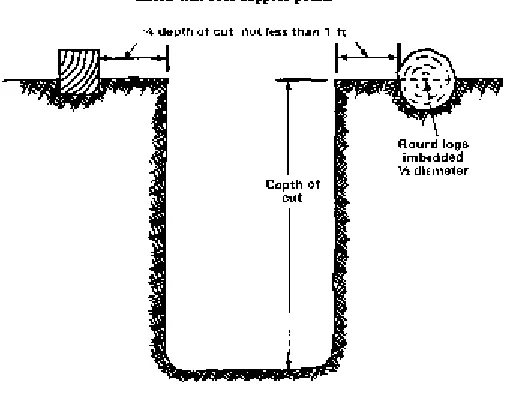
Walls of fighting and protective positions are of two basic types-below ground (earth or revetted earth) and aboveground. Below ground walls are made of the in-place soil remaining after excavation of the position. This soil may need revetment or
Aboveground walls are normally constructed for shielding from direct fire and fragments. They are usually built of revetted earth, sandbags, concrete, or other materials. When constructed to a thickness adequate for shielding from direct fire and
fragments, they are thick and stable enough for roof support. Additional details on wall design are given in FM 5-35.
Roofs
[image:47.612.169.423.82.279.2]When roof structures are designed to defeat contact bursts of high explosive projectiles, substantial additional roof
protection is required. The table on defeat contact bursts gives basic design criteria for a roof. Appendix B of this manual
describes a procedure for overhead cover design to defeat contact burst of high explosive projectiles.
POSITION CATEGORIES
Seven categories of fighting and protective positions or components of positions that are used together or separately are-
• Holes and simple excavations. • Trenches.
• Earth parapets.
• Overhead cover and roof structures.
• Triggering screens.
• Shelters and bunkers.
HOLES AND SIMPLE EXCAVATIONS
Excavations, when feasible, provide good protection from direct fire and some indirect fire weapons effects. Open excavations have the advantages of-
• Providing good protection from direct fire when the occupant would otherwise be exposed.
• Permitting 360-degree observation and fire.
• Providing good protection from nuclear weapons effects.
Open excavations have the disadvantages of-
• Providing limited protection from direct fire while the occupant is firing a weapon, since frontal and side protection is negligible.
• Providing relatively no protection from fragments from overhead bursts of artillery shells. The larger the open excavation, the less the protection from artillery.
• Providing limited protection from chemical effects. In some cases, chemicals concentrate in low holes and excavations.
TRENCHES
Trenches provide essentially the same protection from conventional, nuclear, and chemical effects as the other excavations described, and are used almost exclusively in
defensive areas. They are employed as protective positions and used to connect individual holes, weapons positions, and
shelters. They provide protection and concealment for personnel moving between fighting positions or in and out of the area. They are usually open excavations, but sections are sometimes covered to provide additional protection. Trenches are difficult to camouflage and are easily detected from the air.
Trenches, like other positions, are developed progressively. As a general rule, they are excavated deeper than fighting
positions to allow movement without exposure to enemy fire. It is usually necessary to provide revetment and drainage for them.
Tunnels are not frequently constructed in the defense of an area due to the time, effort, and technicalities involved. However, they are usually used to good advantage when the length of time an area is defended justifies the effort, and the ground lends itself to this purpose. The decision to build tunnels also depends greatly on the nature of the soil, which is usually determined by borings or similar means. Tunneling in hard rock is slow and generally impractical. Tunnels in clay or other soft soils are also impractical since builders must line them
throughout to prevent collapse. Therefore, construction of tunneled defenses is usually limited to hilly terrain, steep hillsides, and favorable soils including hard chalk, soft sandstone, and other types of hard soil or soft rock.
In the tunnel system shown, the soil was generally very hard and only the entrances were timbered. The speed of excavation using hand tools varied according to the soil, and seldom exceeded 25 feet per day. In patches of hard rock, as little as 3 feet were excavated per day. Use of power tools did not significantly increase the speed of excavation. Engineer units, assisted by infantry personnel, performed the work. Tunnels of the type shown are excavated up to 30 feet below ground level. They are usually horizontal or nearly so. Entrances are strengthened against collapse under shell fire and ground shock from nuclear weapons. The first 16½ feet from each entrance should have
Untimbered tunnels are generally 31½ feet wide and 5 to 6 1/2 feet high. Once beyond the portal or entrance, tunnels of up to this size are unlimbered if they are deep enough and the soil will stand open. Larger tunnels must have shoring. Chambers constructed in rock or extremely hard soil do not need timber supports. If timber is not used, the chamber is not wider than 6½ feet; if timbers are used, the width can increase to 10 feet. The chamber is generally the same height as the tunnel, and up to 13 feet long.
Grenade traps are constructed at the bottom of straight lengths where they slope. This is done by cutting a recess about 3½ feet deep in the wall facing the inclining floor of the tunnel.
The danger that tunnel entrances may become blocked and trap the occupants always exists. Picks and shovels are placed in each tunnel so that trapped personnel can dig their way out.
Furthermore, at least two entrances are necessary for
ventilation. Whenever possible, one or more emergency exits are provided. These are usually small tunnels with entrances
normally closed or concealed. A tunnel is constructed from
inside the system to within a few feet of the surface so that an easy breakthrough is possible.
EARTH PARAPETS
Excavations and trenches are usually modified to include front, rear, and side earth parapets. Parapets are constructed using spoil from the excavation or other materials carried to the site. Frontal, side, and rear parapets greatly increase the protection of occupants firing their weapons. Thicknesses
required for parapets vary according to the material's ability to deny round penetration.
Parapets are generally positioned as shown below to allow full frontal protection, thus relying on mutual support of other firing positions. Parapets are also used as a single means of protection, even in the absence of excavations.
OVERHEAD COVER AND ROOF STRUCTURES
Fighting and protective positions are given overhead cover primarily to defeat indirect fire projectiles landing on or exploding above them. Defeat of an indirect fire attack on a position, then, requires that the three types of burst
layer over any soil cover to prevent it from gaining moisture or weathering.)
Overhead Burst (Fragments)
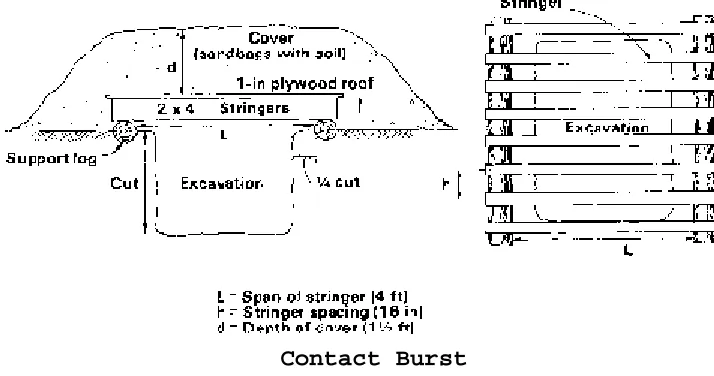
Protection against fragments from airburst artillery is provided by a thickness of shielding required to defeat a certain size shell fragment, supported by a roof structure adequate for the dead load of the shielding. This type of roof structure is designed using the thicknesses to defeat fragment penetration given in the table on Indirect Fire Fragmentation and Blast. As a general guide, fragment penetration protection always requires at least 11/2 feet of soil cover. For example, to defeat
fragments from a 120-mm mortar when available cover material is sandbags filled with soil, the cover depth required is 1½ feet. Then, the Maximum Span table shows that support of the l½ feet of cover (using 2 by 4 roof stringers over a 4-foot span)
requires 16-inch center-to-center spacing of the 2 by 4s. This example is shown below.
Contact Burst
Protection from contact burst of indirect fire HE shells
[image:54.612.119.476.396.584.2]Delay Fuse Burst
Delay fuse shells are designed to detonate after penetration. Protection provided by over-head cover is dependent on the
amount of cover remaining between the structure and the shell at the time of detonation. To defeat penetration of the shell, and thus cause it to detonate with a sufficient cover between it and the structure, materials are added on top of the overhead cover.
If this type of cover is used along with contact. burst
protection, the additional materials (such as rock or concrete) are added in with the soil unit weight when designing the
contact burst cover structure.
TRIGGERING SCREENS
Triggering screens are separately built or added on to existing structures used to activate the fuse of an incoming shell at a "standoff' distance from the structure. The screen initiates detonation at a distance where only fragments reach the
enough material to activate the fuse. Delay shells require more material to both limit penetration and activate the fuse.
Typical standoff framing is shown below.
Defeating Super-Quick Fuzes
Incoming shells with super-quick fuzes are defeated at a standoff distance with several types of triggering screen materials. The first table below lists thicknesses of facing material required for detonating incoming shells when impacting with the triggering screen. These triggering screens detonate the incoming shell but do not defeat fragments from these shells. Protection from fragments is still necessary for a
Defeating Delay Fuzes
Delay fuzes are defeated by various thicknesses of protective material. The table below lists type and thickness of materials required to defeat penetration of delay fuse shells and cause their premature detonation. These materials are usually added to positions designed for contact burst protection. One method to defeat penetration and ensure premature shell detonation is to use layers of large stones. The figure below shows this added delay fuse protection on top of the contact burst protection designed in appendix B. The rocks are placed in at least three layers on top of the required depth of cover for the expected shell size. The rock size is approximately twice the caliber of the expected shell. For example, the rock size required to
In some cases, chain link fences also provide some standoff
protection when visibility is necessary in front of the standoff and when positioned as shown. However, the fuse of some incoming shells may pass through the fence without initiating the firing mechanism.
SHELTERS AND BUNKERS
Protective shelters and fighting bunkers are usually constructed using a combination of the components of positions mentioned thus far. Protective shelters are primarily used as-
• Command posts.
• Observation posts.
• Medical aid stations.
Protective shelters are usually constructed aboveground, using cavity wall revetments and earth-covered roof structures, or they are below ground using sections that are airtransportable.
Fighting bunkers are enlarged fighting positions designed for squad-size units or larger. They are built either aboveground or below ground and are usually made of concrete. However, some are prefabricated and transported forward to the battle area by
trucks or air.
If shelters and bunkers are properly constructed with
appropriate collective protection equipment, they can serve as protection against chemical and biological agents.