533
Learning with Structured Representations for Negation Scope Extraction
Hao Li and Wei Lu
Singapore University of Technology and Design 8 Somapah Road, Singapore, 487372
hao [email protected],[email protected]
Abstract
We report an empirical study on the task of negation scope extraction given the nega-tion cue. Our key observanega-tion is that cer-tain useful information such as features re-lated to negation cue, long distance de-pendencies as well as some latent struc-tural information can be exploited for such a task. We design approaches based on conditional random fields (CRF), semi-Markov CRF, as well as latent-variable CRF models to capture such information. Extensive experiments on several standard datasets demonstrate that our approaches are able to achieve better results than exist-ing approaches reported in the literature.
1 Introduction
Negation is an important linguistic phenomenon (Morante and Sporleder,2012), which reverts the assertion associated with a proposition. Broadly speaking, the part of the sentence being negated is callednegation scope(Huddleston et al.,2002). Automatic negation scope detection is a vital but challenging task that has various applications in areas such as text mining (Szarvas et al., 2008), and sentiment analysis (Wiegand et al., 2010;
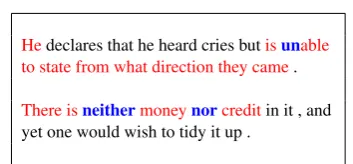
Councill et al., 2010). Negation scope detection task commonly involves a negation cue which can be one of the following 3 types – either a single word (e.g.,not), affixes (e.g.,im-, -less) or multi-ple words (e.g., no longer) expressing negation. Figure 1 presents two real examples for such a task, where the first example involves discontin-uous negation scope of an affix cue. The second example shows a discontinuous negation cue and its corresponding discontinuous negation scope.
Most existing approaches tackled the negation scope detection problem from a boundary
detec-Hedeclares that he heard cries butisunable to state from what direction they came.
[image:1.595.327.504.216.298.2]There isneithermoneynorcreditin it , and yet one would wish to tidy it up .
Figure 1: Two examples with negation cues in bold blue and negation scope in red.
tion perspective, aiming to identify whether each word token in the sentence belongs to the nega-tion scope or not. To perform sequence labeling, various approaches have been proposed based on models such as support vector machines (SVMs) (with heuristic rules) (Read et al., 2012; de Al-bornoz et al., 2012; Packard et al.,2014), condi-tional random fields (CRF) (Lapponi et al.,2012;
Chowdhury and Mahbub,2012;White,2012;Zou et al.,2015) and neural networks (Fancellu et al.,
2016;Qian et al.,2016). These models typically either make use of external resources for extract-ing complex syntax and grammar features, or are based on neural architectures such as long short-term memory networks (LSTM) and convolutional neural networks (CNNs) to extract automatic fea-tures.
We observe that there are some useful fea-tures that can be explicitly and implicitly captured and modelled in the learning process for negation scope extraction. We use the term partial scope to refer to a continuous text span that is part of dis-continuous scope, and use the term gap to refer to the text span between two pieces of partial scope.
He declares that he heard cries but is unable to state from what direction they came .
I
Linear O O O O O O I I I I I I I I I O
I
Semio O I I I I I I I I I O
I
Semii O O O O O O I O
I
Semiio O I O
I0
Latenti O O O O O O I0 I0 I0 I0 I0 I0 I0 I0 I0 O
I1 I1 I1 I1 I1 I1 I1 I1 I1 I1
I
Latento O0 O0 O0 O0 O0 O0 I I I I I I I I I O0
O1 O1 O1 O1 O1 O1 O1
I0
Latentio O0 O0 O0 O0 O0 O0 I0 I0 I0 I0 I0 I0 I0 I0 I0 O0
[image:2.595.76.524.62.169.2]I1 O1 O1 O1 O1 O1 O1 I1 I1 I1 I1 I1 I1 I1 I1 I1 O1
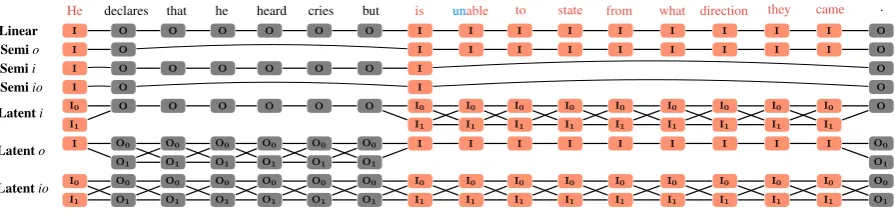
Figure 2: Label assignments of model variants for the first example mentioned in Figure1.
as we mentioned earlier may also reveal crucial information for this task. Moreover, two pieces of partial scope separated by a gap might have some long distance dependencies. For instance, in the first sentence of Figure1, “He” as the first partial scope is the subject phrase of the token “is” which is the first word of the second partial scope with a long gap in between.
Similarly, the second example shows that a dis-continuous negation cue involves multiple words,
neither andnor, which shows the importance of cue features and some long distance dependencies among text spans.
Furthermore, besides explicit features that we are able to define, we believe there exist some implicit linguistic patterns within the scope for a given negation cue. While it is possible to manu-ally design linguistic features to extract such pat-terns, approaches that can automatically capture such implicit patterns in a domain and language independent manner can be more attractive. How to design models that can effectively capture such features mentioned above remains a research ques-tion to be answered.
In the paper, we design different models to cap-ture such useful feacap-tures based on the above moti-vations, and report our empirical findings through extensive experiments. We release our code at http://statnlp.org/research/st.
2 Approaches
Based on the observations described earlier, we aim to capture three types of features by design-ing different models based on CRF.
Negation Cue
The linear CRF (Lafferty et al., 2001) model (which we refer to asLinearin this paper), as il-lustrated in Figure2, is used to capture negation cue related features. The probability of predicting
a possible outputy, the label sequence capturing negation scope, given an input sentencexis:
p(y|x) = exp (w
Tf(x,y))
P
y0∈Y(x)exp(wTf(x,y 0
))
where f(x,y) is a feature function defined over the(x,y)pair. The negation cue related features mainly involve cue type, position of the cue, as well as relative positions of each partial scope. For example, the cue type refers to the string form of the cue, which could be a single word, an affix (prefix or suffix), or a multi-word expression.
We follow a standard approach to assign tags to words. Specifically,OandI are used to indicate whether a word appears outside or inside the nega-tion scope respectively.
Long Distance Dependencies
We use the semi-CRF (Sarawagi and Cohen,2004) model (referred to as Semi) to capture long dis-tance dependencies. The semi-CRF is an exten-sion to the linear-CRF. The difference is that the output y may not be a sequence of individual words. Rather, it is now a sequence of spans, where each span consists of one or more words. The semi-CRF model is more expressive than the linear-CRF model as such a model is able to cap-ture feacap-tures that are defined at the span level, al-lowing longer-range dependencies to be captured. Since the Semiapproach is capable of model-ing a span (which can be a gap or partial scope), we are able to model the features between two sep-arate text spans. We propose three variants for the Semimodel, as illustrated in Figure2, to capture different types of long distance features. TheSemi
model regards both partial scope and gaps as spans to capture both types of long distance dependen-cies mentioned above.
Implicit Patterns
The latent variable CRF model, denoted as La-tent, is used to model implicit patterns. The prob-ability of predicting a possible outputy, which is the label sequence capturing negation scope infor-mation, given an input sentencexis defined as:
p(y|x) =
P
hexp (wTf(x,y,h))
P
y0∈Y(x)Ph0exp(wTf(x,y 0
,h0))
wherehis a latent variable encoding the implicit pattern.
We believe such latent pattern information can be learned from data without any linguistic guid-ance. The Latent model is capable of capturing this type of implicit signals. For example, as illus-trated asLatentioin Figure2, each position has O0, O1, I0 and I1 as latent tags. This way, we
can construct features of forms such as “He/Oi
-declares/Ij” that capture the underlying
interac-tions between the words and the latent tag patterns. In order to investigate the relation between la-tent variables and tags, we proposed another two latent models. TheLatentionly considers latent variables onI tags (for partial scope), while La-tent o only takes latent variables on Otags (for gaps).
3 Experimental Setup
CDS-CO Train Dev Test
#Sentence 847 144 235
[image:3.595.309.529.63.186.2]#Instance 983 173 264
Table 1: Statistics of theCDS-COcorpus.
We mainly conducted our experiments on the
CDS-CO corpus released from the *SEM2012
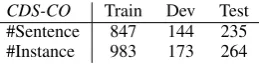
shared task (Morante and Blanco, 2012). The negation cue and corresponding negation scope are annotated. For each word token, the corre-sponding POS tag and the syntax tree informa-tion are provided. If the sentence contains mul-tiple negation cues, each of them is annotated separately. The corpus statistics is listed in Ta-ble1. During training and testing, following prior works (Fancellu et al.,2016), only instances with at least one negation cue will be selected. For the sentence containing multiple negation cues, we create as many copies as the number of instances,
System Token-Level Scope-Level (Exact Scope Match) P. R. F1 PA. RA. F1A PB. RB. F1B Read et al.(2012) - - - 98.8 64.3 77.9 - -
-Packard et al.(2014) 86.1 90.4 88.2 98.8 65.5 78.7 - -
-Fancellu et al.(2016) 92.6 85.1 88.7 99.4 63.9 77.8 - -
-Linear(-c-r) 84.7 73.9 78.6 99.2 49.4 65.6 51.5 49.4 50.4
Linear(-r) 90.6 78.4 84.1 100 60.6 75.5 61.4 60.6 61.0
Linear(-c) 91.0 78.9 84.5 99.3 56.6 72.1 60.0 56.6 58.3
Linear 94.4 82.6 88.1 100 67.9 80.9 69.3 67.9 68.6
Semii 95.0 84.1 89.2 100 67.5 80.6 69.4 67.5 68.4
Semio 94.0 85.3 89.4 100 69.1 81.7 71.1 69.1 70.1
Semiio 94.5 84.1 89.0 100 68.3 81.2 70.3 68.3 69.3
Latenti 94.4 83.4 88.6 99.4 67.9 80.7 69.6 67.9 68.7
Latento 90.4 83.9 87.1 99.4 65.5 78.9 66.3 65.5 65.9
[image:3.595.116.246.515.547.2]Latentio 94.8 83.2 88.6 100 69.5 82.0 70.6 69.5 70.0
Table 2: Main results onCDS-COdata
each of which has only one negation cue and its corresponding negation scope.
The L2 regularization hyper-parameter λis set
to0.1based on the development set. We conduct evaluations of negation scope extraction based on metrics at token-level evaluations and scope-level evaluations. There are two versions of evalua-tion metrics, referred to as version A and version B1, defined at the scope-level that can be used to measure the performance according to *SEM2012 shared task (Morante and Blanco,2012).
Moreover, to understand the model robustness, we also conducted additional experiments on Bio-Scope (Szarvas et al., 2008) and CNeSP (Zou et al.,2015).
4 Results and Discussion
4.1 Main Results
The main results on theCDS-COcorpus are shown in Table2.PA.,RA.andF1A.are precision, recall
andF1measure under version A, whilePB.,RB.,
F1B.are for version B. Note that none of the prior
works reported results under version B. Moreover,
crefers to the cue type features,rrefers to relative position of partial scope with respect to the cue.
We focus onLinearmodels first, whereLinear (-c -r) is the baseline without featurescandrfor comparisons. By addingc, theLinear(-r) model improves the performance by9.9and10.6in terms ofF1 scores for both versions of evaluation
meth-ods at the scope level respectively. By adding r
solely, theLinear(-c) model increases the perfor-mance by 6.5 and7.9 on F1 scores of both
ver-sions. By adding bothcandr, theLinearmodel increases the performance by15.3and18.2onF1
scores at the scope level, outperforming previous
1The official evaluation contains both two versions. We
This personis alone andcannotbe approached by letter without a breach of that absolute secrecy .
He has been there for ten days, andneitherMr. War-ren , norI ,nor the girl has once set eyes upon him.
Figure 3: Examples showing incorrect instances in theLinearmodel but correct inSemiomodel (The incorrect predictions by Linear model are un-derlined).
works. These improvements demonstrate the im-portance of the negation cue features.
Compared with theLinearmodel,Semimodels achieve better results. Specifically,Semiomodel achieves the best result onF1B at the scope level
among all the models and achieves the highest re-sult onF1at the token level.
The Latentiomodel outperforms all the other models in terms ofF1Aat scope level and a
com-petitive result in terms ofF1B.
4.2 Analysis
By analyzing predictions that are incorrect in Lin-ear model that are correct in the Semi models, we have some interesting observations explaining why Semimodels work better. The first type of observation is that the Semimodels tend to pre-dict more correct scope tokens, which improves results at scope level and token level. The second type is thatSemimodels recover some missing re-mote partial scope, which shows the importance of capturing long distance dependencies. For in-stance, in the first example of Figure3, the Semi models recover the subject phrase “This person” as the first partial scope. The third type happens on discontinuous cues as well as multiple short gaps as shown in the second example in Figure3. The Linearmodel fails to predict “Mr. Waren ,” and “I ,’’ as two pieces of partial scope between three cue words which are also gaps. These observations in-dicate thatSemimodels are capable of capturing long distance features and can correct some wrong predictions made by theLinearmodel.
Similarly, by analyzing predictions that are in-correct inLinearmodel that are correct in the La-tentmodels, we observe thatLatentmodels tend to make more accurate predictions. We found that there is only 1 incorrect prediction from the La-tentiothat is corrected by theLinearmodel. This indicates that theLatentiomodel is able to fix
er-System Abstract Full Paper Clinical
F1T F1A P CS F1T F1A P CS F1T F1A P CS Li et al.(2010) - - 81.8 - - 64.0 - - 89.8
Velldal et al.(2012) - 74.4 - - 70.2 - - 90.7
-Zou et al.(2013) - - 76.9 - - 61.2 - - 85.3
Qian et al.(2016) 89.9 - 77.1 83.5 - 55.3 94.4 - 89.7
Linear 90.3 90.3 82.3 80.8 74.0 58.8 96.4 96.6 93.3
[image:4.595.303.531.62.143.2]Semiio 92.1 91.3 84.1 83.1 75.1 60.1 97.5 97.1 94.4 Latentio 91.5 90.8 83.2 79.5 71.0 55.1 97.3 97.0 94.1
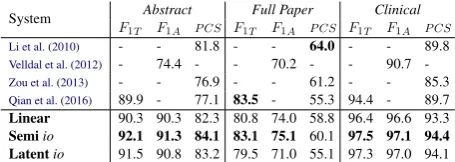
Table 3: Results on BioScope datasets.
rors for theLinearmodel without producing other wrong predictions. This analysis implies that the Latentmodels are able to capture some latent pat-terns to some extent. The performance of the La-tentomodel is lower than the performance of La-tent io and Latent i, indicating that latent vari-ables on tagIcaptures more information.
Let us focus on the token-level performance of our model. We obtained satisfactory precision scores, but comparatively low recall scores. Mean-while, at the scope level, our precision scores are comparable to the previous works, but our recall scores are consistently better, indicating our mod-els are capable of successfully recovering more gold scope information from the test data. Our further analysis shows that our models tend to predict negation scope that is significantly shorter than the gold scope for those instances that involve some long negation scope. We find that around 1/3 of the word tokens appearing inside any nega-tion scope come from such instances. These facts make token-level recall of our models compara-tively low.
In addition, we inspect the top 200 features with highest feature weights, and we find that around
45% of them are related to POS tags with label transition (the string form concatenating current tag and next tag), indicating POS tag features play an important role in the learning process for our models.
4.3 Experiments on Model Robustness
To understand the robustness of our model, we ad-ditionally conducted two sets of experiments.
BioScope
The BioScope corpus (Szarvas et al.,2008) con-tains three data collections from medical domains:
Abstract, Full Paper and Clinical. NLTK (Bird and Loper, 2004) is used to perform tokeniza-tion and POS tagging for preprocessing. Follow-ing (Morante and Daelemans, 2009; Qian et al.,
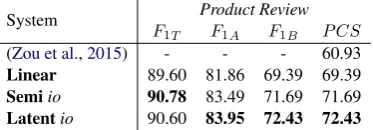
Ab-System Product Review
F1T F1A F1B P CS
(Zou et al.,2015) - - - 60.93
[image:5.595.89.276.63.128.2]Linear 89.60 81.86 69.39 69.39 Semiio 90.78 83.49 71.69 71.69 Latentio 90.60 83.95 72.43 72.43
Table 4: Results onProduct Reviewfrom CNeSP.
stract, whereas the results onFull Paperand Clin-icalare obtained by training on the full Abstract
dataset and testing onFull PaperandClinical re-spectively. The latter experiment can help us un-derstand the robustness of the model by applying the learned model to different types of text within the same domain.
The Semi io model mostly outperforms the other models. Comparing against all the prior works, our models are able to achieve better results onAbstractunder both token-level and scope-level F1 as well as P CS 2. Moreover, we also
ob-tain significantly higher results in terms of scope-level F1 on Full Paper and Clinical, indicating
the good robustness of our approaches. Note that the P CS score onFull Paper is not as satisfac-tory as on Clinical. This is largely because the model is trained onAbstract, butFull Paper con-tains much longer sentences with longer negation scope, which presents a challenge for our model as discussed in the previous sections. On the other hand, the baseline systems (Li et al.,2010;Velldal et al., 2012) adopt features from syntactic trees, which allow them to capture long-distance syntac-tic dependencies.
CNeSP
To understand how well our model works on another language other than English, we also conducted an experiment on the Product Review
collection from the CNeSP corpus (Zou et al.,
2015). We used Jieba (Sun, 2012) and Stanford tagger (Toutanova and Manning, 2000) to per-form Chinese word segmentation and POS tag-ging. Following the data splitting scheme de-scribed in (Zou et al., 2015), we performed 10-fold cross-validation and the results are shown in Table4. Our model obtains a significantly higher P CSscore than the model reported in (Zou et al.,
2015). The results further confirm the robustness of our model, showing it is language independent.
2P CSis defined as percentage of correct scope which is
the same as the recall score.
5 Related Work
The negation scope extraction task has been stud-ied within the NLP community through the Bio-Scope corpus (Szarvas et al., 2008) in biomed-ical domain, usually together with the negation cue detection task. The negation scope detection task has mostly been regarded as a boundary de-tection task. Morante et al.(2008) and Morante and Daelemans(2009) tackled the task by build-ing classifiers based onk-nearest neighbors algo-rithm (Cover and Hart, 1967), SVM (Cortes and Vapnik, 1995) as well as CRF (Lafferty et al.,
2001) on each token to determine if it is inside the scope. Li et al. (2010) incorporated more syntactic features such as parse tree information by adopting shallow semantic parsing (Gildea and Palmer,2002;Punyakanok et al.,2005) for build-ing an SVM classifier. With similar motivation,
Apostolova et al. (2011) proposed a rule-based method to extract lexico-syntactic patterns to iden-tify the scope boundaries. To further investigate the syntactic features, Zou et al.(2013) extracted more syntactic information from constituency and dependency trees obtained from parsers to feed into the SVM classifier. Qian et al. (2016) adopted a convolutional neural network based ap-proach (LeCun et al.,1989) to extract position fea-tures and syntactic path feafea-tures encoding the path from the cue to the candidate token along the con-stituency trees. They also captured relative posi-tion informaposi-tion between the words in the scope and the cue as features in their model.
In order to resolve the corpus scarcity issue in different languages for the negation scope extrac-tion task, Zou et al.(2015) constructed a Chinese corpus CNeSP analogous to the BioScope corpus. They again tackled the negation scope extraction task using CRF with rich syntactic features ex-tracted from constituency and dependency trees.
6 Conclusion
Acknowledgments
We would like to thank the anonymous reviewers for their constructive comments on this work. We would also like to thank Bowei Zou for answer-ing our questions. This work is supported by Sin-gapore Ministry of Education Academic Research Fund (AcRF) Tier 2 Project MOE2017-T2-1-156.
References
Emilia Apostolova, Noriko Tomuro, and Dina
Demner-Fushman. 2011. Automatic extraction of lexico-syntactic patterns for detection of nega-tion and speculanega-tion scopes. In Proc. of ACL.
http://www.aclweb.org/anthology/P11-2049.
Steven Bird and Edward Loper. 2004. Nltk: The natural language toolkit. In Proc. of ACL.
https://doi.org/10.3115/1219044.1219075.
Md Chowdhury and Faisal Mahbub. 2012. Fbk:
Exploiting phrasal and contextual clues for nega-tion scope detecnega-tion. In Proc. of *SEM2012.
http://www.aclweb.org/anthology/S12-1045.
Corinna Cortes and Vladimir Vapnik. 1995.
Support-vector networks. Machine
learn-ing https://link.springer.com/content/pdf// /10.1007/BF00994018.pdf.
Isaac G Councill, Ryan McDonald, and Leonid Ve-likovich. 2010. What’s great and what’s not: learning to classify the scope of negation for im-proved sentiment analysis. In Proc. of NeSp-NLP. https://aclanthology.info/pdf/W/W10/W10-3110.pdf.
Thomas Cover and Peter Hart. 1967.
Near-est neighbor pattern classification. IEEE
transactions on information theory
https://ieeexplore.ieee.org/document/1053964.
Jorge Carrillo de Albornoz, Laura Plaza, Alberto D´ıaz, and Miguel Ballesteros. 2012. Ucm-i: A rule-based syntactic approach for resolving the scope of negation. In Proc. of *SEM2012.
http://www.aclweb.org/anthology/S12-1037.
Federico Fancellu, Adam Lopez, and
Bon-nie L Webber. 2016. Neural networks for
negation scope detection. In Proc. of ACL.
https://doi.org/10.18653/v1/p16-1047.
Daniel Gildea and Martha Palmer. 2002.
The necessity of parsing for predicate
ar-gument recognition. In Proc. of ACL.
https://doi.org/10.3115/1073083.1073124.
Rodney Huddleston, Geoffrey K Pullum, et al. 2002. The cambridge grammar of english. Lan-guage. Cambridge: Cambridge University Press
http://www.academia.edu/download/37907813// /2001025630.pdf.
John Lafferty, Andrew McCallum, and
Fer-nando CN Pereira. 2001. Conditional random fields: Probabilistic models for segmenting and labeling sequence data. In Proc. of ICML.
http://repository.upenn.edu/cis papers/159.
Emanuele Lapponi, Erik Velldal, Lilja Øvrelid, and Jonathon Read. 2012. Uio 2: sequence-labeling negation using dependency features. In Proc. of *SEM2012. http://www.aclweb.org/anthology/S12-1042.
Yann LeCun, Bernhard Boser, John S Denker,
Donnie Henderson, Richard E Howard,
Wayne Hubbard, and Lawrence D Jackel.
1989. Backpropagation applied to handwrit-ten zip code recognition. Neural Computation
https://doi.org/10.1162/neco.1989.1.4.541.
Junhui Li, Guodong Zhou, Hongling Wang, and Qiaoming Zhu. 2010. Learning the scope of nega-tion via shallow semantic parsing. InProc. of COL-ING.http://www.aclweb.org/anthology/C10-1076.
Roser Morante and Eduardo Blanco. 2012. *sem 2012 shared task: Resolving the scope and fo-cus of negation. In Proc. of *SEM 2012.
http://www.aclweb.org/anthology/S12-1035.
Roser Morante and Walter Daelemans. 2009.
A metalearning approach to processing the
scope of negation. In Proc. of CoNLL.
http://www.aclweb.org/anthology/W09-1105.
Roser Morante, Anthony Liekens, and Walter
Daele-mans. 2008. Learning the scope of
nega-tion in biomedical texts. In Proc. of ACL.
https://doi.org/10.3115/1613715.1613805.
Roser Morante and Caroline Sporleder. 2012. Modal-ity and negation: An introduction to the special issue. Computational linguistics 38(2):223–260.
https://doi.org/10.1162/COLI a 00095.
Woodley Packard, Emily M Bender, Jonathon Read, Stephan Oepen, and Rebecca Dridan. 2014. Sim-ple negation scope resolution through deep parsing: A semantic solution to a semantic problem.InProc. of ACL.https://doi.org/10.3115/v1/p14-1007.
Vasin Punyakanok, Dan Roth, and Wen-tau Yih. 2005. The necessity of syntactic parsing for semantic role labeling. In Proc. of IJCAI.
http://www.ijcai.org/Proceedings/05/Papers/1672.pdf.
Zhong Qian, Peifeng Li, Qiaoming Zhu, Guodong Zhou, Zhunchen Luo, and Wei Luo. 2016. Spec-ulation and negation scope detection via convo-lutional neural networks. In Proc. of EMNLP.
https://doi.org/10.18653/v1/d16-1078.
Jonathon Read, Erik Velldal, Lilja Øvrelid, and
Stephan Oepen. 2012. Uio 1:
Constituent-based discriminative ranking for
nega-tion resolution. In Proc. of *SEM2012.
Sunita Sarawagi and William W Cohen. 2004.
Semi-markov conditional random fields for in-formation extraction. In Advances in neural information processing systems. pages 1185– 1192. http://papers.nips.cc/paper/2648-semi- markov-conditional-random-fields-for-information-extraction.pdf.
J Sun. 2012. Jieba chinese word segmentation tool.
https://github.com/fxsjy/jieba.
Gy¨orgy Szarvas, Veronika Vincze, Rich´ard
Farkas, and J´anos Csirik. 2008. The bio-scope corpus: annotation for negation, un-certainty and their scope in biomedical texts. In Proc. of the Workshop on Current Trends in Biomedical Natural Language Processing.
https://aclanthology.info/pdf/W/W08/W08-0606.pdf.
Kristina Toutanova and Christopher D
Man-ning. 2000. Enriching the knowledge
sources used in a maximum entropy
part-of-speech tagger. In Proc. of EMNLP.
https://doi.org/10.3115/1117794.1117802.
Erik Velldal, Lilja Øvrelid, Jonathon Read, and Stephan Oepen. 2012. Speculation and
nega-tion: Rules, rankers, and the role of syn-tax. Computational linguistics 38(2):369–410.
https://doi.org/10.1162/COLI a 00126.
James Paul White. 2012. Uwashington: Negation res-olution using machine learning methods. InProc. of *SEM2012. http://www.aclweb.org/anthology/S12-1044.
Michael Wiegand, Alexandra Balahur, Benjamin Roth, Dietrich Klakow, and Andr´es Montoyo. 2010.
A survey on the role of negation in sentiment analysis. In Proc. of the workshop on nega-tion and speculanega-tion in natural language process-ing. https://aclanthology.info/pdf/W/W10/W10-3111.pdf.
Bowei Zou, Guodong Zhou, and Qiaoming Zhu. 2013. Tree kernel-based negation and spec-ulation scope detection with structured syn-tactic parse features. In Proc. of EMNLP.
http://www.aclweb.org/anthology/D13-1099.
Bowei Zou, Qiaoming Zhu, and Guodong Zhou. 2015. Negation and speculation identifica-tion in chinese language. In Proc. of ACL.